2024 College Football Playoff Field

With only conference championship games left to play, here is how the field currently shakes out for the 2024, 12-team College Football Playoff.

  1. Oregon
  2. Texas
  3. SMU (presumed conf. champ.)
  4. Boise State (presumed conf. champ.)
  5. Penn State
  6. Notre Dame
  7. Georgia
  8. Ohio State
  9. Tennessee
  10. Indiana
  11. Alabama
  12. Arizona State (presumed conf. champ.)

The presumed conference champions get their spots in the field due to winning the conference, not due to the CFP’s actual ranking of teams. From there, the at-larges are slotted in order from highest to lowest until the field is filled. The teams on the outside-looking-in, in order, are:

  1. Miami
  2. Ole Miss
  3. South Carolina

Let’s look at certain scenarios to determine how much the bracket can change from here to Sunday when the final rankings are released and actual bracket is generated.

The MWC conference game takes place Friday night, with Boise State hosting UNLV. Obviously Boise wins and it is in. If UNLV wins, Boise will fall outside the top 12 and the Rebels will almost certainly get a bid in the CFP. The reason we use almost is because there is another conference championship being played that night, Army vs. Tulane. In theory, a 1-loss Army team could get the final spot reserved for a conference champion over a 2-loss UNLV. However, given the fact UNLV is currently at #20 and Army is at #24 as well as the fact UNLV is facing a tougher opponent (#10 Boise State) than Army (unranked Tulane), it is very difficult to see Army jumping UNLV and making the field1.

Regarding seeds, Boise State with a win should hold on to the #4 seed. The only team that could jump over the Broncos would be the Big 12 winner (#16 Iowa State / #15 Arizona State, more on this game later), and while the Big 12 winner will get a solid win to add to its resume, a Boise State defeat of UNLV would boost Boise a bit as well. So it’s very unlikely that Boise falls to below the #4 seed and first-round bye.

On to Saturday, where the Big 12 championship game kicks off first at 11:00 am in Arlington. This is a simple, win-and-you’re-in situation. Either Arizona St. or Iowa St. will represent the Big 12 in the CFP. The only question is whether or not the winner will earn a bye and top 4 seed. They will have a better idea depending on the result of the MWC game the day before, but the ACC result later on will matter as well.

Next, at 3:00 pm CT, is the SEC championship game from Atlanta. Georgia and Texas face in a rematch, with the winner almost certainly getting a top-2 seed and the loser falling somewhere from #5-#10. Texas is probably the only team that can get a #1 seed (if Oregon loses) and would likely only fall to #6 at worst. Georgia winning would get the Bulldogs a #2 seed and losing would give them 3 losses and could make them be the road team in the first round of the playoff. It is highly unlikely a 3 loss Georgia team falls out altogether, given the SOS is great and only getting stronger this week and the fact UGA has 10 wins already. In other words, Georgia will remain in front of the other 3-loss SEC teams.

Saturday evening sees the final two relevant conference championship games, with the ACC championship in Charlotte and Big 10 championship in Indianapolis. Should Oregon knock off Penn State, the Ducks keep the #1 seed. A loss puts them down to the #5 seed regardless. Penn State winning would get the Nittany Lions a #2 seed if Texas won the SEC game and a #1 seed if Georgia won. A Penn State loss would find the Nittany Lions in the #5-#7 range depending on what happened with Texas/Georgia and how the committee decided to order Penn State with Ohio State. In the head-to-head, Ohio State defeated Penn State. However, even with a loss, Penn State would have a better record (11-2 vs. 10-2) than Ohio State. But both teams would still host a first round game.

Onto the ACC, which has the biggest implications for the bubble. SMU is the #3 seed and keeps that with a win, whereas Clemson is only in the field with a win. Let’s start with a Clemson win to see how high the Tigers could likely go. At 10-3, Clemson would have a worse record than 11-2 Big 12 winner. They would also be behind a 12-1 Boise. However, if UNLV beat Boise the night prior, Clemson winning would get them into the top-4 with UNLV getting the final conference spot (and #12 seed). Can Clemson jump the Big 12 winner? Not likely, however it would have a better win (SMU is #8) than either Big 12 team winning, as it is #15 vs. #16 in Arlington.

Clemson winning would knock down SMU, the current #3 seed but #8 ranked team. A loss, albeit not a “bad” one, would drop the Mustangs some. How far is the question. In this scenario, 11 teams would be decided (Oregon, Texas, Penn State, Notre Dame, Georgia, Ohio State, Tennessee, Indiana, ACC champ Clemson, Big 12 champ, MWC champ), with the final spot presumably coming down to SMU, Alabama, and perhaps Miami. It’s tough to see how SMU losing would help Miami, but we will get more into the Miami/Alabama discussion at the end. Were SMU to lose and it came down to SMU/Alabama, would the committee punish SMU for losing a conference championship game (they were required to play in while Alabama sat idle)? Seems like a really poor decision. Then again, the committee seems to be beholden to the wishes of Greg Sankey.

SMU can end all discussion by winning and securing a #3 seed, a spot which would give it a good chance of advancing (vs. the winner of #6 and #11) in the quarterfinal bowl game it plays in. While it may still make the CFP with a loss, the best chance SMU has at going all the way is to win Saturday night in the ACC title game.

Now let’s look at some further scenarios. Notre Dame is effectively locked in as a first-round host, but it would get all the way up to #5 with losses by both Penn State and Georgia. If both Penn State and Georgia win, the Fighting Irish are nearly guaranteed to get the #7 seed. Still a first-round home game, but not as good of a path.

Ohio State can move up 1 or 2 spots (they need Penn State and/or Georgia to lose), but as the current #8 seed they are poised to host a first-round playoff game. What a weird year with the 12-team field. Normally losing on senior day to arch-rival Michigan would be the end of the Buckeyes’ dreams, but not only can they still win a national championship they can do so by winning in their final game at the Horseshoe, thereby helping to erase the embarrassing loss in the Big Game.

Idle Tennessee (at #9) could move in to a host spot were Georgia to lose and lose somewhat convincingly. Again, it’s tough to say how far the committee would ding a 10-2 Georgia if it loses on Saturday to fall to 10-3. Georgia already beat Tennessee this year head-to-head, why should the Vols be rewarded from sitting at home while the Dogs are forced to play Texas? But would the committee keep Tennessee at #9 and drop Georgia to #8, generating a first-round all-SEC rematch? Not sure that’s what anyone really wanted the playoff for.

Idle Indiana (#10) seems stuck in place, with the only potential movement coming in the event of an SMU loss (which would likely move the Hoosiers up to #9). This would still force Indiana to go on the road in the first round, in spite of its 11-1 record. We have Indiana with the 8th best resume (WAB), as does ESPN’s SOR. Tough luck for the Hoosiers, who have a convincing case that they should be hosting a first-round playoff game. Still, Indiana is a lock.

We finally make it to the final playoff spot, which likely comes down to Alabama, Miami, and SMU with a loss. Should the Ponies lose, this gets even more complex than it already is. Let’s assume SMU wins and look just as Alabama/Miami. For Alabama, they can’t do much except trust that the committee won’t change their collective mind. The Tide are in the #11 spot, one ahead of Miami, and both teams are idle. Should be an easy case of “this has already been decided.” For Miami, they arguably have a better resume (ESPN SOR disagrees, but other sources show the Canes), but if the committee doesn’t see it that way they can’t do anything. One thing that would benefit Miami is a Georgia loss. While the Dogs won’t likely fall below Miami in this scenario, it would weaken the resume of Alabama, a team who boasts a big win against Georgia. If this win were diminished somewhat, is that enough to push Miami over ‘Bama? Likely not, but some hope is better than none. Still, I don’t see Alabama falling out to Miami. The far more likely way for them to miss the field is if Clemson beats SMU (in a close game), allowing SMU to remain in the field but nudging the Tide out in the process.

Predictions:

Boise State over UNLV. Boise in the field as #4.

Tulane over Army. Both out, but ending any long-shot of Army sneaking in.

Iowa State over Arizona State. ISU in the field as #12.

Georgia over Texas. UGA as #2, UT as #5.

Oregon over Penn State. UO as #1, PSU as #7.

SMU over Clemson (close game). SMU as #3.

Notre Dame goes to #6. Ohio State #8. Tennessee #9. Indiana #10. Alabama #11.

Predicted First round games:

#12 Iowa State @ #5 Texas

#11 Alabama @ #6 Notre Dame

#10 Indiana @ #7 Penn State

#9 Tennessee @ #8 Ohio State

Bowl games:

#1 Oregon chooses the Rose Bowl.

#2 Georgia chooses the Peach Bowl.

#3 SMU chooses the Fiesta Bowl.

#4 Boise State is slotted the Sugar Bowl.

  1. Had UNLV lost to say, Kansas in the non-conference, then a 3-loss UNLV team would likely miss out to a 1-loss Army. Had this occurred, what would have been even more amazing would be the fact Army still has a regular season game to play…its rivalry game against Navy. Navy is not the worst mid-major at 8-3 (#68 in FPI, so near the middle of FBS), and could easily knock off Army in a game that wouldn’t matter to the playoff committee solely because it was played after the selection. Inversely, perhaps Army getting an 11th win vs. Navy before the conference championship would have boosted its resume enough to help it jump over UNLV. The timing of the Army/Navy game almost had huge ramifications on the CFP field, and arguably it still might have had a minor impact this season. ↩︎
Determining the College Football Playoff Field

Tonight (12/3/2024) will be the second-to-last CFP field reveal of the 2024 season, with the final 12 being announced this Sunday following conference championship Saturday. Even despite the field expanding from 4 teams to 12, controversy and debate have followed the announced rankings each week. This season has seen quite a bit of parity with multiple potential playoff teams losing games as favorites late in the season. Just this past weekend (Thanksgiving weekend), Miami lost to fall to 10-2 and miss the ACC championship game, Clemson lost to South Carolina to fall to 9-3 (but gained entry to the ACC championship game due to Miami’s loss), and of course Ohio State fell to 10-2 with its loss to rival Michigan. Additionally, Georgia needed 8 overtimes to escape its rival Georgia Tech.

Generally the debates about the field are whether or not a 3-loss SEC team (Alabama, South Carolina, Ole Miss) should make the playoff over a 2-loss ACC team like Miami or if a 1-loss Big 10 team with an easier schedule like Indiana has done enough to earn a bid. Much of the controversy is pointless discussion by people who don’t actually go through the exercise of filling out a 12-team bracket. Still, it is very likely that 2 to 3 teams who are left out will claim valid reasons for why they should have been included.

Rather than debating the merits of each particular team, we should determine what the criteria should be beforehand and use this criteria to rank the teams. This helps to take away any bias. From the CFP website, here is how the committee looks at how it selects and ranks the teams:

The selection committee ranks the teams based on the members’ evaluation of the teams’ performance on the field, using conference championships won, strength of schedule, head-to-head results, and comparison of results against common opponents to decide among teams that are comparable.

This criteria was first stated in 2016 when the CFP was 4-teams. Of course the 4-team era had its own controversies, including last season when undefeated Florida State missed out after losing its starting QB to injury and not impressing the committee enough in how it won.

Frankly, last season’s decision to drop FSU to #5 and a slew of other decisions have harmed the committee-model. I’ve defended the basketball selection committee from those who’ve wished for a computer-based selection process, but the basketball system seems to have better criteria and the committee members are more reliant on resume metrics than simply the teams’ brands. Regarding computers picking teams, the BCS computer-based model of years ago had its own flaws (including leaving out AP #1 USC in 2003). Regardless of the method chosen, some of this becomes “pick your own poison.”

But the poison of the current system is that, using the own words of the committee, win/loss results in-and-of-themselves don’t matter. This is somewhat overstated, of course a team’s record does matter, for instance the committee will view 10-2 Tennessee better than 9-3 Alabama, given the two share three common opponents in SEC play and a head-to-head matchup (won by Tennessee). But this is rather easy to do, we hardly need a committee to tell us this. What is more difficult is comparing the performances of 11-1 Indiana in the Big 10 and 10-2 Miami in the ACC. Neither share a common opponent nor were there many games between Big 10 and ACC opponents to draw from. The ACC went 3-2 this season, but this is hardly enough to go off of. In addition, given how large these conferences have become, a team can have a much easier or harder schedule than the median team in a particular conference. So when it comes to deciding, between certain teams, too often the committee goes with its gut instead of what’s fair.

The committee is tasked with something difficult (i.e. comparing Indiana vs. Miami) without many tools at its disposal nor a clear direction on how to get there. This only leads to biased selections, justified in their own minds no doubt, but biased nonetheless.

A Map and a Compass

The CFP Committee needs not just a map, it also needs a compass. The map in this case is a clear description as to the criteria the process is selecting for. The compass is the metric-based tool that helps the committee along the path to ranking 25 teams and selecting 12.

So what is the map? What should the criteria be? This is where the arguments come in. In my opinion, here is what the committee should be tasked with doing:

The selection committee’s job is firstly to rank the teams most deserving of making the Playoff, determined by how strong each team’s record is in comparison to the difficulty of its schedule, using a number of pre-approved analytic metrics. When head-to-head or shared-opponent comparisons exist, they should be used but not without due concern to the prior criterion. Thirdly, conference championships may be considered but with understanding that each conference is unique in terms of number of teams, strength of teams, and games played.

The term “deserving” alongside a “Strength of Record” metric is the crux of what the committee should be tasked with ranking. That metric should be its compass. Currently the term “deserving” isn’t used, and this is where the current bias comes in. Teams with good records who aren’t winning impressively (but are winning nevertheless) are seeing their clutch-play in high leverage situations discounted so a team with arguably more talent but also more losses can make the field. This makes a mockery of the regular season and the idea that winning games matters.

Now ESPN has a Strength of Record metric, one the committee can (and does) use. This is a good thing, however this metric is not without needless flaws. First, the metric is a black box in that it isn’t calculable by outside sources. Second, we don’t know the degree of difference between teams, just the order of teams. In other words, it is a ranking not a rating. If there is a clear gap between the #4 SOR and the #5 SOR, we should be able to see this. Third, it may be the case that this metric, based upon ESPN’s Football Power Index (FPI) includes a preseason weight. Obviously preseason weights cannot exist in determining the playoff field for this season.

What is preferable is an independent SOR, one that can be checked/validated by the public and one which only considers game results from the current year. Interestingly, it isn’t too easy to find this around the web. Power ratings are published in numerous places, although many of these have preseason weights and are thus not acceptable for use in creating a SOR metric. But the scarcity of people attempting to objectively rank college football resumes shows how dire the situation is. The old bowl system was fairer, because at least the smaller (8-10 team) conferences of those days did a decent job of determining a regional champion and the bowl tie-ins featured teams of comparable conferences.

Ranking the Field. Top 20 teams as of 12/3/2024.

RankTeamRecordWAB (SOR)
1Oregon12-02.817
2Texas11-12.192
3Penn State11-12.001
4Notre Dame11-11.994
5Georgia10-21.949
6SMU11-11.587
7Ohio State10-21.421
8Indiana11-11.367
9Boise State11-11.037
10Miami (FL)10-21.032
11BYU10-20.918
12Tennessee10-20.864
13South Carolina9-30.800
14Iowa State10-20.674
15Alabama9-30.648
16Arizona State10-20.591
17Army10-10.319
18Illinois9-30.271
19Ole Miss9-30.153
20Missouri9-3-0.006

The preceding table shows an objective SOR-type metric (Wins Above Bubble or WAB) which allows us to not only rank the teams but also show how close they are to one another. We see Oregon, the only undefeated team left, far and above the others as having the #1 resume. We see how the various 11-1, 10-2, and 9-3 teams are handled. For instance, #11 BYU is nearly a full win above #19 Ole Miss in this scenario1.

The table was created using College Football Ranking’s Simple Rating System (SRS) numbers as the power ratings. These SRS team ratings allow us to see how likely it is for a “bubble team” (set as an SRS of 15) to have won any particular game on any particular schedule (accounting for home, neutral, or away). When we compare this to a team’s actual results, we arrive at a team’s WAB/SOR. So Oregon, by virtue of going 12-0 against the schedule it faced, did an estimated 2.8 wins better than a “bubble” team.

Admitted Drawbacks

The logic is simple enough as to why an objective, resume-based selection system is ideal. But there are drawbacks. One is that while there are numerous objective metrics we can use, there isn’t one infallible way to determine the order of the resumes. To highlight this, we will take a look at the top teams in ESPN’s SOR.

Oregon remains #1, however #2 isn’t Texas (like we have) but rather Georgia (who is #5 in our rankings). Now while these two teams will determine it on the field in the SEC Championship game, the fact of the matter is sometimes different rating systems will produce different resumes. ESPN appears to show the SEC stronger than CFR does (perhaps ESPN uses preseason weights?), with Tennessee at #7 in SOR not #12. ESPN does see a similar spread between BYU and Ole Miss at #12 and #18.

Another website, one of the few I found which looks at resumes in this way, uses Massey and Sagarin to determine team strength. It has Big 12 teams stronger than other sources, with BYU (#7), Iowa State (#10), and Arizona State (#11) all currently much higher than elsewhere and in the top 12. It has Ohio State at #12, which would technically put the Buckeyes outside the field given the need for a fifth conference champion in the playoff (presumably #13 Boise State)2.

The point is, there isn’t a “One True Metric” that will prevent all controversy. Objective systems disagree with one another. Now we could average a series of different computer-based resumes similar to how the BCS system worked, and this would help reduce error. Regardless, a committee should still exist, just with guidelines and a strategy (map and compass).

Closing Arguments

With its map and its compass, the committee should look seriously at a collection of resume-metrics to give it a full picture of which teams deserve consideration as the most “deserving.” From here, other metrics (including Game Control) as well as head-to-head and shared opponents should be considered, particularly among teams which are very close to one another in resume ratings. For instance if SMU lost to get to 2 losses and was right next to BYU and on the bubble, it would be tough to go with the Mustangs over the Cougars given BYU’s win at SMU earlier in the season.

EDIT: Comparing Alabama with Miami

Last night (12/3/2024), the committee’s updated rankings had Alabama over Miami, giving the Crimson Tide the final at-large spot in the playoff and left the Hurricanes outside the top 12. Although Alabama is 9-3 and Miami 10-2, the committee felt Alabama had better wins and that was enough to jump over Miami. Let’s compare the two resumes:

Best wins for Alabama:

  • at LSU +.507
  • vs Georgia +.490
  • vs South Carolina +.478

Best wins for Miami:

  • at Louisville +.530
  • at Florida +.453
  • vs Virginia Tech +.375

Despite what the committee said, Miami’s top wins aren’t that much below Alabama’s. The committee focused on top 25 wins, which Alabama does have in greater excess, but the top 25 they used was the very list they selected! If we go by a top 25 of computer metrics, whether that be College Football Reference’s SRS or ESPN’s FPI, then Miami has top 25 wins against Louisville, Virginia Tech, and Florida at (for FPI, SRS has the Gators at #27) while ‘Bama keeps its 3 listed above. Now, the Tide’s top wins are objectively better than the Canes’, but the gap here isn’t as wide as the committee made it look. Take Miami’s road win at Louisville. Even the SEC-biased FPI has Louisville at #13.

But, good wins are only part of the equation. Michigan arguably has the best win of the season, going into Columbus and beating Ohio State last weekend. But no one has the Wolverines in the CFP, simply because their record is not good enough at 7-5. Too many bad losses in other words. So let’s compare the losses for both Miami and Alabama:

Alabama losses:

  • at Vanderbilt -0.664
  • at Oklahoma -0.625
  • at Tennessee -0.507

Miami losses:

  • at Georgia Tech -0.598
  • at Syracuse -0.595

Alabama’s 2 worst losses are objectively worse than Miami’s losses, as Georgia Tech and Syracuse aren’t actually all that bad. In fact, losing at Vandy is something a bubble-team should only do 1 in 3 times and losing at Oklahoma about the same. In fact, ‘Bama went 2-3 on the road whereas the U went 4-2. Different schedules, but if you cherry-picked those results it would lead you to favoring Miami over Alabama. Case in point for a new map and compass; when things are close in the standings, the committee can basically pick whatever data points it wants to get the result it wants.

Which brings us to the final point, we need to look at the entirety of the teams’ resumes to determine who is more deserving. Did the committee do this? Likely not. We have Miami as having a 1.032 WAB (#10) and Alabama at 0.648 (#15). The Massey/Sagarin WAB average method had Miami with 0.85 (#14) and Alabama with 0.84 (#16), so closer, and BPI’s SOR does have Alabama (#10) ahead of Miami (#14)3. Using SOR would have been valid justification had the committee done that. Instead, we got cherry-picked portions where Alabama’s resume was better as they ignored areas where Miami’s was superior.

Perhaps no team is more overlooked than BYU. The Cougars are 10-2 with wins against Kansas State, at Baylor, and at SMU. They have the #11 WAB in the SRS model, #7 WAB in the Massey/Sagarin average, and #12 SOR in BPI; yet the committee has them at #17. BYU’s computer (efficiency) numbers are poor–#17 in SRS, #30 in College Football Insiders, and #32 in FPI–but again this shouldn’t matter if we focus on the final results. At 10-2 against a solid schedule, BYU should be very much in consideration for a top 12 spot. Instead, they are very much out of consideration.

  1. Ole Miss is an interesting case. The Rebels have great wins against Georgia and at South Carolina, but they also have a home loss against Kentucky alongside two others. Meanwhile, BYU’s true road win against a top-2 ACC team in SMU, which wasn’t necessarily impressive at the time, has actually become the third-best win this season of any team listed in the top 20 above. BYU also got a great road win at Baylor, a team that finished 8-4 and with strong computer metrics. ↩︎
  2. Making matters more complex, there are metrics arguably better than WAB at determining which resumes are best, including a multiplicative one which looks at what level of likely team strength would be needed to have a team’s actual record against its actual schedule. ↩︎
  3. Again, I found it highly likely that there are preseason weights in FPI’s numbers. The SEC is very strong when compared to other systems. And in researching, I found the Wikipedia article mention: “In college football, each team unit has its own prior. Four of the main inputs for each prior includes data on the last 4 seasons (with an emphasis on the previous season), the number of returning starters on the offense and defense (with the QB counting as more), a binary input on the returning coach, and the strength of the team’s recruiting class (with an input for transfers). College FPI is more reliant on the priors in the model due to the regular occurrences of mismatches each week.” Amazing. FPI, which is owned by ESPN (the same organization which broadcasts the CFP and weekly rankings show), includes preseason metrics in its most important computer ranking system, thereby affecting the rankings for teams/conferences who may not have been historically great but are having good seasons. FPI also affects SOR, thereby inflating or deflating resumes based upon the historic strength of teams, not their proven on-field strength for this season. ↩︎

2025 Kansas Jayhawks

The 2025 Kansas Jayhawks finished the season at 21-13 (11-9). Kansas earned a 7-seed before losing in the First Round of the NCAA Tournament. The team’s Sports Reference page is here.

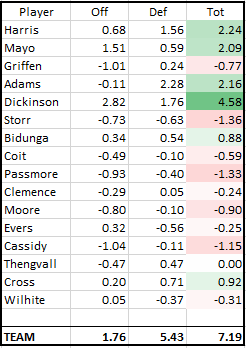
Offense

Defense

Total

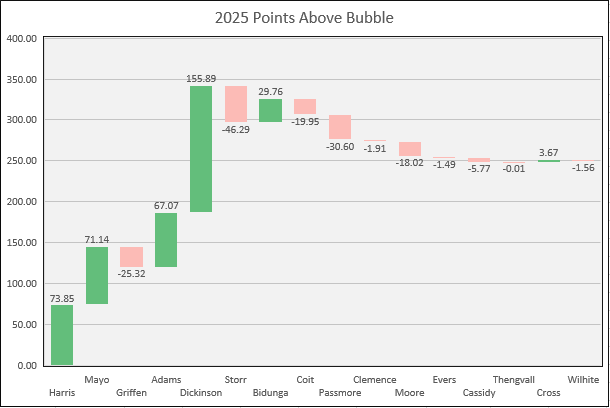
Points Above Bubble

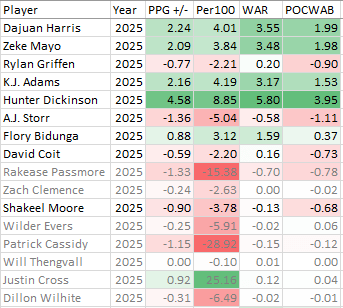
Value 4 Ways

Season Write-Ups

2025 Season Preview (10/15/2024)

What Will 2025 Bring (1/2/2025)

Dajuan Harris’s Value in Context (1/31/2025)

Value Splits (2/12/2025)

The Un-Clutch 2025 Jayhawks (3/3/2025)

Grading the NCAA Tournament Committee (3/17/2025)

Season Recap (4/8/2025)

2025 Season Preview

The 2025 Kansas Jayhawk basketball season is underway. Starting this week on Friday, with Late Night in the (recent renovated) Phog, KU basketball will have some sort of contest at least once each week now until either late-March or early-April. KU will have a couple of exhibition contests before officially beginning the regular season on Monday November 4, 2024.

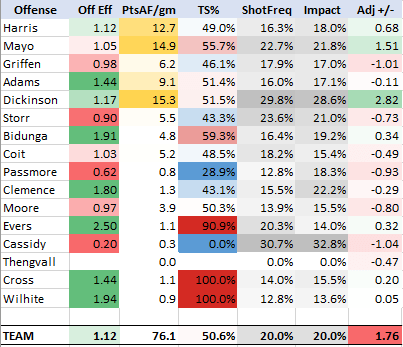
The Kansas roster is set, with KU having 12 healthy scholarship-players available for the 2025 season. Bill Self has said it is likely one player redshirts, and going through the roster we see the likeliest candidate as Jamari McDowell. But for the other 11 players, we have projected the impact we think they will have on the 2025 Kansas Jayhawks.

Group A: The Returnees

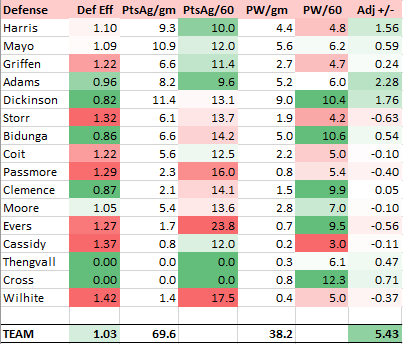
Dajuan Harris PG (C Sr.) Projections: 75% Mins, -0.20o, +1.18d, +0.98 PPGAB, +1.86 Per100, 2.48 WAR

Hunter Dickinson C (C Sr.) Projections: 75% Mins, +3.00o, +1.09d, +4.09 PPGAB, +7.80 Per100, 5.67 WAR

K.J. Adams PF (Sr.) Projections: 75% Mins, +0.50o, +2.01d, +2.51 PPGAB, +4.78 Per100, 4.05 WAR

As a collective, bringing back these three is the best thing that happened in the off-season for Kansas. Continuity is proven to be beneficial in college basketball, and each of these players has proven he can be solid, above-bubble value-adders on both ends of the court. The demise of their talents, presumed upon due to last season’s failures, is greatly exaggerated. The struggles from 2024 were largely due to extremely poor play from the bench and the injury to Kevin McCullar. While Harris, Dickinson, and Adams aren’t without flaws, each is a KU-level starter at his position at worst. Expect these guys to produce.

On to a discussion of their projections. Bill Self stated he planned on playing each fewer than 30 minutes per game. We’ll see if he sticks to those plans. Self is notorious for playing his bench limited minutes, and Dickinson’s minutes last year weren’t any more than he was playing at Michigan. By setting each at 75% of available minutes, we’re putting their loads right at 30 mpg. While there is more depth this season behind this initial trio, it’s just tough to go any lower than this level of playing time. You’re gonna see a lot of Juan, Hunt, and K.J.

As you should. Dickinson in particular is an elite offensive weapon. Should his free throw shooting pop back up into the upper-70’s or so where it belongs (it was 62% last year), he will take care of the only real weakness in his offensive game since coming to Lawrence. Hunt only had two games where he failed to reach double-figures, and aside from those two games he was producing bubble-level or (more-often) better offense each night for Kansas. Such offensive consistency is tough to find. That’s why we think Hunt’s better than a bubble-level center by 3 points per game. Defensively, Dickinson’s rebounding stands out. His kryptonite is on the high-ball screen, and if adjustments aren’t made on how he covers that his defensive number will be lower than our projection.

Dajuan Harris has never been a scorer, but his assists and shooting touch can get him closer to bubble-level on that end. Aside from a shocking start to the season a year ago, Harris as an upper-classman has been a good-enough offensive point guard. Where he justifies starters-minutes is from his defense.

K.J. Adams compliments Dickinson nicely on the floor. It’s commonly spewed out that Adams’ presence somehow clogs things up for Dickinson, but is this the case? Adams is constantly moving on the offensive end. He moves the ball with the pass and attacks with the dribble to either score or serve. The best offense isn’t to put one big guy in the middle and have four “shooters” stand stationary around him, as some lower-IQ fans would think.

Adams will produce around 0.50 points more per game than a bubble-player would, making up for a limited outside shot for extremely athleticism in finishing dunks and rim-runs as well as a nice touch with floaters and solid ability to draw fouls. But like Harris, Adams’ better end of the court is the defensive side, where he is versatile enough to guard anyone 1-5. He matches up best against wings and disrupts opposing offenses by getting in passing lanes, contesting shots, and walling up against potential penetration.

Group B: The Best from the Portal

A.J. Storr SF (Jr.) Projections: 65% Mins, +1.10o, +0.52d, +1.62 PPGAB, +3.57 Per100, 2.94 WAR

Zeke Mayo SG (Sr.) Projections: 65% Mins, +1.30o, +0.43d, +1.73 PPGAB, +3.81 Per100, 3.06 WAR

Rylan Griffen SF (Jr.) Projections: 60% Mins, +0.25o, +0.15d, +0.40 PPGAB, +0.95 Per100, 1.59 WAR

Storr is the class of the portal pick-up in the off-season, and he is certainly KU’s best chance at having an NBA draft pick in 2025. Everyone knows his solid year at Wisconsin a season ago, but we’re tempering expectation given his poor freshman year at St. John’s. A.J. will need to learn to score within a high-powered and multi-functioning Kansas offensive system. He will need to be aggressive at times but be willing to be the second or third option at others…and know when to do which. This may be a bit of an adjustment.

Storr is the Kansas player with the best chance to blow away expectations, ala Ochai Agbaji, Jalen Wilson, or Kevin McCullar their final seasons at KU. We don’t project it, but wouldn’t be surprised if he did play at an All-American level.

But Zeke Mayo is more likely to be the best-performing newcomer Jayhawk for 2025. Mayo is a smooth shooting guard who hit 38% of his 3’s and 87% of his FT’s at South Dakota State. Mayo also has decent rebounding and assist numbers without turning it over too much. He should fit easily into Kansas’ system.

Griffen comes in as another proven shooter, having torched the nets at 39% from downtown last season while playing for Alabama. What is his defense like? Will he be able to expand his game from primarily spot-up shooting? As a junior, Griffen shouldn’t be overwhelmed at Kansas.

Group C: The Rest of the Portal

Shakeel Moore PG (C Sr.) Projections: 30% Mins, -0.25o, +0.21d, -0.04 PPGAB, -0.17 Per100, 0.55 WAR

David Coit PG (Sr.) Projections: 11% Mins, +0.25o, -0.11d, +0.14 PPGAB, +1.76 Per100, 0.36 WAR

After the loss of Elmarko Jackson to a 12-month + injury, Bill Self was sure to have enough guard depth. He went out in the portal and got two PG’s who play different styles, with Self hoping to hit success with at least one. Shak Moore from Mississippi State is a solid defender with some scoring ability. He is himself injured and recovering to get ready for the season, but once healthy he has the chance to be a bubble-level type player. His counterpart for this back-up PG role is 5’11 David Coit, an offensive-minded player from Northern Illinois. He put up 37 in his final game as a Husky. The projections are for Moore to get more of a nod from Self, particularly against bigger opponents, and for Coit to shoot it well and add value in that way in small bits.

Group D: The Freshmen

Flory Bidunga C (Fr.) Projections: 15% Mins, -0.25o, +0.34d, +0.09 PPGAB, +0.87 Per100, 0.39 WAR

Rakease Passmore SG (Fr.) Projections: 14% Mins, -0.25o, -0.03d, -0.28 PPGAB, -2.87 Per100, -0.01 WAR

The projections were slotted to the player’s recruiting rank given historical precedence at KU. Last season this exercise worked out well when it accurately determined Jamari McDowell’s level of value. Bidunga’s minutes will be limited because he’s backing up Hunter Dickinson. Flory can find his role by hustling and getting easy baskets, contesting shots, and finishing alley-oops.

Passmore’s role will be dependent on how well he adjusts to the college game. He has a bit more of an opportunity because multiple wings can play at once, so he could find more minutes by cutting each of the other wings’ minutes by just a few. We know Self is high on both freshmen, but they are both freshmen and we expect them to be role players in 2025.

Group E: The Return of Clemence

Zach Clemence PF (RS Jr.) Projections: 10% Mins, -0.15o, -0.10d, -0.25 PPGAB, -3.64 Per100, -0.06 WAR

Clemence red-shirted last year and is primed to be a full-roster player for 2025. Zach has improved according to rumors, and these rumors are probably true given that he decided to return to Kansas instead of redshirt. The staff believes he has a role at Kansas, and he brings good size and a good shooting touch. His 2023 season was poor to say the least, and very disappointing given the promise he showed as a freshman in 2022. Clemence’s minutes, along with Bidunga’s and a few others, depend on how well they can do while they’re in the game and Self thinks it’s possible to play two bigs still (it is, but they have to defend the perimeter). Zach’s advantage over Flory is that he can stretch the floor a bit more, and maybe we’ll see both Zach at the 4 and Flory at the 5 when Hunter is resting.

TEAM Projections

+5.15o, +5.32d, +10.47 PPGAB (works out to a 28.96 KenPom rating)

A team with that type of point-differential is a strong candidate for a 1-seed, with a 2-seed or better very likely and a 3-seed about the lowest it’d go. That’s what we predict KU to be. An elite team who will be one of the odds-on favorites when everyone is filling out brackets and putting down closing bets in March. The tournament is tough to predict, so who knows after that. KenPom opens KU at a 24.42 rating, which is noticeably lower than what we see for the Hawks. Torvik isn’t much different at 24.4. Evan Miya has KU at 23.6. About everywhere has KU in the top 10, with the AP voters putting KU as the #1 team.

Let’s hope the season turns out better than the Allen Fieldhouse renovations did.

Close Calls at the PHOG

One area PHOG magic can be seen is in the number of close games KU wins at Allen Fieldhouse. Even more precisely, the number of end-of-game defensive stops KU gets.

On a Saturday afternoon in early February, 1997, the highly-favored Jayhawks were in a dog-flight with the Nebraska Cornhuskers. Tied 60-60, Nebraska had a chance to win it in regulation and upset the then-undefeated and #1 Jayhawks. KU used pressure defense and didn’t allow a clean attempt at the basket, forcing overtime which was won by Kansas. The video can be seen here.

Since that time, defensive stands by KU at home have always stood out to us. From that date – 2/1/1997 – to the present, we’ve calculated that KU has played in 49 games with the following criteria:

  • KU is on defense
  • Score is anywhere from KU +3 to a tied game
  • Clock is under 30 seconds

Effectively, KU needs a defensive stand to either win or force overtime. Were it to allow the opponent to score, it would either lose or be at risk losing in overtime. Excluded from this are scenarios where KU is down, as it would have to either foul or force a turnover to have a chance at winning.

Of these 49 games, KU has gone on to win 44, for a 89.8% winning percentage. And while some of these are easier to win (when KU is ahead), they’ve also gotten 10 stops in tie games to force overtime while only giving up 4 game-winning shots. They’ve additionally given up a few shots to tie the score while eventually going on to win. Still, 44-5 with the games so close seems astronomically impossible if the aura of the PHOG weren’t real.

Another way to look at this is to take each possession where the above criteria apply. As these games sometimes feature multiple defensive-stand possessions, we arrive at 70 possessions where KU needs a stop to either win/force OT. We calculate that 59.5 of these possessions ended in success (KU fouled and allowed 1/2 FT’s on one possession, which we’ll call a draw), or an 85.0% success rate. Opponents score at 0.357 points per possession in these scenarios, indicating that KU clamps down on the defensive end, using the energy of the crowd to win these high-leverage possessions.

The five defeats are:

  • 1/22/2004 – Richmond. The Spiders hit a midrange shot down 1 to win by 1 with under a second to go.
  • 2/19/2005 – Iowa State. The Cyclones made a midrange shot in a tie game to win by 2. KU still had 5 seconds left to tie/win, but couldn’t convert.
  • 2/3/2007 – Texas A&M. Acie Law buried a corner 3 and led the Aggies to an eventual 3-point win. Law’s 3-pointer put A&M up 1 and they got a stop when KU tried to retake the lead in the final 20 seconds.
  • 12/31/2024 – West Virginia. Javon Small made 1/2 FT’s with 1.8 seconds left.
  • 1/25/2025 – Houston. Incredible collapse by KU allowed this to happen. In fact KU got scored on twice to allow Houston to extend the game…first in regulation and then in the first OT (following a turnover by Mayo).

Some might also wonder about 2017 Iowa State. KU did lose but that game never saw such a scenario. Sure, it was close. But KU wasn’t tied/ahead needing a defensive stand in the last 30 seconds of the 2H/OT. They had the final shot in regulation (a miss) and trailed in the late stages of the extra period.

Some notable wins include the 2022 Iowa State game, when ISU took the lead (briefly) with 18 seconds left only for Dajuan Harris to hit a scooping runner and for ISU to miss the final shot as time expired. KU did allow a basket when it needed a defensive stand, but it also got a final defensive stand here.

KU gave up a 3 to UCLA in the 2011 season which tied the score, but would go on to win in regulation after Mario Little got fouled as time expired and hit a FT.

KU had a clutch stop against Texas in 2022 on Senior Day inside 30 seconds left. The Hawks would go on to win in overtime.

Connecticut had a game-winning 3-point attempt in the 2024 season that was missed at the buzzer. Many of KU’s defensive stands are just watching the opponent miss. Again, is this the PHOG?

The most epic scenario was in the 2016 Oklahoma game, the triple-overtime victory which saw KU get 5 crucial defensive stands throughout the end of regulation (missed front-end FT) and overtime periods.

Charting basketball games provides crucial information for player value

Charting the Hawks began charting during the 2019 season, when the idea was formed to attempt to isolate player value by simply charting everything (good or bad) the player did while on the court. Since that time as more and more thought has gone into this exercise more information has been gleaned, but the gist remains the same as it did from the beginning. Axiomatically, if Kansas as a team wins by 10 points, the means the individual players cumulatively were 10 points better than the opponents. The team’s performance just is the sum of its parts, and from there we can see who KU’s most valuable players are.

Adjusting for quality of opponent plays a big role as well, which we needn’t get into the details of. But adjusting for opponent makes our comparisons between years more accurate. A player who out-performs an easier schedule should be graded in comparison to a player who played in a season with a monstrous schedule.

Every year since 2019, which comes to 6 seasons so far, we have a full season’s worth of games charted using video replay1. Video replay allows for the charting process to be as accurate as possible. Seasons before 2019 are still charted where video exists, and the player-value estimates we arrive at shouldn’t be far off. Still, how far off are these estimates possibly off? How can we determine this?

We decided to take the season’s worth box score information from each of the previous six seasons, calculate player-value metrics using only this information, and then compare it to what we calculated from the charts. In other words, how much additional information is provided by watching games as opposed to simply taking box score data as the basis for player value?

We looked at two value metrics, PPGAB and Per100AB. We compared Offensive, Defensive, and Total breakdowns from what the box score showed vs. what the charted data provided. We calculated this for 58 rotation player-seasons (all players who got at least 10% of possible minutes in a season) so as to ignore small sample sizes/walk-ons. The results follow.

Offense

Starting with Offensive PPGAB, only one player of 58 had a per game score of more or less than 1.00 point. This was Jalen Wilson in 2023. Wilson’s higher score (+1.30 per game) was likely due to his ability to score without an assist and his ability to win extra offensive rebounds that may have been credited as team rebounds. In Per100 terms, this was +2.10 points per 100 better than the box score alone would dictate. Other players who out-performed their box score estimates were David McCormick in 2021 and Devon Dotson in both 2020 and 2019. For Dot, he scored a bulk of his points without an assist, something the box score-alone data would miss2.

On the other side of things, 2023 K.J. Adams had a far worse offense than box score data alone would have indicated. Because Adams required assists for much of his scoring that season, he was charted as -0.63 PPG and -1.32 points Per100 compared to box score data. Dajuan Harris from that same season was also a poorer offensive weapon than the box score presumed, as was 2019 Quentin Grimes.

Defense

Not surprisingly, the biggest differences between box score data and utilizing the charting system showed up on defense. Without seeing video evidence and considering each defensive possession using charting, people wouldn’t know that Marcus Garrett was 3.12 PPG better on this end in 2021 and 2.44 PPG better in 2020. Garrett got unfairly maligned for the team’s relative struggles in 2021. In reality he was an elite defender who helped that team maximize its potential. In addition, 2024 K.J. Adams excelled in guarding the ball. A season after playing out of position, wing K.J. Adams used his quickness and size to shut down scoring opportunities to the tune of 2.70 PPG compared to his box score estimate.

The worst defensive seasons come from Dedric Lawson (2019) at -2.36 PPG and -4.09 Per100 and Hunter Dickinson (2024) at -2.34 PPG/-4.20 Per100. Both offense-first, slower moving big men gave up more points per possession than the team average, something that was confirmed by charting games. Other poor defensive seasons include Jalen Wilson in 2021 (-1.93 PPG, -3.93 Per100) and Lagerald Vick in 2019 (-1.85 PPG, -3.19 Per100). This matters, particularly when looking at player value from other sources (Torvik, CBB Reference).

Total

The following players were over 2.00 PPG better than their box score value metrics would indicate. Marcus Garrett (2021) at +2.98, Marcus Garrett (2020) at +2.76, K.J. Adams (2024) at +2.38 and Devon Dotson (2019) at +2.12. These aren’t small differences.

On the flip side, the four biggest declines in player value came from aforementioned names. Jalen Wilson (2021) was 1.93 PPG worse than his box score information would suppose. Dedric Lawson (2019) was -1.84, Hunter Dickinson -1.81, and Lagerald Vick -1.62.

Hunter Dickinson has one more season at Kansas. Can he improve his defense? Well, it depends. Jalen Wilson certainly did. He became a -0.33 per game defender in 2021 to a +1.96 per game defender in 2023. I doubt Hunter has this drastic of an improvement, but with the team’s added depth this upcoming season he needs to perform better in 2025 than he did in 2024.

Absolute Value

It makes no sense to average out the differences, since by definition each season some players’ value scores will improve and some will worsen after we take into account chart data3. But we can use absolute value to see what the average difference is, whether plus or minus.

For Per100 numbers, the average offensive score is off by +/- 0.62 points. This isn’t too bad. Using the normal distribution, we’d expect about 89% of players to have an offensive chart score within 1 point of their pure box score Per100s. For the most part, the offensive data you receive from other sources is reasonable enough to conclude how good a player actually is on offense.

But on defense, the average Per100 number is off by +/- 2.07 points. This is quite a large gap. Defense makes up half of the game, and the majority of defensive player value comes from what we call “defensive coverage,” or the ability to prevent the man you’re responsible from scoring. And while the eye test can tell you some things about who a roster’s best defenders are, it cannot quantify things like charting does.

Only about 37% of players have a defensive score within +/- 1.00-point Per100 of their box estimates. Meaning its more likely than not that a player is noticeably better or worse than his box estimate.

If we use the total Per100 value scores and contrast the box estimates and the charted scores, we see an average difference of +/- 2.05 points Per100. This is about the same as the defense-alone score. Again, because box score data doesn’t provide us any look into defensive coverage, value scores derived from box score data alone tend to have significant differences from what a fully-charted system provides. Charting matters.

Looking forward

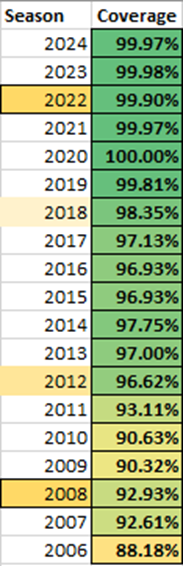
What this information does is it provides us with the ability to use confidence intervals in assessing player value from older seasons. For instance, the 2006 season only has 11/34 full games available for review (alongside some highlight clips that can help fill some gaps). In total, we give the 2006 season an 88.2% video coverage score, with 100.0% being a full season worth of game video and 66.7% being only box score info. Given such a large gap, it wouldn’t be surprising to see players’ value scores changing by as much as +/- 0.50 to +/- 1.00 per game4 should more videos become available for charting. From 2024 back to 2006, here are the video coverage scores by season:

Yes, in recent seasons occasionally a play is missed here or there thanks to technical difficulties or the broadcast failing to get back from a reply in time. This should be immaterial to player value calculations.

It’s encouraging to see relatively high scores for most seasons in the 2010’s, indicating that there should be small margins of error throughout the roster in these years. But generally, the further back we go, the less accurate the value estimates are.

Closing Thoughts

Half of the game of basketball is contested on the defensive end. If a player cannot defend, he will give up value which gets missed without video/charting. While player-value metrics from other sources admirably attempt to give the best estimates they can, they’re inadequate in revealing exactly how valuable a player is. Charting the Hawks has shown that the average difference in what box score only data provides and what a fully-charted system provides is +/- 2.05 points per 100 possessions. Therefore, elite defenders are highly underrated and terrible defenders highly overrated when other systems assess the value they bring to teams.5

  1. Technically part of the Wofford game in the 2019 season was missing, but for the most part 2019 is complete. ↩︎
  2. However, play-by-play info would have this mostly covered. Box score data is simply the most basic form of statistical information from which player-value estimates can be calculated. Certain other systems, to their credit, attempt to utilize other sources of info. ↩︎
  3. If we average out each season, we will arrive at a number close to 0. On the whole, it evens out. But we want to know each player’s component of value, not the team as a whole (which we already know). ↩︎
  4. Recently partial game footage from that season was discovered, with a certain player’s value score improving by 0.39 PPG. It’s unlikely every game will be this dramatic or shift a particular player’s value score in one direction, but it does show the effect even one game can have on value scores. ↩︎
  5. On/off data, as utilized by Hoop Explorer and Evan Miya, is intriguing but after looking at how they correlate to CtH’s value scores we see noticeable gaps. This doesn’t prove they’re wrong (perhaps we are), but it does give us pause about using them. These systems rely on on/off data that might not always be accurate and are very “noisy” given they are attempting to isolate player value just from what a team does while a player is on the floor. It doesn’t have the eyes that charting does. ↩︎

2024 High School Football Ratings

Power Ratings for 2024. To compare teams, subtract one team’s rating from the other. This will provide an estimated skill difference in points per game.

RankTeamClassRecordRating
1Derby6A11-159.94
2Manhattan6A12-156.91
3St. Thomas Aquinas5A13-054.93
4St. James Academy5A6-652.95
5Gardner Edgerton6A12-152.93
6Blue Valley West6A10-251.27
7Mill Valley5A9-250.88
8Blue Valley5A6-350.83
9Andale3A13-050.14
10Blue Valley Northwest6A7-449.68
11Shawnee Mission Northwest6A8-344.57
12Andover Central4A12-144.37
13Hays5A8-543.21
14Lawrence Free State6A6-442.17
15Great Bend5A9-141.50
16Wichita Northwest6A9-240.82
17Kapaun Mt. Carmel4A7-339.28
18Wichita East6A7-439.28
19Lawrence6A4-538.17
20Goddard Eisenhower5A9-337.68
21Shawnee Mission East6A5-535.93
22Bishop Miege4A5-835.87
23Basehor-Linwood5A8-235.85
24Olathe North6A3-635.67
25Olathe East6A6-435.63
26Dodge City6A6-434.78
27De Soto5A7-234.07
28Hutchinson5A8-333.41
29Olathe South6A3-633.18
30Buhler4A9-332.58
31Topeka Hayden3A11-232.14
32Wichita Collegiate3A8-230.90
33Wellington4A8-330.16
34Junction City6A5-530.10
35Olathe Northwest6A6-429.86
36Blue Valley North5A3-829.51
37Maize6A5-529.50
38Cheney3A9-229.37
39Olathe West6A3-628.88
40Goddard5A6-328.61
41Andover5A4-528.37
42Topeka Seaman5A8-327.69
43Rock Creek3A8-226.85
44Wamego4A9-226.69
45Southeast of Saline2A13-026.23
46Pittsburg5A7-326.21
47Liberal5A7-325.71
48Maize South5A6-424.29
49Shawnee Mission North6A2-723.96
50Scott Community3A9-223.73
51Louisburg4A7-223.69
52Salina Central5A4-523.46
53Washburn Rural6A3-622.80
54Chanute4A8-322.46
55Blue Valley Southwest5A2-721.50
56Spring Hill5A8-220.95
57Pratt3A6-319.86
58Winfield4A6-417.93
59McPherson4A5-517.37
60Tonganoxie4A8-417.28
61Lansing4A6-516.12
62Valley Center5A3-716.10
63Marysville3A6-315.30
64Wellsville3A11-115.16
65Nemaha Central2A11-214.81
66Conway Springs1A13-014.54
67Hesston3A8-214.27
68Shawnee Mission South6A1-814.23
69Mulvane4A7-314.17
70Beloit2A9-313.95
71Ottawa4A6-413.35
72Garden Plain2A8-313.32
73Holcomb3A9-312.34
74Fort Scott4A6-412.07
75Garden City6A2-711.67
76Atchison4A7-311.40
77Clay Center3A5-511.19
78Leavenworth5A6-410.58
79Osage City2A10-110.31
80Wichita South6A6-410.11
81Bishop Carroll5A2-710.05
82St. Marys2A6-49.98
83Eudora4A4-58.82
84Council Grove2A8-48.80
85Shawnee Heights5A2-88.67
86Silver Lake2A7-38.40
87Topeka6A4-57.65
88Kansas City Piper4A3-67.34
89Haven2A8-27.24
90Sedgwick1A8-26.83
91Arkansas City4A2-75.15
92Norton2A8-35.14
93Humboldt2A10-14.40
94Moundridge1A7-14.15
95Hoisington2A6-54.10
96Labette County4A5-52.53
97Goodland3A4-52.45
98Prairie View3A8-32.25
99Jackson Heights1A9-22.13
100Holton3A5-51.65
101Clearwater3A3-61.41
102Circle4A3-61.40
103Frontenac3A9-11.36
104Augusta4A1-81.15
105Abilene4A3-61.11
106Centralia1A11-21.07
107Halstead2A4-60.50
108Phillipsburg2A6-40.01
109Rossville1A8-4-0.78
110Paola4A1-8-1.48
111Hugoton3A6-3-2.79
112Sabetha2A6-4-2.79
113Sterling1A6-4-2.82
114Perry-Lecompton3A5-6-3.05
115Shawnee Mission West6A1-8-3.31
116Topeka Highland Park5A6-3-3.55
117Valley Heights1A9-3-3.89
118Wichita Heights6A2-7-3.94
119Royal Valley2A5-4-4.22
120Medicine Lodge1A8-4-4.26
121Rose Hill4A2-7-4.28
122Wichita West6A2-7-4.64
123Riley County2A5-4-5.25
124Caney Valley2A6-3-5.94
125St. Mary’s-Colgan1A9-2-6.08
126Lakin2A6-3-6.24
127Hillsboro2A4-5-6.79
128Marion1A6-4-7.05
129Field Kindley4A2-7-7.30
130Salina South5A1-8-9.27
131Troy1A6-4-9.45
132Ellinwood1A4-4-9.72
133Wichita Southeast6A2-7-9.76
134Kingman2A4-5-9.85
135Newton5A0-9-9.91
136Plainville1A7-4-9.93
137Minneapolis2A3-6-10.26
138Concordia3A1-7-10.41
139Ellsworth2A4-5-11.54
140Girard3A6-4-11.62
141Colby3A4-5-11.70
142Hutchinson Trinity1A4-6-11.90
143Kansas City Sumner4A6-4-11.96
144Columbus3A7-3-12.15
145Inman1A4-5-13.03
146Kansas City Washington5A6-3-13.91
147Smith Center1A5-4-14.15
148Emporia5A0-9-16.96
149Russell2A3-6-17.37
150Santa Fe Trail3A5-4-17.77
151Olpe1A7-3-18.02
152Hiawatha3A2-7-18.33
153El Dorado4A0-9-18.60
154Riverside1A6-4-18.81
155Kansas City Turner5A0-8-18.89
156Wichita Trinity Academy3A3-6-19.27
157Chapman3A2-7-19.54
158Thomas More Prep-Marian1A5-4-19.59
159Smoky Valley3A2-7-19.72
160Cimarron2A2-7-19.91
161Campus6A0-9-20.17
162McLouth1A8-2-20.29
163Jayhawk Linn1A5-4-22.47
164Parsons3A2-7-22.54
165Osawatomie3A1-4-22.98
166Remington1A3-6-23.11
167Kansas City Schlagle4A2-6-23.92
168Iola3A4-5-24.21
169Independence4A0-9-24.55
170South Sumner1A3-6-25.31
171Bishop Ward3A2-7-25.33
172Jefferson West3A2-7-26.12
173Burlington3A3-6-26.67
174Ulysses4A0-8-27.10
175Topeka West5A1-8-27.65
176Douglass2A2-7-29.06
177Chaparral3A1-8-29.76
178Baldwin3A1-8-29.88
179Republic County1A3-6-30.15
180Salina Sacred Heart1A4-5-30.24
181Onaga1A3-6-30.37
182Bonner Springs4A1-8-31.12
183Nickerson3A1-8-32.23
184Oakley1A3-6-32.75
185Wabaunsee1A3-6-33.11
186Riverton2A4-6-33.54
187Mission Valley1A5-4-33.66
188Jefferson County North1A5-4-34.10
189Eureka2A6-3-34.43
190Galena2A4-5-34.76
191Atchison County2A2-7-35.38
192Wichita North6A0-9-36.84
193Larned2A2-7-36.97
194Lyons2A2-7-37.23
195Anderson County3A1-8-37.60
196Cair Paravel1A2-6-38.70
197Fredonia2A4-5-39.04
198Maur Hill Prep1A4-5-39.95
199Bennington1A1-8-40.15
200Horton1A3-6-40.17
201Neodesha3A3-6-40.49
202Central Heights2A4-5-41.00
203Cherryvale2A3-6-41.70
204Herington1A1-8-42.59
205Pleasanton1A4-6-47.69
206Kansas City Wyandotte6A0-8-47.86
207Baxter Springs3A2-7-49.56
208Doniphan West1A2-7-49.85
209Southwestern Heights2A2-7-49.92
210Kansas City Harmon5A2-7-51.62
211Uniontown1A2-6-52.08
212Erie1A1-6-53.21
213Belle Plaine2A0-9-53.73
214Oskaloosa2A2-7-54.97
215Pleasant Ridge1A1-8-55.02
216Bluestem2A2-7-55.25
217Stanton County1A1-7-57.64
218Southeast1A2-8-58.08
219Valley Falls1A1-8-63.46
220Syracuse1A0-9-63.80
221West Franklin2A0-9-78.24
222Maranatha Academy1A0-9-81.89

Introducing Effective Depth

In basketball, depth is an oft-discussed aspect of a team but one that can be difficult to measure or quantify. The size of the rotation is part of what depth is, but when we discuss “depth” we also want to know how good the rotation is. A team which plays 9 to 10 guys who aren’t any good isn’t really “deep,” at least not in terms of our expectations for KU basketball. Thus, a metric named Effective Depth has been created for us to measure recent KU teams in terms of depth.

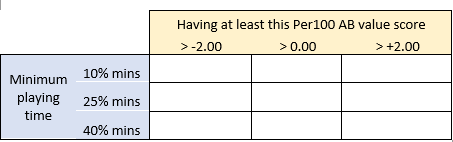
Effective Depth measures not only how many players on the roster play a certain percentage of minutes, it also filters out players who don’t reach a certain threshold of player value. See the table below.

To calculate Effective Depth, fill in the number of players on the roster that meet the criteria in each of the 9 spaces. The top left is the easiest to reach (and will therefore be the highest number in the 3 x 3 matrix) and accounts for all players which play at least 10% of team’s minutes and contribute a Per100 value score of at least -2.00 points. After filling each of the 9 spaces, divide the total number by 9 and this will be that team’s Effective Depth.

Effective Depth does a few things. Not only does it adjust for the skill of depth, it also does so on a sliding scale. A very deep team won’t just have 10 guys in the rotation, it will have multiple players which reach 40% minutes and also have a minimum value score which is at least positive. A player with at least +2.00 Per100 AB value and 40% minutes played will contribute a full point to the tally. Players who contribute fewer minutes and/or at a lower value score will contribute some fraction of a point.

Since 1993, or the most-recent 32 seasons of Jayhawk basketball, the average KU team has had an Effective Depth of 5.47. This number is scaled to rotation size, so anything north of 5 means KU has a roster which should be solid at all times. Anytime such a team would have to go to the bench to play lesser players, it shouldn’t have to expend too many minutes on them and thus can manage minutes to be consistently competitive.

The teams with the highest Effective Depth scores since 1993 are the following:

  • 1993 (7.89 players)
  • 2007 (7.11)
  • 2008 (6.67)
  • 2006 (6.67)
  • 2010 (6.44)

The 1993 team’s value score estimates aren’t as complete as those in later years, so this season’s Effective Depth score might be inflated somewhat. If a few guys see their scores drop, this number could come down closer to the others. But it is still safe to say that the 1993 team had solid depth.

Other deep teams came during the Chalmers/Rush-era, when KU didn’t rely on any one star but was still solid enough to win three straight Big XII regular season and conference titles, earn two #1 seeds, make two Elite 8’s, and of course win the ’08 NCAA National Championship. Additionally, the 2010 team had great Effective Depth and was the most-recent Kansas team to have a score above 6.00 players. Since the 2010 season, KU just hasn’t been super deep1. Blame recruiting, NIL/transfer rule changes, early entrants to the NBA, etc. but the simple fact is KU teams aren’t as deep as they used to be.

Still, it hasn’t been all bad news. The bottom 4 rosters in terms of Effective Depth were solid teams that made it work by having stars carry the load despite not having much depth.

  • 2004 (4.56)
  • 2017 (4.22)
  • 2009 (4.11)
  • 2005 (4.00)

The 2004 and 2005 teams carried over three solid upperclassmen from the Williams era (Simien, Langford, Miles) yet not much else. Self’s best recruits were only underclassmen or not yet on campus. And while the big three holdovers had success in these seasons, they could only do so much. The 2004 run to the Elite 8 was a good tournament showing; the following year we’d rather forget. The ’09 and ’17 teams each had two elite players, a few solid role players, and then after that tried to make do and win games. They were both second-weekend teams, however.

The above teams weren’t actually the bottom 4, but rather team’s 2-5 in the bottom 5. The team with the worst depth hasn’t been discussed yet. It was last season’s team, the 2024 team, which had Effective Depth of 3.67 players. Remember in order to add Effective Depth, a player must contribute time on the floor and player value. For the 2024 team, only McCullar, Dickinson, and Adams could do both. Harris and Furphy did add a little value (as they were better than a -2.00 player), but the 2024 bench gave KU no Effective Depth. This is why KU struggled to maintain leads and was so bad after McCullar got injured. It decimated an already thin rotation. If we compared the 2024 roster’s Effective Depth to all others in the most-recent 32 seasons, it has a z-score of -1.90 or percentile of 2.9%. Your eyes weren’t lying. The 2024 roster was an outlier in terms of how thin and weak it was.

That’s also why Self said in the offseason he wanted a roster with “8 starters.” One way to look at Effective Depth is that it measures how many (KU-level) starters are on the roster. An Effective Depth of 5.00 should be considered the median score. Such a team’s depth is okay, neither great nor terrible. Anything below 5.00 and the roster is thin with certain players logging minutes despite not being quite up to the level KU fans would want. A score above 5.00 means KU has more depth and is likely bringing talented-enough-to-start players off the bench.

Looking at the bright side, the 2025 team is expected to have around 6.00 Effective Depth given preliminary projections2. Even if these projections don’t fully hit, KU will certainly have a deeper team than it did last year, and should also be about as deep or deeper than it has been at any point over the last 15 seasons.

Edit Note: Now that season has begun, the 2025 season will show updated scores.

Effective Depth by Season:

  1. KU has had good depth at times since 2010, including its 2022 National Championship team. It just hasn’t had elite depth since 2010 or earlier. ↩︎
  2. KU’s top 6 should be very talented and we’d expect 1-2 others contribute as bench rotation players. ↩︎

Weighting Medal Counts

Every 2 years when the Olympics come around and events start awarding medals, a debate is sparked on how to represent which country is performing best. You can sort the list by gold medals or total medals, but neither is the best way, as the former way undercounts non-gold medals while the latter way undersells the prestige of the gold medal.

Enter “weighted medal count.” In doing some quick research, I came across a few proposals that have been made. First we will start with the 3/2/1 method, also called the Swedish method. Golds get credit for 3, silvers 2, and bronzes 1. This equation would have one silver and one bronze equating to one gold. A different method that strengthens golds is the 5/3/1 method, also called the English method. 5 for gold, 3 for silver, and 1 for bronze. This would require one silver and two bronze medals to equal one gold. Another method is the 4/2/1 proposal, which requires two silvers for one gold and two bronzes for one silver.

Each of these methods is fine and would be better than what is implemented now (no weighting system). But none are perfect as they have been created ad hoc. The thing is, the correct answer is already out there if you’re willing to use some reasoning and do some math.

Let’s start with the reasoning. What is the difficulty of winning a gold medal compared to a silver or bronze? Let’s assume there is a competition with 100 participants, with medals for first, second, and third. Let’s just assume the winning time is one minute, zero seconds (1:00). Thus, of everyone who raced, only one person got a time of 1:00 or better.

Total ParticipantsTimeParticipants finishing at this time or betterMultiple who beat time
1001:001100

Now we get to the math. The multiple column is calculated by taking the total participants by the number of participants to finish in 1:00 or better. In our example, let’s assume second came in at 1:01 and third at 1:04. Now, let’s fill out the chart for the top three places.

Total ParticipantsTimeParticipants finishing at this time or betterMultiple who beat time
1001:001100
1001:01250
1001:04333.33

If we filled out this chart we’d get each finisher’s time and multiples getting smaller and smaller until it reaches nearly 0. But we are only concerned with the top part of this table. The multiple helps us see what we intuitively know. When an athlete competes we judge his performance by how many of the others he is better than. Getting first is the equivalent of beating 100-fold of the field. Getting second is equivalent of beating 50-fold of the field, and getting third is beating 33.33-fold of the field.

Let’s examine the relationship between the multiples. First place is 100, second place is 50, and third is 33.33. First is two times that of second, and three times that of third. Necessarily, second is 1.5 times that of third. And if we upped the total participants who raced to 1,000 or 10,000 or any other number–doesn’t matter–we’d still get the same relationship between first, second, and third place. This follows a 6/3/2 relationship or a 3/1.5/1 method.

Therefore, since a gold medalist’s winning time was achieved by half as many as the silver medalist’s, we reason that the gold medalist was twice as special. And the relation between every other participant is decided in this way. When it comes to weighting medals, this means 3 for gold, 1.5 for silver, and 1 for bronze.

This can also be intuitively remembered by the formula that two silvers = one gold or three bronzes = one gold.

Analyzing the Other Methods Again

Each method has its pros and cons. The Swedish (3/2/1) is correct with regards to the weight between gold and bronze (3 to 1), but the silver is too high in relation to both. The English method (5/3/1) doesn’t get any relationship perfect, but it does pull down silver closer to where it should be with regards to gold (although it makes bronze far worse than it should be). The 4/2/1 method gets the gold to silver relationship correct but not the bronze which it undervalues. Still, either of these proposals is better than the gold only method (effectively 1/0/0) or the no-weight method (1/1/1).

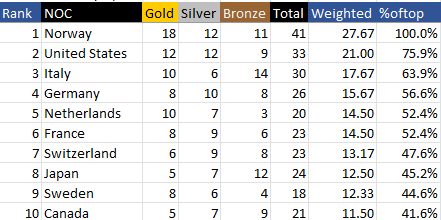
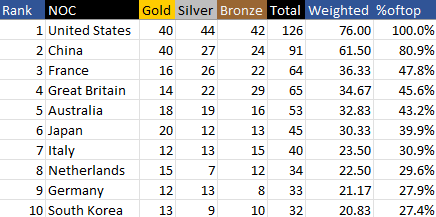
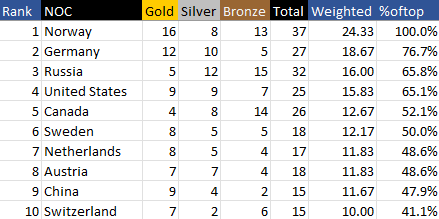
Using the 3/1.5/1 method, and weighting it so a gold medal = 1 (effectively making it the 1/0.5/0.33 method), here are the top 10 countries in weighted medal count at the close of recent Olympic games.

2026 Winter Olympics (Milan Cortina)

Another nice thing about the weighted system is that we can now use a “Percent of top” multiple allowing us to compare any two countries. In 2026, the US did better than every country except Norway, clearing third place and host Italy by 3.33 weighted medals.

2024 Summer Olympics (Paris)

In 2024’s Paris games, the US and China tied in the gold medal count, but this obscures the fact that the US of A won far more silver and bronze medals. In total, this is a whopping difference of 14.50 weighted medals. This is a lot less close than sorting by gold medals would make it appear. Notice also that no other country third and down was within 50% of the United States’ weighted medal count. America easily won the 2024 Olympics.

2022 Winter Olympics (Beijing)

Norway dominated the 2022 Winter games, finishing 5.67 weighted medals in front of Germany. This was the most-recent games that Russia was allowed to compete, and the US finished fourth and at 65.1% of the winner.

Future Major Projections – 2025

For the Projections made heading into 2024, see here. Date of Projection: 2/13/2025.

The model for projecting career majors for elite professional golfers has been simplified. While historic skill level and specific performance at majors was previously calculated using a pain-staking process, the new method is looking instead at historic pre-major betting odds and using that as the proxy for how likely a player was to win a major. Then, instead of building a “player age skill curve (PASC),” the age distribution of major winners since WWII was used. From here, a player’s recent trends and his career overall is factored in using multiples until we finally arrive at a career projection. Not only is this process easier to arrive at, it is also more objective than the prior one. Additionally, it ties to the (linked above) pre-major betting odds page, creating a symmetry within our databank of calculation/forecast systems. We let the market decide player value, the actual results of majors dictate the age curve, and then choose reasonable multiples to help smooth the data and hopefully arrive at solid estimates for golfers’ careers. Age refers to what the golfer will turn during calendar year 2025. The Projected Majors category refers to future majors. To calculate career estimated majors, add the player’s actual major total going into 2025.

GolferAgeProjected Majors
Scottie Scheffler295.32
Tom Kim232.53
Ludvig Aberg262.09
Collin Morikawa282.04
Jon Rahm311.98
Xander Schauffele321.67
Viktor Hovland281.62
Rory McIlroy361.39
Akshay Bhatia231.21
Joaquin Niemann271.10
Nick Dunlap220.98
Bryson DeChambeau320.90
Sungjae Im270.89
Justin Thomas320.84
Jordan Spieth320.83
Cameron Young280.75
Sam Burns290.66
Luke Clanton220.65
Hideki Matsuyama330.64
Rasmus Hojgaard240.63
Brooks Koepka350.62
Sahith Theegala280.62
Matt Fitzpatrick310.61
Patrick Cantlay330.59
Cameron Smith320.59
Nicolai Hojgaard240.58
Min Woo Lee270.54
Will Zalatoris290.47
Tommy Fleetwood340.43
Tyrrell Hatton340.41
Si Woo Kim300.35
Wyndham Clark320.34
Robert MacIntyre290.32
Tony Finau360.30
Davis Thompson260.30
Tom McKibbin230.23
Max Homa350.23
Corey Conners330.21
Shane Lowry380.21
Sepp Straka320.20
Aaron Rai300.18
Jason Day380.18
Rickie Fowler370.16
Dustin Johnson410.15
Russell Henley360.15
Austin Eckroat260.14
Christiaan Bezuidenhout310.14
Byeong Hun An340.13
Kurt Kitayama320.11
Patrick Reed350.11
Denny McCarthy320.10
Maverick McNealy300.10
J.T. Poston320.09
Brian Harman380.09
Thomas Detry320.09
Thriston Lawrence290.08
Jose Luis Ballester220.08
Harris English360.08
Daniel Berger320.08
Keegan Bradley390.07
Cam Davis300.07
Keita Nakajima250.07
Billy Horschel390.06
Adam Scott450.06
Dean Burmester360.06
Taylor Moore320.06
Taylor Pendrith340.05
Justin Rose450.05
Adrian Meronk320.05
Talor Gooch340.05
Tom Hoge360.05
Matt McCarty280.05
Matthieu Pavon330.04
Davis Riley290.04
Alex Noren430.04
Chris Kirk400.04
Ryan Fox380.04
Stephan Jaeger360.03
Emiliano Grillo330.03
Guido Migliozzi280.03
Tiger Woods500.03
Sergio Garcia450.03
Louis Oosthuizen430.03
Romain Langasque300.03
Matthew Jordan290.03
Gary Woodland410.03
Jake Knapp310.03
Nick Taylor370.03
Nico Echavarria310.03
Kevin Yu270.02
Jordan Smith330.02
Adam Schenk330.02
Justin Hastings220.02
Thorbjorn Olesen360.02
Dan Bradbury260.02
Adam Hadwin380.02
Lee Hodges300.02
Max Greyserman300.02
Rikuya Hoshino290.02
Matt Wallace350.02
Eric Cole370.02
Erik van Rooyen350.02
Ryggs Johnston250.01
Matteo Manassero320.01
Harry Hall280.01
Jacob Skov Olesen260.01
Angel Hidalgo270.01
Jesper Svensson290.01
Danny Willett380.01
Marc Leishman420.01
Jhonattan Vegas410.01
Phil Mickelson550.01
Sebastian Soderberg350.01
Laurie Canter360.01
Daniel Brown310.01
Patton Kizzire390.01
Martin Kaymer410.01
Lucas Glover460.01
Francesco Molinari430.01
Frederic Lacroix300.01
Antoine Rozner320.01
Charl Schwartzel410.01
Richard Bland520.01
Shugo Imahira330.01
Rafael Campos370.00
Zach Johnson490.00
Bubba Watson470.00
Henrik Stenson490.00
Jorge Campillo390.00
Niklas Norgaard330.00
Curtis Luck290.00
Paul Waring400.00
Padraig Harrington540.00
Julien Guerrier400.00
Jason Dufner480.00
Jimmy Walker460.00
Stewart Cink520.00

We’ve included 137 golfers who are currently have listed betting odds in one or more major championship for 2025. There are others who weren’t included, though they are either non-competitive legacy winners or amateurs who qualified and don’t have much chance either.

The process for creating projections was multi-layered, but as noted earlier much more simple than the earlier iteration. A player’s forecasted future majors is predicated on his age and historic betting odds in the majors…that’s it. In one sense this forecast is less a projection of future majors and more a projection of how many majors the betting markets will think a player will win.

The toughest thing to account for in this model is whether or not a player will sustain elite play. Right now Scottie Scheffler has been clearly the world’s best golfer, and his major projections over the past three seasons have reflected that. As a golfer who will turn 29 in 2025, he is also in the prime years of a professional golfer’s career. This combination is what produces such a high projection. The model weights recent seasons heavily, and it is tough to forecast how likely it is that Scheffler sees a decline ala Jordan Spieth…a golfer who peaked in his 20’s.

Another difficulty is forecasting major qualification for LIV golfers. While it is built into the data to a degree, young talented golfers like David Puig and Joaquin Niemann will have a much better chance of winning majors if they can get into them. Niemann did well in LIV’s off-season and got into 3/4 majors in 2024. If he can continue to get into a majority of majors, his current estimate will be a lot more accurate than if he starts missing a lot of majors due to his league not having a direct path to the grand slam events.

Ultimately, it is the Scottie-era if he can maintain elite play. He’s projected to win 5.32 additional majors, which if he could get 5 more would get him to 7 for a career. This tie Arnold Palmer and cement him as one of the game’s greats. Others projected to win multiple majors moving forward include Tom Kim, Ludvig Aberg, and Collin Morikawa. Being young helps.

For 2025 itself, here is what the market is projecting in terms of total majors won (top 25 players only):

GolferExpected 2025 Majors Won
Scottie Scheffler0.48
Rory McIlroy0.28
Xander Schauffele0.22
Jon Rahm0.17
Ludvig Aberg0.16
Bryson DeChambeau0.14
Collin Morikawa0.14
Brooks Koepka0.11
Viktor Hovland0.11
Justin Thomas0.10
Hideki Matsuyama0.10
Patrick Cantlay0.08
Tyrrell Hatton0.07
Tommy Fleetwood0.07
Cameron Smith0.07
Jordan Spieth0.07
Joaquin Niemann0.06
Tony Finau0.06
Sahith Theegala0.05
Tom Kim0.05
Sam Burns0.05
Shane Lowry0.05
Matt Fitzpatrick0.05
Wyndham Clark0.05
Will Zalatoris0.05

Note that this top 25 only accounts for 2.85 expected majors, so we’d expect one of the four to be won by someone not on this list. However, each major last season was won by a golfer in the top 10 in betting odds going in (Scheffler #1 – Masters, Schauffele T3 – PGA, DeChambeau T5 – U.S. Open, Schauffele #3 – British). We will also keep an updated market projection for the next major at our Current Championship Odds page.