
Updated after the 2026 British Open. What is presented below will be the betting market’s cumulative expected major wins for players. Note that historic betting odds only date back to 1985, so this won’t cover many of the greats, and that more than a few players have their careers intersected by beginning at this time.
Since 1985, the table below shows how many major championships the betting market predicted would be won by each golfer the morning the tournament began. For instance, Tiger Woods’s odds were such that the market collectively set him to have 11.265 majors over his career. The idea of using betting odds to predict major championship expectation stems from the belief that betting markets are at least moderately efficient. Bettors are trying to win money, so prices get shaved down to rational levels and this produces information that is helpful in understanding exactly how realistic it was for a golfer to win any particular major.
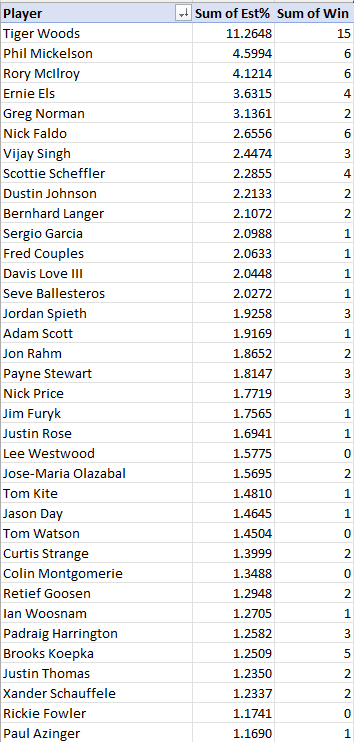
The list cuts off at Paul Azinger for the sake of space, but this shows the top 36 golfers in terms of predicted majors from 1985 – present. For more on the methodology, scroll to the bottom. For some names, such as Tom Watson, there will be a major total that is different from his actual career total (Tom had 0 majors?). But mentioned earlier, this is data from the period from 1985 and after. Some golfers have their careers intersected by this cutoff date.
The question often comes up, “who is the best player to never have won a major?” Looking at this list gives us a good answer, at least for the most recent 41 years of golf.
- Lee Westwood (1.578)
- Colin Montgomerie (1.349)
- Rickie Fowler (1.174)
- Luke Donald (1.024)
- Paul Casey (0.845)
- Matt Kuchar (0.837)
- Tommy Fleetwood (0.799)
- Patrick Cantlay (0.774)
Lee Westwood, with nearly 1.6 expected majors, is the definitive answer as to who is the best to never win one, at least in the modern era of golf. Monty is second, with Rickie (still in his 30’s) coming in as the highest on this list with a realistic chance to eventually come off it. Only four players over this era have been expected to win at least 1 major but aren’t major champions. Many of the “best to never win a major” haven’t actually had the types of careers expected to win one.
Methodology
Using betting odds as a corollary for projected winning percentage has a few assumptions. One is that the market is efficient (enough) to be useful. If a player is wildly misjudged by bettors, this would make his estimated majors won quite off-base. The second assumption is that the cut taken by the bookmakers can be accounted for. This is more than a math problem. Because each player’s betting odds will add up to more than 1, an adjustment factor has to be made. The question is whether this adjustment (which can be significant toward the top of the favorites) is accurate. While these issues could have an effect on the numbers, it’s likely that this effect isn’t large enough to matter.1
While the odds are from 1985 and after, another issue is that before the mid-2010’s, not every tournament has a full set of historic odds. Many had only 30 to 40 golfers available for betting the further back you go in time. In other words, there wasn’t the option to gamble on any particular player in the field until recently, meaning we have a number of tournaments where there was a “Field” option and there have been 15 total major championships over this time frame which didn’t have pretournament odds listed. So, the historic odds data was supplemented by implementing artificial odds for players not listed in majors during these prior years. These artificial odds were applied based on a player’s Data Golf or OWGR ranking at the time of the tournament.
Since the Tiger Era
On Thanksgiving 2009, the Tiger era effectively ended (though we may not have known it at the time), as the scandal around his personal life affected his success on the golf course, particularly in majors. He was no longer dominant, and others took advantage. Here is what the market sees as the top 15 players from 2010 – on (beginning at the 2010 Masters).
15. Bryson DeChambeau (1.041 expected majors, 2 actual). Bryson has overperformed in majors, grabbing two U.S. Opens though his second was a bit closer than his 2020 victory. He has also played well in the PGA, finishing second in both 2024 and 2025.
14. Rickie Fowler (1.174 expected majors, 0 actual). Fowler is the only player from this specific era (2010 – present) to not record a major victory. Though he does have a Players, Rickie’s career will likely be a bit underrated if he never does win a grand slam event.
13. Xander Schauffele (1.234 expected majors, 2 actual). Xander made it count in 2024, grabbing two majors while playing his best golf.
12. Justin Thomas (1.235 expected majors, 2 actual). JT, Xander, and Bryson are all similar in terms of age, expected majors, and actual majors. It will be interesting to see which, if any, break from this group of 2-time winners.
11. Brooks Koepka (1.251 expected majors, 5 actual). Is Brooks actually done winning majors? The market never caught up to his major dominance, but since his 2023 PGA he hasn’t really contended in them.
10. Adam Scott (1.291 expected majors, 1 actual). Scott has played in more majors than just this era, and as he ages his overall ranking will only decline as he gets passed by those still in their 30’s.
9. Justin Rose (1.395 expected majors, 1 actual). Very similar to Adam Scott, though Rose has contended in quite a few majors recently. I doubt he gets another, but who knows.
8. Jason Day (1.465 expected majors, 1 actual). Even before winning the 2015 PGA, Day was a popular player to win a major given his competitiveness in them.
7. Phil Mickelson (1.470 expected majors, 3 actual). What’s crazy is that Phil turned 40 in 2010, so this is only a small part of his illustrious career. While his earlier days were tied to heartbreak in the majors, he captured 3 majors in his age 40 season or older.
6. Jon Rahm (1.865 expected majors, 2 actual). Rahm has been consistently good, and his 2026 season is projected to be his third-best overall per the betting market for majors.
5. Jordan Spieth (1.926 expected majors, 3 actual). Easily one of the more surprising drop-offs, Spieth hasn’t been a real factor since 2021. One can’t write him off completely, but he’s gone from elite to really good to now mediocre.
4. Tiger Woods (2.031 expected majors, 1 actual). The fact Woods has still been the fourth-best player in the game following the end of his “era” is kind of funny I suppose (and would be higher if we capped this from say, 2010 – 2019). Some of this may have been due to the market overvaluing his pre-2009 crash reputation, but he was an elite player in 2012, 2013, 2018, and 2019.
3. Dustin Johnson (2.197 expected majors, 2 actual). For all of DJ’s blown chances, him winning 2 is about where you’d expect a player of his caliber to be. DJ emerged as a potential “next Tiger Woods” at the 2010 U.S. Open but famously collapsed that Sunday. If he never wins another, he will still go down as a tremendous talent.
2. Scottie Scheffler (2.285 expected majors, 4 actual). Scheffler has emerged as the closest thing to Tiger in terms of the market’s predictions for a major. He has sped up this list to reach second place, and while he is a ways back from #1 still, will continue adding expected majors and likely actual ones as well. He is just 30 years old.
1. Rory McIlroy (4.038 expected majors, 6 actual). There is some argument to make that this has been the “Rory era,” though it has not been smooth sailing. McIlroy has had bouts as the #1 golfer but has also been behind (at different times): Scottie Scheffler, Jon Rahm, Jordan Spieth, Dustin Johnson, and Jason Day. He figured out Augusta National to complete the Career Grand Slam and hasn’t aged out of his prime yet. At the close of this year he will be a +4 expected major winner for his career.
Efficiency of the Market
If we break down the field into 11 “tiers” of golfers, we see that the break-down of winners for each tier tracks fairly well (but not perfectly) with who ended up winning.
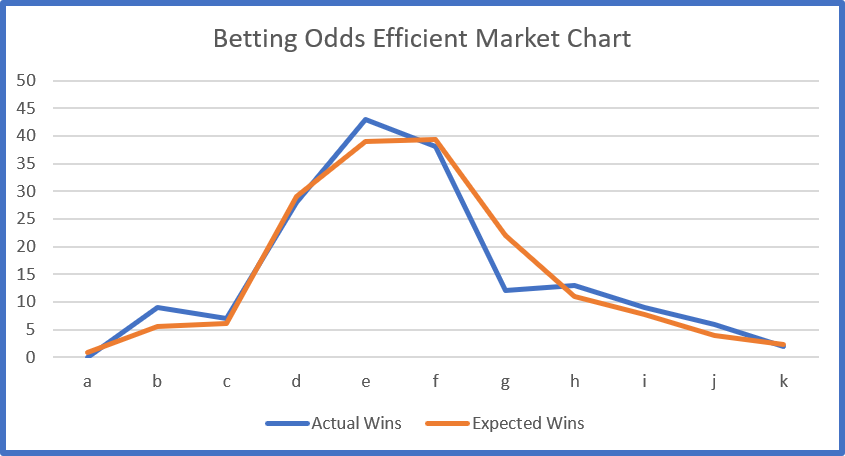
The tiers toward the left, starting with “a”, see fewer cumulative expected and actual wins because there are so few times a golfer has had market-estimated win percentages above 20%. As we move rightward, there are more golfers with odds in the 10% range, then 5%, and so on to make the curves peak around tiers “e” and “f”, which corresponds to an average win range of 3.75% and 1.88% respectively. This declines as we get to the lower win estimates, as each golfer’s low win estimate drops the tier’s collective chance of winning despite there being more golfers at those levels. About 1/3 of all golfers in a major have a less than 0.08% chance of winning according to the odds (tier “k”), with only 2 actually having gotten it done from this tier.
Pre-Tournament Betting Favorites
Here is the list of players over this era who have been the pre-tournament favorite (lists those with at least 3 such instances):
- Tiger Woods (59)
- Scottie Scheffler (16)
- Greg Norman (15)
- Rory McIlroy (15)
- Nick Faldo (12)
- Dustin Johnson (7)
- Seve Ballesteros (5)
- Jordan Spieth (4)
- Ernie Els (3)
- Bernhard Langer (3)
- Jason Day (3)
Tiger accounts for nearly 36% of the total, despite not turning pro until 1997 (the list starts in 1985), battling injuries, and then aging out of his prime by his 40’s (he turned 50 last December). This is further confirmation of the impact he had in the minds of golf fans…he was the presumptive favorite for so long.
Scottie is on a decent pace himself, having passed Rory and Greg by the end of 2026. Will Rory ever add to this? He’s been playing very good golf, but unless Scottie comes back to the pack, it is tough to see how the older McIlroy would ever pass him again as the pre-tourney favorite. Perhaps his recent success at Augusta National will stick in bettors’ minds next April. Between the two of them, either Scheffler or McIlroy has been the pre-tourney betting favorite for the last 19 majors. Scottie is on a run of 12-in-a-row as the favorite, corresponding to 10 straight majors where he has market-derived winning odds of greater than 10%.
Long Shots
Aaron Rai’s 2026 PGA victory was quite unexpected. Rai came in with +30000 odds, which was tied for 67th pre-tournament. Phil Mickelson at the 2021 PGA was similar (+25000, T68), but before that you have to go back to Michael Campbell at the 2005 U.S. Open (unlisted, but estimated it would have been around +92000) to find someone a bigger underdog than Rai.
While going back throughout this era brings with it estimated odds (not all players were listed in older majors, as these events allowed you to bet on the “FIELD”, so we used stats to estimate odds for each player in the field), there was a period from 1999-2005 (smack dab in the Tiger era) which saw unlisted and unlikely golfers win majors. Paul Lawrie in 1999 at Carnoustie (estimated 0.12% win expectation), Shaun Micheel at Oak Hill in 2003 (0.16%), and Todd Hamilton at Troon in 2004 (0.15%) are just a few of the names. Others include the aforementioned Michael Campbell at Pinehurst (0.09%), Ben Curtis at Royal St. George in 2003 (0.04%), and of course Rich Beem at Hazeltine in 2002 (0.03%). Beemer was estimated to win that event only 1 time out of about 3,000 coming in and had a career major win estimate of 0.034 (over 41 events played).
Long shots make the game of golf more exciting. While rare, getting a super unlikely champion makes the event more serious (compared to say, tennis, where unranked contestants have almost no shot at winning the trophy). Even other events which feature upsets, such as the NCAA Tournament, rarely if ever award the trophy to a true long shot. In 2026, the winner of the PGA was the 67th-most likely to win, the winner of U.S. Open the 17th-most likely, and the British winner the 54th-most likely. A lot can happen over 72 holes that are tough to predict, making the sport compelling.

 Charting the Hawks
3 thoughts on “Expected Majors (Based on Pre-Tournament Odds)”