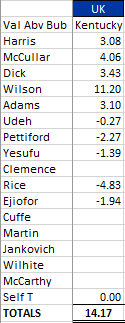
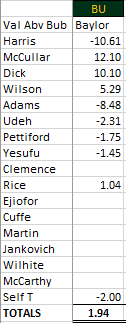
Kansas got a huge win, breaking its 3-game skid. Jalen Wilson had his 11th team-MVP game of the season and his 9th consecutive above-bubble-value game. Each starter produced a positive-value game, where each bench-player was negative. Ernest Udeh had the best game off the bench, and was a bit unlucky to end up below zero. He got lost on a rotation which ended in a 3-point basket.
In creating the ranking of Big 12 players, there was the ability to explore more regarding the makeup of the conference. Here are some additional things that stand out about the makeup of players in the Big 12:
The League is Senior-Heavy. While experience has always mattered, the post-pandemic and transfer-portal era has produced a large share of veterans. Using the classifications from KenPom, 36% of all Big 12 players are seniors. When you look at minutes played, the senior-heaviness of the conference becomes more apparent. 51% of the minutes played by Big 12 players have been played by seniors. Iowa State has 8 seniors who have played at least 100 minutes. For Texas and West Virginia, this is 6. K-State and OSU have 5. Kansas is the only team with fewer than 2 seniors in the main rotation (Kevin McCullar). In many cases, a player labeled as a senior is in his fifth year, however there are some 4th year players classified as seniors which does confuse things somewhat. But with 2021 not counting against eligibility, one would expect the trend of senior-heavy rosters to continue for the next two seasons.
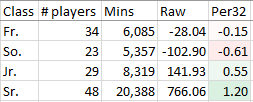
Not only do they play more minutes than the other three classes combined, seniors have collectively produced far more value for their teams. The following chart shows how much value the typical player produces by class. The important column is the one on the right, labeled Per32. This is to set player-value by class over a 32-minute span. We’ll use 32 minutes (80% of a non-OT 40-minute game) to serve as a proxy for the average minutes for a starter in Big 12 play.
When weighted by playing time, the average senior produces 1.20 points above-bubble over 32 minutes of play. The other three classes, when combined, are effectively 0.00. Interestingly, freshmen are out-performing sophomores. This appears to be an effect of the “one-and-done” system. Two Baylor would-be sophomores (Sochan and Brown) went to the NBA draft and are now pros. In turn, two excellent college freshmen in the Big 12 (George from Baylor, Dick from Kansas) are poised to be first round picks in this year’s draft. Were the NBA draft rules different, either the early-entrees would still be in college as sophomores or the freshmen might not have come to school. This would make each class’s value scores look different.
Jalen Wilson is another interesting case. Due to injury as a true freshman, he redshirted. Although he is listed as a junior, by age he is a senior. Think how much wider the senior/junior gap would be if he were classed as a senior. To a lesser extent, this also applies to Dejuan Harris who is a senior by age but junior by class. Last, Joseph Yesufu is classed as a junior even though he is in his fourth season. With him getting a fifth-year of eligibility, KU effectively had both his 2022 and 2023 seasons be as “juniors.” Again, classifications are all a mess in this era.
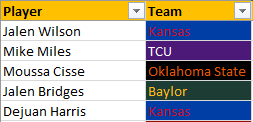
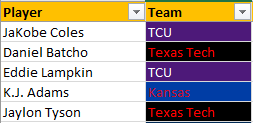
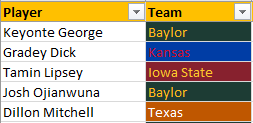
By class, here are the best 5-players in the Big 12 through 1/26/2023.
Seniors
Juniors
Sophomores
Freshmen
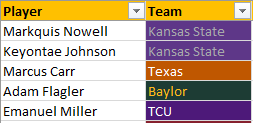
Point Guards and Power Forwards Excel. This is partly due to the two leading Big 12 players, Jalen Wilson (PF) and Markquis Nowell (PG), having separated themselves from the pack. Other great PG’s in the league include Marcus Carr, Adam Flagler, and Mike Miles…all in the Top 6 of all players. Regarding PF’s, Emanuel Miller (TCU), Aljaz Kunc (ISU, currently injured), and Kalib Boone (OSU) are also having good years.
Classing players into a traditional position (PG, SG, SF, PF, C) is harder that it used to be. A few things have happened. One, there are more “positionless” players and systems. Two, teams are becoming more perimeter-oriented, playing 4-out and often 5-out systems without true post presences. This can be handled one of two ways. One is to recognize the change in the game and place players in positions which they’d historically be classed. Therefore, a rotation might play a PG, two SG’s, and a SF alongside a PF. The other way is to do what Pomeroy essentially does, and continue to utilize the traditional position names regardless of the style being played. So when a team plays a small-lineup, this just means that whoever its biggest/most interior player is gets classified as the “Center.” Even a SG might become that line-up’s “Power Forward.” The logic to this seems to be that, regardless of the style you play, you are going to be competing against someone of whatever position you are at, 1-5. To apply this to KU, this would mean that K.J. Adams (as a small-ball “5”) is seen as a Center, because he primarily guards (and is guarded by) the opponent’s biggest player.
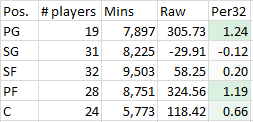
For the chart below, players have been classified using a combination of Pomeroy’s algorithm and the alignment of players into their natural, historical positions. For one, Pomeroy’s algorithm isn’t 100% accurate (he has Jalen Wilson as KU’s “Center,” likely due to how poor of a rebounder K.J. Adams is). We want to see which styles have been most effective among Big 12 play. Some teams play two true PG’s (i.e. Texas with Carr and Hunter). We want to reflect that here. As far as K.J. Adams is concerned, his position is PF. This means KU starts two PF’s, instead of a PF and C as would be traditionally done.
The Shooting Guards and Small Forwards grade out the worst, indicating that there is some diminishing value in filling a roster with wing-types who mostly shoot jump-shots. If you have shooters, it obviously works. But if you don’t, then what? Oklahoma State (-68.92) and Texas Tech (-33.42) have the worst collection of wings in the conference (number in total cumulative points against bubble at those positions). They also have the two-worst offenses in the league according to KenPom. Of the wings who are solid, the three best in the league are Johnson (K-State), George (Baylor), and Dick (Kansas).
Here are the stats of KU and double-digit differences during games. Each game is listed separately. At the end are the totals. Make of this what you will.
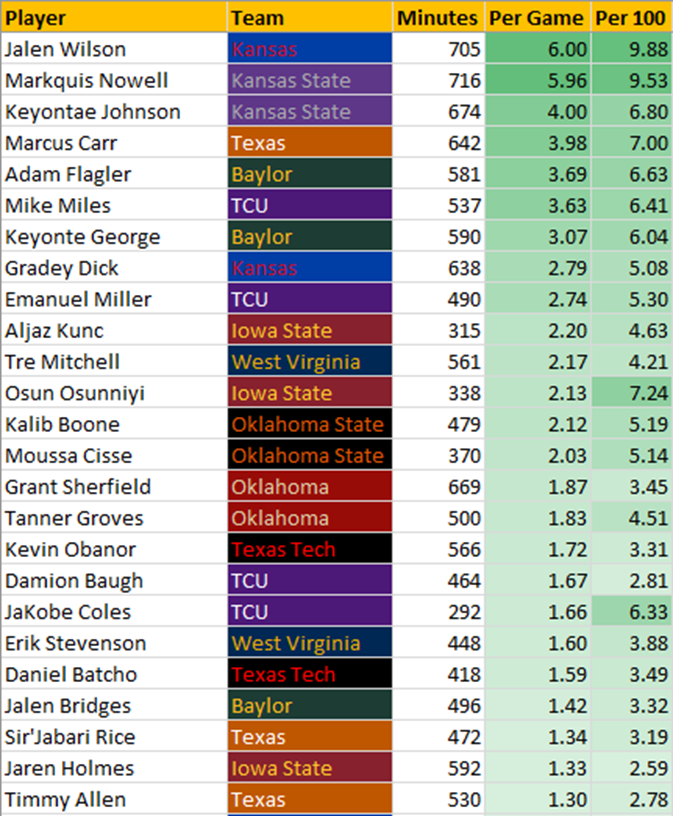
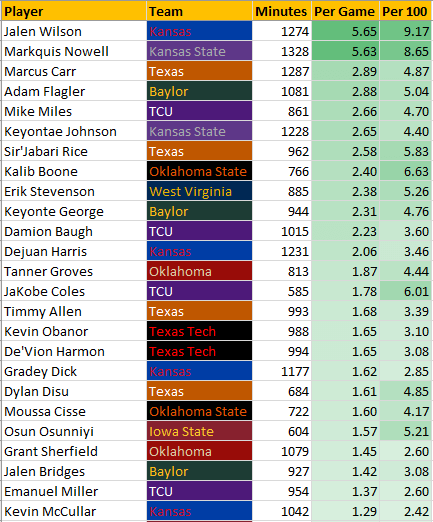
Below are the top 25 players in the Big 12 through: 1/25/2023, linked also here. This ranking covers the entire season of play, not just Big 12 games. This list will be updated on the other link weekly or so, whenever time permits.
The list is sorted on Per Game, which is the Adj. PPG +/- estimate for Big 12 players. Note that for the 9 non-KU Big 12 teams, these are estimates using only box score data. The data for KU players is more complete, as it uses defensive coverage stats (and other non-box-score statistics).
For non-KU players, the actual Adj. PPG +/- number could be higher or lower. This will largely depend on how much better that player is than his team’s average defender, as defensive coverage stats are estimated by divvying out the team’s defensive value among its roster by minutes played. The takeaway is this. For non-KU players, his score is roughly accurate but could vary by as much as 1.00 point per game (or 2.00 points per 100) depending on his defense. If you have good reason to think his defense is much better than average, add some value up to 1.00. Or if he is a less-than-skilled defender, his value may be overstated to some degree.
As far as conference Player of the Year goes, the race is currently between Jalen Wilson and Markquis Nowell. Team success will play into it somewhat, if either Kansas or Kansas State wins the league it might make the difference in who wins this award, but consistency in the area of scoring will be the biggest determinant. Nowell has been a double-figure scorer in 17 of 20 games this season, and two of those were 9-point performances. His low, against Kansas ironically enough, was 4 points.
Jalen Wilson has reached double figure in all of his 20 games, with a season low of 11. Wilson is the better rebounder and has more shot volume, whereas Nowell is the better shooter (TS%) and assist-man. Either would be an acceptable choice at this point.
The other Jayhawk on this list is Gradey Dick, at #8. He checks in as the second-best freshman, only slightly behind Keyonte George. There is a lot of experience on this list. Multiple fourth and fifth-year players are having good seasons. Quite a few of these names were actually born in the 1990’s, making them 23 turning 24 this year. Getting old has been the recipe for success in the post-pandemic era.
Other notable Jayhawks include Dejuan Harris (#26), K.J. Adams (#31), and Kevin McCullar (#32). Right now, KU should have one conference first-teamer and one second-teamer.
If we filter to only include the Big 12 players with at least 100 minutes, which is around 12% of total playing time (each team will have its own number of possible minutes played, but for convenience sake using 100 as a filter works); we get a total set of 97 players. Here are the KU players who qualify, and their conference ranks:
(#1) Jalen Wilson: +9.88
(#14) Gradey Dick: +5.08
(#33) Dejuan Harris: +2.05
(#37) K.J. Adams: +1.74
(#39) Kevin McCullar: +1.52
(#78) Zuby Ejiofor: -3.35
(#88) Joseph Yesufu: -4.61
(#96) M.J. Rice: -6.91
(#97) Bobby Pettiford: -7.95
Compared to the rest of the conference, KU has an elite star, an excellent #2 option, a collection of above-average starters who add a small but positive level of value, and a bench that is among the worst in the league. Actually, other benches are also struggling, even amongst the conference’s good teams. K-State has two elite college players, but after that it goes downhill. Only Texas features a solid, top-to-bottom rotation among its top 8-10 players. The Longhorns are the only school which doesn’t feature a player with a Per100 below -3.00 among its players with at least 100 minutes. In fact, their depth is easily the best in the Big 12. The worst Longhorn is still currently better than -1.00 Per100. Texas’ rotation is deep and experienced.
After KU’s loss Monday night to Baylor, the team’s third loss in a row in Waco, it dawned on me that perhaps Self isn’t winning as many of these tough contests as he used to. So, I decided to quickly look at KU’s recent record both as pregame underdogs as well as its record in true road games to see what conclusions we could draw. These are for games over the past three seasons, namely the ones which ended in the years 2021, 2022, and 2023.
According to KenPom lines, KU has been underdogs in 14 games over the past 3 years. Over that time, the Hawks’ record is 3-11. The wins have come against Duke (2023 season), vs. Baylor (2021), and at Texas Tech (2021). For the record, KU was pregame dogs in 2 games last season, at Baylor and at Texas (obviously both losses).
The average expected margin of loss was 3.1 points, indicating that although KU was underdogs it wasn’t by much. KU was expected to win 5.62 of these games, so a record of 3-11 is certainly disappointing. Running a quick simulation, a record of 3-11 in these games is about the 7th percentile. This is low, but not outside the range of “bad luck.” But it does coincide with what we’ve observed in recent seasons, namely that KU isn’t winning a segment of tough games it used to. Let’s change our dataset to look only at road games, and consider not only underdog games but also games which are projected to be close.
Filtering to the away games which are expected to be within single-digits, we may remember that winning these types of games used to be Self’s wheelhouse. Over these past 3 seasons, KU has played in 22 of these games and won 11 of them. This doesn’t seem too bad. They’ve been expected to win 12.29, so while they’ve underachieved, it isn’t by much.
Now let’s split between the games KU is projected to win vs. those they are projected to lose. In away games in which KU is favored but by fewer than 10 points, the Hawks are 10-4, bettering the expected record of 8.9-5.1. They’ve also overperformed KenPom expectation in these games by an average of 3.7 points. On the flip side, KU is 1-7 in games they’ve been single-digit road underdogs. On average, KU is underperforming expectation in these games by 5.2 points per game, and “should” have won 3.4 of these contests instead of just the 1. So, KU wins the close road games it is favored in but loses the close road games it is expected to lose.
Last, we’ll look again at the 22 game sample of road contests which are projected to be a single-digit final. In these 22 games, KU is outscoring its collective opponents by 2.2 points per game, even though they were expected to only outscore said opponents by 1.7 points per game. It’s tough to say KU is underachieving at all in road games. 2021 was somewhat of a “down year,” to be sure (yes, a down year as a 3-seed shows how absurd this program is). But as far as handling tough road environments, there’s nothing to indicate that KU has lost its ability to win tough road games.
Of course this exercise wouldn’t be complete without the reminder that KU won high-stress NCAA Tournament games (in fact, 6 in a row) last season. Although KU was favored in each game (therefore these results aren’t included in the first exercise), it took quite a bit of guts to win it all. I think I speak for all of Jayhawk fans that we are fine with losing a few more in the regular season if we make it up with close wins in March.
One of KU’s underdog wins came against Texas Tech in the pandemic year (2021). Ochai Agabji finished a layup with 13 seconds to go to put KU up 1, and Jalen Wilson blocked a shot and hustled to get the rebound at the horn to seal the victory.
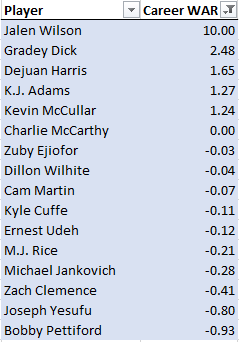
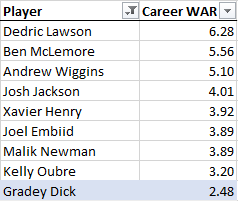
To date, let’s take a look at the career WAR for the 2023 Jayhawk roster.
WAR, or Wins Above Replacement, is an estimate of the value a certain player has accumulated. Set to “wins,” this number estimates how many more games his team has won because of his play against that of a replacement player. In this instance, a replacement player is set to the average D-1 player.
WAR estimates are kept back beginning in the 1994 season, so we can compare the current players to other Jayhawks in this 30 season span. Jalen Wilson is currently #27 (out of 173), having passed Markieff Morris. Next on the list is Udoka Azubuike. Realistically, Jalen can reach players like Keith Langford and Devonte’ Graham by the end of the season. This would place him just outside the top 10. Not bad for effectively 3 seasons of work.
Gradey Dick has already passed names like Lester Earl and Brannen Greene. The next players he should reach are 2-year guys like Kevin Young and Jeff Graves. Assuming he has one-and-done potential, let’s see how he compares to other one-year Kansas guys.
Through 20 games, Dick has put himself in position to be somewhere in the midst of these names. Should he play well, reaching Josh Jackson’s 4 WAR season is achievable. Not bad for one season.
Next is Dejuan Harris, who is in his third season. He has dropped some value of late, but is closest to the career of Isaiah Moss. Harris will have an interesting career. He will likely play 2 more seasons (5 in total), and develop quite a bit from a negative-value freshman to a very experienced veteran who plays a ton of minutes. Where his WAR totals at the end of his career is to be determined.
K.J. Adams and Kevin McCullar are right next to one another. Cliff Alexander is slightly ahead of each, and Tarik Black slightly behind. Adams is another player whose career path will be interesting to track. Even if he only stays one season, McCullar will likely finish with more WAR than Remy Martin, who missed quite a bit of time in 2022 before March due to injury.
The rest of the roster has negative-value career WAR. The lowest career WAR in KU history is Justin Wesley (-1.44). This number is tough to bottom out any further, as players who play poorly don’t normally play much. But both Joseph Yesufu and Bobby Pettiford have been trending downward throughout their Jayhawk careers.
Sometimes KU fans will produce hypothetical lineups, combining players from different eras to imagine how good such a team might be. For fun, here’s one:
PG – 1998 Ryan Robertson
SG – 2012 Elijah Johnson
SF – 2000 Kenny Gregory
PF – 2003 Nick Collison
C – 2017 Landen Lucas
This group of 5 features three juniors and two seniors, all of whom started and played significant minutes during their respective seasons. It includes a player (Nick Collison) who averaged 18.5 PPG and 10.0 RPG, as well as a secondary scoring option (Kenny Gregory) who went for 12.8 and 4.4. Its role players are also capable in their positions. This isn’t a bad lineup by any means. It would win the conference most years and likely be anywhere from a 1 to a 3-seed.
The reason this set of players was chosen is that it best corresponds to the 2023 starting lineup through 20 games. Jalen Wilson is having a season that is as good as Nick Collison’s 2003 season. Gradey Dick has been about as good as a junior Kenny Gregory. Harris’ season best compares to Elijah Johnson’s junior campaign, Adams to Lucas, and McCullar to Robertson. There are certainly stylistic differences between these lineups, but looking purely at player-value, they are nearly identical.
The 2023 team’s starters aren’t the problem. There have been recent slumps—namely from Harris and Adams—but in looking at the whole picture the starting 5 has been solid. Now, let’s look at some other names.
PF – 2006 Christian Moody
PF – 2015 Jamari Traylor
SF – 1997 Nick Bradford
PG – 2003 Jeff Hawkins
PF – 2018 Mitch Lightfoot
SG – 2001 Mario Kinsey
These six names represent the bench for the hypothetical team, and equate to the 2023 bench as follows. Ejiofor equates to (Sr.) Moody, Udeh to (Jr.) Traylor, Rice to (Fr.) Bradford, Yesufu to (Fr.) Hawkins, Clemence to (So.) Lightfoot, and Pettiford to (Fr.) Kinsey. This set of names doesn’t represent a ton of shooting or offensive skill. Some of these guys who developed into better players later in their careers (Lightfoot, Bradford) are underclassmen in this hypothetical roster.
If this hypothetical team existed, then the first subs off the bench would likely be Moody or Traylor for Lucas and Bradford or Hawkins for either Gregory/Johnson/Robertson. Such substitutions would hurt the team, which would have fewer scoring options and be harmed on the defensive end. The same thing is happening when the 2023 team goes to its bench.
Positives: Kevin McCullar had KU’s best game, thanks to a strong defensive effort. While he was only 3-9 from the floor, his 8-8 from the FT line got him to 14 points. He also added 12 rebounds (10 defensive) on a night where Kansas struggled to finish possessions on the defensive end. Gradey Dick had his best game since Indiana despite battling first half foul trouble. Jalen Wilson had another solid offensive game. His efficiency of late has been a consistent bright spot for the team. M.J. Rice finished with 2 points and 4 value rebounds.
Negatives: Dejuan Harris had his second-consecutive all-around very poor game. He scored 2 points on 1-5 shooting and allowed 16 points to the Baylor guards. K.J. Adams was also inefficient on offense while giving up too many points on defense. With only 1 defensive rebound, this was his 6th conference game (out of 8) in which he has failed to secure at least 3 defensive boards. He is leaving value on the floor by not coming up with loose balls. Ernest Udeh only played a few minutes, but a defensive blunder led to an open 3. Bobby Pettiford missed his only shot attempt and allowed a basket. Joe Yesufu didn’t score, but did come up with some nice hustle plays (1 steal, 3 defensive rebounds). Unfortunately, in the first half he also fumbled a potential defensive board that Baylor converted into points.
The TEAM had a positive-value game (meaning they performed better than a bubble-level team would be expected to), and this was with Self getting his 3rd technical of the season and gifting Baylor 2 points. The starters were collectively positive with the bench giving away value.
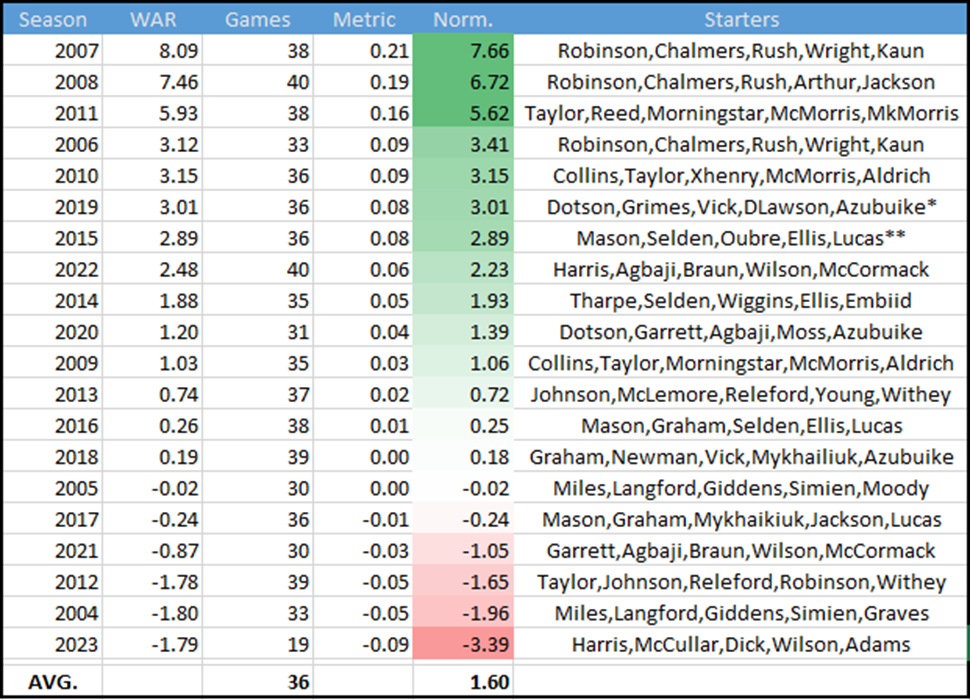
The Bench continues to get worse. It is now projected to provide -3.39 WAR (given a 36-game schedule), which is nearly 1.50 WAR worse than the current-worse bench in the Self-era (which was his first season). If anyone, anyone at all, could provide solid minutes, this problem would be drastically reduced. Self needs about 40 minutes per game off his bench. If one guy could provide 20 consistent minutes around 0.00 value (think Christian Braun as a freshman), then the additional 20 could be spot-minutes. Self wouldn’t have to play multiple negative-value players together that often and could rotate this hypothetical 6th man around while his starters each got a break.
Should Michael Jankovich get a shot? He can’t defend, but then again it isn’t like the others bench guards/wings play great defense. At the very least he’d be a surprise for a possession or two.
“I think what we’ve got to do is get our starting five playing better,” he said after Saturday’s loss. “Our bench isn’t such where they’re going to make a huge difference in us winning or not winning. The way they can contribute the most is defending, not turning it over, getting confidence from doing the things that don’t show up in the stat sheet and then they’ll get more confidence moving forward.”
Losing by 23 is not on the reserves who only played 41 combined minutes out of 200, this much is true. Still, it would be nice if the reserves could actually defend. They really aren’t doing that well. But KU’s success is going to be determined by whether or not the starting 5 plays well. Unless KU fouls out over half of its starters, like it did at Kansas State, crunch-time will feature KU’s best lineup against the opponent’s best. Most of the time, KU’s will be better.

 Charting the Hawks