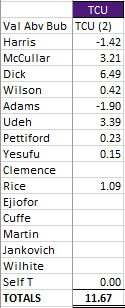
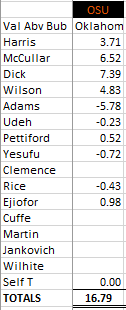
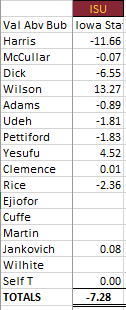
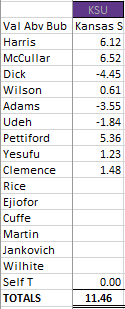
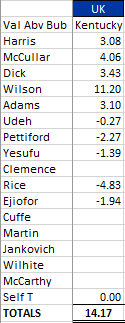
Kansas avenged its earlier loss to TCU, defending excellently and holding on to win by 5. Gradey Dick had his 6th team-MVP game of the season. Other positive performers included Ernest Udeh, who was KU’s second-best player in Ft. Worth. Kevin McCullar had a solid game on both ends, and M.J. Rice played solid defense while scoring an assisted layup during the second half. Jalen Wilson, Bobby Pettiford, and Joseph Yesufu also graded out as slightly above-bubble-level. Dejuan Harris and K.J. Adams each had solid moments, but still graded out as negative given the flow of the game. In total, it was a solid team effort despite poor shooting.
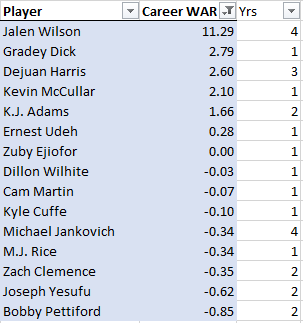
Earlier in the season, WAR (Wins Above Replacement) was introduced. I wanted to catch up with the 2023 team to see where each member of the roster is, in terms of Career WAR.
Currently, the rest of the team apart from Jalen Wilson has 6.74 Career WAR, with most of this coming from the play this season. This means that Jalen Wilson, with 11.29 Career WAR, is 62.6% of the current roster’s entire Career WAR at Kansas. His combination of experience and skill mean that this really is Jalen’s team. How far this team goes in March will depend on him.
Speaking of Jalen Wilson, it is all but assured that this season will be his final as a Jayhawk. He almost left after last season, but he returned understanding that a solid junior season could help his pro-prospects. He’s achieved all he wanted to do, and more. With a national championship under his belt, there’s little left for him to do in college regardless of the rest of the season. Jayhawk fans should be grateful for all that he’s provided for the program.
Jalen has really done all of this in 3 seasons, even if it says he’s played 4 in the chart above. This is only technically true. Technically he did appear in 2 games (for 2 total minutes) in his true freshman season before being injured. And technically, he does have 2 more seasons of college eligibility following this one since he took a medical redshirt and also got the “free” Covid year (in 2021). But as was stated earlier, this will certainly be his final season at KU.
But he still has some season left. 4 games in the regular season, with a potential of 9 more in the Big 12/NCAA Tournaments. Let’s compare his Career WAR to other Jayhawk greats to see how he stacks up. Since 1994, WAR estimates have been provided by season. This encompasses 30 seasons (including the current one) and 172 Jayhawks who have played at least one second of a regular season KU game. To clarify things, this range of years (1994 – 2023) means that certain players’ careers are interrupted. In other words, we have stats for Greg Ostertag (7.09 WAR) from his junior and senior seasons, but not his freshman or sophomore years. And Steve Woodberry had an excellent senior year (4.83 WAR) in 1994, but his first three seasons aren’t included on this list. It’s doubtful that either of these guys are at Jalen’s career level at this point, but it was still something that needed to be said.
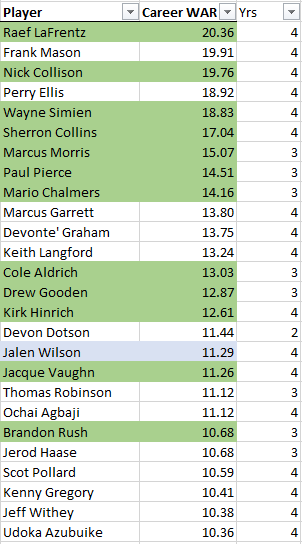
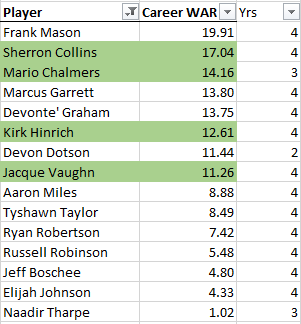
So, at 11.29, how does Wilson’s Career WAR stack up? At this point, he is at #17 (out of a total 172), having just passed Jacque Vaughn. Next on the Career WAR list is Devon Dotson, a name which might be surprising to some people. Dotson was extremely good during his 2 years in Lawrence. If we estimate that Wilson will play ~ 9 more games (a conservative but not overly cautious guess), Wilson will have a excellent chance to pass not only Dotson but also Kirk Hinrich (#15), Drew Gooden (#14), and maybe even Cole Aldrich (#13).
Here’s the list of all players with a Career WAR over +10 from the years (1994 – 2023):
WAR is calculated by using a multiple to convert value points (points above replacement) into an estimated amount of “wins.” What this multiple is depends upon a separate conversion, and so changes as more data comes in. In short, the exact WAR number is in flux as more games are played, even for players that are non-current. This doesn’t change the order of the players, but it does change the WAR estimate. So don’t be surprised if these numbers don’t match a separate, more current list of WAR. I plan on pinning a link to Career WAR at the end of the season.
Either way, we see in green the players who’ve had their jerseys retired, and in blue the current players (Jalen Wilson). Jalen is in the company of some great names, and will end his career in the area which normally earns one a jersey ceremony. Given that he has a strong candidacy for 1st-team All-American this season, that he will get that jersey retirement in the future looks almost certain.
As he has effectively played only 3 seasons, it’s fun to compare him to other 3-year players. If he can pass Gooden and Aldrich (which he has a shot to do), then the only names that will outdo him for their KU careers in a 3-year career over the past 30 seasons are Mario Chalmers, Paul Pierce, and Marcus Morris. He’s had an amazing career.
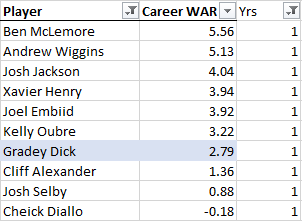
Next on the list we’ll look at Gradey Dick, and compare him to other 1-and-done freshmen.
Of course, Dick has not officially become a 1-and-done player yet. But given his skillset and draft potential, this is the most likely thing. KU has had 10 1-and-done players under the criteria that a player leaves college after 1 season to go pro (KU has had other 1-year transfer players such as Remy Martin or Bryce Thompson…these are left off). The majority of these guys were “wing” type players, with a few post men as well as SG/CG Josh Selby. Of these wings, Dick keeps good company. Again, it depends on the number of games he has left. But extrapolating his current play to an additional 9 games, and he will be above Oubre and just below Embiid/Henry/Jackson. With a stretch of solid play and a deep run in the NCAA Tournament, Dick could leap into 3rd on this list. Gradey’s been as good as advertised.
Last, let’s try and forecast Dejuan Harris’ career using WAR. Harris began his career with a negative-WAR season in 2021. He was someone who hardly scored the ball, and while his defense had potential he would still be bullied by stronger players quite often. Harris has improved on both of these areas, and is now generating positive impact for Kansas. With 2 more seasons of eligibility remaining and little chance of him leaving the program early, let’s look at how his season-by-season play has been.
From this table, we can see each of Harris’ seasons from most recent to oldest. We see that he has increased his playing time (he is on the floor in 83.1% of available minutes), his scoring, and in turn his WAR. Assuming that his final two seasons will be at least as good as this one (with likely value growth, albeit slower growth), we might estimate it as follows:
2025: 3.50
2024: 3.25
2023: 3.00
2022: 0.63
2021: -0.56
CAREER PROJECTION: 9.35 WAR
The comparison list here is of multi-year players who were legitimate PG’s or lead ball-handling guards. This will include guys that aren’t necessary thought of as “pure-PG’s” but still handled the ball in that role. These are the types of players that Dejuan Harris would have been competing for regarding playing time had he played in a different era.
From a projected Career WAR, he might end up roughly halfway up the list. Now this still has to happen, and he would benefit from a 5th season that the others didn’t get, but his trajectory places him as a legitimate KU-level player, something that wasn’t apparent during his first season.
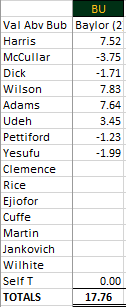
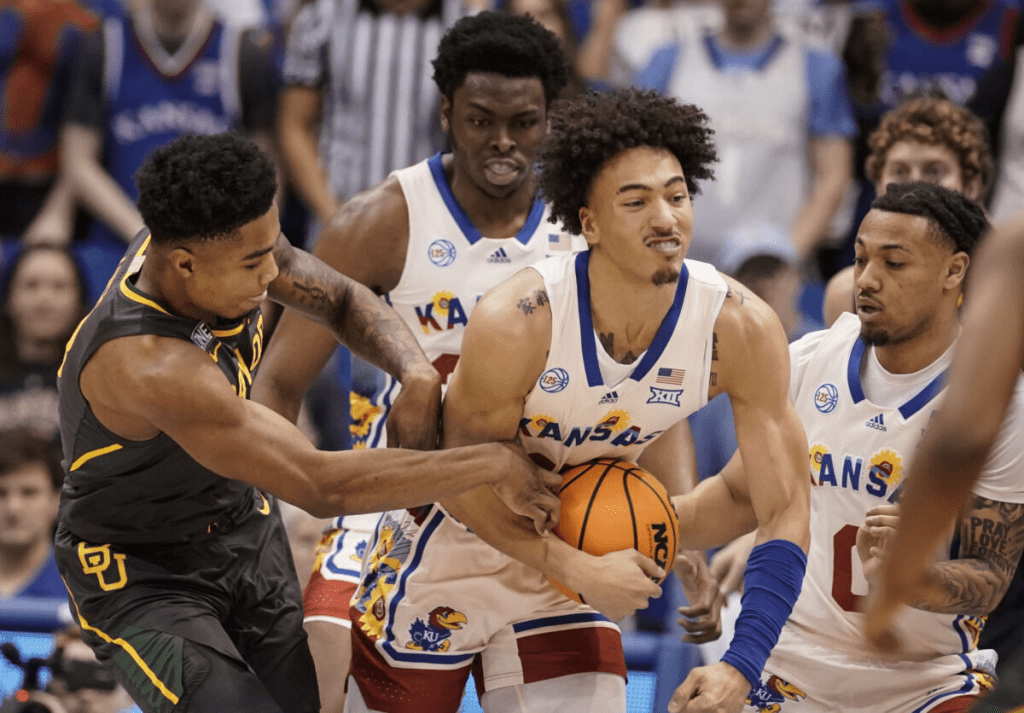
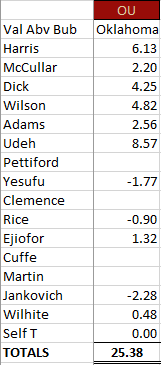
Down as many as 17 in the first half, the Kansas Jayhawks used a ferocious second-half comeback to win going away against Baylor. Jalen Wilson’s value score led the team, his 13th game this season doing such, but both K.J. Adams and Dejuan Harris were essentially just as valuable. Ernest Udeh was also a very solid contributor, continuing his stretch of good play with a positive game score.
The TEAM’s +17.76 score was its 11th above +10 on the season, and its sixth in its last seven games. Signs are pointing to this team peaking at the right time, as the final week of February arrives.
Freshman Gradey Dick had his 5th team-MVP game of the season in a career high 26 point effort. After accounting for his defense and opponent, it was his 4th-best game of the season. Other Jayhawks who added value were Kevin McCullar, Jalen Wilson, Dejuan Harris, Zuby Ejiofor, and Bobby Pettiford. The team was able to go deeper into its bench thanks to the (relative) health of Ejiofor and Pettiford. However, it’s clear that Pettiford in particular isn’t quite 100%. Late injuries to Harris and McCullar might also be a factor moving forward.
Ernest Udeh followed up his excellent OU game with another high-energy performance, although his fouls contributed to a negative-value score. Still, he has played well of late. M.J. Rice only contributed an offensive foul in his 2 minutes of play, and Joe Yesufu had a typical game for him. KU’s worst performer against the Cowboys was K.J. Adams, who had the worst defensive outing of anyone this year. He was responsible for a lot of easy baskets from OSU’s Kalib Boone, and also got scored on at times when switching onto guards late. He has struggled during conference play due to his position (undersized 5), but he is also overrated on the perimeter.
The TEAM is on a roll, averaging an 11.74 value score over its past 6 games (where it has gone 5-1). If it can keep up this level of play, it will not only earn a 1-seed but have the capabilities that past 1-seeds have had. Getting contributions from its bench has been huge, as the bench has been +1.10 per game over that span (this may seem pedestrian, but the bench was averaging -5.57 before that time). In its last 5 outings, the bench has been even better (+3.49). This has shown up in the results of the games.
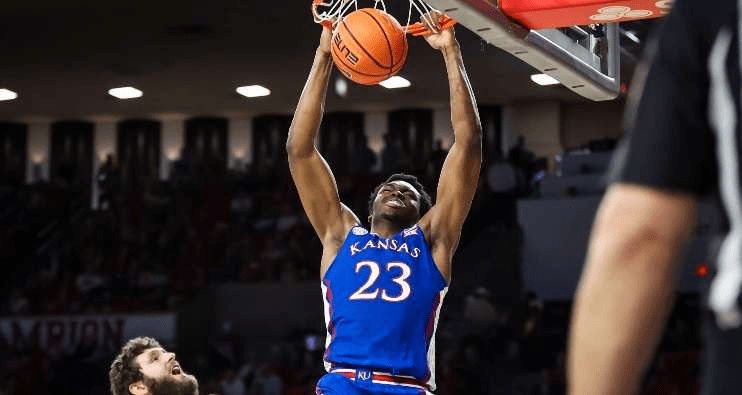
Kansas may have found its next great big man. Ernest Udeh had his best game as a freshman, particularly on the defensive end. He gave up only 1 point while winning 10 possessions due to blocked shots, deflections, steals, forced turnovers, and rebounds. He was all over the place, taking the game over on the defensive end. In total, he added 8.57 points of value above a bubble-player and became the first bench-player to earn a team-MVP for KU this season.
The five starters all put up positive-value games as well, with Dejuan Harris performing best. Gradey Dick didn’t let a lower-output performance (8 points scored, 0 3-pointers) dampen his value as he made up for his lack of production with an efficient game and solid defensive effort. Jalen Wilson was solid as he led the team in scoring after a sluggish start. Kevin McCullar had another solid game on the offensive end. He’s been an above-bubble player on that end of the floor over his last 9 games.
Zuby Ejiofor and Dillon Wilhite had positive outings in mop-up minutes. Joseph Yesufu, M.J. Rice, and Michael Jankovich were the only Jayhawks below zero-value.
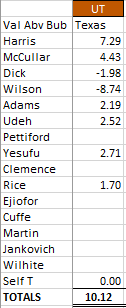
Kansas went to 19-5 (7-4) with a huge Big Monday win. Dejuan Harris led the team in value, producing a value-score of +7.29 for his second team-MVP game of the season. He had a positive impact on both ends of the floor to help the Hawks secure the victory. Kevin McCullar was also effective, scoring in double-figures while also adding offensive value through numerous assists. McCullar has had a nice stretch over his past 5 games, averaging +5.44 points of value per game above bubble. K.J. Adams also contributed a positive outing for only the second time in his last 7.
On the negative side of things, Jalen Wilson had his worst game of the season in an uncharacteristic manner. Scoring on 2 points and adding an assist, Wilson was shut down on the offensive end all night. He also gave up more baskets than he’s accustomed to, contributing to his second game of the year where he had a negative effect on both ends of the floor (Indiana was the other). Strange as it may be, Jalen seems to play better when others around him aren’t.
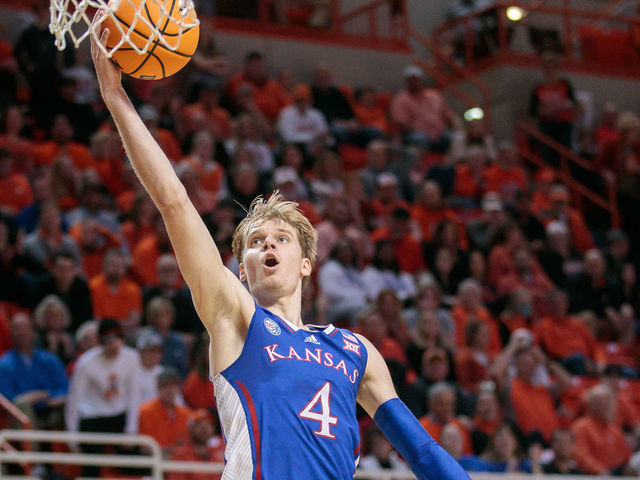
Gradey Dick had as good an offensive outing as anyone Monday night (tied with McCullar, who added his offensive value in a different style). Dick went 2-3 from downtown and finished at the rim effectively to produce nearly 5 points of offensive value. It was his defense which drove him into the red, particularly late in the game. Dick has been a serviceable defender, particularly when you consider his age and role on the team. He has to continue to work on improving on that end and prove his worth, as team’s will game plan around his perceived weaknesses.
Now on to the bench. With five scholarship players out due to injury (Pettiford, Clemence, Ejiofor, Cuffe, Martin), KU went into the game knowing it had to make due with a shortened rotation. And the reserves who were healthy stepped up in a big way. Joe Yesufu had his best offensive game of the season and has now produced three consecutive positive outings for his team. Ernest Udeh finally broke into the plus-side of things. He’s been bringing good energy recently, but his value scores weren’t showing the full effort he brought. M.J. Rice made numerous good hustle plays, finishing with a basket and a couple assists and solid defense in 14.6 minutes of play. The bench has now outperformed the starting 5 for 3 games in a row.
In an ugly game that would have been even uglier if not for Jalen Wilson, KU shot 26% from 3 and had 20 turnovers to reach its second-lowest point total in a game this season. Wilson had his 3rd-best opponent-adjusted game of the season, accounting for a fraction over 24 points while only allowing 6 on the defensive end. He went for 39 minutes yet still competed on both ends of the floor. He desperately needs consistent production from others on the team.
Joseph Yesufu was the other Jayhawk to have a positive-impact Saturday. Yes made a couple of jump shots in his nearly 20 minutes of work, balanced out by solid defense. He’s been a bubble-level player over the past 7 games (86.7 minutes of play), a trend which will hopefully continue.
On the other side of things, the play of Dejuan Harris has been the biggest harbinger of victory or defeat. In the past 5 games, he’s had his worst 3 games of the season which were all defeats. When he’s played well, KU has won. In his past dozen outings, he’s produced a value score of -1.12 PPG, which is worse than his play last season. For KU to win, he has to be better.
Gradey Dick has also been slumping of late, but his worsening value scores are primarily due to missed shots. He’s doing much of the other things better, aside from turnovers which have also ticked up as he has been attempting to put the ball on the deck more.
After 11 consecutive above-bubble games for K.J. Adams, he has produced negative-value scores in 5 of his last 6. He has been struggling to finish some of the plays he was making earlier in the season, and his defense continues to lag behind as he fails to drop well on ball-screen coverage or get many defensive rebounds. He’s still KU’s best option at the 5.
Kevin McCullar, in turn, has generally been playing good ball of late. His defense has reached the point of being the team’s best. He is a great defensive rebounder, attacking the glass with his long frame to finish possessions after an opponent’s missed shot. He also gets his fair amount of steals, blocks, and forced turnovers. Offensively, his game has been a challenge. Since conference play began, he’s only had 2 games above bubble-value from the offensive side of things. KU can live with this, as long as his defense stays stingy. In the 11 games (beginning with Oklahoma State), he’s averaged a defensive game score of +3.06.
The Jayhawks put the Cats back in their place, using a strong opening half to cruise to a double-digit victory. Kevin McCullar graded out as the team’s best Tuesday night, with Dejuan Harris close behind. Bobby Pettiford had his best performance of the seasons to lead a bench effort that was likewise its best. In fact, the bench outdid the starting 5 last night for Kansas. This was only the 3rd time in 22 games that the bench scored better.
Other positive performances included Zach Clemence, Joseph Yesufu, and Jalen Wilson. On the negative-value side, Ernest Udeh allowed too many baskets while K.J. Adams and Gradey Dick battled foul trouble and worse-than-usual offensive outings.
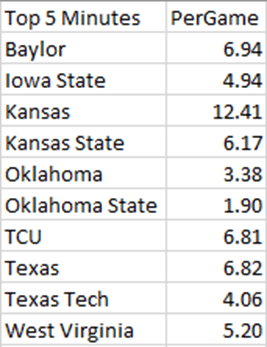
“Starters” reflects the Top 5 players on the team in minutes played. Due to injuries, rotation patterns, and so on; what constitutes a starter might differ from team-to-team. The term “crunch-time five” might also apply. These numbers are in Points Above Bubble through 1/29/23:
Kansas leads the league with a top five which is collectively 12.41 points above bubble per game. There is a large gap until you get to the rest of the pack. The list is in alphabetical order.
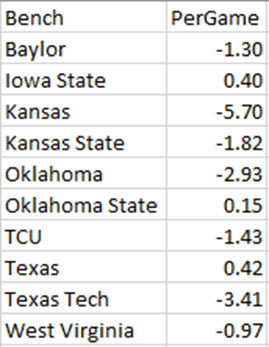
The bench refers to the rest of the roster combined. Walk-ons are included, but their numbers are negligible. This shows the collective points against bubble of the reserves in a per game ratio:
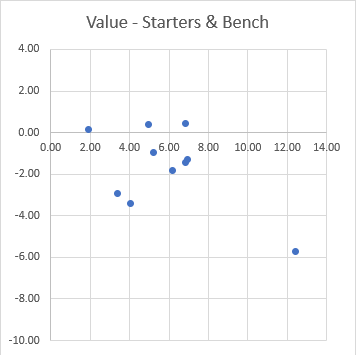
The best bench is Texas’ bench, which is slightly above bubble-level. Iowa State and Oklahoma State are also above-bubble. As you can see, Kansas’ bench is by far the lowest. The below chart graphs this out, putting the starters on the X-Axis and bench on the Y-Axis. To the right and up is where you want your team to be. See if you can tell which button Kansas is represented by:
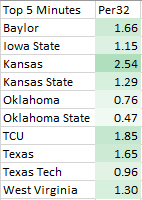
A Per32 look is also instructive. First, look at the average starter for each team in a 32 minute span. This will be a good estimate of how much value a certain team’s average starter can provide if playing a decent load of minutes.
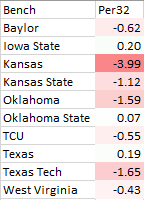
Now the same thing, just with the bench.
KU’s starters are clearly the class of the league, but its reserves are so far behind it almost boggles the mind. KU’s bench isn’t just bad, it’s also the most noticeable unit in this exercise. Any bubble-level player from past seasons, such as a freshman Christian Braun or a sophomore Landen Lucas or a junior Naadir Tharpe, would make this team 2 to 3 points better per game. KU can only make this work as good as it has because it plays its starters the bulk of available minutes (77.4%, leads the conference). If it lost anyone of its starting 5 for a decent amount of time, it would get noticeably worse.
One more note about the Kansas starters. If you removed Jalen Wilson, the other four starters would still produce an above-bubble value which is above 6.00 points per game. That group would still be 5th in the conference among starting 5’s, but very close to the other 4 teams and under 1.00 point per game below the new first-place team. With Jalen, its not even close who has the best starting 5. Effectively, Jalen’s excellent season is mostly being washed away by the team’s poor bench.
Kansas got a huge win, breaking its 3-game skid. Jalen Wilson had his 11th team-MVP game of the season and his 9th consecutive above-bubble-value game. Each starter produced a positive-value game, where each bench-player was negative. Ernest Udeh had the best game off the bench, and was a bit unlucky to end up below zero. He got lost on a rotation which ended in a 3-point basket.


 Charting the Hawks