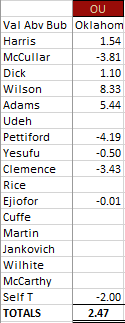
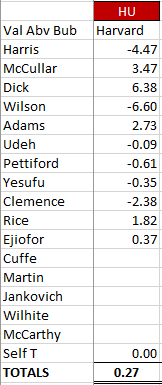
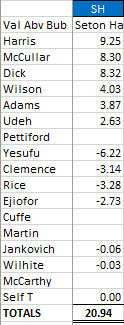
Jalen Wilson’s defense graded out so well it earned him his 8th team-MVP game of the season. Wilson’s defense has been especially solid the last two games despite poor shooting performances. Once again, KU’s starters carried the load, as its bench was collectively 8 points worse than a bubble-team against OU. Zach Clemence had a great offensive night that was cancelled out by a poor defensive showing. Bobby Pettiford gave up a few baskets as well, while producing only 1 FT and 2 assists.
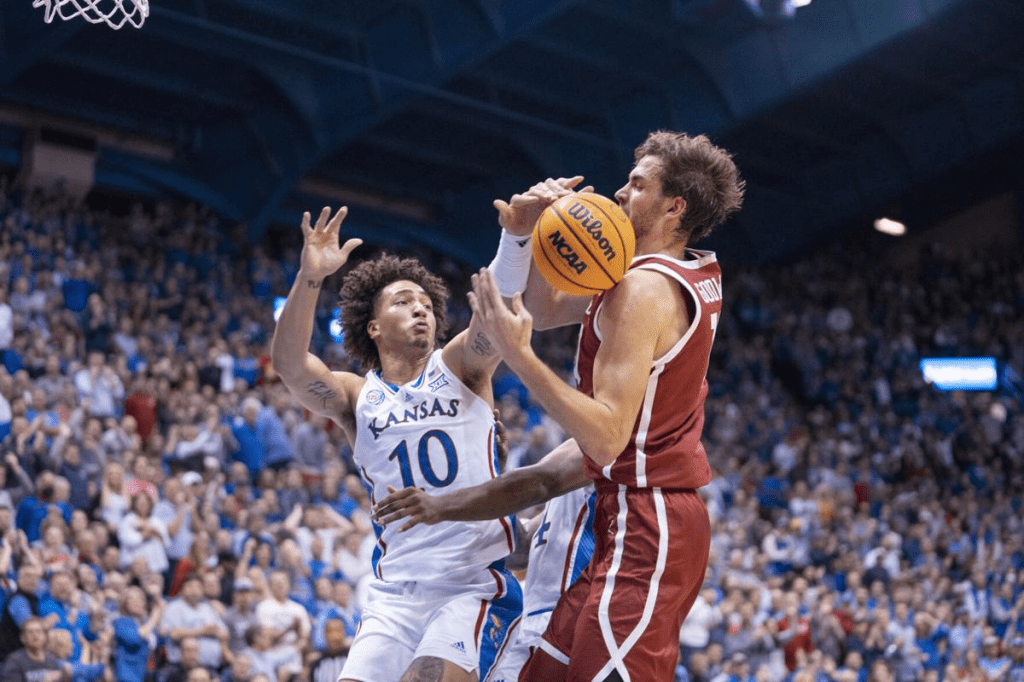
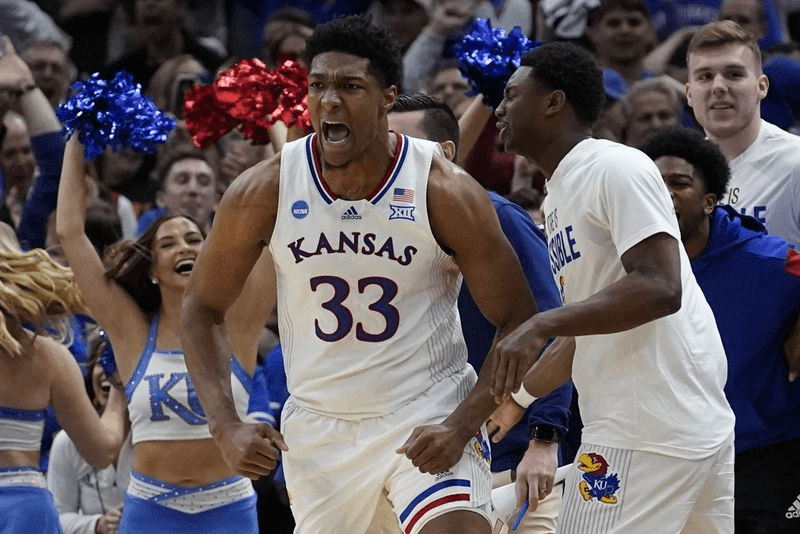
K.J. Adams had his 10th consecutive positive-bubble game thanks to a career-high 22 points. His rebounding was still the thing holding him back. Thus far, we have him with 54 fewer defensive boards than Jalen Wilson. When broken down by playing time, Wilson is nearly doubling him up on defensive rebounds on a per-minute or per-possession basis. The point is that if K.J. could clean the glass a bit more, he’d be adding even more value. Despite this limitation, he’s been great for Kansas.
Gradey Dick finished with his second consecutive team-MVP game and third team-MVP of the season. Despite being the team’s leading scorer, Jalen Wilson had the worst overall game of any Jayhawk due to poor defense.
The “5” spot in the rotation this year was hotly debated by KU fans coming into the season. Some like Zach Clemence due to his perceived shooting ability. Others were high on 5-star freshman Ernest Udeh with his 6’11 frame. Other have pointed out Zuby Ejiofor’s ability, especially now that we have seen his rebounding skill. Still others wanted to see what D-2 transfer Cam Martin could do, given his prolific scoring ability at the lower level.
Despite all this, the man who has won the starting job is K.J. Adams. Undersized for a 5, Adams is neither a post-up scorer nor an outside shooter (he is 0-1 from 3, and 4-13 total on shots outside the paint). His free throw shooting is poor (8-21). Yet, he finds a way to average a respectable 8.2 PPG, currently good for fourth on the team.
His defensive rebounding rate is 8.7%, which is very low for a post player. Despite this, and his lack of size for his position, he attacks the offensive glass effectively. His 4.5 RPG is not great, but it does add some value for Kansas. He blocks a fair number of shots (his 9 leads the team). He has 24 assists as well, good for third. On the other hand, he only has 9 steals, which is the fewest among the starters.
The question, “how is K.J. Adams adding value” is not meant to disparage Adams. It is merely a curiosity. He plays an unorthodox style, yet does so effectively for Kansas. Through 10 games, Adams has added +0.83 points per game above bubble. Anything positive is a good score, and Adams’ score indicates he would earn minutes on about any Kansas team (although there are many years in which he wouldn’t start at either front-court position).
Let’s first answer this through breaking down his value stats as calculated on this website. Adams is adding +0.83 per game. Broken down, his value is +0.04 from offense and +0.79 from defense. Let’s start with his offense.
Offense +0.04
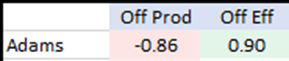
This first split breaks down K.J.’s offensive value into Production and Efficiency. These are points of value relative to bubble, with 0.00 being bubble-level. K.J. hasn’t been super-productive. He is averaging 8.2 PPG, which in 25 minutes per game, is not outstanding. However, he is getting those points through efficient play, which cancels out the low productivity. Basketball Reference has him with a TS% of 64.1%, which is second-highest among the rotation players. He gets a lot of his points from layups and dunks. Most of these are set up from a teammate, as he is scoring 79.2% of his points off an assist.
Another way to breakdown his value is through the following categories. K.J.’s Offensive Efficiency is 1.49, second-highest among the rotation players and best among the starters. We see that his Points accounted for per game at 7.6, or below his official PPG mark. This is because he scores off an assist more than he sets up plays for himself or others. The True shooting percentage of 58.4% is lower than the calculated one on Basketball Reference, as assisted baskets are discounted in this formula. Still, it is a very good number for one who is not traditionally thought of as a good shooter. He knows his limitations, and takes shots that are good for him. This validated by his Shot Frequency of 14.4%, which is below the mean of 20%. His Impact, however, on offense is at 17.4%, partly due to his solid assist numbers (for a big) and his offensive rebounding marks. At Missouri, Adams had a career-high 19 points. All of his points came through dunks (4), layups (5), or free throws (1). He found gaps and finished. He also made two nice passes to Kevin McCullar for assists. Here is a highlight video to get a visual of his offensive play.
A lot of Adams’ baskets are of him starting away from the goal and diving to the rim, although he scored a few this game in the post by sealing his man top-side. Still, his baskets are all at the rim. According to the box score stats, the last “jumper” made by K.J. Adams was against Tennessee, at a play at the 18:39 mark of the 2nd half. In this play, Adams finished a floater through contact while in the lane. Even Adams’ shots which aren’t layups are still relatively close.
We can break down offensive value further. This will convert elements of offense into three buckets…scoring, ball-handling, and rebounding. Scoring accounts for a player’s ability to score. It can be through volume, good outside shooting, getting to the line, or finishing tough shots. Doesn’t matter. All that matters is points. Ball-handling takes into account assists and turnovers. Assists are good, turnovers are bad. A conservative player with the ball like Gradey Dick might not turn it over much (increasing his handling score), but this comes with a price (fewer assists, which decreases the score). Rebounding looks at all the offensive rebounds won by a player, as well as any hustle play to retain possession after a teammate has a near-turnover (such as the loose-ball K.J. dove on the floor for in the above video).
K.J. Adams’ scores break down like this. Instead of having this as a per-game stat, it is per-100 possessions. This coverts to a +0.09 score. Adams’ Scoring value is below-bubble. This isn’t too surprising, as he isn’t a tremendous scorer. Still, his Scoring value isn’t terrible either. It is above Udeh, Pettiford, Clemence, and Ejiofor. Only Yesufu and Rice grade out as better bench-scorers among the rotation.
Ball-handling is also better than it looks. Adams is a post-man, and traditionally they have fewer assists. For a 5, having a score close to 0.00 is really good. Of the other big men, Adams tops Udeh and Ejiofor by a wide margin. Zach Clemence, with only 2 official turnovers this year, is slightly better in this category (but well behind in others).
Lastly, K.J. Adams is a solid offensive rebounder, and it is this category which puts him above 0.00 on the offensive value scale. Although he is actually behind the other bigs in the rotation on a per-possession basis, he is still quite valuable on the offensive glass. His offensive rebounds against Omaha were certainly noteworthy, as they provided many second-shots that game. Next, we will break down his defensive value in a similar way.
Defense +0.79
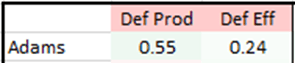
Defensive production and defensive efficiency are somewhat counterintuitive to think about. Defense here is thought of as being the inverse of offense. Therefore, defensive production looks at how well you prevent the other team from scoring, and defensive efficiency looks at how well you can block shots and collect rebounds, steals, and forced turnovers. The more defensive possessions you win, the more “leeway” you have in allowing points while still maintaining a good defensive efficiency score.
For Adams, he is stronger at not allowing points than he is on the defensive efficiency side of things. To note, this stat isn’t saying he has a 0.24 Def Eff. Rather, it is saying he adds 0.24 points per game above a bubble player’s expected defensive efficiency. At any rate, both subcategories of defense are above-bubble.
We will now go down the line, looking at statistical metrics that feed into the +0.79 Adj +/- value score. First, we see the defensive efficiency, not as a value-score as before but as the real defensive efficiency rating. At 0.94, this is better than the replacement efficiency of 0.977. In other words, given KU’s opponents, what we expect from a KU rotation player is to have a defensive efficiency rating of 0.977 or lower. Adams is lower than 0.977, albeit by just a small amount.
This rating is a product of a few things, none bigger than his points allowed. K.J. is allowing 7.5 points per game. We know from above that he is producing 7.6 points per game. So, despite him not being a solid scorer, he still produces more points than he allows. His defense is good enough to keep him on the floor.
The next column is also important, as it converts the 7.5 points allowed per game into a per possession metric. At 10.2 points allowed per 60 possessions, K.J.’s defense can be more easily compared to others. Looking at others battling for minutes at the 5-spot, we note that K.J.’s is better than Udeh’s points allowed per 60 (14.1) and Ejiofor’s (14.4). Clemence actually has a lower points-against per 60 rate (8.3), however this is in far fewer minutes. We aren’t sure if this is significant, first because Clemence has only played 45 minutes and second because Clemence doesn’t have to worry about things like foul trouble. Last season, Clemence was the worst rotation player on the team in giving up points. So, more data is needed. Cam Martin doesn’t have enough playing time yet to have a reasonable score.
The final metric we look is the possessions won, both per game and per 60 possessions. Adams only winning 6.4 defensive possessions per 60 is not good for a 5-man. Normally, the 5 will get a lot of defensive rebounds due to his height and proximity to the rim. Again, to compare against the other 5’s, we see that Udeh has 10.8 possessions won per 60 and Ejiofor has 13.8. Clemence (6.1) is slightly worse than Adams on this metric, again with limited playing time.
This graph shows Adams’ defensive value in terms of points per 100 possessions. The first category, Stinginess, indicates how well a defender does at not allowing his man to score. Here, Adams is better than the replacement, bubble-level defender by 1.94 points per 100 possessions. The next category is titled Pressure, but it refers to steals and other forced turnovers. Adams is slightly above bubble-level. Note that guards tend to score more highly in this category, so for KU to have its starting 5 above-bubble is a good sign. The last category is rebounding. The story here is different. At first, it doesn’t look so bad for Adams, just slightly below-bubble at -0.25 per 100 possessions. That’s a difference of 1 point over the course of about 8 games or so for Adams when compared to a bubble-level player. But remember that these values are not position-adjusted. Comparing him to other power forwards and centers, we see that each is well-above him (Wilson +1.69, Udeh +1.50, Clemence +1.38, Ejiofor +4.80). Even Gradey Dick has been a better defensive rebounder this season than Adams.
Wrapping everything up, let’s answer the question. How is K.J. Adams adding value? It’s truly very strange. Not that he is adding value, he is a great athlete and hard worker. He adds value on offense not through scoring but with high efficiency dunks and layups. But unlike other starting 5’s in recent KU history, such as David McCormack or Udoka Azubuike, K.J. Adams doesn’t score through post moves but by starting outside and cutting to the rim off of ball-screens and ball-rotation. He handles the ball fine for a big-man, which helps offset his lower-than-expected scoring marks. His strongest attribute is his offensive rebounding, but it is less through tip-ins or other boards at the rim as in the past and more through hustling down long rebounds.
Conversely, his defense is the reverse. He adds value through his defensive stinginess. Sure, he doesn’t score a bunch. But he doesn’t give up many points to his man on the other end. Furthermore, he gets enough steals and forced turnovers to add value, almost balancing out his negative-value ball-handling on offense. Lastly, despite being a strong offensive rebounder, K.J. is a minus defensive rebounder, a truly odd occurrence for any power forward given that these marks aren’t position-adjusted. Any position-adjusted look at these numbers would be even more skewed.
But we can think even more basic on this. K.J. Adams adds value because he competes. Game-in, game-out, he attempts to be better than his opponent. First to the ball, making plays on defense, sealing his man, switching onto any type of player while on defense, etc. In the 10 games so far, K.J. has produced positive value-scores in all but 2. Even after adjusting for opponent, K.J. has been positive in 7 out of 10 games, including each of the last 5. Sure, he has areas he can improve on. But regardless of whom he matches up against, he wants to win. He wants to win that matchup, that possession, that game. That’s why he is the starter, and why he will play a big role on this team in the future if he can continue to compete.
As with any value stat, WAR (Wins Above Replacement) is standardized around a certain threshold value. In this case, the replacement is an average D-1 player (or more precisely, a player who provides neutral value for the average D-1 team). WAR is good because it allows us to quantify experience, and specifically experience weighted toward winning games.
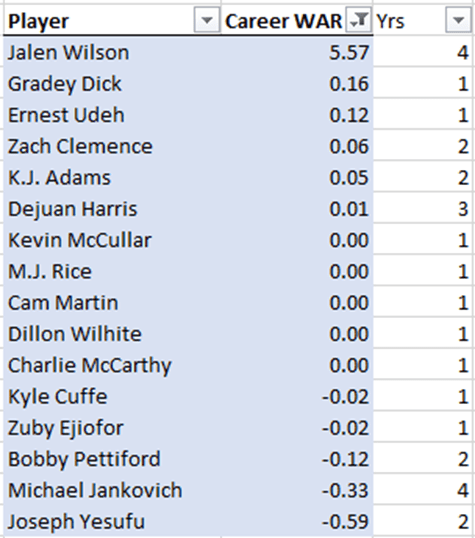
WAR is cumulative, so with more games and more playing time, a solid player will build up his WAR over the course of his career. It was surprising to calculate Career WAR for the 2023 team and see this list:
Yes, Gradey Dick has the second-most Wins Above Replacement of any current Jayhawk despite having played in only 1 official game. Note that the following have also only played one (or zero) game(s): Udeh, McCullar, Rice, Martin, Wilhite, McCarthy, Cuffe, Ejiofor. But this still leaves us with the following list of players: Clemence, Adams, Harris, Pettiford, Jankovich who have less career WAR than Dick despite being at Kansas for at least a full season.
The freshmen last season (this year’s sophomores) produced very little in value. The other name, Dejuan Harris, struggled as a freshman and only crossed into positive Career WAR at the end of last season. Expect Harris to trend further positive as the year progresses, but it is unlikely he catches Dick at any point in this season.
Which is to say the following. KU doesn’t have a ton of experience in winning games on the floor. It has past role players and guys that played sparingly, but not a lot of game MVP winners. Kansas came into the 2023 season with its roster having a combined 4.55 WAR over the course of their KU careers. To compare to past seasons, only twice since at least 1995 has there been less combined WAR coming into a season—2006 and 2014. Of course, this ignores Kevin McCullar’s Big 12 experience from his days at Texas Tech. Once that is factored in, he is likely around Jalen Wilson in terms of Career WAR.
A close comp to the 2023 roster is the 2009 roster, which coincidently was also the year following a national championship. KU returned Sherron Collins (who had produced 5.59 Career WAR to that point), along with a handful of other guys. Cole Aldrich only had 0.61 WAR his freshman season (but would generate quite a few wins his next two seasons). There were a number of solid incoming freshmen that year, namely Tyshawn Taylor and the Morris twins. For returnees who would play a bigger role following the roster turnover from the prior season, you had Brady Morningstar and Tyrel Reed.
There’s a small correlation between experience (in terms of Career WAR) and NCAA Tournament success for past KU teams. Seasons like 2008 point to experience = success, however 2005 and 2010 teams had comparatively similar experience but still lost in the first weekend. On the other side, the 2012 and 2018 teams had less incoming WAR than the average KU team does yet each managed to make the Final Four. The 2022 team was somewhere in the middle.
The 2007 Kansas Jayhawks finished with a record of 33-5 (14-2), winning both the Big 12 Regular Season and Conference Tournament. The team earned a 1-seed in the NCAA Tournament and reached the Elite 8 before losing. The team’s Sports Reference link is here.
Offense
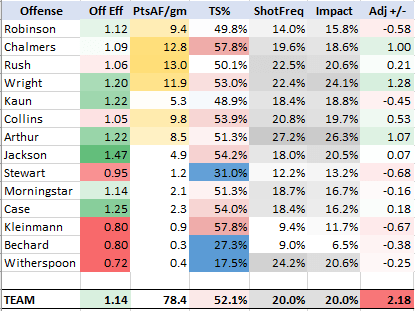
The 2007 offense was worse than people may remember, finishing 29th in Adjusted efficiency according to KenPom. The team’s most productive players were Brandon Rush, Mario Chalmers, and Julian Wright–each producing more than 10 points a game. Chalmers, with a TS% of 57.8%, was the team’s most efficient shooter.
There was good balance among the rotation players, with Darrell Arthur posting the highest shot frequency of 27.2%. Russell Robinson was the opposite end, distributing more than shooting from the PG position.
In total, the 2017 team produced some decent but not spectacular offensive seasons. Wright, Arthur, and Chalmers were all above +1.00 PPG in value. Freshman Sherron Collins was also positive, with Rush and Darnell Jackson barely above 0.00.
Defense
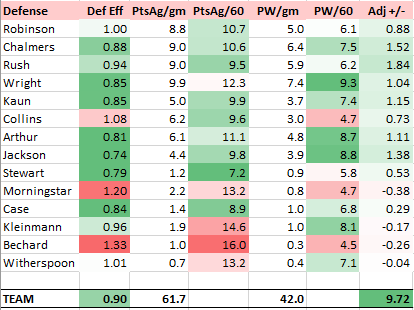
On the other side of things, the 2007 defense is Bill Self’s best defensive team and the best since at least 1997. The team held 7 opponents to under 50 points during the season. Brandon Rush led all rotation defenders by allowing 9.5 points per 60 possessions, with Sherron Collins, Darnell Jackson and Sasha Kaun also posting solid coverage stats. Additionally, reserves like Rodrick Stewart and Jeremy Case defended solidly in their limited playing time.
The team also had balance in winning possessions. Forward Julian Wright led the team in getting the ball back after a defensive stop with strong defensive rebounding, but guards like Mario Chalmers and Russell Robinson got plenty of stops with steals and forced turnovers. The team also blocked tons of shots, finishing second in the nation in block% according to Pomeroy.
The team’s top 10 players (in minutes played) all finished with positive defensive scores, the only time a KU team has done this on record. Rush, Chalmers, Jackson, Kaun, Arthur, and Wright all finished with value scores above +1.00, with Robinson and Collins not far behind.
Adj. PPG +/-
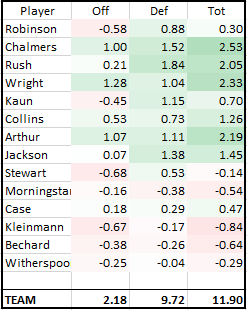
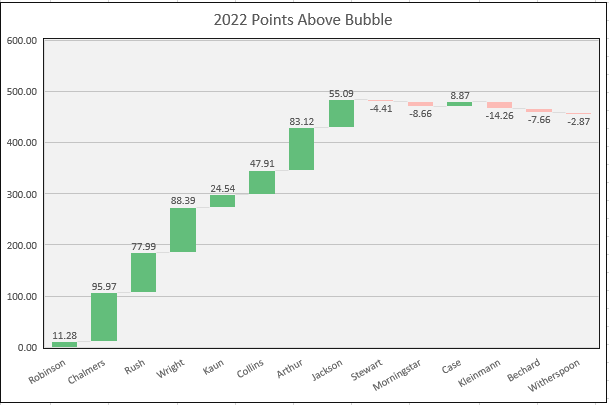
The 2007 team was incredibly balanced, with no true stars but no weaknesses either. Chalmers, Wright, Arthur, and Rush all finished above +2.00 in value; in addition Jackson and Collins added over +1.00 points per game in value. It’s top 8 players were all positive contributors against bubble-level.
The TEAM score of +11.90 was KU’s first +10 score (roughly equating to a 1-seed level performance) since Bill Self began coaching at Kansas.
Mario Chalmers contributed the most value of any player. But not far behind him were Julian Wright, Darrell Arthur, and Brandon Rush. The 2007 team didn’t have a “best” player, but a bunch of very good ones.
Elite 8 Run
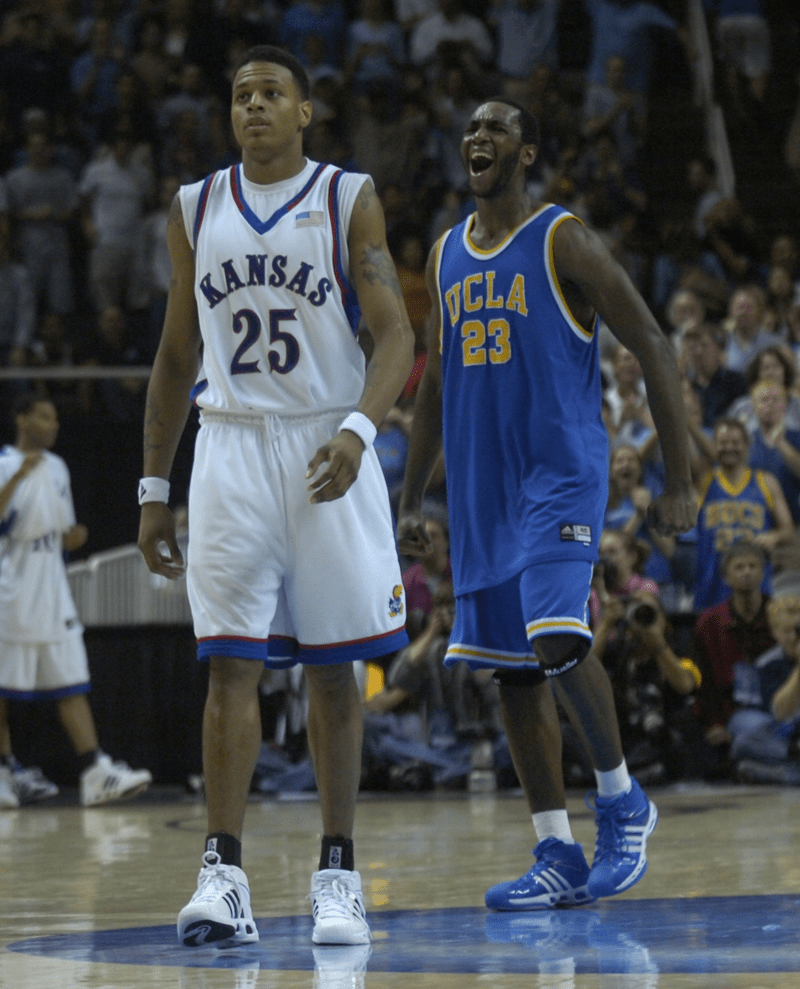
After getting bounced in back-to-back opening rounds in the NCAA Tournament, Bill Self and his players were ready to put the past behind them and make a deep run. Earning the final #1 seed, the Jayhawks cruised past Niagara in the Round of 64, and then defeated #8 seed Kentucky in the Round of 32. A defensive struggle in the Sweet 16 saw Kansas get past #4 seed Southern Illinois, only to lose in the regional finals against UCLA.
It was a tough ending to a successful season. But KU was back. The program, despite a few rocky seasons, had reestablished itself as one of the top teams in college basketball.
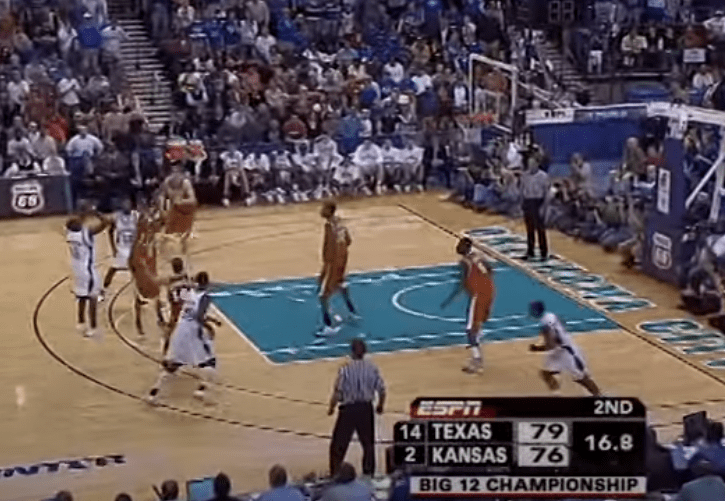
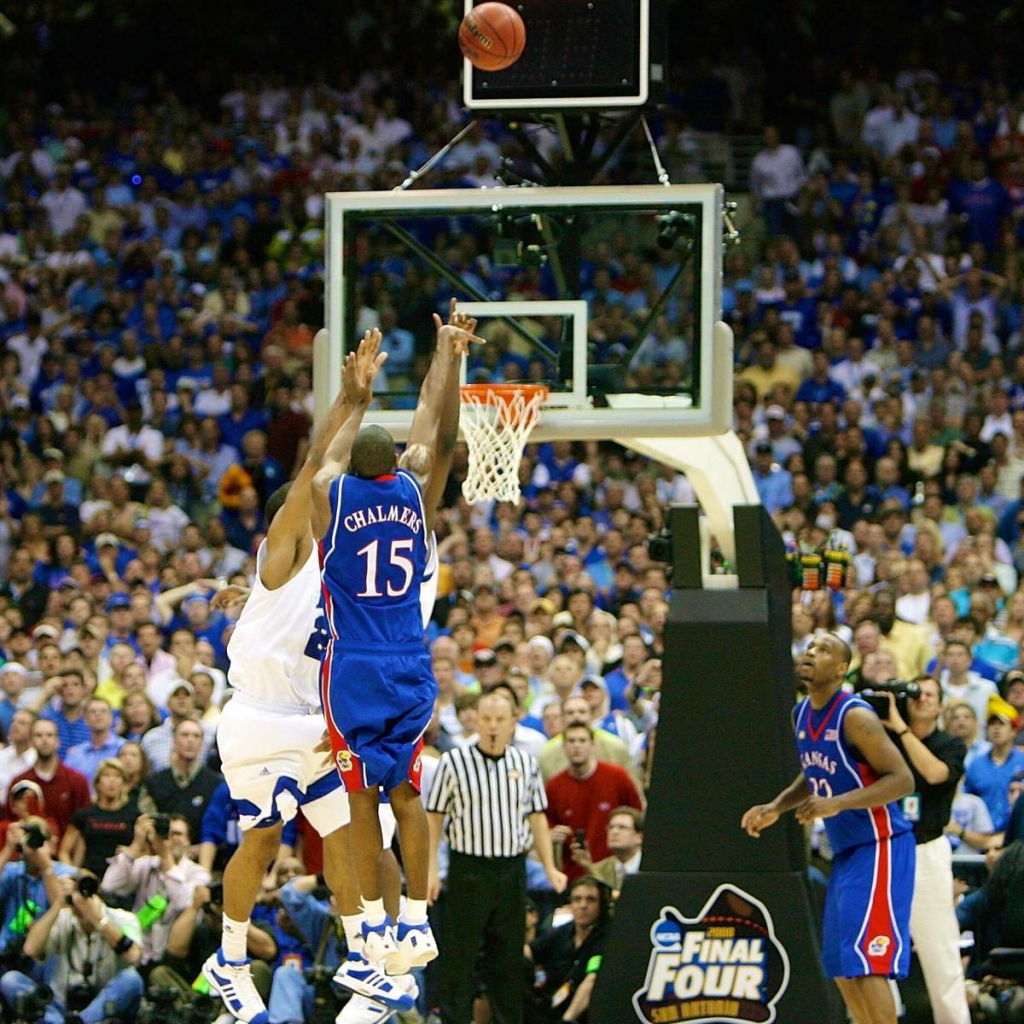
Brandon Rush would return for his junior season in ’08 after an ACL injury following the ’07 season.Julian Wright played his final game as a Jayhawk in the 2007 season. The Mario shot before “the shot.” KU ran same play as they would a year later. This one sent Big XII Tournament Championship game to OT, which would then be won by Kansas 88-84.
The 2008 Kansas Jayhawks finished with a record of 37-3 (13-3), winning both the Big 12 Regular Season and Conference Tournament. The team earned a 1-seed in the NCAA Tournament and won the National Championship. The team’s Sports Reference link is here.
Offense
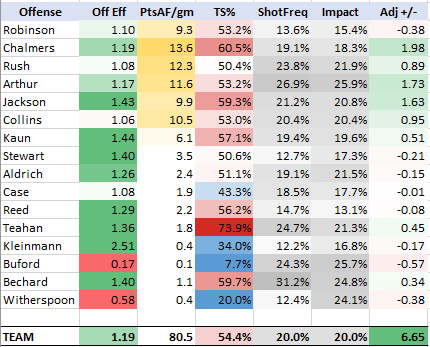
The 2008 team was so balanced, and this balance applied on offense. It’s top six player accounted from between 9.3 and 13.6 points per game. No one had a shot frequency above 27%. Six of the top seven players had a positive Offensive Adj. PPG +/-, though none scored above +2.00.
Mario Chalmers’ season gets overlooked somewhat due to this balance and a particular shot he is more famous for. But he was very good. Not needing to shoot a ton on volume, he torched the nets with a 60.5% True Shooting percentage, and contributed as an off-guard with assists and ball-handling. Inside, both Darrell Arthur and Darnell Jackson put together strong seasons on the offensive side of the ball. Sherron Collins, Brandon Rush, and Sasha Kaun were also positive contributors on this end.
The team had a very good score of +6.65.
Defense
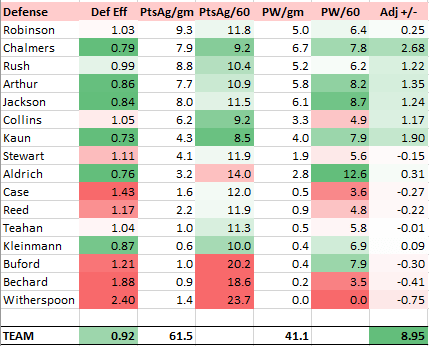
The 2008 defense was even better than its offense, and was the team’s calling card for a multi-year period during this era (2006-2008). It isn’t hard to see why. Mario Chalmers getting steals. Brandon Rush locking down. Sasha Kaun grabbing boards and blocking shots. Both Darnell Jackson and Darrell Arthur developed into fine defenders, using their size and athleticism to bother shots both inside and out. Russell Robinson’s score is a little lower than expected during this season, although his pressure defense was unrivaled during his career.
But once again, we see that Chalmers was the team’s most valuable defender. Known for his steals, Mario did a fine job of not over-gambling and kept his man in front quite well.
Adj. PPG +/-
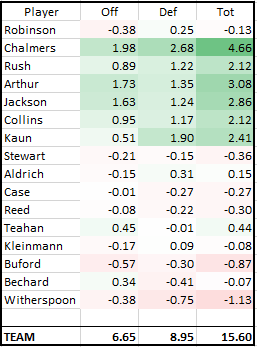
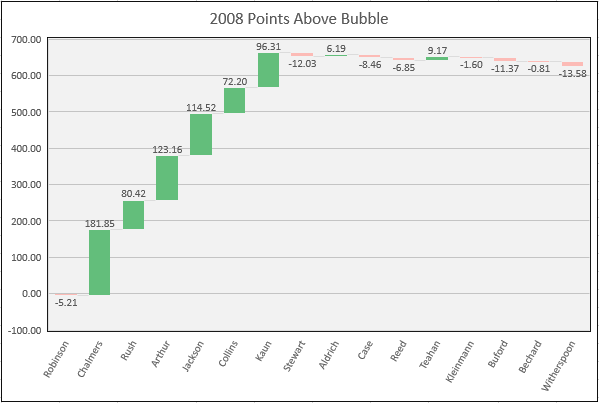
The 2008 team saw 6 players with a PPG +/- score above +2.00, the most of any season for Kansas since 1997. This balance manifested itself throughout the year. Once again, note that Chalmers easily graded out as the team’s MVP. He was efficient on offense and solid on defense. The team’s trio of big men in Arthur, Jackson, and Kaun were excellent as well.
The TEAM score of +15.60 is KU’s best in the last 26 years, with 1997 the next closest.
Rock Chalk Championship
The question this team faced during the year was simply, who will take the big shot when the team needs a bucket in a close NCAA Tournament game? At the time, it was a silly question. Whoever was open was the correct one. But KU would face this dilemma. It needed a play; it needed 3 points. Thankfully Coach Self had a trick up his sleeves. Down 3, with 12 seconds left, he had his best driver race downcourt and flip it to his best shooter coming around on a curl.
David McCormack had his 7th team-MVP game of the season
Game Summary:
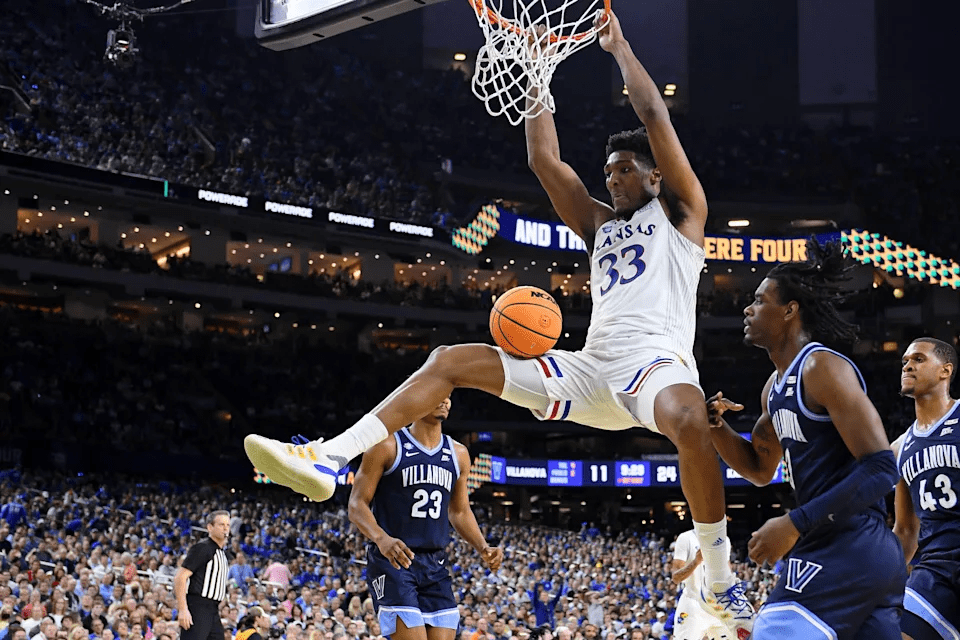
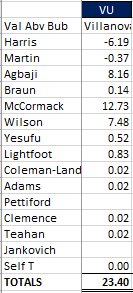
David McCormack had 25 points Saturday against Villanova, but none bigger were the 2 he got after rebounding a Christian Braun miss with 5:50 to go. This basket put KU up 8, and Nova would never get closer as KU put the game away during its final run. Ochai Agbaji was on fire from deep (6-7) from 3, and Jalen Wilson’s double-double (11 points, 12 rebounds) and solid defense earned him another quality game.
Both Mitch Lightfoot and Christian Braun did enough to add small value. Braun had a tough first half, but made three huge shots down the stretch to ice the game. Neither Martin nor Harris had great outings, and this was partly due to a difficult matchup at the guard positions.
The five reserves all posted positive games as well, with Joseph Yesufu forcing a turnover.
The TEAM score of +23.40 is KU’s fourth-best of the season, and second consecutive game with a +20 score. The team plays in the National Championship game next.
David McCormack had his 6th team-MVP of the season
Game Summary:
Down 6 at halftime, not much was going well for Kansas. The team was only 13-31 from the floor (0-5 on 3’s), and worse still from the free-throw line (3-9). Despite the size and athletic advantage, the Hawks were being outrebounded 17 to 16. The results by player were mixed…Ochai Agbaji was playing okay; 6 points on 3-5 shooting, 2 rebounds, 1 steal, 1 assist. Remy Martin also had 6 points on 3-7 shooting. Jalen Wilson had yet to score.
But David McCormack was quietly having a good game. He had 7 points in 10 minutes on 3-3 shooting, making his only FT attempt as well. He added 2 rebounds and had a +/- of +3, one of only 2 Jayhawks to have a positive first half +/-. Defensively, he only gave up 2 points in the half.
It makes sense that he would be the one to lead Kansas back in the second half. D-Mac scored the first 5 Kansas points (cutting the 29-35 deficit to 34-35). But his biggest highlight was in the midst of a 16-2 run. After Jalen Wilson missed a transition shot, McCormack pulled down an offensive rebound in traffic, battled through the contact, and finished for an and-1 to put KU up 7. His FT made it 8, and KU would never see the lead dip below 6 following that play.
When he checked out at 12:25, KU was up 7 and would go on another extended run to put the game away. Although Ochai Agbaji was the team’s leading scorer with 18 points, McCormack was the team’s most valuable player, adding 15 points while giving up only 2. He added 3 rebounds as well. This was McCormack’s first MVP since the first TCU game.
KU dominated the interior, as Mitch Lightfoot’s minutes were nearly equally as valuable as McCormack’s. But Mitch did it a little differently. Scoring 9 points, Mitch added more activity on defense, blocking a shot and getting boards. He also drew a charge. But like McCormack, he only allowed 2 points on defense.
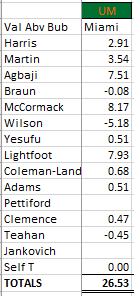
Ochai Agbaji broke out of his slump to finish with 18 points. He was also active on defense, coming away with 4 steals. Remy Martin had his lowest scoring output of the NCAA Tournament, with 9, but he did other things to help his team win. 3 assists. 4 defensive rebounds. Solid perimeter defense. Ditto for Dejuan Harris. A nifty layup was part of the 5 points he scored, but he also added 4 assists and played stingy defense. After Kameron McGusty lit up KU in the first half, Harris took away Miami’s best weapon during the second half with strong defensive energy. Christian Braun had big plays in the second half, and although his score finished up below 0, it was due to him allowing points in the first half. He made adjustments and played well for Kansas when it counted.
The reserves also had good moments. Joseph Yesufu drew a charge. Jalen Coleman-Lands (finally) hit a 3, but he also played solid defense during the first half to not allow any points. Speaking of solid defense, K.J. Adams made an excellent block to keep KU within 6 at the end of the first half. Zach Clemence grabbed a board and Chris Teahan missed his only shot attempt.
A TEAM score of 26.53 is KU’s second-best outing of the year, only behind the Baylor game. Kansas is Final Four bound, and is playing its best ball at the right time. In its 7 post-season games, the Hawks are averaging a team score of +14.69.
Remy Martin now has 3 team-MVP’s, continuing his hot streak in March
Game Summary:
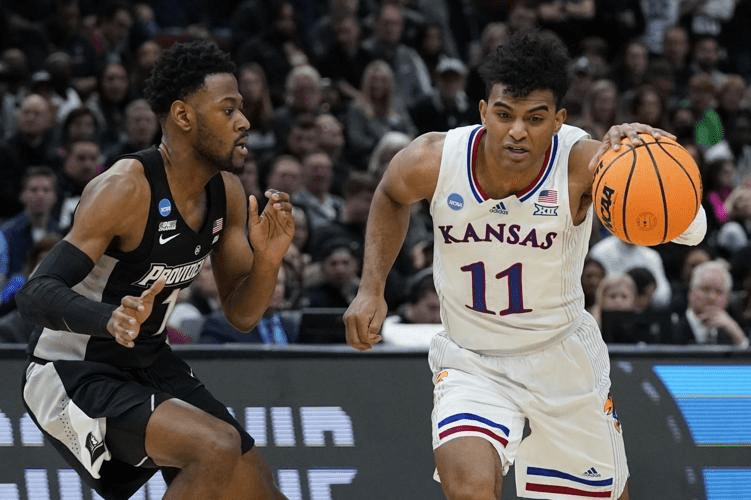
It was KU’s defense, not its offense, which carried it for most of the game. But when Providence made a run to take the lead, the Hawks got huge buckets from Jalen Wilson and Christian Braun.
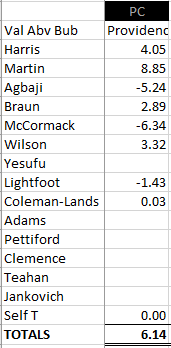
Remy Martin was the team’s MVP, producing over 23 points while giving up only 9. On an opponent-adjusted basis, his game against Providence has been his best in the season. In his last five games, he is averaging +5.72 points of value above bubble per game. He has been Remy Marchtin for sure.
Dejuan Harris deserves a shout-out here, specifically because he will be overlooked. He finished with 6 points and 2 assists while only giving up a junk bucket late. He started out each half well, only to come out to allow Remy to enter. On defense, he forced 2 turnovers and played pesky defense all night.
Other positives were Jalen Wilson and Christian Braun. Wilson racked up 14 rebounds once you factor in the dead-ball rebounds that he won possession of. He scored 16 points, most of them unassisted, on a night where KU’s two leading scorers didn’t have great offensive outings. CB, KU’s #2 scorer on the year, did add value thanks to solid defense and rebounding. Even when he doesn’t have his best game on offense, Braun plays so consistently on defense that he rarely gets outplayed. After giving up a layup on a back-cut (which gave Providence its only lead 48-47), CB added almost 4 points of value over the final 5 1/2 minutes, with no negative plays. He made his only shot, won 4 defensive rebounds, had an assist on Ochai’s dunk, and didn’t turn it over.
On the negative side, Lightfoot made some nice defensive plays but also found himself giving up size inside. He did make a basket in the second-half after a dime by Remy Martin. Ochai Agbaji struggled to get clean looks. He had a great defensive outing in the first half, but his second period was marred by lapses on jump-shooters. David McCormack struggled on both ends, and his 8 points scored was overshadowed by his 13 points allowed. He also rebounded poorly for the amount of time he played.
Last, Jalen Coleman-Lands played nearly 4 minutes and didn’t record a stat. He played solid defense to not give up a bucket.
The TEAM had a score of +6.14, which is its second game in a row below the +10 mark (KU reached that milestone in 4 consecutive games before Creighton). To get through Miami, KU will need a game score of +2 or better. What this means is that Miami is about 2 points a game better than a bubble-team.
After an inconsistent year on the defensive side of the ball, KU has produced 6 out of 7 solid defensive outings down the stretch. KU will want its offense to be much better on Sunday afternoon, but thankfully the Hawks have not had two below-bubble team offensive games in a row this season.





 Charting the Hawks