WAR Update – 2023 Roster and Jalen Wilson

Earlier in the season, WAR (Wins Above Replacement) was introduced. I wanted to catch up with the 2023 team to see where each member of the roster is, in terms of Career WAR.
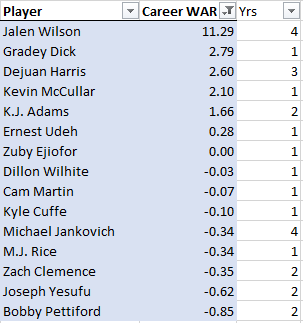
Currently, the rest of the team apart from Jalen Wilson has 6.74 Career WAR, with most of this coming from the play this season. This means that Jalen Wilson, with 11.29 Career WAR, is 62.6% of the current roster’s entire Career WAR at Kansas. His combination of experience and skill mean that this really is Jalen’s team. How far this team goes in March will depend on him.

Speaking of Jalen Wilson, it is all but assured that this season will be his final as a Jayhawk. He almost left after last season, but he returned understanding that a solid junior season could help his pro-prospects. He’s achieved all he wanted to do, and more. With a national championship under his belt, there’s little left for him to do in college regardless of the rest of the season. Jayhawk fans should be grateful for all that he’s provided for the program.

Jalen has really done all of this in 3 seasons, even if it says he’s played 4 in the chart above. This is only technically true. Technically he did appear in 2 games (for 2 total minutes) in his true freshman season before being injured. And technically, he does have 2 more seasons of college eligibility following this one since he took a medical redshirt and also got the “free” Covid year (in 2021). But as was stated earlier, this will certainly be his final season at KU.

But he still has some season left. 4 games in the regular season, with a potential of 9 more in the Big 12/NCAA Tournaments. Let’s compare his Career WAR to other Jayhawk greats to see how he stacks up. Since 1994, WAR estimates have been provided by season. This encompasses 30 seasons (including the current one) and 172 Jayhawks who have played at least one second of a regular season KU game. To clarify things, this range of years (1994 – 2023) means that certain players’ careers are interrupted. In other words, we have stats for Greg Ostertag (7.09 WAR) from his junior and senior seasons, but not his freshman or sophomore years. And Steve Woodberry had an excellent senior year (4.83 WAR) in 1994, but his first three seasons aren’t included on this list. It’s doubtful that either of these guys are at Jalen’s career level at this point, but it was still something that needed to be said.

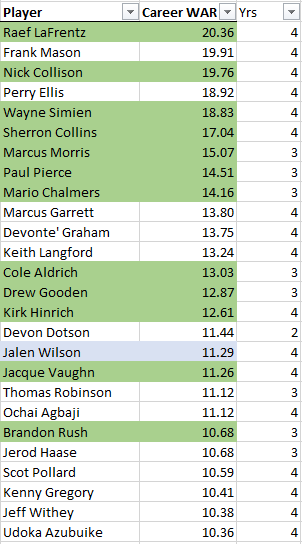
So, at 11.29, how does Wilson’s Career WAR stack up? At this point, he is at #17 (out of a total 172), having just passed Jacque Vaughn. Next on the Career WAR list is Devon Dotson, a name which might be surprising to some people. Dotson was extremely good during his 2 years in Lawrence. If we estimate that Wilson will play ~ 9 more games (a conservative but not overly cautious guess), Wilson will have a excellent chance to pass not only Dotson but also Kirk Hinrich (#15), Drew Gooden (#14), and maybe even Cole Aldrich (#13).

Here’s the list of all players with a Career WAR over +10 from the years (1994 – 2023):
WAR is calculated by using a multiple to convert value points (points above replacement) into an estimated amount of “wins.” What this multiple is depends upon a separate conversion, and so changes as more data comes in. In short, the exact WAR number is in flux as more games are played, even for players that are non-current. This doesn’t change the order of the players, but it does change the WAR estimate. So don’t be surprised if these numbers don’t match a separate, more current list of WAR. I plan on pinning a link to Career WAR at the end of the season.

Either way, we see in green the players who’ve had their jerseys retired, and in blue the current players (Jalen Wilson). Jalen is in the company of some great names, and will end his career in the area which normally earns one a jersey ceremony. Given that he has a strong candidacy for 1st-team All-American this season, that he will get that jersey retirement in the future looks almost certain.

As he has effectively played only 3 seasons, it’s fun to compare him to other 3-year players. If he can pass Gooden and Aldrich (which he has a shot to do), then the only names that will outdo him for their KU careers in a 3-year career over the past 30 seasons are Mario Chalmers, Paul Pierce, and Marcus Morris. He’s had an amazing career.

Next on the list we’ll look at Gradey Dick, and compare him to other 1-and-done freshmen.
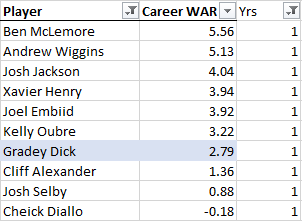
Of course, Dick has not officially become a 1-and-done player yet. But given his skillset and draft potential, this is the most likely thing. KU has had 10 1-and-done players under the criteria that a player leaves college after 1 season to go pro (KU has had other 1-year transfer players such as Remy Martin or Bryce Thompson…these are left off). The majority of these guys were “wing” type players, with a few post men as well as SG/CG Josh Selby. Of these wings, Dick keeps good company. Again, it depends on the number of games he has left. But extrapolating his current play to an additional 9 games, and he will be above Oubre and just below Embiid/Henry/Jackson. With a stretch of solid play and a deep run in the NCAA Tournament, Dick could leap into 3rd on this list. Gradey’s been as good as advertised.

Last, let’s try and forecast Dejuan Harris’ career using WAR. Harris began his career with a negative-WAR season in 2021. He was someone who hardly scored the ball, and while his defense had potential he would still be bullied by stronger players quite often. Harris has improved on both of these areas, and is now generating positive impact for Kansas. With 2 more seasons of eligibility remaining and little chance of him leaving the program early, let’s look at how his season-by-season play has been.

From this table, we can see each of Harris’ seasons from most recent to oldest. We see that he has increased his playing time (he is on the floor in 83.1% of available minutes), his scoring, and in turn his WAR. Assuming that his final two seasons will be at least as good as this one (with likely value growth, albeit slower growth), we might estimate it as follows:

2025: 3.50

2024: 3.25

2023: 3.00

2022: 0.63

2021: -0.56

CAREER PROJECTION: 9.35 WAR

The comparison list here is of multi-year players who were legitimate PG’s or lead ball-handling guards. This will include guys that aren’t necessary thought of as “pure-PG’s” but still handled the ball in that role. These are the types of players that Dejuan Harris would have been competing for regarding playing time had he played in a different era.
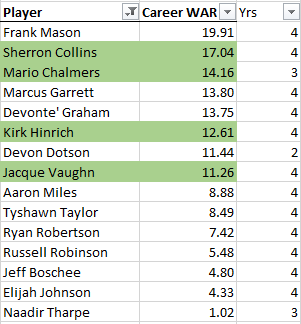
From a projected Career WAR, he might end up roughly halfway up the list. Now this still has to happen, and he would benefit from a 5th season that the others didn’t get, but his trajectory places him as a legitimate KU-level player, something that wasn’t apparent during his first season.
Kansas 87, Oklahoma State 76

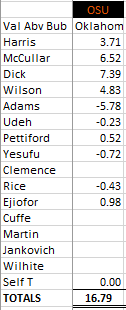
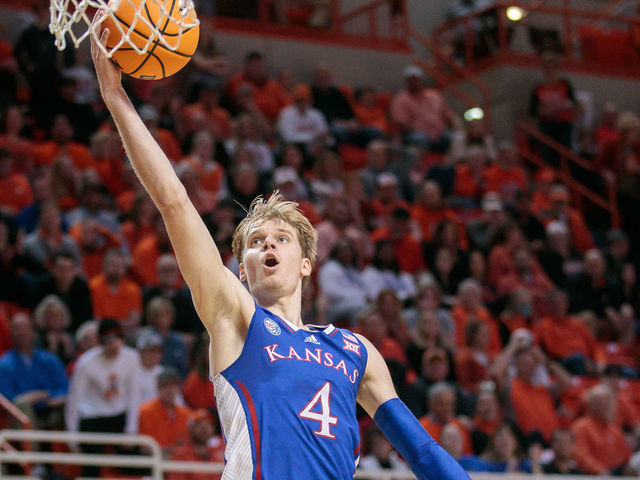
Freshman Gradey Dick had his 5th team-MVP game of the season in a career high 26 point effort. After accounting for his defense and opponent, it was his 4th-best game of the season. Other Jayhawks who added value were Kevin McCullar, Jalen Wilson, Dejuan Harris, Zuby Ejiofor, and Bobby Pettiford. The team was able to go deeper into its bench thanks to the (relative) health of Ejiofor and Pettiford. However, it’s clear that Pettiford in particular isn’t quite 100%. Late injuries to Harris and McCullar might also be a factor moving forward.

Ernest Udeh followed up his excellent OU game with another high-energy performance, although his fouls contributed to a negative-value score. Still, he has played well of late. M.J. Rice only contributed an offensive foul in his 2 minutes of play, and Joe Yesufu had a typical game for him. KU’s worst performer against the Cowboys was K.J. Adams, who had the worst defensive outing of anyone this year. He was responsible for a lot of easy baskets from OSU’s Kalib Boone, and also got scored on at times when switching onto guards late. He has struggled during conference play due to his position (undersized 5), but he is also overrated on the perimeter.

The TEAM is on a roll, averaging an 11.74 value score over its past 6 games (where it has gone 5-1). If it can keep up this level of play, it will not only earn a 1-seed but have the capabilities that past 1-seeds have had. Getting contributions from its bench has been huge, as the bench has been +1.10 per game over that span (this may seem pedestrian, but the bench was averaging -5.57 before that time). In its last 5 outings, the bench has been even better (+3.49). This has shown up in the results of the games.

More on the Bench

While KU continues to win close games, it is in spite of its bench players. This phenomenon was discussed earlier in the season, and the discrepancy between its starters and bench has remained. Self has continued to play Bobby Pettiford and Joseph Yesufu as reserve guards, with an oft-injured M.J. Rice having not playing in the last three games. Zuby Ejiofor has been KU’s most-frequently-used bench big man in conference play (27 minutes), followed by Zach Clemence (21 minutes) and Cam Martin (6 minutes). Ernest Udeh has played in only 1 second of conference play. Yes, just 1 second. This came at the end of the Oklahoma State game when he was guarding the inbounds pass.

Since the last time we examined their performance, the KU bench has hardly changed in overall value it provides. After 10 games, the bench was positioned to earn about -3.00 WAR over a normalized 36-game schedule. With 17 games in the book, this has hardly budged. The 2023 bench is still the worst bench in the 20-year Self-era, and with no signs of improvement would be only the 6th bench to produce negative-WAR value over that time span.

One thing to consider is that there is a sort of floor to this number. The worse the bench plays, the less Self will go to it. Through 5 conference games, the starters have averaged 32.5 minutes per game each. This is Self maxing out starter-minutes. He cannot play them much more, considering foul trouble will occur at times and fatigue will set in. With limited bench minutes, two things should keep the number somewhat afloat. First, the bench has less collective time on the floor to perform poorly. Second, in limited minutes the bench players should have the energy to play each defensive possession 100%. The bench should be giving maximum effort when they are out there, thus maximizing their potential value on a possession basis.

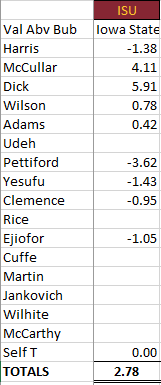
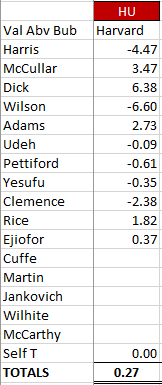
There are various ways to quantify the dreadfulness of the bench rotation. We have used the WAR value metric to compare the 2023 bench to others in the Self-era. Now we will compare the 2023 starters – Harris, McCullar, Dick, Wilson, and Adams – to the remainder of the team using Adj. Points AB +/-. This metric compares a player’s value, in points relative to a bubble-level opponent (about the 45th best team in D-1). Anything positive is quite good and should earn the player rotation minutes, with anything greater than +2.00 indicating a performance level that would start on almost any KU team.

The following numbers are thus presented per game, collectively divided between starters and bench.

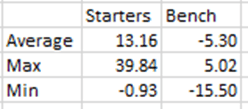
The starting 5 produces an average difference of 13.16 points above a bubble team per game. They have been tremendous. This year’s starters have collectively out-done last season’s starting 5, which were +10.83 points above bubble per game. For the Missouri game, the starters were an absurd +39.84. They have only been below bubble-level as a group twice this season, first against Omaha (which was technically their worst opponent-adjusted performance) and second against Tennessee. Even then, these games were barely below the 0 threshold.

In contrast, the bench has played to a bubble-standard in only four games (23.5% of games). Ironically, its best game was against Omaha with a +5.02 performance, which is also the only time it has outperformed the starting 5. Its worst outing was against Southern Utah, in a game that was only close because of the reserves. Worse, the bench is trending downward. It hasn’t produced a positive outing since the Indiana game. Last season, on a team that featured seniors like Mitch Lightfoot, Jalen Coleman-Lands, and of course Remy Martin off the bench; it was collectively -0.52 and produced 17 games above bubble-standard (42.5%). This number was much higher at the end of the season when it counted, as the bench collectively produced an average game of +5.53 in the 9 games that made up the 2 tournaments. This was due to the great play of Remy, as well as a shortened rotation that played the senior reserves far more than the underclass backups. Suffice to say, the 2023 team doesn’t currently have that kind of fire-power waiting in the wings. It has underclassmen and transfers, none of whom have proven any capacity to be consistently great at the upper echelons of the D1 level.

Having a poor bench is no reason to despair. History has shown that teams with great starters can win in the Tournament despite having little help from its reserves. The 2012 runners-up had a very similar divide between a strong starting 5 and weak bench. However, even the 2012 bench had experience; Kevin Young was a redshirt junior and Conner Teahan a fifth-year senior. The 2016 team is another good comparison. It earned the number-one overall seed and made an Elite 8 on the backs of its experienced starters, getting little from its bench.

There are a few potential bright spots to consider when pondering the bench situation. First, is that KU has talented young players on its roster. It really only takes the development of one or two of the following by March for this situation to drastically improve: Pettiford, Yesufu, Rice, Ejiofor, Udeh, Clemence. If KU can comfortably play any of these guys 10 minutes or so and expect a consistent performance, it can better maintain leads that its starting 5 works to build. The second consideration doesn’t have to do with the bench, but with the makeup of the starting 5. The starters are all capable of playing a heavy-load, thus reducing the negative-impact the bench has collectively brought. K.J. Adams is far more like a wing than a post in terms of fitness and durability, meaning that even the 5-spot needs fewer bench minutes this season than it historically does.

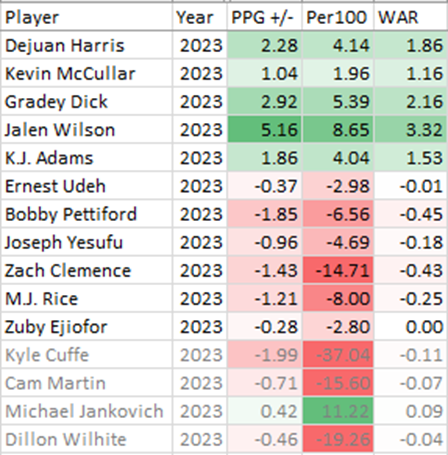
Lastly, where should the team go from here? In comparing Per 100 points above bubble, there is good reason to like the potential development of Udeh and Ejiofor. These two have clearly been superior to other bench-players, particularly the other 5 men. While Ejiofor has gotten in games consistently, Udeh has been relegated to DNPs of late. Perhaps this should be reexamined, particularly if Clemence continues to defend at a poor level.

There hasn’t been much value from the reserve guards/wings. Injuries have plagued all four (with Cuffe still out), and even when healthy none have provided consistent value. The team loses scoring ability, size, and defensive skill when it goes to the bench and gains little. Shifting K.J. down to the 4 when Jalen is out is honestly a worthy consideration.

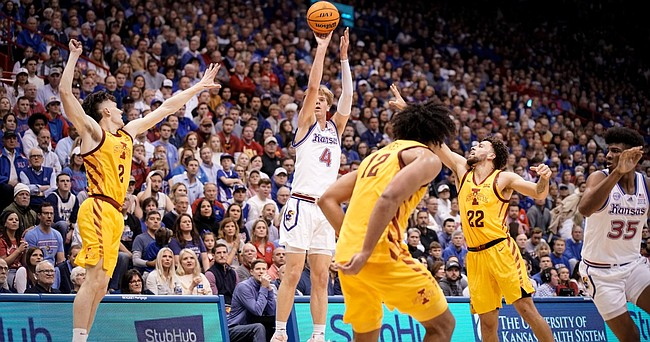
Kansas 62, Iowa State 60

Gradey Dick and Kevin McCullar were KU’s best players against the Cyclones. K.J. Adams, who had the winning basket as part of 15 points and Jalen Wilson, who finished with 16 points, had poor defensive showings overall. Still, K.J. has now ran off 11 consecutive positive-value games, a team record for this season.

The bench was again abysmal, this time combining to produce -7.05 points against bubble. Only once, the Nebraska-Omaha game, has the bench collectively produced more value points than the starting 5. And through 17 games this season, only 4 times (Omaha, NDSU, Texas Southern, Indiana) has the bench been above-bubble (reminder, this is an opponent-adjusted number).

Does KenPom have a Consistency Problem Rating Player Value?

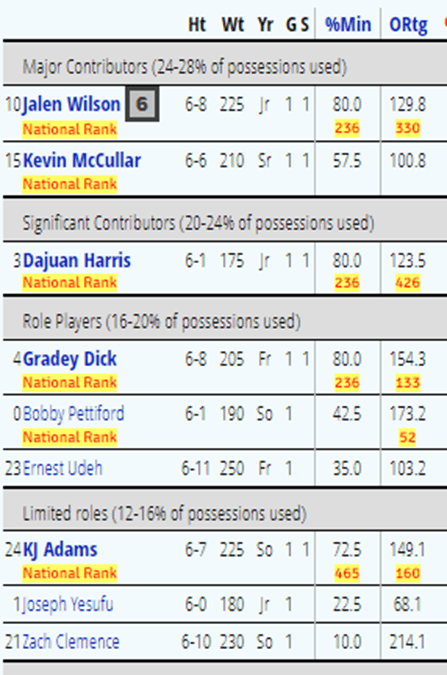
With one game in the books, KU’s list of players looks like this on KenPom:

Pretty straightforward. KenPom breaks down players into categories based on their offensive “usage rate.” He also ranks players nationally based on a black-box algorithm. We see that Jalen Wilson is #6 In this national ranking (after one day of play). Again, this makes enough sense. Jalen had 19 points, 11 rebounds, and 7 assists on a very good 129.8 efficiency. So Jalen Wilson should have been the team’s MVP in the Omaha game, correct?

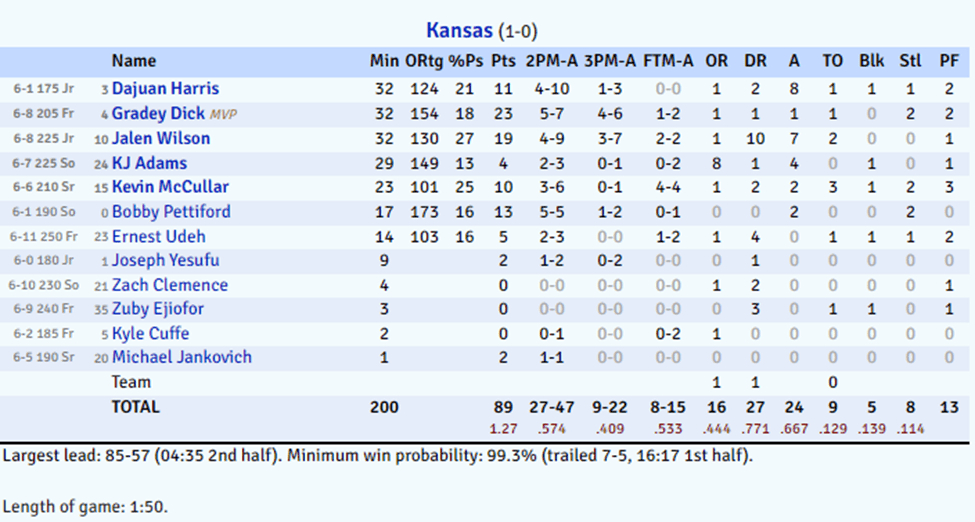
I guess not. This is the KenPom box score from the Omaha game. We clearly see that Gradey Dick is listed as the MVP for this game. And good for him. He had 23 points on 9-13 FGA. This efficiency is certainly very valuable. For what it’s worth, he graded out as CtH’s MVP for this game as well.

But it doesn’t take a skilled logician to see that there is a disconnect here. If Gradey Dick was the team’s MVP for the one and only game so far, this means that he’s been the team’s most valuable player for the entire season. So why is he not listed above Jalen Wilson (who is said to be #6 nationally)? Note that anyone without a number has a ranking outside the top 10. This just doesn’t follow:

Here’s what Ken has to say about his Player of the Year ranking:

The kPOY is not meant to predict who will win the Naismith or Wooden awards. This is a standalone honor designed to identify the most valuable player in the game, free of reputation, future potential, or amount of times the player appears on Big Monday. I’ll track the candidates every week until tourney time, and then we’ll have a season-ending awards ceremony two days after the title game. (Yes, the kPOY will be the one award that includes NCAA tournament play. About time.) [Emphasis added].

If Ken were projecting player of the year, then it might make sense for a returnee like Jalen Wilson to have some pre-built weighting his kPOY score. But according to his own words, Pomeroy is calculating the best players only of games actually played. So what gives? Why does he have Dick > Wilson in the game box score, but Wilson > Dick for the season to this point?

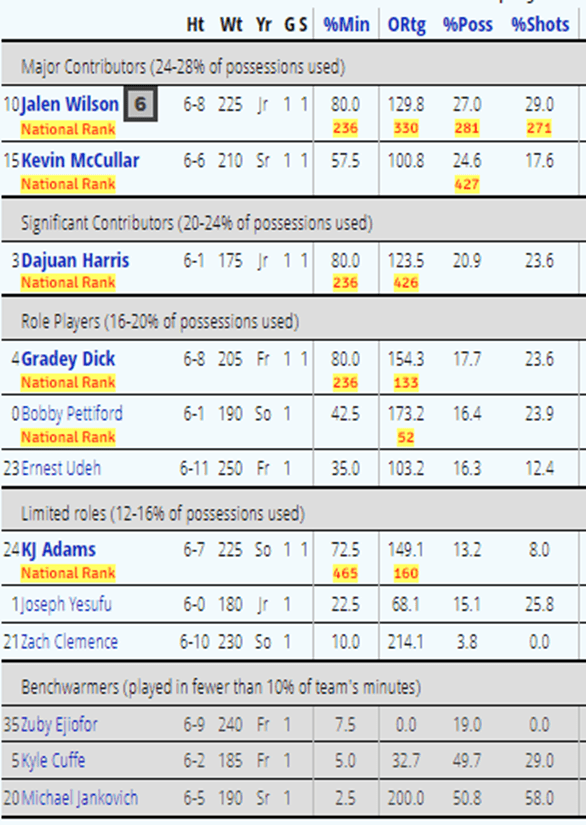
My guess is that the algorithm heavily weights usage rate. Expanding a bit on the initial image, let’s see the actual usage rates for KU players after one game:

There are actually two usage rates Pomeroy calculates. The first, listed as %Poss, looks at the percentage of possessions a player uses while on the court (with 20% being mean, obviously). %Shots looks only at the number of shots that player takes. These numbers can differ somewhat, depending on assists, turnovers, and offensive rebounds. Gradey Dick’s %Poss usage is much lower than his %Shots usage, likely because he only had 1 offensive rebound, 1 turnover, and 1 assist. In contrast, Jalen Wilson had 1 offensive rebound, 2 turnovers, and 7 assists. He was involved in more plays, thus the higher %Poss number.

This still doesn’t justify the inconsistency. There are arguments to be made whether or not Gradey or Jalen had the best game Monday night. Matt Tait went with Jalen.

As mentioned prior, CtH had Gradey Dick as the best Jayhawk. The one caveat is that CtH has additional defensive stats that Pomeroy and Tait don’t capture. We don’t blame them for that. It should be added that defensive metrics take longer to normalize. So, if you just look at our offensive value stats, you’ll get a decent idea of who played the best per box score numbers. We have Gradey Dick with +4.95 points of value vs. Jalen Wilson with +4.07 points of offensive value. This isn’t a huge difference, but it adds further confirmation that Gradey was the game MVP.

So why isn’t he the team MVP one game into the season? The only reason must be that Pomeroy uses a different algorithm for the season, and it takes into account usage rate. Because Dick is a “role player” (only using 17.7% of possessions), his very high efficiency and strong production is discounted. This is unfortunate. Usage doesn’t really need to be taken into account, as efficiency and production can be balanced together to give us player value. With more usage, more production will come. It isn’t usage that is important; it is production. Higher efficiencies are possible with less usage, but this will come at a cost (lower production).

I suppose that’s the lesson in all of this. Despite the recent increase in adopting new stats such as usage rate, the most relevant stat in assessing player value is points per game. It encapsulates so much of what the “advanced stats” try to.

Kansas 89, Nebraska-Omaha 64

The Kansas Jayhawks won their 50th consecutive home-opener as they defeated the Omaha Mavericks for the third time in the past six seasons (2018, 2021).

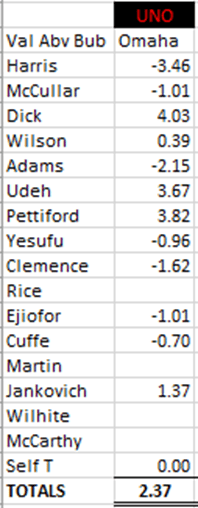
Freshman Gradey Dick led all Jayhawks with +4.03 points of value above bubble. Gradey scored a majority of his points off an assist, with Dejuan Harris and Jalen Wilson setting him up on multiple occasions.

Other positive performances came from Bobby Pettiford (13 points on 6-7 shooting) and Ernest Udeh (7 defensive possessions won in 14 minutes). Both of these bench players showed why they should be part of the rotation due to how they played in the opener.

Walk-on Michael Jankovich made a long 2 with his toes on the line in his only shot attempt.

Junior forward Jalen Wilson also contributed value, producing the most points (21 points produced), but giving up 15 on the defensive end.

The TEAM as a whole was only +2.37 in value. KU only won by 25 against a team that it was favored to beat by 30+ points. On paper, Omaha wasn’t a tough matchup, which is why the value scores look so low. Harris, McCullar, Adams, and Yesufu had positive unadjusted scores; but didn’t do enough to overcome the opponent discount of the Mavericks. Omaha was ranked #330 on KenPom coming into the game. If they improve upon this ranking as they play more games, the value scores for KU will also improve during the season.

The offensive score (+6.74) was more efficient than the defensive effort (-4.37). Although KU only allowed 64 points to UNO, this was on 69 charted possessions. Given Omaha’s discount factor, this graded out to be a poor defensive effort. On the flip side, 89 points against Omaha graded positively in 69 possessions (1.29 Off_eff).

Kansas is back in action Thursday against North Dakota State. The Bison fell to Arkansas 76-58 in their opener, and sit at #205 in KenPom. KU is favored by 23 points according to the computer metric.

Kansas 94, Pittsburg State 63

The 2022 National Champions looked sluggish to start, falling behind as much as 15, midway through the first half. However, the Hawks quickly turned it around and ran away from the Gorillas to win 94-63 in the team’s only televised exhibition matchup. The games will start to count for real on Monday when the Omaha Mavericks come to visit. In terms of most to least valuable, here is how the Jayhawks graded out against Pitt St.

Kevin McCullar +8.90

The Texas Tech transfer finished with 13 points, but it was his defense which stood out. He only allowed 1 point, while winning 11 possessions because of a steal, rebound, block, or forced turnover. While he may have benefited from his man missing an open shot here or there, it’s clear he is a legitimate plus defender who will almost certainly grade out as the team’s best over the course of a 31+ game schedule. He will do best getting his points in transition, although he can make the occasional 3.

Gradey Dick +6.01

The 5-star frosh started slowly, but got into the action with a backdoor cut for a dunk. From there his full offensive game was on display. Ripping open 3’s with a ridiculously quick and pure jumper. Running the floor. Finding the open man. Hustling to get tip-ins. Cutting backdoor and finishing off a reverse while drawing contact. All-in-all he had 20 points on 9 FGA’s. The question will be his defense. He doesn’t have to be an all-conference player on the defensive end to add value, but will he do enough to ensure that teams don’t pick on him at that end. Either way, he has earned a starting nod.

Zuby Ejiofor +3.97

Despite playing a shade under 10 minutes, Ejiofor finished with 8 points and 4 rebounds. He was KU’s best interior player in this game, showing how he can compliment a team with skilled wings and guards who know how to find the open man. Like any freshman, up and down games are to be expected. But he appears to be ahead of schedule in his development.

Ernest Udeh +2.18

The other freshman big man got the start, but played sparingly afterwards. He finished with 4 points and 3 boards while not giving anything up on the other end. Udeh’s size and activity will net him minutes this season, but it is apparent that certain defensive matchups will be trouble.

Jalen Wilson +1.66

Jalen went for 23 and 4. He started slow but ended up having a decently efficient game in the end. Defensively, his second half was much cleaner than the first period. Wilson is clearly Kansas’s best iso-scorer, given his ability to put the ball on the deck and score through contact. Since he will be KU’s number one option, he will have to learn to adapt to different defensive schemes he will face this season.

Kyle Cuffe +0.59

Cuffe’s score is due to his defensive effort in not allowing a point. He played 12 minutes, seemed to rotate well, and put some pressure on in-bounds plays to force turnovers. On offense, he looked raw but did have a nice finish in transition. Cuffe’s minutes will increase if he can take care of the ball and win hustle plays.

Dillon Wilhite -0.10

The redshirt freshman walk-on only saw 41 seconds and a few moments of action. The entry pass to him was deflected out of bounds, hence a score near 0.

Zach Clemence -0.48

Clemence’s unadjusted score was positive, but when you add the team factor of a D-2 school in, it becomes below bubble. But don’t less this distract from the nice game Zach had. He finished with an efficient 7 points and 4 rebounds in 14 minutes. He did give up a few 3-pointers on defense, which might have partially been due to bad luck (other Kansas players gave up open looks that weren’t hit…as the season goes on this luck factor will balance out).

Bobby Pettiford -0.98

Like Clemence, Pettiford did some nice things despite the negative score. He was quick and active, creating scoring opportunities for teammates and pressuring at the point while on defense. Pettiford probably won’t ever be a “scoring guard,” but if he can get out in transition, he will provide more on that end than in the half-court.

Michael Jankovich -1.33

Jank had a 3 and an assist in six-and-a-half minutes of play, but also gave up a 3 on defense. He played well, but probably won’t see much action despite his lethal ability to shoot.

Dejuan Harris -3.21

The starting PG did some things well. He finished with 10 assists to 3 turnovers, and added 6 points. He also had some steals and pressured the ball well at times. Like others, his negative score is due to the adjustment factor, as his unadjusted score was slightly positive. The concern this season with Juan is the same as it has been in the past. He does his PG duties well, but does he score enough and “play big” enough on defense to add value? KU switches a bunch, and at times he will lose his man and give up a cheap basket. Let’s put it this way. If Harris doesn’t make a ton of jumpers, he can’t be giving up decent 3-point looks to the opposing guards he faces.

K.J. Adams -4.34

The sophomore forward not only started the game, he also played a decent chunk as the “5” man. He scored 4 points with 2 assists, and had the highest +/- on the team with a +31. So how was his value score so low? Well, he had some sloppy turnovers, but the biggest reason was he didn’t rebound. In 21 minutes, he had 1 rebound for the whole game. Adams is a possible plus-defender with the ability to be a very good defender, but he has to rebound the ball.

Joe Yesufu -11.14 It’s tough to overstate how bad of a game Yesufu had. He forced up numerous bad shots, lost his man in defensive rotations, and while playing off the ball didn’t contribute anything in terms of assists. It’s clear the team wants him to be aggressive, but there is a line between aggressiveness and poor shot selection.

A look ahead to the Regular Season

You can learn a lot in exhibition games, even if the level of competition isn’t equivalent to what the team will be facing for the bulk of the season. Having watched the game, here’s what I expect in terms of rotations, playing time, etc. moving forward. Also, keep in mind that Kansas will have additional “buy games” which should allow them additional possessions to experiment with lineups before conference play starts.

Starters:

Given how the team looked, expect the starting 5 to look like this on Monday. Harris, McCullar, Dick, Wilson, Adams. This puts Adams as the starting 5, which isn’t ideal. As indicated above, Adams did worse than the other three big men in terms of player value, even though his box score +/- was the team’s best. But like Pitt State, Omaha won’t have a ton of size. I expect the coaches to go with the experience of K.J. for game one.

Gradey Dick’s performance was too good to ignore. His presence on the court should open up driving lanes for others like Wilson and McCullar. His defense isn’t great, but it isn’t the worst on the team either. He deserves to start, but even if he doesn’t start, he will play serious minutes. The other three are definite starters.

Rotation:

In addition to the starters, the rotation will consist of Pettiford, Clemence, Ejiofor, Udeh, and one of either Cuffe/Yesufu/Rice.

Starting with Pettiford, who looked great with the ball in his hands in the exhibition. It’s clear from the rotations that the staff wants to play either Harris or Pettiford as PG. One of these two will be in the game, but rarely will they play together. In fact, against Pitt State, the two played a combined 40 minutes and 45 seconds, with the only overlap coming at the end of the 1st half. Other than that, it was one or the other at PG.

Next comes the three big men. There’s a chance one of these three starts over K.J. on Monday. Either way, each will get time at the “5” spot. Additionally, KU looked okay with both Clemence and Ejiofor on the floor together. Given Clemence’s ability to shoot, playing these two together doesn’t hurt the team’s spacing on offense. It would be defense that would be the concern. It will be interesting to see what Coach Roberts does.

The last question, and the one that seems the least clear, is the question of the reserve off-ball guards/wings. Joe Yesufu didn’t play any point guard against Pitt State, and all signs seem to indicate that the coaches see him as a scoring guard and not a point. However, he didn’t play great on either end in this role. Looking at his stats last year, Joe was best with the ball in his hands, playing point. But it’s clear that the coaches are happy with Harris/Pettiford at this position, hence the reason to shift Joe to the off-guard spot.

Kyle Cuffe likewise had some struggles, but did look a little sharper than Yesufu. And last, how serious is the injury to M.J. Rice? He will seemingly be out for some time, but is this a few weeks, a month, or longer? In the exhibition, both Cuffe and Yesufu played quite a bit on the court together. I think the reason for this was that Self wanted to see which one he liked better. To me this was Cuffe, but I wasn’t super-impressed by him either.

Ultimately, the main rotation will consist of:

PG: Harris / Pettiford

Wing: McCullar / Yesufu

Wing: Dick / Cuffe

4: Wilson / Adams

5: Udeh / Clemence / Ejiofor

With Clemence and Adams having the potential to play either the 4 or 5, and the wings being interdependent. Also, McCullar and/or Dick could play the “4,” it really is fluid aside from the PG and post positions.

Projected minutes is another way to do it. This will be for roughly the first 5 games, understanding that this is flexible based on game score and matchups.

Harris: 26

McCullar: 30

Wilson: 30

Dick: 28

Adams: 15

Pettiford: 14

Clemence: 14

Udeh: 13

Ejiofor: 13

Cuffe: 10

Yesufu: 7

The minutes distro between Harris/Pettiford will be 40 or very close to it. The minutes distro between Udeh/Clemence/Ejiofor will be close to 40, with Adams playing some 5 at times but Zach playing some 4 at times as well. The off-guards/wings will be 120, so 120 between the likes of Adams, Wilson, Dick, McCullar, Yesufu, and Cuffe.