Kansas 88 Stony Brook 59

After getting off to a slow start, the Jayhawks blitzed the Sea Wolves for a 29 point victory. It is the team’s final game before heading to Orlando for the ESPN Events Invitational over Thanksgiving weekend. KU will face North Texas on Thursday afternoon.

Once again, Ochai Agbaji earned team MVP honors. After scoring 25 last night, he is averaging 26.3 ppg on the season, with his shooting percentages as 71%/42%/90% (2pt/3pt/FT).

Photo detail | KUsports.com Mobile

Below are each player’s offensive and defensive efficiencies, followed by the Adj. PPG +/- player values from the Stony Brook game. The efficiency score calculates points produced over possessions (if on offense) or points allowed over possessions (if on defense). Player value incorporates these efficiency scores, along with measures of player production.

Ochai Agbaji: 1.16 Off_Eff 0.80 Def_Eff +10.29

Zach Clemence: 1.75 Off_Eff 0.71 Def_Eff +4.20

David McCormack: 1.67 Off_Eff 0.64 Def Eff +4.04

Jalen Coleman-Lands: 1.83 Off_Eff 0.67 Def_Eff +3.74

Christian Braun: 2.25 Off_Eff 0.90 Def_Eff +3.20

Dejuan Harris: 0.95 Off_Eff 0.00 Def_Eff +3.18

Mitch Lightfoot: 1.40 Off_Eff 0.60 Def_Eff +1.57

Michael Jankovich: 1.20 Off_Eff No Def_Eff +0.97

K.J. Adams 0.00 Off_Eff 0.00 Def_Eff +0.51

Joseph Yesufu 1.50 Off_Eff 1.67 Def_Eff -2.05

Chris Teahan 0.00 Off_Eff 3.00 Def_Eff -3.65

Bobby Pettiford 0.90 Off_Eff 1.10 Def_Eff -4.82

Remy Martin 0.50 Off_Eff 1.43 Def_Eff -7.91

TEAM 1.28 Off_Eff 0.86 Def_Eff +13.27

Grade: A

Context: Beating Stony Brook by 29 points at home is similar to beating a bubble-team by 13.27 at a neutral site. If KU could perform at this level throughout the season, it would win 95% of its games and earn a 1 seed. This is the reason for the A grade. Looking at individual performances, Agbaji’s +10.29 score means he was 10.29 points better than an average player of a bubble-team, or about that many points better than the typical KU-level replacement player (think 7th or 8th man). Martin’s -7.91 score was the result of little offensive output and getting scored on. Hopefully it will be his worse game this season.

Defensive scores tend to vary more game to game. Stony Brook hit some tough shots over good defense, which will result in worse defensive scores for certain players than their actual skill level. This should even it self out over the course of 30-40 games.

Kansas 88 Tarleton State 62

Ochai Agbaji once again receives game MVP honors. His offensive game looked professional last night, but he has been playing very good defense as well. The Adj PPG +/- scores are similar to what BPM provides but take into account more information on the defensive end such as individual points allowed and other non-box metrics like charges drawn. It gets adjusted against opponent quality/game location. The number can be used to rate the quality of overall performance for each player.

Kansas guard Ochai Agbaji (30) gets a reverse layup past the outstretched arm of Tarleton State guard Tahj Small (4) during the first half on Friday, Nov. 12, 2021 at Allen Fieldhouse.

Ochai Agbaji: 25 points, 6 rebounds, 0 turnovers. +9.64

Christian Braun: 15 points, 8 rebounds, 5 blocks, 5 assists. +4.22

Jalen Coleman-Lands: 10 points, 4-4 FGs, 1 steal. +3.67

Remy Martin: 14 points, 6 rebounds, 3 assists. +2.72

Zach Clemence: 3 points, 1-1 FGs, 1 assist. +2.40

Bobby Pettiford: 4 points, 3 rebounds, 3 assists, 1 steal, 0 turnovers. +0.43

Michael Jankovich: 0 points. +0.36

Chris Teahan: 3 points, 1-1 FGs. -0.93

K.J. Adams: 2 points, 2 rebounds. -1.06

Mitch Lightfoot: 2 points, 3 rebounds, 1 assist. -1.16

David McCormack: 6 points, 8 rebounds, 5 blocks. -2.56

Dejuan Harris: 2 points, 2 rebounds, 6 assists. -3.17

Joseph Yesufu: 2 points, 3 assists, 1 steal. -4.73

Kansas 87, Michigan State 74

Below are the stat-lines for each KU player from last night. The +/- value score is adjusted to account for Michigan State’s current rating. Players are sorted from best to worst performers.

Agbaji's career night helps No. 3 Kansas top Michigan State
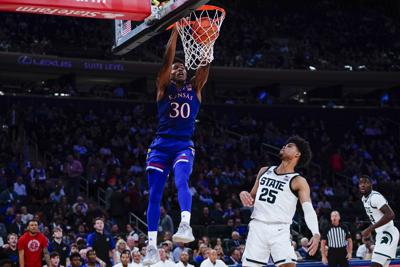
Ochai Agbaji flushes in 2 of his 29 points

Ochai Agbaji: 29 points, 2 rebounds, 1 assist, 2 steals, 0 blocks. +12.47

Bobby Pettiford: 5 points, 2 rebounds, 2 assists, 0 steals, 0 blocks. +4.09

Zach Clemence: 7 points, 1 rebound, 0 assists, 2 steals, 0 blocks. +3.69

Remy Martin: 15 points, 6 rebounds, 2 assists, 0 steals, 0 blocks. +2.53

Jalen Coleman-Lands: 5 points, 0 rebounds, 1 assist, 0 steals, 0 blocks. +1.46

K.J. Adams: 0 points, 2 rebounds, 1 assist, 0 steals, 1 block. +1.44

Mitch Lightfoot: 4 points, 3 rebounds, 0 assists, 0 steals, 1 block. +0.46

Christian Braun: 6 points, 8 rebounds, 2 assists, 1 steal, 0 blocks. +0.39

Joseph Yesufu: 0 points, 0 rebounds, 0 assists, 0 steals, 0 blocks. -0.37

Dejuan Harris: 6 points, 3 rebounds, 4 assists, 3 steals, 0 blocks. -0.69

David McCormack: 10 points, 2 rebounds, 0 assists, 0 steals, 2 blocks. -9.53

TEAM: +15.95 (Off: +13.45 Def: +2.49)

Kansas went to 1-0 after defeating Michigan State by a score of 87-74. Ochai Agbaji easily earned game MVP honors. His 29 points were a career high, but he also played solid defense. The three freshmen; Bobby Pettiford, Zach Clemence, and K.J. Adams; all made positive contributions in their first career regular season games as Jayhawks. Incoming transfer Remy Martin score 15 second-half points to produce a solid offensive outing but gave up some points on defense which reduced his contribution overall. Jalen Coleman-Lands was defensively solid in his 9 1/2 minutes of play off the bench. Returning veterans Mitch Lightfoot and Christian Braun each produced slight positive value. Braun struggled offensively but rebounded and defended. Dejuan Harris made some contributions on defense and was efficient offensively, but his lack of production meant a negative value score. Josephy Yesufu did little of note in 6 1/2 minutes of play. Last, David McCormack struggled mightily on defense, and his offensive efficiency hurt his output on that end.

Emporia State (Exhibition) Game Recap

Last night, the new look Kansas Jayhawks defeated the Emporia State Hornets 86-60 in the team’s only preseason exhibition matchup. They will start the regular season Tuesday against Michigan State.

Chris Teahan, starter

Predicting who the starting five was going to be has been a much-debated exercise among KU fans in the recent weeks, but I don’t think anyone had walk-on super Senior Chris Teahan in the lineup. With Jalen Wilson out on suspension and Remy Martin apparently not practicing in the way Self wants, Coach went with Chris Teahan alongside Dejuan Harris, Ochai Agbaji, Christian Braun, and David McCormack. Teahan didn’t score in nearly 7 minutes of play.

From best to worst, here is how KU players performed. Keep in mind that this is just one game, and it was against a team that is far less competitive than KU’s normal opponents. The three PPG +/- numbers below reflect the unadjusted value score, the opponent-adjusted value score, and the per 60 possession estimated score. The per 60 possessions is made to normalize a player’s score over 60 possessions (or about what a key starter would play in an important, close game). Basically, it lets us see what the player would have contributed had he played at his value level for a full-length game.

Ochai Agbaji: 17 pts (6-12, 0-0), 7 rebounds, 2 assists, 2 steals in 23 minutes. +10.68 +7.24 +10.64

Ochai was excellent on both ends of the floor, drilling 5-7 from 3 while playing good on-ball defense. He only gave up 2 points in 23 minutes. Despite being last season’s leading scorer, Och has been overlooked somewhat coming into the season. But it is clear from last night that he will be a key piece of the puzzle.

David McCormack: 16 pts (5-8, 6-6), 8 rebounds, 1 assist, 1 steal in 15 minutes. +8.75 +6.54 +14.94

D-Mac got off to a slow start but finished the first half strong and dominated inside during his second half minutes as well. It would have been nice to see more playing time out of the team’s best center, but Self wanted to see how the other post guys would do. He posted a 1.78 offensive efficiency score and should quietly be one of the team’s most valuable guys this year.

Remy Martin: 15 pts (7-10, 0-0), 2 rebounds, 4 assists, 1 steal in 18 minutes. +6.84 +4.18 +7.92

The most-expected performance was that of Remy Martin, and it didn’t disappoint. Benched to start as an obvious motivation ploy by his head coach, Remy came in and immediately started to score, posting 13 points in the first half. His defense wasn’t great at times, getting beat off the bounce and then over the top on a lob as well. Shot selection will be key this season. Keep in mind, however, that he is the best Jayhawk at getting his own shot and scoring is the most important element in basketball statistics.

Mitch Lightfoot: 5 pts (1-4, 2-2), 5 rebounds, 2 blocks in 8 minutes. +3.05 +1.90 +8.41

Mitch was the team’s best interior defender yesterday, as he finished with a 0.20 defensive efficiency score (lower is better) by giving up only 2 points. To translate that number, if everyone had played as good of ball defense as Lightfoot the team would have given up 51 points instead of 60. And while he hit his only 3-point field goal, his inability to score in tight was a frustrating reminder of his offensive ceiling.

Christian Braun: 10 pts (4-10, 0-0), 3 rebounds, 3 assists, 1 steal in 24 minutes. +2.96 -0.58 -0.83

Braun played fine, and his adjusted number could have easily been on the plus side if the ball bounced slightly differently. Still, he continues to struggle to score on his own. He should benefit from better point guard play this year.

Joseph Yesufu: 4 pts (2-7, 0-0), 1 rebound, 3 assists, 3 steals in 21 minutes. +2.30 -0.78 -1.28

Yesufu’s value score looks better than what the eye-test says. But he actually defended adequately, giving up only 2 points while swiping 3 steals. He missed some shots inside, but shared the ball well to add value with assists. Still figuring out his role, if he continues to defend he should be a nice addition to this year’s squad.

Dejuan Harris: 6 pts (3-3, 0-0), 1 rebound, 2 assists, 1 steal in 22 minutes. +2.12 -1.16 -1.80

Harris was super-efficient (1.69 offensive efficiency), but like last season it was his limited production that contributed to a lower value score. He played 4 more minutes than Remy Martin, but produced nearly 11 fewer points of offense than his backcourt teammate. Defensively he bothered ball-handlers but gave up a few buckets. His value will increase with more transition opportunities.

Michael Jankovich: 2 pts (0-2, 2-2), 1 rebound in 4 minutes. +1.03 +0.49 +4.63

Jank outscored his man 2 to 0, while grabbing a defensive rebound as well in mop-up minutes. Would be nice for him if he can get in more games than last year when he was injured and only played in 1.

K.J. Adams: 2 pts (1-3, 0-0), 1 rebound, 1 assist in 14 minutes. +1.01 -1.08 -2.62

The last remaining Jayhawk who outperformed his Emporia State opponent, KJ showed some versatility on both ends (and didn’t give up any points). With both Jalens out to begin the season, he might get an opportunity when the regular season starts. If he can defend and rebound, he can add some value.

Cam Martin: 0 pts (0-2, 0-0), 4 rebounds, 0 assists, 1 steal in 8 minutes. -0.59 -1.72 -7.68

Cam didn’t seem to get into the offensive flow much while he was in. As a scorer in D-II, the question of how he can help this team in a different role is still unanswered. Still, his size and rebounding shows that he can be a factor, particularly in the half-court. He will likely get more minutes in certain games as opposed to others.

Chris Teahan: 0 pts (0-0, 0-0), 1 rebound in 7 minutes. -1.50 -2.49 -12.70

Surprisingly Teahan didn’t get a shot off in 7 minutes of action. His only negative play was giving up 2 points during second-half action, so while he was with the starters, he mostly played a complimentary piece and did well to not hurt the team.

Bobby Pettiford: 3 pts (1-4, 1-1), 4 rebounds, 2 assists, 0 steals in 20 minutes. -2.13 -5.13 -8.65

The eye-test judged him more favorably, as he can clearly handle the ball, score, distribute, and defend at this level. His defensive score fared worse than his offense, and that was him missing some shots. I don’t find it likely that he redshirts.

Kyle Cuffe: 2 pts (1-3, 0-0), 0 rebounds, 0 assists in 7 minutes. -3.44 -4.42 -22.69

Struggled on both ends, but did get a nice finish and 2 points late in the game. He is likely to redshirt.

Zach Clemence: 4 pts (2-2, 0-0), 4 rebounds, 0 assists, 0 steals in 10 minutes. -5.09 -6.50 – 23.29

Zach finished with a decent offensive efficiency of 1.25, but he gave up multiple 3-point baskets which killed his defensive value. Over the course of more minutes and more games, that number wouldn’t look as bad. As a freshman, expect little playing time if he doesn’t redshirt.

Lineups, lineups, lineups

As I wrote yesterday, the lineups in November buy games can get quite fun. Yesterday was certainly no different. Self stuck exclusively with four-guard/wing lineups, meaning that the four post players (McCormack, Lightfoot, Cam Martin, Clemence) shared 40 minutes of action. Self made comments before the game that since the team has only practiced 4-out 1-in, he won’t be playing 2 posts together. If he stuck with this strategy during a pre-season game, I believe him.

But playing this way also meant that the team had 3 “little” guards (under 6’1) in the game at the same time (Harris, Remy Martin, Yesufu, Pettiford). Going this small caused some defensive problems, and Emporia State was able to throw the ball over the top or dump it inside easier at these moments. This was especially true when it ran an inverted offense, i.e. it brought its big man out to clear space and gain the advantage inside at the “3” position.

For these reasons, it seems that the depth chart will look like this come Tuesday.

PG/SG (1/2 position): 2 of Remy Martin, Dejuan Harris, Joseph Yesufu, Bobby Pettiford

SF/PF (3/4 position): 2 of Ochai Agbaji, Christian Braun, KJ Adams

C (5 position): 1 of David McCormack, Mitch Lightfoot, Cam Martin, Zach Clemence

With Jalen Wilson (PF) and Jalen Coleman-Lands (SF) out, this gives KJ Adams an opportunity. Even if both Och and CB played 32 minutes Tuesday, this would still leave 16 minutes for KJ Adams. Of course, Self could still go with 3 small guards for some of the game, but Adams will certainly play. David McCormack averaged 23 minutes per game last season, so unless he dramatically improves his ability to stay on the court, this leaves a decent amount of back-up time for the likes of Lightfoot, Cam Martin, and even Clemence. Expect the team to run a more guard-oriented offense when McCormack is out. What the backup posts can do is defend and rebound, and so far, Lightfoot looks like the most capable.

Closing Thoughts

The 2022 Kansas Jayhawks will be fun to watch. They will be able to stay in games since they can score at so many positions. The team’s depth should allow it to play better defense than it might otherwise be able to. At least initially, guys like Ochai Agbaji and Christian Braun will get more minutes than fans think they should. This perception will especially hold if either struggle to make shots. But we know Self won’t play two posts together, and the other option of playing three small guards will make half-court defense and rebounding worse. Also, keep in mind that both Agbaji and Braun are KU’s most prolific 3-point shooters. Ironically going small can take away shooting and spacing for this year’s team.

Remy Martin will take over some games and pull the team out of the fire. But in playing so freely, he will also take ill-advised shots that will get him a seat next to the coaches. Self will want to get the ball into David McCormack, and this is a good thing. D-Mac can be inconsistent, but give him 25+ minutes and enough touches and his offensive efficiency and production tends to be quite good. He played absolutely great during last year’s Big 12 play (+4.97 Adj PPG +/- in 18 games), demonstrating he was the league’s best center. Feed him the ball and those force teams who want to play small to stop him.

Getting the Jalens back will be the cherry on top of a potent offense. Coleman-Lands will naturally provide the wing spacing and veteran consistency that the team is missing when Agbaji/Braun need a rest. Wilson will bring even more offensive potency to a loaded lineup. The games (and the stats) start to count this Tuesday! Rock Chalk!

Pre-Conference KU Basketball is Underrated

It’s here! The 2021-22 Kansas Jayhawk basketball season is finally here. After a virus-shortened end to the 2020 season and a low-attendance, socially-distanced truncated 2021 season; 2022 will be close to back to normal. Allen Fieldhouse will be at full attendance, teams will be playing full 31-game schedules, and hopefully there won’t be any dramatic pauses or shutdowns. Tonight’s game against Emporia State is the only broadcasted exhibition game KU will have.

With that in mind, I wanted to celebrate the period of the season we are in. College basketball gets overlooked this time of year with football still in full swing, Thanksgiving/Christmas/New Years holidays approaching, and the more important conference and tournament games still some time away. Even many fans of college basketball in general or KU in particular tend to downplay games in November or December. But here’s why you shouldn’t! Pre-conference KU basketball is a time to be excited about.

Reason 1: College Hoops is Back

This goes without saying, but any games are better than none. It’s been a long time since March. While the off-season has spiced up in recent years with so much roster turnover…who goes to the NBA, who transfers out, who transfers in, what late recruits decide, etc.…there’s nothing like seeing live competition. For KU fans specifically, it’s the return to the Fieldhouse, the Jayhawk on center court, the bright lights, the whistles, the squeaks of the shoes, the substitution horn, the band playing “Living on a Prayer”, the crowd roaring after a fast-break dunk, the Rock Chalk chant, the Alma Mater, the analysis on TV or radio or online before and after, etc. The season is just different than the off-season. This morning many Kansans awoke to frost on the ground for the first time in months. The cold weather has returned. It just feels like basketball season.

Reason 2: Season’s Unlimited Potential

Prognostication is fun, but until the ball is tipped you don’t exactly know how the games will turn out. Will this be the year that KU finally makes it back to the Final Four and cuts down the nets? There are no losses or periods poor play to poor cold water on those dreams yet. The journey begins tonight, even if it is only a preseason game. In the same way, it is fun to finally see how much the returning players have improved, how the freshmen look, and in this new era how the incoming transfers play. Thinking about Remy Martin breaking down his defender and getting to the cup or kicking it to a shooter, or how much Dejuan Harris has improved makes you believe that these are the guys and this is the team that can do it. At Preseason #3, this team has the accolades to be there at the end of the year.

Reason 3: Easy Wins, Less Stress

One-possession away conference games and nail biters in March Madness are fun, but can be very stressful to watch. Games that are basically guaranteed wins allows you to enjoy watching the superior talent and coaching of the Hawks. Looking at non-conference Allen Fieldhouse games against non-power opponents since 2003-04 season, Self’s Jayhawks are 106-3, with the most recent loss being against Oral Roberts in November 2006. And the games themselves are often fun, at least for a while. More fastbreaks, dunks, up-and-down play, and possessions equals more fun. And while these games sometimes find a lull in excitement as the margin gets wider, the walk-ons getting to play and the chance at getting 100 points doesn’t happen every day.

Reason 4: New Faces, Fun Lineups

Once we get into conference play, the rotation is normally shrunk down to about 8 key players. But early-season games allow Self to experiment with lineups and we get to see freshman and others who didn’t contribute much get more court time as they seek to improve the value they bring to the team. The 2022 team has 10 players who played at least 25% of minutes last year for their respective teams. None want to sit on the bench. It also has 4 incoming freshman who want to earn court time. Guys will play hard when they want to.

Reason 5: New Matchups

KU will face Tarleton State for the first time in school history, and then Stony Brook the following week. Where is Stony Brook located you ask? Why Stony Brook, NY of course!

Reason 6: Dave Armstrong

The corny catchphrases and homerism mixed in with the genuine excitement is something you don’t miss until its gone. He’s been doing games for years, and moved over to ESPN+ to call the Jayhawk Network games a few years back. We should get him tonight and also for the Tarleton St., Stony Brook, UTEP (in KC), Stephen F. Austin, and Harvard home games. Wow!

Reason 7: Games Only Get Better from Here

So, you’re not convinced yet? Who remembers what team KU beat by 39 the first game of the 2007-08 season (it was Louisiana Monroe, 107-78 btw), but we all remember how that season ended! Fair point. Sure, not every game of the season is equal. But we have to start somewhere. So even if you don’t find yourself as excited for preseason basketball as I am, try and make the most of it. Enjoy the season!

2011 Kansas Jayhawks

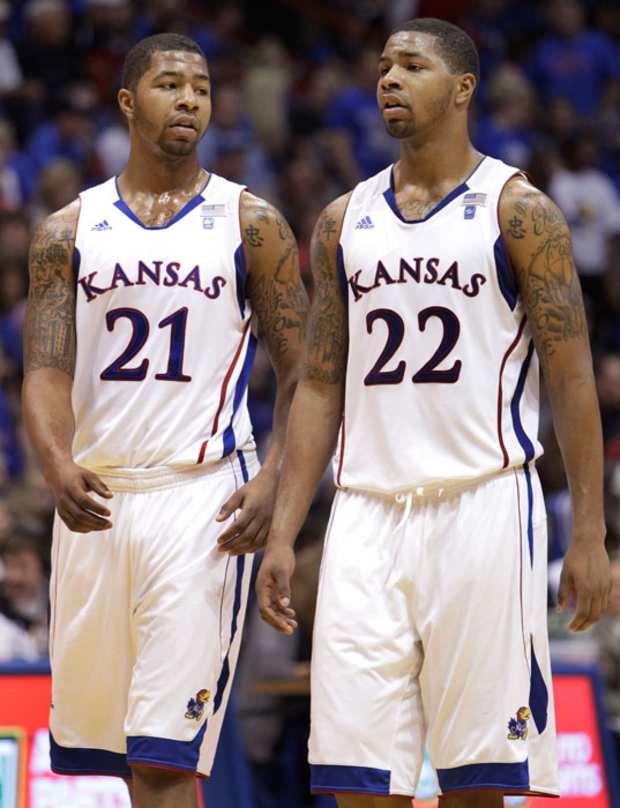
The 2011 Kansas Jayhawks finished 35-3 (14-2), winning the Big 12 Regular Season and Conference Tournament. The team earned a 1-seed in the NCAA Tournament and made the Elite 8 before losing. The team’s Sports Reference link is here.

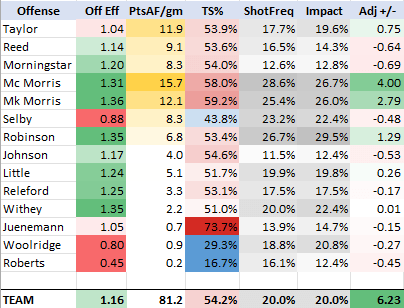
OFFENSE

The 2011 offense was based heavily on the interior, with PF Marcus Morris producing the most value of anyone at +4.00. Markieff Morris and reserve Thomas Robinson were also efficient and productive, adding +2.79 and +1.29 points of value per game. The point production was fairly balanced among the main guards, although aside from Josh Selby it was clear that the role of the guards was to be facilitators first. The team’s true shooting was fairly balanced, again aside from Selby who took too many shots. This suggests the other players took shots at a sensible frequency that would best help the team win.

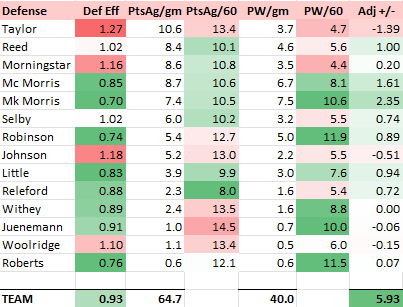
DEFENSE

The 2011 defense was an underrated group. Without a primary shot-blocker in the starting rotation; it relied on lateral quickness, communication, and rebounding. Junior PF Markieff Morris graded out as the best individual defender, winning 10.6 possessions per 60. His brother was also solid inside. On the perimeter Tyrel Reed, Josh Selby, and Travis Releford produced solid seasons. Brady Morningstar finished with positive value on this side (albeit not by much), and Tyshawn Taylor finished with the worst per game value score of any defender since 1993.

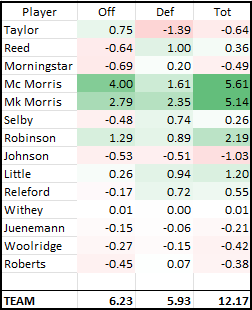
Total Adjusted PPG +/-

Marcus Morris and Markieff Morris performed a feat that has only been done one other time since 1997 (through the 2026 season), namely be a part of a duo that each produced over 5 points of per game value. Raef LaFrentz and Paul Pierce in 1998 also accomplished this. Beyond the Morris twins, KU had valuable bench forwards in Thomas Robinson and Mario Little. Tyrel Reed made a small contribution (+0.36) as a senior, as did Josh Selby in his only season (+0.26). The other rotation guards faired poorly. Travis Releford could have made the argument that he warranted more time on the wing given his decent value in limited minutes.

There was a lot of questions coming into the 2011 season for Kansas, but it soon became clear that Marcus and Markieff had improved enough to get Kansas to the heights it wanted to get. In their junior season, the Morris twins parlayed their starring roles at Kansas into mid-first round picks in the following summer’s NBA Draft. Each developed from inconsistent freshmen into lottery picks with similar but slightly different games that were good enough to stick around in the professional ranks. Like most players, their careers ended on a sour note. But without them, this team is nowhere near a 1 seed or Elite 8 caliber squad.

Kansas walk-on children's book 'Fieldhouse' - Sports Illustrated

2022 Season Preview

Coach Bill Self did a lot in the offseason, adding four veteran transfers to a recruiting class of four 4-star recruits to a roster returning four starters. That’s a lot of fours.

The biggest loss from last season is Marcus Garrett. Playing out of position as the starting point guard, Garrett still managed to put up a decent offensive season. His greatest value was through his defense, topping all other seasons of KU players since 1997 including his now-second-place 2020 campaign. He will be missed.

Let’s first look at returning KU rotation players, using value data from prior seasons, and attempt to project PPG +/- value scores.

Ochai Agbaji (Sr.):

2019: Off -1.01 Def +1.57 Tot +0.56

2020: Off -1.14 Def +0.19 Tot -0.95

2021: Off +0.42 Def +0.88 Tot +1.30

Agbaji’s sophomore slump was all-but-forgotten when he got off to a hot start in the 2021 season. He did revert back down as the season went on, but he did finish as KU’s leading scorer and a key piece of a team that earned a 3-seed in March. He is an extremely good athlete and solid shooter who is now a senior. If he can improve on some weaknesses (ball handling, decision making) and put it all together this season, it could have tremendous benefit to both the team and his draft stock. Still, even a middle-of-the-road estimate puts him as a critical part of the 2022 team.
2022 Prediction: Off +0.65 Def +1.20 Tot +1.85

Christian Braun (Jr.):

2020: Off -0.33 Def +0.49 Tot +0.16

2021: Off -0.40 Def +0.48 Tot +0.08

Braun’s value scores were very similar from 2020 to 2021. The major difference was his playing time, he jumped from 45.8% of minutes played as a freshman to 77.7% as a sophomore. Braun will play significant minutes as a junior, and should improve on both sides of the ball. Playing with ball-handling-heavy guards should free him up to knock down jumpers and get set up on backdoors and transition opportunities. The bulk of his value above bubble-player will come from his defense and rebounding. 2022 Prediction: Off -0.05 Def +0.75 Tot +0.70

Dejuan Harris (RS So.):

2021: Off -1.09 Def -0.35 Tot -1.44

Harris struggled to produce points despite shooting efficiently and distributing the ball nicely. He wasn’t a threat to score, and his lack of size was exposed whenever he was tasked with guarding larger or more physical players. Still, with an offseason of adding strength, he has the skill to be a valuable player. The biggest question is how Self will structure his rotation. With two new transfer PGs coming in, Harris might not get too many minutes. But Self could decide to play small and go with four guards most of the time. Harris shouldn’t be asked to do more than he is capable of with the roster as deep as it is. He will certainly improve on his freshman value scores. 2022 Prediction: Off -0.75 Def -0.20 Tot -0.95

Mitch Lightfoot (RS Sr.):

2017: Off -0.46 Def -0.19 Tot -0.65

2018: Off -0.69 Def -0.59 Tot -1.29

2019: Off -0.61 Def -0.10 Tot -0.71

2021: Off -0.36 Def -0.48 Tot -0.84

Lightfoot took a step back in 2021 after redshirting. He has clearly reached his peak as a college basketball player. His sixth year in the program should only get him fill-in minutes with the depth of the roster, but his defense might still be needed at times based on matchup. Ideally, he should play around 10% of season minutes, which will keep his value score from getting too low on a per game basis. 2022 Prediction: Off -0.25 Def -0.25 Tot -0.50

David McCormack (Sr.):

2019: Off +0.39 Def -0.68 Tot -0.29

2020: Off +1.15 Def -0.67 Tot +0.48

2021: Off +3.44 Def -0.56 Tot +2.88

McCormack’s offense is highly underrated. He is a good scorer who gets his hands on a number of offensive rebounds, and at 80% is a solid free throw shooter. With Remy Martin and Yesufu getting him looks, he should easily score as well as he did during last season’s Big 12 play. On the other side of the ball, his defense will still be a weakness. His uncomfortably low defensive score in 2021 was partially due to how his season ended with very poor showings in the NCAA Tournament. He should improve on that side of the ball, but he won’t turn into Sasha Kaun. 2022 Prediction: Off +3.20 Def -0.10 Tot +3.10

Jalen Wilson (RS So.):

2020: Off -0.64 Def +0.20 Tot -0.44

2021: Off +0.95 Def -0.31 Tot +0.64

Jalen Wilson was KU’s biggest positive surprise for the 2020 season. He started in all but a few games, and was a serious scorer particularly early on. He can drive, pull-up, or hit the deep shot. He also rebounded well on both ends. On the other end, his on-ball defense was not very good. He struggles to find someone to guard…traditional bigs can take him into the post and quicker guards can easily beat him on the drive. 2022 Prediction: Off +1.15 Def -0.10 Tot +1.05

We have the most data on these six players, so their estimates should be more accurate than other players. These six form a solid core that could get KU into the tournament easily enough. It is the next set, the transfers, that can get this team from a middling seed and into the upper echelon of the sport and a deep tournament run.

Jalen Coleman-Lands (RS Sr):

2021: Off +0.60 Def -1.25 Tot -0.75

Jalen Coleman-Lands began his college career in the same season that Perry Ellis graduated (he was in the same recruiting class as Ben Simmons). After two years at Illinois, a transfer year, a medical redshirt year, a season at DePaul, then a season at Iowa St., he is taking advantage of the new transfer rules to finish his career as a Jayhawk.

As a shooter, he’s a career 39%/37%/81% marksman (FG%, 3pt%, FT%). He should excel playing on a spaced-out floor with other shooters and ball-handlers. He did average 14.3 ppg on a dreadful Iowa St. team last season, but his career assist-per-game mark is only at 1.1. He doesn’t create a lot of offense on his own and relies on spacing/ball-movement.

Defensively he is a question mark. He played on poor defensive team last season, so how much will playing with better athletes help him on that end this season? Isaiah Moss is a comparison here, but Moss was a very good on-ball defender playing for KU. But if Lands’ defense is more like that of Lagerald Vick, he won’t add much value to the roster. The prediction below believes he can step up his game well enough to be a value-neutral player, given his solid shooting and veteran presence. Any defensive competency he shows on the wing will be an added bonus to the team. 2022 Prediction: Off +0.50 Def -0.50 Tot +0.00

Cam Martin (Sr.)

The Missouri Southern (D-2) transfer can fill it up, as he averaged 25.0 ppg, 9.1 rpg with excellent shooting percentage numbers (44% from 3). But scoring against Division 1 athletes will be tougher, as will be playing solid enough defense to earn floor time. But he will get his chances during the season, and should be playing with good enough facilitators which allow him to score. 2022 Prediction: Off +0.45 Def -0.15 Tot +0.30

Remy Martin (Sr.)

2021: Off +3.52 Def +0.17 Tot +3.69

2-0 against Kansas during his career as an Arizona St. Sun Devil, Martin brings ball-handling, passing, shooting, and scoring to the PG position. He should start and has a great chance to be KU’s leading scorer and best player. Over the last two seasons, he’s averaged 19.1 ppg and 3.9 apg playing for a mediocre team. Surrounded with scorers like Wilson and McCormack and shooters like Agbaji and Braun, he might not score as much as he had to at ASU but he should up his assists and increase his efficiency. Defensively, he is quick and gets a fair share of steals. He has the physical tools to be a good defender on the perimeter against fellow guards. He is smaller, so any switches would give him trouble inside. Should he stay healthy, he could add his name to the list of excellent KU point guards that have come through in recent seasons. 2022 Prediction: Off +3.00 Def +0.50 Tot +3.50

Joseph Yesufu (Jr.)

2021: Off +0.91 Def +0.10 Tot +1.01

Yesufu blew-up for Drake at the end of last season, working his way not only into the starting rotation but also as the guy for the Bulldogs. He averaged 23.2 ppg in his last 9 games on 47% shooting from 3. But for most of the season, and for his freshman season the year prior, he was a reserve-guard for a mid-major program. Can he continue to play at his highest level? How does he defend? These are tough questions to answer and to predict. Still, due to his age (junior) and his scoring ability, he will find time on the court. 2022 Prediction: Off +1.25 Def -0.15 Tot +1.10

These four guys didn’t transfer to sit; they came to help KU achieve its program goals. Remy Martin will almost certainly start, while Yesufu and even Coleman-Lands have a decent chance of starting. These four will need to perform to their capacity in order to push KU to the heights of a 1 or 2 seed. The next set of players, all true freshmen, have an exciting mix of potential and raw talent. We don’t know exactly what KU is getting with these guys, but each has the opportunity to be solid multi-year guys for the program. Any value added by any of these players will add a bonus element to an already-stacked roster. Due to the team’s depth, there is a good chance at least one of these guys redshirts. The early money is on Kyle Cuffe to sit. We’ll assume this is the case for now, and leave his prediction score off.

KJ Adams (Fr.)

The freshman 4-star is ranked lower in the Top 100 (#71 composite) but is still a serious prospect. At 6’6 with quickness, he could find high-leverage minutes as a stretch four when KU is wanting to play aggressive on defense. His role should be playing high-energy, getting rebounds, loose balls, pressing his man on defense, etc. His estimate assumes he plays in some games early, but ultimately gets only a few minutes in some Big 12 games as the season wears on. 2022 Prediction: Off -0.25 Def -0.40 Tot -0.65

Zach Clemence (Fr.)

The freshman 4-star is ranked somewhere in the middle part of the Top 100 (#39 composite), a spot which usually assumes some development is still to come. As an upper classman, Clemence should be a key piece. But let’s not expect much from him as a freshman. Since 2016, the average score for a freshman rotation player is +0.04. He is far closer to the lower-end (Harris, Thompson) of that spectrum than the upper end (Jackson, Dotson) which is why his score is negative. If he were to contribute, it’d be to his shooting, ball skills, and size as a solid and versatile 4-man. He should get a trial run in the games before Christmas, but expect his minutes to be shrunk by conference play. 2022 Prediction: Off -0.20 Def -0.35 Tot -0.55

Bobby Pettiford (Fr.)

The freshman 4-star combo guard is ranked lower than the other KU frosh recruits (#88 composite), but early reports have been positive. He is playing behind three ball-handling guards (Martin, Yesufu, Harris) and three good-shooting wings (Agbaji, Braun, Coleman-Lands), so there aren’t many minutes left unless he overperforms his ranking. 2022 Prediction: Off -0.25 Def -0.35 Tot -0.60

The last group of players would be walk-ons. KU has four walk-ons this season, but only two will be given any detail. Dillon Wilhite and Charlie McCarthy are potential redshirts.

Chris Teahan (Sr.):

2018: Off -0.10 Def -0.10 Tot -0.20

2019: Off -0.17 Def -0.00 Tot -0.17

2020: Off -0.17 Def -0.90 Tot -1.07

2021: Off +0.39 Def +0.40 Tot +0.79

Walk-ons’ value scores shouldn’t be taken too seriously, as their limited playing time and quality of opponent during mop-up time can skew their numbers dramatically. Still, Teahan showed strong shooting and rebounding ability to generate a strong, positive, value-score in 2021. With KU’s 2022 depth being what it is I doubt he gets serious minutes in the upcoming season. But he might actually be better than his brother, who did play serious minutes for the 2012 national runners-up. 2022 Prediction: Off +0.00 Def -0.20 Tot -0.20

Michael Jankovich (Jr.):

2020: Off +0.05 Def -0.91 Tot -0.86

2021: Off -0.79 Def -1.09 Tot -1.88

Jankovich was injured most of last season and only played in one game (the USC game). Like Teahan, he is a seriously good shooter who can make shots coming in cold. 2022 Prediction: Off -0.25 Def -0.50 Tot -0.75

2022 KU Jayhawks basketball team predictions

As a team, predicting playing patterns that Self tends to favor (8-9 player rotation by conference play), the math works out to a +9.50 Team Score this season. This would put the overall performance about on par with the 2012 team, and around average for a Bill Self Kansas team. However, this year’s roster will get it done primarily through offense (+8.93), while its defense struggles (+0.58) to attain what past KU teams have. Translating these numbers to efficiency ratings, the estimate is that KU should be ranked about 2nd on offense and 40th on defense this season in all of D-1.

There are three big questions heading into the season.

1…Can Self get this team to defend?

It’s surprising to see a projected defensive score so low. As a comparison, in the Bill Self era the worst defensive team (2018) is still better than the projection of the 2022 team. The 2018 team was still able to make the Final Four, but did so due to great offense. But why is the 2022 team’s projected defense so bad?

The PPG +/- system relies on the assumption that the team is as good as its parts. Or another way to put it, the skill level of the team (reflected in points against opponent weighted by strength) is attributed to each player so that the sum of all player scores just equals the team score. A team with good defenders will have a higher (better) defensive score than a team with poor defenders.

Last season’s defense wasn’t great, but the largest reason it was competent at all was the play of Marcus Garrett. Losing him on the perimeter means teams should have an easier time running their offense this season. Can KU pick up the pieces and defend scorers? Can Agbaji become the team’s best on-ball defender? Can Braun step up his defense? What will the incoming guards/wings do on this end?

One dark horse on this end is the depth that KU can throw out there. Would Self be open to pressing more given how much athleticism is on the roster? Upping the tempo might be in the team’s best interest. It would also be a lot of fun. Perhaps the best defense KU can put out there is to counterintuitively increase scoring. But on a per possession basis, running might make its defense more efficient if it wears its opponents down.

2…What will the rotation look like?

KU has 18 players on the 2022 roster, with 14 of those players being on scholarship. Redshirting at least one player seems likely. Let’s assume the freshmen won’t provide much value. That still leaves 10 non-freshmen, all of whom used to playing rotation-minutes, having to work together.

KU’s depth is particularly strong at the guard/wing position. Remy Martin, Joseph Yesufu, Jalen Coleman Lands, Ochai Agbaji, Christian Braun were all starters last year for whatever team they were on. Dejuan Harris was a 6th man averaging 29 minutes per game during the final four games of KU’s season. Six guys for three spots makes it crowded.

Looking at the forward position, you have two serious returning starters in David McCormack and Jalen Wilson. Mitch Lightfoot’s minutes can likely be cut back, but Cam Martin will likely play when D-Mac is on the bench. KU could go small, and move Braun/Agbaji into the 4-man role when Wilson is sitting. This would open up a fourth spot to rotate the 6 guards/wings.

Of course, the freshman will still get a look. Clemence and Adams each bring a unique skill set that isn’t realized by a veteran player. Either would be a natural four in the current era of college basketball. It will be interesting to see Self mix and match rotations during the easy part of the November/December schedule. If the freshmen can defend, this would be a good way to get on the floor given how offensively-capable the team already is.

3…How explosive can the offense be?

This is the big unknown, because on paper this team will have the best offense in the Self era. McCormack, Wilson, Remy Martin, Yesufu, Coleman-Lands, and Cam Martin are scorers. If they are to produce the value they are capable of, it will have to be due to offense. Are there too many spoons in the pot? Note that this leaves of Agbaji, KU’s leading scorer from last season!

But this may be yet another argument for pushing the pace. The team has guard depth and quickness that can be utilized in transition. Upping the tempo allows more guys to get more shots and more offensive flow. Guys like Remy Martin can improve their efficiency by facilitating more than they’ve been able to in years past. Neither Agbaji nor Braun should need to force shots this season, and can focus on playing excellent defense and finishing plays when they get open opportunities. They team has complementary parts if they play together and stay within their roles.

Best Case/Worst Case/Middle Case

The realistic best-case scenario for the 2022 Kansas Jayhawks is to cut down the nets in April. They have depth, skill, experience, variety, and good coaching. Team’s will struggle to slow down an offense that can beat you from all five spots. Who can you pressure? Who can you leave to double-team? KU should have an answer to any challenge a defense might throw at them.

In this scenario, the defense doesn’t become all-time but gels together and wins possessions by playing solidly and limiting second-chance opportunities. In order to make up for losing Marcus Garrett, you’ll need Agbaji and Braun to continue to improve. McCormack and Wilson will need to perform better. The newcomers will need to show they can play defense at a program like Kansas. If everyone steps up his game just marginally, the cumulative effect can be a defense that is not a glaring weakness but in fact complements the outstanding offense.

On the flip side, the realistic worst-case scenario would be a middling regular season, capped by a higher single-digit seed and first round exit. Barring NCAA penalties or multiple critical injuries, this scenario would play out because the team had trouble making all the new pieces fit together. Poor decision making, too much isolation play, and lazy defense combined would hurt the team’s performance. Even with the team’s depth, a single injury to either McCormack or Remy would change the complexion of the team significantly. While not likely, the team could revert into what it was for much of last season, except without Marcus Garrett.

The realistic middle-case scenario is a 26 to 29-win pre-NCAA tournament season, Big 12 title, and on the line between a 1 or 2 seed and over/under 3.0 tournament wins. An Elite 8 run would be neither disappointing nor above-expectation, but rather a push when it came to season expectations. Like any team in any year, a Final Four should still be seen as a good season even if the team wasn’t able to close out the deal and win two more in April. The team should put up some points this year, which will be fun.

2012 Kansas Jayhawks

The 2012 Kansas Jayhawks finished with a record of 32-7 (16-2), winning the Big 12 Regular Season. The team earned a 2-seed in the NCAA Tournament and finished National Runners-Up. The team’s Sports Reference link is here.

Offense

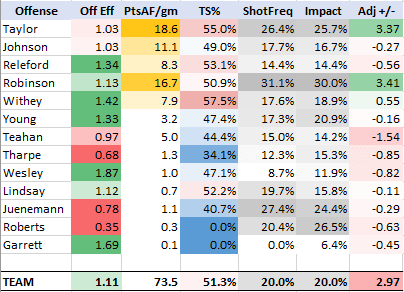
The 2012 Offense was led by Thomas Robinson (31.1% of shots while in game) and Tyshawn Taylor (26.4% shot frequency). With each player having such high volume, neither finished with high efficiency marks. But it was their overall productions, with Taylor producing 18.6 points a game and Robinson at 16.7, that drove their value scores.

The only other positive-value Jayhawk on offense was Jeff Withey, who was efficient thanks to a 57.5% true shooting and solid offensive rebounding marks.

Defense

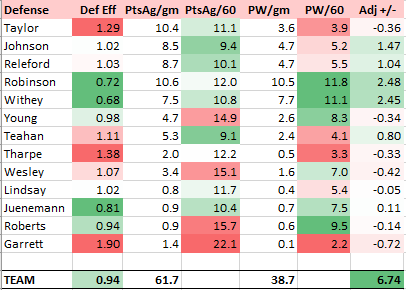
The 2012 Defense was what carried the team, as it was the #3 ranked adjusted defense on KenPom that year. Jeff Withey was the Big 12’s Defensive Player of the Year thanks to his shot blocking prowess (led the nation in block rate), but it was Thomas Robinson who actually produced the highest value score thanks to his excellent defensive rebounding ability (in fact he led the nation in defensive rebounding rate). Elijah Johnson and Travis Releford also produced over a point of value per game on defense. Conner Teahan was the other Jayhawk rotation player to provide positive defensive value, as he only allowed 9.1 points per 60 possessions. His positioning and ability to move laterally were underrated.

Adj. PPG +/-

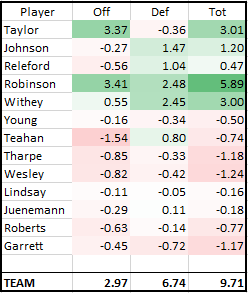
Thomas Robinson showed why he was the Big 12 Player of the Year and Consensus first-team All-American, producing over 6 points of value per game above that of a bubble-player at his position. Tyshawn Taylor edged out Jeff Withey for second place on the list, as each hovered around 3 points of value per game. Both Johnson and Releford rounded out the starting lineup with positive-value seasons thanks to solid defense.

The bench was another story. Both Kevin Young and Conner Teahan were able to keep their value scores respectable given that each was playing more minutes than expected (Young transferred from a mid-major; Teahan was a former walk-on), and they were certainly better than both Naadir Tharpe and Justin Wesley. Both Tharpe and Wesley had sub -1.00 scores despite playing relatively few minutes, if we looked at these value scores on a per possession basis they would look even lower for these two.

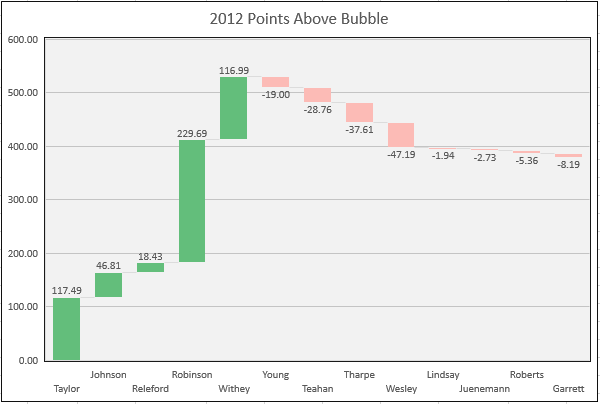
Per-100 Numbers:

  • Taylor +5.37
  • Johnson +2.22
  • Releford +0.91
  • Robinson +11.04
  • Withey +7.20
  • Young -2.61
  • Teahan -2.09
  • Tharpe -11.85
  • Wesley -9.04
  • Lindsay -4.13
  • Juenemann -3.46
  • Roberts -21.27
  • Garrett -30.46

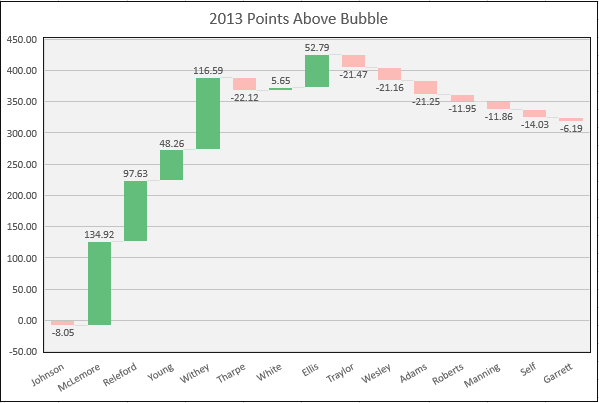
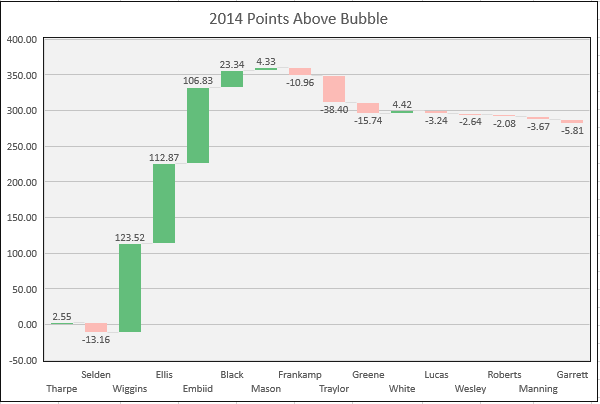
This waterfall chart is a nice representation of KU’s strengths and weaknesses. Good point guard play, dependable wing play, excellent power forward play, alongside good center play from its starters. When the team went to its bench, it started losing value rapidly.

Jayhawk of the Year

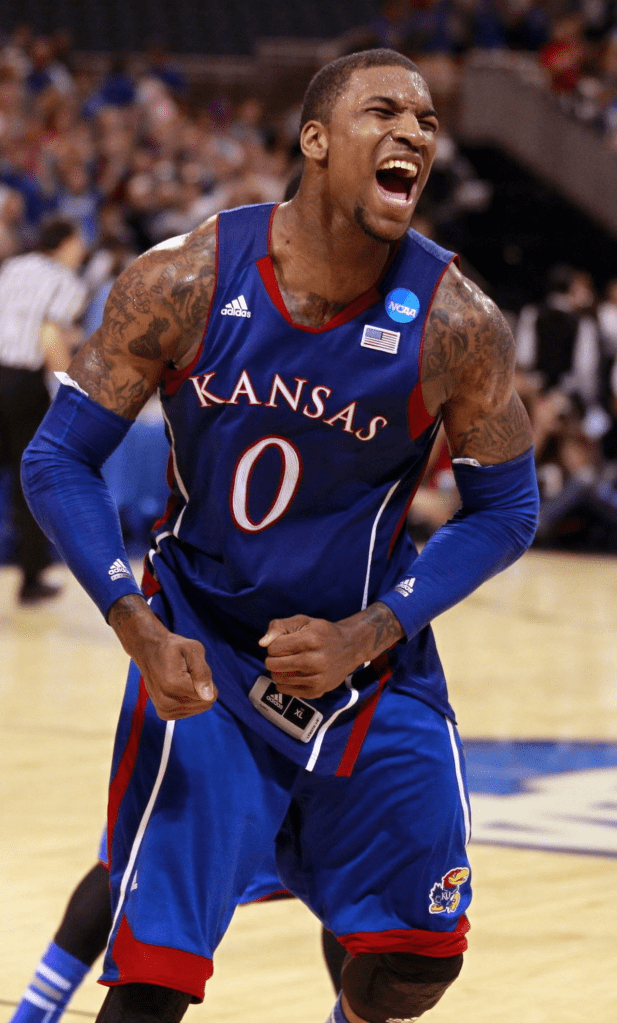
T-Rob celebrating a Final Four berth

KU’s run to the national championship game was quite unexpected at the beginning of the year, and wouldn’t have been possible if not for the dominant play of junior forward Thomas Robinson. A bench guy his first two seasons, Robinson excelled as a starter and go-to offensive weapon. He played with a lot of heart as well, bringing energy and helping to elevate the play of his teammates.

The 2012 season was a memorable run and has a special place in the hearts of many KU fans. Self’s ability to get the most out of his starters (all returnees who had their best seasons to that point in 2012) earned him many coaching accolades.

2013 Kansas Jayhawks

The 2013 Kansas Jayhawks finished with a record of 31-6 (14-4), winning the Big 12 Regular Season and Conference Tournament. The team earned a 1-seed in the NCAA Tournament, reaching the Sweet 16 before losing. The team’s Sports Reference link is here.

Offense

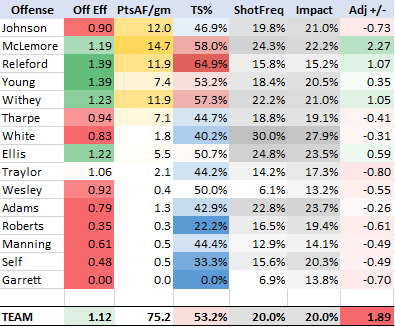
Losing leading scorers Thomas Robinson and Tyshawn Taylor from the prior year, the 2013 offense struggled compared to other Jayhawk teams. Redshirt freshman Ben McLemore was KU’s most talented scorer, contributing 14.7 points of offense per game while shooting a nice percentage on good volume. He was the only Jayhawk who provided over 2 points of value on offense for the season.

Seniors Travis Releford and Jeff Withey had solid offensive seasons, with Releford contributing an excellent 1.39 Offensive Efficiency at the wing position. Both Perry Ellis and Kevin Young were complimentary offensive players as well. Senior PG Elijah Johnson’s poor offensive season was due primarily to poor shooting.

Defense

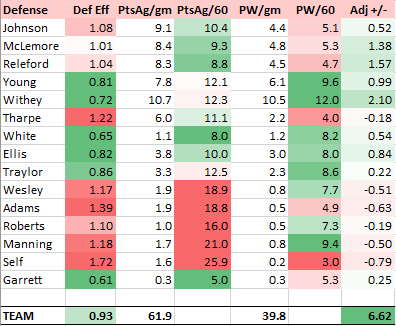
The 2013 team was very defensive-oriented. In fact, of its top-9 players, only Naadir Tharpe failed to provide above-bubble value. The defense was anchored inside by Jeff Withey who finished with a defensive score above +2.00 for the second straight season. Ben McLemore’s defense was underrated, as he graded out as a near-peer defender to senior Travis Releford. The 2013 team was Bill Self’s 8th consecutive team to reach a defensive Adj. +/- score of +5.00 or better, a mark that only 2 KU defenses have reached since (2016, 2020). The 2013 team was a classic, early Bill Self team that hung its hat on defense.

Adj. PPG +/-

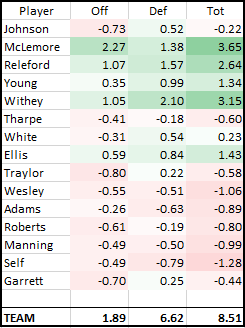
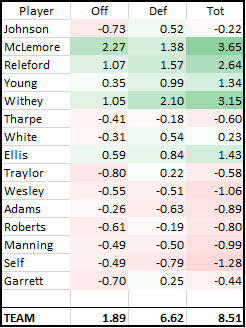
Ben McLemore was KU’s most valuable player in 2013, followed by Jeff Withey and Travis Releford. The team had nice balance with Young and Ellis also providing over +1.00 of value per game. The PG position was the team’s weakness, with Elijah Johnson battling injury all year and Naadir Tharpe struggling in moments. The TEAM score of +8.51 is actually a full point below KU’s average score since 1997. What’s amazing is that this team was still good enough to earn a 1 seed. The veteran play from its four seniors won it many close games.

Season Memories:

The 2013 team had multiple nice wins. Going into Columbus and beating a good Ohio State team for the third-straight time over the past two seasons. Smoking K-State by 21 after going through a rough three-game losing streak. But most memorable for this team are its two regular season wins against Iowa State. The first was in Allen Fieldhouse, when Ben McLemore banked in a 3 with 2 seconds left to send the game to overtime. He would torch the nets in the extra session as well, finishing with 33 points on 6-6 3’s for the game to lead the Jayhawks to victory.

The other Iowa State game will always be remembered as the “Elijah game.” With the Jayhawks needing a miracle to win in Ames, Johnson hit big shot after big shot to get the game to overtime, where he would then win it single-handedly. Johnson finished with 39 points and had a season-high game score of +19.78.

These moments proved to be huge for a Kansas program looking to extend its Big 12 Conference Title streak. KU would go on to share the regular season crown with K-State as each team had 14-4 records, though KU won both regular season meetings. In the conference tournament, KU would establish itself as the best team in the league by beating K-State for a third time in three tries, taking home the tournament trophy.

Stud frosh Ben McLemore shot 42% from 3 on the season
Jeff Withey spurred a huge second-half comeback in the Sprint Center to advance KU to the Sweet 16

Information Availability Analysis for 2013 season

Charting the Hawks looks to estimate player value for Kansas Jayhawks teams and players by using as much information as is publicly available. In order to get the most accurate player value data, game video must be available. For seasons past, this isn’t always possible for each game KU has played. When a certain game isn’t available to watch, supplemental information is used (play-by-play data, video replay highlights, scouting videos, radio coverage, box score info, postgame write-ups, game-feed discussions, etc.). This supplemental information allows for a better estimates, which can be amended whenever better information comes available. However, this necessarily means that each season has different amounts of info which can be used. More recent seasons have every play (or 99.9% of plays) on video. These estimates are the best. The further we go back, generally there are fewer games available for rewatch and less supplemental info.

To account for this discrepancy, CtH has a system which can analyze how complete the info is for a given season. This scale is set to 100%, with 100% meaning that each available possession during the season was watched on video. If no games were on video and the only information that was available were box scores, we would have an estimate of around 67%. This means that box score data can get us player value estimates that are about 2/3 as good as having each game. Thus the range of options for a given game, going back from the mid-90’s to today, tends to be around 67% to 100%, again with that number more likely to be closer to the high end the nearer to the present we are.

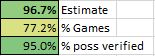
For the 2013 Kansas Jayhawks season, the info availability scores are:

The Estimate number best estimates the average accuracy of each possession over the course of the season. For plays that weren’t able to be recorded (such as defensive points allowed), an educated guess is used, divided among the players in the game. There is a scale which determines how certain we are of player-value for that possession. At 96.7%, we have good confidence that the 2013 player value scores listed above are accurate to within a small range. With more information, the player value scores would change, but probably not by much.

The % Games shows the number of full games that were available to watch for that season during the time CtH was charting these games for player value. At 77.2%, this means that 28 of the 37 KU games for the 2013 were available. Thanks to those who upload archived games, whether on YouTube or elsewhere.

The % Poss verified number looks at all possessions, and counts only the ones that were recorded either through video or through a play-by-play transcript. While play-by-plays aren’t 100% accurate, they are mostly reliable and excellent supplemental information to use. They are missing a few important player value components, most notably defensive points allowed, but for offensive stats and rebounding/steals, they help make things more accurate. At 95.0%, only 1 possession out of 20 is below a 90% confidence level of estimating player-value.

In summary, the take-away is this. For the 2013 player value numbers, resubmitted below, there is a high confidence level that these values are within +/- 0.25 points per game. The info availability for 2013 is quite good, and while the true CtH player value would be somewhat different if we had 100% info availability through all possessions being on video when charted, there wouldn’t be much change in all likelihood. Note this doesn’t say anything about the CtH system itself. So even at 100% info availability, these numbers would still best be considered quantitative estimates of player value.

The 2013 Kansas Jayhawks player value table. At Adjusted PPG +/-, Ben McLemore is considered to be +3.65 points better per game than a bubble-level replacement would be at his position and minutes. This value score is an estimate, but one that is backed up by a solid amount of information (96.7%) and a logically-based system that seeks to balance all elements of a basketball game in order to show one value-score.

2014 Kansas Jayhawks

The 2014 Kansas Jayhawks finished with a record of 25-10 (14-4), winning the Big 12 Regular Season. The team earned a 2-seed in the NCAA Tournament, reaching the Round of 32 before losing. The team’s Sports Reference link is here.

Offense:

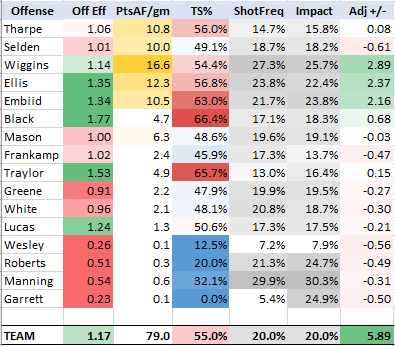
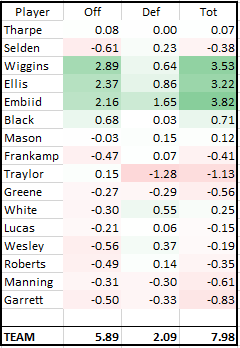
Andrew Wiggins led the Jayhawks’ offense in 2014, accounting for 16.6 points per game on 54.5% true shooting. He was joined by strong interior scoring from Perry Ellis and Joel Embiid. KU was a strong interior team this year, as both Tarik Black and Jamari Traylor also had positive value seasons in the interior. KU’s five starters all produced over 10 points a game. Naadir Tharpe shot the ball well on a limited frequency. The two biggest offensive letdowns were off-ball freshmen guards in Wayne Selden and Conner Frankamp.

Defense:

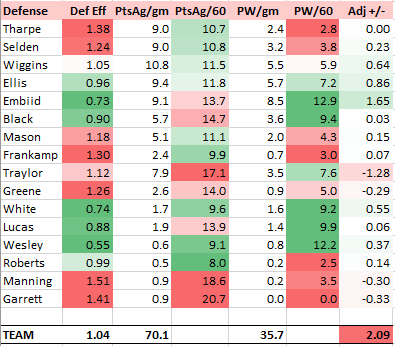
The team’s defense was Coach Self’s weakest to this point while at Kansas. The best defender was Joel Embiid, an excellent shot blocker and rebounder. Both Perry Ellis and Andrew Wiggins played good enough defense, but what was most disappointing was the effort from role players on the roster. KU didn’t need guys like Naadir Tharpe or Jamari Traylor to focus on scoring. They both should have done better on this end.

Adj. PPG +/-

Kansas was led by three star players; Embiid, Wiggins, and Ellis. Two of these three would be top-three picks in the 2014 NBA draft, and Ellis would go on to have an excellent college career. The guard play was noticeably mediocre. Starting PG Naadir Tharpe had some excellent shooting games in 2014, but also had down games as well. His average score was right at bubble-level. Tharpe would be benched during the tournament due to poor play, and his two replacements in Frank Mason and Conner Frankamp would go on to post slightly-above and slightly-below replacement seasons. Wayne Selden would also produce a below-value season as a freshman.

The TEAM’s offense-defense value-difference of +3.80 (meaning its offense was 3.80 points better relative to its offense) was the widest offense-dominant team that Self had to this point (2017, 2018, and 2022 would all be wider). This was likely due to a prominent number of skilled scorers and large number of underclassmen who hadn’t learned to defend yet.

Two Lottery Freshmen, Two Value Leaders

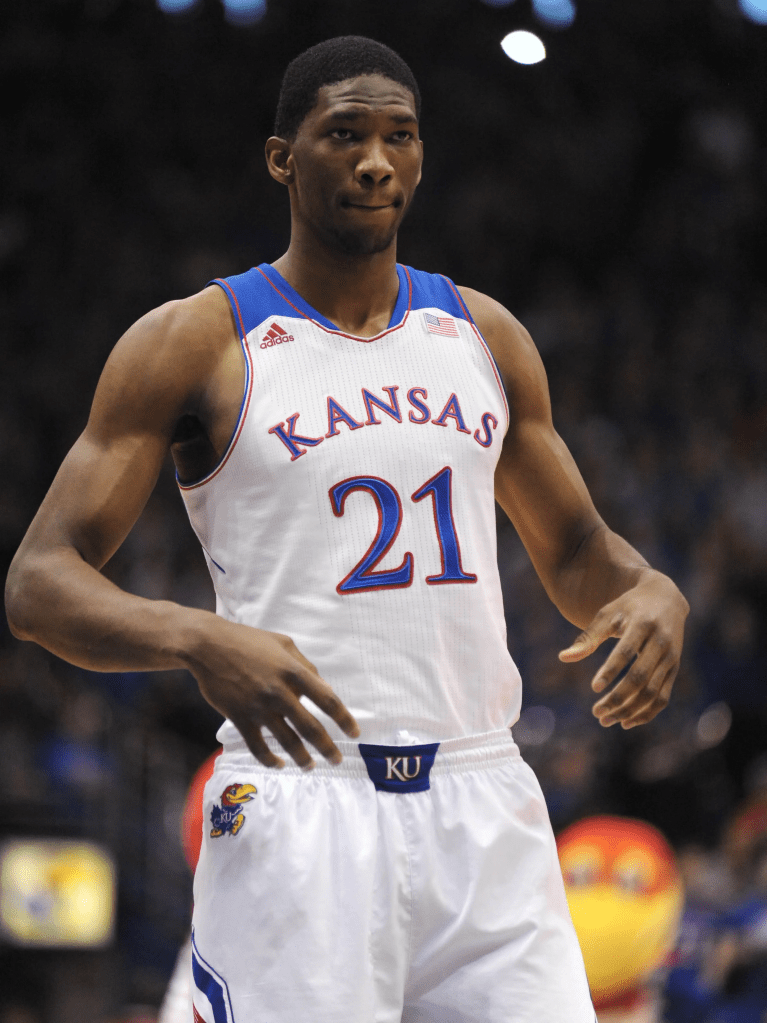
Joel Embiid was KU’s most valuable player on a per-game basis, thanks to his efficient scoring and strong interior defense. He added positive, above-bubble value in 22 of the 28 games he played in (78.6%). His best game in a Jayhawk uniform was against New Mexico in the Sprint Center.

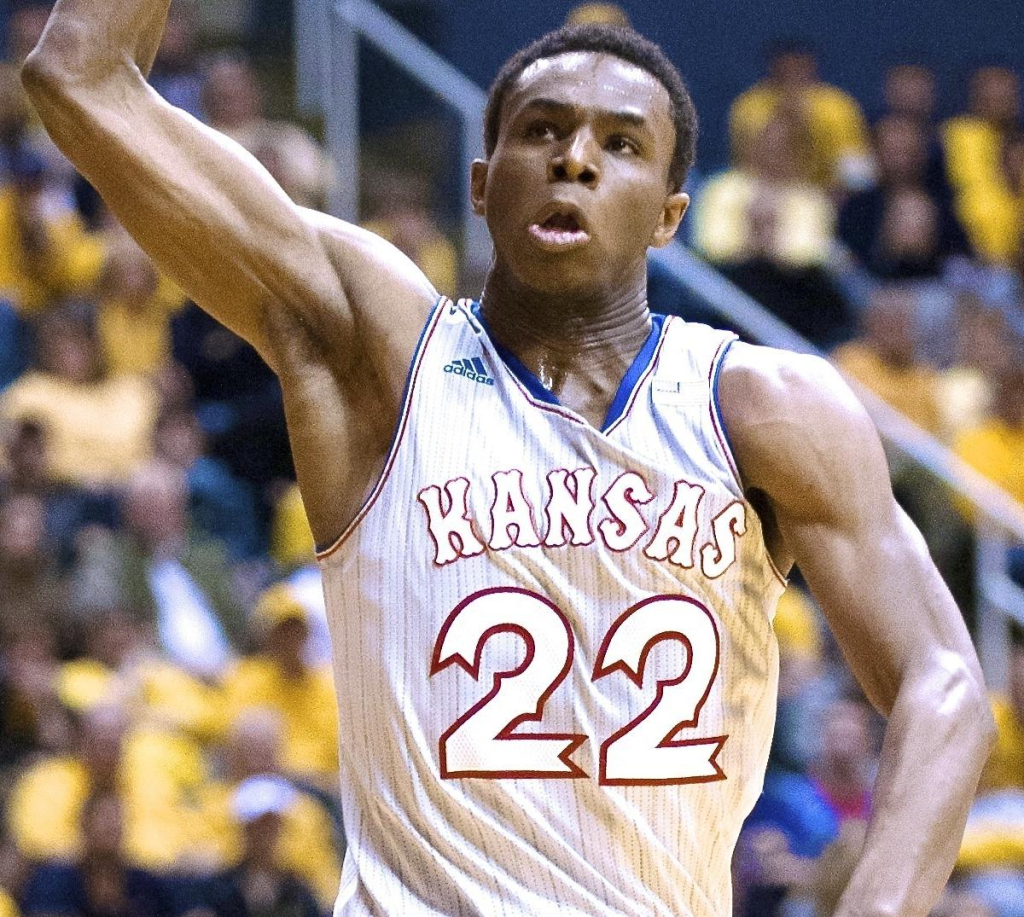
However, Andrew Wiggins was more durable. He played in all 35 of Kansas’ games, providing the most value from a total perspective. He also had the best game of any Jayhawk in the 2014 season, posting a +18.83 value score in his 41-point performance against West Virginia in Morgantown in the final regular season game of the season. Wiggins would also lead the team with 11 game MVPs.

The 2014 team in retrospective:

The 2014 team came in with a lot of hype, and although it wasn’t to live up to it, it’s two best prospects were. The negatives are obvious. Not getting past the first weekend. Poor guard play. Double-digit losses. But on the flip side, this team extended the conference-title streak to 10. When healthy, the team was very tough to beat. It had incredible depth and a number of guys who might have been overlooked during this season would go on to have great careers at Kansas.

WAR rankings. Here are the Wins Above Replacement for the 2014 season:

  • Andrew Wiggins +5.08
  • Perry Ellis +4.54
  • Joel Embiid +3.92
  • Naadir Tharpe +1.45
  • Tarik Black +1.27
  • Wayne Selden +1.04
  • Frank Mason +0.91
  • Andrew White +0.28
  • Landen Lucas +0.06
  • Conner Frankamp 0.00
  • Justin Wesley -0.03
  • Niko Roberts -0.04
  • Evan Manning -0.09
  • Christian Garrett -0.15
  • Brannen Greene -0.20
  • Jamari Traylor -0.33

NCAA Tournament:

The 2014 team earned a 2-seed and drew 15-seed Eastern Kentucky in a closer-than-expected game. In the end, KU turned to the effort and energy of Jamari Traylor to win the game down the stretch. Traylor would go for 17 and 14, adding 6.29 points of value above bubble for the game in his only team-MVP game of the year. This game is sometimes overlooked, but it was good to win because of how bad of a loss it would have been. Unfortunately, Kansas didn’t play well in its next game as it would fall to 10-seed Stanford.