In charting, “Coverage” indicates the level of detail which is covered by the media available for a specific game or season. In order to provide estimates of player value, each play or possession is charted and the Kansas player(s) most responsible for that play occurring is allocated that play (with its inherent value, good or bad) to his ledger. After some math, a value score estimate is provided that can be compared to others of different seasons and positions.
Coverage is an important aspect to this exercise, because with better coverage we have a better estimate of a player’s value score. The theory behind charting is that, simply by keeping a record of which players did “good” or “bad,” we can reasonably rate players for comparison. With more information, this rating gets more accurate.
Specifically, coverage relates to something along the following scale:
TV broadcast – Video Highlights – Radio broadcast – Play-By-Play – Box Score – Message Board Game threads – Newspaper Summary Articles
What’s best is the TV broadcast itself, but short of that there are other supplemental media sources that help determine how to best chart the game. Note some of these work well together. Without a full game broadcast, having video highlights along with the official play-by-play summary is a good source of reconciling possessions using accurate info. But as we go back further in time, less and less of this is available. In some instances, all we have is Box Score data. Effectively, this is a “bare minimum” of coverage.
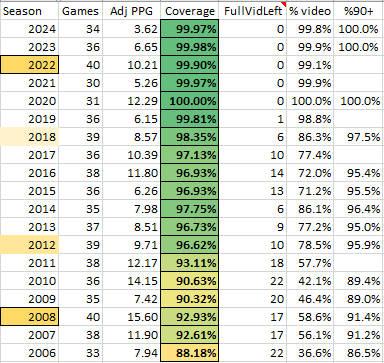
Like the player value stats themselves, coverage is itself recorded and graded. A score of 100.0% is best with 89.0% being set as the middle and 78.0% being worst. Since 2006, the coverage by season is as follows:
Coverage has been near-perfect since 2019, which was the first season for this project. Every season prior to 2019 was done retroactively, and the Coverage had to be obtained through archival means. As we go back further in time, we see the Coverage score slip lower and lower.
Coverage isn’t exactly at 100% for the recent seasons solely because there are a few plays that the TV coverage didn’t fully capture and/or there are a few games that weren’t caught live and had to be pieced together through an edited highlight video that, while very good, wasn’t exhaustive enough to show each possession for that game. But, effectively this won’t change value scores much.
The Full Video Left column shows the number of games that season that don’t have full video coverage, or a coverage score that is at least 95.7% for that game. Some games have a small segment missing (such as the first 3 minutes), but these are still given the “full video” designation. What this column shows is how many games are still there to be hunted down in order to fully complete this project.
The % Video column indicates the number of plays which are tracked through video. It will tie closely to Coverage. This metric is a good judge of how much more media there is to find for that specific season.
The last column isn’t complete for each season, but it shows which percentage of plays get a Coverage score of 90% or higher. In order to get a coverage score of 90% or higher, the play must be either viewed through video, heard through radio, or be recorded through play-by-play. Certain plays that aren’t available will be all possessions before play-by-play is available (which is most games before 2004), defensive possessions with no video/radio in which there is an opponent make or non-steal turnover, as well as other odd possessions that play-by-play doesn’t give full context to. Before 2006, this number will likely be far lower.
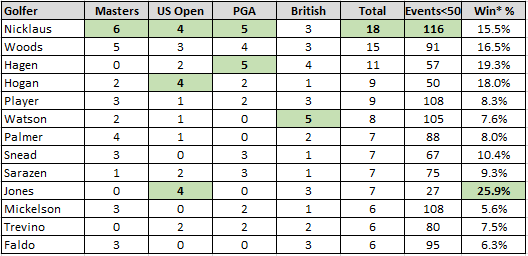
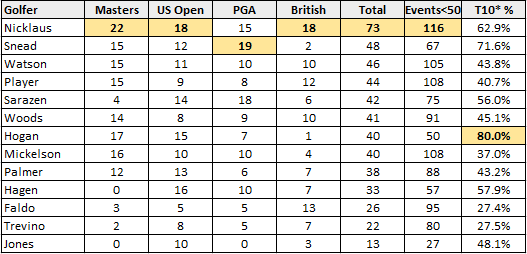
There are 13 golfers who have won at least 6 career majors. The following tables compare and contrast these 13.
The top table looks at major victories; the bottom table looks at major Top 10’s. Each table is sorted by total victories/Top 10’s. Additionally, the highest finisher in each category (column) is highlighted. Jack Nicklaus leads in this category, as he has not only the most majors won but also the most of 3 of the 4 majors. This is likewise true for Top 10’s by major.
In addition to looking at total performances, winning and Top 10 percentages are included. This is because, specifically for prior eras, players had fewer opportunities to compete in all the majors. The Masters wasn’t formed until after Walter Hagen’s prime for instance. And Ben Hogan only played in the British Open once (winning).
In order to keep the percentages meaningful, only the events played before a player turned 50 count in the divisor. We want to ensure that percentages aren’t punishing a player who plays in majors as a legacy winner (The Masters and PGA allow lifetime exemptions for all past winners, the British allows winners to play until they turn 60). This means that each major a player plays at 50 or older can only help him. He can add to his numerator should he get a Top 10, or even win as was the case for then 50-year-old Phil Mickelson at the 2021 PGA.
When we look at the percentages, it better shows just how good Bobby Jones and Ben Hogan were in their primes, and how much better their major totals may have been had they played 4 majors a year like the modern crop of players do.
Golf is mostly an individual sport, but each year one of two biennial competitions pits 24 of the top pros in either the Ryder Cup (odd-numbered years) or Presidents Cup (even-numbered years). With competition most weeks being stroke-play based, the match-play team-format of the Cups has caused confusion regarding how to track player success.
For instance, a player’s official record in the Ryder Cup or Presidents Cup makes no distinction between team events and singles events. For reference, the first days of competition are between 2-man teams who face off in 18-hole matches. Only on Sunday are individuals paired against each other. This distinction should matter. A player whose record is good (poor) in team-competition may be due to his partner’s play more than his own. Further, each match in a Cup is awarded 1 point which goes to the winner. A draw earns each team 1/2 a point. So if a player is part of a 2-man partnership which wins an alternate shot match on Friday, the 1 point he earns for his team (i.e. America, Europe, International) is partially earned by him and partially earned by his partner. Giving full-credit to both partners over-counts the actual number of points in the competition. This is non-sensical.
To rectify this, partner contests (best ball and alternate shot) should allocate 0.5 points to each member of the winning duo. If there is a draw, 0.25 points are awarded to each of the four competitors. This makes a player’s singles record accurately reflect this format’s added importance. The following tables will show players’ Ryder/Presidents Cup records using this adjusted counting system.
Ryder Cup – All Time Points Leaders
There are multiple ways to rank Cup success. The first way accumulates the points won over the course of a career. This list rewards success at the Ryder Cup, but also the success of getting on the team and getting numerous opportunities to earn points.
United States
Player
Points Won
Billy Casper
15.25
Arnold Palmer
15
Lee Trevino
13.5
Phil Mickelson
13.5
Lanny Wadkins
13.25
Gene Littler
12.25
Jack Nicklaus
11.75
Tom Kite
11.5
Tiger Woods
9.75
Hale Irwin
9
Europe
Player
Points Won
Sergio Garcia
16.5
Nick Faldo
15.75
Colin Montgomerie
15
Bernhard Langer
14.75
Lee Westwood
14
Rory McIlroy
13
Seve Ballesteros
12.75
Jose Maria Olazabal
11.5
Neil Coles
11.25
Ian Poulter
11.25
Ryder Cup – Net Points by Team
Another way to look at Ryder Cup performance is to view it as a zero-sum game. This list recognizes that if you lose a match, your opponent earns a point for his team.
United States
Player
Net Points
Arnold Palmer
+8.5
Billy Casper
+7
Lee Trevino
+7
Sam Snead
+6.5
Gene Littler
+6
Lanny Wadkins
+5.5
Tom Kite
+5.5
Hale Irwin
+5
Tony Lema
+5
Jimmy Demaret
+4.5
Gardner Dickinson
+4.5
Jack Nicklaus
+4.5
J.C. Snead
+4.5
Europe
Player
Net Points
Colin Montgomerie
+8.5
Ian Poulter
+6.5
Sergio Garcia
+5.5
Luke Donald
+4
Bernhard Langer
+3.5
Jose Maria Olazabal
+3.5
Peter Oosterhuis
+3.5
Seve Ballesteros
+3
Nick Faldo
+3
Paul Way
+3
Tommy Fleetwood
+3
Rory McIlroy
+3
The following tables show all players with a Ryder Cup net points total of -4 or worse. These are the worst performers in this competition.
United States
Player
Net Points
Jim Furyk
-5
Bubba Watson
-5
Fuzzy Zoeller
-4.5
Mark O’Meara
-4
Rickie Fowler
-4
Europe
Player
Net Points
Christy O’Connor
-9
Harry Weetman
-6.5
George Will
-6
Dave Thomas
-5.5
Neil Coles
-5
Max Faulkner
-5
Eamonn Darcy
-4.5
Bernard Hunt
-4.5
Mark James
-4.5
Alfred Padgham
-4.5
Sam Torrance
-4.5
Peter Townsend
-4
Tom Haliburton
-4
Matt Fitzpatrick
-4
Presidents Cup – All Time Points Leaders
United States
Player
Points Won
Phil Mickelson
19
Tiger Woods
17.25
Jim Furyk
13.25
Davis Love III
11.25
Steve Stricker
8
Presidents Cup – Net Points by Team
United States
Player
Net Points
Tiger Woods
+8.5
Jim Furyk
+6.5
Davis Love III
+5.5
Phil Mickelson
+4.5
International player points have not been calculated yet.
The Americans haven’t gotten enough credit for their dominance in the Presidents Cup. While Team USA’s (road) Ryder Cup struggles are well documented, the fact it has gone 13-1-1 in the Presidents Cup gets explained away by the assumption the International Team is too overmatched to seriously compete anyway. This is not only circular, it is also misleading. Since 2000, International players (non-Americans and non-Europeans) have won 19 major championships compared to European players having won 21. American players top this list with 63 majors. Basically, while America’s struggles against Europe are surprising, their dominance against the Internationals is even more surprising (90.0% win rate).
Isolating a player’s contribution
Ryder Cup and Presidents Cup competitions differ from regular tour stroke-play in a number of ways. Players must qualify or be selected to even play. Match play is determined by holes won, not total strokes. The team portion means your partner can help or hurt your chance of winning, and likewise you have an effect on your partner’s record. Additionally, your record of success depends on how well your opponents play.
Further analytics can strip away these incidentals and calculate an estimate of each player’s value in the cup. The one problem is that detailed shot-level info is required. This info has only been tracked over the last 5 cups, the 2021, 2023, and 2025 Ryder Cups as well as the 2022 and 2024 Presidents Cups.
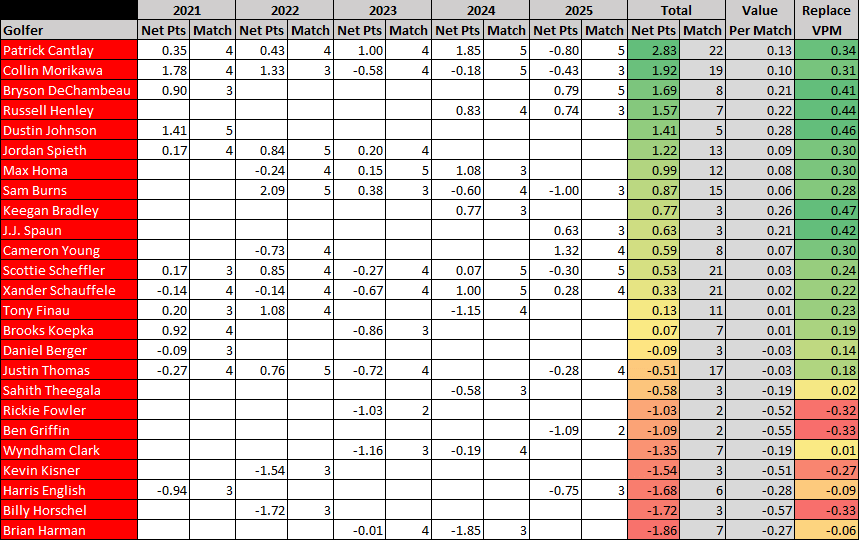
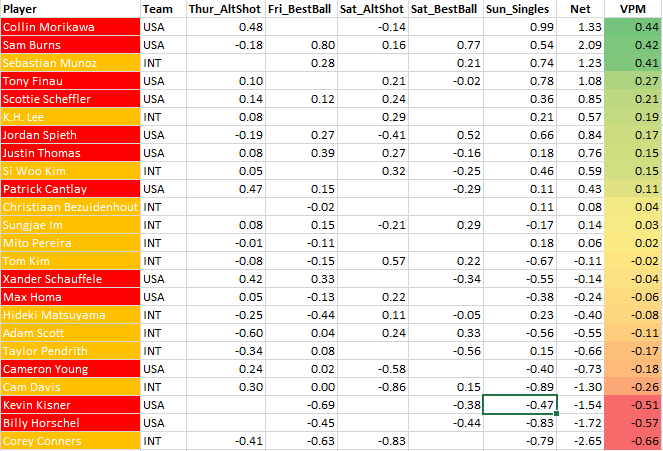
The below tables show a player’s estimated value in terms of net points added or lost in terms of matches played. This is called Value Per Match (VPM). The best performances in the last 5 seasons have come from Collin Morikawa, who earned VPM scores of 0.44 in the 2021 Ryder Cup and 2022 Presidents Cup.
Overall American Performances: 2021-2025
This table looks at the 25 American golfers who have competed in a Presidents or Ryder Cup from 2021-on, and ranks them by the estimated total Net Points won. Patrick Cantlay leads, having played in all 5 cups and playing an American-most 22 matches. Second is 5-cup Collin Morikawa, and third is Bryson DeChambeau (who has only appeared in the 2021 and 2025 Ryder Cups).
The two other 5-cup players, Scottie Scheffler and Xander Schauffele, are closer to the middle of the American list. Other quiet positives include Russell Henley and Sam Burns (though Burns had a tough 2025 Cup). The only player with negative value among those who have played in at least 10 matches is Justin Thomas. We estimate his play has lost Team USA 0.51 points over the four cups he’s played in.
Along with Net Points, we also made a Replacement-level Value Per Match to account for the fact that sometimes being below average still adds value (over that of the 13th best player who would hypothetically fill in). Setting the replacement level to the 20th percentile of all players who played in that particular cup, we estimated what each player added on a per match basis. Not too surprisingly, the best Americans in this regard have low sample sizes: Keegan Bradley (3 matches), Dustin Johnson (5), Russell Henley (7), J.J. Spaun (3), and Bryson DeChambeau (8). But in the case of DeChambeau in particular, this is partly due to him being excluded from Presidents Cups.
This Replace VPM column also shows that most Americans have been value-adding players, with Scheffler and Justin Thomas looking a bit better once we include the context of a replacement player. Being a slightly-negative value-player in a cup is not the worst thing. The four golfers who have objectively been terrible over the past five team competitions are: Billy Horschel, Ben Griffin, Rickie Fowler, and Kevin Kisner. It should be noted that Harris English’s Replace VPM drops to -0.15 once we ignore his envelope-aided tie in the 2025 Ryder Cup.
Next we will look at each Cup from 2021-on in more detail from most-recent to oldest.
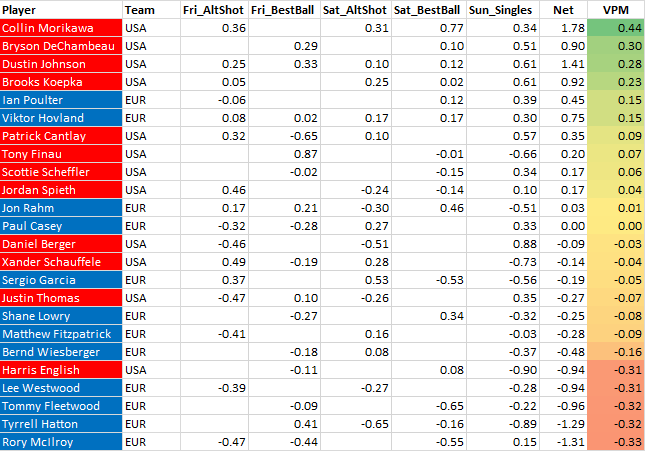
2025 Ryder Cup Performance Table
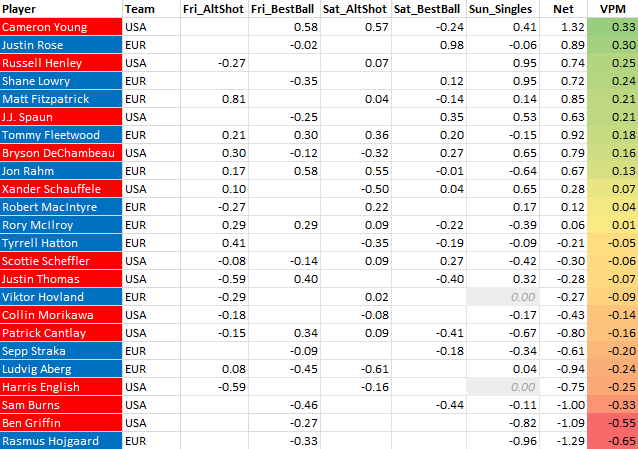
Cameron Young graded out as the 2025 Ryder Cup’s best performer, with Justin Rose (who had an all-time Saturday afternoon Best Ball format performance) in a close second. The top ten ping-pongs between American and European players, so the deciding factor for Europe’s win really came toward the bottom half of things. The US needed more from guys like Scottie Scheffler, Justin Thomas, and Patrick Cantlay.
Viktor Hovland sat out the Sunday singles match with an injury, causing Harris English to also sit out. Each technically received a half-point and is credited for it on this table. If we removed English’s singles half-point which wasn’t earned on the course, he would have earned -0.37 VPM. He was certainly a weak link for Team USA, but he wasn’t America’s worst (Burns and Griffin).
This table shows that Team Europe’s players, in isolation, were +0.88 points (and Team USA’s players -0.88). This was the closest Cup (Ryder or Presidents) in the last five years. As the Cup is not played in isolation (Team Europe teams up with each other against Team USA), it is understandable the European side won the Cup by a score of 15-13.
***NEW for 2025…Pairing Luck***
We ran some other counterfactual analysis for 2025, trying to see how lucky or unlucky Team USA got by the draw. In other words, given that the matchups are somewhat randomly decided in the Ryder Cup (each captain blindly puts out his lineup not knowing what the other is doing), what would the final results have been had these lineups been rearranged in random ways?1
This took even more work and simulations to calculate, but our estimates are the following for Team USA based on how they played and who they were paired with:
Wins – 23.6%
Ties – 15.0%
Losses – 61.4%
This was a bit surprising. Yes, Europe played better and deserved to win. But had a few pairings been rearranged, the US was very much a contender. Running 500 simulations, the maximum points the US received was 17 (would be 17-11 win) and the fewest 10 (would be 10-18 loss). The majority of results were between 12 and 16 points (87.8% of sims) for the US.
Looking at each format, the US underachieved on days 1 and 2 when it found itself in a big hole. Yes, Europe played better those two days. But we’d expect the US to have ~6.1 points through the partner portion of the match (with Europe at ~9.9) instead of the 4.5-11.5 score it was heading into Sunday singles. On the flip side, the US overachieved during the singles portion due to fortunate pairings. The Americans grabbed 8.5 points to nearly come back, with the average scenario being more like 6.8 points for Team USA on Sunday. In all, a mean estimated score of 12.9-15.1 was very close to the actual 13-15 result.
2024 Presidents Cup Performance Table
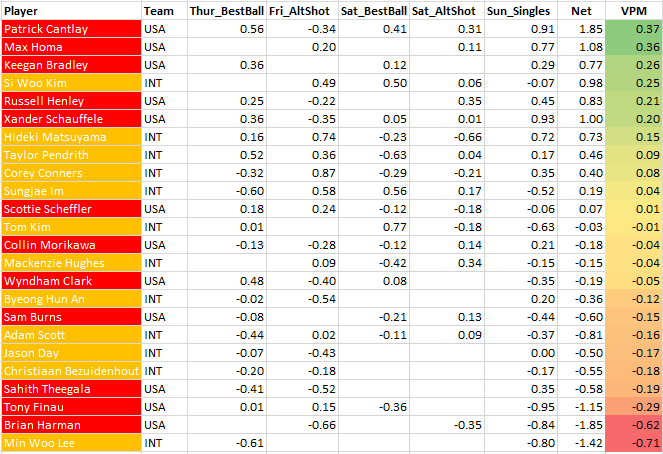
The 2024 Presidents Cup’s top three performers were all Americans–Patrick Cantlay, Max Homa, and Keegan Bradley. Cantlay played all five matches and added above-average value in four of them, while both Homa and Bradley were above-average in all three matches they each played.
At the bottom, both Brian Harman and Min Woo Lee had terrible Cups, with Lee having the worst performance of anyone in a Ryder or Presidents Cup over the past four years. However, he only played in two matches and therefore had less of a chance to work his way back to average.
Team USA once again struggled with alternate shot while succeeding in the best ball format. Interestingly, the Internationals played better over the team formats than the Americans despite Team USA holding an 11-7 lead going into Sunday. In the team formats, the Americans won 5 matches 1 Up compared to the Internationals winning on 2 matches 1 Up.
2023 Ryder Cup Performance Table
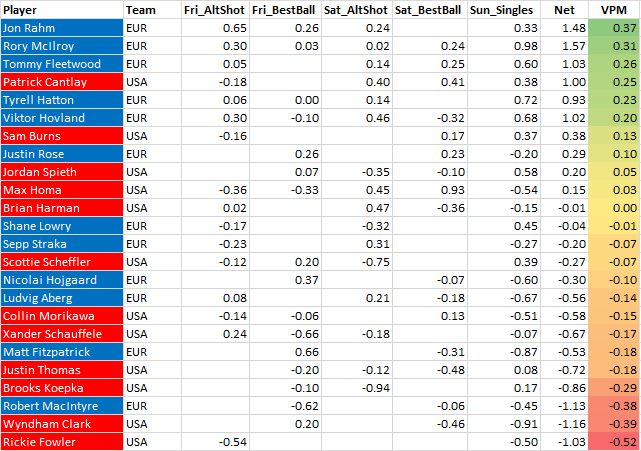
For 2023, Jon Rahm had the highest VPM (Rory McIlroy played in all matches and had the highest total estimated net points, which is seen in the Net column). It’s estimated that Rahm would added +0.37 net points on average per match. Additionally, each format shows the estimated net points that player added. McIlroy’s Sunday singles performance was expected to win +0.98 net points, making it the best performance of anyone in any session that week.
The losing captain normally faces criticism, and Zach Johnson was critiqued on a number of grounds. One area that’s mostly out of the captain’s control is the performance of his team once the competition begins. The teams were evenly matched according to datagolf.com before the Cup began. The home side just played better.
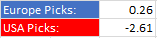
Still, Captain Johnson’s captains picks were under his control. He could have chosen different players than the ones he selected. Here’s how each side’s captain’s picks fared.
To calculate the difference, you have to subtract these two numbers and divide by 2. This means Europe’s captains picks outplayed America’s picks by 1.43 net points over the course of the Cup. On this measure, Luke Donald > Zach Johnson.
2022 Presidents Cup Performance Table
At the 2022 Presidents Cup, the USA had 6 of the top 8 players, with now-LIV player Sebastian Munoz having the best showing for the Internationals. The best performance in any session was Collin Morikawa’s singles round. Sam Burns played all 5 matches and did exceptionally well, particularly in his best-ball matches.
Team USA individuals played an expected 3.01 points better than the Internationals but won by 5 (17-12). There is likely a cumulative effect here. Although the individual players that make up Team USA were only better than the individuals who make up Team INT by 3 net points, when you combine the better players in the team formats it leads to a larger actual margin.
One can look at this a few ways. Namely, the International Team isn’t terribly behind the Americans. Or, once one appreciates the format, realize how difficult it is for a true underdog to win. Any small difference in talent will be amplified when better players are paired against slightly lesser players.
2021 Ryder Cup Performance Table
Team USA dominated the 2021 Ryder Cup, with the top four individual performers and 8 of the top 10. Rory McIlroy had a pathetic showing and graded out as the worse player at Whistling Straits.
The American 10-point victory was much higher than the net points shown above. This provides further confirmation that the team matches help the better side to stretch the margin further than a pure strokes-gained or holes-won perspective would indicate. In addition, Jordan Spieth/Justin Thomas’ 2 Up Alternate Shot win on Saturday morning was in spite of playing poorly from a strokes-gained perspective against both European competitors. They had some dreadful shots, but those occurred on the same hole that would be conceded anyway. If your opponents make a birdie, you lose the same with par or quadruple bogey. The match-play format rewards birdies and eagles while penalizing high scores less than in stroke play.
In the last 3 Cups, there have been four players which have played in all (Patrick Cantlay, Justin Thomas, Collin Morikawa, and Scottie Scheffler). Now only Americans can achieve this feat, and only those who aren’t on LIV (banned from the Presidents Cup). And of these four, only Cantlay has performed above average for each cup.
No new pairings were made, rather what was done was an analysis to determine what would have happened if Team USA’s first group out in Friday’s morning alternate shot instead played, say, Team Europe’s third group out that morning. We kept the results each team made on a hole and assumed they would do no better or worse if they played against a different pairing. For holes that weren’t finished/conceded, we used strokes gained to estimate the score. The same thing was done for all 28 matches in the Ryder Cup. ↩︎
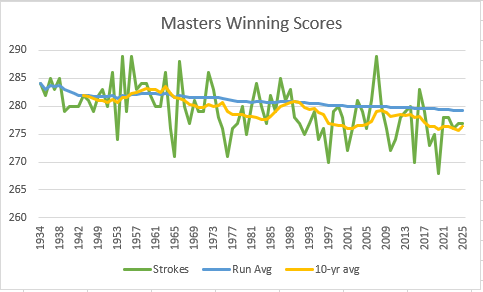
There have been 89 Masters tournaments (through 2025). The Masters is unique among the majors in that it has only been played on one course. While the course has been updated throughout the years, it is still routed the same way it was since its first year. Same holes, same pars, etc. Some have been lengthened, some slopes have changed, etc.
The first chart shows the winning scores (green), the average running of winning scores (blue) and the 10-year average winning score (yellow) by year.
There has been a downward trend in winning score. The lowest score, 268 (-20), was by Dustin Johnson in 2020. The current 10-year average is at 276.4 (-11.6).
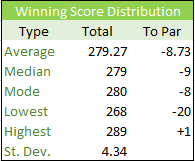
Next, we look at the winning score distribution. Both total score and to par are shown.
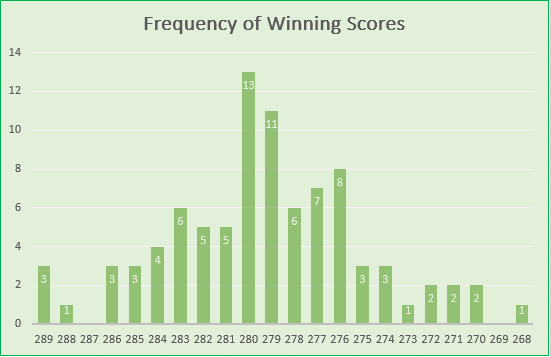
The next chart shows how often the winning score is at a certain number.
288 is Even par. There have only been 3 winning scores over par at the Masters, with the most recent being Zach Johnson in 2007.
Winning a golf major is partly based upon luck. Not only does a player have to play exceptionally well, he also has to avoid another player having a career week. We know from history that some runners-up didn’t lose because of sub-optimal play, they just got beat by an exceptional performance. In the 2016 British Open, Phil Mickelson finished -17, or 11 shots better than everyone else except Henrik Stenson. The Swede, at -20, turned in an all-timer to win the Claret Jug. Most other years, Lefty’s performance would have been enough to win. Is there a way we can quantify this?
Yes. Enter expected majors. An expected major is a number between 0 and 1 telling us how likely it is that a player’s 72-hole performance was good enough to win a golf major. For most players in any major, this will be 0. Even players that reach as high up as 5th place after 72 holes aren’t really performing well enough to win. But for the top 3-5 spots in most majors, players will produce an expected major score above 0 (also called major share) which shows how good the performance is when judged across all other major championships throughout the years.
Expected majors, or major shares, are calculated using a blend of strokes-gained and an adjusted Gaussian distribution allowing us to place each major championship performance along a bell curve. Again, we really only care about the far right end of that curve…those who played well enough to hypothetically win.
These major championship shares are additive, meaning a player’s career can be analyzed by adding these major championship shares together across all his majors. Summing these expected wins into a total provides more context to major performance over the course of a career, highlighting the fact that some golfers’ major totals are at least partially “luck” derived.
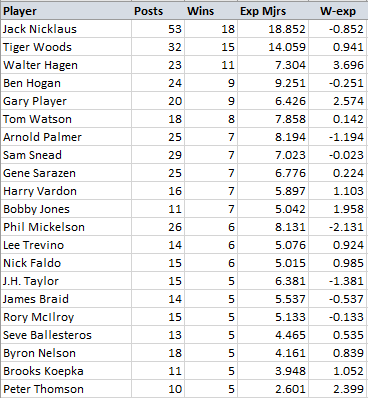
For all 21 golfers who have won at least 5 majors, we show each’s expected majors alongside his wins as well as the difference between actual and expected major championships.
Jack Nicklaus, the winner of 18 majors, played well enough to have “deserved” 18.852 majors. This validates what we all know. Jack, who also had 19 runner-up finishes in majors, has proven himself to be the best major champion golfer in history.
As we go through the list, look at the differences between a player’s actual career and what it “should” have been. Walter Hagen won 11 but only “earned” 7.304. Hagen’s 3.696 wins above expectation are the most all time. Conversely, Arnold Palmer’s 7 majors were done with him playing well enough to win 8.194 and Phil Mickelson’s 6 majors really should have been higher considering his 8.131 career win shares. Lefty’s -2.131 wins against expectation indicate that he was likely even better than his record indicates.
The first column, “Posts,” counts the number of majors a player finished that gave him at least a 0.1% chance of winning. Nicklaus’s completed 53 majors where his 72-hole total was good enough to at least give him a chance to win, 21 more than second-place Tiger Woods.
When it comes to winning majors, the era someone plays in matters. It is tougher to win a major today when compared to the earliest years of the British and U.S. Opens, although this isn’t linear as there was a dip in “competitiveness” in the 1940’s and 1980’s. This doesn’t mean that we’re assuming that golfers today are better or worse than those from other eras. Equipment changes, course maintenance evolution, economic growth and even the introduction of the airplane and speedy international travel allowing for deeper fields have made the game much different than what it was in 1860. We’ve kept all those variables as is. What we’re purely looking at it how difficult a major championship is to win based on how well the field plays. A small field (as the early British and U.S. Opens were) made these tournaments easier to win and harder for the winner to prove he actually separated from a full field. Additionally, when there are tournaments which don’t have much separation at the top, this indicates the lack of elite closing and widens the potential for a surprise winner. Geoff Ogilvy at the 2006 U.S. Open needed players around him to double-bogey the final hole to seal his win. The 2004 PGA Championship saw a number of players fail to close, leading to a 3-man playoff won by Vijay Singh1. Some eras see majors that are like this…the 2000’s aside from the dominant Tiger Woods performances were often this way…while other eras seem to showcase elite golfers rising to the occasion and validating their major championships by strong finishes. The 2020’s are currently one of those eras, with recent winners nearly always separating themselves2.
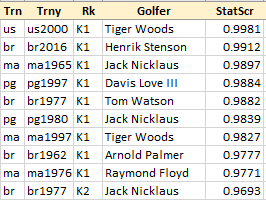
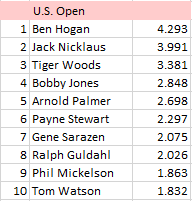
The most dominant performance in a major is Tiger Woods’s 15-stroke win at the 2000 U.S. Open. Unsurprisingly, this tournament “sets the curve” when it comes to grading other performances. It was truly historic. Henrik Stenson’s 2016 British Open victory comes in second, and the Golden Bear has three performances in the top 10. Note that Nicklaus’s 1977 British Open play, which is 10th in our all time list, came in a second-place finish to Tom Watson (whose play that week comes in fifth all time). Tiger’s 12-shot 1997 Masters “only” places 7th all time, in part due to the closest pursuers not playing as well as the field average would project3.
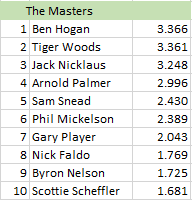
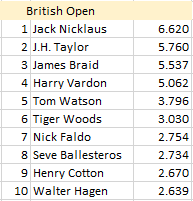
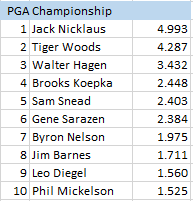
The top win share earners by particular major is shown above. Hogan leads in the Masters4 and U.S. Open; Nicklaus leads in the British Open and PGA Championship. Among active players (those still competitive and relevant), Scottie Scheffler is already the 10th best Masters performer, and Brooks Koepka is the 4th best in the PGA.
Speaking of the PGA Championship, that major was match-play for its first 39 years. Win shares had to be calculated differently for those tournaments, but they are included as part of the estimated majors in the above tables.
The best anyone has done in any particular tournament is Jack Nicklaus at the British. Nicklaus performed well enough to win an expected 6.62 Claret Jugs, although in reality this was the major he won the least, finishing with 3 actual British Open championships.
A few other bits of info. The most-dominant performance in a decade was Tiger Woods in the 2000’s. Tiger won 12 majors, but he “earned” 11.068 of them. This is just further confirmation of how good he was in that era. He didn’t really luck out to get to 12 over that 40-major stretch5. Jack Nicklaus in the 1970’s didn’t quite match this feat, but at 9.546 win shares he too was incredible during his prime. Ultimately, Jack’s durability (he was highly competitive in the 1960’s and 1980’s as well) is what produced such an all-time career.
Only Ben Hogan has the most win shares in 2 separate decades, doing so in the 1940’s and 1950’s. The best major performer in the 2010’s may surprise some people. While Rory, Brooks, and Jordan gave it a run during their respective peaks that decade, they were all a bit behind Phil Mickelson, who should have won 3.480 majors (Lefty only won 2 from 2010-2019). Through 2025, Scottie Scheffler is at 3.894 expected majors. Should he continue on his pace over the next four seasons, he would land at about 6.5 expected majors over the 2020’s, placing him fourth behind Woods (2000’s), Nicklaus (1970’s), and Palmer (1960’s).
There’s a handful of one-time major champions who were incredibly fortunate to have won. The inaugural U.S. Open champ Horace Rawlins takes the cake here (his 2-stroke victory was in a limited and weak field), but more recent examples include Keegan Bradley (0.331 win shares), Paul Lawrie (0.215), and Webb Simpson (0.138). Each of these men had one good shot to close a major, so good for them for doing so. On the flip side, the unluckiest non-major winner is Doug Sanders. Sanders played well enough to win 2.048 majors, but his best finish was only second place. Harry Cooper, the English-born American who was in his prime during the interwar period, was able to put up 12 posts good enough to have a shot, but none earned him a trophy. His closest chance was in the 1936 U.S. Open. In recent years, Colin Montgomerie (1.389) and Chris DiMarco (1.388) have gotten the short end of the stick. DiMarco in particular was hurt by having his best performances come up against Tiger Woods (at the ’05 Masters and ’06 British). In total, we’ve calculated that 613 golfers have put up a score that had a chance of winning a major, with 234 different men actually coming away with at least one.
We close with a list of golfers relevant to today that can be compared. The current* top 50 (in Data Golf) and their career major win shares are in the table below. (This is current as of the week following the 2025 British Open).
Rank
Golfer
Win Shares
1
Scottie Scheffler
3.89
2
Rory McIlroy
5.13
3
Jon Rahm
1.36
4
Bryson DeChambeau
2.08
5
Tommy Fleetwood
0.91
6
Russell Henley
0.20
7
Xander Schauffele
1.62
8
Justin Thomas
0.65
9
Corey Conners
0.00
10
Tyrrell Hatton
0.00
11
Keegan Bradley
0.33
12
Harris English
0.14
13
Ben Griffin
0.00
14
Sepp Straka
0.05
15
Matt Fitzpatrick
0.39
16
Hideki Matsuyama
0.72
17
Patrick Cantlay
0.24
18
Sam Burns
0.00
19
Joaquin Niemann
0.00
20
J.J. Spaun
0.38
21
Robert MacIntyre
0.02
22
Ludvig Aberg
0.44
23
Viktor Hovland
0.68
24
Collin Morikawa
1.38
25
Harry Hall
0.00
26
Maverick McNealy
0.00
27
Chris Gotterup
0.05
28
Jordan Spieth
3.94
29
Jason Day
2.43
30
Shane Lowry
1.15
31
Taylor Pendrith
0.00
32
Aaron Rai
0.00
33
Nick Taylor
0.00
34
Max Greyserman
0.00
35
Lucas Glover
0.33
36
Daniel Berger
0.00
37
Si Woo Kim
0.00
38
Denny McCarthy
0.00
39
Patrick Reed
0.80
40
Akshay Bhatia
0.00
41
Brian Harman
0.97
42
Wyndham Clark
0.56
43
Ryan Fox
0.00
44
Adam Scott
1.61
45
Andrew Novak
0.00
46
Nicolai Hojgaard
0.00
47
Kevin Yu
0.00
48
Rickie Fowler
0.95
49
Michael Kim
0.00
50
Christiaan Bezuidenhout
0.00
The winning score was -8, but that Sunday four different players were -10 or better at some point in their rounds. Stephen Ames, Chris DiMarco, Justin Leonard, and Vijay Singh himself had great chances to win before any potential playoff and couldn’t play well in that pressure. Ernie Els bogeyed 18 to finish -7, one spot shy of a playoff. After capturing this distribution of 72-hole scores, we estimate that Singh’s performance only wins 3.87% of the time in a major. ↩︎
Take 2024. Scottie Scheffler earned 0.9281 win shares by closing the door with a 4-stroke Masters victory over Ludvig Aberg. Xander Schauffele got to -21 at Valhalla to win by a stroke over an incredible charge from Bryson DeChambeau. Schauffele’s win share for his PGA was 0.7547. Speaking of Bryson, his U.S. Open wasn’t flawless but he still earned 0.5767 shares. Rory McIlroy’s late bogeys cost him a chance at a major. Last, Xander closed the British Open in style to win the Claret Jug. He earned 0.7849 win shares in his 2-stroke win, holding off charges from Justin Rose and Billy Horschel. Other years, the play of Aberg, DeChambeau (at the PGA), McIlroy, Rose, and Horschel would have been enough to get them majors, but instead they watched as someone else’s play exceeded expectation. ↩︎
Woods’ ’97 Masters performance would still be expected to win by 8 or 9 strokes. ↩︎
Tiger is neck-and-neck with Hogan when it comes to performance in the Masters and has the ability to catch him by virtue of the curve changing due to more data. Effectively, he and Hogan are tied at the top in terms of cumulative performance at Augusta National. ↩︎
Woods only played in 38 of those majors, missing the 2008 British Open and 2008 PGA Championship due to injury. ↩︎
Updated after British Open 2025. What is presented below will be the betting market’s cumulative expected major wins for players. Note that historic betting odds only date back to 1985, so this won’t cover many of the greats, and that more than a few players have their careers intersected by beginning at this time.
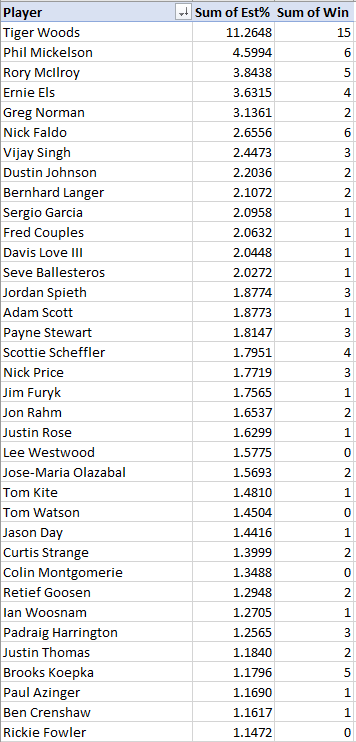
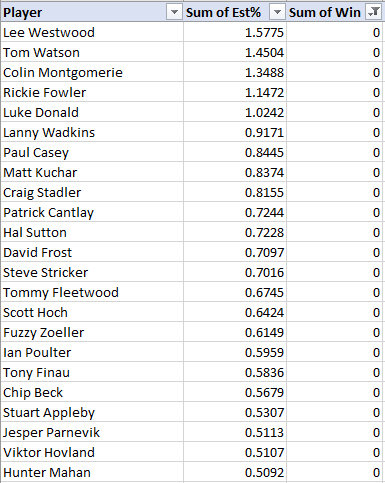
Since 1985, the table below shows how many major championships the betting market predicted would be won by each golfer the morning the tournament began. For instance, Tiger Woods’s odds were such that the market collectively set him to have 11.26 majors over his career. The idea of using betting odds to predict major championship expectation stems from the belief that betting markets are at least moderately efficient. Bettors are trying to win money, so prices get shaved down to rational levels and this produces information that is helpful in understanding exactly how realistic it was for a golfer to win any particular major.
The list cuts off at Rickie Fowler for the sake of space, but this shows the top 36 golfers in terms of predicted majors from 1985 – present. For more on the methodology, scroll to the bottom. For some names, such as Tom Watson, there will be a major total that is different from his actual career total (Tom had 0 majors?). But mentioned earlier, this is just from the period from 1985 and after. Some golfers have their careers intersected by this cutoff date.
The question often comes up, “who is the best player to never have won a major?” This list is the answer to that question, at least from the period of 1985 onward. Now, as mentioned earlier, Tom Watson doesn’t belong on this list given the fact he was an 8-time winner prior to 1985. (Lanny Wadkins and Craig Stadler are others on this list that got championships before 1985).
Lee Westwood is the definitive answer as to who was the best to never win, at least in the modern era of golf. Monty is second, with Rickie coming in as the highest on this list with a realistic chance to eventually come off it. There’s been some talk about Viktor Hovland’s inability to win a major, but he is only slightly more likely-than-not to be a major champion according to the market’s predictions.
Methodology
Using betting odds as a corollary for projected winning percentage has a few assumptions. One is that the market is efficient (enough) to be useful. If a player is wildly misjudged by bettors, this would make his estimated majors won quite off-base. The second assumption is that the cut taken by the bookmakers can be accounted for. This is more than a math problem. Because each player’s betting odds will add up to more than 1, an adjustment factor has to be made. The question is whether this adjustment (which can be significant toward the top of the favorites) is accurate. While these issues could have an effect on the numbers, it’s likely that this effect isn’t large enough to matter.1
While the odds are from 1985 and after, another issue is that before the mid-2010’s, not every tournament has a full set of historic odds. Many had only 30 to 40 golfers available for betting the further back you go in time. In other words, there wasn’t the option to gamble on any particular player in the field until recently, meaning we have a number of tournaments where there was a “Field” option and there have been 15 total major championships over this time frame which didn’t have pretournament odds listed. So, the historic odds data was supplemented by implementing artificial odds for players not listed in majors during these prior years. These artificial odds were applied based on a player’s Data Golf or OWGR ranking at the time of the tournament.
Efficiency of the Market
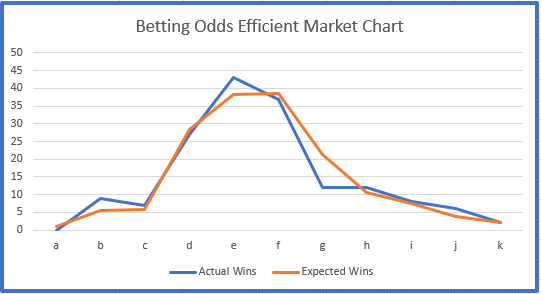
If we break down the field into 11 “tiers” of golfers, we see that the break-down of winners for each tier tracks fairly well (but not perfectly) with who ended up winning.
The tiers toward the left, starting with “a”, see fewer cumulative expected and actual wins because there are so few times a golfer has had market-estimated win percentages above 20%. As we move rightward, there are more golfers with odds in the 10% range, then 5%, and so on to make the curves peak around tiers “e” and “f”, which corresponds to an average win range of 3.75% and 1.88% respectively. This declines as we get to the lower win estimates, as each golfer’s low win estimate drops the tier’s collective chance of winning despite there being more golfers at those levels. About 1/3 of all golfers in a major have a less than 0.08% chance of winning according to the odds (tier “k”).
Closing Thoughts
Within golf commentary, hindsight is often applied after a champion is crowned…as this write-up was done shortly after the 2025 British Open, the talk of the greatness of Scottie Scheffler being self-evident is commonplace. But coming into the tournament, Scheffler only got +450 odds or so (18.2% implied win probability, which after the juice was whittled down to 12.8%). He was never really in contention the week prior at the Scottish, finishing a respectable T8 but still six strokes behind the winner. If it were so obvious coming into the week that Scottie was head-and-shoulders the favorite, the market would have priced him down from +450.
Nevertheless, one thing the market loves to bet on is past major champions…winning a major shows to bettors that the golfer has the skill and mental toughness to be a champion…and golfers who win a major normally see their odds pop quite a bit for the next one. Wyndham Clark was +10000 to win the U.S. Open in 2023. After he won, his next major odds were +6000 (2023 British), +3000 (2024 Masters), +3500 (2024 PGA), and +6000 (2024 U.S. Open). Sure, some of this was likely due to him playing well week-over-week. But after he showed he can play at the level it took to win a major, the market priced that in.
The lesson here might be that the market will eventually catch up to a golfer’s true skill level in major championships over the course of a career. Even if certain champions have been underpriced due to the market not knowing how good that player truly is in majors (to take an extreme example, Brooks Koepka), this could cause it to over-correct, which might actually make things more accurate in the long run.
The one place where this math problem might be important is among the elite in the field, i.e. Tiger Woods when he was getting +200 odds (or lower). Had a bettor placed bets on Tiger to win in each major he played, he would have actually lost money despite the fact we suggest the market calculated Woods winning only 11.26 when he won 15 in actuality. The bookmaker’s cut comes into play. So, Woods was rationally priced, yet the market undervalued him at the same time? Kind of. Again, this isn’t a big number when we look at players lower down the ranks. Scottie Scheffler’s low odds are starting to run into this issue as well. ↩︎
Here is the top 10 in the standings for 2026 through 4 events:
Jon Rahm – 466.00
Bryson DeChambeau – 276.90
Elvis Smylie – 238.56
Anthony Kim – 230.51
Thomas Detry – 166.10
Thomas Pieters – 158.26
Richard T. Lee – 147.05
Peter Uihlein – 140.98
Lucas Herbert – 86.91
Lee Westwood – 86.76
Barely escaping relegation a season ago, Lee Westwood has made an improbable comeback in the league and is currently in the top 10 despite playing in only 2 of the first 4 events. He has sealed his position for 2027 as well.
For the first time ever, LIV is earning OWGR points. Here is the total cumulative OWGR points for the top 10.
Jon Rahm – 54.86
Bryson DeChambeau – 29.98
Elvis Smylie – 25.63
Anthony Kim – 23.13
Thomas Pieters – 17.89
Thomas Detry – 17.02
Peter Uihlein – 15.52
Richard T. Lee – 13.45
Dean Burmester – 9.94
Lucas Herbert – 9.33
Aside from winners, it is tough to really build much OWGR equity only playing LIV events. My guess is that the guys who want to get into the majors will look to supplement their LIV schedules with European Tour events (and the occasional Asian Tour event). Since the OWGR only awards points to the top 10 (and ties), only 30 total guys have earned any OWGR points in LIV over these first four events of 2026.
The points system internal to LIV changed in 2026, so we are now tracking career points in reference to first place that tournament. In other words, for each tournament in LIV, the winner receives 1 point and each subsequent place receives the proportion of actual points in relation to first. Here are the top 10 in terms of total (adjusted) points:
Joaquin Niemann – 14.79
Jon Rahm – 13.86
Bryson DeChambeau – 12.10
Talor Gooch – 11.68
Cameron Smith – 10.92
Dustin Johnson – 10.49
Sergio Garcia – 10.12
Brooks Koepka – 9.95
Patrick Reed – 9.18
Carlos Ortiz – 8.32
So far in 30 career LIV events, Jon Rahm’s average point allocation is 0.47, or half-way between 2nd and 3rd place using 2026 point allocation. Rahm’s career is equivalent to a golfer who alternately finishes 2nd and then 3rd for 29 straight events. Rahm’s actual results include an insane 28/30 on Top 10’s (other two were a W/D injury and T11) with 3 wins.
The Team Standings through four events show the following:
Ripper GC – 80.75
4Aces GC – 78.00
Legion XIII – 39.75
Torque GC – 34.75
Smash GC – 32.00
Southern Guards GC – 25.25
Crushers GC – 21.25
RangeGoats – 19.25
Fireballs GC – 19.25
Cleeks Golf Club – 14.00
Korean Golf Club – 13.75
HyFlyers GC – 12.00
Majesticks Golf Club – 10.00
The new relegation system means that the top 34 golfers are in the Lock Zone (Green) and get their spots in LIV 2027. From 35-46 is the Open Zone (Yellow) meaning they are eligible to play in 2027 if signed by a team. Last off-season there was some confusion surrounding Jinichiro Kozuma, who was eligible to return but never signed. Those in the Open Zone can still qualify back into LIV if not picked up. From 47 on down is the Relegation Zone (Red) which means the player has to leave LIV but can still qualify through the other means (win International Series on Asian Tour or through Qualifying series).
With that in mind, here are some notable storylines surrounding the zones through 23% of the season.
Mixed results for the “Young Guns.” There are 11 golfers on LIV who are 27 or younger, and currently 5 are in the Green Zone, 2 in the Yellow, and 4 in the Red. LIV needs to continue to acquire young talent to stay relevant, so it has vested interest in these guys playing well (being good). The hope is they will be able to compete in majors and bring more credibility to LIV.
On the positive side, Elvis Smylie won in his LIV debut, is third in the league standings, and is tied for 7th in LIV total SG. Joaquin Niemann has started playing better again and is in 11th place, followed by 14th place Matt Wolff, 16th place David Puig, and 24th place Josele Ballester.
Caleb Surratt sits in 35th, the best spot in the Yellow Zone. Just behind him is Legion XIII teammate Tom McKibbin. These two are still relatively safe provided they do not collapse during the back-half of the schedule.
On the negative side, HyFlyers signee Michael La Sasso is in 52nd and 7.87 points outside of the Yellow Zone with finishes of T41, T32, T55, and 55. His average SG is -1.70 per round. As someone who turns 22 next month, it isn’t unexpected he would struggle, but it would be awkward to see him relegated after being rushed into a league he didn’t qualify for. Other 20-somethings in danger of relegation are Minkyu Kim (51st), Luis Masaveu (53rd) and reserve Ben Schmidt (57th).
On the other side of things would be the aging captains. Currently Ian Poulter, the Majesticks co-captain who barely qualified for this season, is in the Red Zone at 49th, 2.49 points below the final Yellow spot. Bubba Watson is in 45th place, safe for now but only by 1.96 points. Martin Kaymer, who missed Adelaide, has only earned 10.40 points and sits 14.25 points below the final Yellow Zone spot. Kaymer’s losing 1.53 strokes per round, indicating that his level of play is not sustainable if he wants to avoid relegation for next year. Lastly, Phil Mickelson has missed all 4 events so far due to a personal family matter, so his status is very much TBD.
KU plays Howard in the Round of 64 on Thursday afternoon, which according to the computer rankings turns out to be as good as a draw as they could have expected (Northern Kentucky is much better per KenPom, etc.). Even better news is the note that Kevin McCullar appears to be improving per Matt Tait. McCullar was not expected to play much in the Thursday quarterfinal game against West Virginia, but he actually went 26 minutes off the bench while fighting back spasms. This was perhaps a false sign of health, as he only played 12 minutes against Iowa St. in the Big 12 semifinals before reaggravating his back early in the second half. He would sit the remainder of that game and the entirety of the championship game.
If McCullar is healthy enough to go the rest of the way, KU has a much better chance to advance in any given round. Replacing a starter who has played in 71.6% of potential minutes this season would be a challenge in any season, but this is particularly considering the fact KU’s bench—particularly at the guard/wing position—has been historically bad this season.
Let’s start with Kevin’s value-metrics this season. Through 34 games, Kevin is producing an adjusted PPG +/- of +1.34, indicating that he is worth a little over a point per game vs. that of a bubble-level (very good) player¹. A comparable player to McCullar’s wing position who had a season around 0.00 (bubble-level) was Christian Braun as a freshman in 2020. So, if frosh Braun were replacing an injured McCullar this season, KU would expect to be about -1.34 per game worse.
But this isn’t what is actually happening, of course. The concept of a replacement player is employed as a way to judge player performance against a certain baseline. For a program as strong as KU, we expect any rotation player to be able to at least break-even when competing against a team on the NCAA Tournament bubble. After all, if you aren’t good enough to help Kansas beat a team on the bubble, you aren’t helping the program get to even a baseline level of what it deems success.
For 2023, KU’s backup guards and wings are (in terms of minutes): Joe Yesufu, Bobby Pettiford, and M.J. Rice. While they do play different positions, their roles overlap to a large degree. With McCullar out, any one of these three can be plugged into the rotation without much change in style (unlike say, any of the reserve bigs). This matters, because when KU goes into its bench on the perimeter, it gets quite a bit worse. Plugging in Udeh for Adams has been less of a drop off, and in some regards (size, rim protection) it has been an improvement. In the season-summary page (link here), a table listing player value in 3 different ways is shown. As of 3/13/2023, this is what it looked like for Kevin McCullar.
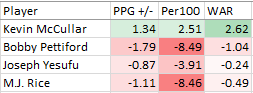
This shows that Kevin is producing +1.34 more net points per game for Kansas than a hypothetical bubble-level player at his position (again, think 2020 Braun). The next column translates the per game value to a Per 100 possession level. At +2.51, this number is still quite solid. The final column looks at Wins Above Replacement, not over that of a bubble-level player but of an even worse replacement-level performer. WAR is calculated against a baseline of an average D-1 player. Clearing the value provided by an average D-1 player is something that should be very achievable for any KU player to make the top 8-9 in the rotation. At +2.62 WAR, McCullar has played well enough this season to add this many wins to his team over that of the average D-1 basketball player.
Now we will show the same table as before, just with Pettiford, Yesufu, and Rice added as a comparison.
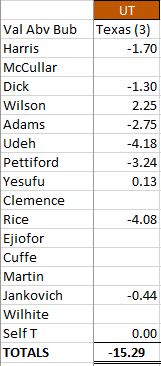
Kevin’s minutes weren’t replaced by a 0.00, bubble-level player at the Big 12 Tournament. They were replaced by these three. In the final two games of the Big 12 Tourney, these three combined for 93 minutes. At 46.5 minutes per game, this was considerably more than the 28.2 that these three average. And this was with McCullar playing some during the Iowa State game. For the Texas game alone, the bench guards/wings played 56 minutes as they covered McCullar’s missing 28 minutes. In these two games, collectively this trio produced a mind-boggling -17.42 points of value. While KU won against Iowa State, it was in spite of the bench. With the Texas game, the bench’s performance only heightened the poor outing of the normal starters.
If we take the difference between McCullar and one of his replacements, we see that Kevin is a better option at the guard/wing by anywhere from 2.21 to 3.21 points per game. The Per 100 numbers are even more stark. Over the course of 100 possessions, Kevin is +6.42 when compared to Joe and +11.00 when compared to Bobby (M.J. Rice is about equal to Bobby). This difference might be able to be masked over a few possessions, but over the course of a game, and certainly over the course of a tournament run; this drop in value will rear its ugly head.
If Kevin were to be out for the rest of the year, KU would need to replace about 50 possessions per game. Even if you could use, perhaps 60% of those minutes with Joe (who has been the best of these three), you would still expect to lose about 4.1 points of value per game. This would dramatically shrink KU’s chances at making a deep run barring some miraculous play from one of the bench reserves. KU needs Kevin, and in fact all of its starters, healthy. This year more than others.
Since 1994, the first year any player-value scores have been estimated, the average SG/SF (wing) player-value for KU players who played at least 40% of available minutes is around +1.46. There is a wide variety of names on this list: Haase, Gregory, Langford, Rush, Wiggins, Mykhailiuk, Grimes, and Agbaji. Some good, some great, some not. McCullar is right around average, which given the comparison still makes him an excellent college basketball player.
But his value to the 2023 team is amplified by who replaces his minutes when he cannot play.
1- As explained, a bubble-level player would be the average performer for a bubble team. A bubble team is determined by looking at the median-level adjusted efficiency at-large team. There is a difference between a team’s adjusted efficiency and its resume, but there is also large overlap. A team around +14.00 on KenPom is normally close to the bubble.
Only two Jayhawks who played were above-bubble, Jalen Wilson and Joe Yesufu. Jalen had an uncharacteristically poor defensive game, otherwise his value-score would have been much better. Joe played 29 minutes filling in for injured starter Kevin McCullar, and finished in double-figures with 11 points.
The remaining starters had poor outings, but none were terrible. Gradey Dick shot poorly but defended adequately. Dejuan Harris likewise had a bad offensive game, but his defense was solid. K.J. Adams wasn’t great, but he outplayed freshmen Ernest Udeh and M.J. Rice. The bench has now had 6 consecutive below-zero outings for Kansas, dropping it to the worst bench in the 20-year Self era.
Next week begins the NCAA Tournament. One hopes the team can use this poor outing as motivation to come out focused and win two in Des Moines next week. It was the TEAM’s second-worst outing of the season (and 8th below-zero game overall).








 Charting the Hawks