
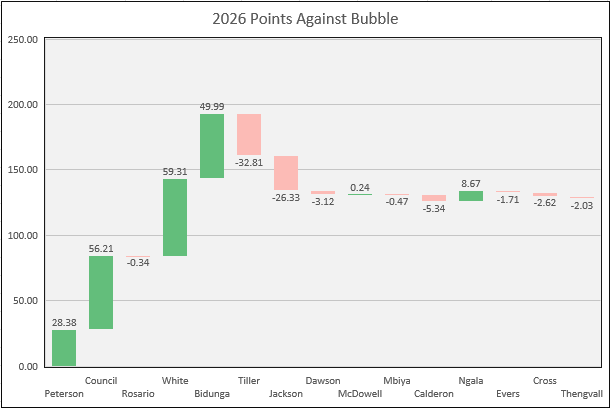
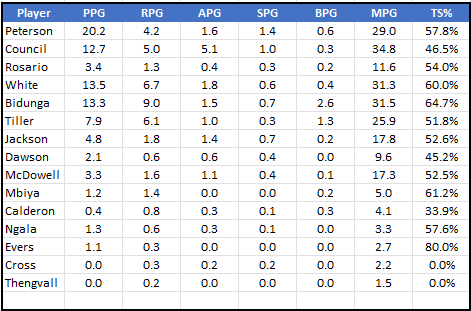
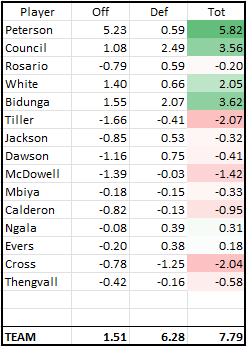
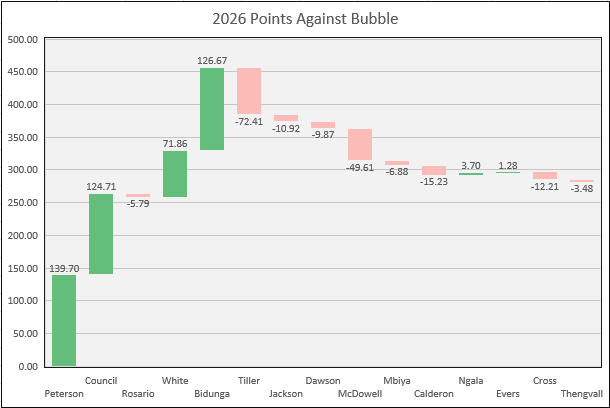
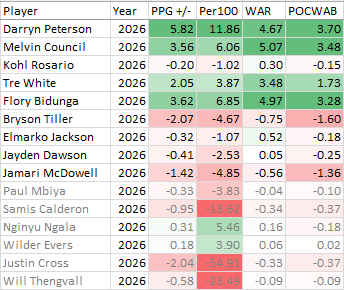
With the on-again, off-again availability of star Darryn Peterson creating uncertainty on the 2026 season, no other player has stepped up more for the Jayhawks than senior transfer point guard Melvin Council. Council is the team leader in minutes played, assists, steals, field goal attempts, and is third in overall points scored.
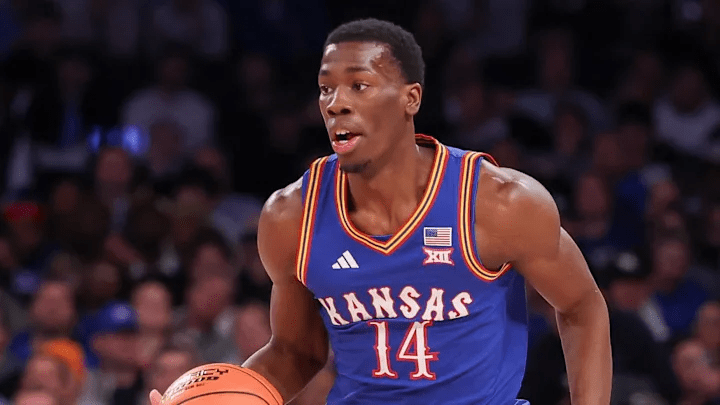
Council has been a fan favorite since before the season began, describing his play on the floor as tenacious, like a “dog,” and then delivering on this. Council’s heroics in Las Vegas, helping lead Kansas to a 3-0 record and third place finish in the 18-team Player’s Era showcase (including a huge comeback win against Tennessee), was really the first time that people thought about this team as being something more than just Darryn Peterson + role players.
At this point of the season, Council was certainly beloved by the fans but he wasn’t without flaws. Some thought he took too many bad shots; others worried about his outside shooting. With only 5 made 3’s on the season (in 28 attempts), N.C. State made the decision to double-team Darryn Peterson and guard other Jayhawks more closely, allowing Melvin open looks. Instead of this getting to his head, Council wound up going 9-15 from downtown that night en route to an-all time 36-point performance, leading KU to a 1-point overtime victory. Melvin has continued his hot play of late, including an efficient 20-point outing at UCF (taking over when Peterson checked out with injury) and of course his 18-point, 8 assist night in the comeback overtime win against TCU (9 of his points were in the extra session). Over his last 11 games, he’s scored in double figures 10 times (with the other game being a 9-point game against Missouri). The point is, not only has Council been what fans hoped he would be, he’s actually performed better than expected of late.
What we want to examine is another angle of this story, namely the comparison between he and former Kansas point guard Tyshawn Taylor. Taylor was a four-year Jayhawk, playing in the 2009 through 2012 seasons. A few months ago, Taylor had Council on his podcast. The two share a resemblance not only physically, but also how they play the game. Both are fast players with the ball who love to get to the rim, both play the same position, and neither is thought of as a great outside shooter. Even before the season fans (and Bill Self) were comparing Council to Taylor. These comparisons haven’t waned after watching Melvin play as a Jayhawk.
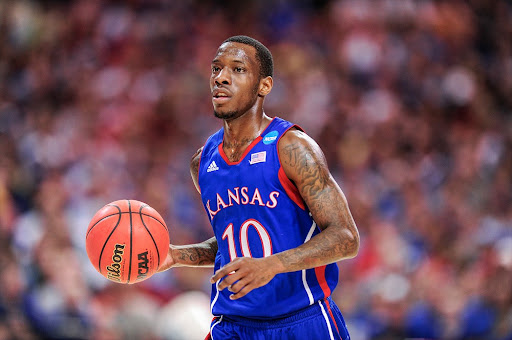
So let’s analyze this. How similar is Council to Taylor? First, the fact they share the same position counts for something. If Council were older/Taylor were younger, KU could switch one for the other and not have to change anyone else’s role on the floor. Another area we could compare is durability. In Tyshawn’s senior season (2012), the former Kansas guard played in 83.2% of possible minutes. Council this season is right in line with that mark (82.8%).
However if we go to past seasons, we see that Taylor was not as key of a piece. In 2011, his junior season, he only played 64.1% of possible minutes. As an underclassman he played similar minutes, but in these seasons he also played off the ball more given that the team had Sherron Collins to run point. In addition, Taylor’s first three seasons produced a cumulative points against bubble of -19.77 (about -0.20 per game). As we will see below, Taylor’s senior season is far more in alignment with Council’s senior season, and as Council only played one season in Lawrence, we will only compare their senior seasons…Taylor’s 2012 against Council’s 2026.
Let’s compare some value scores, noting that Melvin has only played 15 games and Taylor had a full season (39 games).
- Tyshawn Taylor (2012): +3.01 PPGAB, +5.37 Per100, +5.19 WAR
- Melvin Council (2026): +4.57 PPGAB, +8.03 Per100, +2.66 WAR (translates to +6.92 WAR over 39 games)
From a purely value perspective, Melvin has been even better than Tyshawn was at his best, to the rate of about a point and a half per game. Now this doesn’t mean that Council will have a better season; he still has to finish out conference play and the tournaments. How successful KU is, and how well Council leads the team during their stretch run, will also be a factor. Fans warmly remember Tyshawn being the PG of a national runner-up team. It is unlikely that Melvin will have that much team success. Furthermore, should Melvin have a few mediocre or poor games, his value marks will trend back toward where Taylor’s were in 2012. Still, it is undeniable that KU got a good point guard ala 2012 Tyshawn Taylor, they likely got a better version of him with the portal addition of Melvin Council.1
The next look at this will be more detailed. Do they actually play the same. I will posit that, despite notable similarities (position, height, body shape, skin tone, face shape, speed with the ball, average shooting abilities), there a quite a few differences as well.
This is easier to see when we start breaking the player value down. In 2012, Tyshawn Taylor’s per game offense/defense breakdown was: +3.37/-0.36. He was an offense-heavy piece, taking 26.2% of the team’s shots (second on the team), did an excellent job of getting to the line (42.0 FT Rate), but also had a relatively high turnover rate (22.6).2 These numbers were also fairly consistent throughout his career. Sure, he was less important on offense before 2012, but he was always a better offensive piece than defender and he never became a good or even average defensive player.
Melvin, on the other hand, is a noticeably poorer shooter than Tyshawn was (Taylor was a career 37% 3-point shooter, believe it or not). Council’s TS% is currently 49.3% (in range with how he shot at St. Bonaventure and Wagner the prior two seasons), whereas Taylor’s TS% was 56.9% his senior year and never lower than 53.1% in a single season. Council doesn’t get to the line as often either (24.6 FT Rate).
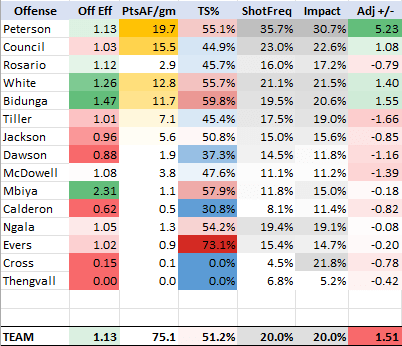
But Melvin handles the ball better. We should be careful some, given that the game has allowed for more liberal ball-handling maneuvers (and thus turnover percentages are down across the board), but Council turns it over about half the rate Taylor did. Melvin is adding an estimated 4.48 points per 100 on his ball-handling abilities alone (i.e. limiting turnovers while adding assists). We haven’t calculated Taylor’s ball-handling value component yet (this takes time to set up for past seasons), but a reasonable estimate would have him close to slightly above bubble-level. Overall, Council is a +2.28 offensive piece, about a full point worse than Taylor per game but still a very solid player on this end.
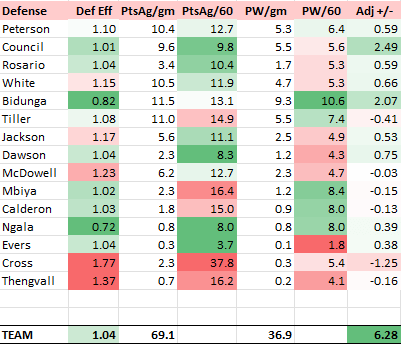
Where the differences lie, undeniably, is on the defensive end. We’ve gone over Taylor’s defensive weaknesses, but Council’s been KU’s best overall defender this season. He’s added +2.29 value points per game defensively (+4.02 per 100 possessions), and he’s done so in a system that relies on KU switching a bunch (meaning he has to be versatile as well). Council isn’t doing it through high rates of steals or rebounds (he’s about bubble level on these components), but through stinginess. Looking at Council’s game, other guards that put up similar offense/defense splits include Frank Mason as a junior (2016), Devon Dotson as a freshman (2019), and Mario Chalmers (especially 2008).3 With data going back only to 2018, there isn’t a closely similar player in terms of Council’s offensive breakdown among the three factors of scoring, ball-handling, and (offensive) rebounding. Council scores at a slightly-above bubble rate, but he’s been the best ball-handler since at least 2018, adding +4.48 points per 100 on this element of his game (Dajuan Harris’ best season was +3.83 and Devonte’ Graham’s 2018 year was +3.61 on this area, but Juan was a notably inferior scorer and Graham a notably superior scorer to Council so far).
In conclusion, Council has been even better than advertised and likely better than even KU fans are giving him for due to his defensive coverage and durability. While there are questions about his consistency doing this over a full season and ability to play alongside Darryn Peterson, there’s no denying that KU getting to 11-4 in a tough schedule without its star for 60% of the available games has been in large part to the play of Melvin Council. Council leads the 2025 team in POCWAB at +2.11, which is already in front of all players from last year over a full season aside from Hunter Dickinson.
- Currently, if we combine all three comparison looks at player value (per game, per possession, and per season), Council is playing as an 89.4%ile KU Jayhawk. Tyshawn Taylor in 2012 was at 90.4%ile. But this is comparing a full season for Tyshawn and only 15 games for Melvin. It’s likely that Melvin’s per game and per possession value regresses some, but his per season only grows. The best estimate is that he will have a more valuable season than Taylor did. ↩︎
- He was nicknamed “Tyshawn Turnover” after all. ↩︎
- Both Mason (2017) and Dotson (2020) would have offense-heavy seasons later in their careers. ↩︎
 Charting the Hawks