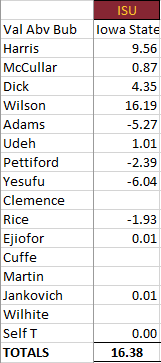
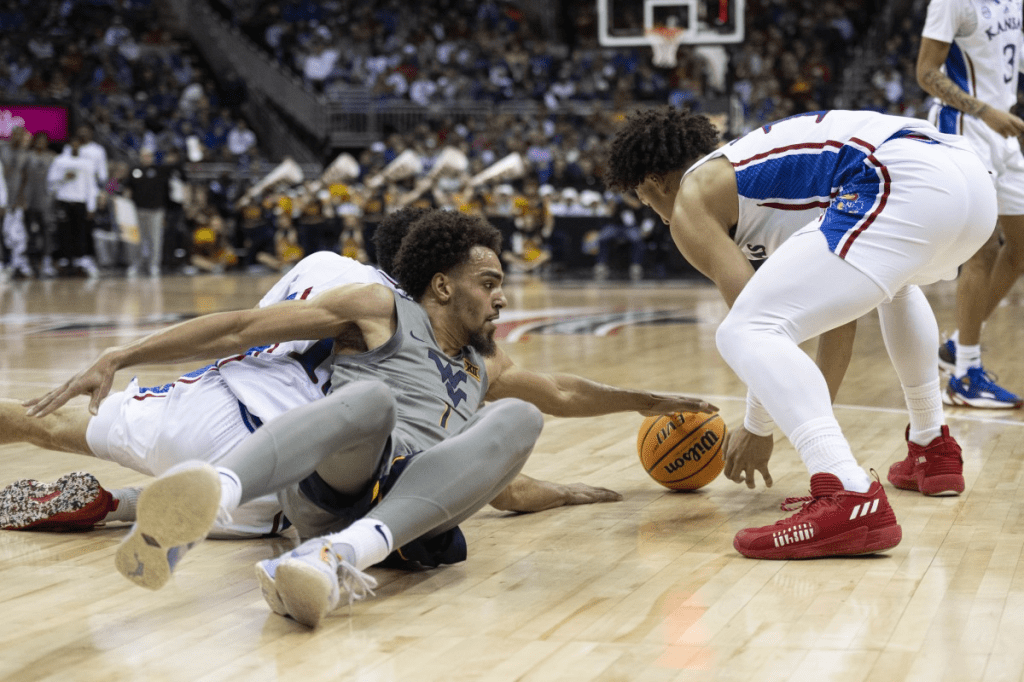
Jalen Wilson had his second-best performance of the season, and Dejuan Harris continued his torrid play of late (averaging +5.28 over his last 10 games) to lead Kansas into the Big 12 Tournament finals. K.J. Adams had trouble inside, giving up a few put-backs to hurt his value score. KU won despite having to go deeper into its bench with Kevin McCullar playing limited minutes due to injury. The bench guards/wings were -10.39 collectively.
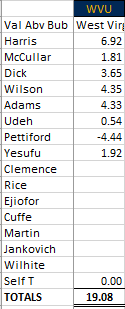
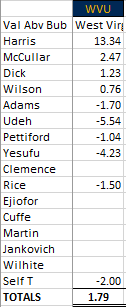
Dejuan Harris had his 5th team-MVP game of the season as the #1 seed Kansas Jayhawks defeated the #8 seed West Virginia Mountaineers in the Big 12 Tournament. Of the 8 Jayhawks who played, all were positive-value except Bobby Pettiford. Kansas advances to play Iowa State in the Big 12 Semifinals.
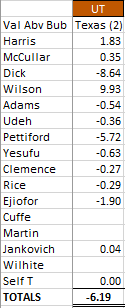
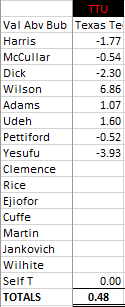
In a game that meant nothing to the conference race, which KU had already clinched, the Jayhawks played flat in Austin and got beat on Texas’ senior day by 16. Jalen Wilson had another great outing in a game when his teammates played poorly. The TEAM’s Game Score of -6.19 (meaning this performance was 6.19 points worse than the expected performance for a bubble team) was its third-worst game of the season and its 7th negative game out of 31.
In these 7 games, Jalen Wilson is averaging a game score of +9.00, whereas the others are collectively at -15.94 for the season. Jalen is having a good season, his current Adj. PPG +/- number is +5.53, but the fact he has raised his game to a high level when others aren’t picking up the slack is impressive. He helped KU win a few of these poorly played games earlier in the season (Southern Utah, Wisconsin).
Gradey Dick had his worst game of the year and has produced negative value over his past 10 games. On the flip side, Dejuan Harris is showing he can provide value even in games where he shoots poorly. Despite managing just 5 points and multiple missed shots, Harris assisted nicely (without turning it over) and defended strongly against Texas’ veteran guards. Kevin McCullar also had a nice defensive game to end slightly above-bubble. K.J. Adams was slightly below-bubble.
The bench had another poor outing, as Bobby Pettiford played the worst of the lot. Only Naadir Tharpe (2012), Justin Wesley (2012), and Stephen Vinson (2006) have had worse Per100 seasons than Bobby out of all rotation players since 2006. (M.J. Rice is also on this list, right next to Pettiford). But Bobby’s played the most out of these names, at 27% of available minutes.
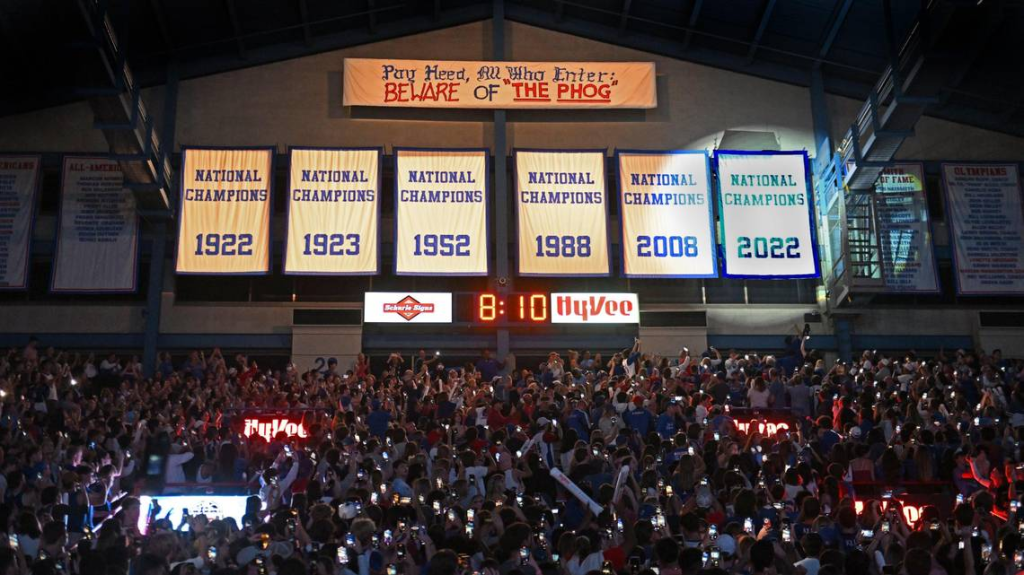
Since the last time we looked at the worth of Allen Fieldhouse, KU has added a National Championship banner. It has also added 15 home wins to just 1 home loss in a difficult Big 12 and non-conference slate. So, it was time to rerun the numbers to see how Allen Fieldhouse has held up.
To refresh, what we’re doing is looking at how good Allen Fieldhouse is at helping Kansas win games per expectation. This is difficult to quantify, but the system that was devised has good reasoning behind it. First, we can look at how good KU has been at home. Since 2010, the beginning season of this exercise, KU is 212-11 in AFH for a 95.1% winning percentage. This is clearly excellent. But how much of this is due to KU being a talented team year in, year out, and how much of this is attributable to the magic of “THE PHOG”?
To isolate the impact of Allen Fieldhouse, we needed to account for KU’s skill. Thankfully, we have a way to do this. Ken Pomeroy’s website (with subscription) provides pregame winning percentage expectations for each D1 game, factoring in the skill levels of both teams and game location (home, away, neutral, etc.). So all we have to do is to compare KU’s wins and losses against cumulative expectation, and what’s left is Allen Fieldhouse. We are effectively comparing the Fieldhouse’s impact against an average home-court.
Since 2010 is the first season where Pomeroy published pregame winning percentage expectation, we begin with this season out of necessity. KU has played 223 games at the Phog in that time, again winning 212 of those games. But what was the expected number of wins (per Pomeroy)? All we have to do is add up each game’s pregame expected winning percentage to get this number. After collecting the data, we arrive at 194.9 expected wins. Simply subtract 212-194.9, and we get 17.1 Wins Above Expectation (abbreviated WAE). In 14 seasons, this works out to over 1 win per year, which can be significant in tight conference races.
This gets us somewhat of an understanding of the excellence of the Fieldhouse, but it still needs further context. After all, just as with anything else there has to be some places which perform better than expectation (just as there are some arenas that perform worse than expectation). In short, is 17.1 WAE a statistically significant difference?
To test this, we constructed a simulation which would run each game 10,000 times (using KenPom’s pregame odds) to see the frequency of results as a total win/loss record. For instance, if KU goes 212-11 in 20% of simulations, this means that it isn’t that unlikely and Allen Fieldhouse’s accolades are overstated.
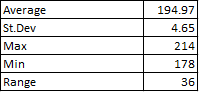
So, running the results this time, we got these totals (in wins out of 223 games):
The average number of wins in the simulation is very close to the true expected number of wins, helping confirm that 10,000 sims was a large enough size. The standard deviation is listed next. The next number is the highest number of total wins in any specific sim, with the number below that the lowest number of total wins in any sim. Last, the range shows the broad difference between high and low win totals.
The Max number of 214 shows that we have at least one result of at least 212 wins, just through “luck.” This tells us that, given enough chances, KU’s run over the past 14 seasons could be replicated at a different home arena. This is noteworthy, but we still need to calculate a few more numbers before we fully discount the aura of “THE PHOG.”
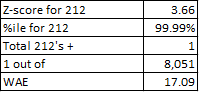
Taking 212 wins (given pregame winning expectations), a z-score of this event occurring is 3.66. Converting this to percentile terms, this high level of a z-score is in the 99.99%. We see next that there was 1 total result of 212+ wins in the 10,000 simulations, and we would expect this result (212 + wins) to occur in 1 out of 8,051 random sims. Last we see the WAE number of 17.09.
In layman’s terms, Allen Fieldhouse has won games for KU. We can factor out KU’s elite talent, as that is already calculated in pregame winning percentage expectations. We can factor out general home-court advantage, as KenPom’s system accounts for where games are played. What is left is the pure aura of Allen Fieldhouse. How KU wins this many games is up for debate. But there is something special about the Phog, and it is something that persists over time.
Jalen Wilson was KU’s best performer for the 14th time in 30 games this season. He was productive but not efficient on offense, and far better on defense than given credit for. The only other starter to produce a positive-value game was K.J. Adams, who also played good defense overall despite giving up a few baskets inside due to his size at the 5. Ernest Udeh also had a positive game and now sits just fractionally above-bubble for the season.
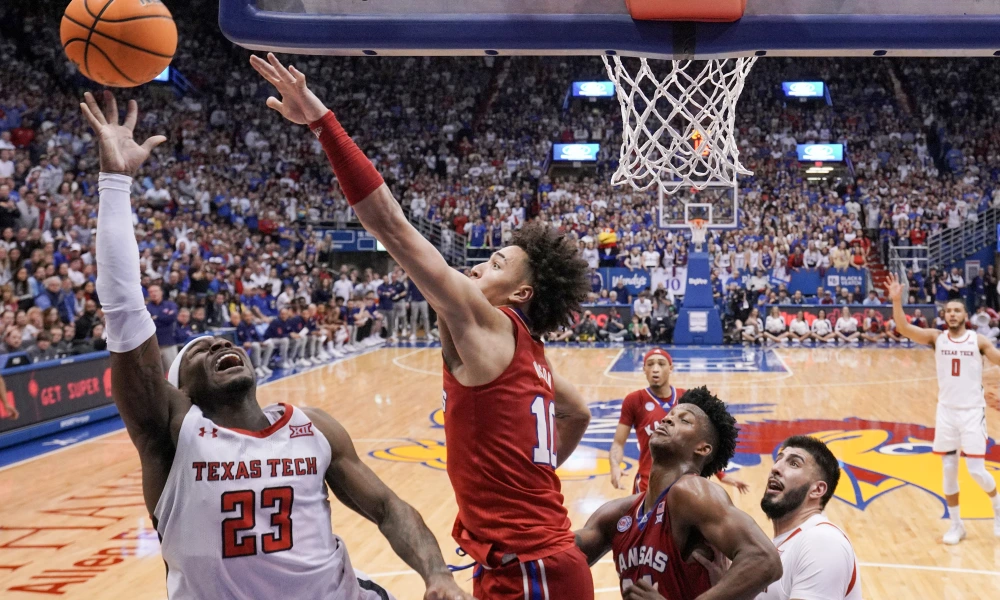
On the other end of things, Kevin McCullar graded slightly below-bubble but made memorable clutch plays late. His recovery block on former teammate and fellow Kevin was incredible. His hustle for the stick back basket to put the Hawks up 3 late was just another of huge high-leverage positive final-minute plays that he has made in close games this season. If the game is close, he just seems to be able to make the winning play. Dejuan Harris had a surprisingly negative game, although the deep 3 he allowed with a few seconds left (to cut a 5 point lead to 2) was a contributing factor. It wasn’t bad D, but his man stuck the shot so per the system these points were allowed by him. These types of “luck” plays will certainly balance out over the course of a season, so be careful to not extrapolate from single-game results. Gradey Dick was KU’s worst starter, but overall his performance was only negative due to poor shooting (0-7 from the floor, 4-4 FT’s for a TS% of 22.2%). Joe Yesufu hit his first 3 (when the KU starters couldn’t get anything to drop from the outside), but then proceeded to miss 2 shots and allow 6 points on defense. Since a nice, three-game run in late January/early February, he has recorded an average Adj. PPG +/- of -2.10 over his last 6 games. Still, he has been KU’s best guard/wing off the bench for the year and likely deserves 8-10 minutes per game. Bobby Pettiford only played a few minutes and missed his only shot.
The TEAM score was barely bubble-level but enough to get it done against an actual bubble-team.
Dejuan Harris had his best career game and his 3rd team-MVP of the season. He was also KU’s best offensive and defensive player Saturday, something which has occurred in only 7 of the team’s 29 games this season. Over his last 6 games, Dejuan has averaged a game score of +6.07, the best on the team in that span.
Kevin McCullar, Gradey Dick, and Jalen Wilson each had slightly positive games. McCullar made numerous impressive defensive plays in the second half, but also gave up a few baskets. He hit some nice shots to finish with a positive offensive outing. Dick would have had a better game, but he gave points away in the final few minutes. Jalen Wilson had a quiet game but still managed to do enough to generate positive value.
K.J. Adams was the only starter to record a negative-value game. The bench had its worst game in weeks. Hopefully this is just a blip that will be corrected in upcoming games.
The TEAM score of +1.79 was the team’s lowest since the road Iowa State loss, but it was still good enough to earn the team the win. Let’s hope the gray/white jerseys are done with. Traditional color schemes need to be preserved.
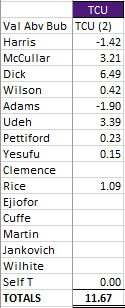
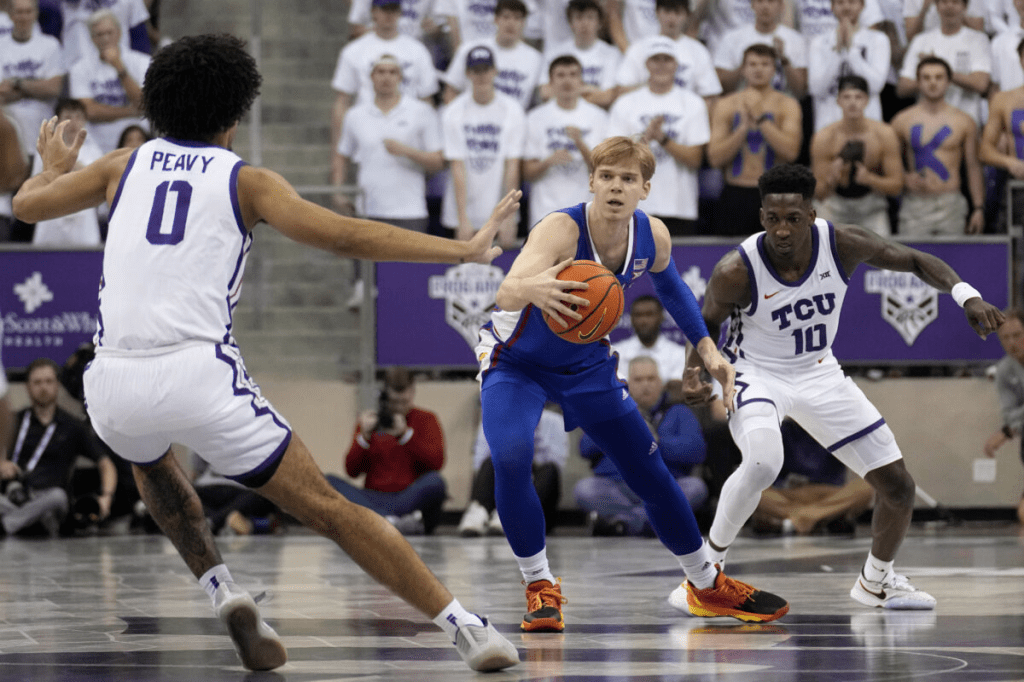
Kansas avenged its earlier loss to TCU, defending excellently and holding on to win by 5. Gradey Dick had his 6th team-MVP game of the season. Other positive performers included Ernest Udeh, who was KU’s second-best player in Ft. Worth. Kevin McCullar had a solid game on both ends, and M.J. Rice played solid defense while scoring an assisted layup during the second half. Jalen Wilson, Bobby Pettiford, and Joseph Yesufu also graded out as slightly above-bubble-level. Dejuan Harris and K.J. Adams each had solid moments, but still graded out as negative given the flow of the game. In total, it was a solid team effort despite poor shooting.
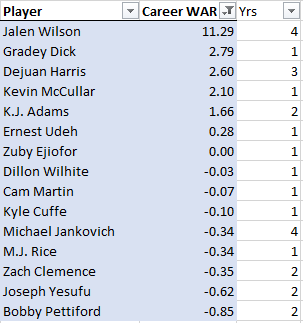
Earlier in the season, WAR (Wins Above Replacement) was introduced. I wanted to catch up with the 2023 team to see where each member of the roster is, in terms of Career WAR.
Currently, the rest of the team apart from Jalen Wilson has 6.74 Career WAR, with most of this coming from the play this season. This means that Jalen Wilson, with 11.29 Career WAR, is 62.6% of the current roster’s entire Career WAR at Kansas. His combination of experience and skill mean that this really is Jalen’s team. How far this team goes in March will depend on him.
Speaking of Jalen Wilson, it is all but assured that this season will be his final as a Jayhawk. He almost left after last season, but he returned understanding that a solid junior season could help his pro-prospects. He’s achieved all he wanted to do, and more. With a national championship under his belt, there’s little left for him to do in college regardless of the rest of the season. Jayhawk fans should be grateful for all that he’s provided for the program.
Jalen has really done all of this in 3 seasons, even if it says he’s played 4 in the chart above. This is only technically true. Technically he did appear in 2 games (for 2 total minutes) in his true freshman season before being injured. And technically, he does have 2 more seasons of college eligibility following this one since he took a medical redshirt and also got the “free” Covid year (in 2021). But as was stated earlier, this will certainly be his final season at KU.
But he still has some season left. 4 games in the regular season, with a potential of 9 more in the Big 12/NCAA Tournaments. Let’s compare his Career WAR to other Jayhawk greats to see how he stacks up. Since 1994, WAR estimates have been provided by season. This encompasses 30 seasons (including the current one) and 172 Jayhawks who have played at least one second of a regular season KU game. To clarify things, this range of years (1994 – 2023) means that certain players’ careers are interrupted. In other words, we have stats for Greg Ostertag (7.09 WAR) from his junior and senior seasons, but not his freshman or sophomore years. And Steve Woodberry had an excellent senior year (4.83 WAR) in 1994, but his first three seasons aren’t included on this list. It’s doubtful that either of these guys are at Jalen’s career level at this point, but it was still something that needed to be said.
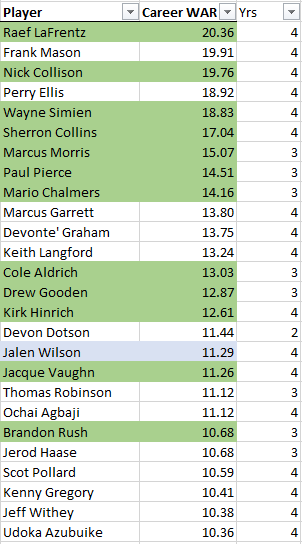
So, at 11.29, how does Wilson’s Career WAR stack up? At this point, he is at #17 (out of a total 172), having just passed Jacque Vaughn. Next on the Career WAR list is Devon Dotson, a name which might be surprising to some people. Dotson was extremely good during his 2 years in Lawrence. If we estimate that Wilson will play ~ 9 more games (a conservative but not overly cautious guess), Wilson will have a excellent chance to pass not only Dotson but also Kirk Hinrich (#15), Drew Gooden (#14), and maybe even Cole Aldrich (#13).
Here’s the list of all players with a Career WAR over +10 from the years (1994 – 2023):
WAR is calculated by using a multiple to convert value points (points above replacement) into an estimated amount of “wins.” What this multiple is depends upon a separate conversion, and so changes as more data comes in. In short, the exact WAR number is in flux as more games are played, even for players that are non-current. This doesn’t change the order of the players, but it does change the WAR estimate. So don’t be surprised if these numbers don’t match a separate, more current list of WAR. I plan on pinning a link to Career WAR at the end of the season.
Either way, we see in green the players who’ve had their jerseys retired, and in blue the current players (Jalen Wilson). Jalen is in the company of some great names, and will end his career in the area which normally earns one a jersey ceremony. Given that he has a strong candidacy for 1st-team All-American this season, that he will get that jersey retirement in the future looks almost certain.
As he has effectively played only 3 seasons, it’s fun to compare him to other 3-year players. If he can pass Gooden and Aldrich (which he has a shot to do), then the only names that will outdo him for their KU careers in a 3-year career over the past 30 seasons are Mario Chalmers, Paul Pierce, and Marcus Morris. He’s had an amazing career.
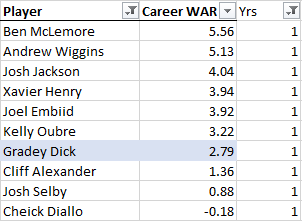
Next on the list we’ll look at Gradey Dick, and compare him to other 1-and-done freshmen.
Of course, Dick has not officially become a 1-and-done player yet. But given his skillset and draft potential, this is the most likely thing. KU has had 10 1-and-done players under the criteria that a player leaves college after 1 season to go pro (KU has had other 1-year transfer players such as Remy Martin or Bryce Thompson…these are left off). The majority of these guys were “wing” type players, with a few post men as well as SG/CG Josh Selby. Of these wings, Dick keeps good company. Again, it depends on the number of games he has left. But extrapolating his current play to an additional 9 games, and he will be above Oubre and just below Embiid/Henry/Jackson. With a stretch of solid play and a deep run in the NCAA Tournament, Dick could leap into 3rd on this list. Gradey’s been as good as advertised.
Last, let’s try and forecast Dejuan Harris’ career using WAR. Harris began his career with a negative-WAR season in 2021. He was someone who hardly scored the ball, and while his defense had potential he would still be bullied by stronger players quite often. Harris has improved on both of these areas, and is now generating positive impact for Kansas. With 2 more seasons of eligibility remaining and little chance of him leaving the program early, let’s look at how his season-by-season play has been.
From this table, we can see each of Harris’ seasons from most recent to oldest. We see that he has increased his playing time (he is on the floor in 83.1% of available minutes), his scoring, and in turn his WAR. Assuming that his final two seasons will be at least as good as this one (with likely value growth, albeit slower growth), we might estimate it as follows:
2025: 3.50
2024: 3.25
2023: 3.00
2022: 0.63
2021: -0.56
CAREER PROJECTION: 9.35 WAR
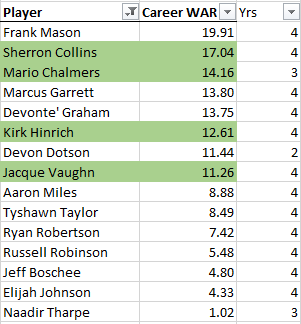
The comparison list here is of multi-year players who were legitimate PG’s or lead ball-handling guards. This will include guys that aren’t necessary thought of as “pure-PG’s” but still handled the ball in that role. These are the types of players that Dejuan Harris would have been competing for regarding playing time had he played in a different era.
From a projected Career WAR, he might end up roughly halfway up the list. Now this still has to happen, and he would benefit from a 5th season that the others didn’t get, but his trajectory places him as a legitimate KU-level player, something that wasn’t apparent during his first season.
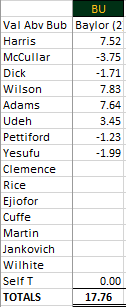
Down as many as 17 in the first half, the Kansas Jayhawks used a ferocious second-half comeback to win going away against Baylor. Jalen Wilson’s value score led the team, his 13th game this season doing such, but both K.J. Adams and Dejuan Harris were essentially just as valuable. Ernest Udeh was also a very solid contributor, continuing his stretch of good play with a positive game score.
The TEAM’s +17.76 score was its 11th above +10 on the season, and its sixth in its last seven games. Signs are pointing to this team peaking at the right time, as the final week of February arrives.
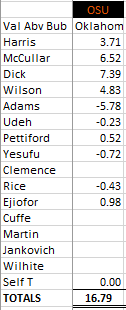
Freshman Gradey Dick had his 5th team-MVP game of the season in a career high 26 point effort. After accounting for his defense and opponent, it was his 4th-best game of the season. Other Jayhawks who added value were Kevin McCullar, Jalen Wilson, Dejuan Harris, Zuby Ejiofor, and Bobby Pettiford. The team was able to go deeper into its bench thanks to the (relative) health of Ejiofor and Pettiford. However, it’s clear that Pettiford in particular isn’t quite 100%. Late injuries to Harris and McCullar might also be a factor moving forward.
Ernest Udeh followed up his excellent OU game with another high-energy performance, although his fouls contributed to a negative-value score. Still, he has played well of late. M.J. Rice only contributed an offensive foul in his 2 minutes of play, and Joe Yesufu had a typical game for him. KU’s worst performer against the Cowboys was K.J. Adams, who had the worst defensive outing of anyone this year. He was responsible for a lot of easy baskets from OSU’s Kalib Boone, and also got scored on at times when switching onto guards late. He has struggled during conference play due to his position (undersized 5), but he is also overrated on the perimeter.
The TEAM is on a roll, averaging an 11.74 value score over its past 6 games (where it has gone 5-1). If it can keep up this level of play, it will not only earn a 1-seed but have the capabilities that past 1-seeds have had. Getting contributions from its bench has been huge, as the bench has been +1.10 per game over that span (this may seem pedestrian, but the bench was averaging -5.57 before that time). In its last 5 outings, the bench has been even better (+3.49). This has shown up in the results of the games.

 Charting the Hawks