The 2025 Kansas Jayhawks enter the New Year after falling in their conference opener (for the first time in over 3 decades), and are now 9-3 (0-1) on the season. This year’s team has had some good wins, but it has also had some bad losses. With the majority of conference play still to come, let’s recap the season so far and look ahead to what might be.
Season So Far – Player Breakdown
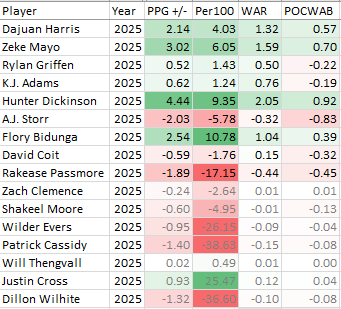
After deriving an estimated level of value in terms of points against a “bubble-level” player or a replacement player, there are four different ways to assess player value. The first, or PPGAB +/-, rates a player’s contribution in terms of points per game above or below an average player on a bubble-team. Generally, KU rotation level players should strive to be above 0.00, and the average number of positive-bubble players KU has in a season has been 6.1 since 19931. This year, with Harris, Mayo, Griffen, Adams, Dickinson, and Bidunga; KU is right at its average.
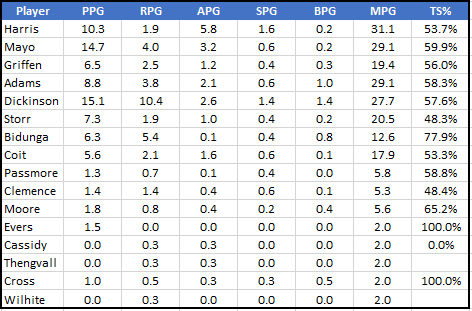
Hunter Dickinson, at +4.44 per game, is having the 24th best PPGAB +/- season in the last 33 seasons of Kansas basketball. This is the 94.8%ile of all player-seasons. He’s nearly a full point-per-game better than his 2024 campaign (+3.46), with this being due to better defense (his offense has actually declined). He’s averaging 15.1 and 10.4 per game on 27.7 minutes a contest. He leads in blocks, is second in steals, and third in assists. Dickinson’s Per 100 is second on the team behind Bidunga (more on him later), and is currently at the 94.0%ile of all KU players since ’93 who’ve qualified2. Hunt’s minutes are down some this season, which is good, but we’ll see if he is asked to play more now that conference play has commenced. Hunter is adding 2.05 WAR, again leading the team. Similarly, his POCWAB is +0.92, leading the team in this metric as well. Simply put, Hunter is better than most of the bigs he faces on the block and cleans up defensive possessions well with boards. He does get hurt when teams make him guard the ball-screen and can fluster him at times when he’s on offense. But he’s the fourth-best player on KenPom for a reason, folks3.
Zeke Mayo, at +3.02 per game, is KU’s hottest player, averaging 26 PPG over his last 3 games. Zeke puts to bed the lie that it is impossible to adjust to a higher level of competition or that Self’s system isn’t conducive to transfer-ins. He’s been tremendous, and is adding value above-bubble on both ends of the floor. Mayo’s Per 100 value puts him at the 81.3%ile among KU players, very close to senior-year Steve Woodberry (1994). Mayo also doesn’t have a real weakness. He’s not a lock-down defender nor excellent ball-handler, but he can cover his man and handle it full-court in limited stretches. Expect him to continue to get big minutes.
Flory Bidunga is a +2.54 per game player despite playing only 12.6 minutes per game. Such high value in such limited playing time has skyrocketed the true freshman to the upper echelon of the Per 100 list. Bidunga’s value per possession is the 11th best since ’93 (96.7%ile), among other elite interior players like 2009 Cole Aldrich and 2012 Thomas Robinson. Will Flo keep up such play if he gets more playing time, something that seems to be on the way? We shall see. But he has been a bright spot thanks to his hustle, rebounding, elite finishing ability at the rim, and overall feel for the game.
Dajuan Harris is having an underrated season, generating +2.14 PPGAB and +4.03 Per 100. He’s in-between sophomore year Jacque Vaughn (1995) and senior year Adonis Jordan (1993) at the moment. Given the criticism of Juan, one would think he was having a terrible year. Harris’s WAR and POCWAB is 3rd on the team, outranking Flory due to Harris having more minutes played and more clutch moments against the better teams. One concern is that Harris is playing worse of late–only +0.54 per game over his past 5 games–but trends come and go throughout the course of any season.
There’s a noticeable decline following these top four players. K.J. Adams is technically an above-bubble player on the season, with a +0.62 PPGAB score and +1.24 Per 100. His corresponding WAR of +0.76 is also okay, and would be over +2.25 if the season extended to the average 36 games this year. But, Adams has a negative POCWAB, which shows he hasn’t been clutch against the tougher opponents on the whole.4 This was exacerbated by a season-low -7.59 game-score against West Virginia in a 1-point loss.
Rylan Griffen has been similar to K.J. on a value-scale. He’s at +0.52 PPGAB and +1.43 Per 100 in fewer minutes than Adams, making his WAR a bit less. Griffen is also below 0 on POCWAB, with poor outings against N.C. State and West Virginia being the major culprits5. Much has been made about his struggles shooting the ball, but his 56.0% true shooting isn’t bad. But he’s not a high margin scorer, nor does he create many opportunities for others.
David Coit has been KU’s best player not in the green, with a -0.59 PPGAB and -1.76 Per 100. Despite being a scorer at the lower levels, he’s also played within his role as a bench energy-guard who can hit the open shot and given effort on both ends.
Rakease Passmore, at -1.89 PPGAB, would be KU’s worst rotation-player in this stat if he played more. His Per 100 of -17.15 certainly is. It’s doubtful that Passmore qualifies with 10% of minutes played by season’s end.
A.J. Storr, who is sitting at -2.03 PPGAB, is KU’s lowest-earning player. He’s also got the second-worst WAR and worst POCWAB on the year. In fact, Storr has only added to his team’s chances of winning in 2 games this season, first against mid-major Oakland and then again at Creighton. He has also had 3 games where his play was neutral in helping the team win, meaning the remaining 7 games (including North Carolina, Michigan State, Duke, Missouri, and West Virginia) were games in which his play hurt the team.
Zach Clemence and Shakeel Moore haven’t played 10% of minutes and thus don’t need much discussion so far. Each has dealt with injuries and had limited impact on the results of the season thus far.
What Comes Next?
Now the fun begins. Kansas is reeling, having lost 3 of 5 and a home game to a West Virginia team that wasn’t supposed to be that good. With losing comes criticism, and there is much consternation about this team.
Hopefully, some of that has been answered above. There are four players (Hunt, Flo, Zeke, Juan) who have been comfortably above-bubble players all season, and have clutched up well enough to help the team win games. While not perfect, these four should be seen favorably. Everyone else warrants more serious scrutiny.
Kansas has struggled with K.J. Adams on the floor recently, though it’s not all the time. Both Creighton and now West Virginia took advantage of his inability to hit the outside shot and sagged off him. While all teams do this to some degree, Adams had very poor games in these two losses, contributing to his negative POCWAB. When he was benched for Flory Bidunga, the Jayhawks made their run to cut an 18-point deficit to 4. The game was eventually tied, with Adams on the court (though he didn’t contribute positively to the effort), but the clear message from Flory’s performance was that Flo could do things K.J. just can’t. Rebound, finish inside, and even cover the roll man on the high-ball screen. Yes, Flory can’t shoot from the outside. But neither can K.J. Might as well play 2 bigs who are elite at the rim/on the glass more.
Even worse has been A.J. Storr, someone who arguably cost KU against West Virginia and could have lost the North Carolina or Duke games had other Jayhawks not rallied and clutched up. One doesn’t hear enough criticism about his play. Some even pine for him to start. While our sympathies are with those who want K.J. to sit more until and unless he starts showing some value, the replacement cannot be A.J.
Our starting line-up, followed by the bench in terms of use, is as follows:
- PG Dajuan Harris
- SG Zeke Mayo
- SF Rylan Griffen
- C Flory Bidunga
- C Hunter Dickinson
Yes, there are 2 centers listed. This recognizes that KU won’t have anything resembling a stretch-4 or point-forward, but rather two more-traditional bigs. Can Self make it work? No reason to think it couldn’t be an improvement. After all, he played with 2 bigs from 2004 through 2016, winning multiple conference titles, going to 6 Elite 8’s and 2 Final 4’s, and winning a national championship. Mayo and Harris will have to make plays with the ball, utilizing the bigs for screens and finding them in places where they can be effective. Hunter can also pop out, and his outside shot (which is okay, not great) becomes a more-valuable option when you have Flory (a great offensive rebounder) underneath.
The bench, in terms of minutes-played, should be as follows:
- K.J. Adams
- David Coit
- Shakeel Moore
- A.J. Storr
This makes a 9-man rotation, with it being necessary for each player to get in the first half for a minimum of 4 or 5 minutes. No excuse. If the game is close, the starters will need blows early so their legs are fresh for a longer run in the second half. If KU builds a comfortable lead, it makes sense to rest the starters some, and if KU is trailing then that must be because some of the starters aren’t playing well and something needs to be tried.
Adams has still been the best of the rest. He’s athletic, a versatile and solid defender, and his energy isn’t matched by other options at the 4 once you pull Flory or Hunter. Putting in another guard, such as Coit or Moore, and shifting Griffen down to the 4 makes the shooting better but it makes the defense much worse.
Coit, as a backup, can spell Mayo, Harris, or even play alongside them in a 3-guard look. Moore is slotted in as Harris’ backup, though he needs closer to 10 minutes, not the 1:40 per game he got against N.C. State and West Virginia. He did get 14 against Brown, in a runaway Jayhawk victory.
A.J. Storr stays in the rotation, despite showing nothing this season to merit it. Storr’s reputation and history as a skilled scorer and adept foul-drawer is what keeps him getting playing time. He should spell Griffen at the 3 primarily, but could arguably get some minutes at the 4 if Adams isn’t working out that night.
What Self decides to do shall be seen. Unfortunately, he doesn’t seem all that willing to sit Harris for long. Harris is averaging 35.3 minutes in the 7 games against power-conference teams. Now, this hasn’t always been the worst move. Moore wasn’t available in all of these games. Harris had great games against Michigan State and N.C. State, and held his own against North Carolina, Duke, Missouri, and West Virginia despite slow starts in the Mizzou and WV games. Harris is +12.01, unadjusted, against these 7 teams this year in total. What one hopes is that Moore’s presence can eat minutes up that Harris can use resting, allowing KU to tire out opposing guards while helping Harris be at his max for crunch time. Why else is Moore on the team?
The biggest issue is how he handles the 4-spot, really the 3 and 4 spot. Flory, getting only 12.6 minutes per game, is being wasted. Getting this number up to 20, 22, even 24 could change the dynamic of the team enough to help it. Going with a 2-big line-up means shooters need to shoot, with Griffen, Coit, even Storr being the wings alongside Harris/Mayo in the backcourt. At the moment Griffen seems to be the best choice. We won’t completely write-off Storr just yet.
The Real Issue – Energy
Focusing on each individual misses that basketball is a team game, and that how someone approaches things affects everyone else. KU brought zero energy to start the Creighton, Missouri, and West Virginia games6, trailing by 10+ points within 10 minutes of each. They had double-digit deficits in each second-half by more than just 10, and each time their comebacks were thwarted in part due to how far behind they got. Had KU only gotten down by 10-12 against West Virginia, instead of 18, it’s likely they would have won. Cutting Missouri’s 24-point lead to 2 in the span of about 10 minutes was impressive, but why not keep the game within arm’s length so your eventual run gets you in front?
Energy, or lack thereof, has been tied to poor road performances recently. KU is 3-9 in true road games the last two seasons, and 1-8 over its most recent 9 road contests. This is unheard of. These games are marked by poor energy, with a number of them being effectively over by halftime. Again, this is where utilizing the bench can help.
- Minimum of 10% minutes played. ↩︎
- Minimum of 10% minutes played. ↩︎
- Pomeroy’s rankings are a bit suspect, but if someone is included on them, he certainly isn’t a net negative to the team he plays for. ↩︎
- K.J. certainly showed his worth against Duke and Flagg, earning a positive game-score. ↩︎
- In fact, Griffen’s performance against N.C. State is the team’s worst clutch performance this season, given the opponent’s quality and being blind to the performance of the team. ↩︎
- KU’s energy wasn’t great against Michigan State, although the Spartans didn’t seem to have much either. Eventually both teams worked into the game and it got better, with KU’s talent winning out. ↩︎

 Charting the Hawks
One thought on “What will 2025 bring?”