
Winning a golf major is partly based upon luck. Not only does a player have to play exceptionally well, he also has to avoid another player having a career week. We know from history that some runners-up didn’t lose because of sub-optimal play, they just got beat by an exceptional performance. In the 2016 British Open, Phil Mickelson finished -17, or 11 shots better than everyone else except Henrik Stenson. The Swede, at -20, turned in an all-timer to win the Claret Jug. Most other years, Lefty’s performance would have been enough to win. Is there a way we can quantify this?
Yes. Enter expected majors. An expected major is a number between 0 and 1 telling us how likely it is that a player’s 72-hole performance was good enough to win a golf major. For most players in any major, this will be 0. Even players that reach as high up as 5th place after 72 holes aren’t really performing well enough to win. But for the top 3-5 spots in most majors, players will produce an expected major score above 0 (also called major share) which shows how good the performance is when judged across all other major championships throughout the years.
Expected majors, or major shares, are calculated using a blend of strokes-gained and an adjusted Gaussian distribution allowing us to place each major championship performance along a bell curve. Again, we really only care about the far right end of that curve…those who played well enough to hypothetically win.
These major championship shares are additive, meaning a player’s career can be analyzed by adding these major championship shares together across all his majors. Summing these expected wins into a total provides more context to major performance over the course of a career, highlighting the fact that some golfers’ major totals are at least partially “luck” derived.
For all 21 golfers who have won at least 5 majors, we show each’s expected majors alongside his wins as well as the difference between actual and expected major championships.
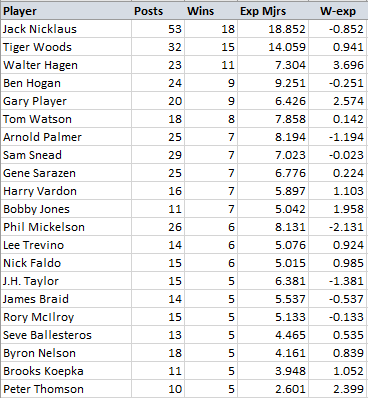
Jack Nicklaus, the winner of 18 majors, played well enough to have “deserved” 18.852 majors. This validates what we all know. Jack, who also had 19 runner-up finishes in majors, has proven himself to be the best major champion golfer in history.
As we go through the list, look at the differences between a player’s actual career and what it “should” have been. Walter Hagen won 11 but only “earned” 7.304. Hagen’s 3.696 wins above expectation are the most all time. Conversely, Arnold Palmer’s 7 majors were done with him playing well enough to win 8.194 and Phil Mickelson’s 6 majors really should have been higher considering his 8.131 career win shares. Lefty’s -2.131 wins against expectation indicate that he was likely even better than his record indicates.
The first column, “Posts,” counts the number of majors a player finished that gave him at least a 0.1% chance of winning. Nicklaus’s completed 53 majors where his 72-hole total was good enough to at least give him a chance to win, 21 more than second-place Tiger Woods.
When it comes to winning majors, the era someone plays in matters. It is tougher to win a major today when compared to the earliest years of the British and U.S. Opens, although this isn’t linear as there was a dip in “competitiveness” in the 1940’s and 1980’s. This doesn’t mean that we’re assuming that golfers today are better or worse than those from other eras. Equipment changes, course maintenance evolution, economic growth and even the introduction of the airplane and speedy international travel allowing for deeper fields have made the game much different than what it was in 1860. We’ve kept all those variables as is. What we’re purely looking at it how difficult a major championship is to win based on how well the field plays. A small field (as the early British and U.S. Opens were) made these tournaments easier to win and harder for the winner to prove he actually separated from a full field. Additionally, when there are tournaments which don’t have much separation at the top, this indicates the lack of elite closing and widens the potential for a surprise winner. Geoff Ogilvy at the 2006 U.S. Open needed players around him to double-bogey the final hole to seal his win. The 2004 PGA Championship saw a number of players fail to close, leading to a 3-man playoff won by Vijay Singh1. Some eras see majors that are like this…the 2000’s aside from the dominant Tiger Woods performances were often this way…while other eras seem to showcase elite golfers rising to the occasion and validating their major championships by strong finishes. The 2020’s are currently one of those eras, with recent winners nearly always separating themselves2.
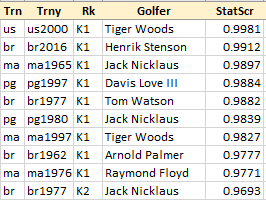
The most dominant performance in a major is Tiger Woods’s 15-stroke win at the 2000 U.S. Open. Unsurprisingly, this tournament “sets the curve” when it comes to grading other performances. It was truly historic. Henrik Stenson’s 2016 British Open victory comes in second, and the Golden Bear has three performances in the top 10. Note that Nicklaus’s 1977 British Open play, which is 10th in our all time list, came in a second-place finish to Tom Watson (whose play that week comes in fifth all time). Tiger’s 12-shot 1997 Masters “only” places 7th all time, in part due to the closest pursuers not playing as well as the field average would project3.
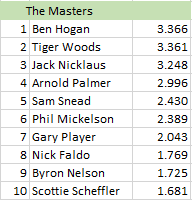
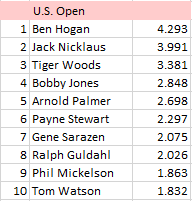
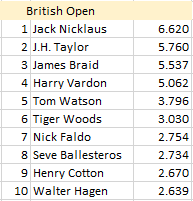
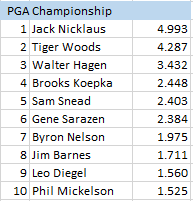
The top win share earners by particular major is shown above. Hogan leads in the Masters4 and U.S. Open; Nicklaus leads in the British Open and PGA Championship. Among active players (those still competitive and relevant), Scottie Scheffler is already the 10th best Masters performer, and Brooks Koepka is the 4th best in the PGA.
Speaking of the PGA Championship, that major was match-play for its first 39 years. Win shares had to be calculated differently for those tournaments, but they are included as part of the estimated majors in the above tables.
The best anyone has done in any particular tournament is Jack Nicklaus at the British. Nicklaus performed well enough to win an expected 6.62 Claret Jugs, although in reality this was the major he won the least, finishing with 3 actual British Open championships.
A few other bits of info. The most-dominant performance in a decade was Tiger Woods in the 2000’s. Tiger won 12 majors, but he “earned” 11.068 of them. This is just further confirmation of how good he was in that era. He didn’t really luck out to get to 12 over that 40-major stretch5. Jack Nicklaus in the 1970’s didn’t quite match this feat, but at 9.546 win shares he too was incredible during his prime. Ultimately, Jack’s durability (he was highly competitive in the 1960’s and 1980’s as well) is what produced such an all-time career.
Only Ben Hogan has the most win shares in 2 separate decades, doing so in the 1940’s and 1950’s. The best major performer in the 2010’s may surprise some people. While Rory, Brooks, and Jordan gave it a run during their respective peaks that decade, they were all a bit behind Phil Mickelson, who should have won 3.480 majors (Lefty only won 2 from 2010-2019). Through 2025, Scottie Scheffler is at 3.894 expected majors. Should he continue on his pace over the next four seasons, he would land at about 6.5 expected majors over the 2020’s, placing him fourth behind Woods (2000’s), Nicklaus (1970’s), and Palmer (1960’s).
There’s a handful of one-time major champions who were incredibly fortunate to have won. The inaugural U.S. Open champ Horace Rawlins takes the cake here (his 2-stroke victory was in a limited and weak field), but more recent examples include Keegan Bradley (0.331 win shares), Paul Lawrie (0.215), and Webb Simpson (0.138). Each of these men had one good shot to close a major, so good for them for doing so. On the flip side, the unluckiest non-major winner is Doug Sanders. Sanders played well enough to win 2.048 majors, but his best finish was only second place. Harry Cooper, the English-born American who was in his prime during the interwar period, was able to put up 12 posts good enough to have a shot, but none earned him a trophy. His closest chance was in the 1936 U.S. Open. In recent years, Colin Montgomerie (1.389) and Chris DiMarco (1.388) have gotten the short end of the stick. DiMarco in particular was hurt by having his best performances come up against Tiger Woods (at the ’05 Masters and ’06 British). In total, we’ve calculated that 613 golfers have put up a score that had a chance of winning a major, with 234 different men actually coming away with at least one.
We close with a list of golfers relevant to today that can be compared. The current* top 50 (in Data Golf) and their career major win shares are in the table below. (This is current as of the week following the 2025 British Open).
| Rank | Golfer | Win Shares |
| 1 | Scottie Scheffler | 3.89 |
| 2 | Rory McIlroy | 5.13 |
| 3 | Jon Rahm | 1.36 |
| 4 | Bryson DeChambeau | 2.08 |
| 5 | Tommy Fleetwood | 0.91 |
| 6 | Russell Henley | 0.20 |
| 7 | Xander Schauffele | 1.62 |
| 8 | Justin Thomas | 0.65 |
| 9 | Corey Conners | 0.00 |
| 10 | Tyrrell Hatton | 0.00 |
| 11 | Keegan Bradley | 0.33 |
| 12 | Harris English | 0.14 |
| 13 | Ben Griffin | 0.00 |
| 14 | Sepp Straka | 0.05 |
| 15 | Matt Fitzpatrick | 0.39 |
| 16 | Hideki Matsuyama | 0.72 |
| 17 | Patrick Cantlay | 0.24 |
| 18 | Sam Burns | 0.00 |
| 19 | Joaquin Niemann | 0.00 |
| 20 | J.J. Spaun | 0.38 |
| 21 | Robert MacIntyre | 0.02 |
| 22 | Ludvig Aberg | 0.44 |
| 23 | Viktor Hovland | 0.68 |
| 24 | Collin Morikawa | 1.38 |
| 25 | Harry Hall | 0.00 |
| 26 | Maverick McNealy | 0.00 |
| 27 | Chris Gotterup | 0.05 |
| 28 | Jordan Spieth | 3.94 |
| 29 | Jason Day | 2.43 |
| 30 | Shane Lowry | 1.15 |
| 31 | Taylor Pendrith | 0.00 |
| 32 | Aaron Rai | 0.00 |
| 33 | Nick Taylor | 0.00 |
| 34 | Max Greyserman | 0.00 |
| 35 | Lucas Glover | 0.33 |
| 36 | Daniel Berger | 0.00 |
| 37 | Si Woo Kim | 0.00 |
| 38 | Denny McCarthy | 0.00 |
| 39 | Patrick Reed | 0.80 |
| 40 | Akshay Bhatia | 0.00 |
| 41 | Brian Harman | 0.97 |
| 42 | Wyndham Clark | 0.56 |
| 43 | Ryan Fox | 0.00 |
| 44 | Adam Scott | 1.61 |
| 45 | Andrew Novak | 0.00 |
| 46 | Nicolai Hojgaard | 0.00 |
| 47 | Kevin Yu | 0.00 |
| 48 | Rickie Fowler | 0.95 |
| 49 | Michael Kim | 0.00 |
| 50 | Christiaan Bezuidenhout | 0.00 |
- The winning score was -8, but that Sunday four different players were -10 or better at some point in their rounds. Stephen Ames, Chris DiMarco, Justin Leonard, and Vijay Singh himself had great chances to win before any potential playoff and couldn’t play well in that pressure. Ernie Els bogeyed 18 to finish -7, one spot shy of a playoff. After capturing this distribution of 72-hole scores, we estimate that Singh’s performance only wins 3.87% of the time in a major. ↩︎
- Take 2024. Scottie Scheffler earned 0.9281 win shares by closing the door with a 4-stroke Masters victory over Ludvig Aberg. Xander Schauffele got to -21 at Valhalla to win by a stroke over an incredible charge from Bryson DeChambeau. Schauffele’s win share for his PGA was 0.7547. Speaking of Bryson, his U.S. Open wasn’t flawless but he still earned 0.5767 shares. Rory McIlroy’s late bogeys cost him a chance at a major. Last, Xander closed the British Open in style to win the Claret Jug. He earned 0.7849 win shares in his 2-stroke win, holding off charges from Justin Rose and Billy Horschel. Other years, the play of Aberg, DeChambeau (at the PGA), McIlroy, Rose, and Horschel would have been enough to get them majors, but instead they watched as someone else’s play exceeded expectation. ↩︎
- Woods’ ’97 Masters performance would still be expected to win by 8 or 9 strokes. ↩︎
- Tiger is neck-and-neck with Hogan when it comes to performance in the Masters and has the ability to catch him by virtue of the curve changing due to more data. Effectively, he and Hogan are tied at the top in terms of cumulative performance at Augusta National. ↩︎
- Woods only played in 38 of those majors, missing the 2008 British Open and 2008 PGA Championship due to injury. ↩︎

 Charting the Hawks
One thought on “Expected Majors (Based Upon Actual Play)”