
Updated after British Open 2025. What is presented below will be the betting market’s cumulative expected major wins for players. Note that historic betting odds only date back to 1985, so this won’t cover many of the greats, and that more than a few players have their careers intersected by beginning at this time.
Since 1985, the table below shows how many major championships the betting market predicted would be won by each golfer the morning the tournament began. For instance, Tiger Woods’s odds were such that the market collectively set him to have 11.26 majors over his career. The idea of using betting odds to predict major championship expectation stems from the belief that betting markets are at least moderately efficient. Bettors are trying to win money, so prices get shaved down to rational levels and this produces information that is helpful in understanding exactly how realistic it was for a golfer to win any particular major.
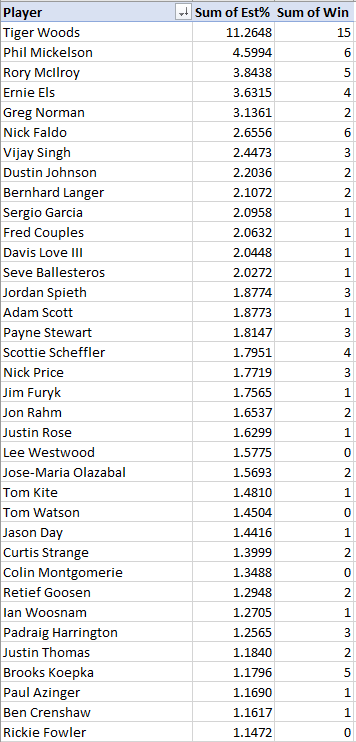
The list cuts off at Rickie Fowler for the sake of space, but this shows the top 36 golfers in terms of predicted majors from 1985 – present. For more on the methodology, scroll to the bottom. For some names, such as Tom Watson, there will be a major total that is different from his actual career total (Tom had 0 majors?). But mentioned earlier, this is just from the period from 1985 and after. Some golfers have their careers intersected by this cutoff date.
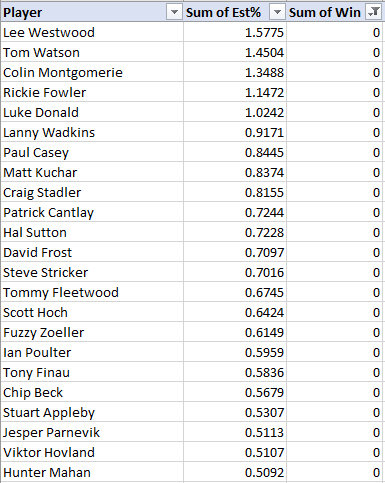
The question often comes up, “who is the best player to never have won a major?” This list is the answer to that question, at least from the period of 1985 onward. Now, as mentioned earlier, Tom Watson doesn’t belong on this list given the fact he was an 8-time winner prior to 1985. (Lanny Wadkins and Craig Stadler are others on this list that got championships before 1985).
Lee Westwood is the definitive answer as to who was the best to never win, at least in the modern era of golf. Monty is second, with Rickie coming in as the highest on this list with a realistic chance to eventually come off it. There’s been some talk about Viktor Hovland’s inability to win a major, but he is only slightly more likely-than-not to be a major champion according to the market’s predictions.
Methodology
Using betting odds as a corollary for projected winning percentage has a few assumptions. One is that the market is efficient (enough) to be useful. If a player is wildly misjudged by bettors, this would make his estimated majors won quite off-base. The second assumption is that the cut taken by the bookmakers can be accounted for. This is more than a math problem. Because each player’s betting odds will add up to more than 1, an adjustment factor has to be made. The question is whether this adjustment (which can be significant toward the top of the favorites) is accurate. While these issues could have an effect on the numbers, it’s likely that this effect isn’t large enough to matter.1
While the odds are from 1985 and after, another issue is that before the mid-2010’s, not every tournament has a full set of historic odds. Many had only 30 to 40 golfers available for betting the further back you go in time. In other words, there wasn’t the option to gamble on any particular player in the field until recently, meaning we have a number of tournaments where there was a “Field” option and there have been 15 total major championships over this time frame which didn’t have pretournament odds listed. So, the historic odds data was supplemented by implementing artificial odds for players not listed in majors during these prior years. These artificial odds were applied based on a player’s Data Golf or OWGR ranking at the time of the tournament.
Efficiency of the Market
If we break down the field into 11 “tiers” of golfers, we see that the break-down of winners for each tier tracks fairly well (but not perfectly) with who ended up winning.
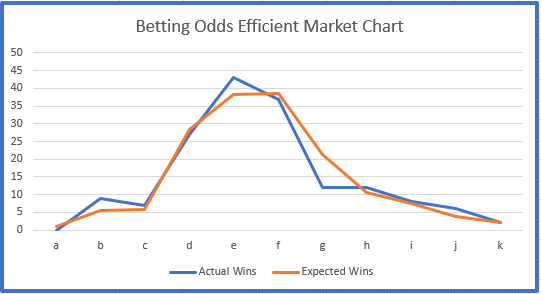
The tiers toward the left, starting with “a”, see fewer cumulative expected and actual wins because there are so few times a golfer has had market-estimated win percentages above 20%. As we move rightward, there are more golfers with odds in the 10% range, then 5%, and so on to make the curves peak around tiers “e” and “f”, which corresponds to an average win range of 3.75% and 1.88% respectively. This declines as we get to the lower win estimates, as each golfer’s low win estimate drops the tier’s collective chance of winning despite there being more golfers at those levels. About 1/3 of all golfers in a major have a less than 0.08% chance of winning according to the odds (tier “k”).
Closing Thoughts
Within golf commentary, hindsight is often applied after a champion is crowned…as this write-up was done shortly after the 2025 British Open, the talk of the greatness of Scottie Scheffler being self-evident is commonplace. But coming into the tournament, Scheffler only got +450 odds or so (18.2% implied win probability, which after the juice was whittled down to 12.8%). He was never really in contention the week prior at the Scottish, finishing a respectable T8 but still six strokes behind the winner. If it were so obvious coming into the week that Scottie was head-and-shoulders the favorite, the market would have priced him down from +450.
Nevertheless, one thing the market loves to bet on is past major champions…winning a major shows to bettors that the golfer has the skill and mental toughness to be a champion…and golfers who win a major normally see their odds pop quite a bit for the next one. Wyndham Clark was +10000 to win the U.S. Open in 2023. After he won, his next major odds were +6000 (2023 British), +3000 (2024 Masters), +3500 (2024 PGA), and +6000 (2024 U.S. Open). Sure, some of this was likely due to him playing well week-over-week. But after he showed he can play at the level it took to win a major, the market priced that in.
The lesson here might be that the market will eventually catch up to a golfer’s true skill level in major championships over the course of a career. Even if certain champions have been underpriced due to the market not knowing how good that player truly is in majors (to take an extreme example, Brooks Koepka), this could cause it to over-correct, which might actually make things more accurate in the long run.
- The one place where this math problem might be important is among the elite in the field, i.e. Tiger Woods when he was getting +200 odds (or lower). Had a bettor placed bets on Tiger to win in each major he played, he would have actually lost money despite the fact we suggest the market calculated Woods winning only 11.26 when he won 15 in actuality. The bookmaker’s cut comes into play. So, Woods was rationally priced, yet the market undervalued him at the same time? Kind of. Again, this isn’t a big number when we look at players lower down the ranks. Scottie Scheffler’s low odds are starting to run into this issue as well. ↩︎

 Charting the Hawks
3 thoughts on “Expected Majors (Based on Pre-Tournament Odds)”