
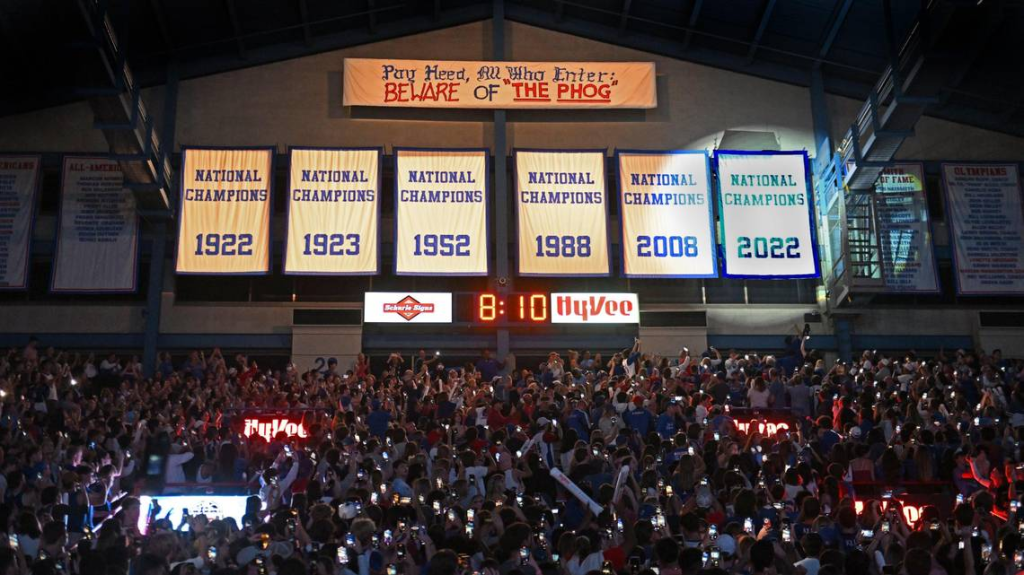
Since the last time we looked at the worth of Allen Fieldhouse, KU has added a National Championship banner. It has also added 15 home wins to just 1 home loss in a difficult Big 12 and non-conference slate. So, it was time to rerun the numbers to see how Allen Fieldhouse has held up.
To refresh, what we’re doing is looking at how good Allen Fieldhouse is at helping Kansas win games per expectation. This is difficult to quantify, but the system that was devised has good reasoning behind it. First, we can look at how good KU has been at home. Since 2010, the beginning season of this exercise, KU is 212-11 in AFH for a 95.1% winning percentage. This is clearly excellent. But how much of this is due to KU being a talented team year in, year out, and how much of this is attributable to the magic of “THE PHOG”?
To isolate the impact of Allen Fieldhouse, we needed to account for KU’s skill. Thankfully, we have a way to do this. Ken Pomeroy’s website (with subscription) provides pregame winning percentage expectations for each D1 game, factoring in the skill levels of both teams and game location (home, away, neutral, etc.). So all we have to do is to compare KU’s wins and losses against cumulative expectation, and what’s left is Allen Fieldhouse. We are effectively comparing the Fieldhouse’s impact against an average home-court.
Since 2010 is the first season where Pomeroy published pregame winning percentage expectation, we begin with this season out of necessity. KU has played 223 games at the Phog in that time, again winning 212 of those games. But what was the expected number of wins (per Pomeroy)? All we have to do is add up each game’s pregame expected winning percentage to get this number. After collecting the data, we arrive at 194.9 expected wins. Simply subtract 212-194.9, and we get 17.1 Wins Above Expectation (abbreviated WAE). In 14 seasons, this works out to over 1 win per year, which can be significant in tight conference races.
This gets us somewhat of an understanding of the excellence of the Fieldhouse, but it still needs further context. After all, just as with anything else there has to be some places which perform better than expectation (just as there are some arenas that perform worse than expectation). In short, is 17.1 WAE a statistically significant difference?
To test this, we constructed a simulation which would run each game 10,000 times (using KenPom’s pregame odds) to see the frequency of results as a total win/loss record. For instance, if KU goes 212-11 in 20% of simulations, this means that it isn’t that unlikely and Allen Fieldhouse’s accolades are overstated.
So, running the results this time, we got these totals (in wins out of 223 games):
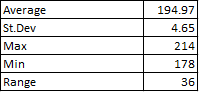
The average number of wins in the simulation is very close to the true expected number of wins, helping confirm that 10,000 sims was a large enough size. The standard deviation is listed next. The next number is the highest number of total wins in any specific sim, with the number below that the lowest number of total wins in any sim. Last, the range shows the broad difference between high and low win totals.
The Max number of 214 shows that we have at least one result of at least 212 wins, just through “luck.” This tells us that, given enough chances, KU’s run over the past 14 seasons could be replicated at a different home arena. This is noteworthy, but we still need to calculate a few more numbers before we fully discount the aura of “THE PHOG.”
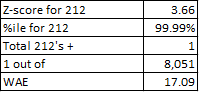
Taking 212 wins (given pregame winning expectations), a z-score of this event occurring is 3.66. Converting this to percentile terms, this high level of a z-score is in the 99.99%. We see next that there was 1 total result of 212+ wins in the 10,000 simulations, and we would expect this result (212 + wins) to occur in 1 out of 8,051 random sims. Last we see the WAE number of 17.09.
In layman’s terms, Allen Fieldhouse has won games for KU. We can factor out KU’s elite talent, as that is already calculated in pregame winning percentage expectations. We can factor out general home-court advantage, as KenPom’s system accounts for where games are played. What is left is the pure aura of Allen Fieldhouse. How KU wins this many games is up for debate. But there is something special about the Phog, and it is something that persists over time.

 Charting the Hawks
2 thoughts on “Beware of the Phog (Part 2)”