
In creating the ranking of Big 12 players, there was the ability to explore more regarding the makeup of the conference. Here are some additional things that stand out about the makeup of players in the Big 12:
The League is Senior-Heavy. While experience has always mattered, the post-pandemic and transfer-portal era has produced a large share of veterans. Using the classifications from KenPom, 36% of all Big 12 players are seniors. When you look at minutes played, the senior-heaviness of the conference becomes more apparent. 51% of the minutes played by Big 12 players have been played by seniors. Iowa State has 8 seniors who have played at least 100 minutes. For Texas and West Virginia, this is 6. K-State and OSU have 5. Kansas is the only team with fewer than 2 seniors in the main rotation (Kevin McCullar). In many cases, a player labeled as a senior is in his fifth year, however there are some 4th year players classified as seniors which does confuse things somewhat. But with 2021 not counting against eligibility, one would expect the trend of senior-heavy rosters to continue for the next two seasons.
Not only do they play more minutes than the other three classes combined, seniors have collectively produced far more value for their teams. The following chart shows how much value the typical player produces by class. The important column is the one on the right, labeled Per32. This is to set player-value by class over a 32-minute span. We’ll use 32 minutes (80% of a non-OT 40-minute game) to serve as a proxy for the average minutes for a starter in Big 12 play.
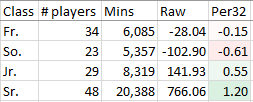
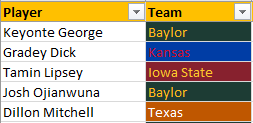
When weighted by playing time, the average senior produces 1.20 points above-bubble over 32 minutes of play. The other three classes, when combined, are effectively 0.00. Interestingly, freshmen are out-performing sophomores. This appears to be an effect of the “one-and-done” system. Two Baylor would-be sophomores (Sochan and Brown) went to the NBA draft and are now pros. In turn, two excellent college freshmen in the Big 12 (George from Baylor, Dick from Kansas) are poised to be first round picks in this year’s draft. Were the NBA draft rules different, either the early-entrees would still be in college as sophomores or the freshmen might not have come to school. This would make each class’s value scores look different.
Jalen Wilson is another interesting case. Due to injury as a true freshman, he redshirted. Although he is listed as a junior, by age he is a senior. Think how much wider the senior/junior gap would be if he were classed as a senior. To a lesser extent, this also applies to Dejuan Harris who is a senior by age but junior by class. Last, Joseph Yesufu is classed as a junior even though he is in his fourth season. With him getting a fifth-year of eligibility, KU effectively had both his 2022 and 2023 seasons be as “juniors.” Again, classifications are all a mess in this era.
By class, here are the best 5-players in the Big 12 through 1/26/2023.
Seniors
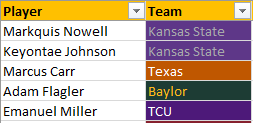
Juniors
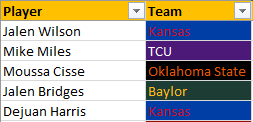
Sophomores
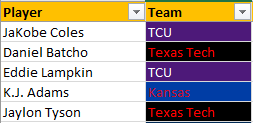
Freshmen
Point Guards and Power Forwards Excel. This is partly due to the two leading Big 12 players, Jalen Wilson (PF) and Markquis Nowell (PG), having separated themselves from the pack. Other great PG’s in the league include Marcus Carr, Adam Flagler, and Mike Miles…all in the Top 6 of all players. Regarding PF’s, Emanuel Miller (TCU), Aljaz Kunc (ISU, currently injured), and Kalib Boone (OSU) are also having good years.
Classing players into a traditional position (PG, SG, SF, PF, C) is harder that it used to be. A few things have happened. One, there are more “positionless” players and systems. Two, teams are becoming more perimeter-oriented, playing 4-out and often 5-out systems without true post presences. This can be handled one of two ways. One is to recognize the change in the game and place players in positions which they’d historically be classed. Therefore, a rotation might play a PG, two SG’s, and a SF alongside a PF. The other way is to do what Pomeroy essentially does, and continue to utilize the traditional position names regardless of the style being played. So when a team plays a small-lineup, this just means that whoever its biggest/most interior player is gets classified as the “Center.” Even a SG might become that line-up’s “Power Forward.” The logic to this seems to be that, regardless of the style you play, you are going to be competing against someone of whatever position you are at, 1-5. To apply this to KU, this would mean that K.J. Adams (as a small-ball “5”) is seen as a Center, because he primarily guards (and is guarded by) the opponent’s biggest player.
For the chart below, players have been classified using a combination of Pomeroy’s algorithm and the alignment of players into their natural, historical positions. For one, Pomeroy’s algorithm isn’t 100% accurate (he has Jalen Wilson as KU’s “Center,” likely due to how poor of a rebounder K.J. Adams is). We want to see which styles have been most effective among Big 12 play. Some teams play two true PG’s (i.e. Texas with Carr and Hunter). We want to reflect that here. As far as K.J. Adams is concerned, his position is PF. This means KU starts two PF’s, instead of a PF and C as would be traditionally done.
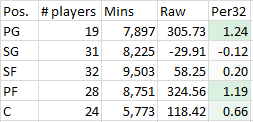
The Shooting Guards and Small Forwards grade out the worst, indicating that there is some diminishing value in filling a roster with wing-types who mostly shoot jump-shots. If you have shooters, it obviously works. But if you don’t, then what? Oklahoma State (-68.92) and Texas Tech (-33.42) have the worst collection of wings in the conference (number in total cumulative points against bubble at those positions). They also have the two-worst offenses in the league according to KenPom. Of the wings who are solid, the three best in the league are Johnson (K-State), George (Baylor), and Dick (Kansas).

 Charting the Hawks