
With one game in the books, KU’s list of players looks like this on KenPom:
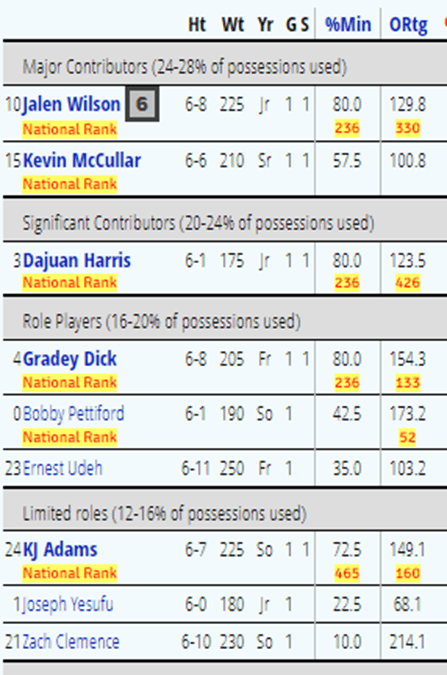
Pretty straightforward. KenPom breaks down players into categories based on their offensive “usage rate.” He also ranks players nationally based on a black-box algorithm. We see that Jalen Wilson is #6 In this national ranking (after one day of play). Again, this makes enough sense. Jalen had 19 points, 11 rebounds, and 7 assists on a very good 129.8 efficiency. So Jalen Wilson should have been the team’s MVP in the Omaha game, correct?
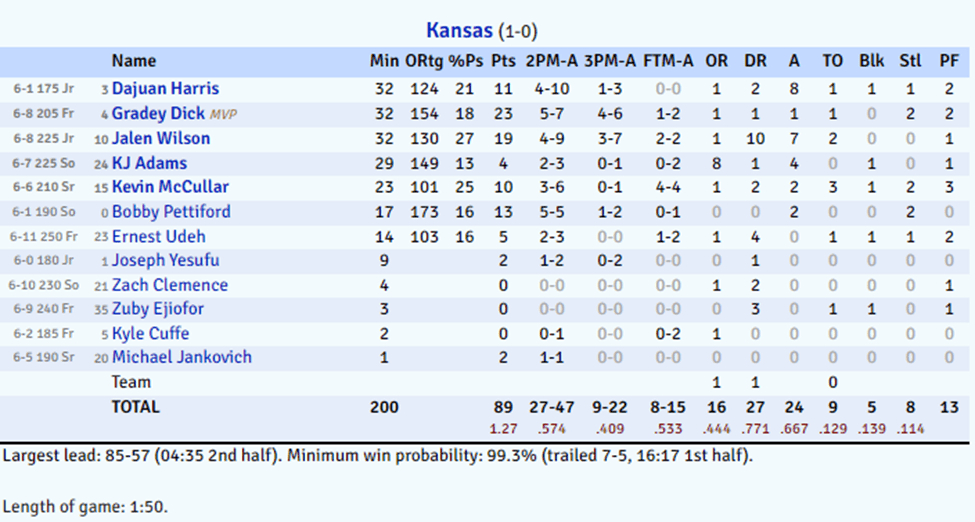
I guess not. This is the KenPom box score from the Omaha game. We clearly see that Gradey Dick is listed as the MVP for this game. And good for him. He had 23 points on 9-13 FGA. This efficiency is certainly very valuable. For what it’s worth, he graded out as CtH’s MVP for this game as well.
But it doesn’t take a skilled logician to see that there is a disconnect here. If Gradey Dick was the team’s MVP for the one and only game so far, this means that he’s been the team’s most valuable player for the entire season. So why is he not listed above Jalen Wilson (who is said to be #6 nationally)? Note that anyone without a number has a ranking outside the top 10. This just doesn’t follow:
Here’s what Ken has to say about his Player of the Year ranking:
The kPOY is not meant to predict who will win the Naismith or Wooden awards. This is a standalone honor designed to identify the most valuable player in the game, free of reputation, future potential, or amount of times the player appears on Big Monday. I’ll track the candidates every week until tourney time, and then we’ll have a season-ending awards ceremony two days after the title game. (Yes, the kPOY will be the one award that includes NCAA tournament play. About time.) [Emphasis added].
If Ken were projecting player of the year, then it might make sense for a returnee like Jalen Wilson to have some pre-built weighting his kPOY score. But according to his own words, Pomeroy is calculating the best players only of games actually played. So what gives? Why does he have Dick > Wilson in the game box score, but Wilson > Dick for the season to this point?
My guess is that the algorithm heavily weights usage rate. Expanding a bit on the initial image, let’s see the actual usage rates for KU players after one game:
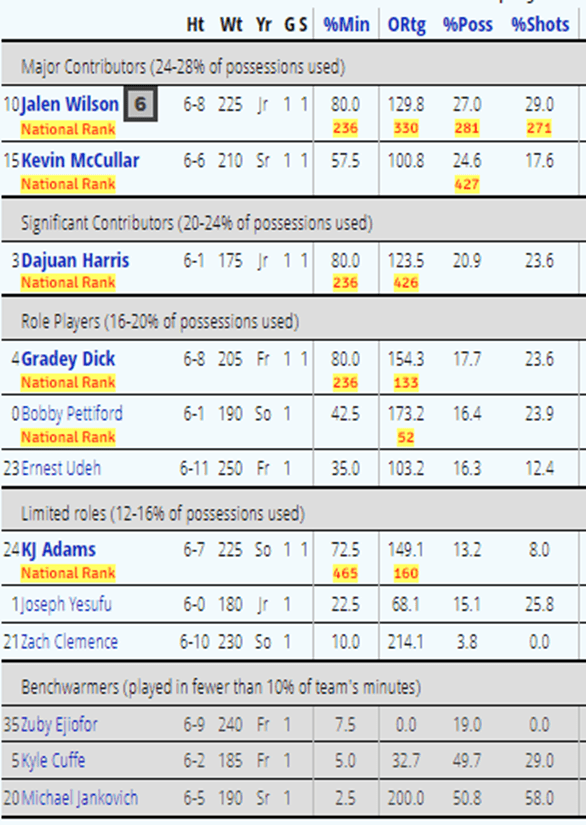
There are actually two usage rates Pomeroy calculates. The first, listed as %Poss, looks at the percentage of possessions a player uses while on the court (with 20% being mean, obviously). %Shots looks only at the number of shots that player takes. These numbers can differ somewhat, depending on assists, turnovers, and offensive rebounds. Gradey Dick’s %Poss usage is much lower than his %Shots usage, likely because he only had 1 offensive rebound, 1 turnover, and 1 assist. In contrast, Jalen Wilson had 1 offensive rebound, 2 turnovers, and 7 assists. He was involved in more plays, thus the higher %Poss number.
This still doesn’t justify the inconsistency. There are arguments to be made whether or not Gradey or Jalen had the best game Monday night. Matt Tait went with Jalen.
As mentioned prior, CtH had Gradey Dick as the best Jayhawk. The one caveat is that CtH has additional defensive stats that Pomeroy and Tait don’t capture. We don’t blame them for that. It should be added that defensive metrics take longer to normalize. So, if you just look at our offensive value stats, you’ll get a decent idea of who played the best per box score numbers. We have Gradey Dick with +4.95 points of value vs. Jalen Wilson with +4.07 points of offensive value. This isn’t a huge difference, but it adds further confirmation that Gradey was the game MVP.
So why isn’t he the team MVP one game into the season? The only reason must be that Pomeroy uses a different algorithm for the season, and it takes into account usage rate. Because Dick is a “role player” (only using 17.7% of possessions), his very high efficiency and strong production is discounted. This is unfortunate. Usage doesn’t really need to be taken into account, as efficiency and production can be balanced together to give us player value. With more usage, more production will come. It isn’t usage that is important; it is production. Higher efficiencies are possible with less usage, but this will come at a cost (lower production).
I suppose that’s the lesson in all of this. Despite the recent increase in adopting new stats such as usage rate, the most relevant stat in assessing player value is points per game. It encapsulates so much of what the “advanced stats” try to.

 Charting the Hawks