
Since beginning to chart KU games during the 2019 season, it’s become clear that without seeing the full picture that the defensive stats (such as points allowed) provide, it becomes difficult to truly see the impact of particular players.
There are a few axioms for charting basketball stats that this website follows, including:
- Offense and defense are equally valuable. Teams will have an equal number of offensive and defensive possessions.
- Offensive and defensive rebounds are of equal value, because getting a defensive rebound is merely preventing your opponent from grabbing an offensive rebound themselves.
- An offensive rebound neutralizes a missed shot. If someone rebounds his own miss, and puts it back in, it neither adds nor takes away value than if he’d made the initial shot.
- Similarly a turnover and forced turnover are equally inverse. If a player has 3 turnovers on offense but forces 3 turnovers on defense, he’s had a neutral game in this regard.
- Similarly all misses are equal. Whether or not an offensive rebound occurs is up to the hustle of the players on the court (including the shooter).
- There are three aspects to scoring: setting up the score, positioning the score, and finishing the score. To relate this to an assisted basket, the assist man sets up the basket with a nice pass, the man who scores must get himself ready to catch the pass, and in turn that same player must have the ability to score by making the shot. With an unassisted basket, the first part of the score (the set up) is not done through a pass but through some type of agile move by the scorer.
The whole point is that there is a systematic way of assessing player value here that avoids bias and selective memory. Now this system also discounts clutchness, or the ability to play well in high-leverage situations. Unlike many in advanced statistics, Charting the Hawks doesn’t disagree that clutchness exists. It almost certainly does. But there are other reasons to discount it for our purposes that we don’t need to get into.
Having said that, and this isn’t to pick on anyone else, but it’s tough not to notice how bias and selective memory pervades the minds of fans and pundits alike. After each game, this website rates the game performance of each Jayhawk (using Adj. PPG +/-). It doesn’t just rank each player, but actually tells you how well or poorly a Jayhawk did in that game as compared to a hypothetical KU-level replacement player (i.e. “bubble” player).
Of course, there are other sites that do the same, albeit without any system. This ends up getting them into trouble. Matt Tait of the Lawrence Journal World took over the Keegan Ratings after longtime LJW Sports Editor Tom Keegan left the paper. It is now called the Kusports.com ratings, although the rankings are based the same as Keegan’s were before. The rater makes his subjective analysis of who played well and who didn’t, then ranks them from best to worst for each game. These ratings are then accumulated for the total season.
Last night’s loss to TCU was ugly to be sure, but rating Zach Clemence as KU’s most effective Jayhawk was a bit far-fetched. Tait’s rankings are represented below, so that we can compare to what a more objective rating system would show. Here’s how Tait ranks them.
- Zach Clemence
- Jalen Wilson
- Ochai Agbaji
- Joe Yesufu
- Christian Braun
- Dejuan Harris, Jr.
- Mitch Lightfoot
- Jalen Coleman-Lands
- Remy Martin
- David McCormack
- K.J. Adams
We won’t go through each player’s write-up, but considering that KU lost by 10 points (which isn’t great, but not the worst ever) and not 30+, it’s odd to think that each of the other 10 players who played more than 7 minutes had less of a positive effect than Clemence’s block and defensive rebound did in 26 seconds.
We will go through a few of the outrageous differences, however. Let’s start with CtH’s most valuable player in this game, David McCormack, who Tait ranks at #10!
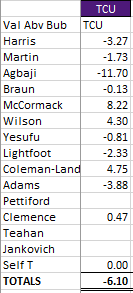
McCormack had a score of +8.22, meaning that after factoring each made shot, missed shot, free throws, rebounds, steals, turnovers, forced turnovers, defensive possessions that did or did not lead to points, as well as minutes played; he was 8.22 points better than the average KU-level replacement 5-man would likely be. This may seem surprising on a night where he was 2-6 from the field; then again by selecting the stat 2-6 on FG’s, we’ve already biased the entirety of McCormack’s performance.
McCormack also went 7-9 on FT’s, to finish with 11 points. Given that he had 6 official offensive rebounds against 1 turnover, his offensive rating was 118.9 on Torvik with 32.2 usage. This is a very solid offensive outing. Note that this also ignores something the video shows, that McCormack hustled to recovery two loose balls on offense that would have been turnovers on bad passes from his teammates (at about the 18:06 mark and 6:52 mark of the 2H). All said, his activity winning possessions and FT shooting outdid the few missed layups he had in close.
Remembering missed layups is the perfect example of selective memory. Here’s Tait’s write-up that tells us more about Tait’s ability to rate players than McCormack’s actual performance on Tuesday:
McCormack never got going in this one, missing so many close-range shots and struggling to gain control of himself throughout. He finished with decent numbers — 13 points and 8 rebounds — but he played just 21 minutes and got so many of those rebounds by badly missing in close.
According to the official stats, McCormack missed 2 lay-ups in the game, one at the 17:57 mark and one at the 16:16 mark of the 2H. It’s tough to agree that D-Mac missed “so many” close-range shots. Now he did miss 2 jumpers inside 8 feet as well, but these were contested. Either way, that is what stuck in Tait’s mind the most, so that is why McCormack was seen as KU’s 10th best player out of 11.
Yet after discounting McCormack’s night, Tait realizes that 13 (actually 11) & 8 aren’t actually terrible. This is the first sign he is starting to come to terms with his own bias. Unfortunately, he doubles down and provides a few more throw away lines that attempt to justify his ranking but only show us his ignorance. Yes, McCormack’s 21 minutes were not as many as he’s had in prior games, but it’s tough to say that limited minutes should discount a player’s performance in your rankings when your top player is someone who played in 1 total possession the entire game.
Another canard is that McCormack’s high offensive rebounding rate is due to him missing close shots. I read/hear this so often, that I might go back through the game logs to see how frequently this actually occurs. For starters, it’s a way to discount the fact that David McCormack is leading the nation in offensive rebounding percentage (OR%), at 20.4%. In other words, he rebounds 1/5 of his team’s misses while he’s on the court.
Tait is appealing to this bit of conventional wisdom, however of his 6 offensive rebounds Tuesday night, only 1 was off his own miss. The other 5 were off a Jalen Wilson missed jumper (5:15 1H), a Dejuan Harris missed 3-pointer (17:58, 2H), a Jalen Wilson missed jumper after a block (15:06 2H), an Ochai Agbaji missed jumper (6:55 2H), and a Christian Braun missed layup that was blocked (5:58, 2H). The only rebound off his own miss came at the 5:06 mark of the 2H, and it was a miss on a post-up jumper. This rebound would lead to Jalen Wilson driving and getting fouled, proving further it added value to the possession.
Tait isn’t close to correct in what he’s saying. But even if he were, remember the axiom that an offensive rebound neutralizes the mal-value of a miss. Even if McCormack were blowing layups out of proportion, in getting back his misses he is not harming his team one bit since KU retains possession. His 112.2 ORtg (and 117.8 Conf ORtg) on KenPom agree here.
Another axiom is that all misses are equal, namely that it doesn’t matter if a possession ends in a missed layup or missed deep 3, the value of the possession is still 0 points. Let’s explain why that is. In basketball, teams are attempting to get the most efficient shot, which occurs closer to the rim than further from it. McCormack is the best on the team at getting close shots, using his size, length, and skill set to get a bulk of shots in close. Yes, him missing these shots is frustrating. But it is quantitatively no different than when some other Jayhawk misses a deep shot late in the possession because he isn’t large or skilled enough to get a close one in 30 seconds of the shot clock. Selective memory only recalls the missed bunnies he has; it discounts his ability to get so many close shots. And he still makes enough of them (while also shooting well from the line) to be a solid offensive contributor.
Tait also had this to say about McCormack:
Give him credit for fighting to get them back, but had it not been for a 7-of-9 night at the free throw line, McCormack’s numbers would’ve matched the way he looked in this one. It’s going to be real interesting to see how he looks against that big, athletic TCU front line in the rematch.
Tait does finally realize the value of winning offensive rebounds back, yet he unfortunately discounts the skill of shooting well from the line. 7/9 is 78%, which isn’t astronomically higher than his season percentage (70.8%) and his below his percentage from last season (79.8%). McCormack’s energy and hustle got him to the line, where he converted.
But it was interesting to see the last bit, the one praising TCU’s front line. TCU certainly dominated the Hawks on the glass, 47-35. McCormack’s countpart, Eddie Lampkin, had 9 rebounds (4 offensive). This would make it seem like McCormack was giving up more than he was scoring. However this was not the case at all.
Lampkin finished with only 2 points. Other interior players, including Xavier Cork (8 points), did have solid games. But this is where charting defensive plays helps. Without seeing how KU’s defensive possessions went, we are only left guessing as to how each player performed on defense. Let’s look back at Lampkin’s only bucket. It was early in the game, when he hit an elbow-jumper with 17:39 in the 1H. It occurred not when D-Mac was in the game, but when Mitch Lightfoot was. Lightfoot was clearly out of position, over-hedging the ball screen and allowing his man to slip and have an uncontested look.
After charting each possession, we see that McCormack’s defensive contributions only led TCU scoring on two different plays, first when he overhelped in the first half and forced Christian Braun to block out his man at the rim (leaving CB’s man uncontested for a put-back) and second when he goaltended a contested layup that didn’t appear to be going in (on a play where CB fouled the driver for an and-1). In 21 minutes, that was it. Needless to conclude, this was a good performance on defense by D-Mac. (As a comparison, Mitch Lightfoot and K.J. Adams combined for 13 points allowed in 19 minutes of play, far more than McCormack gave up in slightly more minutes).
Now for the season, McCormack’s defensive efforts have been rather poor. He is allowing 15.6 points per 60 possessions, which is second-worst on the team behind Mitch Lightfoot (of players playing at least 10% of possible minutes). After accounting for his rebounding, blocks, steals, and forced turnovers; he grades out as a -0.63 per game defender. He’s struggled on this end his whole career, and this season is no different. But he does have solid games from time-to-time.
On the other hand, Ochai Agbaji gave up 23 points in his worst defensive outing of the season. This wouldn’t be known if not for charting the game. While Agbaji will likely bounce back on Thursday, defensive performances tend to fluctuate more than offensive ones, there’s no possible universe in which Ochai was the third-best Jayhawk and McCormack the 10th-best Jayhawk on Tuesday. None.
The last thing I’d like to talk about is the season standings that accumulate each game and appear at the bottom of each Kusports.com Ratings write-up. For one, I’m not sure how the totals are arrived at. It seems, although this could be wrong, that each player receives points in inverse to the number of players that game. So if KU plays 10 players in a game, the #1 player of that game gets 10 points, the #2 player of that game gets 9 points, and so on. But this would only work as a sensible system if every game saw the same number of players play. For instance in games where only 8 players play, the #1 player is only getting 8 points, not 10.
A second problem is that there have been a number of missed games due to injury, illness, suspension, or coaching decision. So while the season standings are an accumulation, it isn’t true that each player has played an equal amount of games.
To his credit, Tait attempts to control for this by putting superscripts to indicate that a certain player his missed one or more games for some reason. But the effect is to make it look clunky. There are six Jayhawk regulars who have missed action because of non-coaching decision reasons, and each has a different symbol or letter to reflect this. For instance Wilson has a bullet-point to indicate he missed three games due to suspension, Agbaji has a + sign (although in the notes it has become a bullet-point as well), and other players have a letter, either x, y, z, or b.
Either way, this leads to the question of how to account for player value (which is what the KUsports.com ratings are trying to do) when players play different numbers of games. As an example, Jalen Wilson didn’t provide any value for the team when he was sitting the bench serving his suspension. So in some sense he should see his value diminished. On the other hand, a per game rating allows us to project his value better (since presumably he won’t be serving any more suspensions).
Charting the Hawks does provide both numbers against a hypothetical bubble player…per game and total. See 2022 here. In addition, I’ll add a third category below, or points above average. The average college basketball player is quite a bit worse (remember there are 358 teams) than your typical KU reserve.
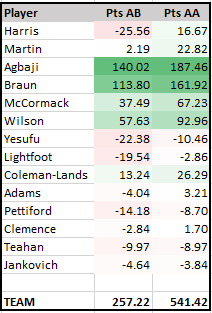
This chart shows the difference in rating, depending on how you define a “replacement player.” For instance, Dajuan Harris has been worse than the bubble-player that KU would expect to be able to recruit and develop. But he has been better than the average D-1 rotation player. So a team of Dajuan Harris-level players would likely be above .500 (depending on strength of schedule, of course), but would not likely be a tournament-level team.
This chart also shows that, even despite playing far more minutes, Harris still grades out worse than Remy Martin no matter how you compare the two. Harris has played the third-most minutes on the team, so his Pts AA is a larger increase to Pts AB than Martin’s change is. Yet when we compare Harris and Yesufu in Pts AA, we see that Harris’s additional minutes make him the better performer over Yesufu. So it is probably good to look at both numbers. Per game or per possession ratings can also help clarify value.

 Charting the Hawks