
Note: This post is one in a series in which we examine the NCAA Tournament in some specific detail. Terms such as “the NCAA’s,” “Tournament,” “Tourney,” “March Madness,” or “March” refer primarily to the NCAA Tournament. Today’s installment looks at the relative importance of guards in the success of NCAA Tournament teams. Initial date of publication: 2/23/2024.
The purpose of this post is to examine if guards really do win in March. There are many claims college basketball fans make that are to the effect that good guards are primarily what matters in the Tournament. Some say that Cinderella runs are fueled mostly by great guard-play, others will extend this to better-seeded teams and say that Final 4 or National Championship teams tend to have elite guards. Others will take this idea even further and claim that interior-based teams which rely on post-play are destined for early exits due to their playing style, regardless of how good they were in the regular season.
Logically this doesn’t really make sense. If a team wins during the season with elite big-men who dominate in the post, why can’t it do so in the NCAA Tournament? After all, it’s the same 40-minute game in the Tournament as it was all year. Sure, maybe there are factors which make March basketball distinct (perhaps the games are officiated slightly differently, etc.), but for the most part the game is mostly the same game it was all season. We should see all types of playing styles work in March.
At the same time, the idea that guard-play is of heightened importance in March does seem to have a hint of truth to it. Looking back to last season’s Tourney (2023 NCAA’s), the Purdue Boilermakers Zach Edeys were a dominant regular season team which earned a 1-seed only to fall in the First Round to 16-seed Fairleigh Dickinson as 23-point favorites. FDU was a guard-oriented team1 that attacked Purdue from the perimeter. Although less-remembered, the 2023 Arizona Wildcats earned a 2-seed on the backs of a strong front-line (with weaker guards) and got bounced by a veteran Princeton team. Other forward-dominant teams also underachieved, whereas strong guard-play propelled Miami and Florida Atlantic to Final 4 appearances. 5’8 point guard Markquis Nowell single-handedly lifted K-State to an Elite 8, averaging 23.5 PPG and 13.5 APG on efficient shooting during his four-game run.
These anecdotes aside, it would be better if we could test to see if a guard-based style is better than a forward or interior-based style in March. But how could we do this? Let’s first by defining the problem and then introduce some terms that will help.
Guards to Posts – A Continuum
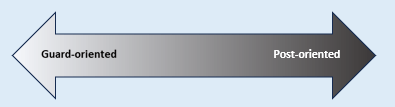
We will conceive of how teams play as a playing Style. Teams which feature guards for higher-than-normal minutes or rely on guards for higher-than-normal production will be classified as having a more guards-based style. Teams that rely on interior players to eat minutes or produce value will have a more interior-based style. This metric will be on a continuum. Certain teams will be very guard-heavy; others will be very interior-heavy. And in the middle there will be a bunch of teams with a more-balanced attack.
Terms
In discussing Style, we are attempting to understand where a particular team falls on this guard to post continuum. Style can be used to describe teams in other ways; such as fast vs. slow tempo, man-defense vs. defense with zone-concepts, and so on, but for our purposes in this post when style is used it is referring to how guard-dominant or forward-dominant a team is.
Relatedly, the two poles of this spectrum are guard-oriented and post-oriented. We will use other terms to describe these extremes, such as guard-based or guard-led or guard-dominant. The same terms will be used for the other pole, just with post or interior or forward used instead of guard.
Other terms will be defined when we get to them, but for the rest of the blog-post, keep the above continuum in mind when considering a team’s playing style.
Problem
Teams clearly play different styles, but how do we quantify these differences? What makes a team guard-based or forward-led? In order to classify teams into playing styles, we will need to get each team’s roster of players and classify each player into a certain position. From here, we will need to find a way to appropriately weight each player’s contribution to the team’s style. For instance, a team which has a slew of walk-ons that are all guards but relies on and plays a forward-heavy rotation is better defined as forward-dominant.
Data
We used Bart Torvik to collect the data, including player positional data. Torvik has already classified each player into a position based on his own algorithmic criteria. We will use his data and trust his insight on a basis from which to build our own analysis. Getting to player position, Torvik has classified players into 8 different positions. Using the 1-5, PG-C basketball-position concept, we will assign each position into a numeric role so that a quantifiable analysis can be achieved. These roles, and corresponding numbers are below.
- Pure PG (1.0)
- Scoring PG (1.0)
- Combo G (1.6)
- Wing G (2.0)
- Wing F (3.0)
- Stretch 4 (3.7)
- PF/C (4.3)
- C (5.0)
Some of these positions are hybrid-roles, so their numeric value is in between two positions. Torvik doesn’t list anyone as a pure PF (4), but many of these types are filled in the PF/C role with some getting a Stretch 4 role. Stretch 4’s aren’t traditional 4-men, but instead a hybrid between a 4 (bigger, good defensive rebounder) and Wing F (can hit outside shots).
We limited data to include only the 68 NCAA Tournament teams. We then gathered the following information from Torvik for each player that earned 10% of minutes for his team.
- Player Name
- Team
- Role (position)
- Min%
- Box Plus-Minus (BPM)
Analysis
There are two different ways that team style can be calculated. One is what we call Style-Value. Style-Value (S-V) is when a team’s style is determined by how much value its guards bring in relative to how much value its interior players bring in. Value itself is calculated through using BPM and converting it to Wins Above Replacement (WAR)2.
The other way to determine team style is by Style-Minutes. Style-Minutes (S-M) calculates style by seeing how many minutes each position plays. Guard-heavy teams will often have multiple point-guards or play 4-guard lineups. Forward-heavy teams will be more traditional in terms of minutes allotment, often having two PF/C types on the floor and/or multiple Wing F’s at times.
These two styles have some correlation to each other, but it isn’t super-strong. We will consider both S-V and S-M in our analysis.
After normalizing style, we see that these teams were the most guard-like in terms of S-V among 2023 NCAA Tournament teams:
- Penn State (-2.22 z-score, 10-seed, R32)
- Baylor (-1.92 z-score, 3-seed R32)
- Kansas State (-1.83 z-score, 3-seed, E8)
- UCLA (-1.58 z-score, 2-seed, S16)
- Miami FL (-1.28 z-score, 5-seed, F4)
Compare this list to the most guard-like teams in terms of S-M:
- Nevada (-2.38 z-score, 10-seed, R64)
- Fairleigh Dickinson (-2.20 z-score, 16-seed, R32)
- Vermont (-1.70 z-score, 15-seed, R64)
- Missouri (-1.69 z-score, 7-seed, R32)
- Colgate (-1.53 z-score, 15-seed, R64)
The top list shows the teams that had elite guard-play, particularly relative to their forwards. The second list shows mid and low-major teams that relied on guard-play, although it wasn’t necessarily that they had elite guards. When we deal with teams in the NCAA Tournament, you have to understand that each team has different goals. For a top seed, making the Final 4 is a reasonable goal. For double-digits seeds, the more likely goal is just an upset win. So we will use both lists, S-V and S-M.
There were different ways to analyze the relative success of guard-oriented teams. We first looked to see how strong the correlation was between style and overall success. We looked for correlation between style and relative success (to seed). There was only a tiny correlation between guard-oriented style and team success, with S-M seeing stronger correlation than S-V.
After viewing correlation, we looked to see if the most guard-oriented teams fared better than the most forward-oriented teams. We filtered out only the styles that were a SD more guard-like than the mean or a SD more forward-like than the mean. Using S-V, we saw that the most guard-like teams won +2.1 games more than expected overall and the most forward-like teams won -3.6 games than expected overall. This was an advantage of 5.7 wins in favor of the guard-heavy teams and worked out to 0.3 wins per team. This isn’t a small difference.
We did the same thing for S-M, and got a difference of +4.4 wins for the heavy-guard teams relative to the forward-heavy teams (which worked out to about 0.2 wins per team). Again these results are in the direction of supporting the conventional wisdom regarding guards and March.
Next we looked at head-to-head results. Previously it was just records overall. But we wanted to see if having a heavier guard-based style was advantageous in head-to-head contests. In the NCAA Tournament there were 67 games played, and the more guard-based S-V team won 36 of these games. For S-M, the more guard-based team won 29/67. These results may seem conflicting, but they actually will lead us to a later insight.
Looking at head-to-head contests but considering Wins Against Expectation (WAE), we see that guard-oriented teams overachieve on the whole. Teams that are more guard-oriented than their opponents won +2.07 more expected games (S-V) or +2.43 more expected games (S-M).
If we look at head-to-head contests from the perspective of the underdog, we see that guard-based underdogs have a +1.80 WAE and forward-based underdogs have a -0.86 WAE in terms of S-V. This comes to a difference of +2.66 in favor of guards-based teams. Looking at the same thing from S-M, this is +1.57 and -1.76 WAE, or a difference of +3.33 in favor of guards-based teams. This doesn’t seem insignificant. Playing a guard-oriented style seemingly helps underdog teams overachieve in March.
We will look at final margin. Using S-V, we see that the more guard-based team is better than its opponent by 0.7 points per game. Using S-M, this is nearly 2.0 points per game better for the guard-based team. It makes sense that if the guard-based team is winning more than expected it is also doing better on expected margin.
So far in head-to-head results, we’ve been considering which team was relatively more guard-oriented to its opponent. But it isn’t like teams can schedule which style on the bracket they get to play against. They can, of course, determine the make-up of their own style. So what happens if we look at the relative success for guard-based teams regardless of opponent?
There were 30 games which faced a guard-oriented team against a forward-oriented team (using S-V). Paradoxically from what we’ve seen from earlier results, the results viewed this way favor forward-based teams. When we look at how guards-based teams fare against forward-based teams, the guards-based teams underachieve, with -2.53 WAE and -1.6 points per game (forwards-based teams are the inverse).
But when we do the same exercise on Style-Minutes, we see that guards-based teams overachieve by +6.05 WAE and are +5.1 points per game better than expected. This shows the importance of defining style. If we say a team is guards-based by looking at the relative value that team’s guards provide, it can give a whole different answer than if we say a team is guards-based by looking at its minutes distribution by position.
Making Some Conclusions
So where does this leave us? Is style important? Do guards win in March? And if so, how can this be used by coaches to gain competitive advantage?
Based on evidence so far, we would conclude not that interior-based styles are doomed to fail, but that guards-based styles are more likely to overachieve in March Madness. While there are weak correlations seen when we regress a team’s style against its success in the 2023 NCAA Tournament, when we filter out the most guard-heavy and forward-heavy teams, there is a clear bias in favor of the guard-heavy teams (relative to pre-Tournament expectation).
Likewise, when we view head-to-head results, the team that is more guard-oriented outperforms the team that is more forward-oriented on the whole. If we look at guard-based teams in head-to-head results (regardless of opponent-style), there is a contradictory answer based on if we base style upon value (Style-Value) or minutes (Style-Minutes). In all assessments, the Style-Minutes view showed stronger benefit for guard-based teams.
Overachievement is the key word. Guards-based styles displayed a better chance of winning when looking at pre-game or pre-Tournament expectation.
However, it isn’t clear how much coaches can use this to their advantage. Particularly because they do so already. Low and mid-major teams looking to pull the upset off are already more likely to be more guard-oriented than their favored opponent. In fact, of all the correlations we ran, the strongest one we found was between a team’s pre-Tournament computer strength and its style as a forward-based team. The best teams heading into the 2023 NCAA Tournament were more likely to be interior-based when compared to the average Tourney team.
But if low to mid-major teams gain a March advantage by playing guard-based styles, can this be neutralized by favorites looking to stave off an upset by playing small themselves? This is tough to say. In one sense, coaches of top teams are best to stick with the style that got them to a good seed in the NCAA’s, as they are still the favorite against the guard-based underdog. A favorite changing its playing style to become more guard-focused might help in some areas but hurt in far more areas (such as dominating the glass and paint). This trade-off might not be worth it.
Additionally, and this hasn’t been analyzed, but favorites might already be changing up their styles during March Madness, and this is partially to blame. Perhaps forward-based teams are going away from what got them to the Big Dance once things get tight in a early-round game, and this is being reflected in the data! We just don’t know.
We’ll close this section with examining the biggest upset in the 2023 Tourney. Purdue’s loss was blamed on its guards, and it strengthened the claim of those who say guards win in March. At the same time, this ignores how well Zach Edey played. Edey had 21 points, 15 rebounds, and 3 blocks. He drew fouls and made FDU work on the defensive end. While it wasn’t enough, had Purdue escaped the upset it would have been due to the team’s interior play. The point is that Purdue wouldn’t have benefited from changing up the style of play that earned it a 1-seed. Rather, it just needed its guards to not choke. The guards/wings went 5-26 from 3. Purdue had 16 turnovers but forced only 9. It lost the game on the perimeter for sure. But if Edey didn’t play, it wouldn’t have had the big advantage inside either, which would have made things worse.
More to Come
With the 2024 tournament coming up, it will be interesting to see if these patterns hold and if this information can be used in filling out a bracket. Picking guard-based top seeds to make deeper runs (using S-V) or double-digit upsets (using S-M) might be a successful strategy. We’ll fill out a few brackets using these principles and see how they do.
Beyond this, we will want to see if this is consistent across tournaments. 2023 had quite a few upsets, so this could have been the reason guards-based teams overachieved. Maybe 2019 (all but one S16 team was a 5-seed or better) or 2008 (all Final 4 teams were 1-seeds) will show the reverse. Maybe upsets or deep-runs are more memorable when a team is led by its guards, and this clouds our view on how style plays into Tournament success.
- FDU was certainly guard-oriented from a minutes-played perspective, but in terms of player-value, FDU was not a team which featured even average guard-play during the 2023 season. FDU wasn’t good at all during the 2023 season, and entered the NCAA Tournament somewhere in the mid-200’s in computer rankings. If anything, it could be seen as having better forwards than guards as its interior players were less-bad than its guards. ↩︎
- WAR multiplies BPM by Min% by a set # of games by a multiple to estimate a player’s contribution to team wins. ↩︎
 Charting the Hawks