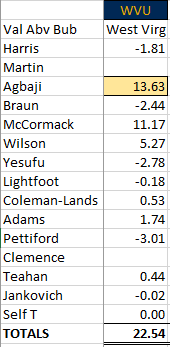
Ochai Agbaji earned his 6th team-MVP of the season, scoring 20 points as well as playing great defense.
Game Summary:
Ochai Agbaji was the overlooked player in KU’s 85-59 win, as 20+ point games are quite common for him now. However, it was Och’s defense which made him so valuable, only allowing 2 points the entire game. Och’s value score against the Mountaineers is the highest game performance of any Jayhawk this season. Of course, the performances of David McCormack (19 points, 15 rebounds) and Jalen Wilson (23 points, 8 rebounds) were a welcome sight to KU fans. The two best returning offensive players from last season finally got going, showing how high the team’s ceiling can be if everyone is playing well. Wilson’s performance was tempered somewhat by poor defense, but for the season he has shown enough improvement on that end to make one think that the last game was a one-off performance. Other positive performers included K.J. Adams, Jalen Coleman-Lands and Chris Teahan.
On the other side of the value-ledger, Christian Braun struggled to finish at the rim in the first half and had his second consecutive negative-value performance after starting the season with fourteen positive games. Another notable would be the play of Joseph Yesufu, who got more minutes Saturday than he typically sees. While his value score wasn’t pretty, he did make some athletic plays, making one think that he is due for a breakout game and some positive-value performances in the future.
With a team score of +22.54, KU broke a slump of poor games with its second-best opponent-adjusted performance of the year (Missouri).
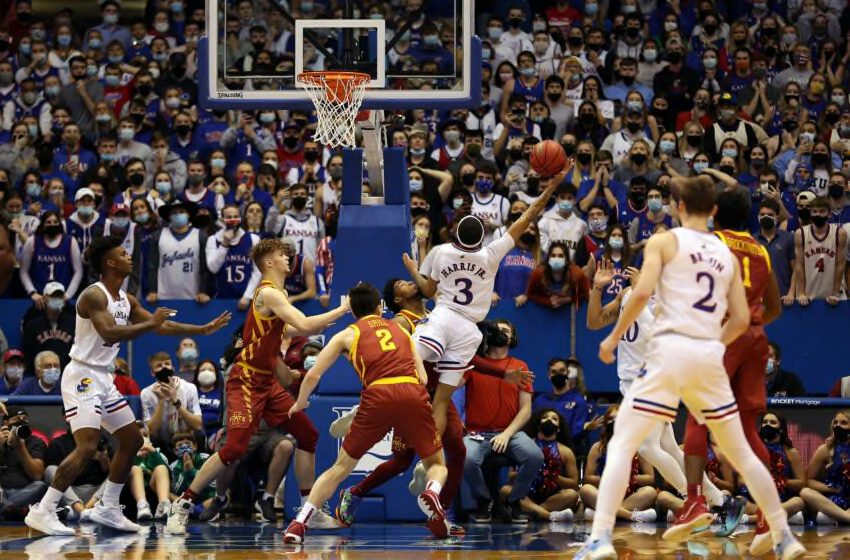
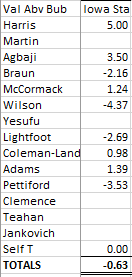
Dejuan Harris earned his first career team MVP against Iowa State
Game Summary:
Not only did he hit the game-winner with 7 seconds left; Dejuan Harris was solid on both ends to earn team MVP honors. Ochai Agbaji was poised to win this distinction due to a solid 22-point outing, but his defense down the stretch lowered his value score significantly. K.J. Adams got the start and had yet another positive outing (10 of his 13 game appearances have netted positive value). Despite being benched for most of the game and only scoring 1 point, David McCormack was good on the defensive end and glass. Christian Braun had his first negative-value performance of the season, and Bobby Pettiford returned from injury but looked very rusty.
The team is missing Remy Martin, and frankly David McCormack although the latter is on the coach and not due to injury. Playing worse players at these positions (such as Pettiford/Yesufu or Lightfoot) has unsurprisingly made this team worse. The team is loaded at wing, so giving K.J. Adams a look at the 5 can provide a small bit of value most nights.
Christian Braun throws down 2 on his way to his third team MVP game of the season
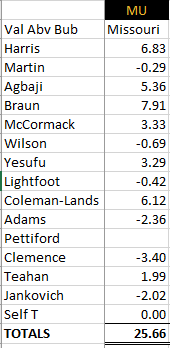
After nine seasons without the rivalry being played, Kansas destroyed Missouri with a balanced attack led by incredibly efficient offense. The win moved Kansas to 8-1 on the season.
Beating Missouri by 37 was the team’s best performance of the season thus far
Dejuan Harris, Joseph Yesufu, Jalen Coleman-Lands, and Chris Teahan had their best outings of the season against Missouri. Braun and Agbaji also produced solid value scores in keeping with the excellent basketball they have been playing. David McCormack played his fourth positive-value game in a row.
The 2011 Kansas Jayhawks finished 35-3 (14-2), winning the Big 12 Regular Season and Conference Tournament. The team earned a 1-seed in the NCAA Tournament and made the Elite 8 before losing. The team’s Sports Reference link is here.
OFFENSE
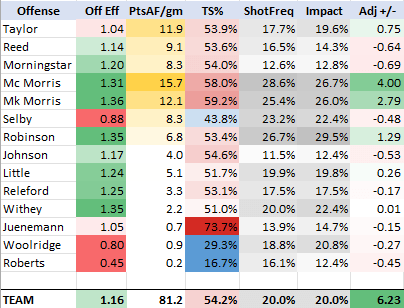
The 2011 offense was based heavily on the interior, with PF Marcus Morris producing the most value of anyone at +4.00. Markieff Morris and reserve Thomas Robinson were also efficient and productive, adding +2.79 and +1.29 points of value per game. The point production was fairly balanced among the main guards, although aside from Josh Selby it was clear that the role of the guards was to be facilitators first. The team’s true shooting was fairly balanced, again aside from Selby who took too many shots. This suggests the other players took shots at a sensible frequency that would best help the team win.
DEFENSE
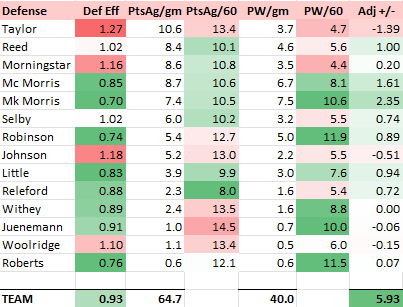
The 2011 defense was an underrated group. Without a primary shot-blocker in the starting rotation; it relied on lateral quickness, communication, and rebounding. Junior PF Markieff Morris graded out as the best individual defender, winning 10.6 possessions per 60. His brother was also solid inside. On the perimeter Tyrel Reed, Josh Selby, and Travis Releford produced solid seasons. Brady Morningstar finished with positive value on this side (albeit not by much), and Tyshawn Taylor finished with the worst per game value score of any defender since 1993.
Total Adjusted PPG +/-
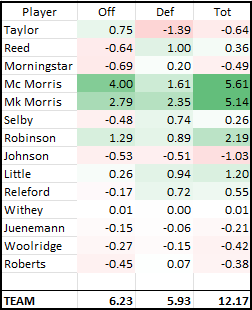
Marcus Morris and Markieff Morris performed a feat that has only been done one other time since 1997 (through the 2026 season), namely be a part of a duo that each produced over 5 points of per game value. Raef LaFrentz and Paul Pierce in 1998 also accomplished this. Beyond the Morris twins, KU had valuable bench forwards in Thomas Robinson and Mario Little. Tyrel Reed made a small contribution (+0.36) as a senior, as did Josh Selby in his only season (+0.26). The other rotation guards faired poorly. Travis Releford could have made the argument that he warranted more time on the wing given his decent value in limited minutes.
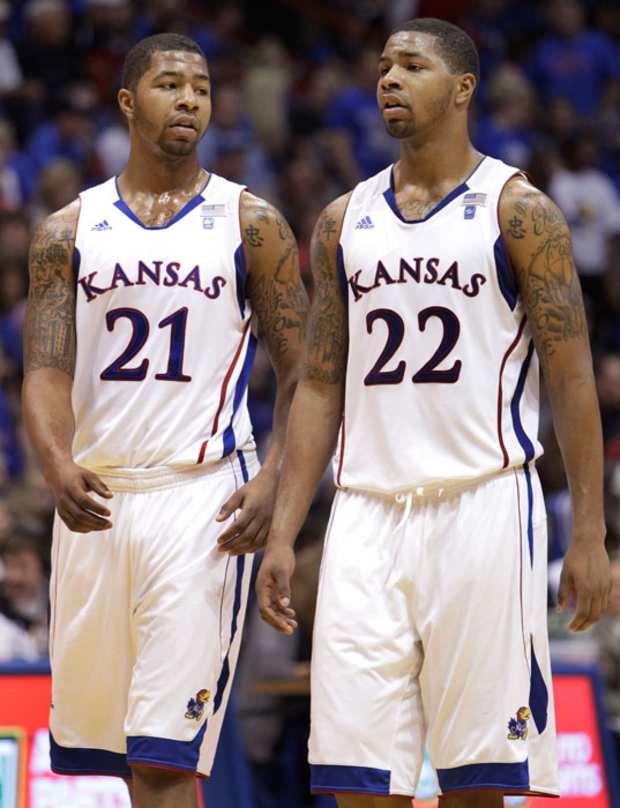
There was a lot of questions coming into the 2011 season for Kansas, but it soon became clear that Marcus and Markieff had improved enough to get Kansas to the heights it wanted to get. In their junior season, the Morris twins parlayed their starring roles at Kansas into mid-first round picks in the following summer’s NBA Draft. Each developed from inconsistent freshmen into lottery picks with similar but slightly different games that were good enough to stick around in the professional ranks. Like most players, their careers ended on a sour note. But without them, this team is nowhere near a 1 seed or Elite 8 caliber squad.
The 2012 Kansas Jayhawks finished with a record of 32-7 (16-2), winning the Big 12 Regular Season. The team earned a 2-seed in the NCAA Tournament and finished National Runners-Up. The team’s Sports Reference link is here.
Offense
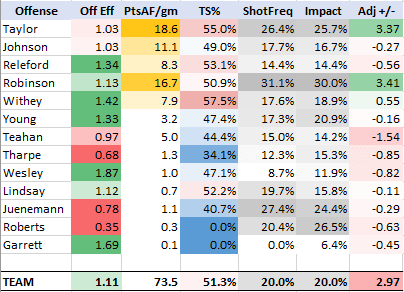
The 2012 Offense was led by Thomas Robinson (31.1% of shots while in game) and Tyshawn Taylor (26.4% shot frequency). With each player having such high volume, neither finished with high efficiency marks. But it was their overall productions, with Taylor producing 18.6 points a game and Robinson at 16.7, that drove their value scores.
The only other positive-value Jayhawk on offense was Jeff Withey, who was efficient thanks to a 57.5% true shooting and solid offensive rebounding marks.
Defense
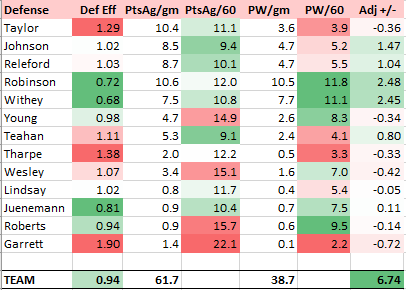
The 2012 Defense was what carried the team, as it was the #3 ranked adjusted defense on KenPom that year. Jeff Withey was the Big 12’s Defensive Player of the Year thanks to his shot blocking prowess (led the nation in block rate), but it was Thomas Robinson who actually produced the highest value score thanks to his excellent defensive rebounding ability (in fact he led the nation in defensive rebounding rate). Elijah Johnson and Travis Releford also produced over a point of value per game on defense. Conner Teahan was the other Jayhawk rotation player to provide positive defensive value, as he only allowed 9.1 points per 60 possessions. His positioning and ability to move laterally were underrated.
Adj. PPG +/-
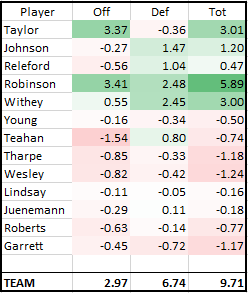
Thomas Robinson showed why he was the Big 12 Player of the Year and Consensus first-team All-American, producing over 6 points of value per game above that of a bubble-player at his position. Tyshawn Taylor edged out Jeff Withey for second place on the list, as each hovered around 3 points of value per game. Both Johnson and Releford rounded out the starting lineup with positive-value seasons thanks to solid defense.
The bench was another story. Both Kevin Young and Conner Teahan were able to keep their value scores respectable given that each was playing more minutes than expected (Young transferred from a mid-major; Teahan was a former walk-on), and they were certainly better than both Naadir Tharpe and Justin Wesley. Both Tharpe and Wesley had sub -1.00 scores despite playing relatively few minutes, if we looked at these value scores on a per possession basis they would look even lower for these two.
Per-100 Numbers:
Taylor +5.37
Johnson +2.22
Releford +0.91
Robinson +11.04
Withey +7.20
Young -2.61
Teahan -2.09
Tharpe -11.85
Wesley -9.04
Lindsay -4.13
Juenemann -3.46
Roberts -21.27
Garrett -30.46
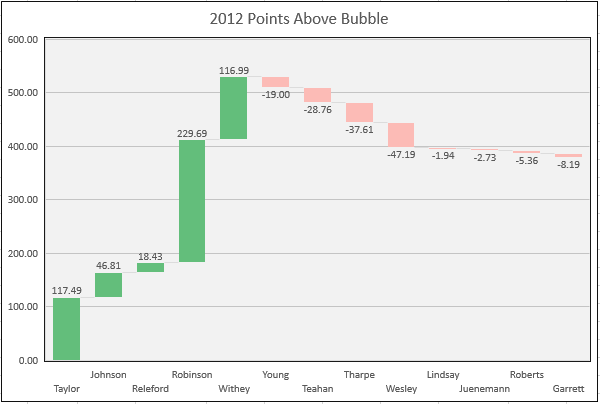
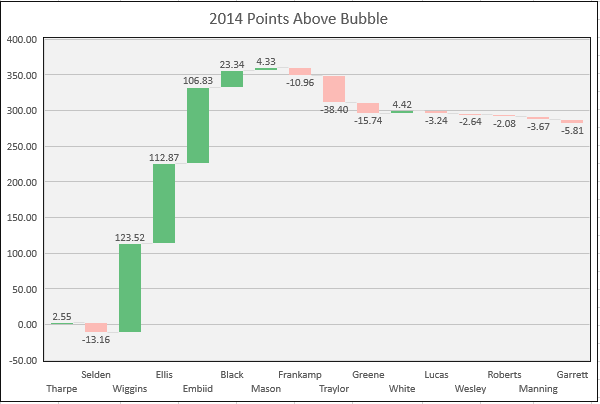
This waterfall chart is a nice representation of KU’s strengths and weaknesses. Good point guard play, dependable wing play, excellent power forward play, alongside good center play from its starters. When the team went to its bench, it started losing value rapidly.
Jayhawk of the Year
T-Rob celebrating a Final Four berth
KU’s run to the national championship game was quite unexpected at the beginning of the year, and wouldn’t have been possible if not for the dominant play of junior forward Thomas Robinson. A bench guy his first two seasons, Robinson excelled as a starter and go-to offensive weapon. He played with a lot of heart as well, bringing energy and helping to elevate the play of his teammates.
The 2012 season was a memorable run and has a special place in the hearts of many KU fans. Self’s ability to get the most out of his starters (all returnees who had their best seasons to that point in 2012) earned him many coaching accolades.
The 2014 Kansas Jayhawks finished with a record of 25-10 (14-4), winning the Big 12 Regular Season. The team earned a 2-seed in the NCAA Tournament, reaching the Round of 32 before losing. The team’s Sports Reference link is here.
Offense:
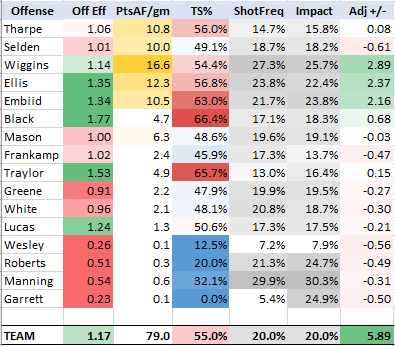
Andrew Wiggins led the Jayhawks’ offense in 2014, accounting for 16.6 points per game on 54.5% true shooting. He was joined by strong interior scoring from Perry Ellis and Joel Embiid. KU was a strong interior team this year, as both Tarik Black and Jamari Traylor also had positive value seasons in the interior. KU’s five starters all produced over 10 points a game. Naadir Tharpe shot the ball well on a limited frequency. The two biggest offensive letdowns were off-ball freshmen guards in Wayne Selden and Conner Frankamp.
Defense:
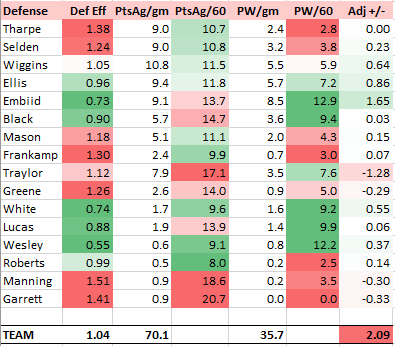
The team’s defense was Coach Self’s weakest to this point while at Kansas. The best defender was Joel Embiid, an excellent shot blocker and rebounder. Both Perry Ellis and Andrew Wiggins played good enough defense, but what was most disappointing was the effort from role players on the roster. KU didn’t need guys like Naadir Tharpe or Jamari Traylor to focus on scoring. They both should have done better on this end.
Adj. PPG +/-
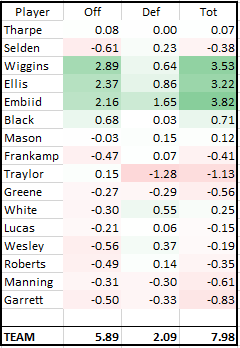
Kansas was led by three star players; Embiid, Wiggins, and Ellis. Two of these three would be top-three picks in the 2014 NBA draft, and Ellis would go on to have an excellent college career. The guard play was noticeably mediocre. Starting PG Naadir Tharpe had some excellent shooting games in 2014, but also had down games as well. His average score was right at bubble-level. Tharpe would be benched during the tournament due to poor play, and his two replacements in Frank Mason and Conner Frankamp would go on to post slightly-above and slightly-below replacement seasons. Wayne Selden would also produce a below-value season as a freshman.
The TEAM’s offense-defense value-difference of +3.80 (meaning its offense was 3.80 points better relative to its offense) was the widest offense-dominant team that Self had to this point (2017, 2018, and 2022 would all be wider). This was likely due to a prominent number of skilled scorers and large number of underclassmen who hadn’t learned to defend yet.
Two Lottery Freshmen, Two Value Leaders
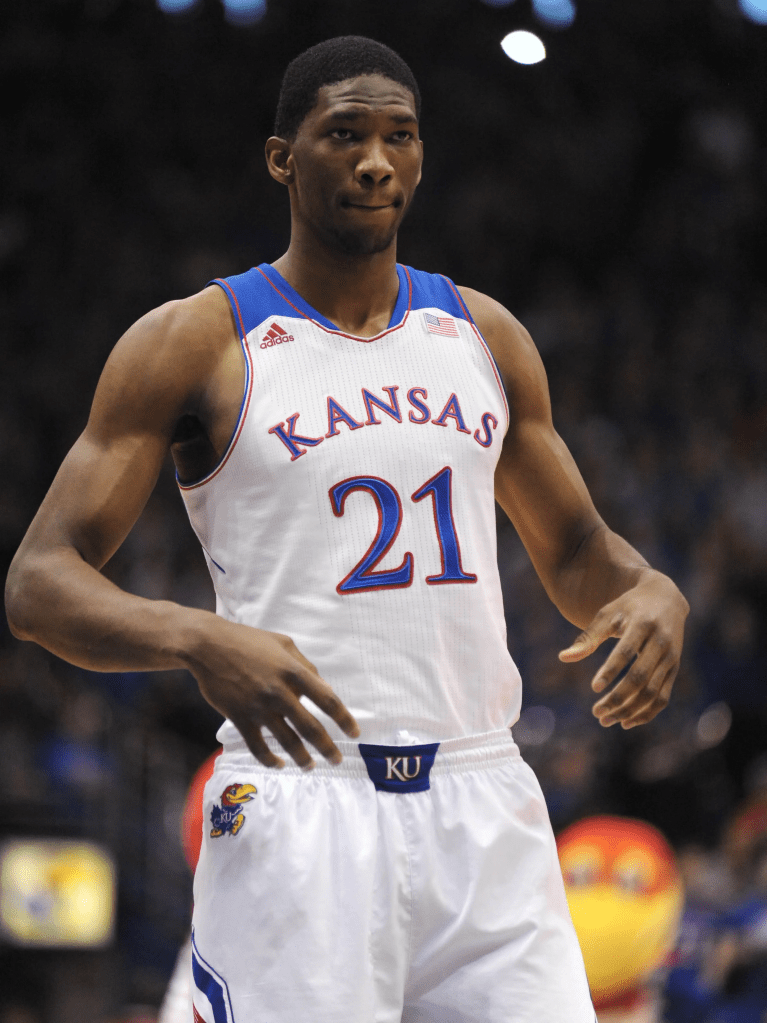
Joel Embiid was KU’s most valuable player on a per-game basis, thanks to his efficient scoring and strong interior defense. He added positive, above-bubble value in 22 of the 28 games he played in (78.6%). His best game in a Jayhawk uniform was against New Mexico in the Sprint Center.
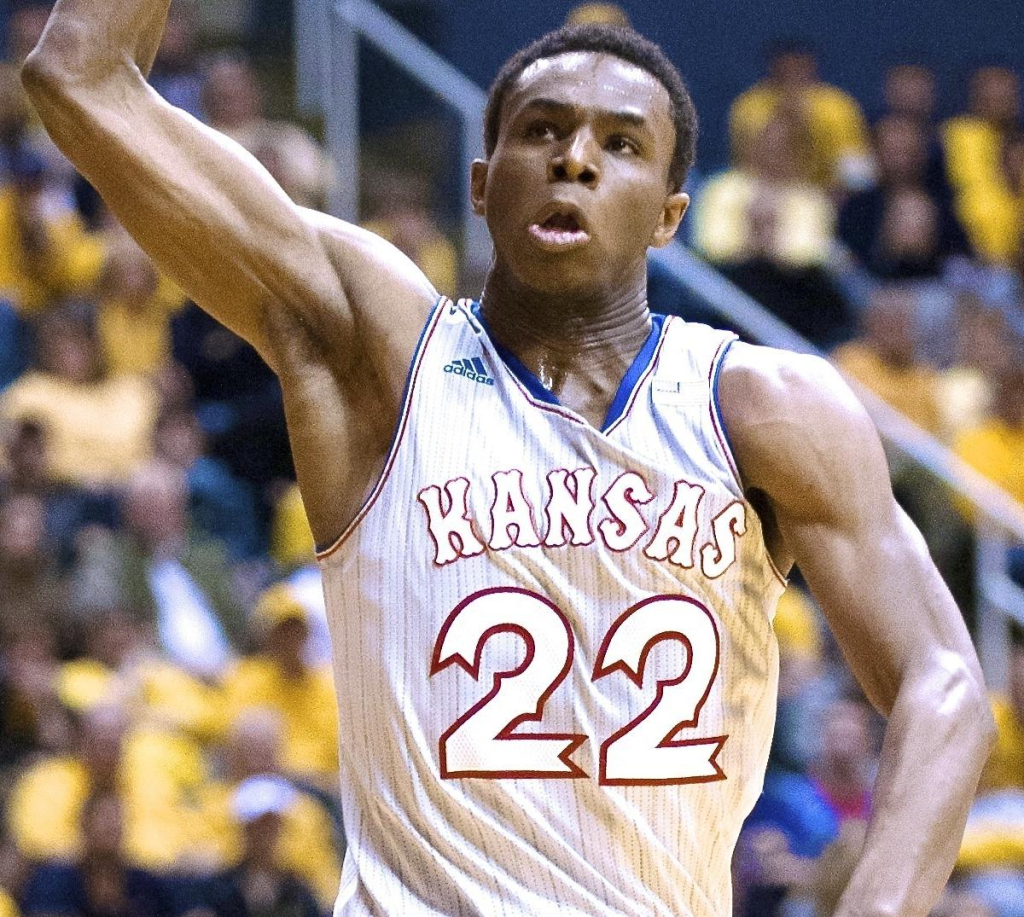
However, Andrew Wiggins was more durable. He played in all 35 of Kansas’ games, providing the most value from a total perspective. He also had the best game of any Jayhawk in the 2014 season, posting a +18.83 value score in his 41-point performance against West Virginia in Morgantown in the final regular season game of the season. Wiggins would also lead the team with 11 game MVPs.
The 2014 team in retrospective:
The 2014 team came in with a lot of hype, and although it wasn’t to live up to it, it’s two best prospects were. The negatives are obvious. Not getting past the first weekend. Poor guard play. Double-digit losses. But on the flip side, this team extended the conference-title streak to 10. When healthy, the team was very tough to beat. It had incredible depth and a number of guys who might have been overlooked during this season would go on to have great careers at Kansas.
WAR rankings. Here are the Wins Above Replacement for the 2014 season:
Andrew Wiggins +5.08
Perry Ellis +4.54
Joel Embiid +3.92
Naadir Tharpe +1.45
Tarik Black +1.27
Wayne Selden +1.04
Frank Mason +0.91
Andrew White +0.28
Landen Lucas +0.06
Conner Frankamp 0.00
Justin Wesley -0.03
Niko Roberts -0.04
Evan Manning -0.09
Christian Garrett -0.15
Brannen Greene -0.20
Jamari Traylor -0.33
NCAA Tournament:
The 2014 team earned a 2-seed and drew 15-seed Eastern Kentucky in a closer-than-expected game. In the end, KU turned to the effort and energy of Jamari Traylor to win the game down the stretch. Traylor would go for 17 and 14, adding 6.29 points of value above bubble for the game in his only team-MVP game of the year. This game is sometimes overlooked, but it was good to win because of how bad of a loss it would have been. Unfortunately, Kansas didn’t play well in its next game as it would fall to 10-seed Stanford.
Adj PPG +/- is the Adjusted Points Per Game the player was against his collective opponents over the course of the season. It is the “one-number” metric (such as WAR in baseball) that tells us how much value a player adds, incorporating all relevant statistics on both sides of the ball. The “Adjusted” refers to the fact the number is adjusted to a hypothetical schedule entirely composed of neutral-site games against a “bubble team.” This is done so the number can be more fairly compared year-over-year or even game-over-game.
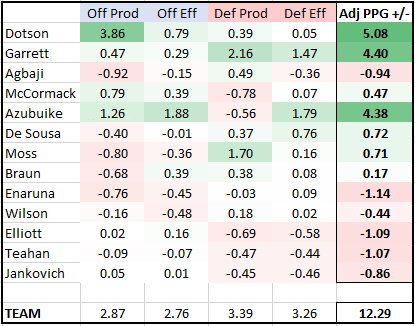
Taking Devon Dotson as an example, the metric indicates that KU is roughly 5 points per game better with him on the court than they would be with a hypothetical “bubble” player at his position.
Production vs. Efficiency
The middle four columns break down the PPG +/- into four components of value. Note that these four columns sum to Adj PPG +/-. In basketball, a player helps his team by producing points (scoring, assisting) or winning possessions (rebounds, steals, forced turnovers). Off Prod refers to offensive production. Namely, how many points is that player producing for his team; while counting unassisted points differently than points scored off an assist as assisted-points must be split between the scorer and assist-man. Off Eff refers to offensive efficiency, which is improved by high FG%, low turnover rate, and grabbing offensive rebounds.
Def Prod accounts for how frequently a player is getting scored on. This requires taking whole new stats that are not tracked or published anywhere else in basketball. More will be said on this in a later entry. Def Eff refers to defensive efficiency, incorporating traditional defensive stats such as blocks, rebounds, and steals (alongside the non-box score stat of forced turnovers).
Interpreting the chart above, Devon Dotson had a highly productive offensive output in 2020. He scored most of his points by himself (unassisted), while also setting up others (second-highest assists on team behind Marcus Garrett). Dotson’s ability to get and convert his own shot grades out as the most valuable aspect of any one Jayhawk during the 2020 season. Udoka Azubuike was the most efficient player on offense, something that makes immediate sense given his high FG% and offensive rebounds.
Marcus Garrett grades out as the best defender, and it isn’t close. Given his minutes, and in turn possessions played, he did an excellent job of “shutting down” his man throughout the course of the season. Isaiah Moss added all his value on this aspect of defense as well. Going to the tape, this was largely due to his ability to restrict open looks from outside against the wings he was guarding. Azubuike was the team’s most efficient defender. His rebounding, shot blocking, and ability to clog the lane to force turnovers were unrivaled. He “won” 302 possessions throughout the year on the defensive end, meaning that per game nearly 10 possessions ended in KU’s favor thanks to an Azubuike block, rebound, steal, or forced turnover. Marcus Garrett’s 202 defensive possessions won in 31 games is also noteworthy, particularly due to his position as a guard.
Ast pts – Points the player’s teammates scored off his assists
Poss Una – Possessions the player used when scoring unassisted.
Poss ast – Possessions used when scoring via assist.
Ast Poss – Possessions used on assists, i.e. number of assists.
Miss – Possessions ending in missed shotsA by player.
TO – Turnovers committed by player.
O Reb – Offensive rebounds credited to player.
Min – Minutes played during season
Adj PPP – Adjusted Points Per Possession, factoring all prior stats.
A FT possessions can also count with misses, not just FG misses. If a player goes 0-2 from FT, or misses front-end of 1&1, the player will be credited with a miss. If a player goes 1-2 from FT, that possession is counted within Poss Una.




 Charting the Hawks