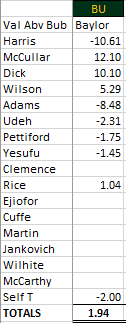
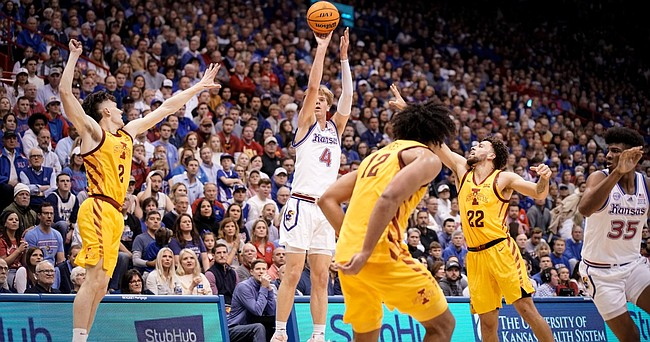
Kansas 53, Iowa St. 68

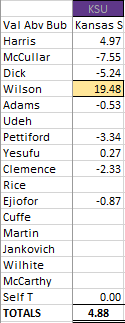
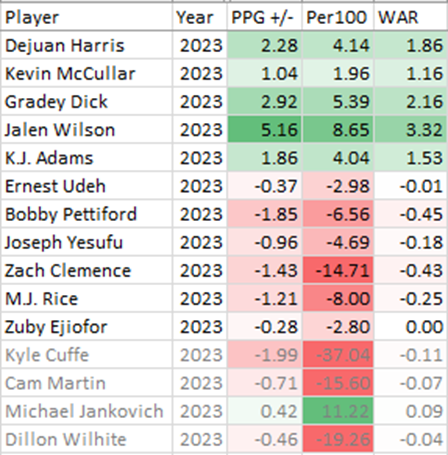
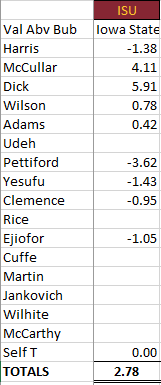
In an ugly game that would have been even uglier if not for Jalen Wilson, KU shot 26% from 3 and had 20 turnovers to reach its second-lowest point total in a game this season. Wilson had his 3rd-best opponent-adjusted game of the season, accounting for a fraction over 24 points while only allowing 6 on the defensive end. He went for 39 minutes yet still competed on both ends of the floor. He desperately needs consistent production from others on the team.

Joseph Yesufu was the other Jayhawk to have a positive-impact Saturday. Yes made a couple of jump shots in his nearly 20 minutes of work, balanced out by solid defense. He’s been a bubble-level player over the past 7 games (86.7 minutes of play), a trend which will hopefully continue.

On the other side of things, the play of Dejuan Harris has been the biggest harbinger of victory or defeat. In the past 5 games, he’s had his worst 3 games of the season which were all defeats. When he’s played well, KU has won. In his past dozen outings, he’s produced a value score of -1.12 PPG, which is worse than his play last season. For KU to win, he has to be better.

Gradey Dick has also been slumping of late, but his worsening value scores are primarily due to missed shots. He’s doing much of the other things better, aside from turnovers which have also ticked up as he has been attempting to put the ball on the deck more.

After 11 consecutive above-bubble games for K.J. Adams, he has produced negative-value scores in 5 of his last 6. He has been struggling to finish some of the plays he was making earlier in the season, and his defense continues to lag behind as he fails to drop well on ball-screen coverage or get many defensive rebounds. He’s still KU’s best option at the 5.

Kevin McCullar, in turn, has generally been playing good ball of late. His defense has reached the point of being the team’s best. He is a great defensive rebounder, attacking the glass with his long frame to finish possessions after an opponent’s missed shot. He also gets his fair amount of steals, blocks, and forced turnovers. Offensively, his game has been a challenge. Since conference play began, he’s only had 2 games above bubble-value from the offensive side of things. KU can live with this, as long as his defense stays stingy. In the 11 games (beginning with Oklahoma State), he’s averaged a defensive game score of +3.06.

Kansas 90, Kansas State 78

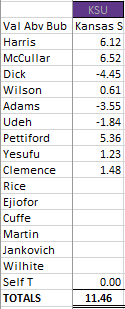
The Jayhawks put the Cats back in their place, using a strong opening half to cruise to a double-digit victory. Kevin McCullar graded out as the team’s best Tuesday night, with Dejuan Harris close behind. Bobby Pettiford had his best performance of the seasons to lead a bench effort that was likewise its best. In fact, the bench outdid the starting 5 last night for Kansas. This was only the 3rd time in 22 games that the bench scored better.

Other positive performances included Zach Clemence, Joseph Yesufu, and Jalen Wilson. On the negative-value side, Ernest Udeh allowed too many baskets while K.J. Adams and Gradey Dick battled foul trouble and worse-than-usual offensive outings.

Comparing Starter vs. Bench Value Across the Big 12

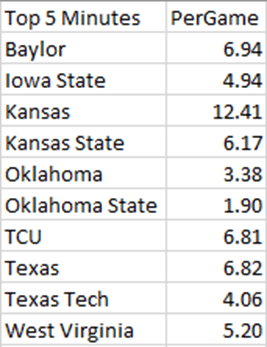
“Starters” reflects the Top 5 players on the team in minutes played. Due to injuries, rotation patterns, and so on; what constitutes a starter might differ from team-to-team. The term “crunch-time five” might also apply. These numbers are in Points Above Bubble through 1/29/23:

Kansas leads the league with a top five which is collectively 12.41 points above bubble per game. There is a large gap until you get to the rest of the pack. The list is in alphabetical order.

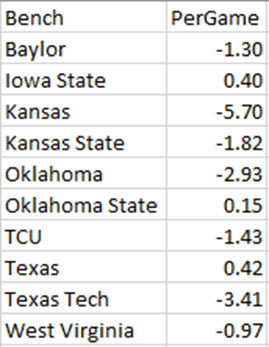
The bench refers to the rest of the roster combined. Walk-ons are included, but their numbers are negligible. This shows the collective points against bubble of the reserves in a per game ratio:

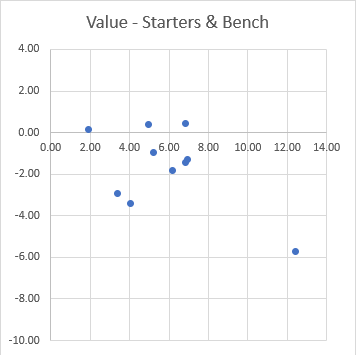
The best bench is Texas’ bench, which is slightly above bubble-level. Iowa State and Oklahoma State are also above-bubble. As you can see, Kansas’ bench is by far the lowest. The below chart graphs this out, putting the starters on the X-Axis and bench on the Y-Axis. To the right and up is where you want your team to be. See if you can tell which button Kansas is represented by:

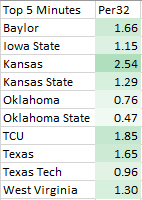
A Per32 look is also instructive. First, look at the average starter for each team in a 32 minute span. This will be a good estimate of how much value a certain team’s average starter can provide if playing a decent load of minutes.

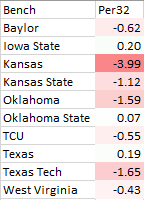
Now the same thing, just with the bench.

KU’s starters are clearly the class of the league, but its reserves are so far behind it almost boggles the mind. KU’s bench isn’t just bad, it’s also the most noticeable unit in this exercise. Any bubble-level player from past seasons, such as a freshman Christian Braun or a sophomore Landen Lucas or a junior Naadir Tharpe, would make this team 2 to 3 points better per game. KU can only make this work as good as it has because it plays its starters the bulk of available minutes (77.4%, leads the conference). If it lost anyone of its starting 5 for a decent amount of time, it would get noticeably worse.

One more note about the Kansas starters. If you removed Jalen Wilson, the other four starters would still produce an above-bubble value which is above 6.00 points per game. That group would still be 5th in the conference among starting 5’s, but very close to the other 4 teams and under 1.00 point per game below the new first-place team. With Jalen, its not even close who has the best starting 5. Effectively, Jalen’s excellent season is mostly being washed away by the team’s poor bench.

More on the Big 12 in 2023

In creating the ranking of Big 12 players, there was the ability to explore more regarding the makeup of the conference. Here are some additional things that stand out about the makeup of players in the Big 12:

The League is Senior-Heavy. While experience has always mattered, the post-pandemic and transfer-portal era has produced a large share of veterans. Using the classifications from KenPom, 36% of all Big 12 players are seniors. When you look at minutes played, the senior-heaviness of the conference becomes more apparent. 51% of the minutes played by Big 12 players have been played by seniors. Iowa State has 8 seniors who have played at least 100 minutes. For Texas and West Virginia, this is 6. K-State and OSU have 5. Kansas is the only team with fewer than 2 seniors in the main rotation (Kevin McCullar). In many cases, a player labeled as a senior is in his fifth year, however there are some 4th year players classified as seniors which does confuse things somewhat. But with 2021 not counting against eligibility, one would expect the trend of senior-heavy rosters to continue for the next two seasons.

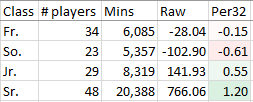
Not only do they play more minutes than the other three classes combined, seniors have collectively produced far more value for their teams. The following chart shows how much value the typical player produces by class. The important column is the one on the right, labeled Per32. This is to set player-value by class over a 32-minute span. We’ll use 32 minutes (80% of a non-OT 40-minute game) to serve as a proxy for the average minutes for a starter in Big 12 play.

When weighted by playing time, the average senior produces 1.20 points above-bubble over 32 minutes of play. The other three classes, when combined, are effectively 0.00. Interestingly, freshmen are out-performing sophomores. This appears to be an effect of the “one-and-done” system. Two Baylor would-be sophomores (Sochan and Brown) went to the NBA draft and are now pros. In turn, two excellent college freshmen in the Big 12 (George from Baylor, Dick from Kansas) are poised to be first round picks in this year’s draft. Were the NBA draft rules different, either the early-entrees would still be in college as sophomores or the freshmen might not have come to school. This would make each class’s value scores look different.

Jalen Wilson is another interesting case. Due to injury as a true freshman, he redshirted. Although he is listed as a junior, by age he is a senior. Think how much wider the senior/junior gap would be if he were classed as a senior. To a lesser extent, this also applies to Dejuan Harris who is a senior by age but junior by class. Last, Joseph Yesufu is classed as a junior even though he is in his fourth season. With him getting a fifth-year of eligibility, KU effectively had both his 2022 and 2023 seasons be as “juniors.” Again, classifications are all a mess in this era.

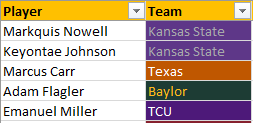
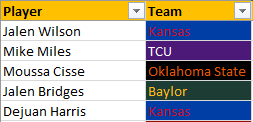
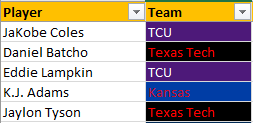
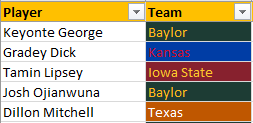
By class, here are the best 5-players in the Big 12 through 1/26/2023.

Seniors

Juniors

Sophomores

Freshmen

Point Guards and Power Forwards Excel. This is partly due to the two leading Big 12 players, Jalen Wilson (PF) and Markquis Nowell (PG), having separated themselves from the pack. Other great PG’s in the league include Marcus Carr, Adam Flagler, and Mike Miles…all in the Top 6 of all players. Regarding PF’s, Emanuel Miller (TCU), Aljaz Kunc (ISU, currently injured), and Kalib Boone (OSU) are also having good years.

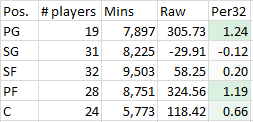
Classing players into a traditional position (PG, SG, SF, PF, C) is harder that it used to be. A few things have happened. One, there are more “positionless” players and systems. Two, teams are becoming more perimeter-oriented, playing 4-out and often 5-out systems without true post presences. This can be handled one of two ways. One is to recognize the change in the game and place players in positions which they’d historically be classed. Therefore, a rotation might play a PG, two SG’s, and a SF alongside a PF. The other way is to do what Pomeroy essentially does, and continue to utilize the traditional position names regardless of the style being played. So when a team plays a small-lineup, this just means that whoever its biggest/most interior player is gets classified as the “Center.” Even a SG might become that line-up’s “Power Forward.” The logic to this seems to be that, regardless of the style you play, you are going to be competing against someone of whatever position you are at, 1-5. To apply this to KU, this would mean that K.J. Adams (as a small-ball “5”) is seen as a Center, because he primarily guards (and is guarded by) the opponent’s biggest player.

For the chart below, players have been classified using a combination of Pomeroy’s algorithm and the alignment of players into their natural, historical positions. For one, Pomeroy’s algorithm isn’t 100% accurate (he has Jalen Wilson as KU’s “Center,” likely due to how poor of a rebounder K.J. Adams is). We want to see which styles have been most effective among Big 12 play. Some teams play two true PG’s (i.e. Texas with Carr and Hunter). We want to reflect that here. As far as K.J. Adams is concerned, his position is PF. This means KU starts two PF’s, instead of a PF and C as would be traditionally done.

The Shooting Guards and Small Forwards grade out the worst, indicating that there is some diminishing value in filling a roster with wing-types who mostly shoot jump-shots. If you have shooters, it obviously works. But if you don’t, then what? Oklahoma State (-68.92) and Texas Tech (-33.42) have the worst collection of wings in the conference (number in total cumulative points against bubble at those positions). They also have the two-worst offenses in the league according to KenPom. Of the wings who are solid, the three best in the league are Johnson (K-State), George (Baylor), and Dick (Kansas).

Kansas 69, Baylor 75

Positives: Kevin McCullar had KU’s best game, thanks to a strong defensive effort. While he was only 3-9 from the floor, his 8-8 from the FT line got him to 14 points. He also added 12 rebounds (10 defensive) on a night where Kansas struggled to finish possessions on the defensive end. Gradey Dick had his best game since Indiana despite battling first half foul trouble. Jalen Wilson had another solid offensive game. His efficiency of late has been a consistent bright spot for the team. M.J. Rice finished with 2 points and 4 value rebounds.

Negatives: Dejuan Harris had his second-consecutive all-around very poor game. He scored 2 points on 1-5 shooting and allowed 16 points to the Baylor guards. K.J. Adams was also inefficient on offense while giving up too many points on defense. With only 1 defensive rebound, this was his 6th conference game (out of 8) in which he has failed to secure at least 3 defensive boards. He is leaving value on the floor by not coming up with loose balls. Ernest Udeh only played a few minutes, but a defensive blunder led to an open 3. Bobby Pettiford missed his only shot attempt and allowed a basket. Joe Yesufu didn’t score, but did come up with some nice hustle plays (1 steal, 3 defensive rebounds). Unfortunately, in the first half he also fumbled a potential defensive board that Baylor converted into points.

The TEAM had a positive-value game (meaning they performed better than a bubble-level team would be expected to), and this was with Self getting his 3rd technical of the season and gifting Baylor 2 points. The starters were collectively positive with the bench giving away value.

Bench Update

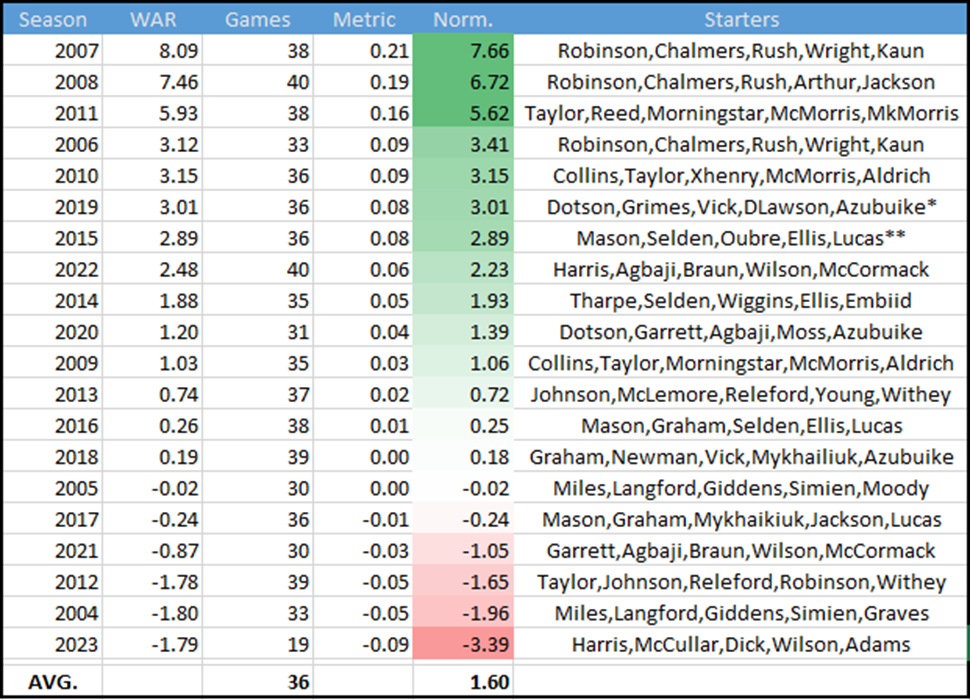
The Bench continues to get worse. It is now projected to provide -3.39 WAR (given a 36-game schedule), which is nearly 1.50 WAR worse than the current-worse bench in the Self-era (which was his first season). If anyone, anyone at all, could provide solid minutes, this problem would be drastically reduced. Self needs about 40 minutes per game off his bench. If one guy could provide 20 consistent minutes around 0.00 value (think Christian Braun as a freshman), then the additional 20 could be spot-minutes. Self wouldn’t have to play multiple negative-value players together that often and could rotate this hypothetical 6th man around while his starters each got a break.

Should Michael Jankovich get a shot? He can’t defend, but then again it isn’t like the others bench guards/wings play great defense. At the very least he’d be a surprise for a possession or two.

For what it’s worth, Self has basically given up on his bench.

Money quote:

“I think what we’ve got to do is get our starting five playing better,” he said after Saturday’s loss. “Our bench isn’t such where they’re going to make a huge difference in us winning or not winning. The way they can contribute the most is defending, not turning it over, getting confidence from doing the things that don’t show up in the stat sheet and then they’ll get more confidence moving forward.”

Losing by 23 is not on the reserves who only played 41 combined minutes out of 200, this much is true. Still, it would be nice if the reserves could actually defend. They really aren’t doing that well. But KU’s success is going to be determined by whether or not the starting 5 plays well. Unless KU fouls out over half of its starters, like it did at Kansas State, crunch-time will feature KU’s best lineup against the opponent’s best. Most of the time, KU’s will be better.

Comparing the 2023 team to Preseason Expectations

For reference, at this point of the season, KU is 16-3 and about to play at Baylor. The season is about half-way done. Let’s look at each player compared to his preseason expectation in the value stat Adj. PPG +/-.

Dejuan Harris (RS Jr.) Projection: -0.28, Current: +1.79

The biggest question on Harris was if he could score more this season. Until recently, the answer was a resounding “yes.” In the past three games, he’s only scored 3 points (on 1-13 FGs and 0-0 FTs). Even when accounting for this recent scoring slump, Harris has scored at a better rate than past seasons. Looking at Per100 value, his scoring value was at -4.47 in 2021 and at -4.09 last season. This has improved to -2.32 this season. Improvement is this area is key. Harris will continue to recover value through his consistently strong ball-handling and defense. It is his scoring that will determine how successful of a player he will be in his career.

Speaking of Harris’ defense, it’s on this side of the ball where he’s improved more. He’s always had quick hands and been good at anticipating the opponent’s movements, but now he has tightened up his coverage skills and allowed fewer easy baskets. Last season he added +2.24 points based on his defensive coverage per 100 possessions, this season it is +4.40. These are subtle differences when watching the game, but it really adds up over the course of a season.

Projecting out the rest of the season, we know that Harris will play and play a lot. The team is going to need some more scoring out of him. He was in double-digits in half of his first 16 games. If he can put up 10+ points every other game or so, it will be enough to keep him around +2.00 in value per game for the season.

Kevin McCullar (Sr.) Projection: +1.94, Current +0.17

Kevin McCullar was KU’s big off-season transfer portal veteran pickup, continuing in the same vein as Remy Martin, Jalen Coleman-Lands, and Isaiah Moss. However, he has underperformed expectations due to inconsistent play and poor offense. McCullar had a poor start through his first 7 games, but picked up his play with great outings against Seton Hall and Missouri. Since that time, he’s been up-and-down, with 2 poor performances coming against K-State and TCU. As he goes, so goes the team. His best games have come in KU wins, particularly KU blowouts. His worst games have coincided with games where the team has struggled.

McCullar’s offense was the question mark coming in, and if anything, it’s only grown larger. His shooting is up-and-down (currently down), and he’s turning it over more frequently than in years past. He’s best when he’s cutting off the ball and attacking the offensive glass. He needs to get comfortable in that role, and find his shot again, for him to be the type of player he was brought to Kansas to be.

Defensively, he’s been great at times. He gets steals, rebounds, and forces turnovers at a strong rate. At times he’s been out of position or gambled to the point of giving up an easy basket. In total, his defense is third-best on the team (this number fluctuates more than offense, by season’s end it could easily be second or first). He’s been about as good as advertised, although by tightening things up he could add even more for this team.

McCullar needs to find confidence with his shot and make decisive actions with the ball. He isn’t going to be the team’s best weapon on that end, but he’s good enough to be a neutral-value type player. The fact he’s losing -1.20 points per game against a bubble-level player is inexcusable.

Gradey Dick (Fr.) Projection: +1.57, Current +2.41

Freshmen are the toughest to predict. Recruiting rankings give us a rough idea as to how good the player is supposed to be, but sometimes it takes a while for it to click. KU’s had elite, 1-and-done types (like Andrew Wiggins). It has also seen top recruits struggle despite being given ample playing time and shot volume (Quentin Grimes, Bryce Thompson).

Gradey Dick has been one of the good ones. All of their games are slightly different, but KU has had a collection of very good freshmen wings over the years. Henry. McLemore. Wiggins. Oubre. Jackson. This season, Gradey Dick has continued that tradition. He’s the best shooter of the bunch, but he’s also improved his on-ball defense and rebounding. He also doesn’t force too much (low turnover numbers), keeping his value as high as possible.

Areas for improvement continue to be finishing at the rim and staying aware on defense. He’s been in a shooting slump recently, but that won’t last forever. He hustles and competes, therefore adding winning-plays even in games where he isn’t shooting efficiently. Still, his value this season will depend on how he shoots.

Jalen Wilson (RS Jr.) Projection: +2.79, Current +6.04

One reason Jalen Wilson returned to Kansas this season was because he’d seen what other players (such as Ochai Agbaji) had done in returning. But Wilson has been even better than Agbaji was last season. Officially averaging 21.3 points per game, Wilson has been a solid defender and rebounder as well. He’s put together 17 positive-value games out of 19, which is a level of consistency not seen since Frank Mason in 2017.

It’s easy to say now, but Wilson’s projection was too conservative. Getting a higher volume of shots allows him to really extend his value-range, as he is a capable volume scorer. Without Wilson on this roster, KU would be a bubble-level team. He’s been that invaluable.

We mentioned that Kevin McCullar tends to play well in the games where KU plays well, conversely there is no correlation between Wilson’s best games and the team’s best games. If anything, Wilson does better in picking up his teammates during their worst performances. The key for Wilson is to not get stressed out or frustrated and try to do too much. The rest of the team will start to play well again at some point.

K.J. Adams (So.) Projection: +0.28, Current +1.30

Adams’ projection was based upon his athletic strengths and his defensive abilities. What was totally unexpected was his offensive skills. He averages double-figures on excellent efficiency, utilizing his skillset to play a small-ball 5 and take advantage of slower opponents. He is KU’s third-best offensive player so far this year, and closer to number two Gradey Dick than number four Dejuan Harris.

His defensive presence has been affected by his role as the team’s starting 5-man. He is still a solid perimeter defender for someone his size. He plays hard, draws charges, knocks the ball away, gets the occasional block, and so on. Yet he also gives up size inside and is a very weak rebounder. He is still a positive-value defender. If he could get his hands on a few more rebounds, this would quickly improve his defensive value.

Bobby Pettiford (So.) Projection: -0.59, Current -2.07

Getting now to reserves, Bobby Pettiford has the most minutes off the bench. He’s produced the most offense off the bench, shooting an efficient percentage while dishing out a fair amount of assists. However, the value he’s produced this season has been dreadful. He’s turning it over too much for a point-guard type, and despite his efficiency is not taking enough shots to add offensive value. On defense, he’s allowing 13.9 points per 60 possessions (the worst starter, Kevin McCullar is at 11.9 on far more minutes). Combined with his low numbers of rebounds and steals, his defense is -4.76 points per 100 possessions compared to a bubble-level player. His size is a factor, particularly on switches. He has not defended well, and I’m not sure why he checks in for late-game defensive possessions.

Joe Yesufu (Jr.) Projection: -0.35, Current -0.95

Yesufu has played a fair number of minutes as well backing up the starting wings. He’s shot about as poorly as last year. He did show some offensive skill in back-to-back 14-point outings against Tennessee and Texas Southern, but since that time he’s been bad. Injury may have something to do with this. On defense, he’s guarded better than others off the bench. He is adding a small amount of defensive value thanks to strong on-ball defense. He uses his strength and competes. He won’t get many steals or rebounds, but he is the best perimeter defender from the reserves.

Zuby Ejiofor (Fr.) Projection: -0.18, Current -0.33

In the carousel which is the back-up 5-spot, Zuby Ejiofor has gotten the most minutes. He is performing about as well as expected. His defense outshines his raw offensive game at this point, and his per-100 rebounding value equates to +2.32 points above bubble. He has also done relatively well at disallowing his man easy baskets. He generally stays in a good position, staying between his man in the basket, which likely helps his rebounding numbers. He’d be my first choice off the bench going forward.

M.J. Rice (Fr.) Projection: +0.69, Current -1.11

Rice’s season has been plagued by ailments. His playing time has diminished significantly during conference play, and he hasn’t actually taken a shot since the Harvard game. He certainly exudes potential. Good size, athletic, skilled, etc. His defense has been the worse-half of his game, as he doesn’t do anything bubble-level on that end (coverage, pressure, or rebounding). For Rice to add value for this team, it will have to be in extended minutes and as an offensive weapon. Depending on how McCullar performs, it might be worth taking another shot with M.J.

Ernest Udeh (Fr.) Projection: +0.12, Current -0.51

Udeh is yet another under-performing bench player. His current value is also in limited playing time (less than 5 minutes per game KU has played). He does not play disciplined in the post, and will give up baskets to skilled and patient opponents. His offensive game is limited to plays at the rim. Yet, he too has potential. He was good enough in the preseason to earn a start against Pitt State in the exhibition game. He is excellent at finishing lob dunks and uses that frame to block shots. He had good outings early on, but against higher-level competition gets exposed.

Zach Clemence (So.) Projection: +0.47, Current -1.47

Clemence has greatly underperformed expectations. Last season, he was able to produce a season nearly at bubble-level thanks to good hustle plays (offensive rebounds, rim protection). With his capacity to shoot the ball, it seemed natural that he would play an important role on this year’s team. Things haven’t worked out that way. He’s been the worst per possession performer of any KU player to get rotation minutes (at least 10% of team’s available minutes). In fact, he is -14.6 per 100 possessions, which is nearly 7.0 points worse per 100 than Bobby Pettiford or M.J. Rice. If there is someone to drop from the rotation based on current in-game performance, at this point it has to be Zach.

Michael Jankovich (Sr.) Projection: -0.36, Current +0.38

Moving now to the part of the rotation that only gets spot minutes, or less than 10% of available court-time. Walk-on Michael Jankovich has added a small amount of value in his nearly 16 minutes. He’s scored 11 points on 4-5 shooting (3-4 from 3). While a few shots at the end of non-close games isn’t too relevant as projecting out future performance, he’s been KU’s best bench player. This raises the question, should he get a chance to play meaningful minutes? He can at least shoot.

Cam Martin (RS Sr.) Projection: -0.31, Current -0.71

Martin’s season got sidelined with a shoulder injury, but he came back to appear in 4 games and score 7 points. His offensive value per 100 is extremely good (thanks to limited minutes), whereas his defense is even worse (in part due to limited minutes). We really only have the eye-test to judge him on, as his stats aren’t over a large sample size. His best minutes came at Texas Tech, where he scored a basket, grabbed a rebound, and got a steal without any negative plays. It’s doubtful Martin plays more than 5 minutes in any one game. But we can’t write him off this team completely, either. He has offensive skills and a nice shot. Whether that can be utilized to help KU in the Big 12 or NCAA Tournament is another question.

Kyle Cuffe (RS Fr.) Projection: -0.35, Current -2.00

Cuffe got injured in the team’s second game and has only played 6+ minutes. He isn’t schedule to return until February at the earliest, which may necessitate a medical redshirt. He was never expected to do much, but given how weak the bench has been, it would have been interesting to see if he could work himself into being a good defender at the very least.

Dillon Wilhite (RS Fr.) Projection: -0.53, Current -0.46

Dillon has played in 5 ½ minutes so far and has yet to take a shot (or record any stat save a foul). He has also given up 2 points. For a walk-on, this is typical.

Charlie McCarthy (RS Fr.) Projection: -0.53, Current DNP

Charlie has yet to play. He didn’t suit up earlier in the season, which caused me to think he was injured. Since he redshirted last season, I didn’t think he could redshirt this year. Either way, his status is not known. He remains on this season’s list of active players in case he does appear. If he doesn’t ever play in 2023, he will be removed to indicate he didn’t appear.

2023 TEAM Projection: +5.76, Current +5.90

Not unlike last season, the TEAM score is very close to the preseason projection despite there being a wide variance in each player’s performance compared to estimate. Some do better, some do worse, and some do about as expected. In the end, this evens out somehow.

A team that is about +5.76 is expected to earn a 4-seed. At 16-3, KU is projected to be a 2-seed at this point. By winning most of its close games, KU has gotten itself a better chance at advancing through the bracket. But it still has to continue to win more close games than it loses.

Kansas 82, Kansas State 83

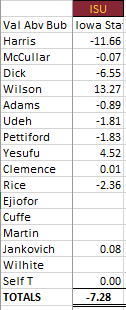
Jalen Wilson carried the Jayhawks all game, and in doing so posted the team’s best performance of the season. Not only did he score 38 points on efficient offense, he did so by playing solid defense throughout all 45 minutes of game time.

Dejuan Harris was KU’s second-best player. Although he only scored 3 points, he produced points thanks to 11 value assists and played solid defense on K-State’s second-best player and opposing PG. Conversely, poor defensive outings by Gradey Dick and K.J. Adams contributed to negative value-games on their ledgers, despite them scoring 16 and 17 points respectively.

This was the bench’s 7th-straight negative-value outing.

More on the Bench

While KU continues to win close games, it is in spite of its bench players. This phenomenon was discussed earlier in the season, and the discrepancy between its starters and bench has remained. Self has continued to play Bobby Pettiford and Joseph Yesufu as reserve guards, with an oft-injured M.J. Rice having not playing in the last three games. Zuby Ejiofor has been KU’s most-frequently-used bench big man in conference play (27 minutes), followed by Zach Clemence (21 minutes) and Cam Martin (6 minutes). Ernest Udeh has played in only 1 second of conference play. Yes, just 1 second. This came at the end of the Oklahoma State game when he was guarding the inbounds pass.

Since the last time we examined their performance, the KU bench has hardly changed in overall value it provides. After 10 games, the bench was positioned to earn about -3.00 WAR over a normalized 36-game schedule. With 17 games in the book, this has hardly budged. The 2023 bench is still the worst bench in the 20-year Self-era, and with no signs of improvement would be only the 6th bench to produce negative-WAR value over that time span.

One thing to consider is that there is a sort of floor to this number. The worse the bench plays, the less Self will go to it. Through 5 conference games, the starters have averaged 32.5 minutes per game each. This is Self maxing out starter-minutes. He cannot play them much more, considering foul trouble will occur at times and fatigue will set in. With limited bench minutes, two things should keep the number somewhat afloat. First, the bench has less collective time on the floor to perform poorly. Second, in limited minutes the bench players should have the energy to play each defensive possession 100%. The bench should be giving maximum effort when they are out there, thus maximizing their potential value on a possession basis.

There are various ways to quantify the dreadfulness of the bench rotation. We have used the WAR value metric to compare the 2023 bench to others in the Self-era. Now we will compare the 2023 starters – Harris, McCullar, Dick, Wilson, and Adams – to the remainder of the team using Adj. Points AB +/-. This metric compares a player’s value, in points relative to a bubble-level opponent (about the 45th best team in D-1). Anything positive is quite good and should earn the player rotation minutes, with anything greater than +2.00 indicating a performance level that would start on almost any KU team.

The following numbers are thus presented per game, collectively divided between starters and bench.

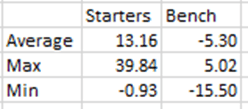
The starting 5 produces an average difference of 13.16 points above a bubble team per game. They have been tremendous. This year’s starters have collectively out-done last season’s starting 5, which were +10.83 points above bubble per game. For the Missouri game, the starters were an absurd +39.84. They have only been below bubble-level as a group twice this season, first against Omaha (which was technically their worst opponent-adjusted performance) and second against Tennessee. Even then, these games were barely below the 0 threshold.

In contrast, the bench has played to a bubble-standard in only four games (23.5% of games). Ironically, its best game was against Omaha with a +5.02 performance, which is also the only time it has outperformed the starting 5. Its worst outing was against Southern Utah, in a game that was only close because of the reserves. Worse, the bench is trending downward. It hasn’t produced a positive outing since the Indiana game. Last season, on a team that featured seniors like Mitch Lightfoot, Jalen Coleman-Lands, and of course Remy Martin off the bench; it was collectively -0.52 and produced 17 games above bubble-standard (42.5%). This number was much higher at the end of the season when it counted, as the bench collectively produced an average game of +5.53 in the 9 games that made up the 2 tournaments. This was due to the great play of Remy, as well as a shortened rotation that played the senior reserves far more than the underclass backups. Suffice to say, the 2023 team doesn’t currently have that kind of fire-power waiting in the wings. It has underclassmen and transfers, none of whom have proven any capacity to be consistently great at the upper echelons of the D1 level.

Having a poor bench is no reason to despair. History has shown that teams with great starters can win in the Tournament despite having little help from its reserves. The 2012 runners-up had a very similar divide between a strong starting 5 and weak bench. However, even the 2012 bench had experience; Kevin Young was a redshirt junior and Conner Teahan a fifth-year senior. The 2016 team is another good comparison. It earned the number-one overall seed and made an Elite 8 on the backs of its experienced starters, getting little from its bench.

There are a few potential bright spots to consider when pondering the bench situation. First, is that KU has talented young players on its roster. It really only takes the development of one or two of the following by March for this situation to drastically improve: Pettiford, Yesufu, Rice, Ejiofor, Udeh, Clemence. If KU can comfortably play any of these guys 10 minutes or so and expect a consistent performance, it can better maintain leads that its starting 5 works to build. The second consideration doesn’t have to do with the bench, but with the makeup of the starting 5. The starters are all capable of playing a heavy-load, thus reducing the negative-impact the bench has collectively brought. K.J. Adams is far more like a wing than a post in terms of fitness and durability, meaning that even the 5-spot needs fewer bench minutes this season than it historically does.

Lastly, where should the team go from here? In comparing Per 100 points above bubble, there is good reason to like the potential development of Udeh and Ejiofor. These two have clearly been superior to other bench-players, particularly the other 5 men. While Ejiofor has gotten in games consistently, Udeh has been relegated to DNPs of late. Perhaps this should be reexamined, particularly if Clemence continues to defend at a poor level.

There hasn’t been much value from the reserve guards/wings. Injuries have plagued all four (with Cuffe still out), and even when healthy none have provided consistent value. The team loses scoring ability, size, and defensive skill when it goes to the bench and gains little. Shifting K.J. down to the 4 when Jalen is out is honestly a worthy consideration.

Kansas 62, Iowa State 60

Gradey Dick and Kevin McCullar were KU’s best players against the Cyclones. K.J. Adams, who had the winning basket as part of 15 points and Jalen Wilson, who finished with 16 points, had poor defensive showings overall. Still, K.J. has now ran off 11 consecutive positive-value games, a team record for this season.

The bench was again abysmal, this time combining to produce -7.05 points against bubble. Only once, the Nebraska-Omaha game, has the bench collectively produced more value points than the starting 5. And through 17 games this season, only 4 times (Omaha, NDSU, Texas Southern, Indiana) has the bench been above-bubble (reminder, this is an opponent-adjusted number).