2014 Kansas Jayhawks

The 2014 Kansas Jayhawks finished with a record of 25-10 (14-4), winning the Big 12 Regular Season. The team earned a 2-seed in the NCAA Tournament, reaching the Round of 32 before losing. The team’s Sports Reference link is here.

Offense:
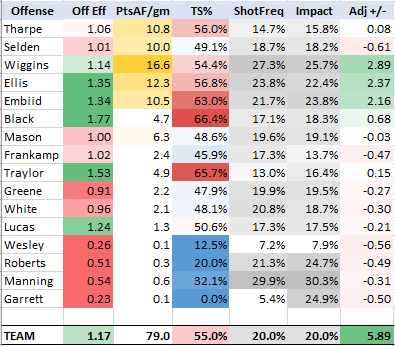
Andrew Wiggins led the Jayhawks’ offense in 2014, accounting for 16.6 points per game on 54.5% true shooting. He was joined by strong interior scoring from Perry Ellis and Joel Embiid. KU was a strong interior team this year, as both Tarik Black and Jamari Traylor also had positive value seasons in the interior. KU’s five starters all produced over 10 points a game. Naadir Tharpe shot the ball well on a limited frequency. The two biggest offensive letdowns were off-ball freshmen guards in Wayne Selden and Conner Frankamp.

Defense:
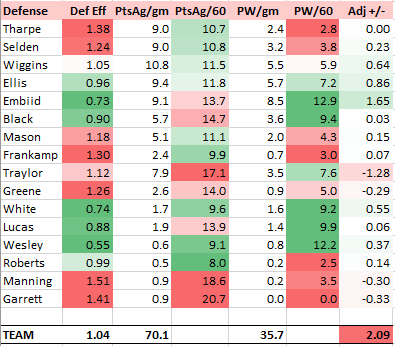
The team’s defense was Coach Self’s weakest to this point while at Kansas. The best defender was Joel Embiid, an excellent shot blocker and rebounder. Both Perry Ellis and Andrew Wiggins played good enough defense, but what was most disappointing was the effort from role players on the roster. KU didn’t need guys like Naadir Tharpe or Jamari Traylor to focus on scoring. They both should have done better on this end.

Adj. PPG +/-
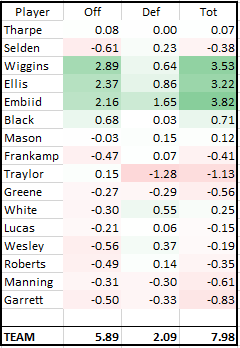
Kansas was led by three star players; Embiid, Wiggins, and Ellis. Two of these three would be top-three picks in the 2014 NBA draft, and Ellis would go on to have an excellent college career. The guard play was noticeably mediocre. Starting PG Naadir Tharpe had some excellent shooting games in 2014, but also had down games as well. His average score was right at bubble-level. Tharpe would be benched during the tournament due to poor play, and his two replacements in Frank Mason and Conner Frankamp would go on to post slightly-above and slightly-below replacement seasons. Wayne Selden would also produce a below-value season as a freshman.

The TEAM’s offense-defense value-difference of +3.80 (meaning its offense was 3.80 points better relative to its offense) was the widest offense-dominant team that Self had to this point (2017, 2018, and 2022 would all be wider). This was likely due to a prominent number of skilled scorers and large number of underclassmen who hadn’t learned to defend yet.
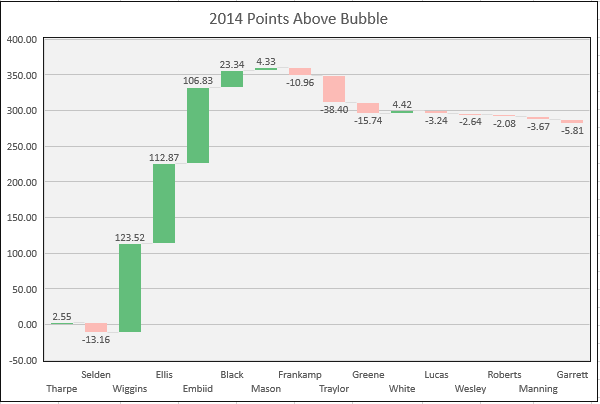
Two Lottery Freshmen, Two Value Leaders

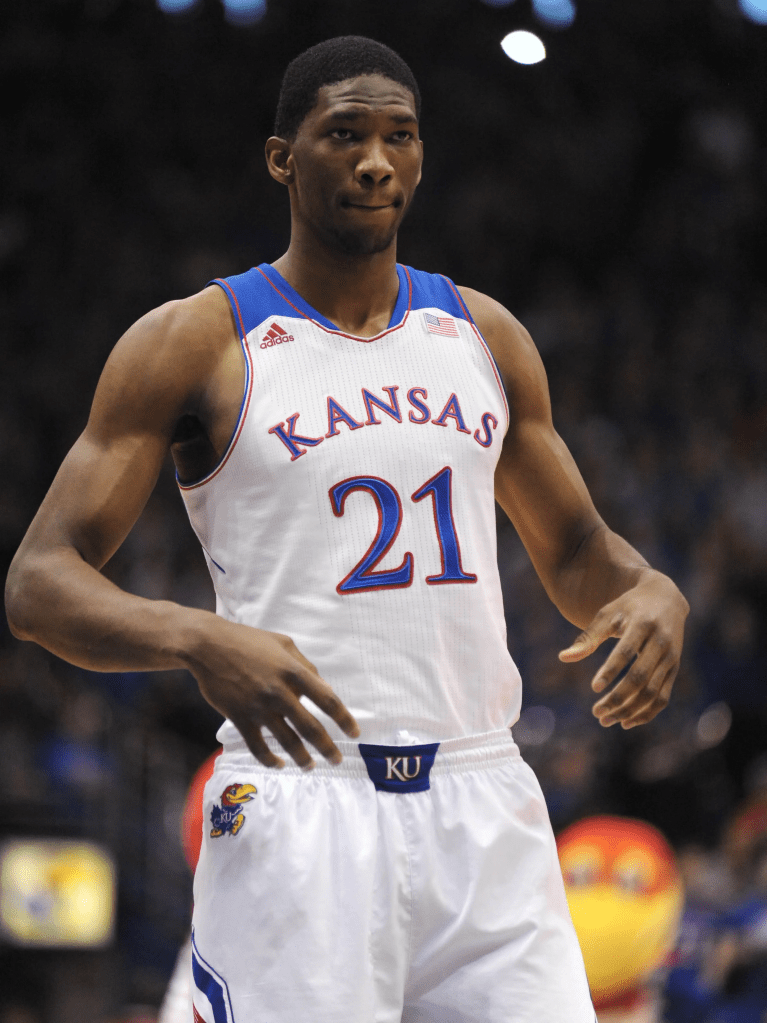
Joel Embiid was KU’s most valuable player on a per-game basis, thanks to his efficient scoring and strong interior defense. He added positive, above-bubble value in 22 of the 28 games he played in (78.6%). His best game in a Jayhawk uniform was against New Mexico in the Sprint Center.
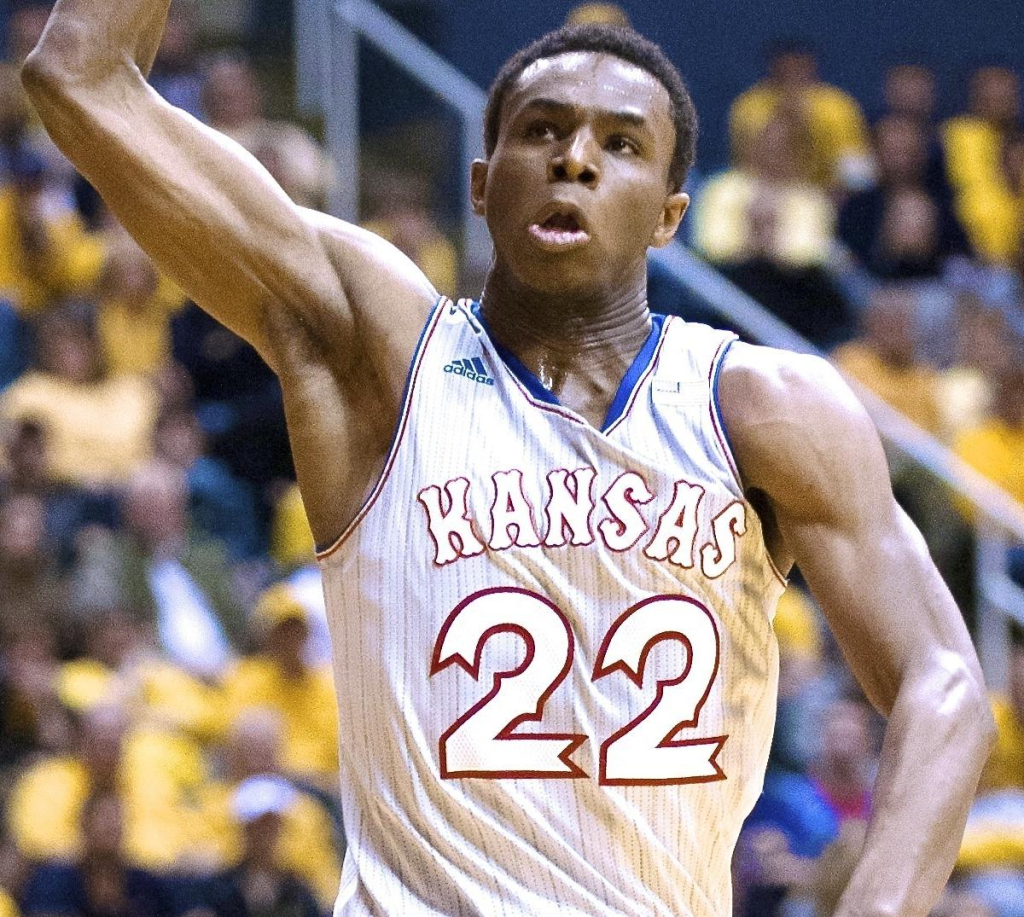
However, Andrew Wiggins was more durable. He played in all 35 of Kansas’ games, providing the most value from a total perspective. He also had the best game of any Jayhawk in the 2014 season, posting a +18.83 value score in his 41-point performance against West Virginia in Morgantown in the final regular season game of the season. Wiggins would also lead the team with 11 game MVPs.
The 2014 team in retrospective:

The 2014 team came in with a lot of hype, and although it wasn’t to live up to it, it’s two best prospects were. The negatives are obvious. Not getting past the first weekend. Poor guard play. Double-digit losses. But on the flip side, this team extended the conference-title streak to 10. When healthy, the team was very tough to beat. It had incredible depth and a number of guys who might have been overlooked during this season would go on to have great careers at Kansas.

WAR rankings. Here are the Wins Above Replacement for the 2014 season:

  • Andrew Wiggins +5.08
  • Perry Ellis +4.54
  • Joel Embiid +3.92
  • Naadir Tharpe +1.45
  • Tarik Black +1.27
  • Wayne Selden +1.04
  • Frank Mason +0.91
  • Andrew White +0.28
  • Landen Lucas +0.06
  • Conner Frankamp 0.00
  • Justin Wesley -0.03
  • Niko Roberts -0.04
  • Evan Manning -0.09
  • Christian Garrett -0.15
  • Brannen Greene -0.20
  • Jamari Traylor -0.33

NCAA Tournament:

The 2014 team earned a 2-seed and drew 15-seed Eastern Kentucky in a closer-than-expected game. In the end, KU turned to the effort and energy of Jamari Traylor to win the game down the stretch. Traylor would go for 17 and 14, adding 6.29 points of value above bubble for the game in his only team-MVP game of the year. This game is sometimes overlooked, but it was good to win because of how bad of a loss it would have been. Unfortunately, Kansas didn’t play well in its next game as it would fall to 10-seed Stanford.
2015 Kansas Jayhawks

The 2015 Kansas Jayhawks finished with a record of 27-9 (13-5), winning the Big 12 Regular Season. The team earned a 2-seed in the NCAA Tournament, reaching the Round of 32 before losing. The team’s Sports Reference link is here.

Offense

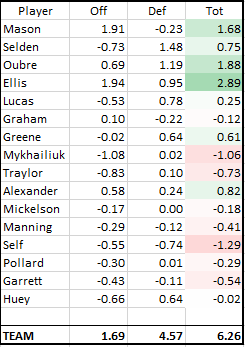
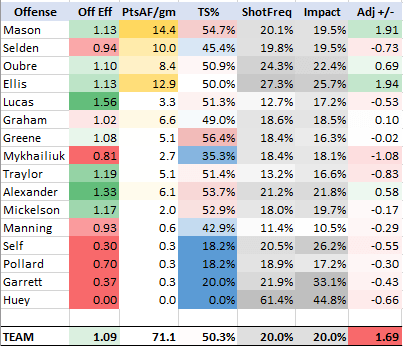
The 2015 Offense struggled to score, producing only about 1.69 points per game above a bubble offense. Both Frank Mason and Perry Ellis were solid contributors, each just a shade under +2.00. Freshmen Kelly Oubre and Cliff Alexander will likewise positive on the offensive end of things. Aside from that, players were either bubble-level or worse.

Defense

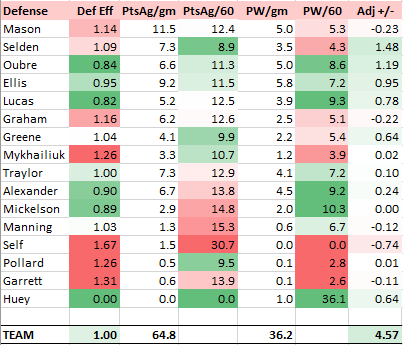
The 2015 Defense was the better side for Kansas, ranking 9th in KenPom adjusted defensive efficiency. Wayne Selden graded out as KU’s strongest defender, allowing only 9.0 points per 60 possessions. Both Kelly Oubre and Perry Ellis were also above 1.00 PPGAB in defensive value. The defense didn’t have a weak spots opponents could exploit, although the younger guards (Mason, Graham) would improve on this end as their careers developed.

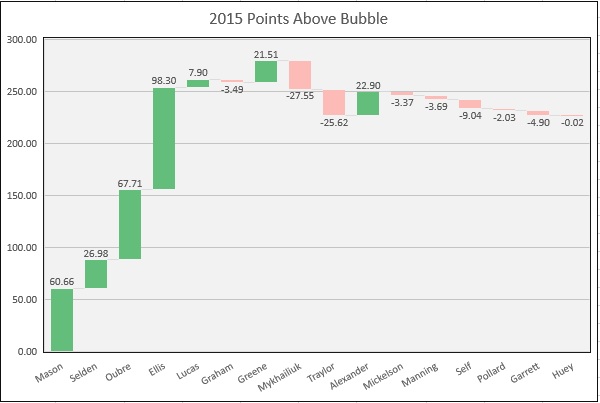
Perry Ellis was the team’s most valuable player in 2015, averaging over 3.00 PPGAB in value before his knee injury (he would struggle for the first few games when he returned, which dropped him to the final PPGAB mark he’s showing). Despite a slow start to the season, Kelly Oubre added nearly 2.00 PPGAB in value, with sophomore PG Frank Mason not far behind. Wayne Selden, Cliff Alexander, Brannen Greene, and Landen Lucas were other players with positive impact on the season.

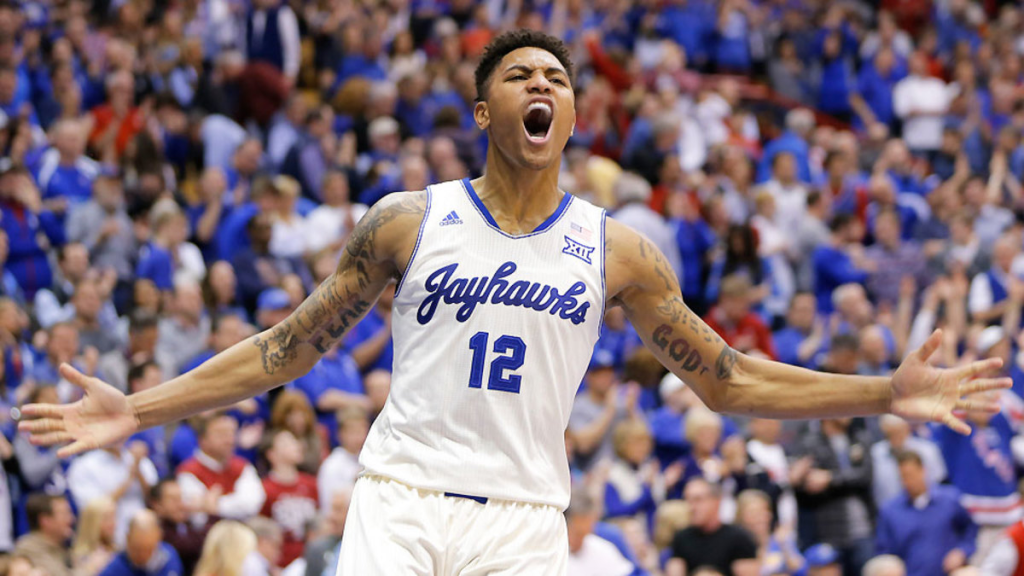
Kelly Oubre and the 2015 Jayhawks went undefeated at Allen Fieldhouse (15-0).

KU had a nice rotation for much of 2015, but this got weaker after Cliff Alexander was held out and Perry Ellis suffered his knee injury.

Data Fulfillment

For the 2015 season, 23/36 games were able to be watched in their entirety. The other 13 games were charted using video highlights, radio broadcasts, play-by-play box score information, and other sources to most accurately record what happened. This led to a Coverage score of 96.93%, which is very good. Over 71.2% of the season’s plays were available on video, with 95.5% of all possessions having at least a 90% confidence rating.

What this indicates is that the value-stat estimates from this season are not prone to much data-absence error. These value scores aren’t likely to be too far off what they would be had we the entire season, since only a small percentage of overall possessions are in question.

Season Stats: Interpretation

Below is a summary of how to interpret the stats published on this website. These stats will differ from the ones traditionally offered.

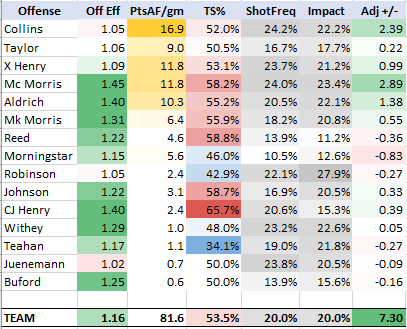
We will use the 2010 season numbers as a guide. Below are the offensive stats for the 2010 team.

2010 Offense

First, let’s start with how the players are sorted. The primary starting five are the first five listed, from point guard to center, 1-5. From here, bench players are listed in order of importance, with the sixth man listed sixth, seventh man listed seventh, and so on until the walk-ons are at the bottom.

Next, let’s look at Offensive Efficiency. Each player’s individual efficiency is calculated, as well as the team’s, and is shown as points per possession (used). For instance if a player produces 110 points and uses 100 possessions, his Off Eff is 1.10. Clearly, higher is better. The color formatting from red to green (bad to good) reflects the efficiency of what a replacement-level KU rotation player should show at average usage. For 2010, most of the team shows green or very faint colors because the team was well-above replacement level offensively.

The third column is Points Accounted For per game. This stat accounts for all plays in which a player creates points: the player scoring unassisted, the player scoring from an assist, as well as the player assisting a teammate’s score. Senior PG Sherron Collins led the team by accounting for 16.9 points per game, which was north of the 15.5 points per game he scored. Guards which tend to create more scoring opportunities–for themselves and others–produce more points for the team than what they actually score. In contrast, some wings and post men score a large portion of their points by finishing plays set up by others, so their PtsAF/gm numbers tend to be less than what their points scored per game is. The nice thing about this stat is that it combines points and assists into one number.

The fourth column is True Shooting Percentage. TS% is calculated by other sources, but the calculation here takes into account that assisted baskets are (or should be) easier to convert than unassisted baskets. It is takes into account actual possessions used on shots (instead of estimating them). This number won’t differ much from other sources, but it should more accurately reflect what occurred when the player shot the ball. The color formatting is from blue (cold) to red (hot). 50% is set as the neutral mark for formatting. Guard C.J. Henry led the team in this stat.

The fifth column is Shot Frequency, which looks at how often that player shot the ball while he was on the floor. The darker the gray is, the more frequent that player took the shot in comparison to his teammates. Looking down the list, one can see that KU relied more heavily on Collins, Marcus Morris, and Xavier Henry to take shots. With five players on the court at once, the average ShotFreq is exactly 20.0%.

The sixth column is similar to the last, and is called Offensive Impact. First, let’s confirm firm that the average Impact number is 20.0% for the same reason as above. But what exactly is Offensive Impact? As the name implies, it looks at how large each player’s impact was on the offensive end in comparison to his teammates. Knowledgeable fans will know what offensive usage is, and this stat is similar. However, Impact uses offensive rebounds differently. Instead of ignoring offensive rebounds or using them against offensive usage, we include them in calculating Impact just as we would a shot. Last, note that this stat and the one above aren’t a measure of value. In other words, Impact calculates all offensive plays–good and bad–that a player has during his minutes. Freshman Thomas Robinson was KU’s most impactful offensive player (28.0%) on a per possession basis, even though he graded out as a negative offensive value player.

The final column is Adjusted PPG +/-, or the value score for each player on the offensive end. This number includes all the information from the previous categories and puts it together in a way that balances offensive production and efficiency. It is also schedule-adjusted to account for the relative strength of opponents. Marcus Morris led the team in this category for 2010 at +2.89. Looking back at earlier columns, we can see he is at or near the top of each offensive stat. The +2.89 number means that he was 2.89 points per game better on offense than a KU-level replacement player at his position. The team score of +7.30 is also very good.

2010 Defense

The Defensive stats published on this website far exceed what an official box score can provide. The primary difference is that each point scored by the opponent is counted against the KU defender who was most responsible. This will be explained further below, but it allows us to better grade individual defense instead of having to guess each player’s defensive impact, as other advanced statistical models do.

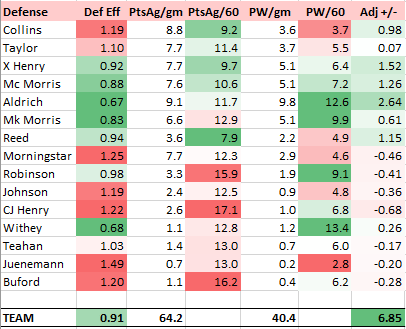
The Defensive Efficiency column is like its offensive counterpart…points allowed divided by possessions won. The color formatting is inverse offense, with higher numbers being worse. To explain another way, take a look at Sherron Collins’ 1.19 score. This is saying that for every defensive possession that Collins was responsible for, his opponent scored 1.19 points. Def Eff will be tend to be better among big men who grab far more rebounds than small guards.

The next two columns are similar, Points Against per game and Points against per 60 possessions. These stats are carefully charted by observing game film (among other methods) to assign points allowed by individual defenders. Because of the differing minutes played for each player, the PtsAg/60 offers the best look at scoring defense. The color formatting, from green (good) to red (bad) indicates that Tyrel Reed was the team’s best at not allowing his man to score, followed by Collins and Xavier Henry.

The following two columns are likewise similar to each other, Possessions won per game and Possessions won per 60 possessions. To “win” a possession, a player must rebound, block a shot, steal the ball, or force a turnover so that his team gets the ball back without the other team scoring. As one can see, big men excel at winning possessions. This is primarily through rebounding numbers, although blocked shots and forced turnovers also play a part for big men with active hands.

The final column is Adjusted PPG +/-, or the value score for each player on the defensive end. It takes into account a player’s points allowed along with his possessions won, awarding more value to defensive plays that occurred before a shot (steals, forced turnovers) than those that were the result of a miss (rebounds). It is schedule-adjusted to account for the relative strength of opponents. Cole Aldrich led the team at +2.64, bolstered by his rebounding and shot-blocking prowess. Of note might be the large difference between Tyrel Reed and Brady Morningstar. Reed was an underrated defender; whereas Morningstar was the opposite.

2010 Value Scores

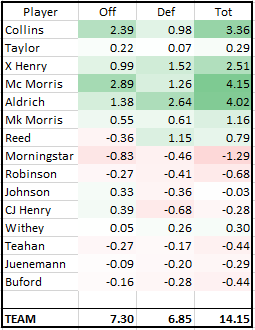
The last box combines the offensive and defensive PPG +/- stats into one total number. 0.00 is replacement level (think 7th or 8th man on a KU roster), someone who doesn’t help his team much but doesn’t hurt their chances either.

For 2010, Marcus Morris led the team with a +4.15 score, although Cole Aldrich at +4.02 was statistically identical. The 2010 had tremendous balance and depth, though the bulk of the value was from the top seven players. The team’s score of +14.15 was the third best since 1993, with only the 2008 and 1997 teams scoring higher.