2014 Kansas Jayhawks

The 2014 Kansas Jayhawks finished with a record of 25-10 (14-4), winning the Big 12 Regular Season. The team earned a 2-seed in the NCAA Tournament, reaching the Round of 32 before losing. The team’s Sports Reference link is here.

Offense:
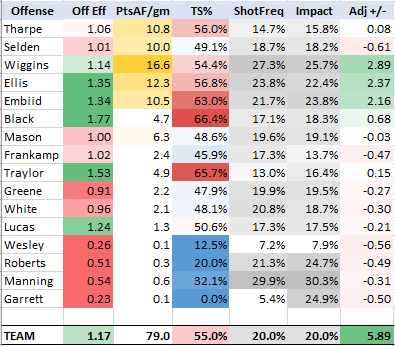
Andrew Wiggins led the Jayhawks’ offense in 2014, accounting for 16.6 points per game on 54.5% true shooting. He was joined by strong interior scoring from Perry Ellis and Joel Embiid. KU was a strong interior team this year, as both Tarik Black and Jamari Traylor also had positive value seasons in the interior. KU’s five starters all produced over 10 points a game. Naadir Tharpe shot the ball well on a limited frequency. The two biggest offensive letdowns were off-ball freshmen guards in Wayne Selden and Conner Frankamp.

Defense:
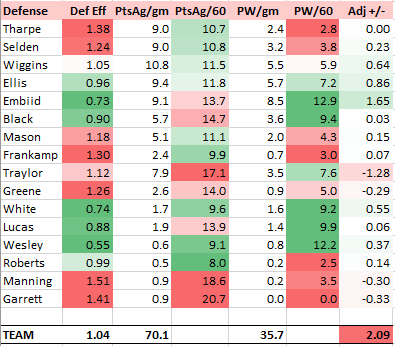
The team’s defense was Coach Self’s weakest to this point while at Kansas. The best defender was Joel Embiid, an excellent shot blocker and rebounder. Both Perry Ellis and Andrew Wiggins played good enough defense, but what was most disappointing was the effort from role players on the roster. KU didn’t need guys like Naadir Tharpe or Jamari Traylor to focus on scoring. They both should have done better on this end.

Adj. PPG +/-
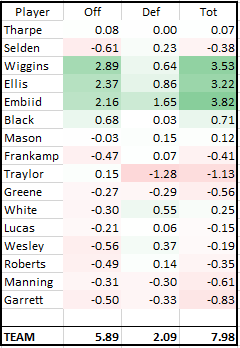
Kansas was led by three star players; Embiid, Wiggins, and Ellis. Two of these three would be top-three picks in the 2014 NBA draft, and Ellis would go on to have an excellent college career. The guard play was noticeably mediocre. Starting PG Naadir Tharpe had some excellent shooting games in 2014, but also had down games as well. His average score was right at bubble-level. Tharpe would be benched during the tournament due to poor play, and his two replacements in Frank Mason and Conner Frankamp would go on to post slightly-above and slightly-below replacement seasons. Wayne Selden would also produce a below-value season as a freshman.

The TEAM’s offense-defense value-difference of +3.80 (meaning its offense was 3.80 points better relative to its offense) was the widest offense-dominant team that Self had to this point (2017, 2018, and 2022 would all be wider). This was likely due to a prominent number of skilled scorers and large number of underclassmen who hadn’t learned to defend yet.
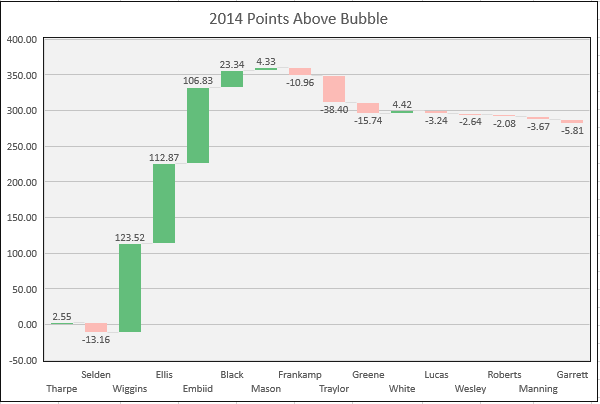
Two Lottery Freshmen, Two Value Leaders

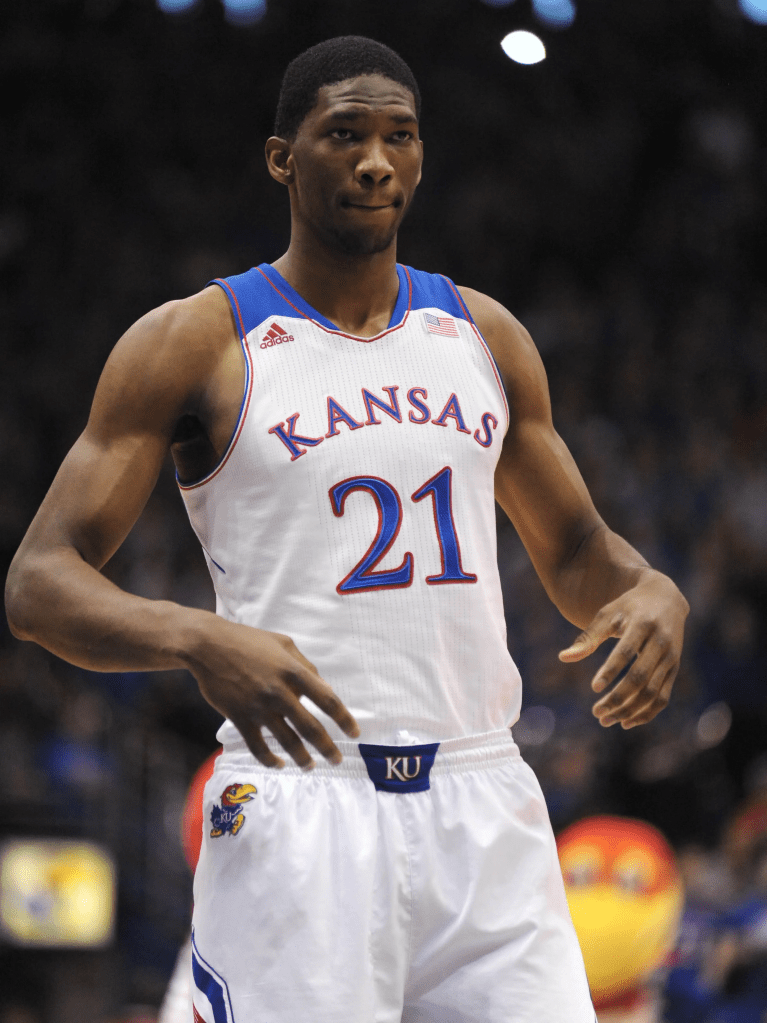
Joel Embiid was KU’s most valuable player on a per-game basis, thanks to his efficient scoring and strong interior defense. He added positive, above-bubble value in 22 of the 28 games he played in (78.6%). His best game in a Jayhawk uniform was against New Mexico in the Sprint Center.
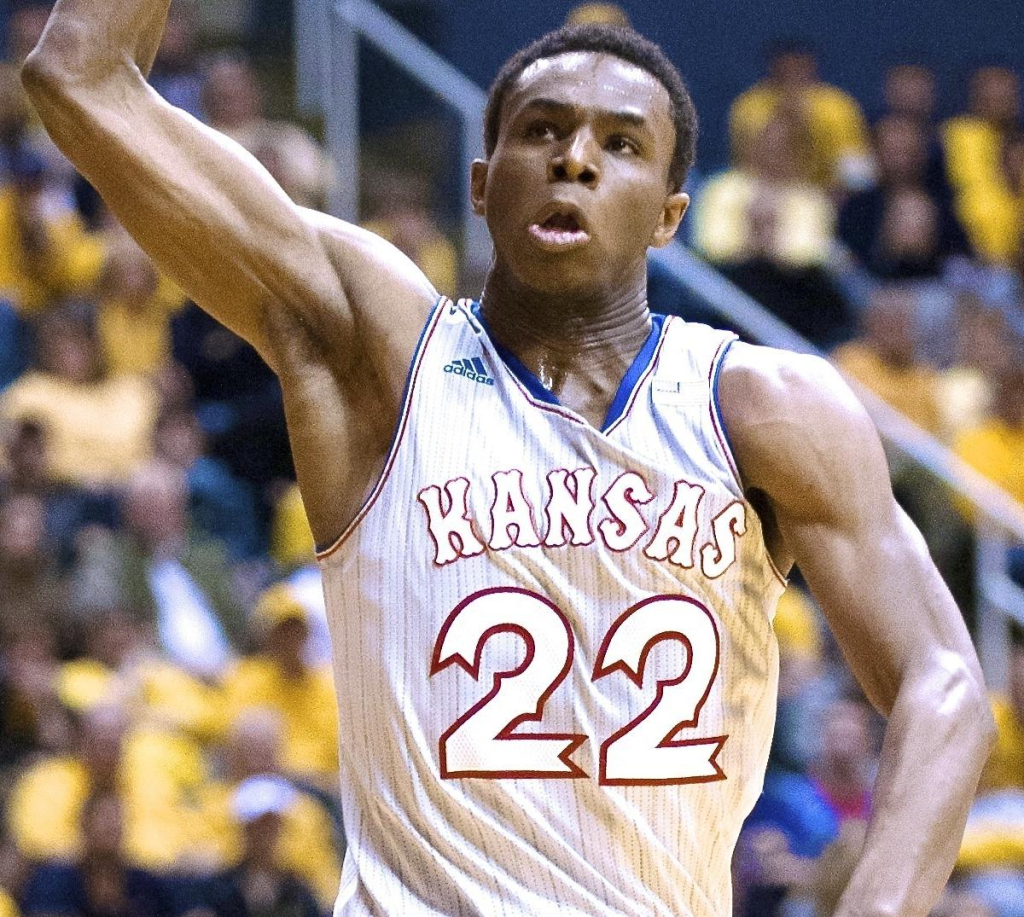
However, Andrew Wiggins was more durable. He played in all 35 of Kansas’ games, providing the most value from a total perspective. He also had the best game of any Jayhawk in the 2014 season, posting a +18.83 value score in his 41-point performance against West Virginia in Morgantown in the final regular season game of the season. Wiggins would also lead the team with 11 game MVPs.
The 2014 team in retrospective:

The 2014 team came in with a lot of hype, and although it wasn’t to live up to it, it’s two best prospects were. The negatives are obvious. Not getting past the first weekend. Poor guard play. Double-digit losses. But on the flip side, this team extended the conference-title streak to 10. When healthy, the team was very tough to beat. It had incredible depth and a number of guys who might have been overlooked during this season would go on to have great careers at Kansas.

WAR rankings. Here are the Wins Above Replacement for the 2014 season:

  • Andrew Wiggins +5.08
  • Perry Ellis +4.54
  • Joel Embiid +3.92
  • Naadir Tharpe +1.45
  • Tarik Black +1.27
  • Wayne Selden +1.04
  • Frank Mason +0.91
  • Andrew White +0.28
  • Landen Lucas +0.06
  • Conner Frankamp 0.00
  • Justin Wesley -0.03
  • Niko Roberts -0.04
  • Evan Manning -0.09
  • Christian Garrett -0.15
  • Brannen Greene -0.20
  • Jamari Traylor -0.33

NCAA Tournament:

The 2014 team earned a 2-seed and drew 15-seed Eastern Kentucky in a closer-than-expected game. In the end, KU turned to the effort and energy of Jamari Traylor to win the game down the stretch. Traylor would go for 17 and 14, adding 6.29 points of value above bubble for the game in his only team-MVP game of the year. This game is sometimes overlooked, but it was good to win because of how bad of a loss it would have been. Unfortunately, Kansas didn’t play well in its next game as it would fall to 10-seed Stanford.
2021 Recap

The final 2021 stats have been published. Below is a brief look at the value provided by this season’s roster. Note that the assessments are in relation to a KU-level talent for how they performed this season. It is not a prediction on what they will be later in their careers.

2021 Value Scores

STARTERS

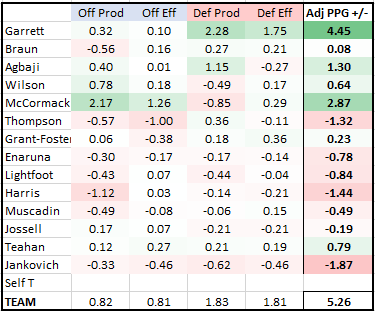
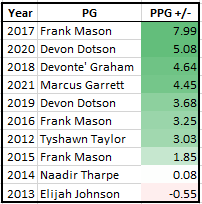
Marcus Garrett led the team with a +4.45 score. He provided the most-valuable defensive season on record (20 seasons) with a +4.03 Def PPG +/- score. The scores confirm what the eye-test tells us, Garrett’s defense was outstanding. Additionally, Garrett provided +0.42 value on offense. Not great, but above replacement-level. Since 2012, Garrett was KU’s fourth-best starting point guard, and not too far below Devonte’ Graham’s 2018 season.

KU PG’s over past 10 seasons

KU has been spoiled with outstanding PG’s in recent years. Don’t blame Garrett for having to play out of position in 2021, blame those around him for not elevating their games. Assessment: KU-level star (A+).

Christian Braun finished barely in the green, with a +0.08 score. He had some excellent games but was an inconsistent shooter. He also had trouble generating his own offense, so he was the least productive starter on offense. His defense was not bad, but not great either. He is a good rebounder for a guard, and an okay on-ball defender. Looking at his total value, he likely doesn’t start most seasons at KU. But he was still the team’s fifth-best player, and will be a vital piece moving forward should he improve like most KU players do who return for a third season. Assessment: KU-level reserve (C).

Ochai Agbaji was the team’s leading scorer at 14.1 ppg, and finished with a +1.30 score. His offensive efficiency declined throughout the season, and he didn’t grab many rebounds or steals on defense either. Still, he did a good job of outscoring his man, and he graded out as the team’s second-best defender. I don’t see him being anywhere near an NBA-level talent yet. His junior season was a clear jump over his underclass years, but he still has room to grow as a player. Assessment: KU-level starter most years (B-).

Jalen Wilson finished with a score of +0.64, with his value coming on the offensive side of the ball. At times he was a very good scorer, and his rebounding skill made KU less of a “small ball” team than was predicted. His defense was poor, particularly when he was in a mismatch against a quicker player. If he can improve his shooting and on-ball defense, he can be a very good college player. Assessment: KU-level reserve (C+).

David McCormack had a dominant offensive portion of the schedule, which elevated him to a +2.87 score. He graded out as a better offensive weapon than Doke last season due to his production, free throw shooting, and ability to take care of the ball while playing against a tougher schedule. He was a versatile scorer. McCormack’s defense, while better than his underclass years, was nevertheless quite poor. He struggled against versatile players whether underneath or (especially) on the perimeter. Assessment: KU-level starter (A-).

ROTATION BENCH PLAYERS

Bryce Thompson finished his freshman season at -1.32. This is actually far more respectable than how he played at the beginning of the season. Thompson’s offense was the worst on the team, and he never outscored the 12 points he put up against Gonzaga in the first game of the season. His defense was slightly positive, and he showed flashes of the talent that brought him to Kansas. I don’t doubt he can improve. Assessment: Not KU-level (D-).

Tyon Grant-Foster was the only rotation bench guy to have a positive score, at +0.23. He was not an efficient offensive player, which hurt his minutes. But he defended, rebounded, and made the occasional athletic play when he was in the game. He should have been given more minutes given what he did do. His lack of minutes will end up hurting his grade, as we don’t know if he would have been able to maintain his value playing more minutes. Assessment: KU-level reserve (C-).

Tristan Enaruna did perform slightly better than last season, but across the board he was negative on all categories. His total score was -0.78. He did some things well, but he was a bit soft on both ends of the court. Assessment: Not KU-level (D).

Mitch Lightfoot did not put up a score as high as he should have, given his status as a 5th year senior. He finished at -0.84. His minutes were mostly due to KU not having a viable back-up at the 5, unlike in years past. His inability to develop offensively is surprising, given how athletic he is and how competent his shot looks. Assessment: Not KU-level (D).

Dejuan Harris made many nice plays last season, but also wasn’t much of an offensive factor. This is why his score was so low at -1.44. Harris has a nice game; he takes care of the ball, sees the floor well, can make an open shot. He needs to improve his scoring and on-ball defense. Assessment: Not KU-level (D-).

DEEP BENCH PLAYERS

Gethro Muscadin didn’t see the court much, and when he did he showed how his size could be of value but not much of his skill. His score was -0.49 while only playing 2.7% of possible minutes. With him transferring out, there’s not much else to say. Assessment: Not KU-level (N/A).

Latrell Jossell also didn’t play much, but his quickness and ball-skill weren’t bad. He is undersized, so might have trouble defending should he get more minutes. His score of -0.19 included some deep jump-shots, showing range. Assessment: Undetermined (N/A).

Chris Teahan was money, and had a score of +0.79 thanks to multiple made shots and decent defense. He could have played 5-10 minutes against most opponents and been fine. Assessment: KU-level walk-on (N/A).

Michael Jankovich was injured for most of the season and played in one game (USC), finishing with a score of -1.87. Assessment: KU-level walk-on (N/A).

To reiterate, the assessments and grades relate to the 2021 season only, and are not a reflection of the player’s potential or a prediction of the player’s value moving forward. Before next season, a prediction of the 2022 season will be published, using players’ historic numbers and historic trends of player improvement over the years.

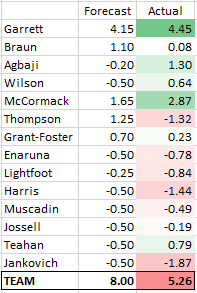
Having said that, let’s take a look at how close this season’s forecasted Value scores (Adj PPG +/-) were to the actual results. Note that the forecasted numbers weren’t published before now, so you’ll just have to trust these predictions were made before the season:

2021 Player Forecasts vs. Actual PPG +/- scores

The sum of the five starters exceeded their collective forecast by around 3 ppg. Looking back, it is easy to see I should have flipped Braun and Agbaji. In 2020, however, Braun was nearly a full point better than Agbaji, who had a poor season as a sophomore. Agbaji’s sophomore to junior jump was impressive even if we want more out of Och. Wilson was a nice surprise, and McCormack elevated his offensive production as the team’s main interior scorer. KU’s five starters weren’t the problem.

The bench was a major disappointment. Thompson’s forecast was ridiculously off in a bad way, but it was a prediction made after believing much of the hype around him. To a similar extent, this happened on Tyon Grant-Foster. Lightfoot not improving from 2019 was discouraging, and the rest of the bench was tough to predict. Part of Harris’ low score was him getting more minutes than expected. Either way, not a single bench player was able to consistently produce at a level that should warrant considerable time on the floor in a Kansas uniform.

Looking at the team score, the team underperformed what I thought it was capable of. However, the initial form of this team included Silvio De Sousa. De Sousa was a good interior defender in 2020, so his place on the roster would have helped the team immensely on that end. As much as I’d like to predict the 2022 team right now, we’ll let the roster finalize and make forecasts in the fall. There are many moving pieces at the current stage.