Understanding the NCAA Tournament Committee

Note: This was written immediately following Selection Sunday 2024. If we can analyze what the committee values on Selection Sunday, it can help us understand what teams can do to make sure they have the best shot to get the seed they deserve.
Every year there is chaos, controversy, and confusion on Selection Sunday. 2024 is no different. Iowa State sits at #8 on the S-curve despite running through the Big 12 Tournament. Auburn, the SEC champ and advanced-metrics darling, got a 4-seed no one wants to face. At the same time, 14-loss Michigan State was comfortably in the field (9-seed) and bubble-team Texas A&M (also a 9-seed) comfortably avoided Dayton despite having 4 Q3/Q4 losses on the season.

What is going on? Is the committee schizo? Well, sort of. But it isn’t really their fault.

The NCAA Tournament committee’s job is to select and seed the best 68 teams for the bracket. To help it, it has certain principles as a guide. There are 32 automatic qualifiers and 36 at-large teams. So, they really only pick 36 teams. After the 36 are selected, they rank all 68. This two-part process is messy to a degree, as the AQ’s and at-larges mix until about the 12-seed or so (most years), after which the worst teams are always AQ’s.

For 2024, Championship Week saw numerous upsets and bid thieves, so the last four teams into the tournament (who make the play-in round in Dayton) were on the 10-line, which is the first time this has happened since the field when to 68. Before it has always been 11’s, 12’s, or even 13’s to make the First Four as at-large teams.

In order to help the committee decide who should be in the field, team sheets are used showing relevant information. This is what Houston’s looked like:
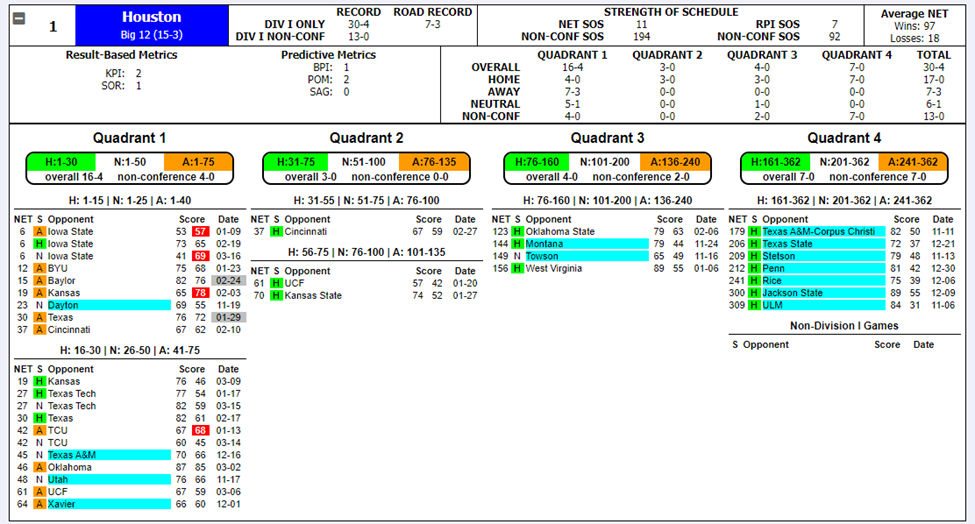
That’s quite a display of number and color. And this is just one team’s team sheet. Imagine going through nearly 100 of these, repeatedly, for hours if not days!

While we aren’t privy to the conversations of the committee, we do have the advantage of people doing bracket exercises which help us understand what the committee values. Believe it or not, bracketologists have some value to give us! Additionally, the committee chair normally hints or gives brief explanations regarding the committee’s decision after the release of the bracket. So we can make certain assumptions and guesses ourselves as we seek to understand the committee.

The Task at Hand

The exercise we’re engaging in is to attempt to quantify the committee’s preferences in terms of the information they have access to. For instance, what’s most important to the committee? Overall record? Quad 1 wins? Computer metrics? Strength of schedule?

There are a few types of criticism the committee sees. The first is that it fails to rank the teams as they truly are. This is a very difficult thing to assess, without first assuming some other metric which to judge the committee against. Instead, we want to study the consistency of the list. Based on the committee’s preferences; what numbers, metrics, etc. on the team sheets is it valuing?

To even get started, we have to identify what relevant numbers are even being evaluated, something we do using common knowledge of the sport of college basketball and clues from bracketologists and the committee chair. We’ve come up with 6 different categories:

  • Strength of Schedule
  • Overall Record
  • Performance Against the Best – Quad 1
  • Performance Against Good Teams – Quads 1 & 2
  • Avoiding Bad Losses – Quads 3 & 4
  • Advanced Metrics

Results

More detail will be provided later on how these are determined. But what we did was quantify these 6 categories by ranking teams in each, then weight each category based on its relative importance to come up with a weighted average score. We then ranked the field on this weighted average score and compared it to the committee’s own S-curve. We want the tightest correlation, so we played around with the weights of these 6 categories until we arrived at an R2 of 0.8793. The weights were as follows:

  • Strength of Schedule (6.5%)
  • Overall Record (0.0%)
  • Performance Against the Best – Quad 1 (25.5%)
  • Performance Against Good Teams – Quads 1 & 2 (9.5%)
  • Avoiding Bad Losses – Quads 3 & 4 (Multiple)
  • Advanced Metrics (58.5%)

There are some noteworthy things here. One, the raw winning percentage wasn’t factored in by the committee. This is to its favor. A team’s overall record shouldn’t matter per se, as the relevant numbers should be seen in other areas of the team sheets.

The next thing to note is that bad losses were calculated using a multiple. If a team has 0 bad losses, its overall weighted average goes down (improving its ranking). The more bad losses a team has, this affects its weighted average (worsening its ranking). Better to have 1 bad loss than 2, 2 bad losses than 3, and so on.

Finally, the advanced metrics accounted for a large proportion of what the committee valued. This isn’t necessarily terrible, as these advanced metrics taken into account what the committee looks for (i.e. good wins increase a team’s SOR, NET and KenPom ranking). But it is interesting, based on how closely the Quadrants are discussed, that just averaging a team’s computer metric component got you most of the way there.

Biggest Outliers – A Discussion of Certain Teams

Given how the committee viewed the importance of each item on the team sheet, let’s look at which teams were furthest from their final place on the S-curve. These outliers should generate the most controversy, because they are where the committee veered off most from their implied preferences.

Florida Atlantic

The Owls were the committee’s #31 overall team (earning an 8-seed), whereas the weighted ranking had them as the #46 team—just outside the at-large field. FAU’s resume was unique in that it had 3 Q3/Q4 losses. While the weighted ranking did indicate that the committee accounted for bad losses for most teams, it seemed to not do this for FAU. Though perhaps the weighted ranking over-penalized bad losses. Either way, FAU’s metrics were solid enough (all in the 30’s and low-40’s) and it played a solid schedule. But #31 is too high.

Colorado

The Buffaloes were the committee’s #39 overall team (earning a 10-seed and First Four game), 13 worse than their #26 weighted ranking. The Buffs could arguably be a 7-seed given their resume and what the committee valued most of the time. Colorado’s worst feature was its Non-Con SOS. Like Iowa State, this may have hurt it.

Boise State

The Broncos were the committee’s #38 overall team (and will face CU Wednesday night), but would have been #28 had the weighted ranking been used. Boise had good metrics across the board; nothing really stood out as being worthy of dropping them to the play-in game.

Kentucky

The Wildcats were “only” 8 spots off—the committee has them #11 while the weighted ranking has them #19—but since it is tougher to miss by many spots toward the top of the bracket, this was noteworthy. UK’s computer metric numbers were all between 18-21. It went 8-8 in Q’s 1&2. Whatever resume numbers you looked at in isolation; it was tough to place Kentucky as a 3-seed or top 12 team in any single of them. Yet they were given a 3-seed above teams such as Auburn or Duke or Kansas.

Others

These others, which were 8 spots off, will be listed in terms of boosted or screwed by the committee. Nevada was screwed. South Carolina was boosted. Colorado State was screwed, and is also a play-in team. Drake was boosted. Northwestern was also boosted.

Bubbles

Some bubbles have already been mentioned. The teams that were the most screwed out of making the tournament, given the committee’s implied preferences, were Oklahoma, Providence, and St. John’s. Virginia was boosted enough to get it in when it should have been out, but the boost wasn’t egregious. They were close given the committee’s preferences. FAU, as mentioned, would have been (barely) out. The other team that would have been out, if weighted average were used, was Northwestern.

What About…

Iowa State was actually only off by 1 spot given the committee’s implied preferences. With its computer metrics averaging over 5, ISU’s case for a 1-seed was always going to be dicey. But what hurt it most was undeniably its SOS score. Despite having the #16 NET SOS overall, its rank in this category was 63, far below the likes of UNC and Tennessee. What stuck out and pulled down ISU’s SOS was its #324 non-con SOS. One can argue that non-con SOS shouldn’t be considered (if we have overall SOS, what’s the point of looking at one portion of the schedule), but the committee sees that number and no doubt uses it in their considerations.

Michigan State, at 19-14, was thought to be gifted a Tourney bid. But the Spartans are actually only one spot off their implied rank given the committee’s preferences across the field. In other words, the same things the committee valued in seeding the rest of the field was applied to MSU. Michigan State had a great schedule overall (8th best according to this exercise) as well as solid computer metrics (being #18 in KenPom and BPI doesn’t hurt a team). This did enough to pull it up to an at-large berth without much sweat. Again, one can criticize what the committee values, but one can’t say it was being inconsistent by including Tom Izzo’s team in the 2024 Tournament.

Texas A&M had four bad losses but was the #34 team according to the S-curve. A&M earned a 9-seed, but maybe deserved a 10 given the committee’s preferences overall. Still, this team was getting in. It went 13-10 in Q’s 1/2 and had solid enough computer metrics.

And Finally… Not being talked about much is the fact Purdue dropped to the #3 overall seed, when many had it as the #1 overall for most of February and into March. The Boilermakers were the #1 overall ranked team according to the weighted rank, thanks to having the best SOS metrics in the nation and performance metrics right there with UConn and Houston. But the committee went with the Huskies and Cougars. Not that this matters much. The #1 overall seed hasn’t won March Madness since 2013, while 1-seeds from the other spots in the bracket have had success.

More Detail, How the Weighted Average Score was Calculated

All data was taken from what the committee had on Selection Sunday. The “Nitty-Gritty” info includes each team’s NET, Avg Opp NET Rank, Avg Opp NET, W-L record, Conf. Record, Non-Con Record, Road W-L, NET SOS, Non-Con SOS, and then results by Quads 1, 2, 3 & 4.

Additional data we needed to pull was each team’s computer metric scores (KPI, SOR, BPI, KenPom). All of these fields became the basis from which we ranked the field using the weighted average. As these categories are what the committee sees, we assumed these categories are what the committee uses to make its judgments.

The next step was the trickiest. How do we apply each of these data-points into sensible categories? After all, some of the information on the team sheets is redundant. After some thought, we came up with the six categories which were presented earlier. In more detail, here are these categories again.

Strength of Schedule

SOS ended up making up 6.5% of the weight. It wasn’t overly important, but it did affect teams like Iowa State. While overall SOS is included, the committee also saw SOS from a few other perspectives, including non-conference SOS. We calculated each team’s SOS sub-categories using percentiles, then found an average percentile, then ranked teams on that percentile. Purdue was #1, Kansas was #6, and Iowa State was #63. Of anyone in consideration for a 1-seed, ISU’s SOS was certainly the biggest outlier.

Overall Record

This is an appealing number, because it is prima facia easy to compare. A 23-9 record looks better than a 19-13 record. However, given SOS differences, this isn’t necessarily the case. To the committee’s credit, it didn’t utilize overall record at all according to the weighted average. This category was 0.0% weight.

Performance Against the Best – Quad 1

There’s no doubt the committee considers Quad 1 games in isolation, which was the gist of this category. They want to know how you did against the top teams in the nation. We looked at both overall wins in this quadrant as well as each team’s winning percentage in Q1 games. Weighting about 2 to 1 to overall wins (i.e. 11-5 is preferable to 8-3), we generated percentiles and rankings for this category. In total, 25.5% of the weight was put here.

Performance Against Good Teams – Quads 1 & 2

We didn’t think the committee looked at each Quad below Q1 in isolation per se, but because some teams don’t play a ton of Quad 1 games and once you get down the bracket not many teams have great Quad 1 winning percentages, we wanted to look to see how much the committee looked a teams’ records against “good opponents” broadly-defined. We had two sub-categories here, total wins from Quads 1&2 as well as the total net wins in these Quads (i.e. going 8-11 in Quads 1&2 mean a -3 net). Balancing these, we see that indeed the committee factored Q1&2 games into its ranking. In total, 9.5% of the weight was put in this category.

Avoiding Bad Losses

Quad 3/Quad 4 losses are seen as discounting a team’s ranking. But this wasn’t done by using weights as with the other categories. A team with 0 bad losses was given a multiple less than 1 (improving its weighted average score). From here, teams with 1 or 2 or 3 or more losses were given a multiple of increasing value (all over 1) which would increase their weighted averages and make them worse in the overall list.

Advanced Metrics

There are five computer ranking systems printed on the team sheets. NET, the NCAA’s performance evaluation tool; KPI, from Kevin Pauga; ESPN’s SOR, a resume-based metric; ESPN’s BPI, an efficiency-based metric; and KenPom, also an efficiency-based metric. The assumption, like with the other categories, was that these were employed by the committee as they were numbers the committee was seeing for each team. What’s clear is that the advanced metrics are being heavily used, and each is being used to some degree. In total, a whopping 58.5% of the weight was put here.

Calculating the Weighted Average

Teams are ranked in each category. From here, weights are applied in each category. Additionally, the bad loss multiple is applied to reward teams with no bad losses and punish teams with bad losses based on the number/severity of the bad losses. We then compare the weighted average ranking to the committee’s actual S-curve, and see how strongly the two lists align.

Using a simple correlation, we attempt to get the R2 as close to 1 as possible. For instance, if we applied 20% weight to each of the 5 categories (aside from the bad loss category, which is a multiple not a weight), we get a solid-enough R2 of 0.8265. After playing around with the weights, the highest R2 we got to was 0.8793 for the weights listed above. While not a perfect system, this is the best we could do without better coding skills.

In Closing

The committee’s preferred preferences matched the S-curve with a 0.8793 correlation. Is this good? Is it bad? Tough to say unless we compare it to other seasons. It clearly had some head-scratching calls, but also fit most teams close enough to what made sense. If we do this for other seasons, we can compare committees from different years to see which was the most and least consistent to its own preferences.

The flip-side is to analyze this from the perspective of teams looking to put themselves in the best possible place on Selection Sunday.

The best things for teams to do is to win games against good teams by as many points as possible. This will help your efficiency and resume metrics, which is what correlates most to the committee’s ultimate seed list (S-curve). Additionally, winning Quad 1 and 2 games (while avoiding bad losses) has a huge impact, and for a related reason. If you in Quad 1 and 2 games you are also improving your computer scores and if you are improving your computer scores it is likely due in part to you winning Quad 1 and 2 games.

What doesn’t help teams is to win “fluff” games. These do improve your overall record, but the committee admirably didn’t show any partiality for a team’s overall record. Sure, teams with great records tend to get great seeds. But this was due to these teams beating good (Q1 & Q2) teams, not just any team.

The last thing that affected a team’s S-curve spot was its SOS metrics. Remember that there are multiple SOS metrics the committee sees, including non-conference SOS. Having poor SOS marks had negative effects on teams’ S-curve ranks.

In wrapping this up, obviously a team wants to beat the best during the regular season so that it gets a top seed in the NCAA Tournament. But that’s easier said than done. Additionally, conference schedules are out of the control of the program, so teams have to do best with who they face in January and February. What coaches can do, on the other hand, is schedule difficult in the non-conference. The three reasons are straightforward: It doesn’t help to beat bad teams. It can only hurt if you lose to a bad team you schedule. A weak non-con SOS will be dinged by the committee. This is the lesson for Iowa State (and perhaps Texas Tech, Colorado, and Nevada).
A Look Through the Bracket in the 64-Team Era

Through the 2025 NCAA Tournament, this post examines all 40 seasons of the 64-team bracket (which began in 1985)1, specifically focusing on how seed-lines have performed in comparison to each other. Yes, the bracket has technically expanded to 68 teams, but effectively it is still a 64-team format. It’s just that there are four extra, play-in games (two between the four worst automatics, two between the four worst at-large teams) to determine the final 64 teams.

Round of 64 Results

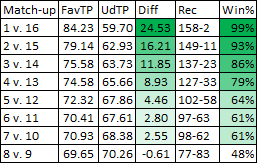
40 tournaments, with 4 regionals in each tournament, mean there are 160 total seeds in this time. 160 1-seeds (Kansas has 16 of these2), 160 2-seeds, etc. It also means that there have been 160 First Round games featuring seeds which add up to 17 (1 v. 16, 2 v. 15, etc.). Here’s how these match-ups have turned out over the past 40 tournaments.

The 1-seeds average 84.23 points and allow 59.70, for an average difference of 24.53 points. They have gone 158-2 overall, winning 99% of games against the 16-seeds. From here, we see a drop-off for the favorite as the seeds converge until we get to the 8/9 match-up which is virtually even.

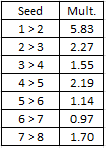
There appears to be a steady drop-off in success by favored seed until you get to the 5-seed, which doesn’t even win 2/3 of its games against the 12. The next chart compares each Round of 64 favored seed to the next seed down and produces a multiple. For instance, how much more likely is it that a 1-seed wins than a 2-seed? Or rather, how much more likely is it that a 2-seed gets upset than a 1-seed?

This shows that the biggest drop-off in terms of avoiding a First Round upset is from the 1-line to the 2-line. 1-seeds are 5.83x more likely to make it to the Second Round than 2-seeds. After that, there are smaller differences when you step down a seed-line. Because these are multiples, one can multiply down the line to compare seeds that aren’t next to each other. For instance, in order to find out how much more likely a 12/5 upset is than a 15/2, simply times 2.27 by 1.55 by 2.19. This gets 7.70. In other words, a 2-seed is over 7 times more successful at winning in the Round of 64 than a 5-seed is.

KU Focus R64

KU has earned 16 1-seeds, 7 2-seeds, 5 3-seeds, 6 4-seeds, 1 5-seed, 2 6-seeds, 1 7-seed, and 1 8-seed in the modern tournament era. This accounts for 39 out of 40 years, as the Jayhawks didn’t make the 1989 NCAA Tournament. In that time, KU has won 36 games (36-3). It’s projected record, given its seeds, is actually 34.3-4.7. So, KU has overachieved in this round. People may remember Bucknell and Bradley, but in terms of big upsets, that’s all there’s been. Don’t take for granted how good KU has been in avoiding opening round disappointments.

Round of 32 Results

The Second Round features games that can only be between these pods of seed-lines:

  • 1/16 v. 8/9
  • 4/13 v. 5/12
  • 3/14 v. 6/11
  • 2/15 v. 7/10

Of these possible matchups, only the 16 v. 8 game has never occurred. In the only two times the 16-seed defeated the 1, the 9-seed won its matchup against the 8. The winning percentage by seed-line in this round is as follows:

  • 1-seed: 86%
  • 2-seed: 68%
  • 3-seed: 61%
  • 4-seed: 61%
  • 5-seed: 54%
  • 6-seed: 48%
  • 7-seed: 30%
  • 8-seed: 21%
  • 9-seed: 10%
  • 10-seed: 40%
  • 11-seed: 43%
  • 12-seed: 38%
  • 13-seed: 18%
  • 14-seed: 9%
  • 15-seed: 36%
  • 16-seed: 0%

This trend begins reasonably enough, with the 1-seed being more successful than the 2-seed and so on. But once we get to the 10-seed, the winning percentage spikes back up. Even the 15-seed has won 36% of its Round of 32 games. Sure, it doesn’t get there that often, but it is 4-7 in this round (while the 9-seed is 8-75).

This is where the structure of the bracket has an effect on how seeds perform. 8’s and 9’s are generally better teams than the double-digit seeds below them, but have a tougher opponent as they face the 1-seed 99% of the time in this round. This causes the 8/9 winner to lose its Second Round game at such a high rate.

One way to look at the Round of 32 is to see which teams get through this round by grouping. We will look at each pod of teams and hope to gain some clarity.

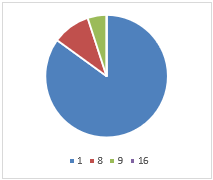
1/16/8/9

  • 1-seed: 136 (85%)
  • 16-seed: 0 (0%)
  • 8-seed: 16 (10%)
  • 9-seed: 8 (5%)

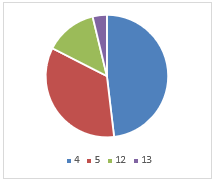
4/13/5/12

  • 4-seed: 77 (48%)
  • 13-seed: 6 (4%)
  • 5-seed: 55 (34%)
  • 12-seed: 22 (14%)

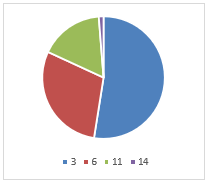
3/14/6/11

  • 3-seed: 84 (53%)
  • 14-seed: 2 (1%)
  • 6-seed: 47 (29%)
  • 11-seed: 27 (17%)

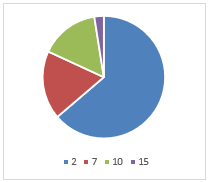
2/15/7/10

  • 2-seed: 102 (64%)
  • 15-seed: 4 (3%)
  • 7-seed: 29 (18%)
  • 10-seed: 25 (16%)

Looking at all these pie-charts next to each other, we can see how much more likely it is for the 1-seed to win than for any other of the better seeds in these First Weekend pods. In terms of getting to the Second Weekend, it better for a team to be a 10 or 11-seed rather than an 8 or 9-seed.

KU Focus R32

This round has infamously been a difficult round for Kansas. In the Self-era, KU is 11-7 in the Round of 32 and 1-4 since 2019. Since 1985, KU is 23-13 in this round, and has failed to make this round 3 other times (2 R64 losses, 1 NCAAT miss). Given KU’s seeds, we’d expect KU to have been to 24.8 Sweet 16’s, indicating that KU is underperforming its seed-line through the First Weekend. Since we know that KU outperformed its First Round record by 1.7 games, we come to the calculation that KU has underperformed in the Round of 32 by 3.5 games. In other words, KU’s 23-13 record should be something like 26-10. Specifically, its multiple losses as a 1-seed (’92, ’98, ’10, ’23) and a 2-seed (’90, ’14, ’15) in this round have been major disappointments and contributed to the gross underperformance.

Sweet 16 Results

The Sweet 16 games begin the Second Weekend, with the bracket starting to winnow down as we approach the Final Four. It is when games tend to get tougher for 1-seeds (who will likely face a 4/5), and where a variety of potential match-ups can occur. The 2 vs. 3 matchup is the second-most-common (behind 1 vs. 4), but it has only happened 31.9% of the time in 160 regionals since 19853.

In order to best understand this round, we’ll consider which seeds make the Elite 8 what percent of time.

  • 1-seed: 67%
  • 2-seed: 45%
  • 3-seed: 26%
  • 4-seed: 16%
  • 5-seed: 8%
  • 6-seed: 11%
  • 7-seed: 6%
  • 8-seed: 6%
  • 9-seed: 3%
  • 10-seed: 6%
  • 11-seed: 6%
  • 12-seed: 1%
  • 13-seed: 0%
  • 14-seed: 0%
  • 15-seed: 1%
  • 16-seed: 0%

Somewhat illuminating is the fact that only the 1-seed is more likely than not to make it past the Sweet 16. And while the 2-seed is close to a 50% chance, this number drops to 1-in-4 for the 3-seed. Of the 640 seeds between 13-16 since 1985, only 1 has made the Elite 8 (2022 Saint Peter’s).

Let’s look at this Sweet 16 match-up from the perspective of the 1’s and 2-seeds. In other words, if a 1-seed makes this round, which seeds are they likely to face?

  • 4-seed: 46%
  • 5-seed: 37%
  • 12-seed: 15%
  • 13-seed: 3%

A full 82% of the time the 1-seed gets to the Sweet 16 it will face a 4 or 5-seed. For the 2-seed, here are its opponents by likelihood.

  • 3-seed: 50%
  • 6-seed: 31%
  • 11-seed: 19%
  • 14-seed: 0%

Similarly, 81% of the time it makes it through to the Sweet 16, a 2-seed faces off against a 3 or 6-seed. Only rarely will it get a double-digit seed in the Sweet 16.

KU Focus S16

KU is 16-7 in this round, which is better than its record in the Round of 32. For Bill Self at Kansas, his teams have a 9-2 record, further cementing the idea that he excels in the tournament games he has more time to prepare for. KU has won its last four in a row playing in this round. Only 2 of these wins were when KU was a 4-seed or worse (1988, 2004), and only once has KU won in this round as a seed-line underdog (1991). One of KU’s most devastating losses happened in this round as well (1997). Overall since ‘85, KU has outperformed seed-expectation by 1.3 games in Sweet 16 contests.

Elite 8 Results

There have been 160 Elite 8 games since 1985. The Elite 8 is the last round to ensure that no two teams of the same seed-line face each other. 107 of these games include a 1-seed, which is the most-likely seed (by far) to make this round. The 2-seed is also frequently at this game, having been there 72 times since 1985.

However, the 1 v. 2 match-up has only happened 51 times, or 31.9% of the time. There have been years when it didn’t occur at all (such as 2022 and 2023). Other oddities of this round include the fact the only 15-seed to make the Elite 8 faced not a 1, 4, or 5-seed but an 8-seed. Since the 14-seed has never made this round, the 1-seed has never faced it either. Here are a list of seeds that each seed-line hasn’t faced in this round that are possible (italics indicate seed has never made E8):

  • 1-seed (14-seed, 15-seed)
  • 2-seed (13-seed, 16-seed)
  • 3-seed (12-seed, 13-seed, 16-seed)
  • 4-seed (14-seed, 15-seed)
  • 5-seed (7-seed, 11-seed, 14-seed, 15-seed)
  • 6-seed (9-seed, 12-seed, 13-seed, 16-seed)
  • 7-seed (5-seed, 9-seed, 12-seed, 13-seed, 16-seed)
  • 8-seed (10-seed, 11-seed, 14-seed, 15-seed)

The 11-seed, which has made a surprising number of Elite 8’s (10), has faced the 1-seed (8 times) a 4-seed and a 9-seed once, but never the 5. The most likely match-up to occur that hasn’t yet is the 5 v. 7. 7 v. 8 is also somewhat likely to occur for the first time in the Elite 8, although it has occurred in later rounds.

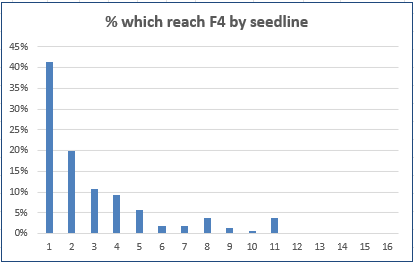
Looking at Elite 8 win results is the same thing as showing Final 4 appearances, so we will include the following table:

We’re again struck by the 1-seeds’ relative dominance. While it is more likely than not the 1-seed gets upset before it makes the Final Four, over 2 in 5 1-seeds have made the National Semifinals. More 1-seeds have made the Final Four as have seeds 3 or worse.

KU Focus E8

This is another stressful round for KU fans due to recent history. Since 1985, KU is 10-6 in the Elite 8, having won its most recent two games. Self is 4-5 overall in this round, with Brown and Williams going a combined 6-1 before Self took over. Given KU’s seed-lines, KU has out-performed the Elite 8 round by 1.2 games. Even with Self’s struggles, KU has been a solid Elite 8 team overall in the modern NCAA Tourney era.

Final 4 Results

The Final Four is the first round in which seed-lines can face off against each other, something that happens with some frequency with 1-seeds and almost never with other seeds. Let’s look at who the 1-seeds face when they make the National Semis:

  • 1-seed vs. 1-seed (15 times, or 30 total 1-seeds)
  • 1-seed vs. 2-seed (12 times)
  • 1-seed vs. 3-seed (7 times)
  • 1-seed vs. 4-seed (7 times)
  • 1-seed vs. 5-seed (2 times)
  • 1-seed vs. 7-seed (3 times)
  • 1-seed vs. 8-seed (1 time)
  • 1-seed vs. 9-seed (1 time)
  • 1-seed vs. 10-seed (1 time)
  • 1-seed vs. 11-seed (2 times)

Counting each contest, being sure to count the 1-seed vs. 1-seed games twice, this reconciles us with the 66 total 1-seeds to make the Final Four. 1-seeds have obviously gone 15-15 against each other in these matchups. In the other 36 matchups, where a 1-seed faced a worse seed, the top seeds went 26-10 (72.2%). The last time a non-1-seed defeated a 1-seed in the Final Four (National Semifinal round) was in 2014 (Connecticut over Florida). Since that time there have been 10 straight wins in this round by the top seed when facing a worse seed.

In addition to 1-seeds playing each other 15 times; 2-seeds have faced each other 3 times, 4-seeds once, and 5-seeds once. 3-seeds have never faced each other in the National Semis.

In terms of winning percentage during the Final Four, the seeds with the best success are the 6-seeds (2-1, 67%) and the 8-seeds (4-2, 67%). The 1-seeds win 62.1% of their National Semifinal contests, in large part due to the fact they often play each other (as we showed above, 1-seeds are 72.2% winners against non-1-seeds) whereas 6 and 8-seeds don’t.

A different way to look at the Final Four round is to look at how many of each seed makes the Championship Game. Of the 78 teams to have won in the Final Four (and thus made it to Monday night), 50% of them have been 1-seeds. Here is the rest of the break-down by seed-line:

  • 1-seeds: 41 (51%)
  • 2-seeds: 13 (16%)
  • 3-seeds: 11 (14%)
  • 4-seeds: 4 (5%)
  • 5-seeds: 4 (5%)
  • 6-seeds: 2 (3%)
  • 7-seeds: 1 (1%)
  • 8-seeds: 4 (5%)

After the top 3 seeds, there isn’t much difference between the remaining seeds. The 8-seeds appear to be overrepresented, especially when you consider that no 9-seeds have made the Title Game.

An all 1-seed Final Four has occurred twice (2008, 2025), while a no-1-seed Final Four has occurred three times since 1985.

KU Focus F4

KU has made 10 Final Fours in the modern tournament era. This puts it third, behind Duke (14) and North Carolina (12). KU has gone 6-4 in this span, and it has won 4 of its last 5 National Semifinal contests. Interestingly, KU has faced only 6 different teams in this round since 1985. It has played North Carolina three times, Duke twice, Villanova twice, and Maryland, Ohio State, and Marquette once. And this is just in relation to the Final Four round. The Championship Game has seen KU face off against Duke and North Carolina as well during this time period. Given its seeds over the years, KU’s 6-4 record has put it 0.0 games against normal in this round.

National Championship Results

The National Championship game is distinct from the Final Four or National Semifinal round despite being played at the same place. Many get this confused for some reason, or ignore the magnitude of winning a Final Four game just to get to the National Championship game. There have been 40 National Championship games in the modern tournament era. Here are the teams who have won (total titles in parentheses):

  • Connecticut (6)
  • Duke (5)
  • North Carolina (4)
  • Kansas (3)
  • Kentucky (3)
  • Villanova (3)
  • Florida (3)
  • Louisville (2)
  • UCLA (1)
  • Indiana (1)
  • Syracuse (1)
  • Michigan State (1)
  • Michigan (1)
  • Arkansas (1)
  • Arizona (1)
  • Virginia (1)
  • Maryland (1)
  • Baylor (1)
  • UNLV (1)

What we should first note is that the 1-seeds have dominated National Championships. 1-seeds have collectively won 65% of the Titles, or 26 of 40. The other 14 titles were won by 2-seeds (13%, 5 titles), 3-seeds (10%, 4 titles), 4-seeds (5%, 2 titles), 6-seeds (3%, 1 title), 7-seeds (3%, 1 title), and 8-seeds (3%, 1 title). The 5-seed has never won.

1-seeds have faced off against each other 10 times, obviously going 10-10 in these contests. In the other contests, those of a 1-seed against a non-1-seed, the 1-seed’s record has been 16-5 (76.2%). This dominance is quite significant and helps to explain why 1-seeds appear to be overachieving their National Title numbers. However, this holds if we look at Title Games without 1-seeds.

In the 29 National Championship games which saw two different seeds face off against each other, the better seed’s record is 22-7 (75.9%). This seems to be remarkable. In the first four rounds of the entire tournament since 1985, seed-favorites have only won 71.5% of their games. In other words, seed-upsets are more common the first two weekends than in the final weekend, even though there are multiple seed-lopsided games in the earlier rounds of the tournament (1 v. 16, 2 v. 15, etc.). One would expect more 2-seeds and 3-seeds to defeat 1-seeds, or more 3-seeds and 4-seeds to defeat 2-seeds in the National Title game. But it happens relatively rarely. It was mentioned that 1-seeds have faced each other 10 times in the National Championship game since 1985, but we should add that once have 3-seeds faced each other for the Title (Michigan/Seton Hall in 1989). In 40 64-team Tournaments, never have two 2-seeds faced each other in the National Championship game. This seems almost impossible.4

The average game margin has been 8.7 points. The closest games were 1-point differences (1987, 1989), and the 2008 game was an overtime game decided by 7 points after 45 minutes. The biggest blow out was 30 points (1990). Of all rounds, the National Championship round has seen the closest end-of-game margins, so there’s an argument to be made that the best games have been in this round.

KU Focus NC

KU has played in 6 National Championship games since 1985. These games, in order, are as follows:

  • 1988. (6) Kansas 83, (1) Oklahoma 79
  • 1991. (3) Kansas 65, (2) Duke 72
  • 2003. (2) Kansas 78, (3) Syracuse 81
  • 2008. (1) Kansas 75, (1) Memphis 68
  • 2012. (2) Kansas 59, (1) Kentucky 67
  • 2022. (1) Kansas 72, (8) North Carolina 69

KU has gone 3-3 in the National Championship game in the 64-team era. All 6 of its games have been decided by single-digits. These games have been exciting.

If we consider KU’s seeds over the years, we’d expect them to have won 3.0 National Championship games in this span, which is right where they are. In spite of disappointing losses, “coulda, woulda, shoulda” games, and upset defeats; KU’s 3 national championships are no underachievement. In total, KU overachieves in getting past each round except the Round of 32 and Elite 8. Combined with the fact KU already gets great seeds to begin with, KU’s achievements in March Madness since 1985 have been elite.

3 NCAA Tourney MOP’s in the 64-team era.

  1. Seeding began in 1979 for a 48-team tournament, so there is more data that could be used. However, we will stick with 1985 as the beginning of our exercise for a few reasons. One, the bye-game that the top 4-seed received into the Round of 32 did affect the bracket. If seeds 1-4 had to play First Round games in these seasons, there would have been upsets that would have reverberated throughout the tournament. Two, 1985 is a great starting point because it closely aligns with two other modern innovations. The shot-clock was first used for the 1986 Tournament, and the 3-point line was first introduced for the 1987 Tournament. Therefore, the past 39 years mostly have what we would consider the modern game. A shot-clock, 3-point line, and 64-team bracket. ↩︎
  2. The 2018 season, in which KU officially vacated both their 1-seed and Final Four appearance, is included throughout the numbers in this post. While we don’t include these achievements when comparing KU’s status to other college basketball programs, we are keeping the 2018 results in this exercise for a few reasons. One, KU competed that season with the belief that their results were legitimate. Two, it makes things easier for our dataset. Three, the violation (money from Adidas rep to Silvio De Sousa’s guardian) is hardly a huge violation. Four, there’s a chance these vacated games get revalidated given the NCAA’s recent troubles in the court system. ↩︎
  3. The 1 vs. 4 Sweet 16 matchup happens 37.8% of the time. ↩︎
  4. If we accept that 2-seeds independently have a 16% chance of making the National Championship game, which is their actual total, then we’d expect 2-seeds to face off 3% of the time. In 40 seasons, we’d expect this to occur with a 65.7% chance. So, apparently it isn’t impossible for this not to occur yet. Still, we might expect 2-seeds to make the Title game more frequently than 16%, which if they did would improve their odds of having two 2-seeds face off in the NC game. Bump the 2-seed odds to 25% for a NC appearance, and there’s a 93.4% chance two 2-seeds would face each other in 40 National Title games. ↩︎

NCAA Tournament

Each linked post has to do with college basketball’s biggest event, the NCAA Tournament.

Guards and March

A Look Through the Bracket in the 64-Team Era

KU’s NCAA Tournament Paths by Difficulty

Understanding the NCAA Tournament Committee – 2024

Grading the NCAA Tournament Committee – 2025

NCAA Tournament Selection – 2026 Pre-Tourney Case Study

Bracketology 2026 – Weighting Team Sheets

Grading the NCAA Tournament Committee – 2026

2026 NCAA Tournament – First Round Preview