Wrapping Up the 2024 Season

Note: The value-metrics in this write-up might not match the final published numbers, as the 2024 college basketball season is still being played. But since KU’s season is complete, the only changes to value-metrics will be small and due to what happens with KU’s opponents and how their computer metrics trickle down.
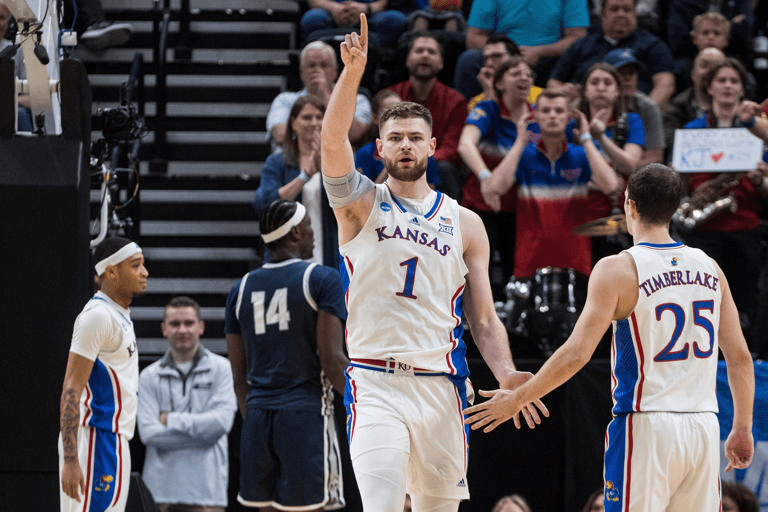
The 2024 team came in with high expectations. Landed the best big-man transfer in the portal. Landed a sought-after portal wing and highly-athletic combo-guard. Returned three starters from team that earned a 1-seed in 2023. A McDonald’s All-American guard leading a decent recruiting class. A healthy coach. Pre-season AP #1. This took a bit of a hit when they lost Arterio Morris to a felony charge. Even still, on paper the team was expected to be good.

For the most part during the non-conference, Kansas lived up to expectations. Sure, its computer metrics took a when it failed to blow out certain teams it should have (Eastern Illinois, UMKC, Missouri). But it got huge wins against the likes of Kentucky, Tennessee, and Connecticut. At 12-1 heading into conference play, the team was trending toward another 1-seed.

The conference schedule was back-loaded in terms of difficulty, so the Jayhawks knew they had to play well in January. Unfortunately, the team lost to UCF and West Virginia on the road (as well as Kansas State in early February). It did have nice home wins—including a 13-point win against Houston in early February—but after McCullar got injured Kansas struggled to find any consistency. Since January 1, KU didn’t win or lose more than 3 games in a row. The team couldn’t find any momentum on the season, although saying the wheels fell off does seem like a stretch.

With that said, the focus on the season recap will be to look at how the roster performed relative to value metrics that help us judge players across seasons. We will also look at how each player did compared to his pre-season expectation, and finally look at the team as a whole. The shooting splits will be listed in the order of FG%/3-pt%/FT%.

Dajuan Harris

Traditional Stat-Line: 8.5 PPG, 6.5 APG, 2.0 RPG, 1.5 SPG, 0.4 BPG on 35.7 MPG, 42.4%/38.4%/80.4%.

Pre-season Value Projection: +2.50 PPGAB, +4.20 Per100AB, +4.24 WAR

Actual Value Score: -0.14 PPGAB, -0.23 Per100AB, +1.57 WAR

Harris was projected to be KU’s second most-valuable player for 2024, as that’s what he was in 2023. But he got off to an awful start to the 2024 season. Aside from a stellar shooting night against Kentucky, he failed to reach double-figures in points until Indiana (11th game of the season). His defensive metrics were poor to begin the year. Through 10 games he was a -1.27 per game defender (in 2023 he was a +2.17 per game defender). This poor play wasn’t reflected much in the team’s overall record, but it did but Juan behind the 8-ball as far as his season-long performance.

By conference season, Harris would begin to play better, improving on the whole until he started playing near the level he had last season. Over his final 15 games, Harris was +2.54 per game, right where he was projected to be on the season. As these games included the stretch run and tournament play, it should be noted that he basically became the player KU was expecting him to be by the time the games really mattered. This makes his season a bit odd. KU played better during the part of the season where its point guard was playing worse. Given how polarizing he is as a player, this makes things even more confusing.

Harris will be back in 2025. There will be plenty of time to look ahead and forecast out his final season in a Kansas uniform. But in looking back at his 2024 campaign, Harris’ Per100 value metrics put him in the 34.5%ile of all Jayhawk rotation players since 1993. You want more from your starter than this. And while he can’t shoulder all of the blame on the team’s poor season, had he been as good as expected from Day 1, the team may have been a bit more competitive.

Elmarko Jackson

Traditional Stat-Line: 4.3 PPG, 1.7 APG, 1.4 RPG, 0.8 SPG, 0.1 BPG on 18.6 MPG, 40.6%/26.7%/76.9%.

Pre-season Value Projection: +0.10 PPGAB, +0.20 Per100AB, +1.44 WAR

Actual Value Score: -2.20 PPGAB, -6.83 Per100AB, -1.26 WAR

Freshmen are basically projected on a curve given their incoming class-ranking, so Jackson was expected to be about bubble-level given how the rating services saw him as a high school senior. Even during the off-season, 2024 NBA mock drafts had him as a possible lottery pick given his intangibles (explosive player, good size as a guard, decent-looking stroke, and so on). Nothing close to this potential developed in 2024. Jackson was given the starting spot in the backcourt to begin the season—in large part due to the poor play of others competing for that role—until he started to slump at the beginning of conference play as was replaced by Johnny Furphy.

Jackson’s season is at the bottom of the list in terms of KU history since 1993. He had the second-worst PPGAB score over the last 3+ decades (Quentin Grimes). His Per100 score was in the 3.85%ile of all rotation players, clearing only a hand-full of role-players and walk-ons who played minutes on past KU teams with depth issues (i.e. Jeff Hawkins and Moulaye Niang in 2003). His WAR, thanks to him playing so many minutes, was the worst in the 1993-2024 span.

It was a disaster of a season for Elmarko. He appeared in all 34 games, but only had an above-bubble impact in 8 of them. (Offensively, he was above-bubble in only 5 of 34). His non-conference play of -0.83 PPGAB looks relatively strong, compared to how he ended the season. Since the beginning of the conference season in early January, Jackson was a -3.05 PPGAB player.

Kevin McCullar

Traditional Stat-Line: 18.3 PPG, 4.1 APG, 6.0 RPG, 1.5 SPG, 0.4 BPG on 34.2 MPG, 45.4%/33.3%/80.5%.

Pre-season Value Projection: +1.71 PPGAB, +3.25 Per100AB, +3.23 WAR

Actual Value Score: +3.97 PPGAB, +6.71 Per100AB, +4.22 WAR

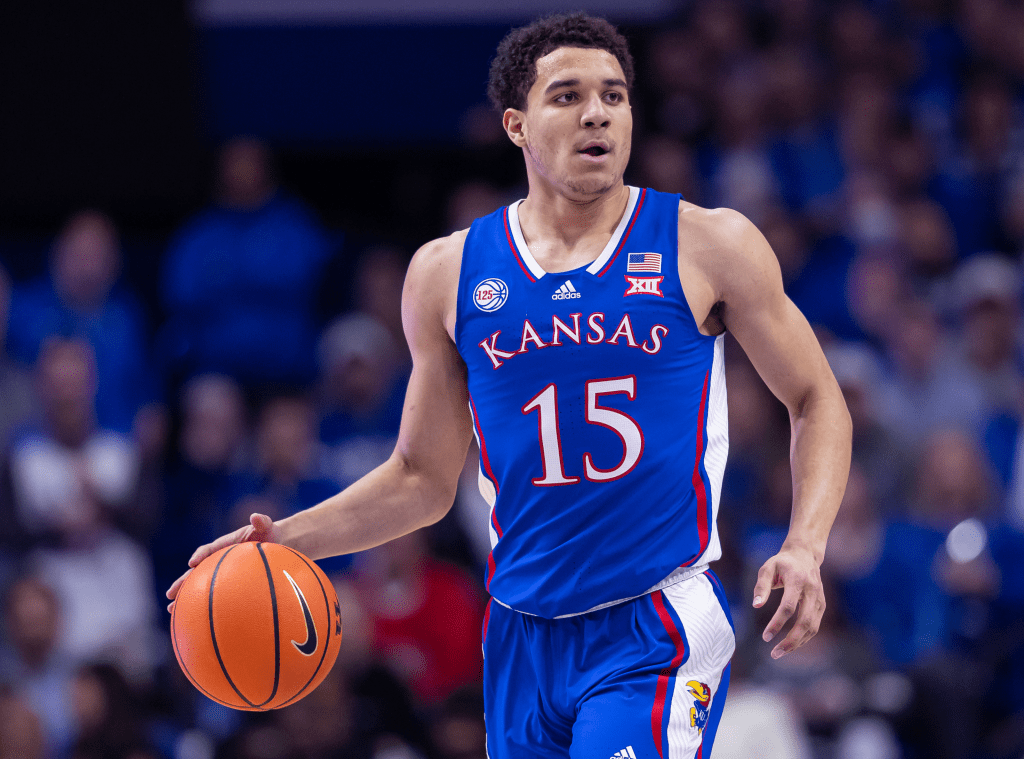
McCullar was a late-returnee for Kansas, coming back after nearly going pro. His return was certainly good news in the summer, but when he came out with an improved shot and stronger offensive game in the non-conference, KU was playing its best ball. Kevin cleared his PPGAB estimate by over 2 points and his Per100AB estimate by over 3 points. And even though he got injured and missed 8 ½ games, his WAR was over a win above expected.

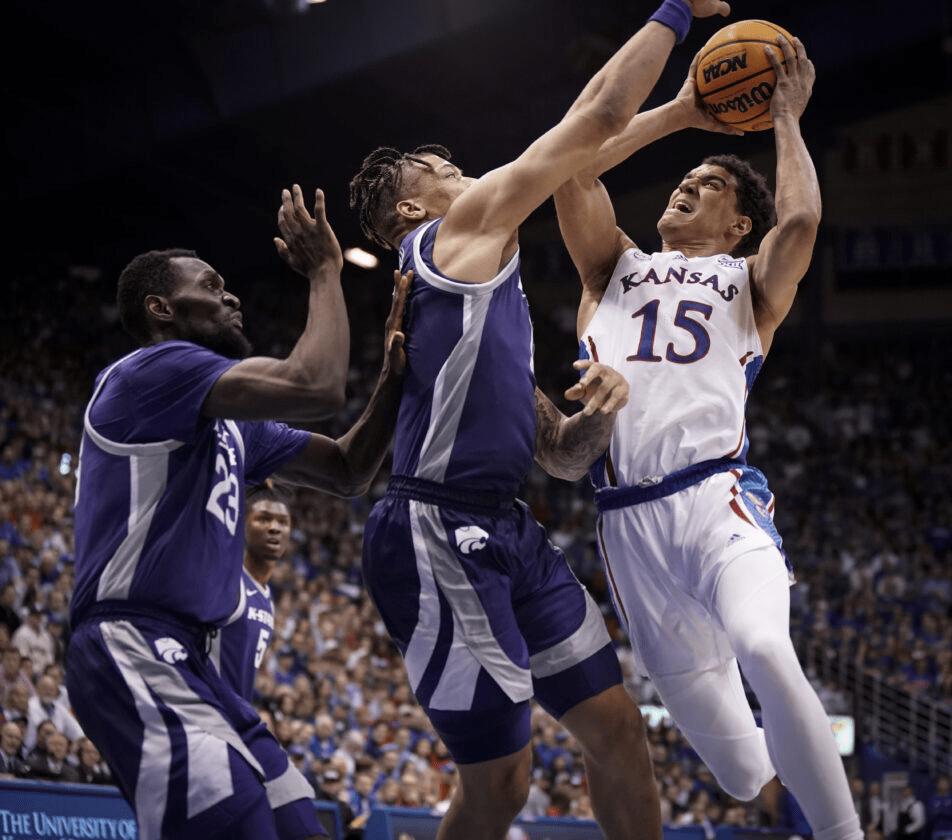
McCullar had the highest PPGAB and Per100AB marks of any Jayhawk this season, and his WAR was third on the team but closely behind two players with 248 and 173 more minutes of game action. McCullar’s injury prevented him from adding to his legacy, as his efficiency waned during the part of the season he was trying to play through the pain.

Overall, Kevin’s jump in performance was a pleasant surprise in a season with few of them, and makes his injury and even more frustrating. When he was out there, he was an 85.1%ile Jayhawk, which is right on par with Ben McLemore’s lone season (2013).

K.J. Adams

Traditional Stat-Line: 12.6 PPG, 3.1 APG, 4.6 RPG, 1.1 SPG, 0.6 BPG on 33.5 MPG, 60.1%/0.0%/60.0%.

Pre-season Value Projection: +0.93 PPGAB, +1.90 Per100AB, +2.33 WAR

Actual Value Score: +2.88 PPGAB, +4.98 Per100AB, +4.42 WAR

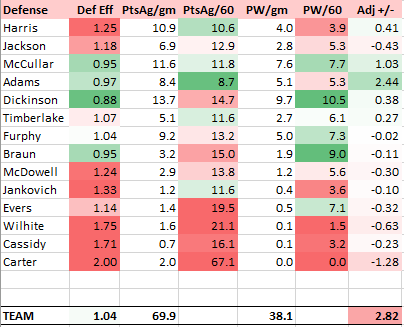
Alongside McCullar, K.J. Adams was KU’s most-improved player. He overachieved his PPGAB and Per100AB expected scores by 2 and 3 points respectively, and added 2 WAR above his projection. Adams’s offensive value was right where we thought it would be, it was his defense that made a huge leap. Adams was KU’s best defender, allowing 0.145 points per possession (or 8.7 points per 60 possessions). His strength, quickness, and ability to switch to both guards and posts helped KU put together a mostly acceptable defense for much of the season. Adams was also healthy and consistent, something no other Jayhawk from 2024 can really say. He was the team-MVP in 11 of KU’s 34 games, which led the team this year.

Another polarizing player, we will focus on 2025 and his role at a later date. But KU was barely a tournament team without Adams (even if McCullar/Dickinson were healthy all season). Unfortunately, he had his worst game of the season against Gonzaga, especially on the defensive end. For the season, he had a Per100AB at the 75.2%ile, which is very similar to the per possession value Julian Wright gave as a freshman (2006). And K.J. did this playing far more minutes and less rest. Adams’ value was very under-appreciated.

Hunter Dickinson

Traditional Stat-Line: 17.9 PPG, 2.3 APG, 10.9 RPG, 0.9 SPG, 1.4 BPG on 32.2 MPG, 54.8%/35.4%/62.4%.

Pre-season Value Projection: +5.18 PPGAB, +9.25 Per100AB, +6.88 WAR

Actual Value Score: +3.45 PPGAB, +6.19 Per100AB, +4.77 WAR

Hunter Dickinson had a good season, producing the second-highest PPGAB and Per100AB scores on the team and the highest WAR. Let’s start with that fact, so that the rest of the discussion will be in its proper context. Within this context, Dickinson very-much underachieved his projected totals, and his play worsened as the season progressed (even before his shoulder injury).

Hunt was a +5.40 PPGAB player through the home Houston game, when KU looked like it had turned a corner and was poised to have a strong February run building into March. After that game, beginning with the road K-State contest, Hunt was a -0.45 per game player. This was seen on both ends of the floor, but especially on defense. Over these last 11 games he played (he missed the Cincinnati game in Kansas City), Dickinson was a -2.41 per game defender. His shooting, particularly behind the 3-point and free-throw lines, got worse and hurt his overall offensive game. Even during his slumps, his offense was good enough to be value-adding.

On the season, Dickinson had 9 team-MVP games and had the best performance overall in his dominance of Tennessee’s big men during the third-place game at the Maui Invitational. But that seems like months ago because it was. He saw the likes of Samford take advantage of his propensity to over-hedge ball screens and recover slowly. Teams kept hurt the Jayhawks on this play, to the point that March Madness analyst Brendan Haywood pointed out that KU should think about dropping him into the lane to cover ball-screens this way. We would agree.

Dickinson was in many ways the anti-Harris. He started the season great but limped to the finish, unlike Harris who came around during the late push. But we don’t want to ignore Hunter’s 82.5%ile mark, second on the team and comparable to Nick Collison as a sophomore (2001). From a WAR perspective, Hunt’s season compared to the seasons of other big-men such as Perry Ellis as a junior (2015) or Jeff Withey either his junior or senior seasons (2012 or 2013). These are solid players, and show that Hunt added quite a bit of value.

Nicolas Timberlake

Traditional Stat-Line: 5.2 PPG, 0.6 APG, 1.9 RPG, 0.5 SPG, 0.1 BPG on 15.4 MPG, 38.3%/30.3%/78.6%.

Pre-season Value Projection: +0.32 PPGAB, +0.75 Per100AB, +1.50 WAR

Actual Value Score: -0.93 PPGAB, -3.50 Per100AB, -0.18 WAR

Timberlake had a rough season, producing 4 points worse Per100AB than expected. His poor play, particularly to start the season, also lowered his minutes volume…not something this KU team needed given its depth issues. And by the time Nick started to play better, KU had injuries to key pieces. We really never saw him filling his role when KU was at its best, although there were glimpses such as his senior-night performance vs. K-State.

In the non-conference, Timberlake played at a -1.78 PPGAB. Starting January 1, which was the beginning of conference play on through the NCAA Tournament, his performance was at -0.41 per game. This improvement was more pronounced on the defensive end, where he would grade out as a +0.27 per game player. He was able to move his feet okay, grabbed enough rebounds, and otherwise was a healthy and energetic player.

But his offense, unfortunately, never really clicked. He was officially credited with 22 assists on the season, which, as a 2-guard, is really terrible. We had him with 17 value-assists, which even if you doubled his minutes, would come to about 1 per game on 30 minutes. His shot didn’t consistently fall, which really hurt the value he provided to the team.

Timberlake was at the 14.0%ile of all Jayhawk rotation players since 1993. A close comp here would be 2010 Brady Morningstar or 2023 Joseph Yesufu. Given that Timberlake was meant to be a step-up from Yesufu, this was a major disappointment.

Positive moments Nick will be remembered for are his athletic dunks as well as drawing a late foul against Samford and knocking down 2 FT’s to put KU up 3 in the final seconds.

Johnny Furphy

Traditional Stat-Line: 9.0 PPG, 1.0 APG, 4.9 RPG, 0.9 SPG, 0.8 BPG on 24.1 MPG, 46.6%/35.2%/76.5%.

Pre-season Value Projection: -0.84 PPGAB, -6.30 Per100AB, -0.49 WAR

Actual Value Score: -0.23 PPGAB, -0.54 Per100AB, +0.90 WAR

Furphy was KU’s latest roster move, he joined the team so late he didn’t even play in Puerto Rico in August, and he wound up being the only newcomer to meet expectations. His were low, given limited information about him from recruiting services and the unknown about foreign players. Compared to Svi Mykhailiuk, Furphy had a much stronger season as a frosh than Svi did. After cementing his role as KU’s fifth starter (when the team was fully healthy), Furphy worked his way into an above-bubble player for the Jayhawks during the middle of conference play. He had some rough moments down the stretch of the season to finish below-bubble, but he was comfortably above D-1 average and therefore produced nearly 1 full win above replacement.

Furphy was at the 32.1%ile of Jayhawk players who crack the rotation, which was very close to Wayne Selden’s freshman season (2014). A career trajectory like Selden’s would be excellent news for Kansas. We shall see what happens with Johnny, a skilled scorer with clear pro potential.

Johnny’s offense ended up worse than his defense, which seems strange. Furphy’s defense wasn’t great, but he did add value by rebounding and just competing. His inability to break down defenses or generate points for others (only 28 value-assists on the season) took away from his solid shooting numbers.

Parker Braun

Traditional Stat-Line: 2.2 PPG, 0.3 APG, 1.6 RPG, 0.2 SPG, 0.6 BPG on 7.5 MPG, 66.7%/36.4%/66.7%.

Pre-season Value Projection: -0.39 PPGAB, -2.75 Per100AB, 0.00 WAR

Actual Value Score: -0.70 PPGAB, -5.44 Per100AB, -0.33 WAR

Parker was projected to be a replacement player, or average D1 guy coming in as a backup to Hunter Dickinson. The fact he didn’t get there is important, although he was never the guy who was going to make or break the season for Kansas. Parker knew his role, but his defense was never where it needed to be. He did shoot a high percentage, mostly on lob-dunks and layup attempts, but his lack of production hurt the team whenever he played.

Braun’s play registered at the 6.9%ile of all Kansas Jayhawk rotation players since ’93. He was about as good, per possession, as sophomore Mitch Lightfoot (2018), who played a similar role for a Final Four team when he backed up Doke. Braun played 18.6% of available minutes, close to the 20.1% that was projected for him.

Jamari McDowell

Traditional Stat-Line: 1.8 PPG, 0.5 APG, 1.2 RPG, 0.2 SPG, 0.1 BPG on 7.2 MPG, 30.8%/28.1%/84.2%.

Pre-season Value Projection: -0.72 PPGAB, -6.02 Per100AB, -0.40 WAR

Actual Value Score: -0.75 PPGAB, -6.01 Per100AB, -0.35 WAR

Jamari’s projection was the most accurate. We even nailed his minutes (he played 16.4%; projection was 17.1%). As a true freshman toward the lower-end of the Top 100, Jamari was never expected to be a huge contributor. With only 9 scholarship players, he filled a role as a back-up wing who was there to play defense first. McDowell’s play was at the 5.5%ile of all rotation players in KU history since ’93. He was about the same as Tristan Enaruna as a freshman (2020). Given how much better Enaruna has gotten (albeit at a low-major), there’s no reason to think McDowell can’t become a KU-level player as an upper-classman.

TEAM

We projected KU to be a +8.51 team, meaning they would beat their opponents by 8.51 more points per game than a bubble-team would be expected to. This projection, independently arrived at, was quite close to how KenPom and Bart Torvik saw them. This number ended up being +3.62 by season’s end. This ended up being the worst team in the Self-era as well as the worst team since 1993 (1989 was likely the last Kansas team to be this bad from a computer-rankings/efficiency perspective).

In October we looked at different scenarios as to how the season could play out. A median case, worst case, and best case scenario. Look at what we wrote about what could happen if KU had a worst case type of season.

In this scenario, one of its key players struggles with an injury and this weakens an already depleted roster. KU’s offense could also struggle as teams force McCullar and Adams to make jump-shots while forcing the ball out of Dickinson’s hands. On defense, while it’s difficult to see KU being bad on this end, teams could put Dickinson in high-ball pick-n-rolls and take advantage of Self’s propensity to switch screens.

If KU were to struggle enough, it could lose games it was projected to win preseason and find itself slipping down into the 5-6 seed range. In this range, a First Round upset loss is more likely and a second-weekend in the NCAA’s less likely. For KU’s worst case scenario to be a comfortable NCAA Tournament team is something most teams can’t say a few weeks before the season starts.

This is basically what happened. McCullar’s injury proved to be too much. Jump-shots stopped falling, and Hunter had more difficulty avoiding double-teams. KU’s defense faltered when Hunt was put in high-ball pick-n-rolls. Kansas did get a 4-seed, making it slightly better than it could have been, but didn’t make the second-weekend. However, its tough to see the season playing out worse under any reasonable situation. KU’s floor is so high, that it makes rebuilding easier. We won’t look ahead until later posts, but there isn’t any reason to panic about the state of the program right now.

That about puts a bow on the 2024 season. Thank you and Rock Chalk.

Wrapping Up the Non-Con

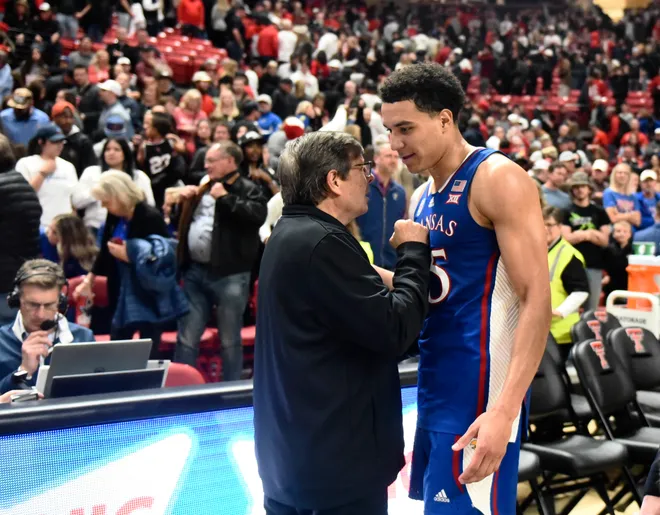
KU's McCullar earns Big 12 award after second triple-double | KSNT 27 News

The 2023 portion of the 2024 regular season is wrapped up. KU went 12-1 during this non-conference stretch, a good result given the quality of opponents it faced. Using the NCAA’s Net Rankings, KU went 3-1 in Quad 1 games and 1-0 in Quad 2 games. Extrapolate that type of performance out over the rest of the season, and the Jayhawks will cruise into March as a 1-seed. But, this may not be that likely given a few concerning trends.

Best Game, Worse Game

Using a very similar concept to how Ken Pomeroy rates his teams, Charting the Hawks using a point margin difference to rate individual players or games. For CtH, a comparison level of a bubble-team is used to judge how well a player or the Kansas team itself is performing. This is in point differential (or margin) in comparison to a bubble-level mark. For instance, if we’d expect a bubble-level team to beat KU’s current opponent by 10 points (after accounting for location), and KU wins by 18, we’d say that KU had a “game score” of +8.00. This +8.00 score would also equal the net of all Kansas players’ individual game scores, as the system is breaking down each player’s value as a portion of the total team score.

This system is not perfect, but it does have the benefit of being easy(ish) to calculate and understand. In the non-conference, KU’s best game (relative to opponent) was its first one against North Carolina Central. KU’s game score was +24.04, meaning it won by 24 more points than a bubble-team would have expected to. On the flip side, KU’s 8-point win against Eastern Illinois garnished a game score of -15.43, indicating that the actual single-digit margin Kansas won by was about 15 points worse than what a bubble-team would have expected to achieve.

Looking at individuals, KU’s best performance in a game was Hunter Dickinson’s +17.63 margin against Tennessee. Dickinson scored 17 points in that game, but defended great (only allowing 3 points) and rebounded at an elite level, coming down with 20 official rebounds. The interior was owned by Kansas, forcing Tennessee to jack up 33 3-point shots, only to make 9. KU scored 20 more points than the Vols inside the arc that game.

Hunter also has KU’s worst individual performance. It occurred the night before the Tennessee game, against Marquette. Hunt’s score was -10.16 points, indicating a bubble-level player (think average player on a bubble-team) would be expected to play this many more points better against that opponent. In Dickinson’s case, it was the play of Oso Ighodaro which contributed to such a poor game score. Hunter had his worst defensive performance as Ighodaro scored 21 points that night, much of it against HD. In total, Dickinson would give up 26 points to Marquette while grabbing a season-low 8 rebounds.

While this was Dickinson’s worst game, on the season Hunter has been tremendous. Through 13 games, he is adding an estimated 5.35 points per game above bubble, second only to Kevin McCullar at +5.89. The team, as a whole, is averaging only +5.30 points per game above bubble. While the Hawks are 12-1, their point margins haven’t been as good as we’d expect.

Grading Projections

Before the season, KU was projected to have an average game score of +8.51 (vs. +5.30 in reality). This 3.21 point per game difference could be the difference of a win and loss in multiple conference games. In fact, KenPom’s predicted scores for KU’s conference games show 14 games out of 18 to finish within single-digits. KU having underachieving its desired margins so far is a sign of concern, as point margin has predicative implications. This doesn’t mean Kansas can’t improve. To see how, let’s break down KU’s performance to the player level.

This table shows each player’s 2024 projection and actual play through 13 games in points per game.

PlayerPre-Season ProjCurrent Actual
Dajuan Harris+2.50-2.79
Elmarko Jackson+0.10-0.89
Kevin McCullar+1.71+5.89
K.J. Adams+0.93+2.33
Hunter Dickinson+5.18+5.35
Nicolas Timberlake+0.32-1.82
Johnny Furphy-0.84-0.12
Parker Braun-0.39-0.37
Jamari McDowell-0.72-1.07
TEAM+5.30+8.51
In PPG, individual scores won’t add up to TEAM due to walk-on scores missing

While there is still a lot of season left, there have been quite a few players with far different scores than their preseason predictions. Dajuan Harris has been the worst, performing over 5 points worse per game than his projection. Nicolas Timberlake and Elmarko Jackson have also been worse than expected, although Jackson has performed to his preseason expectation over his last 8 games (thanks to his defense). But KU’s guards are what’s holding the team back.

On the flip side, Kevin McCullar has overshot his preseason forecast by more than 4 points a game. McCullar is the Jayhawks’ leading scorer, having hit double-figures in every game this year. His low output was 12 against Kentucky, but this came in his first triple-double performance of the season (he’d add another against Chaminade). Fellow returnee K.J. Adams is defending at a conference first-team level after making the switch back to the defensive perimeter this season. His value score has easily exceeded his value score last year, as he’s also finding new ways to score. Newcomer Hunter Dickinson has hit his lofty preseason expectation of over 5 points of value per game. His backup, Parker Braun, is right at his incoming projection. The other wings, Johnny Furphy and Jamari McDowell, are within range of their projections, but Furphy has certainly played the better of the two.

If we look at where KU can get more value, it’s clear that the wings and interior players are tapped out. Not much more can be expected from Hunter or Kevin. KU needs its guards to start playing better on a consistent basis. This starts with Dajuan Harris. After reaching a season low -3.64 points per game against bubble mark after the Mizzou game, an unprecedented mark for a starter, Harris has responded with 2 positive games over his last 3. Against Wichita State, Harris had his best performance mostly due to a solid defensive game. It’s on this end where Harris has been especially disappointing. Dajuan was the conference defensive player of the year last season; in the 2024 season he’s worse than 1.08 points per game compared to a bubble-level defender. Had he been generating a bunch of offense to compensate, this would be more understandable. But his offense has been the worst it’s ever been, due to limited scoring and poor shooting rates on his floaters and runners.

With KU performing around 3.21 points worse per game than expected, and some of that due to the play of the walk-ons, we can essentially single out one single culprit as to why KU’s margins aren’t as strong as they were expected to be. This culprit is Dajuan Harris. While Timberlake and Jackson have been less valuable than expected, their poor play has been covered by the strong play of McCullar and Adams. Had Harris only played at a bubble-player level, or around 0.00, KU would be hitting its preseason expectations and be about fifth on KenPom (instead of 13th). Furthermore, Harris is KU’s point guard. He is the only one with the pace and ball-handling to run the team effectively at this point. KU can mix and match on the wings, using Furphy and McDowell when Jackson or Timberlake struggle. It doesn’t really have a Dajuan replacement and thus needs him to perform.

New Projections

The new projections use the actual play over the first 13 games along with the preseason projections in a weighted fashion. We should expect a player to trend back toward his preseason projection. These numbers are just a math equation; there’s been no new analysis involved at deriving them.

PlayerPre-season ProjCurrent Projection
Dajuan Harris+2.50-0.63
Elmarko Jackson+0.10-0.49
Kevin McCullar+1.71+4.18
K.J. Adams+0.93+1.76
Hunter Dickinson+5.18+5.28
Nicolas Timberlake+0.32-0.95
Johnny Furphy-0.84-0.36
Parker Braun-0.39-0.38
Jamari McDowell-0.72-0.88
TEAM+8.51+6.61
In PPG, individual scores won’t add up to TEAM due to walk-on scores missing

Worst Case, Median Case, Best Case Scenario

These scenarios are updated from the preseason ones. Also included after each scenario is a look at what that team’s Final 4 chances would be, using historic F4 percentages by seed-line.

The new team scenarios are as follows. The actual worst case is of course an injury to Kevin or Hunter, but barring that improbability, a worst-case scenario that sees KU maintaining its full roster would be that KU’s guards never develop and teams continue to double on Hunter to make the others beat them. In this scenario, teams also focus their defensive energies on denying the ball to McCullar. While I can’t see KU failing to win all but a few of its home games, it could hit a tough spell during conference play on the road and rack up multiple losses in a row. For seeding purposes, KU could fall to a 5 or 6-seed if it can’t get necessary plays from its back-court. F4 chances: ~5%.

The most-likely scenario, or median case, would be that Jackson and Harris pick things up, building off of recent good performances, and start to produce for the Jayhawks during conference play. Harris doesn’t seem far off, and Jackson has been a legitimately solid defender whose offensive game has started to come around (had a career high 12 points vs. Wichita State). In this scenario, KU continues to win close games, loses a few close games, but also gets a bit better on the margin front which helps it out. KU earns a 2 or 3-seed and has a good chance to make the second weekend given its experience and talent. F4 chances: ~15% (Bart Torvik puts KU’s F4 chances at 10.4% as of 1/2/2024)

The best-case scenario is that KU gets the Dajuan Harris of last season to go along with the excellent play of its wings and front-court. Jackson fills his role nicely as a solid transition player and defender, Furphy and Timberlake come off the bench to knock in 3’s, and Braun and McDowell continue providing solid energy so the team can play 9 and stay fresh. In this scenario, KU establishes its dominance during conference play and fends off the new teams with strong efficiency marks in non-conference play. KU then goes on to earn a 1-seed in the NCAA’s and puts itself in a good position to make a Final Four run. F4 chances: ~35%

Three’s Company

Eleven games into the 2024 season, KU’s been carried by its “Big 3” of Hunter Dickinson, Kevin McCullar, and K.J. Adams. The trio has combined for 64.7% of KU’s points scored this season while playing 48.4% of available minutes. This production works out to points per game averages of 19.2, 19.2 and 13.0. No one else on the team averages even 7.0.

Additionally, these three have been the best defenders on the team according to the charting. Per total per game value; Dickinson (+6.64), McCullar (+5.14), and Adams (+2.31) are playing well beyond that of a bubble-player, while all 6 of the other scholarship guys are below 0.00. KU is heavily reliant on this trio to win games.

For a Kansas team to be so reliant on just a few players seemed odd, so I explored a way to quantify this and compare it to other KU seasons. The best way was to use WAR, which is additive, and sort each season by that year’s team’s most valuable player to its worst.

Here are the numerous ways the 2024 team stands out:

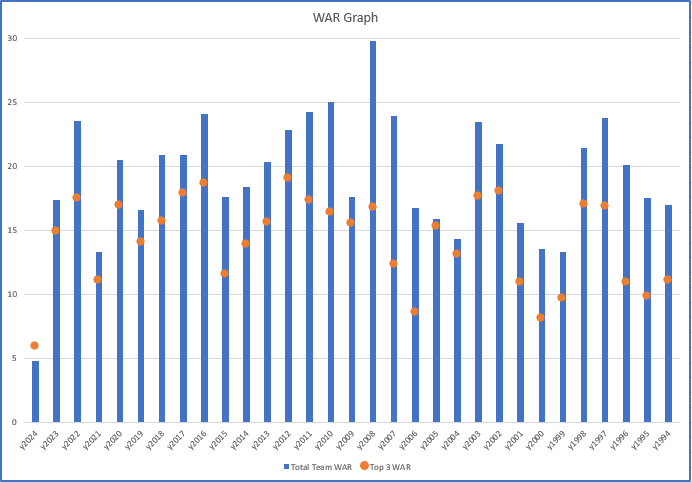
  • Of the 2024 team’s total WAR, each of KU’s Big 3 has collected at least 25% of the team’s total WAR (note that a player can be negative if he has negative WAR). Since 1994 (31 seasons), only once has this happened over the course of an entire year (2017 with Frank Mason, Josh Jackson, Devonte’ Graham).
  • Through 11 games, the trio of HD/KM/KJA has produced 5.94 WAR, which if multiplied out to a 36-game season, would be 19.43. This would be the best out of any KU team’s best three players, with the 2012 team earning 19.07 during a 38-game schedule. (If we compared apples to apples, this year’s Big 3 is on pace to earn 20.51 WAR over 38 games).
  • It’s not only that this year’s top trio is playing well; it’s also that no one else is doing much. Of the team’s total WAR, the HD/KM/KJA three have earned 124% of the WAR, indicating that the sum of everyone else is below replacement-level. At no point since 1994 have players 4 on down collectively generated negative Wins Above Replacement score for the Kansas Jayhawks. The closest was in 2005, when all players save Wayne Simien, Keith Langford, and Aaron Miles produced a meager 0.53 WAR. The current 2024 non-Big 3 is at -1.15 WAR through 11 games.

Note how the orange dot (Top 3 combined WAR) is always contained within the blue bar (Total Team WAR) except for the 2024 season. For the 2024 team, KU’s needed everything it has gotten from its Big 3 due to the rest of the roster struggling to play at a high level. Projecting forward, one assumes that Dajuan Harris will pick things up. There might also be some reversion down, particularly with Kevin McCullar. McCullar has vastly over-performed his projected marks coming into the season.

2024 Kansas Jayhawks

The 2024 Kansas Jayhawks were 23-11 (10-8) and earned a 4-seed in the NCAA Tournament. They made the Round of 32 in the NCAA Tournament before losing. The team’s Sports Reference page is here.

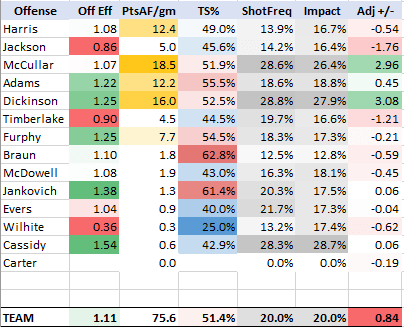
Offense

Defense

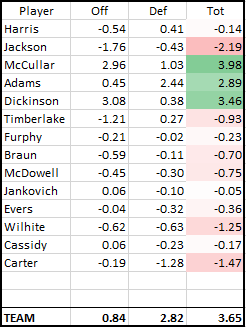
Total Adjusted PPGAB +/-

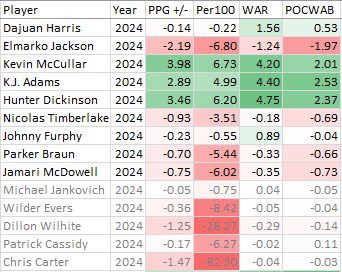
Value Seen 4 Ways

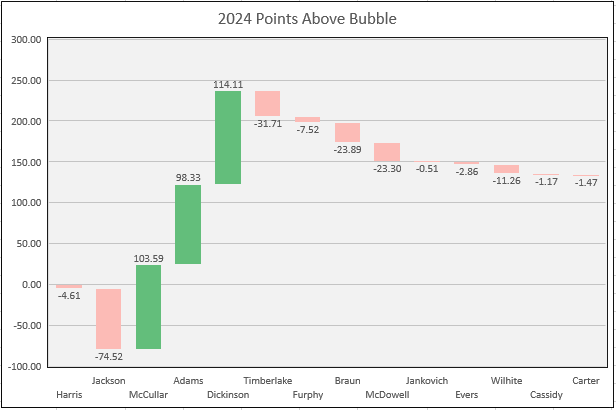
Cumulative Points Above Bubble on the Season Chart

Summary

  • KU’s big 3 of McCullar, Adams, and Dickinson accounted for 100.1% of the team’s WAR this season, making it the first time since at least 1993 where a Kansas team had its three best players be over 100% of total WAR.
  • Similarly, KU only has 3 rotation players (10%+ minutes played) with a positive value-score. This was the fewest above-bubble players on any KU team since 1993 (2017 had 4). On average, KU has 6.1 rotation players per season achieve a positive, or above-bubble, value.
  • The above waterfall chart does a great job showing where KU was getting its value from and where it was losing its value. This chart makes those who blame K.J. Adams or Hunter Dickinson look silly. The team’s struggles stemmed from Elmarko Jackson, Nick Timberlake, Parker Braun, and Jamari McDowell. Harris and Furphy, slightly sub-bubble, were overused due to the team’s lack of depth but still basically KU-level rotation guys.
  • To Harris’s credit, he did play better in higher-leverage game (positive 0.53 POCWAB).
  • The following players accounted for team-MVP games: K.J. Adams (11), Hunter Dickinson (9), Kevin McCullar (7), Dajuan Harris (3), Johnny Furphy (2), and Nicolas Timberlake (2).
  • KU’s average game-score at home (+8.34) was far superior to its average game-score in true road games (-0.59).
  • The injury to Kevin McCullar hurt the Jayhawks. Kansas was a +5.51 team in games where Kevin McCullar played, and -2.39 team in games where he did not (8 total games missed).
  • In a similar vein, KU was a +5.35 team through the Iowa State game. Kevin would miss the next game due to injury, while playing off-and-on and through pain some nights the rest of the season. In these final fourteen games, KU was a +1.23 team.

2024 Season blog-posts:

Wrapping Up the 2024 Season (3/25/2024)

Beware the Slides of March (3/14/2024)

The Final Push (3/11/2024)

K.J. Adams’ Defense (2/16/2024)

Hunter Dickinson’s Defense (2/7/2024)

KenPom Rankings, Game Score, Determining Best Teams (1/17/2024)

A Tale of Two Juans (1/11/2024)

Wrapping Up the Non-Con (1/2/2024)

Three’s Company (12/21/2023)

Dajuan, Dajuan, What is Wrong (12/11/2023)

The Battle for Net Extra Possessions (11/28/2023)

Kansas 89, Kentucky 84 (11/15/2023)

2024 Prediction Scenario (10/24/2023)

2024 Projections (10/19/2023)

Kansas 96, Howard 68

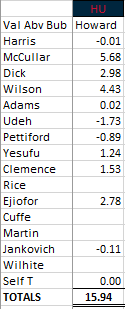
Kevin McCullar was KU’s most-valuable player in their Round of 64 win against Howard. The bulk of his value came from stingy defense and solid rebounding, but he also produced a positive offensive outing as well. Jalen Wilson had a quiet 20 points and also played strong defense, whereas Gradey Dick had the Jayhawks’ best offensive performance to overshadow his poor defense. This was also the bench’s first positive-value performance in its last 7 games.

The TEAM score of +15.94 was its third +15 game in the last four.

Kevin McCullar and the Value of a Replacement Player

KU plays Howard in the Round of 64 on Thursday afternoon, which according to the computer rankings turns out to be as good as a draw as they could have expected (Northern Kentucky is much better per KenPom, etc.). Even better news is the note that Kevin McCullar appears to be improving per Matt Tait. McCullar was not expected to play much in the Thursday quarterfinal game against West Virginia, but he actually went 26 minutes off the bench while fighting back spasms. This was perhaps a false sign of health, as he only played 12 minutes against Iowa St. in the Big 12 semifinals before reaggravating his back early in the second half. He would sit the remainder of that game and the entirety of the championship game.

If McCullar is healthy enough to go the rest of the way, KU has a much better chance to advance in any given round. Replacing a starter who has played in 71.6% of potential minutes this season would be a challenge in any season, but this is particularly considering the fact KU’s bench—particularly at the guard/wing position—has been historically bad this season.

Let’s start with Kevin’s value-metrics this season. Through 34 games, Kevin is producing an adjusted PPG +/- of +1.34, indicating that he is worth a little over a point per game vs. that of a bubble-level (very good) player¹. A comparable player to McCullar’s wing position who had a season around 0.00 (bubble-level) was Christian Braun as a freshman in 2020. So, if frosh Braun were replacing an injured McCullar this season, KU would expect to be about -1.34 per game worse.

But this isn’t what is actually happening, of course. The concept of a replacement player is employed as a way to judge player performance against a certain baseline. For a program as strong as KU, we expect any rotation player to be able to at least break-even when competing against a team on the NCAA Tournament bubble. After all, if you aren’t good enough to help Kansas beat a team on the bubble, you aren’t helping the program get to even a baseline level of what it deems success.

For 2023, KU’s backup guards and wings are (in terms of minutes): Joe Yesufu, Bobby Pettiford, and M.J. Rice. While they do play different positions, their roles overlap to a large degree. With McCullar out, any one of these three can be plugged into the rotation without much change in style (unlike say, any of the reserve bigs). This matters, because when KU goes into its bench on the perimeter, it gets quite a bit worse. Plugging in Udeh for Adams has been less of a drop off, and in some regards (size, rim protection) it has been an improvement. In the season-summary page (link here), a table listing player value in 3 different ways is shown. As of 3/13/2023, this is what it looked like for Kevin McCullar.

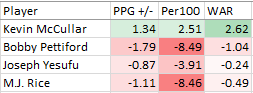
This shows that Kevin is producing +1.34 more net points per game for Kansas than a hypothetical bubble-level player at his position (again, think 2020 Braun). The next column translates the per game value to a Per 100 possession level. At +2.51, this number is still quite solid. The final column looks at Wins Above Replacement, not over that of a bubble-level player but of an even worse replacement-level performer. WAR is calculated against a baseline of an average D-1 player. Clearing the value provided by an average D-1 player is something that should be very achievable for any KU player to make the top 8-9 in the rotation. At +2.62 WAR, McCullar has played well enough this season to add this many wins to his team over that of the average D-1 basketball player.

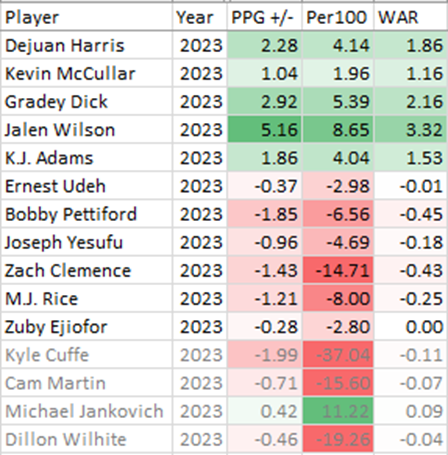
Now we will show the same table as before, just with Pettiford, Yesufu, and Rice added as a comparison.

Kevin’s minutes weren’t replaced by a 0.00, bubble-level player at the Big 12 Tournament. They were replaced by these three. In the final two games of the Big 12 Tourney, these three combined for 93 minutes. At 46.5 minutes per game, this was considerably more than the 28.2 that these three average. And this was with McCullar playing some during the Iowa State game. For the Texas game alone, the bench guards/wings played 56 minutes as they covered McCullar’s missing 28 minutes. In these two games, collectively this trio produced a mind-boggling -17.42 points of value. While KU won against Iowa State, it was in spite of the bench. With the Texas game, the bench’s performance only heightened the poor outing of the normal starters.

If we take the difference between McCullar and one of his replacements, we see that Kevin is a better option at the guard/wing by anywhere from 2.21 to 3.21 points per game. The Per 100 numbers are even more stark. Over the course of 100 possessions, Kevin is +6.42 when compared to Joe and +11.00 when compared to Bobby (M.J. Rice is about equal to Bobby). This difference might be able to be masked over a few possessions, but over the course of a game, and certainly over the course of a tournament run; this drop in value will rear its ugly head.

If Kevin were to be out for the rest of the year, KU would need to replace about 50 possessions per game. Even if you could use, perhaps 60% of those minutes with Joe (who has been the best of these three), you would still expect to lose about 4.1 points of value per game. This would dramatically shrink KU’s chances at making a deep run barring some miraculous play from one of the bench reserves. KU needs Kevin, and in fact all of its starters, healthy. This year more than others.

Since 1994, the first year any player-value scores have been estimated, the average SG/SF (wing) player-value for KU players who played at least 40% of available minutes is around +1.46. There is a wide variety of names on this list: Haase, Gregory, Langford, Rush, Wiggins, Mykhailiuk, Grimes, and Agbaji. Some good, some great, some not. McCullar is right around average, which given the comparison still makes him an excellent college basketball player.

But his value to the 2023 team is amplified by who replaces his minutes when he cannot play.

1- As explained, a bubble-level player would be the average performer for a bubble team. A bubble team is determined by looking at the median-level adjusted efficiency at-large team. There is a difference between a team’s adjusted efficiency and its resume, but there is also large overlap. A team around +14.00 on KenPom is normally close to the bubble.

Kansas 90, Kansas State 78

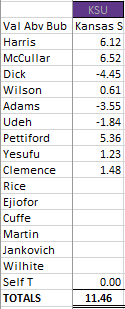
The Jayhawks put the Cats back in their place, using a strong opening half to cruise to a double-digit victory. Kevin McCullar graded out as the team’s best Tuesday night, with Dejuan Harris close behind. Bobby Pettiford had his best performance of the seasons to lead a bench effort that was likewise its best. In fact, the bench outdid the starting 5 last night for Kansas. This was only the 3rd time in 22 games that the bench scored better.

Other positive performances included Zach Clemence, Joseph Yesufu, and Jalen Wilson. On the negative-value side, Ernest Udeh allowed too many baskets while K.J. Adams and Gradey Dick battled foul trouble and worse-than-usual offensive outings.

Kansas 69, Baylor 75

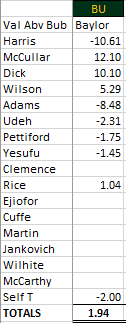
Positives: Kevin McCullar had KU’s best game, thanks to a strong defensive effort. While he was only 3-9 from the floor, his 8-8 from the FT line got him to 14 points. He also added 12 rebounds (10 defensive) on a night where Kansas struggled to finish possessions on the defensive end. Gradey Dick had his best game since Indiana despite battling first half foul trouble. Jalen Wilson had another solid offensive game. His efficiency of late has been a consistent bright spot for the team. M.J. Rice finished with 2 points and 4 value rebounds.

Negatives: Dejuan Harris had his second-consecutive all-around very poor game. He scored 2 points on 1-5 shooting and allowed 16 points to the Baylor guards. K.J. Adams was also inefficient on offense while giving up too many points on defense. With only 1 defensive rebound, this was his 6th conference game (out of 8) in which he has failed to secure at least 3 defensive boards. He is leaving value on the floor by not coming up with loose balls. Ernest Udeh only played a few minutes, but a defensive blunder led to an open 3. Bobby Pettiford missed his only shot attempt and allowed a basket. Joe Yesufu didn’t score, but did come up with some nice hustle plays (1 steal, 3 defensive rebounds). Unfortunately, in the first half he also fumbled a potential defensive board that Baylor converted into points.

The TEAM had a positive-value game (meaning they performed better than a bubble-level team would be expected to), and this was with Self getting his 3rd technical of the season and gifting Baylor 2 points. The starters were collectively positive with the bench giving away value.

More on the Bench

While KU continues to win close games, it is in spite of its bench players. This phenomenon was discussed earlier in the season, and the discrepancy between its starters and bench has remained. Self has continued to play Bobby Pettiford and Joseph Yesufu as reserve guards, with an oft-injured M.J. Rice having not playing in the last three games. Zuby Ejiofor has been KU’s most-frequently-used bench big man in conference play (27 minutes), followed by Zach Clemence (21 minutes) and Cam Martin (6 minutes). Ernest Udeh has played in only 1 second of conference play. Yes, just 1 second. This came at the end of the Oklahoma State game when he was guarding the inbounds pass.

Since the last time we examined their performance, the KU bench has hardly changed in overall value it provides. After 10 games, the bench was positioned to earn about -3.00 WAR over a normalized 36-game schedule. With 17 games in the book, this has hardly budged. The 2023 bench is still the worst bench in the 20-year Self-era, and with no signs of improvement would be only the 6th bench to produce negative-WAR value over that time span.

One thing to consider is that there is a sort of floor to this number. The worse the bench plays, the less Self will go to it. Through 5 conference games, the starters have averaged 32.5 minutes per game each. This is Self maxing out starter-minutes. He cannot play them much more, considering foul trouble will occur at times and fatigue will set in. With limited bench minutes, two things should keep the number somewhat afloat. First, the bench has less collective time on the floor to perform poorly. Second, in limited minutes the bench players should have the energy to play each defensive possession 100%. The bench should be giving maximum effort when they are out there, thus maximizing their potential value on a possession basis.

There are various ways to quantify the dreadfulness of the bench rotation. We have used the WAR value metric to compare the 2023 bench to others in the Self-era. Now we will compare the 2023 starters – Harris, McCullar, Dick, Wilson, and Adams – to the remainder of the team using Adj. Points AB +/-. This metric compares a player’s value, in points relative to a bubble-level opponent (about the 45th best team in D-1). Anything positive is quite good and should earn the player rotation minutes, with anything greater than +2.00 indicating a performance level that would start on almost any KU team.

The following numbers are thus presented per game, collectively divided between starters and bench.

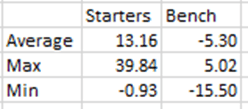
The starting 5 produces an average difference of 13.16 points above a bubble team per game. They have been tremendous. This year’s starters have collectively out-done last season’s starting 5, which were +10.83 points above bubble per game. For the Missouri game, the starters were an absurd +39.84. They have only been below bubble-level as a group twice this season, first against Omaha (which was technically their worst opponent-adjusted performance) and second against Tennessee. Even then, these games were barely below the 0 threshold.

In contrast, the bench has played to a bubble-standard in only four games (23.5% of games). Ironically, its best game was against Omaha with a +5.02 performance, which is also the only time it has outperformed the starting 5. Its worst outing was against Southern Utah, in a game that was only close because of the reserves. Worse, the bench is trending downward. It hasn’t produced a positive outing since the Indiana game. Last season, on a team that featured seniors like Mitch Lightfoot, Jalen Coleman-Lands, and of course Remy Martin off the bench; it was collectively -0.52 and produced 17 games above bubble-standard (42.5%). This number was much higher at the end of the season when it counted, as the bench collectively produced an average game of +5.53 in the 9 games that made up the 2 tournaments. This was due to the great play of Remy, as well as a shortened rotation that played the senior reserves far more than the underclass backups. Suffice to say, the 2023 team doesn’t currently have that kind of fire-power waiting in the wings. It has underclassmen and transfers, none of whom have proven any capacity to be consistently great at the upper echelons of the D1 level.

Having a poor bench is no reason to despair. History has shown that teams with great starters can win in the Tournament despite having little help from its reserves. The 2012 runners-up had a very similar divide between a strong starting 5 and weak bench. However, even the 2012 bench had experience; Kevin Young was a redshirt junior and Conner Teahan a fifth-year senior. The 2016 team is another good comparison. It earned the number-one overall seed and made an Elite 8 on the backs of its experienced starters, getting little from its bench.

There are a few potential bright spots to consider when pondering the bench situation. First, is that KU has talented young players on its roster. It really only takes the development of one or two of the following by March for this situation to drastically improve: Pettiford, Yesufu, Rice, Ejiofor, Udeh, Clemence. If KU can comfortably play any of these guys 10 minutes or so and expect a consistent performance, it can better maintain leads that its starting 5 works to build. The second consideration doesn’t have to do with the bench, but with the makeup of the starting 5. The starters are all capable of playing a heavy-load, thus reducing the negative-impact the bench has collectively brought. K.J. Adams is far more like a wing than a post in terms of fitness and durability, meaning that even the 5-spot needs fewer bench minutes this season than it historically does.

Lastly, where should the team go from here? In comparing Per 100 points above bubble, there is good reason to like the potential development of Udeh and Ejiofor. These two have clearly been superior to other bench-players, particularly the other 5 men. While Ejiofor has gotten in games consistently, Udeh has been relegated to DNPs of late. Perhaps this should be reexamined, particularly if Clemence continues to defend at a poor level.

There hasn’t been much value from the reserve guards/wings. Injuries have plagued all four (with Cuffe still out), and even when healthy none have provided consistent value. The team loses scoring ability, size, and defensive skill when it goes to the bench and gains little. Shifting K.J. down to the 4 when Jalen is out is honestly a worthy consideration.

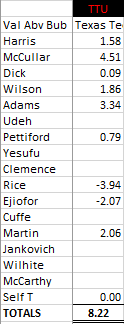
Kansas 75, Texas Tech 72

An odd game from a value-score standpoint, Kevin McCullar grades out as KU’s best player thanks to his stingy defense. Although he had a poor offensive showing, guys like Dejuan Harris and K.J. Adams stepped up for 18 and 14 respectively. McCullar was responsible for allowing only 3 points, earning him his third team-MVP game of the season (tied for second, with Gradey Dick).