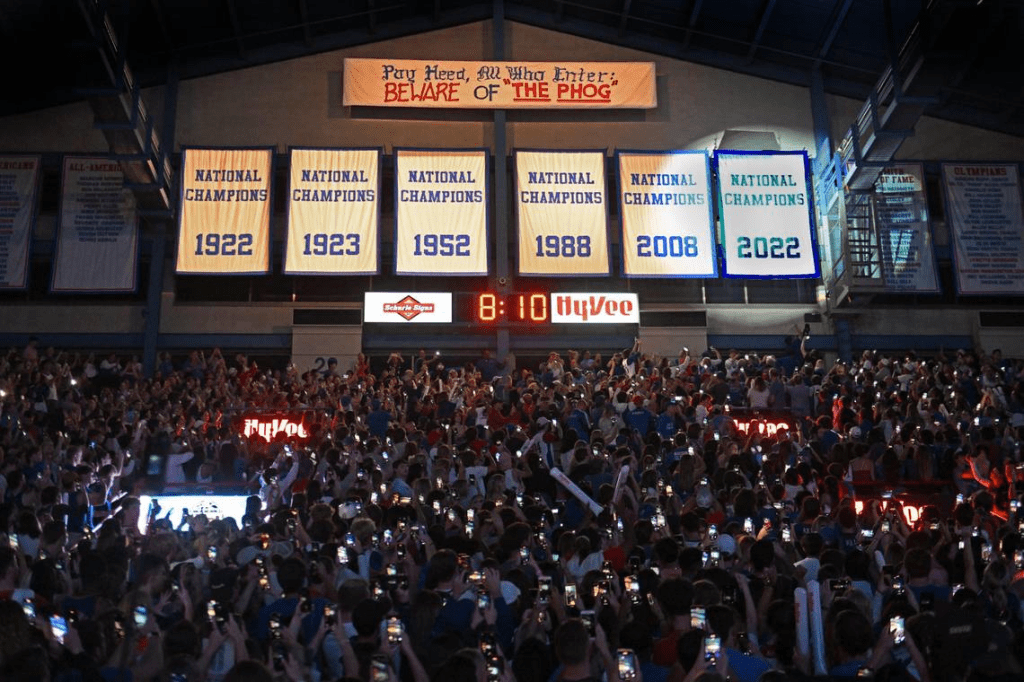
Allen Fieldhouse has been redecorated. The 2022 banner has now been raised, so it seems like a good time to review the National Championship games in terms of player value.
Game Summary:
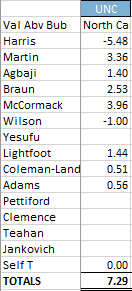
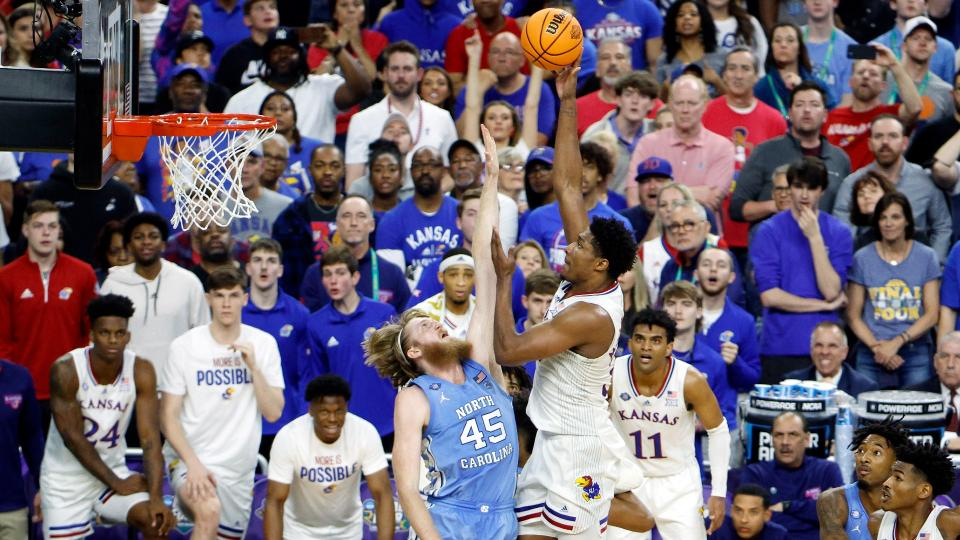
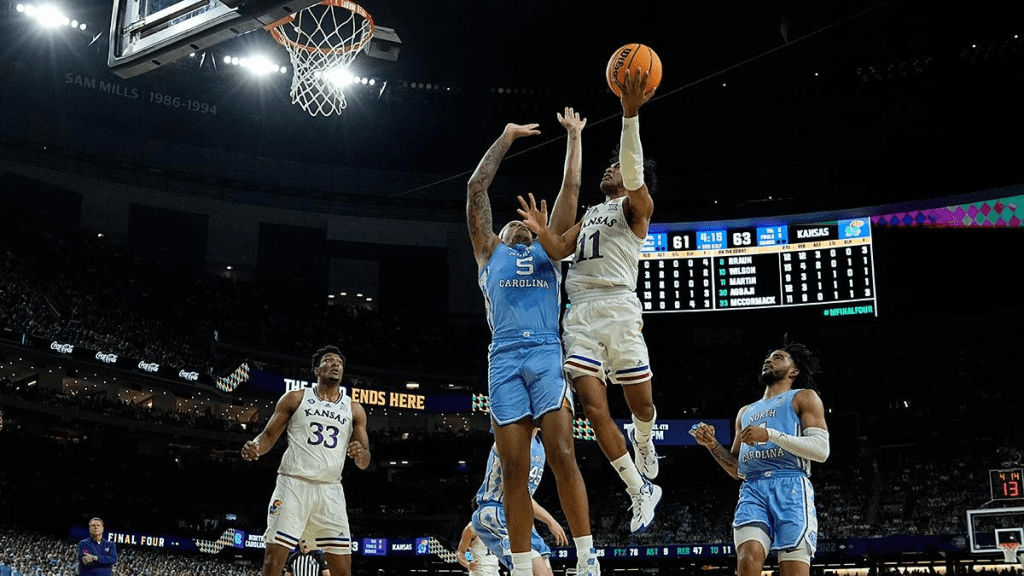
David McCormack was the game MVP for the Jayhawks. His value above bubble was added in the final two minutes. He made a put-back off his own miss to put KU up 70-69, walled up Armando Bacot to force a turnover, and then made the final basket of the game over Brady Manek to extend the score to 72-69. These three possessions made the difference.
Remy Martin was just below McCormack in terms of player value. He hit 3 huge second-half 3’s as well as a driving layup, with each shot answering Carolina runs which had brought the Tar Heels closer to the lead. Martin was KU’s best player in the tournament, adding 4.11 PPG above bubble during the 6 tournament games.
Christian Braun shook off a tough first half to finish in the black. His tough contest on the final shot made it impossible for Carolina to hit a miracle 3 to tie the game. Mitch Lightfoot fouled a lot, but when he was in he did enough to add value. He made his own shot, grabbed an offensive rebound, and forced a turnover to balance out the 3 FT’s he gave up. Ochai Agbaji didn’t record a counting play after his missed layup with 5:53 to play. but throughout the game, he did more good than harm, particularly in the first half when other Jayhawks were struggling. K.J. Adams contributed one play, forcing UNC into a turnover in the first half. Jalen Coleman-Lands grabbed a rebound for his contribution.
Jalen Wilson turned away from a dreadful first half to contribute to a comeback for the ages. Although he finished below bubble, he was very close to neutral. Dejuan Harris had the worse game of any Jayhawk, with his best stretch coming at the beginning of the second half. His worse blunder was stepping on the sidelines with 4 seconds left to give the Heels a final shot to tie. But by only scoring 2 points on 5 shots, he was KU’s weakest link in the game.
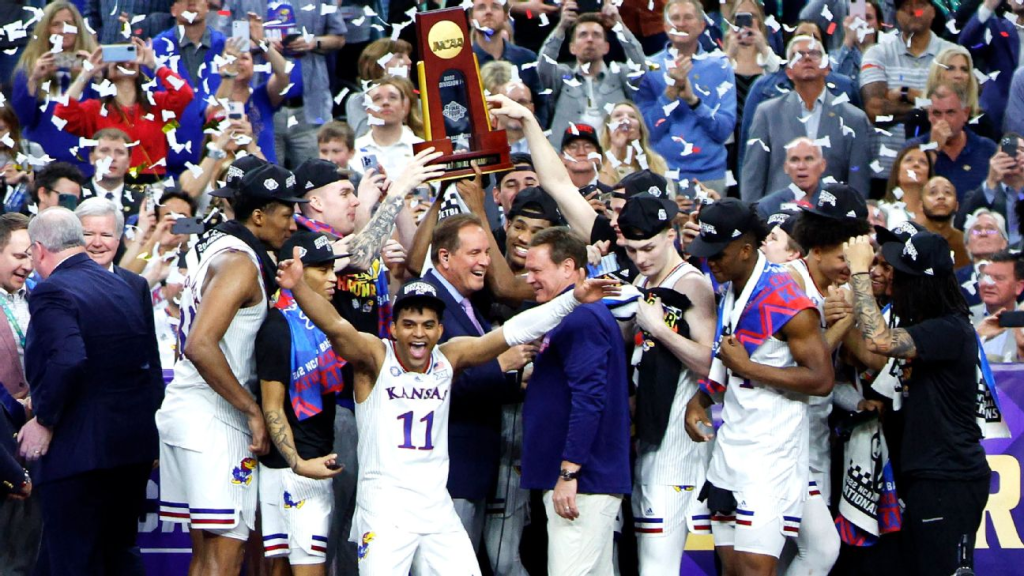
The TEAM score of +7.29 was KU’s 11th consecutive positive, above-bubble performance. While not the best overall game of the season, it was enough to get the win and with it KU’s 6th banner.
Remy Martin now has 3 team-MVP’s, continuing his hot streak in March
Game Summary:
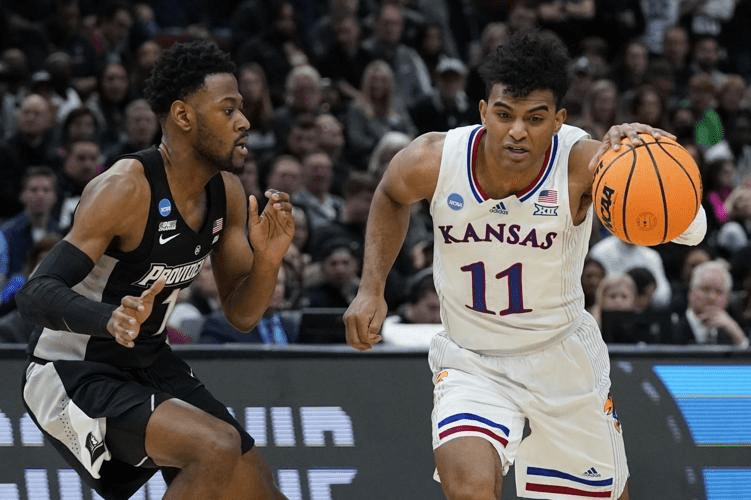
It was KU’s defense, not its offense, which carried it for most of the game. But when Providence made a run to take the lead, the Hawks got huge buckets from Jalen Wilson and Christian Braun.
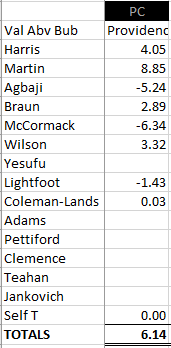
Remy Martin was the team’s MVP, producing over 23 points while giving up only 9. On an opponent-adjusted basis, his game against Providence has been his best in the season. In his last five games, he is averaging +5.72 points of value above bubble per game. He has been Remy Marchtin for sure.
Dejuan Harris deserves a shout-out here, specifically because he will be overlooked. He finished with 6 points and 2 assists while only giving up a junk bucket late. He started out each half well, only to come out to allow Remy to enter. On defense, he forced 2 turnovers and played pesky defense all night.
Other positives were Jalen Wilson and Christian Braun. Wilson racked up 14 rebounds once you factor in the dead-ball rebounds that he won possession of. He scored 16 points, most of them unassisted, on a night where KU’s two leading scorers didn’t have great offensive outings. CB, KU’s #2 scorer on the year, did add value thanks to solid defense and rebounding. Even when he doesn’t have his best game on offense, Braun plays so consistently on defense that he rarely gets outplayed. After giving up a layup on a back-cut (which gave Providence its only lead 48-47), CB added almost 4 points of value over the final 5 1/2 minutes, with no negative plays. He made his only shot, won 4 defensive rebounds, had an assist on Ochai’s dunk, and didn’t turn it over.
On the negative side, Lightfoot made some nice defensive plays but also found himself giving up size inside. He did make a basket in the second-half after a dime by Remy Martin. Ochai Agbaji struggled to get clean looks. He had a great defensive outing in the first half, but his second period was marred by lapses on jump-shooters. David McCormack struggled on both ends, and his 8 points scored was overshadowed by his 13 points allowed. He also rebounded poorly for the amount of time he played.
Last, Jalen Coleman-Lands played nearly 4 minutes and didn’t record a stat. He played solid defense to not give up a bucket.
The TEAM had a score of +6.14, which is its second game in a row below the +10 mark (KU reached that milestone in 4 consecutive games before Creighton). To get through Miami, KU will need a game score of +2 or better. What this means is that Miami is about 2 points a game better than a bubble-team.
After an inconsistent year on the defensive side of the ball, KU has produced 6 out of 7 solid defensive outings down the stretch. KU will want its offense to be much better on Sunday afternoon, but thankfully the Hawks have not had two below-bubble team offensive games in a row this season.
Remy Martin slams down 2 points, and earns his second team-MVP of the season
Game Summary:
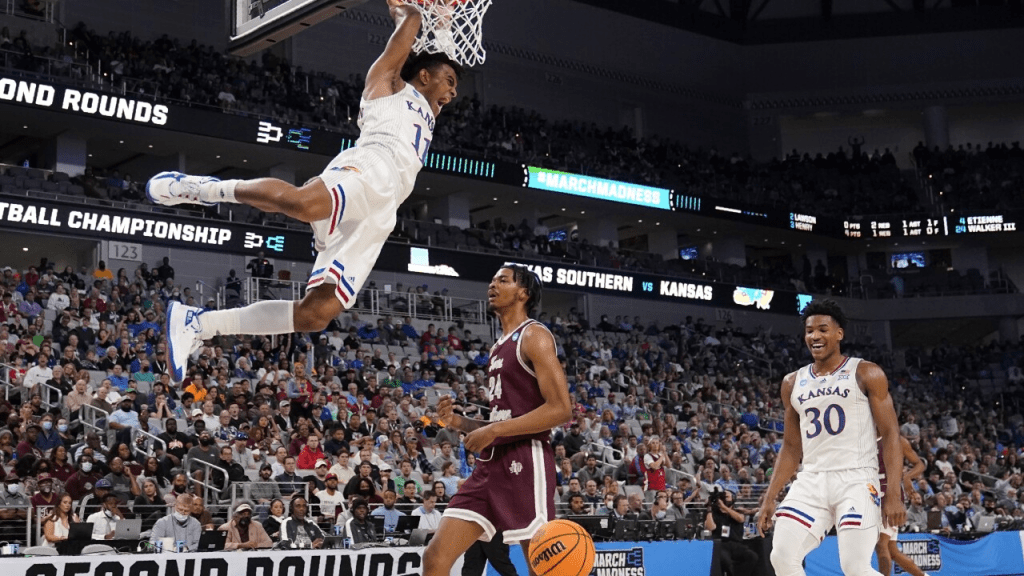
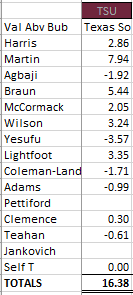
Cook, Remy, cook. After earning his first team-MVP of the season in the 34th game on the schedule in the Big 12 Championship, Remy Martin got his second team-MVP right away. Scoring, assisting, stealing, and playing with a contagious energy; he was a spark that allowed KU to put away 16-seed Texas Southern early in the game. If he continues to play like this, KU is undervalued when it comes to their chances.
Other strong outings were from Christian Braun, Mitch Lightfoot, Jalen Wilson, Dejuan Harris, and David McCormack. Focusing on Mitch, the sixth-year super-senior has had positive value-performances in 5 of his last 6 games. For the season he is nearly adding more value than a bubble-player, showing he has improved tremendously.
With a TEAM score of +16.38, KU has played four games in a row where their opponent-adjusted value score was +10 or higher. This matches their longest streak of the season, which occurred in the season’s first four games. It may be tough to remember that streak now, but it was when KU was playing its best and didn’t look to have many flaws. Although that period was short-lived, injury and slumping play from some its regulars would plague much of the season, it seems to have returned at the right time.
Coach Self said that Martin and Lightfoot essentially give KU 7 starters, an assessment that the numbers show to be accurate. If anything, it is understated; Jalen Coleman-Lands has been playing well on the year, also. With the team strongly favored in its next two potential games, KU is rolling when you want to be.
Remy Martin had his first team-MVP of the season, sparking KU to a Big 12 Tournament Championship
Game Summary:
Kansas took home the Big 12 Tournament with three great team outings. On Saturday, it was Remy Martin off the bench (12 points, 3 assists, 4 rebounds) who led the team in value. For the tournament, Ochai Agbaji was the best Jayhawk (+6.16 per game average). Mitch Lightfoot was also very good over the course of the three games (+4.64 per game).
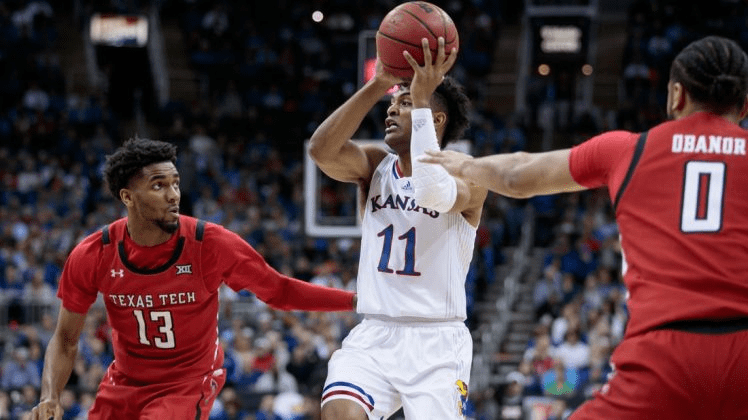
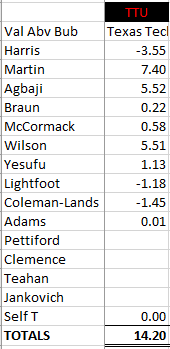
With 5:04 left in regulation, Remy Martin checked out for the final time against Texas Tech on Monday. Although we didn’t know it at the time, the game would last 15:04 due to 2 overtimes being needed, and it would be Dejuan Harris and not Remy Martin getting the PG duties. When Martin left the game, KU was up 8. The Hawks would be outscored by 5 the rest of the way, first giving up an 8-point lead in regulation and then needing a second overtime to avoid losing the game.
Martin’s playing time, or lack thereof, down the stretch certainly had Jayhawk fans scratching their heads. Coach Self was even asked about this during his press conference. He responded that he didn’t know who to take out if he put Remy in, even insinuating that he didn’t consider removing Harris by noting he couldn’t play two small guards together due to defensive mismatches.
Those wanting to see Martin finish the game pointed out +/- differentials to justify their arguments. Martin was +9 and Harris -8 on Monday night. But even those using +/- acknowledged its limitations and uselessness over a small sample size of 1 game. *
*Really the sample size isn’t 1 game, but the 85 possessions the game featured, or perhaps the 50 or 60 possessions that Martin or Harris actually played. Nevertheless, we would want to see more possessions (closer to 1,000) against similar competition than what we saw on Monday.
The eye-test certainly bolsters the argument for Remy. He was quick, aggressive, and made countless plays despite only scoring 4 points (the same total as Harris). The team seemed to have more offensive flow with Martin running the show. On the other hand, the eye-test runs into the same problem as +/-. Yes, Remy played better on Monday night. But what about the whole season? Just a few days prior, Martin had a rough game against Kansas St. Given his recent health issues and bouts of inconsistent play, how long do you want to gamble with someone who has overperformed in this one game?
The point of all this, is to ask the question on everyone’s mind…who should play more as the team’s point guard, Dejuan Harris or Remy Martin? To answer this, we will use the stats found on this website to compare how each has played over the first 19 games.
To start, we will fragment each’s games into offensive numbers and defensive numbers. From there, we will combine these into value scores and see which has played better so far throughout the course of the season. Last, we will look beyond the value scores (which are just season averages) and attempt to see who has been more consistent, who has produced more good games, fewer bad games, and so on.
Offensive Stats:
The first offensive stat we will compare is actually PPG. Although this is not an “advanced” stat, it actually correlates quite strongly with overall player value. Players who lead the team in points per game are likely the team’s best natural offensive talent. They are likely to be better shooters than average (from a TS% perspective). They are likely to be better athletes than average and thus are probably better rebounders or passers or defenders than others their position. And they are also good enough to play enough minutes to have the chance at leading the team in PPG.
Through 19 games, Remy Martin is averaging 8.4 points and Dejuan Harris is averaging 5.2. This is a noticeable difference. When we even out the minutes (Harris is playing 4.5 more MPG), this gap is even wider. Martin is averaging 14.0 points per 40, and Harris is nearly half as proficient of a scorer at 7.2.
Next, we will look at shooting efficiency. Effective FG% is a good way to do this, but TS% is even better. Getting to the FT line, and converting, is a skill that needs to be accounted for. Using the formula for calculating TS% developed by CtH, we arrive with Martin at 50.8% and Harris at 46.8% (Sports Reference has Martin at 55.1% and Harris at 50.5%, so the relative difference isn’t affected much by source).
Putting these two stats together, we see that Remy is scoring more than Harris is on a rated basis and is doing so by shooting better. The last comparison we want to make for two guards is assist and turnover numbers. Once again, per 40 numbers from Sports Reference are helpful. Both players are averaging 5.1 assists per 40, whereas Martin turns it over more than Harris (3.0 vs. 2.0 per 40 minutes). CtH’s numbers are similar, but we give the slight ball-handling advantage to Harris.
Offensive rebounds are negligible for small guards. The main components on offense are scoring, shooting, assists, and turnovers. Martin is comfortably the better of the two when it comes to scoring and shooting, whereas Harris is slightly better on the ball-handling stats.
Putting it all together, Martin is producing +0.50 points per game of value more than a KU-level replacement guard would. He hasn’t been great on offense, but he has been serviceable. On the other hand, Harris is well-below where KU fans would expect from a starting or even backup PG. His only value-adding offensive aspect is his low turnover numbers, although this is a product of conservative play which creates little offense.
Martin’s shot frequency is in a normal range, Harris barely shoots.
Defensive stats:
Just as points scored is a strong indicator of player value, the strongest defensive indicator is how many points a player gives up on defense. However, this stat isn’t kept at the official level. It is kept by CtH, so we are in luck. Instead of a per game basis, we will compare Harris and Martin on a per possession basis. This is multiplied up to 60 possessions, so the numbers are per 60.
Harris is allowing 10.8 points per 60; Martin is giving up 12.3 points per 60. Harris has been the more consistent defender and grades slightly above replacement, whereas Martin is slightly below replacement. The next thing to check is possession winners, which are defensive rebounds, steals, and forced turnovers. When we rate per 60 possessions, we see that Martin is better at winning possessions off a defensive stop than Harris (6.6 vs. 4.7). There isn’t much more to say on defense. Once we put everything on this end together, we see that Harris (-0.02) grades out slightly better than Martin (-0.33). Neither are that impressive.
Martin’s defense took a step forward after a solid outing Monday night.
Total Value:
Next comes simple arithmetic. Adj. PPG +/- is just the sum of the Off and Def components.
Adj. PPG +/- scores
Martin is over 1.5 points per game better than Harris. This isn’t an insignificant difference by any means. Harris’s poor offensive output really stands out here. KU-level players should be able to reach a higher level of production.
Consistency:
The last thing to consider is the level of consistency each displays. What are each’s highs and lows? To answer this, we will take each’s best three games and worst three games using value score, adjusted to opponent.
Harris has both the best and worst overall game between the two. He also has the worst second and third lowest scores, whereas Martin has the second and third best scores in comparison. It should be noted that Harris has played 19 games, but Martin has only played 16. This is partially the reason Harris has lower-scored games. Of course, playing in fewer games works against Martin on the plus side. But generally Martin’s highs and higher and lows lower than Harris.
Team MVP’s is another way to compare. Harris’s +4.98 score against Iowa State (including the game winner) was the best of any Jayhawk that night. Martin has yet to register a team MVP this year. Each player has had one game where he was more valuable than the team’s margin of victory; Harris +4.98 in that 1-point win over Iowa State and Martin +5.42 in that 3 point Texas Tech win. On the other side, Harris scored -4.36 against Dayton (in a 1-point loss) and Martin has not had a score lower than the margin of defeat in any of KU’s losses so far this season.
We can also look at the number of positive games vs. negative games using value score. Harris has had 6 positive games and 13 negative games, meaning 32% of the games he plays in add value to KU. Martin is 8 positive and 8 negative, which is 50%. Just as with average value score, Martin has been the better player over the course of the season when we use this measure of consistency.
Conclusion:
In summary, Martin is the better offensive player as he is a better scorer and shooter even at higher volumes than Harris. Harris takes care of the ball better and grades slightly higher at assisting, but these are too small to make up for the scoring/shooting value difference.
On defense, Harris is better at not giving up points, whereas Martin’s rebounding is superior (Harris gets more steals/forces more turnovers). These factors mean Harris has more defensive value.
In total, Martin has been worse than advertised yet still a consistently better player than Harris. I don’t recommend changing the starting lineup, but the closing lineup, that is the one down the stretch in a close important game should include Martin as the PG and leave Harris on the bench.
The 2022 Kansas Jayhawks finished with a record of 34-6 (14-4), having won the Big 12 Regular Season and Tournament Championships. The team earned earned a 1-seed in the NCAA Tournament and won the National Championship. The team’s Sports Reference link is here.
Offense
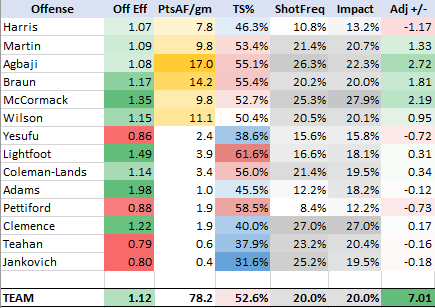
At +7.01, the 2022 team was KU’s third-best offense in the Self era, slightly behind 2017 and 2018. The team had an excellent mix of offensive talent, led by Ochai Agbaji. Agbaji finished with 17.0 points produced per game, which translated to +2.72 offensive points above a bubble-level player. David McCormack was KU’s second most valuable offensive player on a per game basis, producing 9.8 points per game but also adding value through offensive rebounding. His Offensive Efficiency of 1.35 was easily the highest of any starter.
Christian Braun was a steady player on offense, scoring in double figures in all but 5 games. He was good at the rim, shot well from outside, assisted nicely, and had his fair share of stick-backs and other hustle plays to bring value. Remy Martin got hot late in the season, carrying the Jayhawks when the team needed him. Had he been healthy the entire season, his numbers would have looked very good. Even where they are, he provided +1.33 points more per game than a replacement option would have been expected to add.
Jalen Wilson finished a fraction below +1.00, held back by poor perimeter shooting but buffered by rebounding and strong finishes at the rim. Given how many big moments he had, its crazy to think of him as only the fifth-best offensive player during the 2022 season.
Off the bench, both Jalen Coleman-Lands and Mitch Lightfoot added decent offensive value through efficient shooting numbers.
Defense
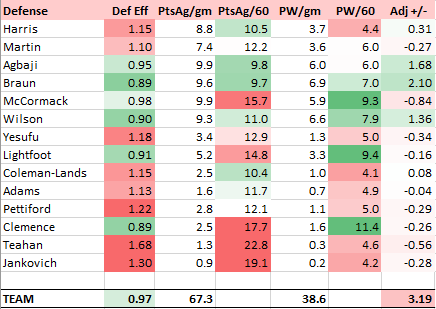
KU’s defense of +3.19 was the weaker side of the ball all season. But the team played well when it mattered most, averaging a +7.75 value score in its last 10 games.
On the season, Christian Braun was KU’s most valuable defender, giving up 9.7 points per 60 possessions and grabbing a fair share of rebounds for a wing. Fellow wings Agbaji and Wilson were also solid and versatile defensive pieces, with Och being a better on-ball defender and Wilson being an excellent defensive rebounder.
Point guard Dajuan Harris was KU’s leading steal-man, coming away with 58 live-ball steals on the year. He also forced 50 (dead-ball) turnovers, for 108 total. Given the fact he turned the ball over only 70 times himself, he was +38 for the year with regards to taking care of the ball. This is what you want to see from your main ball-handler.
Total Adjusted PPG +/-
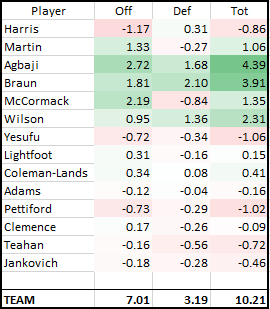
Ochai Agbaji was KU’s best player all season, and his Adj. PPG +/- of +4.39 was the 24th best season of any Jayhawk in the last 26 seasons (1997-2022). Christian Braun at +3.91 was not far behind, producing the 29th best Adj. PPG +/- score over that time period. Of the 7-man rotation that played the bulk of the minutes during NCAA Tournament play, 6 had positive scores (Agbaji, Braun, Wilson, McCormack, Martin, Lightfoot).
Unbelievably, the TEAM score of +10.21 was KU’s 12th best season from 1997-2022. This speaks to the consistency of the program. 2022 may not have been KU’s most talented team, but they played well when it mattered most. Over the team’s final 10 games, the Jayhawks were +14.22.
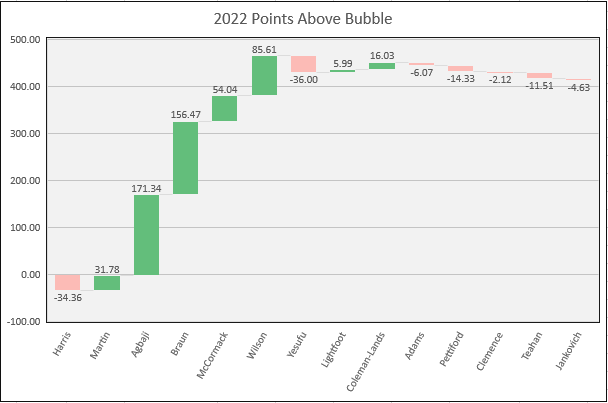
This waterfall chart shows how much value in Points Above Bubble that each Jayhawk added. The bulk of KU’s success came from its wings. The Jayhawks had 7 rotation players produce positive value, a sign of depth and maturity. However, only 1 of these 7 was a point guard type.
MVP’s
In the 40 games KU played, here are the total game MVP’s for KU players ranked from most team-MVP’s to least. Agbaji 11, Braun 10, McCormack 8, Wilson 5, Martin 3, Harris 1, Coleman-Lands 1, Lightfoot 1.
After adjusting for opponent-quality, here are the percent of games with positive value score by player from best to worst (above 50% performers): Braun 83%, Agbaji 74%, Wilson 68%, Clemence 63%, Martin 57%, McCormack 55%, Adams 51%, Coleman-Lands 51%.
Points Above Bubble vs. Points Above Average
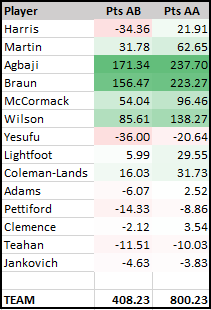
Ideally, each KU rotation player would be at a “bubble level” of value, but this isn’t the case most years. To add context to each player’s season, we can lower the skill level of the comparative player to that of the average D-1 player. When we do this, notice how each player’s Pts AA is higher than Pts AB, and how all rotation players except Joseph Yesufu and Bobby Pettiford have performed above that of a D-1 average player.
This incorporates total minutes, so Dajuan Harris’s ability to play as much as he has helps his Pts AA far more than someone like Joe Yesufu or Jalen Coleman-Lands. Focusing more on Harris, what we can say is that although he isn’t good enough to carry a team to the heights KU has reached, he has been a steady role-player that hasn’t hurt the team’s chances either. The 2022 team was carried by Agbaji, Braun, Wilson, with McCormack and Martin stepping up in the Big Dance as well. But durable guys like Harris and Lightfoot were good enough to keep KU at the high level they’ve had this season. If KU had to replace its role players (specifically Harris, Coleman-Lands, and Lightfoot) with average D-1 players, the team would have been worse off on the year.
National Champions
During the team’s six-game NCAA Tournament run, here are the Adj. PPG +/- scores:
Dajuan Harris -1.02
Remy Martin +4.11
Ochai Agbaji +3.11
Christian Braun +3.42
David McCormack +2.53
Jalen Wilson +1.46
Joseph Yesufu -0.84
Mitch Lightfoot +1.76
Jalen Coleman-Lands +0.02
K.J. Adams -0.06
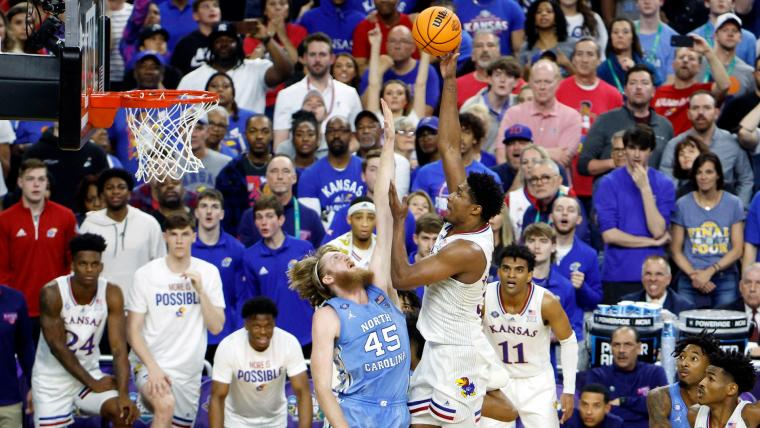
Remy Martin was the most valuable Jayhawk during March Madness, after an up-and-down year plagued by missed games and injuries. David McCormack stepped up late, becoming KU’s best player in the final three games of the season. He may not have won Final 4 MOP officially, but he was the biggest reason KU cut down the nets in New Orleans. His biggest plays came during the final moments of the National Championship game. After missing a turnaround shot, he collected his own rebound and finished it to turn a 1-point deficit into a 1-point lead with 1:21 left. He then played solid defense against Carolina’s Armando Bacot (who went down with an injury), forcing a turnover. On the other end, with the shot clock winding down, McCormack got deep inside position and scored again to extend the lead to 3, which would be the final margin. Down 72-69 and with only seconds to spare, the Tar Heels would fire 3 contested 3’s that were all off the mark, cementing Kansas as the 2022 NCAA Champions.
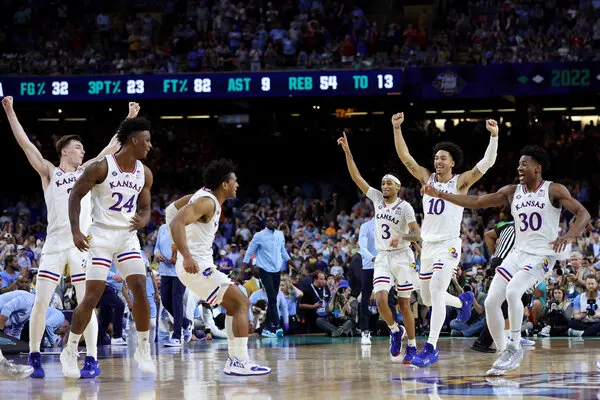
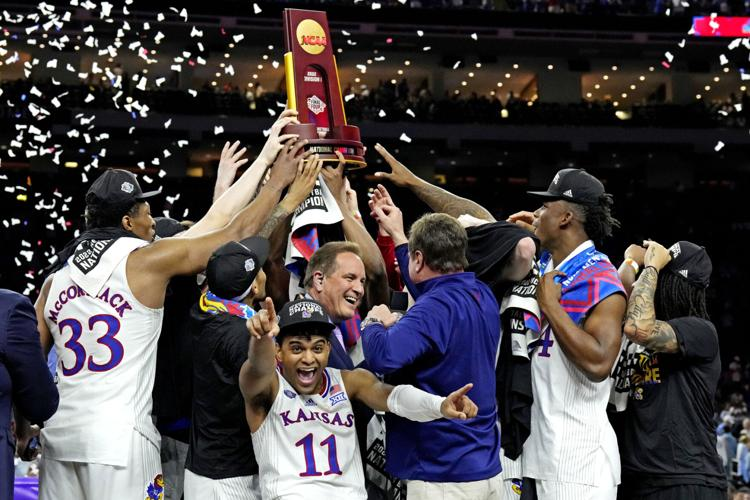
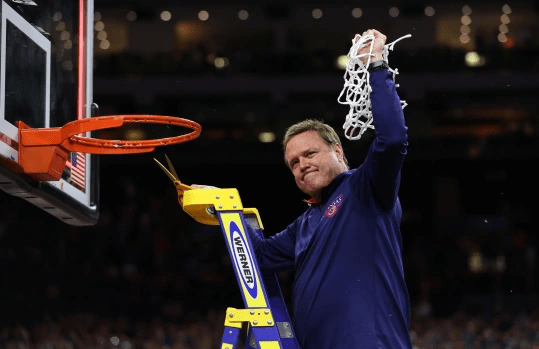
D-Mac’s final bucket put KU up 3 with 22 seconds left, forcing UNC into a difficult spotThe Hawks celebrate after a final defensive standRock Chalk, Championship!National Championship net



 Charting the Hawks