
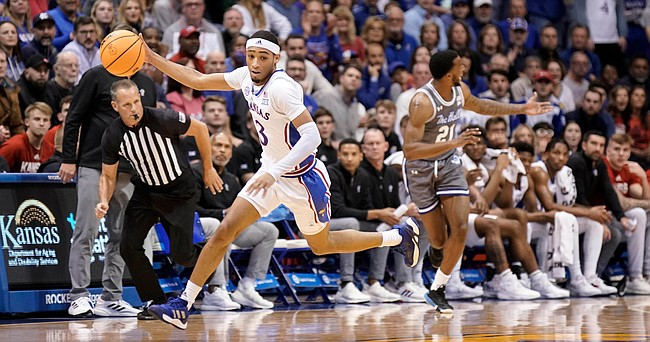
At Big 12 Media Day, Coach Self was all praises on his Point Guard:
And he should be. Harris is the type of kid who plays the game hard, never complains, is a great teammate, and from all appearances seems like the model player off the court. And as he comes into his third year as a Jayhawk player (fourth year in the program), he is positioned to be one of the leaders on the team in the 2023 season.
On KU Twitter and the Message Boards, Harris is generally seen as a positive contributor, however there are the occasional unpopular types who will point out his stats. The Harris-haters are derided. But are they completely wrong? For instance, take a look at his per game stats for 2022.

Harris isn’t a scorer, of that people agree. His assist total is solid, but then again, he is a PG. The A/TO ratio of is 2.8 is very good. He also gets some steals. On the negative side, his rebounding is quite low. And his shooting could improve. But stats are meaningless without context. The question is less, is Dejuan Harris good, and more, how should we judge his skill? Against all D-1 college basketball? Or against KU-level point guards? Let’s first compare his stats to other KU point guards from their sophomore years.
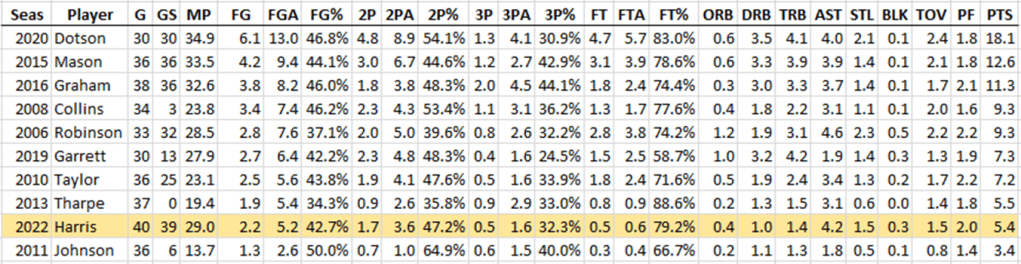
This list contains the sophomore-year stats of all players in the Self-era who were the primary starting PG for their team in at least one season. We want to compare Harris as the starting PG against other starters. For this reason, guys like Mario Chalmers (he played some point, but was never the primary starter at that position) and Niko Roberts (never started) are left off, and guys like Elijah Johnson (who was an off-guard most of his career until he became the PG as a senior) are included.
The list is sorted by highest PPG total. Looking at the comparison, we see Harris below everyone except Elijah Johnson, who played 13.7 MPG on a loaded 2011 team and was behind 4 other guard-types. Harris has relatively good numbers when it comes to ball-handling stats (assists, turnovers) and steals. His rebounding and shot attempt numbers don’t look great.
But what about his defense? Unlike traditional stats, Charting the Hawks has the ability to judge defensive skill-level more robustly, and not just steals, fouls, rebounds, and blocks. Let’s take a look at these 10 player-seasons from the defensive side of the ball.
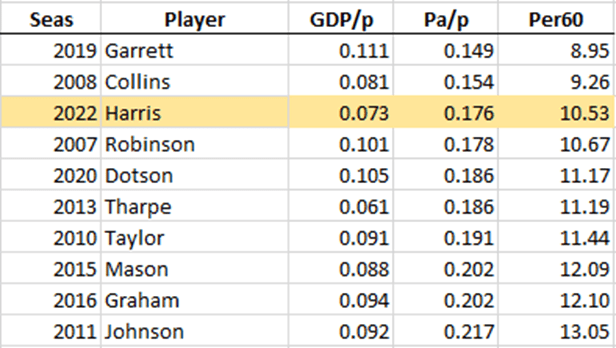
Some explanation here is helpful. This list is sorted by Pa/p or Per60 columns, with lowest being better. Pa/p stands for Points Against per Possession. This shows how many points the player gave up per possession. This number is set to Per 60 possessions (about 35 minutes of game play) to make it more intuitive. Harris is third among his peers in the Self-era in this category.
The GDP/p refers to Good Defensive Plays per possession. This refers to the number of rebounds, steals, blocks, and non-steal forced turnovers a player contributes on the defensive end. We note that Harris is second-worst on this end, as his rebounding totals are below his peers.
Player value is best seen by putting everything together. All relevant offensive and defensive metrics makes the total player. Glancing above, we know that Harris is a solid defender and good ball-handler. These are two skills associated with point guards. However, we also see he doesn’t do much else, even when compared to other point guards.
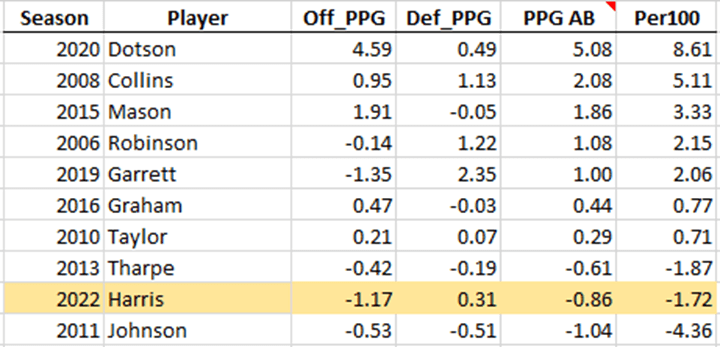
The final table sorts these 10 players by PPG AB +/-. Harris comes in 9th of 10, only ahead of 2011 Elijah Johnson. The Per100 column is also useful, as it looks at player value from a per (100) possession basis to account for playing time differences. Here Harris grades out slightly higher than 2013 Naadir Tharpe.
Breaking down Harris further, we see his offense only bettered that of 2019 Marcus Garrett. His defense came in around average, and this was in large part due to his rebounding. Had he rebounded at a rate of Devon Dotson (3.5 DRPG), he would have been the second-best defender on this list and had a PPG AB +/- value score that was positive.
The irony of Harris is this. When you examine “pure” point guard skills such as defensive pressure, steals, forced turnovers, ball-handling, assists, turnovers, and free throw shooting; Harris is solid and one of the best. But when you add the other elements of basketball not always associated with PG’s—such as scoring volume and rebounding—Harris’s value diminishes. Point guards don’t have to rebound much, but they have to get enough boards. And they don’t have to lead the team in scoring, but they still have to be a capable enough option that it forces other teams to guard them.
Last, the final table looks at the seasons all starting point guards have had since 2007. This is different in that it compares PG’s of different classes—freshman, sophomore, junior, and senior.
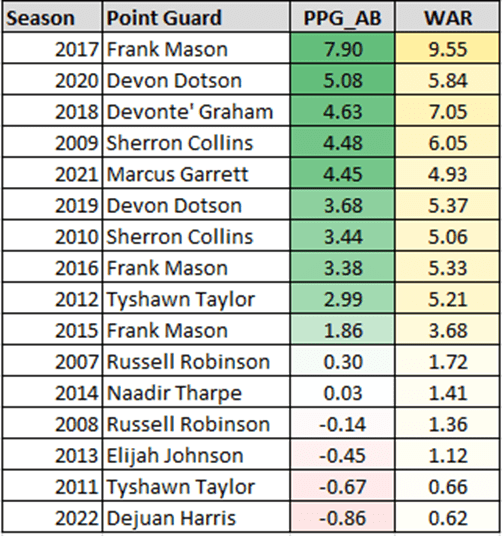
Here we see Harris in last. The WAR is Wins Above Replacement, with replacement-level equaling the average D-1 player. This is estimating that Harris gave KU an extra 0.62 wins above the average D-1 player getting his minutes. So even if Harris has been at the bottom of starting point guards in the Self-era, he can still add value.
Looking ahead to 2023:
For the upcoming season, we expect Harris to improve on his 2022 campaign. College players tend to improve season-to-season. As Harris plays a larger role, expect his scoring to improve. But we also want to see gains on his rebounding numbers. There were multiple times when he allowed an offensive rebound, which gave the opponent a good-look at a score (see 3:42 here: https://www.youtube.com/watch?v=AIMOY6CoQKI Harris drifts away from his man instead of blocking out and watches his man tip the ball out for an open 3). By just adding a little more physicality to his game, he can add a rebound per game or so which will lift his value alongside other improvements to his game.
Charting the Hawks has Dejuan Harris’s 2023 season with a -0.28 projected PPGAB. But this is merely an objective estimate using trends of player improvement. Players improve by an average of around half a point per game per season. But some improve more than this, while some actually decline in value. Don’t be surprised if Harris makes a big leap from sophomore to junior year.
With 5:04 left in regulation, Remy Martin checked out for the final time against Texas Tech on Monday. Although we didn’t know it at the time, the game would last 15:04 due to 2 overtimes being needed, and it would be Dejuan Harris and not Remy Martin getting the PG duties. When Martin left the game, KU was up 8. The Hawks would be outscored by 5 the rest of the way, first giving up an 8-point lead in regulation and then needing a second overtime to avoid losing the game.
Martin’s playing time, or lack thereof, down the stretch certainly had Jayhawk fans scratching their heads. Coach Self was even asked about this during his press conference. He responded that he didn’t know who to take out if he put Remy in, even insinuating that he didn’t consider removing Harris by noting he couldn’t play two small guards together due to defensive mismatches.
Those wanting to see Martin finish the game pointed out +/- differentials to justify their arguments. Martin was +9 and Harris -8 on Monday night. But even those using +/- acknowledged its limitations and uselessness over a small sample size of 1 game. *
*Really the sample size isn’t 1 game, but the 85 possessions the game featured, or perhaps the 50 or 60 possessions that Martin or Harris actually played. Nevertheless, we would want to see more possessions (closer to 1,000) against similar competition than what we saw on Monday.
The eye-test certainly bolsters the argument for Remy. He was quick, aggressive, and made countless plays despite only scoring 4 points (the same total as Harris). The team seemed to have more offensive flow with Martin running the show. On the other hand, the eye-test runs into the same problem as +/-. Yes, Remy played better on Monday night. But what about the whole season? Just a few days prior, Martin had a rough game against Kansas St. Given his recent health issues and bouts of inconsistent play, how long do you want to gamble with someone who has overperformed in this one game?
The point of all this, is to ask the question on everyone’s mind…who should play more as the team’s point guard, Dejuan Harris or Remy Martin? To answer this, we will use the stats found on this website to compare how each has played over the first 19 games.
To start, we will fragment each’s games into offensive numbers and defensive numbers. From there, we will combine these into value scores and see which has played better so far throughout the course of the season. Last, we will look beyond the value scores (which are just season averages) and attempt to see who has been more consistent, who has produced more good games, fewer bad games, and so on.
Offensive Stats:
The first offensive stat we will compare is actually PPG. Although this is not an “advanced” stat, it actually correlates quite strongly with overall player value. Players who lead the team in points per game are likely the team’s best natural offensive talent. They are likely to be better shooters than average (from a TS% perspective). They are likely to be better athletes than average and thus are probably better rebounders or passers or defenders than others their position. And they are also good enough to play enough minutes to have the chance at leading the team in PPG.
Through 19 games, Remy Martin is averaging 8.4 points and Dejuan Harris is averaging 5.2. This is a noticeable difference. When we even out the minutes (Harris is playing 4.5 more MPG), this gap is even wider. Martin is averaging 14.0 points per 40, and Harris is nearly half as proficient of a scorer at 7.2.
Next, we will look at shooting efficiency. Effective FG% is a good way to do this, but TS% is even better. Getting to the FT line, and converting, is a skill that needs to be accounted for. Using the formula for calculating TS% developed by CtH, we arrive with Martin at 50.8% and Harris at 46.8% (Sports Reference has Martin at 55.1% and Harris at 50.5%, so the relative difference isn’t affected much by source).
Putting these two stats together, we see that Remy is scoring more than Harris is on a rated basis and is doing so by shooting better. The last comparison we want to make for two guards is assist and turnover numbers. Once again, per 40 numbers from Sports Reference are helpful. Both players are averaging 5.1 assists per 40, whereas Martin turns it over more than Harris (3.0 vs. 2.0 per 40 minutes). CtH’s numbers are similar, but we give the slight ball-handling advantage to Harris.
Offensive rebounds are negligible for small guards. The main components on offense are scoring, shooting, assists, and turnovers. Martin is comfortably the better of the two when it comes to scoring and shooting, whereas Harris is slightly better on the ball-handling stats.
Putting it all together, Martin is producing +0.50 points per game of value more than a KU-level replacement guard would. He hasn’t been great on offense, but he has been serviceable. On the other hand, Harris is well-below where KU fans would expect from a starting or even backup PG. His only value-adding offensive aspect is his low turnover numbers, although this is a product of conservative play which creates little offense.

Defensive stats:
Just as points scored is a strong indicator of player value, the strongest defensive indicator is how many points a player gives up on defense. However, this stat isn’t kept at the official level. It is kept by CtH, so we are in luck. Instead of a per game basis, we will compare Harris and Martin on a per possession basis. This is multiplied up to 60 possessions, so the numbers are per 60.
Harris is allowing 10.8 points per 60; Martin is giving up 12.3 points per 60. Harris has been the more consistent defender and grades slightly above replacement, whereas Martin is slightly below replacement. The next thing to check is possession winners, which are defensive rebounds, steals, and forced turnovers. When we rate per 60 possessions, we see that Martin is better at winning possessions off a defensive stop than Harris (6.6 vs. 4.7). There isn’t much more to say on defense. Once we put everything on this end together, we see that Harris (-0.02) grades out slightly better than Martin (-0.33). Neither are that impressive.

Total Value:
Next comes simple arithmetic. Adj. PPG +/- is just the sum of the Off and Def components.

Martin is over 1.5 points per game better than Harris. This isn’t an insignificant difference by any means. Harris’s poor offensive output really stands out here. KU-level players should be able to reach a higher level of production.
Consistency:
The last thing to consider is the level of consistency each displays. What are each’s highs and lows? To answer this, we will take each’s best three games and worst three games using value score, adjusted to opponent.
Harris’s 3 best games: +6.77 (Missouri) +4.98 (Iowa State) +4.97 (Oklahoma State)
Martin’s 3 best games: +6.52 (North Texas) +5.90 (St. John’s) +5.42 (Texas Tech 2)
Harris’s 3 worst games: -12.64 (George Mason) -8.91 (Texas Tech 2) -4.69 (UTEP)
Martin’s 3 worst games: -10.12 (Kansas State) -7.93 (Stony Brook) -3.38 (Texas Tech 1)
Harris has both the best and worst overall game between the two. He also has the worst second and third lowest scores, whereas Martin has the second and third best scores in comparison. It should be noted that Harris has played 19 games, but Martin has only played 16. This is partially the reason Harris has lower-scored games. Of course, playing in fewer games works against Martin on the plus side. But generally Martin’s highs and higher and lows lower than Harris.
Team MVP’s is another way to compare. Harris’s +4.98 score against Iowa State (including the game winner) was the best of any Jayhawk that night. Martin has yet to register a team MVP this year. Each player has had one game where he was more valuable than the team’s margin of victory; Harris +4.98 in that 1-point win over Iowa State and Martin +5.42 in that 3 point Texas Tech win. On the other side, Harris scored -4.36 against Dayton (in a 1-point loss) and Martin has not had a score lower than the margin of defeat in any of KU’s losses so far this season.
We can also look at the number of positive games vs. negative games using value score. Harris has had 6 positive games and 13 negative games, meaning 32% of the games he plays in add value to KU. Martin is 8 positive and 8 negative, which is 50%. Just as with average value score, Martin has been the better player over the course of the season when we use this measure of consistency.
Conclusion:
In summary, Martin is the better offensive player as he is a better scorer and shooter even at higher volumes than Harris. Harris takes care of the ball better and grades slightly higher at assisting, but these are too small to make up for the scoring/shooting value difference.
On defense, Harris is better at not giving up points, whereas Martin’s rebounding is superior (Harris gets more steals/forces more turnovers). These factors mean Harris has more defensive value.
In total, Martin has been worse than advertised yet still a consistently better player than Harris. I don’t recommend changing the starting lineup, but the closing lineup, that is the one down the stretch in a close important game should include Martin as the PG and leave Harris on the bench.
Game Summary:
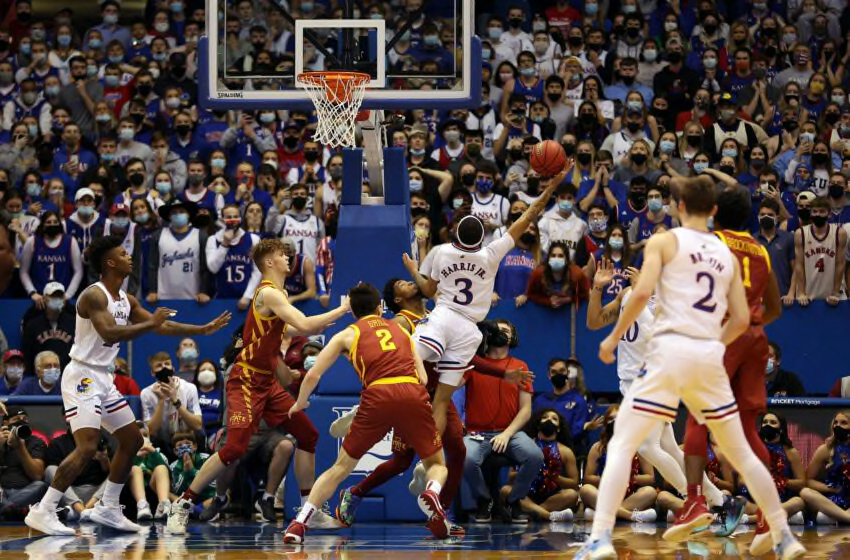
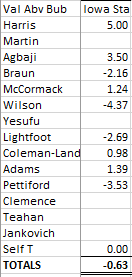
Not only did he hit the game-winner with 7 seconds left; Dejuan Harris was solid on both ends to earn team MVP honors. Ochai Agbaji was poised to win this distinction due to a solid 22-point outing, but his defense down the stretch lowered his value score significantly. K.J. Adams got the start and had yet another positive outing (10 of his 13 game appearances have netted positive value). Despite being benched for most of the game and only scoring 1 point, David McCormack was good on the defensive end and glass. Christian Braun had his first negative-value performance of the season, and Bobby Pettiford returned from injury but looked very rusty.
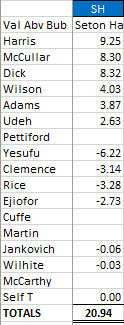
The team is missing Remy Martin, and frankly David McCormack although the latter is on the coach and not due to injury. Playing worse players at these positions (such as Pettiford/Yesufu or Lightfoot) has unsurprisingly made this team worse. The team is loaded at wing, so giving K.J. Adams a look at the 5 can provide a small bit of value most nights.
 Charting the Hawks