
After losses, questions from the KU fanbase arise. Players buried on the bench seem like a possible rescue for the current challenges the team is facing.
M.J. Rice came in as one of KU’s more highly-touted players. As an athletic wing with a strong ranking and build, he was expected to produce and maybe even start this season. There have been numerous freshmen wings to start in the Self-era. Brandon Rush, Xavier Henry, Ben McLemore, Andrew Wiggins, Wayne Selden, Kelly Oubre, Josh Jackson, Quentin Grimes, and, (even this season) Gradey Dick to name a few. Further names of freshmen wings to get quality playing time (and a few starts along the way) include Josh Selby, Svi Mykhailiuk, Marcus Garrett, Ochai Agbaji, and Christian Braun. While some of these guys came in more highly-touted (and proved to be legitimate pro-prospects), others were not better recruits. Based on incoming hype alone, he is somewhere in the middle of these names.
Injuries, illnesses, and inconsistency have held him back. He’s had 4 straight DNP’s, played under than 5 minutes all conference season, and hasn’t played a noticeable amount of time in any game since Harvard. For the season he has appeared in 11 games, but he has shown flashes of skill.
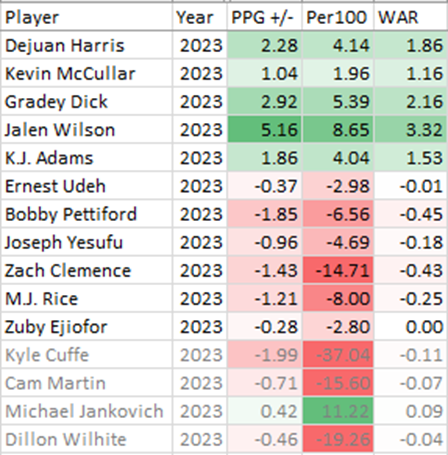
Against Texas Southern, a game in which an injured Kevin McCullar did not appear, Rice logged a season-high 21.5 minutes. He scored 19 points on efficient shooting. He graded out as KU’s second-best player that night, producing an above-bubble value-score of +7.05. This is the best single performance of any KU bench-player this season, and even scored better than K.J. Adams’ best game.
Aside from this game, he’s been less-than-stellar. Of the other 10 he’s appeared in, only against Harvard has he produced positive value. And while the value-score is opponent-adjusted, it should be noted that his worst games have came against the best competition as he has produced -16.83 points of value in 39.5 minutes against Power 6 foes. He hasn’t proven he can perform against top-tier quality, and since that is all that is left on KU’s schedule, one can understand why he isn’t currently in the rotation.
Still, its not like KU has a wide range of wings on its bench. The team effectively starts 4 wings alongside PG Dejuan Harris (for this exercise I’ll use the term “wing” to refer to players who are primarily non-post scorers, who will shoot at least an occasional 3, yet are not a primary ball-handling type. Defensively, wings are better perimeter defenders, which differentiates them from post-men). KU’s bench, on the other hand, has 2 small PG/CG-types (Pettiford, Yesufu) and 4 “bigs” or “5-men” (Ejiofor, Clemence, Udeh, Martin). None of these would traditionally be considered wings, although each of these six players has unique skill sets from one another. The only other bench player that could be considered a wing is Kyle Cuffe, who has been injured since the second game and thus not relevant to our current discussion.
The point is, this team starts all of the wings it plays. While the team has had success doing so, when it goes to the bench, the makeup of the lineup changes. When Pettiford and/or Yesufu come in, KU will play 2 (or 3) PG/CG types. Smaller, quicker, and with better ball-handling, these players give up size and are better scorers in the full-court rather than half-court. Defensively, these smaller guards tend to have trouble rebounding and contesting against the shots of taller opponents.
Whenever a backup 5 replaces Adams (namely Ejiofor or Clemence recently), KU loses an excellent wing defender (Adams) and gains a better rebounder who has trouble switching onto the opponents’ best guards and wings. The point is, KU is best suited to play its starting 5. Not only is the team better, the defensive strategy (liberal amounts of switches) is best suited for guys who are mobile and range from 6’6 – 6’8. Additionally, the offensive strategy of playing a spaced-out high-ball-screen system, utilizing a 5-man who can handle it well, doesn’t work as well with a substitute 5 who cannot handle it or an off-guard who isn’t able to make jump shots.
Rice’s skillset fits in nicely with what the team’s strategy is. Having him spell Kevin McCullar means you don’t give up any size at the off-guard position. Switching most screens still makes sense. Having him fill in for a Gradey Dick or Jalen Wilson means you have someone who has clear offensive potential…someone who can score. Playing alongside a Harris means he will get good looks.
One suggestion is that he would perform better if he could get into a rhythm. His semi-recent spot minutes have not been impressive, to be sure. But when he did play extended runs, such as his 18 minutes against NDSU or 21 against TSU, he scored 10 and 19 points.
Below is a table of KU wings in their freshmen years. What we want to do is compare Rice to these other names through about the same point in the season. As Rice has played 96 minutes, we will attempt to break-down these other freshmen wings at this point in their careers in terms of minutes played. It won’t be perfect, but we should be able to get value-scores of other wings.
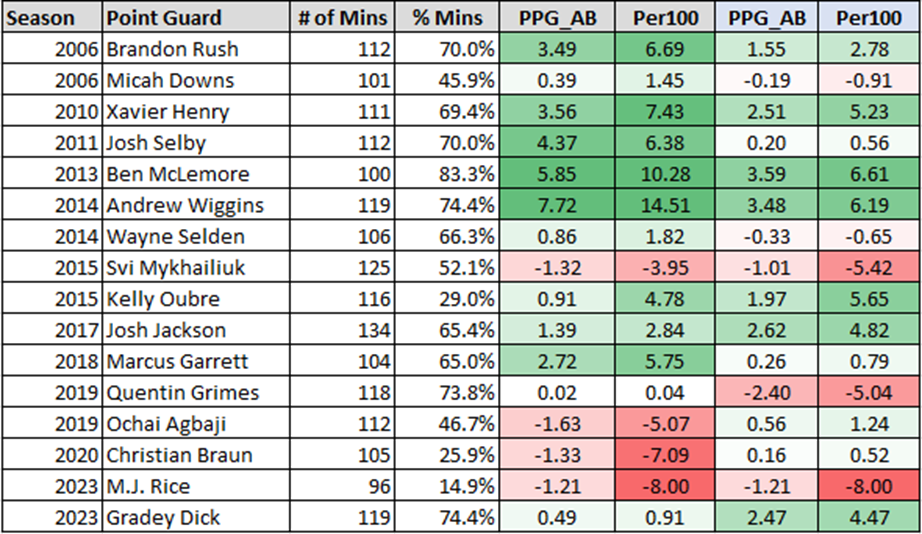
The filter was to count the first 100 minutes of a player’s freshman season, with the difference being that we are counting whole-games worth of statistical value. The percentage of minutes show a variety of playing time by individual, with Ben McLemore playing the most of anyone. The PPG_AB and Per100 in gray show how well that player was doing through his first 100 minutes of court time. The last two blue columns show that player’s entire season.
The player who got off to the best start was Andrew Wiggins, and generally players who got off to good starts continued that momentum, albeit it with reversion to the mean. There were a few notable players who improved after sluggish starts, with Kelly Oubre and Josh Jackson being notables. Ochai Agbaji, although he showed potential, was a negative-value player when he first burned the redshirt. However, immediately following his first 112 minutes in 6 games played, he had his best outing against Texas. Thus, perhaps his development is overstated here. Conversely, Kelly Oubre’s slow start is somewhat masked by the fact his final game in the sequence was his best to that point. He hardly played at first, but slowly became a very solid player. His development throughout the course of the season was significant.
Where does this leave us with M.J.? Through roughly 100 minutes played, he is behind each of these names in terms of minutes played and per-possession value. On total value, his closest comps for the whole season are Grimes and Svi, neither of whom were any good in their freshman campaigns. In terms of minutes played, he is getting similar time as Braun or Oubre did. Both of these improved to become positive-value players, indicating that there is still hope for a turnaround. But perhaps his closest comps are players not on this list. Wings that primarily sat as freshmen; players such as Travis Releford, Lagerald Vick, Brannen Greene, Andrew White, or Tristan Enaruna.
The biggest debate about M.J is one that is unanswerable. We don’t know how he’s doing in practice, and speculation about him being better than the team’s current crop of reserves is just that. When he’s played well, he’s certainly shown a dimension that guys like Pettiford or Yesufu don’t have, namely one that fits in well on the wing (BP and JY should still get minutes, especially when Harris needs a break). But when he’s been bad, well, it could cost you a game in an ultra-competitive Big 12.
 Charting the Hawks