Best Duos in Recent KU Basketball History

This blog post was inspired by a discussion that Matt Tait and Nick Schwerdt had recently. Tait always has a refreshingly positive look at the team, and Schwerdt’s assessments are always quite reasonable. If you haven’t seen it already, I recommend watching the short video located here. In it they discuss how well Ochai Agbaji and Christian Braun have been playing. Schwerdt goes as far to posit that this might be one of Bill Self’s best duos he’s had, something Schwerdt admits he wasn’t expecting to say at the beginning of the season.

This prompts both to think of other pairs at KU. Schwerdt comes up with Frank Mason and Devonte’ Graham, who played together for three seasons (2015, 2016, 2017), and which had their best collective season in 2017. Tait brings up Devon Dotson and Udoka Azubuike, who mostly played together in the 2020 season (Azubuike missed most of 2019). Another duo mentioned was Graham and Svi Mykhailiuk, although this seemed to be chosen more for stylistic reasons.

If there’s one thing Charting the Hawks seeks to do, it’s to answer questions such as these using an objective statistical-scoring system which assesses player value. The value-metric of choice will be Adjusted PPG +/-, the proprietary system developed here. This will be a one-number metric, expressed in points per game, which shows the value a player provides over that of a KU-level replacement player (or “bubble” player).

In order to see which duos have performed best, I simply separated the two best players of each season, and combined their scores. For instance, for the 2021 season, I took Marcus Garrett and David McCormack’s value scores and combined them to arrive at +7.32. I went back to each year since 1997 and then ranked the duos in terms of highest to lowest. The results are below.
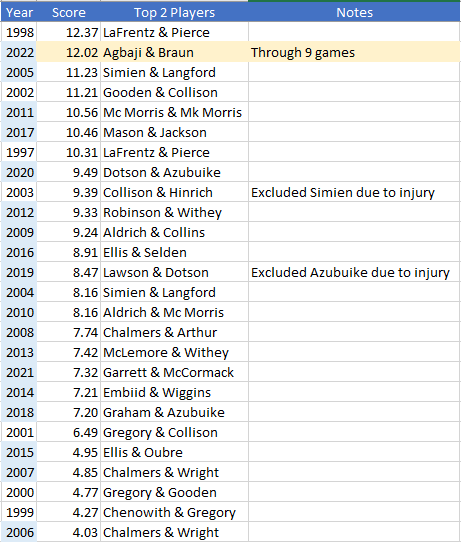
The 1998 team was carried by Raef LaFrentz and Paul Pierce

Through nine games, the duo of Agbaji and Braun have been the second-best of any season since 1997, closely behind LaFrentz and Pierce. Of course, this is only through nine games. The season is about 1/4 of the way complete, so there’s reason to think both players will see their value scores revert down somewhat. (Note however that these numbers are schedule-adjusted, so they aren’t arbitrarily high due to opponent quality. Agbaji and Braun have truly been that good). The current leaders in the Bill Self era (years highlighted in blue) was the 2005 version of Wayne Simien and Keith Langford. Simien’s 2005 season is currently the highest of any player since 1997, barely nudging out Frank Mason’s 2017. Langford had a solid senior season, but the reason that due is so high on this list is because of Simien. With the Agbaji/Braun combo, it’s the case that both have been elite that is so interesting.

The next question I had was to see how rare it was for any one team to have two or more players with a value score as high as Agbaji and Braun. Without being arbitrary, we can select +5.00 as the cutoff…how many Jayhawk teams since 1997 have had two players with a value score of at least +5.00?

Since 1997, there have been 356 player-seasons (for instance Devonte’ Graham’s has 4 of these 356 player-seasons seasons since he played at Kansas 4 seasons). Only 15 out of 356 have been above +5.00. So this is a rare feat for any individual player. Rarer still is the occasion of this happening for multiple Jayhawks in the same season. In fact, it has only happened twice; in 1998 with LaFrentz and Pierce, and in 2011 with the Morris twins. Agbaji and Braun would be only the third duo if they keep this up.

In closing, Agbaji and Braun have been playing at elite levels even by KU standards, comparable to the LaFrentz/Pierce duo or even the Morris twins. But it is the vast improvement of both players which is so surprising. In a future post we will look at the largest improvements year-over-year and see how these two compare.
Kansas 95 St. John’s 75

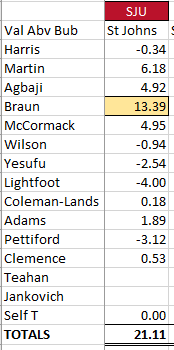
KU defeated St. John’s by 20 in New York in the Big 12 / Big East Challenge game, improving to 6-1 in the non-conference. Below are the value scores for each player.

Christian Braun recorded the best game of any Jayhawk this season at +13.39. David McCormack had his second consecutive good outing, and both Ochai Agbaji and Remy Martin performed at a level we’ve been accustomed to seeing. K.J. Adams actually won 6 possessions from rebounds (5 offensive) in only 6 minutes, two more than what the official box score gave him. Despite only scoring 8 points so far in 7 games, K.J. is actually adding offensive value this season because of his rebounds.

2022 Kansas Jayhawks

The 2022 Kansas Jayhawks finished with a record of 34-6 (14-4), having won the Big 12 Regular Season and Tournament Championships. The team earned earned a 1-seed in the NCAA Tournament and won the National Championship. The team’s Sports Reference link is here.

Offense

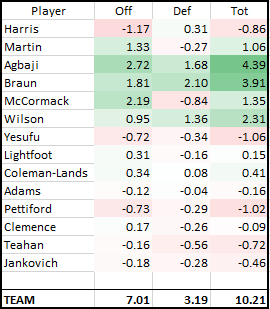
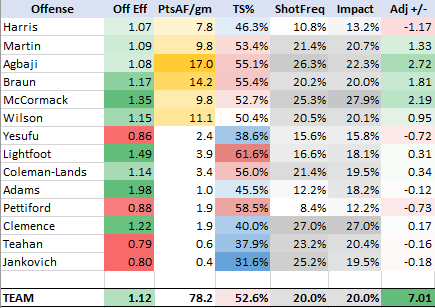
At +7.01, the 2022 team was KU’s third-best offense in the Self era, slightly behind 2017 and 2018. The team had an excellent mix of offensive talent, led by Ochai Agbaji. Agbaji finished with 17.0 points produced per game, which translated to +2.72 offensive points above a bubble-level player. David McCormack was KU’s second most valuable offensive player on a per game basis, producing 9.8 points per game but also adding value through offensive rebounding. His Offensive Efficiency of 1.35 was easily the highest of any starter.

Christian Braun was a steady player on offense, scoring in double figures in all but 5 games. He was good at the rim, shot well from outside, assisted nicely, and had his fair share of stick-backs and other hustle plays to bring value. Remy Martin got hot late in the season, carrying the Jayhawks when the team needed him. Had he been healthy the entire season, his numbers would have looked very good. Even where they are, he provided +1.33 points more per game than a replacement option would have been expected to add.

Jalen Wilson finished a fraction below +1.00, held back by poor perimeter shooting but buffered by rebounding and strong finishes at the rim. Given how many big moments he had, its crazy to think of him as only the fifth-best offensive player during the 2022 season.

Off the bench, both Jalen Coleman-Lands and Mitch Lightfoot added decent offensive value through efficient shooting numbers.

Defense

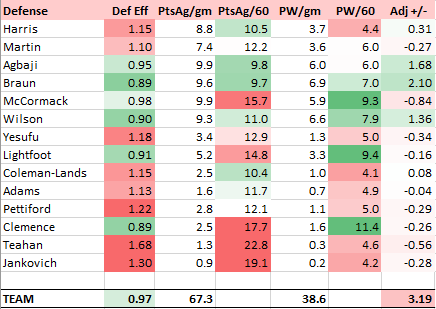
KU’s defense of +3.19 was the weaker side of the ball all season. But the team played well when it mattered most, averaging a +7.75 value score in its last 10 games.

On the season, Christian Braun was KU’s most valuable defender, giving up 9.7 points per 60 possessions and grabbing a fair share of rebounds for a wing. Fellow wings Agbaji and Wilson were also solid and versatile defensive pieces, with Och being a better on-ball defender and Wilson being an excellent defensive rebounder.

Point guard Dajuan Harris was KU’s leading steal-man, coming away with 58 live-ball steals on the year. He also forced 50 (dead-ball) turnovers, for 108 total. Given the fact he turned the ball over only 70 times himself, he was +38 for the year with regards to taking care of the ball. This is what you want to see from your main ball-handler.

Total Adjusted PPG +/-

Ochai Agbaji was KU’s best player all season, and his Adj. PPG +/- of +4.39 was the 24th best season of any Jayhawk in the last 26 seasons (1997-2022). Christian Braun at +3.91 was not far behind, producing the 29th best Adj. PPG +/- score over that time period. Of the 7-man rotation that played the bulk of the minutes during NCAA Tournament play, 6 had positive scores (Agbaji, Braun, Wilson, McCormack, Martin, Lightfoot).

Unbelievably, the TEAM score of +10.21 was KU’s 12th best season from 1997-2022. This speaks to the consistency of the program. 2022 may not have been KU’s most talented team, but they played well when it mattered most. Over the team’s final 10 games, the Jayhawks were +14.22.

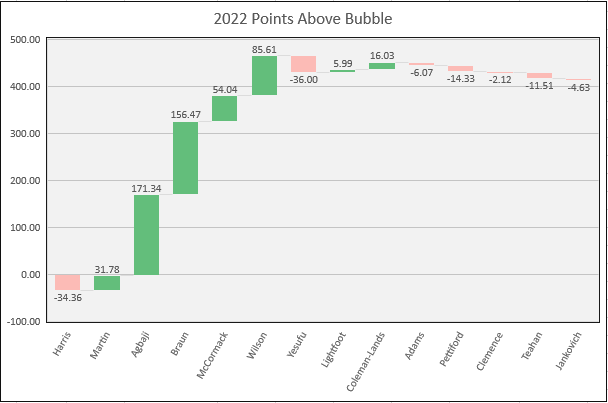
This waterfall chart shows how much value in Points Above Bubble that each Jayhawk added. The bulk of KU’s success came from its wings. The Jayhawks had 7 rotation players produce positive value, a sign of depth and maturity. However, only 1 of these 7 was a point guard type.

MVP’s

In the 40 games KU played, here are the total game MVP’s for KU players ranked from most team-MVP’s to least. Agbaji 11, Braun 10, McCormack 8, Wilson 5, Martin 3, Harris 1, Coleman-Lands 1, Lightfoot 1.

After adjusting for opponent-quality, here are the percent of games with positive value score by player from best to worst (above 50% performers): Braun 83%, Agbaji 74%, Wilson 68%, Clemence 63%, Martin 57%, McCormack 55%, Adams 51%, Coleman-Lands 51%.

Points Above Bubble vs. Points Above Average

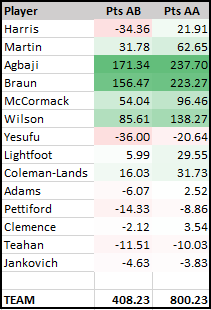
Ideally, each KU rotation player would be at a “bubble level” of value, but this isn’t the case most years. To add context to each player’s season, we can lower the skill level of the comparative player to that of the average D-1 player. When we do this, notice how each player’s Pts AA is higher than Pts AB, and how all rotation players except Joseph Yesufu and Bobby Pettiford have performed above that of a D-1 average player.

This incorporates total minutes, so Dajuan Harris’s ability to play as much as he has helps his Pts AA far more than someone like Joe Yesufu or Jalen Coleman-Lands. Focusing more on Harris, what we can say is that although he isn’t good enough to carry a team to the heights KU has reached, he has been a steady role-player that hasn’t hurt the team’s chances either. The 2022 team was carried by Agbaji, Braun, Wilson, with McCormack and Martin stepping up in the Big Dance as well. But durable guys like Harris and Lightfoot were good enough to keep KU at the high level they’ve had this season. If KU had to replace its role players (specifically Harris, Coleman-Lands, and Lightfoot) with average D-1 players, the team would have been worse off on the year.

National Champions

During the team’s six-game NCAA Tournament run, here are the Adj. PPG +/- scores:

  • Dajuan Harris -1.02
  • Remy Martin +4.11
  • Ochai Agbaji +3.11
  • Christian Braun +3.42
  • David McCormack +2.53
  • Jalen Wilson +1.46
  • Joseph Yesufu -0.84
  • Mitch Lightfoot +1.76
  • Jalen Coleman-Lands +0.02
  • K.J. Adams -0.06

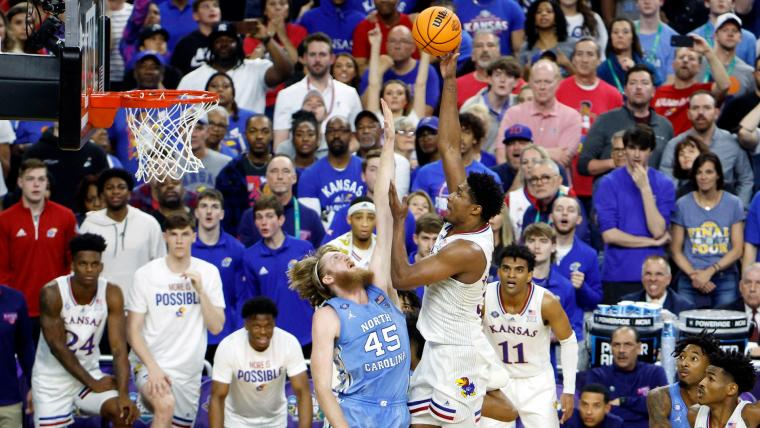
Remy Martin was the most valuable Jayhawk during March Madness, after an up-and-down year plagued by missed games and injuries. David McCormack stepped up late, becoming KU’s best player in the final three games of the season. He may not have won Final 4 MOP officially, but he was the biggest reason KU cut down the nets in New Orleans. His biggest plays came during the final moments of the National Championship game. After missing a turnaround shot, he collected his own rebound and finished it to turn a 1-point deficit into a 1-point lead with 1:21 left. He then played solid defense against Carolina’s Armando Bacot (who went down with an injury), forcing a turnover. On the other end, with the shot clock winding down, McCormack got deep inside position and scored again to extend the lead to 3, which would be the final margin. Down 72-69 and with only seconds to spare, the Tar Heels would fire 3 contested 3’s that were all off the mark, cementing Kansas as the 2022 NCAA Champions.

D-Mac’s final bucket put KU up 3 with 22 seconds left, forcing UNC into a difficult spot
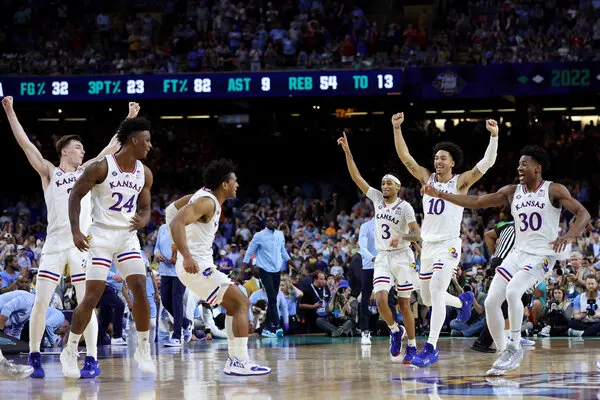
The Hawks celebrate after a final defensive stand
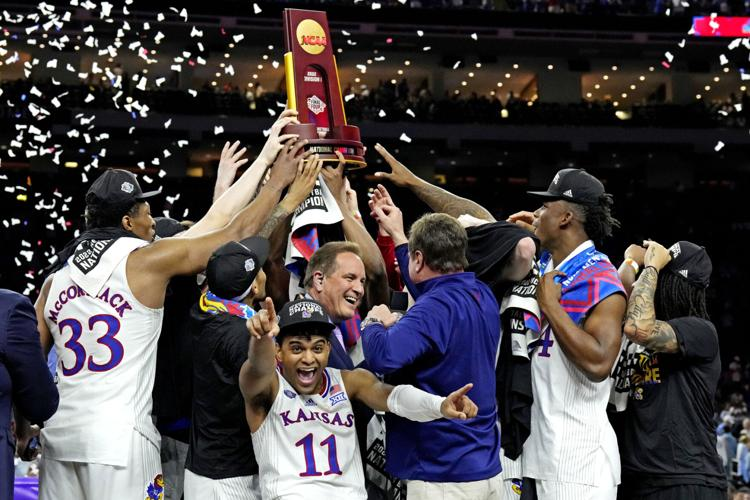
Rock Chalk, Championship!
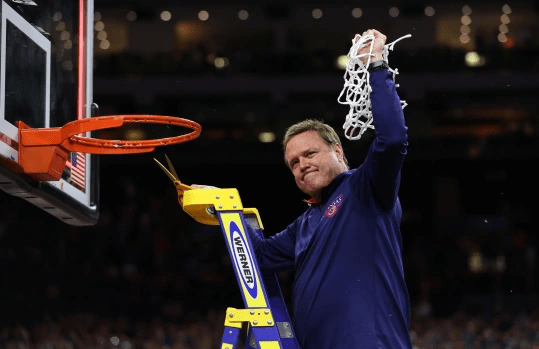
National Championship net

Links

2022 Season Preview (10/19/21)

Pre-conference Basketball (11/3/21)

2022 Through 3 Games (11/19/21)

ESPN Events Orlando Recap (11/29/21)

Best Duos in KU history (12/17/21)

Harris vs. Martin (1/26/22)

How Many Points is Ochai Worth? (2/1/22)

Breaking Down Offense Further (3/4/22)

Kansas 83, Texas Southern 56 Recap (3/17/22)

Kansas 79, Creighton 72 Recap (3/19/22)

Kansas 66, Providence 61 Recap (3/25/22)

Kansas 76, Miami 50 Recap (3/27/22)

Kansas 81, Villanova 65 Recap (4/2/22)

Kansas 72, North Carolina 69 Recap (4/4/22)

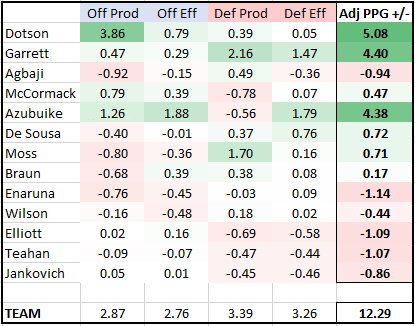
2020 Kansas Jayhaws PPG +/-

How to Interpret:

Adj PPG +/- is the Adjusted Points Per Game the player was against his collective opponents over the course of the season. It is the “one-number” metric (such as WAR in baseball) that tells us how much value a player adds, incorporating all relevant statistics on both sides of the ball. The “Adjusted” refers to the fact the number is adjusted to a hypothetical schedule entirely composed of neutral-site games against a “bubble team.” This is done so the number can be more fairly compared year-over-year or even game-over-game.

Taking Devon Dotson as an example, the metric indicates that KU is roughly 5 points per game better with him on the court than they would be with a hypothetical “bubble” player at his position.

Production vs. Efficiency

The middle four columns break down the PPG +/- into four components of value. Note that these four columns sum to Adj PPG +/-. In basketball, a player helps his team by producing points (scoring, assisting) or winning possessions (rebounds, steals, forced turnovers). Off Prod refers to offensive production. Namely, how many points is that player producing for his team; while counting unassisted points differently than points scored off an assist as assisted-points must be split between the scorer and assist-man. Off Eff refers to offensive efficiency, which is improved by high FG%, low turnover rate, and grabbing offensive rebounds.

Def Prod accounts for how frequently a player is getting scored on. This requires taking whole new stats that are not tracked or published anywhere else in basketball. More will be said on this in a later entry. Def Eff refers to defensive efficiency, incorporating traditional defensive stats such as blocks, rebounds, and steals (alongside the non-box score stat of forced turnovers).

Interpreting the chart above, Devon Dotson had a highly productive offensive output in 2020. He scored most of his points by himself (unassisted), while also setting up others (second-highest assists on team behind Marcus Garrett). Dotson’s ability to get and convert his own shot grades out as the most valuable aspect of any one Jayhawk during the 2020 season. Udoka Azubuike was the most efficient player on offense, something that makes immediate sense given his high FG% and offensive rebounds.

Marcus Garrett grades out as the best defender, and it isn’t close. Given his minutes, and in turn possessions played, he did an excellent job of “shutting down” his man throughout the course of the season. Isaiah Moss added all his value on this aspect of defense as well. Going to the tape, this was largely due to his ability to restrict open looks from outside against the wings he was guarding. Azubuike was the team’s most efficient defender. His rebounding, shot blocking, and ability to clog the lane to force turnovers were unrivaled. He “won” 302 possessions throughout the year on the defensive end, meaning that per game nearly 10 possessions ended in KU’s favor thanks to an Azubuike block, rebound, steal, or forced turnover. Marcus Garrett’s 202 defensive possessions won in 31 games is also noteworthy, particularly due to his position as a guard.

2020 Kansas Jayhawks – Defense

Key

  • Pts Agst – Points scored against that player.
  • Poss Agst – Possessions used when scoring against that player.
  • D Reb – Defensive rebounds credited to playerA.
  • Steals – Steals awarded to player.
  • TO frcd – Turnovers forced by player.
  • Adj PPP – Adjusted Points Per Possession (against). Takes into account prior stats.

A Defensive rebounds also include blocked shots when team wins possession.

2020 Kansas Jayhawks – Offense

Key

  • Pts Una – Points the player scored unassisted.
  • Pts Ast – Points the player scored via assist.
  • Ast pts – Points the player’s teammates scored off his assists
  • Poss Una – Possessions the player used when scoring unassisted.
  • Poss ast – Possessions used when scoring via assist.
  • Ast Poss – Possessions used on assists, i.e. number of assists.
  • Miss – Possessions ending in missed shotsA by player.
  • TO – Turnovers committed by player.
  • O Reb – Offensive rebounds credited to player.
  • Min – Minutes played during season
  • Adj PPP – Adjusted Points Per Possession, factoring all prior stats.

A FT possessions can also count with misses, not just FG misses. If a player goes 0-2 from FT, or misses front-end of 1&1, the player will be credited with a miss. If a player goes 1-2 from FT, that possession is counted within Poss Una.