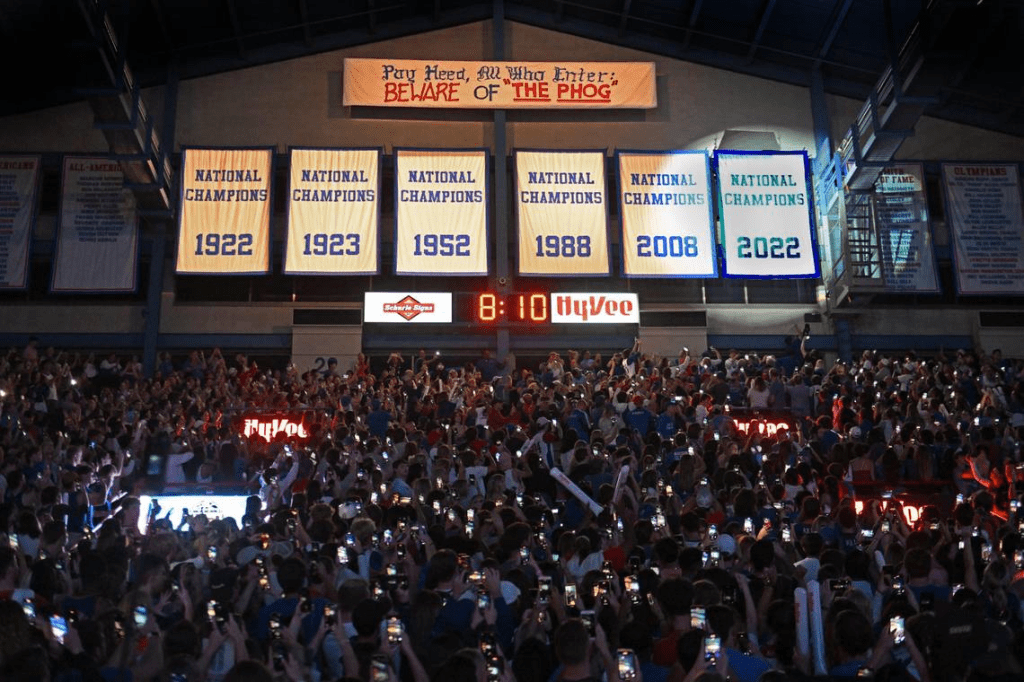
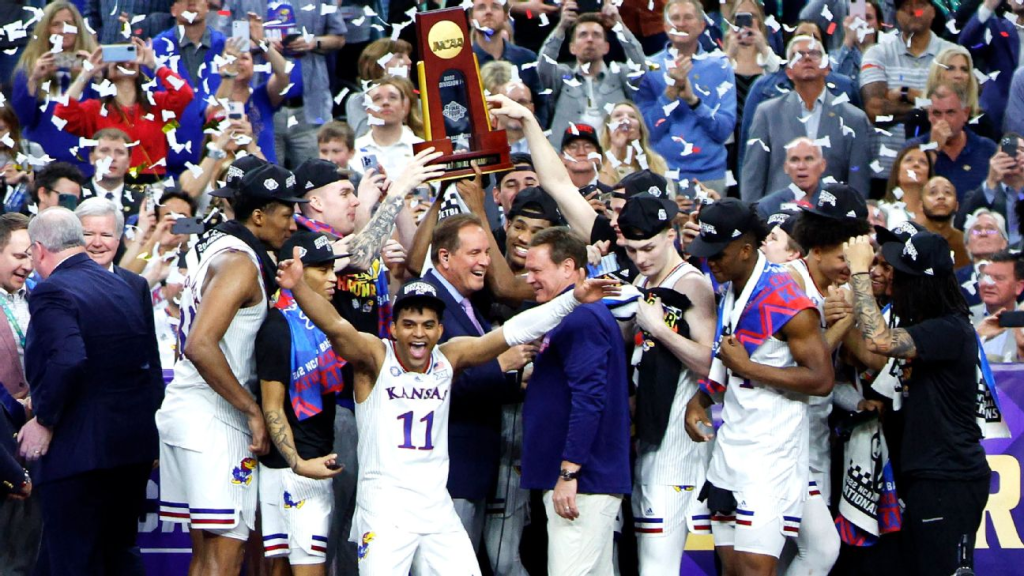
Allen Fieldhouse has been redecorated. The 2022 banner has now been raised, so it seems like a good time to review the National Championship games in terms of player value.
Game Summary:
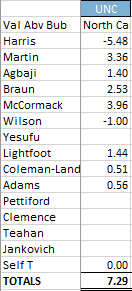
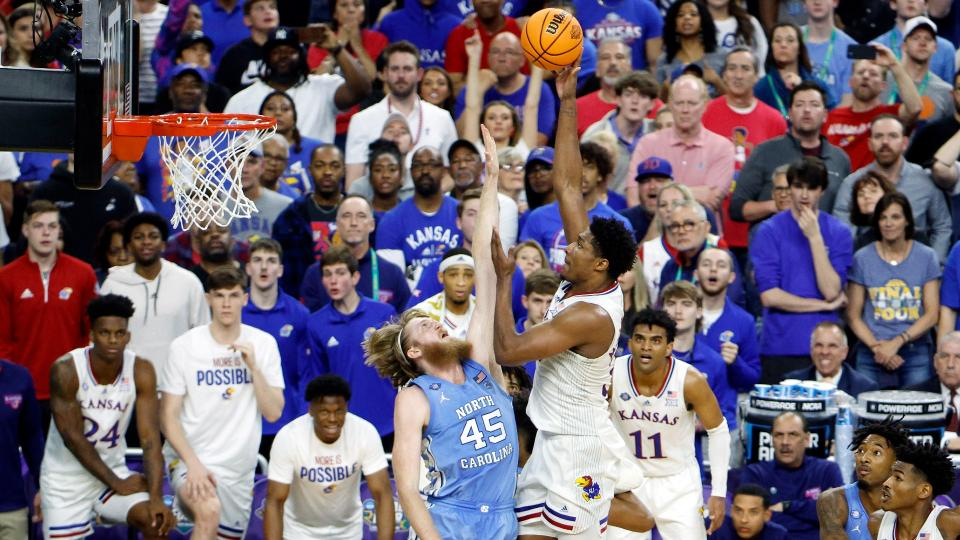
David McCormack was the game MVP for the Jayhawks. His value above bubble was added in the final two minutes. He made a put-back off his own miss to put KU up 70-69, walled up Armando Bacot to force a turnover, and then made the final basket of the game over Brady Manek to extend the score to 72-69. These three possessions made the difference.
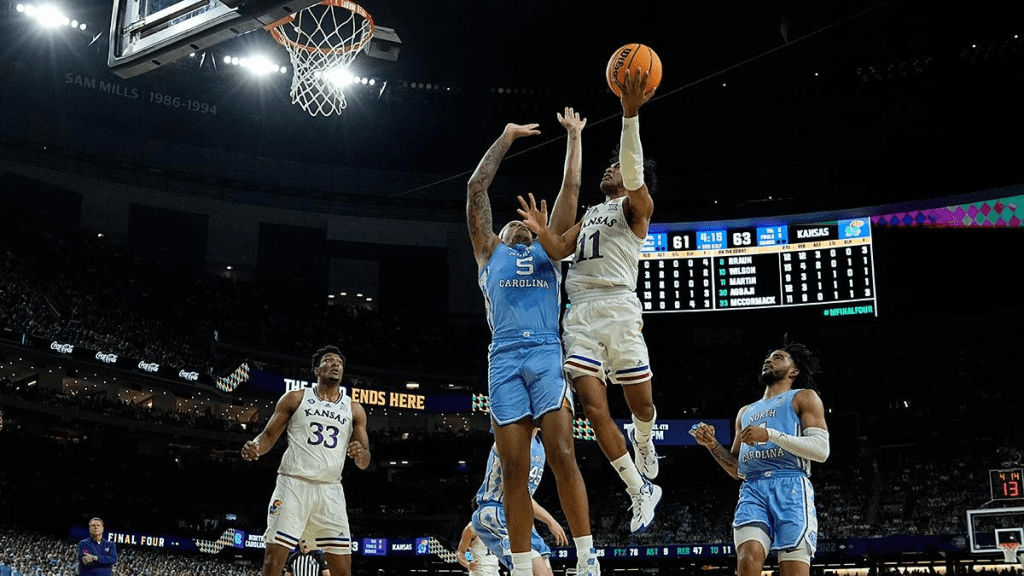
Remy Martin was just below McCormack in terms of player value. He hit 3 huge second-half 3’s as well as a driving layup, with each shot answering Carolina runs which had brought the Tar Heels closer to the lead. Martin was KU’s best player in the tournament, adding 4.11 PPG above bubble during the 6 tournament games.
Christian Braun shook off a tough first half to finish in the black. His tough contest on the final shot made it impossible for Carolina to hit a miracle 3 to tie the game. Mitch Lightfoot fouled a lot, but when he was in he did enough to add value. He made his own shot, grabbed an offensive rebound, and forced a turnover to balance out the 3 FT’s he gave up. Ochai Agbaji didn’t record a counting play after his missed layup with 5:53 to play. but throughout the game, he did more good than harm, particularly in the first half when other Jayhawks were struggling. K.J. Adams contributed one play, forcing UNC into a turnover in the first half. Jalen Coleman-Lands grabbed a rebound for his contribution.
Jalen Wilson turned away from a dreadful first half to contribute to a comeback for the ages. Although he finished below bubble, he was very close to neutral. Dejuan Harris had the worse game of any Jayhawk, with his best stretch coming at the beginning of the second half. His worse blunder was stepping on the sidelines with 4 seconds left to give the Heels a final shot to tie. But by only scoring 2 points on 5 shots, he was KU’s weakest link in the game.
The TEAM score of +7.29 was KU’s 11th consecutive positive, above-bubble performance. While not the best overall game of the season, it was enough to get the win and with it KU’s 6th banner.
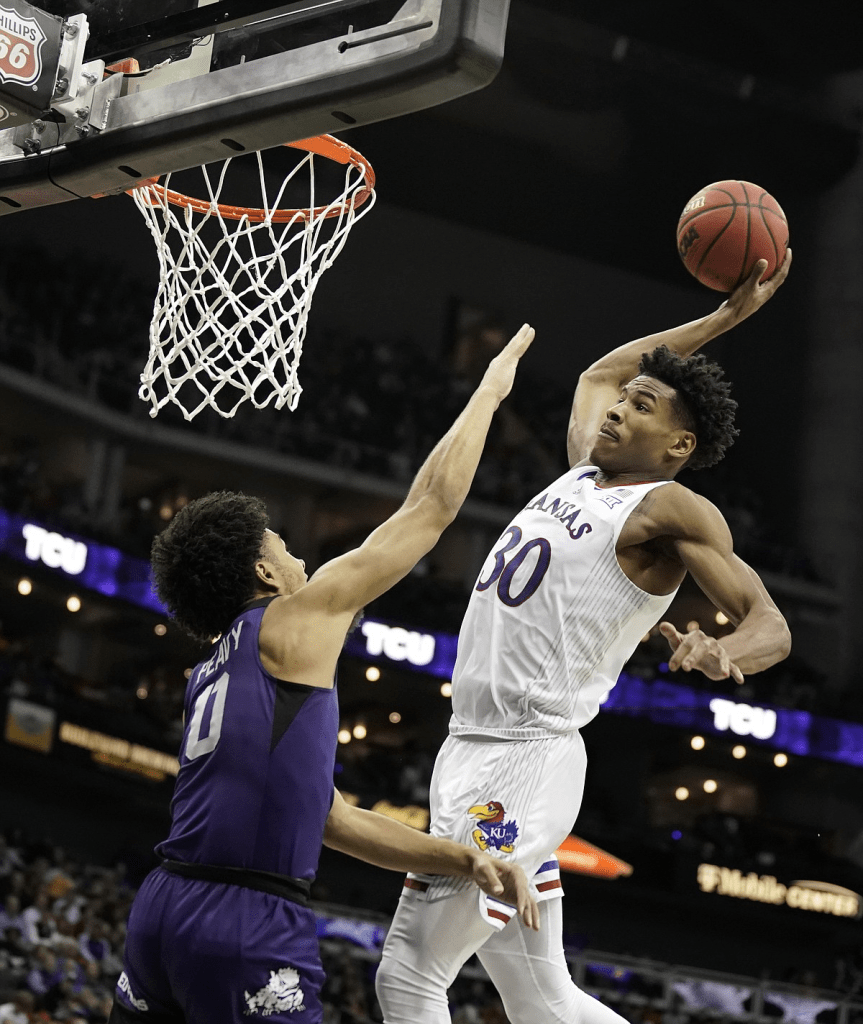
Ochai’s emphatic dunk was part of a team-high 11th MVP game of the season.
Game Summary:
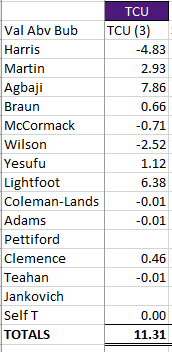
KU took the rubber match against TCU thanks to outstanding efforts from Ochai Agbaji and Mitch Lightfoot. Remy Martin had his best game in a few months, finishing with 10 points and 3 assists. Joe Yesufu got back on the positive side of the ledger with 3 points and 2 assists (with no misses or turnovers). Christian Braun struggled to finish but had a solid defensive outing to add net value.
KU will play for the Big 12 championship on Saturday.
Since beginning to chart KU games during the 2019 season, it’s become clear that without seeing the full picture that the defensive stats (such as points allowed) provide, it becomes difficult to truly see the impact of particular players.
There are a few axioms for charting basketball stats that this website follows, including:
Offense and defense are equally valuable. Teams will have an equal number of offensive and defensive possessions.
Offensive and defensive rebounds are of equal value, because getting a defensive rebound is merely preventing your opponent from grabbing an offensive rebound themselves.
An offensive rebound neutralizes a missed shot. If someone rebounds his own miss, and puts it back in, it neither adds nor takes away value than if he’d made the initial shot.
Similarly a turnover and forced turnover are equally inverse. If a player has 3 turnovers on offense but forces 3 turnovers on defense, he’s had a neutral game in this regard.
Similarly all misses are equal. Whether or not an offensive rebound occurs is up to the hustle of the players on the court (including the shooter).
There are three aspects to scoring: setting up the score, positioning the score, and finishing the score. To relate this to an assisted basket, the assist man sets up the basket with a nice pass, the man who scores must get himself ready to catch the pass, and in turn that same player must have the ability to score by making the shot. With an unassisted basket, the first part of the score (the set up) is not done through a pass but through some type of agile move by the scorer.
The whole point is that there is a systematic way of assessing player value here that avoids bias and selective memory. Now this system also discounts clutchness, or the ability to play well in high-leverage situations. Unlike many in advanced statistics, Charting the Hawks doesn’t disagree that clutchness exists. It almost certainly does. But there are other reasons to discount it for our purposes that we don’t need to get into.
Having said that, and this isn’t to pick on anyone else, but it’s tough not to notice how bias and selective memory pervades the minds of fans and pundits alike. After each game, this website rates the game performance of each Jayhawk (using Adj. PPG +/-). It doesn’t just rank each player, but actually tells you how well or poorly a Jayhawk did in that game as compared to a hypothetical KU-level replacement player (i.e. “bubble” player).
Of course, there are other sites that do the same, albeit without any system. This ends up getting them into trouble. Matt Tait of the Lawrence Journal World took over the Keegan Ratings after longtime LJW Sports Editor Tom Keegan left the paper. It is now called the Kusports.com ratings, although the rankings are based the same as Keegan’s were before. The rater makes his subjective analysis of who played well and who didn’t, then ranks them from best to worst for each game. These ratings are then accumulated for the total season.
Last night’s loss to TCU was ugly to be sure, but rating Zach Clemence as KU’s most effective Jayhawk was a bit far-fetched. Tait’s rankings are represented below, so that we can compare to what a more objective rating system would show. Here’s how Tait ranks them.
Zach Clemence
Jalen Wilson
Ochai Agbaji
Joe Yesufu
Christian Braun
Dejuan Harris, Jr.
Mitch Lightfoot
Jalen Coleman-Lands
Remy Martin
David McCormack
K.J. Adams
We won’t go through each player’s write-up, but considering that KU lost by 10 points (which isn’t great, but not the worst ever) and not 30+, it’s odd to think that each of the other 10 players who played more than 7 minutes had less of a positive effect than Clemence’s block and defensive rebound did in 26 seconds.
We will go through a few of the outrageous differences, however. Let’s start with CtH’s most valuable player in this game, David McCormack, who Tait ranks at #10!
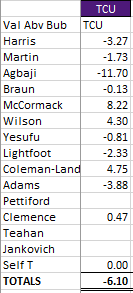
CtH’s ranking of the 3/1 TCU game
McCormack had a score of +8.22, meaning that after factoring each made shot, missed shot, free throws, rebounds, steals, turnovers, forced turnovers, defensive possessions that did or did not lead to points, as well as minutes played; he was 8.22 points better than the average KU-level replacement 5-man would likely be. This may seem surprising on a night where he was 2-6 from the field; then again by selecting the stat 2-6 on FG’s, we’ve already biased the entirety of McCormack’s performance.
McCormack also went 7-9 on FT’s, to finish with 11 points. Given that he had 6 official offensive rebounds against 1 turnover, his offensive rating was 118.9 on Torvik with 32.2 usage. This is a very solid offensive outing. Note that this also ignores something the video shows, that McCormack hustled to recovery two loose balls on offense that would have been turnovers on bad passes from his teammates (at about the 18:06 mark and 6:52 mark of the 2H). All said, his activity winning possessions and FT shooting outdid the few missed layups he had in close.
Remembering missed layups is the perfect example of selective memory. Here’s Tait’s write-up that tells us more about Tait’s ability to rate players than McCormack’s actual performance on Tuesday:
McCormack never got going in this one, missing so many close-range shots and struggling to gain control of himself throughout. He finished with decent numbers — 13 points and 8 rebounds — but he played just 21 minutes and got so many of those rebounds by badly missing in close.
According to the official stats, McCormack missed 2 lay-ups in the game, one at the 17:57 mark and one at the 16:16 mark of the 2H. It’s tough to agree that D-Mac missed “so many” close-range shots. Now he did miss 2 jumpers inside 8 feet as well, but these were contested. Either way, that is what stuck in Tait’s mind the most, so that is why McCormack was seen as KU’s 10th best player out of 11.
Yet after discounting McCormack’s night, Tait realizes that 13 (actually 11) & 8 aren’t actually terrible. This is the first sign he is starting to come to terms with his own bias. Unfortunately, he doubles down and provides a few more throw away lines that attempt to justify his ranking but only show us his ignorance. Yes, McCormack’s 21 minutes were not as many as he’s had in prior games, but it’s tough to say that limited minutes should discount a player’s performance in your rankings when your top player is someone who played in 1 total possession the entire game.
Another canard is that McCormack’s high offensive rebounding rate is due to him missing close shots. I read/hear this so often, that I might go back through the game logs to see how frequently this actually occurs. For starters, it’s a way to discount the fact that David McCormack is leading the nation in offensive rebounding percentage (OR%), at 20.4%. In other words, he rebounds 1/5 of his team’s misses while he’s on the court.
Tait is appealing to this bit of conventional wisdom, however of his 6 offensive rebounds Tuesday night, only 1 was off his own miss. The other 5 were off a Jalen Wilson missed jumper (5:15 1H), a Dejuan Harris missed 3-pointer (17:58, 2H), a Jalen Wilson missed jumper after a block (15:06 2H), an Ochai Agbaji missed jumper (6:55 2H), and a Christian Braun missed layup that was blocked (5:58, 2H). The only rebound off his own miss came at the 5:06 mark of the 2H, and it was a miss on a post-up jumper. This rebound would lead to Jalen Wilson driving and getting fouled, proving further it added value to the possession.
Tait isn’t close to correct in what he’s saying. But even if he were, remember the axiom that an offensive rebound neutralizes the mal-value of a miss. Even if McCormack were blowing layups out of proportion, in getting back his misses he is not harming his team one bit since KU retains possession. His 112.2 ORtg (and 117.8 Conf ORtg) on KenPom agree here.
Another axiom is that all misses are equal, namely that it doesn’t matter if a possession ends in a missed layup or missed deep 3, the value of the possession is still 0 points. Let’s explain why that is. In basketball, teams are attempting to get the most efficient shot, which occurs closer to the rim than further from it. McCormack is the best on the team at getting close shots, using his size, length, and skill set to get a bulk of shots in close. Yes, him missing these shots is frustrating. But it is quantitatively no different than when some other Jayhawk misses a deep shot late in the possession because he isn’t large or skilled enough to get a close one in 30 seconds of the shot clock. Selective memory only recalls the missed bunnies he has; it discounts his ability to get so many close shots. And he still makes enough of them (while also shooting well from the line) to be a solid offensive contributor.
Tait also had this to say about McCormack:
Give him credit for fighting to get them back, but had it not been for a 7-of-9 night at the free throw line, McCormack’s numbers would’ve matched the way he looked in this one. It’s going to be real interesting to see how he looks against that big, athletic TCU front line in the rematch.
Tait does finally realize the value of winning offensive rebounds back, yet he unfortunately discounts the skill of shooting well from the line. 7/9 is 78%, which isn’t astronomically higher than his season percentage (70.8%) and his below his percentage from last season (79.8%). McCormack’s energy and hustle got him to the line, where he converted.
But it was interesting to see the last bit, the one praising TCU’s front line. TCU certainly dominated the Hawks on the glass, 47-35. McCormack’s countpart, Eddie Lampkin, had 9 rebounds (4 offensive). This would make it seem like McCormack was giving up more than he was scoring. However this was not the case at all.
Lampkin finished with only 2 points. Other interior players, including Xavier Cork (8 points), did have solid games. But this is where charting defensive plays helps. Without seeing how KU’s defensive possessions went, we are only left guessing as to how each player performed on defense. Let’s look back at Lampkin’s only bucket. It was early in the game, when he hit an elbow-jumper with 17:39 in the 1H. It occurred not when D-Mac was in the game, but when Mitch Lightfoot was. Lightfoot was clearly out of position, over-hedging the ball screen and allowing his man to slip and have an uncontested look.
After charting each possession, we see that McCormack’s defensive contributions only led TCU scoring on two different plays, first when he overhelped in the first half and forced Christian Braun to block out his man at the rim (leaving CB’s man uncontested for a put-back) and second when he goaltended a contested layup that didn’t appear to be going in (on a play where CB fouled the driver for an and-1). In 21 minutes, that was it. Needless to conclude, this was a good performance on defense by D-Mac. (As a comparison, Mitch Lightfoot and K.J. Adams combined for 13 points allowed in 19 minutes of play, far more than McCormack gave up in slightly more minutes).
Now for the season, McCormack’s defensive efforts have been rather poor. He is allowing 15.6 points per 60 possessions, which is second-worst on the team behind Mitch Lightfoot (of players playing at least 10% of possible minutes). After accounting for his rebounding, blocks, steals, and forced turnovers; he grades out as a -0.63 per game defender. He’s struggled on this end his whole career, and this season is no different. But he does have solid games from time-to-time.
On the other hand, Ochai Agbaji gave up 23 points in his worst defensive outing of the season. This wouldn’t be known if not for charting the game. While Agbaji will likely bounce back on Thursday, defensive performances tend to fluctuate more than offensive ones, there’s no possible universe in which Ochai was the third-best Jayhawk and McCormack the 10th-best Jayhawk on Tuesday. None.
The last thing I’d like to talk about is the season standings that accumulate each game and appear at the bottom of each Kusports.com Ratings write-up. For one, I’m not sure how the totals are arrived at. It seems, although this could be wrong, that each player receives points in inverse to the number of players that game. So if KU plays 10 players in a game, the #1 player of that game gets 10 points, the #2 player of that game gets 9 points, and so on. But this would only work as a sensible system if every game saw the same number of players play. For instance in games where only 8 players play, the #1 player is only getting 8 points, not 10.
A second problem is that there have been a number of missed games due to injury, illness, suspension, or coaching decision. So while the season standings are an accumulation, it isn’t true that each player has played an equal amount of games.
To his credit, Tait attempts to control for this by putting superscripts to indicate that a certain player his missed one or more games for some reason. But the effect is to make it look clunky. There are six Jayhawk regulars who have missed action because of non-coaching decision reasons, and each has a different symbol or letter to reflect this. For instance Wilson has a bullet-point to indicate he missed three games due to suspension, Agbaji has a + sign (although in the notes it has become a bullet-point as well), and other players have a letter, either x, y, z, or b.
Either way, this leads to the question of how to account for player value (which is what the KUsports.com ratings are trying to do) when players play different numbers of games. As an example, Jalen Wilson didn’t provide any value for the team when he was sitting the bench serving his suspension. So in some sense he should see his value diminished. On the other hand, a per game rating allows us to project his value better (since presumably he won’t be serving any more suspensions).
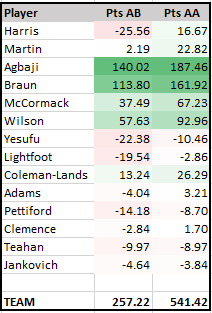
Charting the Hawks does provide both numbers against a hypothetical bubble player…per game and total. See 2022 here. In addition, I’ll add a third category below, or points above average. The average college basketball player is quite a bit worse (remember there are 358 teams) than your typical KU reserve.
Total Pts +/-
This chart shows the difference in rating, depending on how you define a “replacement player.” For instance, Dajuan Harris has been worse than the bubble-player that KU would expect to be able to recruit and develop. But he has been better than the average D-1 rotation player. So a team of Dajuan Harris-level players would likely be above .500 (depending on strength of schedule, of course), but would not likely be a tournament-level team.
This chart also shows that, even despite playing far more minutes, Harris still grades out worse than Remy Martin no matter how you compare the two. Harris has played the third-most minutes on the team, so his Pts AA is a larger increase to Pts AB than Martin’s change is. Yet when we compare Harris and Yesufu in Pts AA, we see that Harris’s additional minutes make him the better performer over Yesufu. So it is probably good to look at both numbers. Per game or per possession ratings can also help clarify value.
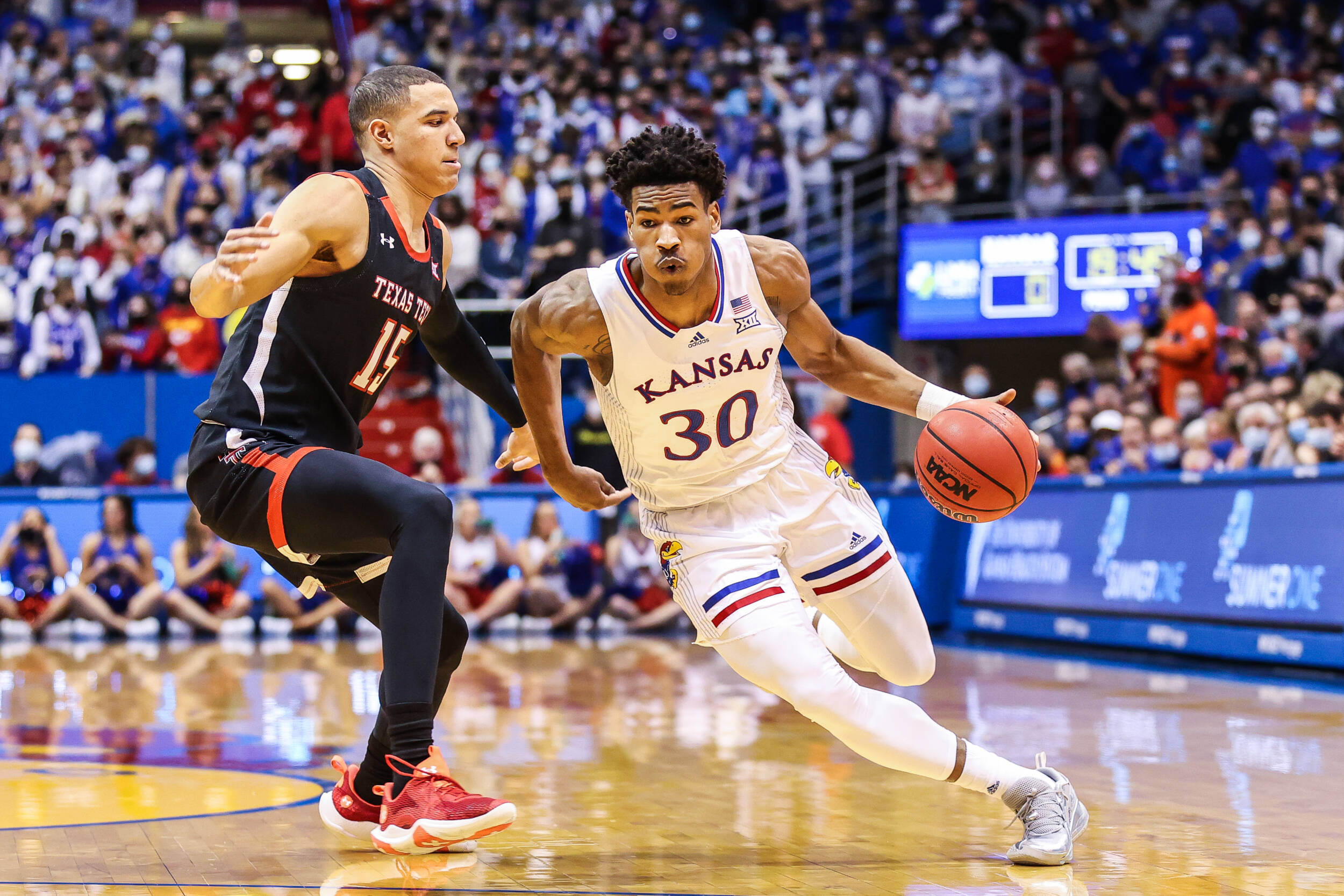
Ochai Agbaji had his best outing since the Texas Tech double OT game, and earned his 10th team-MVP of the year
Game Summary:
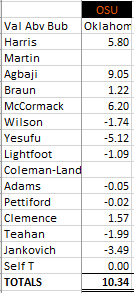
Kansas got solid outings from multiple players against Oklahoma State, with Agbaji adding the most value in the game. Och was active on both ends (had 10 defensive rebounds/steals/forced TO’s) to contribute over 9 points in value for the game. David McCormack had a double-double with 12 points and 12 rebounds, and Dejuan Harris also finished with 12 points to go along with 5 assists and solid defense.
Zach Clemence got credit for 6 rebounds to offset an off shooting night. His energy and skill warrant more time moving forward.
Unlike last game where they were the two best players, Christian Braun and Jalen Wilson were not as sharp. CB managed to add some value, making him 21/25 with a positive-value game. J-Wil missed some layups with the game already decided, hurting his offensive production value.
Joseph Yesufu didn’t do much on offense despite playing over 22 minutes. He balanced an assist with a turnover, but it was his 1/5 shooting that affected his score.
Neither K.J. Adams nor Bobby Pettiford played long enough to record much activity. Adams fought for a loose ball to get a tie-up (that went OSU’s way) and Pettiford had a post feed to McCormack that got him an assist in the official box score.
The walk-ons made the final score closer than it should have been. A team score of +10.34 is lower than it otherwise would have been. For the game, the team’s offensive and defensive efficiency (opponent-adjusted) were each above-bubble.
Agbaji came back from a one-game absence to post his 9th team-MVP of the season
Game Summary:
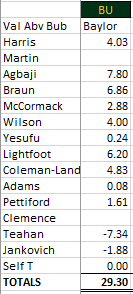
All 10 of KU’s rotation players posted positive value against Baylor. This is the first time to my knowledge that this has happened over the course of 15+ seasons. KU got great efforts from everyone.
Leading the pack was Ochai Agbaji, who finished with 18 points and 9 rebounds. He didn’t produce as much on offense as Christian Braun (18 points) did, but had the better defensive game. Mitch Lightfoot went 4-4 from the floor, added 7 rebounds, and only gave up 3 points on defense.
Jalen Coleman-Lands finished with 8 points in 11 minutes with solid defense. Dejuan Harris posted a very good score despite only scoring 2 points. He dished 7 assists and only gave up 3 points on defense over 28+ minutes of play. Jalen Wilson added 15 points and 4 assists, although his defense wasn’t good. David McCormack hit the glass to account for 8 rebounds, which was the bulk of his value considering he scored and allowed nearly the same amount.
Joe Yesufu and K.J. Adams are barely on the plus side, but Yesufu had a nice shot for 3 and played well on defense. Adams didn’t score but posted positive value because he played solid defense against a good team.
Both walk-ons had poor outings.
At +29.30, this was the team’s best game of the season. If KU had this type of performance against a bubble-team on a neutral site, it would expect to win by ~29.3 points.
Ochai Agbaji will not play the Iowa State game tonight (February 1, 2022) due to Covid protocols. Before the news the opening line was -4.5 KU, however it now sits at -2.5 KU with fewer than four hours before tip-off. It could go move more in that time period, but as of now it’s only moved 2 points in favor of ISU following the news.
This seems to be too small of movement. Ochai Agbaji has been KU’s best player, averaging 20.9 PPG on 46.4% 3-point shooting. He is getting attention as a national player of the year candidate, and is certainly on pace to reach first team all-American. Other Jayhawk notables such as Remy Martin or David McCormack who could theoretically take more of a scoring role in his absence have struggled for much of the season.
Player value is what this site is about. Before we get to what the stats say, let’s look back at a couple of other recent instances where a star KU guard missed a road game and what happened to the line. In the 2020 season, PG Devon Dotson was a late scratch for a road game at Oklahoma. Kansas was just coming off a rough home lost (sound familiar?) to Baylor, and the news was concerning for those wanting the Hawks to get back on track. The line started out as -6.5 KU and finished at -4.5 KU, a movement of 2 points. For some reason, memory seems to indicate that the line moved even more toward OU before reverting back toward KU closer to tip. A Marcus Garrett-led Kansas team would pull away in the second half to win 66-52.
Just last season, Marcus Garrett was the star guard finding himself as the one missing a road game (this time against TCU). Once again, Kansas was coming off a bad home loss (this time to Texas). Dajuan Harris would get the start, David McCormack would finish with 20 points, and KU would cruise to a 93-64 in Fort Worth. Interestingly, the line moved from -4 KU to -6 KU, indicating that Garrett’s injury was likely announced before betting was opened on the game, thus his injury had no effect on the difference between the beginning and closing lines. KenPom, who doesn’t adjust his lines for player injury, only had KU as 4-point road favorites. If anything, Vegas was undisturbed by Garrett’s absence.
The lesson going in to tonight is don’t count out Kansas yet. Even without Ochai, they have a solid rotation and are playing against a team ranked 113th in adjusted offense.
Ochai’s Value
So far in the season, Charting the Hawks has Agbaji as a +6.29 player, meaning he has been 6.29 points better than a hypothetical replacement player. This replacement level is set at the “bubble” level. In other words, the comparison is to a player who provides average value for a bubble team (think starter but not star for a bubble team). A +6.29 score is very good, and Agbaji’s 2022 season would be the fifth-best season of any Jayhawk since 1997 should it hold.
Our first estimate of not having Agbaji will be -6.29 for Kansas. So if Vegas thought KU would be -4.5 with Agbaji, maybe without him the line should be +1.5 or +2.
This is but the first estimate. We must consider other factors. For one, neither KU (nor any other team) has a player that is a precise “replacement player” in terms of value. Ochai’s minutes aren’t going to be replaced by someone exactly -6.29 points per game worse than he. Rather, they will be distributed among different KU players, some of whom are skilled players and positive contributors. For the season, Agbaji is playing 85.7% of KU’s minutes, or 34.3 out of 40 minutes. So KU will need to come up with about 34 minutes to make up what Och has been averaging.
A decent portion of these minutes will go to Christian Braun and Jalen Wilson, two wings who are playing better than the hypothetical “replacement player” we discussed earlier. Likely some additional minutes will go to Remy Martin (if healthy) and Jalen Coleman-Lands. Again, both of these guys are better than replacement level, but not by much. There’s also a chance that K.J. Adams gets some minutes at the 4 to account for less wing depth. He has also been a positive-value KU player.
Perhaps Pettiford and Yesufu, two PG-types with poor seasons to this point, will play more, but it’s not likely that either will need to play much even with Ochai’s absence.
The point is, KU will be replacing Ochai’s minutes with better-than-average players, even though no one has been at Agbaji’s level of performance this season. To calculate a more accurate loss of value, we will distribute Ochai’s minutes mostly to the wings (Braun, Wilson, Coleman-Lands, Adams) and a small portion to the guards (Martin, Harris, Yesufu, Pettiford). From there, we will take each player’s per-minute value, leveraged up to the estimated minutes each will play tonight. Adding this together, we get a new team value-score of +4.87. Since the current team value-score is +8.84, we estimate that Agbaji is worth about four points to this year’s team.
Final Thoughts
These estimates have trouble taking into consideration how differently KU might play without Agbaji. Luckily for Kansas, it has quite a bit of wing and guard depth. Furthermore, Och’s shot volume will be replaced by capable players even though these guys haven’t been as good as Agbaji of course. Another factor is scouting. Not having Ochai might throw off Iowa State’s defense, which has prepared to play against him. KU might have new sets that get them an extra bucket or two that their opponents weren’t prepared for.
Hoop-explorer tracks on/off efficiency, essentially showing how a team does when a certain player is on the court vs. off the court. Unsurprisingly, KU has been much better with Agbaji in the game (Net rating of 32.1 vs. 8.2). This is quite a large difference. But some of this is due to Agbaji being out of the game in weaker lineups. Once you remove the walkons, Yesufu, Clemence, and Pettiford; the difference is less pronounced (32.9 vs. 18.1). This works out to about a 9-point difference over a period of 68 possessions. That’s still a big gap. So who knows?
In closing, the line only moving 2 points is likely undervaluing Och’s presence on Kansas. If KU with Ochai is 4.5 point favorites, they are probably either -1 or even Pick without him. However, in a one game scenario, I’m not sure if that is a huge betting edge.
Ochai Agbaji’s career high of 37 points was matched by solid defense.
Game Summary:
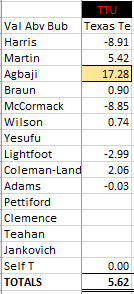
For the second consecutive game, Ochai Agbaji had the best game of his career. Finishing with 37 points, Ochai only gave up 9 points on defense, a stout number in 46+ minutes of play. Agbaji also grabbed 7 defensive boards, including a few clutch ones in double-OT. Remy Martin had the second best game of any Jayhawk. Despite scoring only 4 points, Martin only gave up 2 points, and produced additional value with 6 assists and 3 forced-turnovers. His energy really sparked the Jayhawks, and hopefully there is more to come.
Coleman-Lands didn’t play a ton, but he was solid in his nearly 5 minutes of play. He made a jump shot while not giving up points on defense. Christian Braun and Jalen Wilson, in 48+ and 47+ minutes each, had slightly positive contributions overall. Both had nice plays toward the end of the second OT, sealing the win for the Hawks.
K.J. Adams has the most misleading score, as he was guarding Tech’s Bryson Williams for most of the time he played. Adams gave up 9 points (3 off a banked in jump shot), but scored 6 of his own to go with 6 rebounds and 0 misses/turnovers. Unlucky defense will even itself out over the course of a 35 game schedule, and Adams showed he is capable of playing at this level moving forward.
Mitch Lightfoot was in foul trouble for much of the night, and ended up giving 9 points while only scoring 4. He’s had better outings for sure. David McCormack had his second-worst performance of the season, partially due to Bryson Williams playing outstanding. Still, whenever Tech needed a pop-out 3 they did so going against McCormack. Big Dave also failed to collect important defensive rebounds in crucial times.
Last, Dejuan Harris had a poor outing on both ends. He has produced 4 consecutive negative games since hitting the game-winning shot vs. Iowa St., his worst performance being against Texas Tech.
The team’s score of +5.62 was about 4 points below expectation, as you’d want KU to win a bit more comfortably than they did. KU built up a 12 point lead with about 6 minutes to play, and it was still 8 before Tech won a few offensive rebounds off missed free throws and converted to cut the lead to 4. Personnel questions were also abundant; KU seemed to struggle once Martin came out for good with 5:04 left in regulation. The final 15:04 were played by Harris as the sole ball-handling guard, and KU was -5 in that stretch.
Ochai Agbaji earned his 6th team-MVP of the season, scoring 20 points as well as playing great defense.
Game Summary:
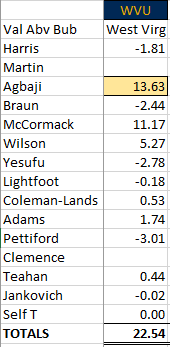
Ochai Agbaji was the overlooked player in KU’s 85-59 win, as 20+ point games are quite common for him now. However, it was Och’s defense which made him so valuable, only allowing 2 points the entire game. Och’s value score against the Mountaineers is the highest game performance of any Jayhawk this season. Of course, the performances of David McCormack (19 points, 15 rebounds) and Jalen Wilson (23 points, 8 rebounds) were a welcome sight to KU fans. The two best returning offensive players from last season finally got going, showing how high the team’s ceiling can be if everyone is playing well. Wilson’s performance was tempered somewhat by poor defense, but for the season he has shown enough improvement on that end to make one think that the last game was a one-off performance. Other positive performers included K.J. Adams, Jalen Coleman-Lands and Chris Teahan.
On the other side of the value-ledger, Christian Braun struggled to finish at the rim in the first half and had his second consecutive negative-value performance after starting the season with fourteen positive games. Another notable would be the play of Joseph Yesufu, who got more minutes Saturday than he typically sees. While his value score wasn’t pretty, he did make some athletic plays, making one think that he is due for a breakout game and some positive-value performances in the future.
With a team score of +22.54, KU broke a slump of poor games with its second-best opponent-adjusted performance of the year (Missouri).
Ochai Agbaji had his 5th MVP of the season, tying him for the team lead with Braun
Game Recap:
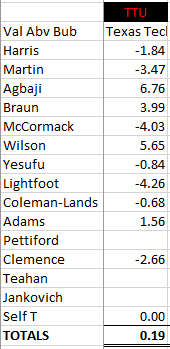
KU got solid performances from four of its wings: Ochai Agbaji, Jalen Wilson, Christian Braun, and even K.J. Adams. These four accounted for over 71% of the team’s points in only about 52% of the team minutes. On defense, these four only have up 40% of the 75 points the Jayhawks allowed Texas Tech. Ochai Agbaji was the team MVP, scoring 24 points and ending with a 1.34 offensive efficiency rate.
Once again, it was KU’s guard and post positions which were a let-down on both ends of the floor. David McCormack failed to follow up his Oklahoma State performance with a good game, as did Dejuan Harris. Remy Martin 12:25 of game play were the fewest in a game this season (aside from the George Mason DNP-injury), making one wonder if he is fully recovered.
The team score of 0.19 was the fourth-worst on the season.
Christian Braun had his 4th MVP game of the season
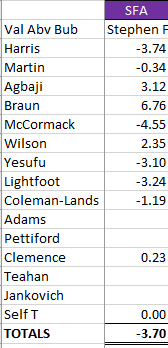
Although it was closer than expected, KU’s talent shown through at crunch time, and the Jayhawks held on to win, 80-72 over Stephen F. Austin. With Kansas being about a 22 point favorite from the computers (Vegas had it at 23.5), the 8 point win meant this was KU’s second-worse performance of the season. Below are the value scores:
Christian Braun has now produced positive value in all ten games this season. He was the most valuable Jayhawk against SFA with a value above bubble of +6.76 points. As in most games, he filled the stat sheet. Along with being the leading point producer, he won 9 defensive possessions Saturday night, the most on the team.
Ochai Agbaji did not have his best game finishing scoring chances (two missed dunks), but played solid defense in 39 minutes, only giving up 7 points defensively. He produced +3.12 points above bubble, showing that his improvement in the off-season has brought up his “floor” immensely.
Jalen Wilson had a nice night off the bench in about 20 minutes. His one 3-point attempt didn’t fall (making him 1-15 on the season), but he made some shots in the midrange. His defense has remained steady in 7 games this year, and it helped provide value for his team last night.
Zach Clemence didn’t play much but scored on a put back attempt following an offensive rebound. His defense wasn’t great in the few minutes he played, but still managed to produce an overall positive value game.
Remy Martin was clutch, making a late 3-point basket to give Kansas a more comfortable 6 point lead during the final minute of play. However, he gave up a quick lay-up soon after. He struggled to get going and had some defensive lapses, leading to a slightly negative game.
Jalen Coleman-Lands made a couple free-throws in a few first-half minutes (he didn’t play in the second half), but also played poor defense.
Joseph Yesufu gave up two buckets in his few minutes of play, once on a mismatch inside and once giving up a drive to a guard.
Mitch Lightfoot played the bulk of the minutes inside, giving up some scoring to SFA’s skilled big Gavin Kinsmil. However, he hit the offensive glass to the tune of 4 boards.
Dejuan Harris only took one field goal attempt, a missed dunk. He did put in four FT’s to ice the game away. While he struggles to produce points aside from assisting, his defense last night was as good as it could have been.
David McCormack had a very poor game, finishing with only 2 points and battling foul trouble all evening. Still, you need more than 10 minutes out of him.
TEAM was at -3.70, meaning a similar type performance against a bubble team on a neutral site would result in a 3-4 point loss. Kansas is getting very consistent positive performances from Ochai Agbaji and Christian Braun. The team normally gets at least an okay game from Martin and Wilson. But it is the others; in particular McCormack, Lightfoot, Coleman-Lands, and Harris; who mix good to great games with bad ones.
Note that K.J. Adams was out sick and was unavailable. Bobby Pettiford is also still recovering from his injury, so KU only dressed 10 scholarship players (all of whom played) for this game. Agbaji, Braun, and Martin all played season-high minutes (39, 36, and 35), which resulted in a game which saw the least amount of bench-play so far this season. Using the HHI player rotation metric (higher means less substitution), the SFA game was at 0.73, well beyond the range of 0.50 – 0.66 that the season’s first 9 games had seen. The rotation is being tightened as conference play nears.




 Charting the Hawks