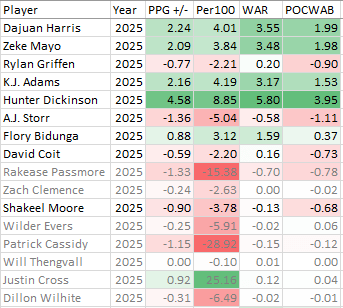
2025 Kansas Jayhawks

The 2025 Kansas Jayhawks finished the season at 21-13 (11-9). Kansas earned a 7-seed before losing in the First Round of the NCAA Tournament. The team’s Sports Reference page is here.

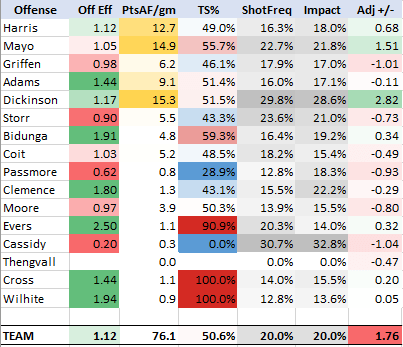
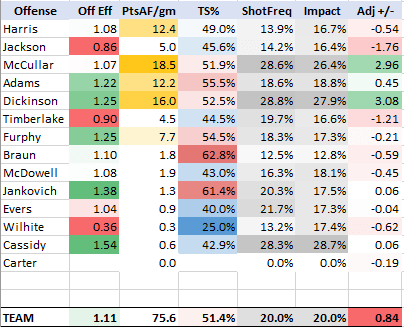
Offense

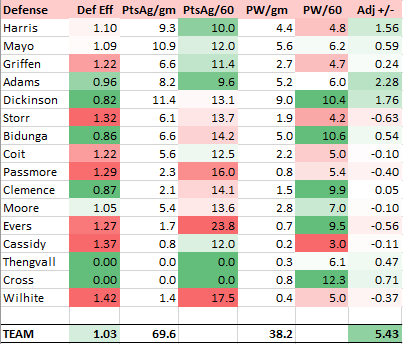
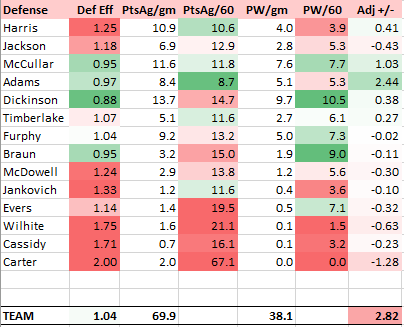
Defense

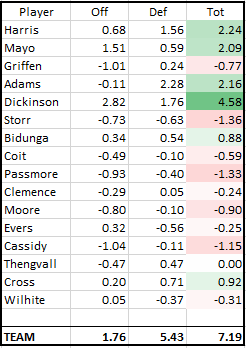
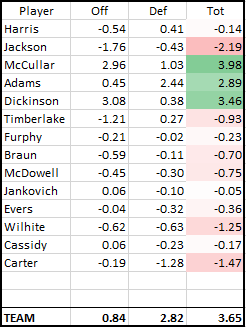
Total

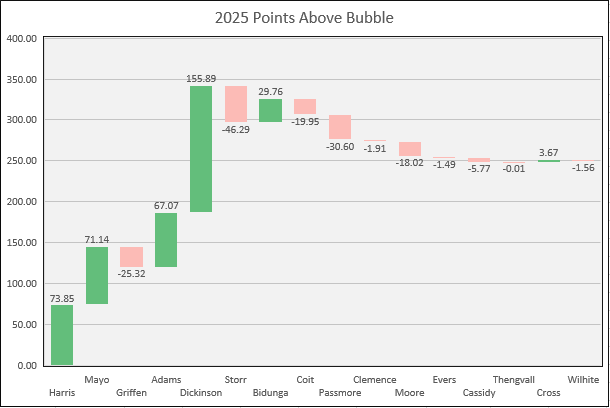
Points Above Bubble

Value 4 Ways

Season Write-Ups

2025 Season Preview (10/15/2024)

What Will 2025 Bring (1/2/2025)

Dajuan Harris’s Value in Context (1/31/2025)

Value Splits (2/12/2025)

The Un-Clutch 2025 Jayhawks (3/3/2025)

Grading the NCAA Tournament Committee (3/17/2025)

Season Recap (4/8/2025)

2025 Season Preview

The 2025 Kansas Jayhawk basketball season is underway. Starting this week on Friday, with Late Night in the (recent renovated) Phog, KU basketball will have some sort of contest at least once each week now until either late-March or early-April. KU will have a couple of exhibition contests before officially beginning the regular season on Monday November 4, 2024.

The Kansas roster is set, with KU having 12 healthy scholarship-players available for the 2025 season. Bill Self has said it is likely one player redshirts, and going through the roster we see the likeliest candidate as Jamari McDowell. But for the other 11 players, we have projected the impact we think they will have on the 2025 Kansas Jayhawks.

Group A: The Returnees

Dajuan Harris PG (C Sr.) Projections: 75% Mins, -0.20o, +1.18d, +0.98 PPGAB, +1.86 Per100, 2.48 WAR

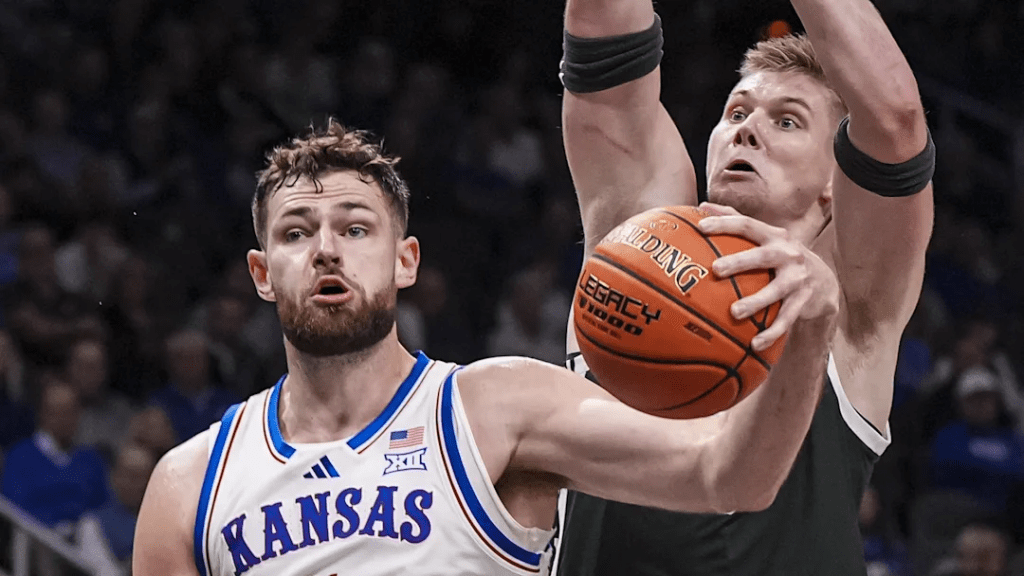
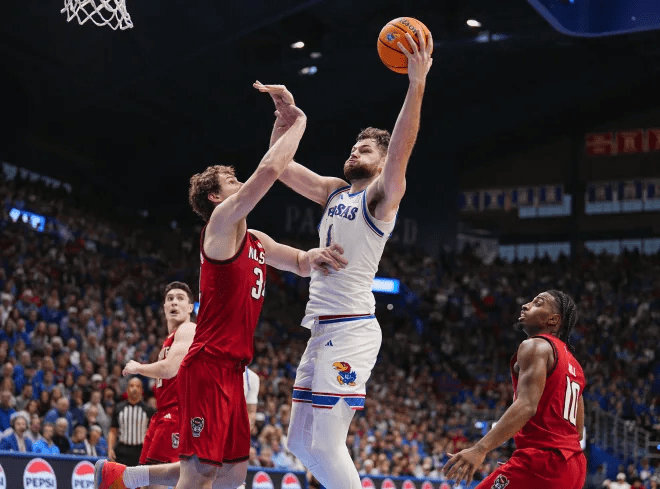
Hunter Dickinson C (C Sr.) Projections: 75% Mins, +3.00o, +1.09d, +4.09 PPGAB, +7.80 Per100, 5.67 WAR

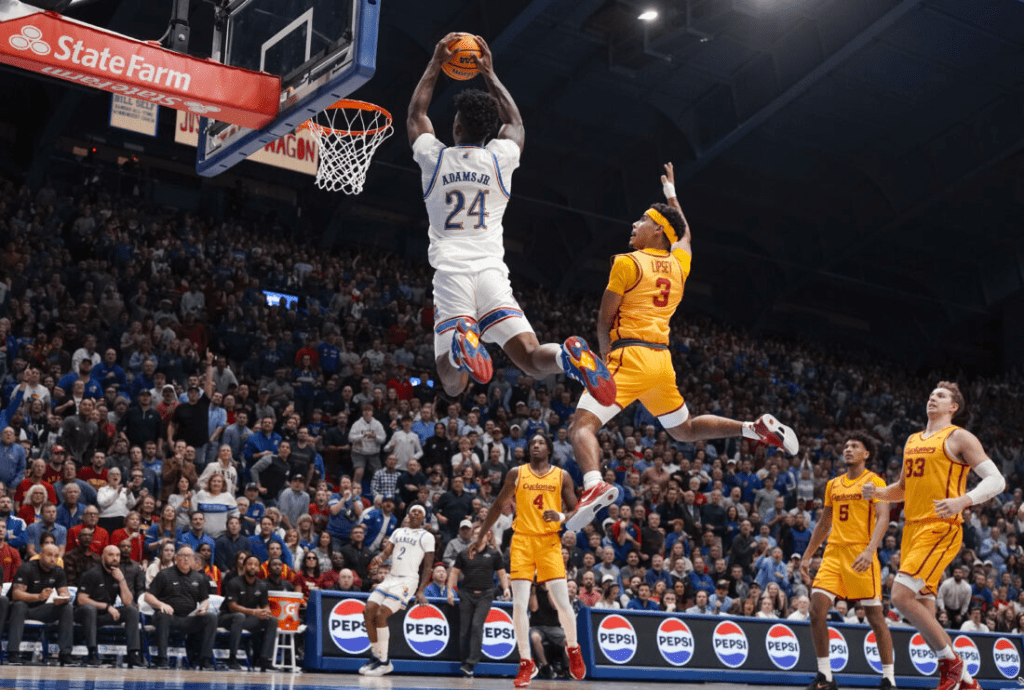
K.J. Adams PF (Sr.) Projections: 75% Mins, +0.50o, +2.01d, +2.51 PPGAB, +4.78 Per100, 4.05 WAR

As a collective, bringing back these three is the best thing that happened in the off-season for Kansas. Continuity is proven to be beneficial in college basketball, and each of these players has proven he can be solid, above-bubble value-adders on both ends of the court. The demise of their talents, presumed upon due to last season’s failures, is greatly exaggerated. The struggles from 2024 were largely due to extremely poor play from the bench and the injury to Kevin McCullar. While Harris, Dickinson, and Adams aren’t without flaws, each is a KU-level starter at his position at worst. Expect these guys to produce.

On to a discussion of their projections. Bill Self stated he planned on playing each fewer than 30 minutes per game. We’ll see if he sticks to those plans. Self is notorious for playing his bench limited minutes, and Dickinson’s minutes last year weren’t any more than he was playing at Michigan. By setting each at 75% of available minutes, we’re putting their loads right at 30 mpg. While there is more depth this season behind this initial trio, it’s just tough to go any lower than this level of playing time. You’re gonna see a lot of Juan, Hunt, and K.J.

As you should. Dickinson in particular is an elite offensive weapon. Should his free throw shooting pop back up into the upper-70’s or so where it belongs (it was 62% last year), he will take care of the only real weakness in his offensive game since coming to Lawrence. Hunt only had two games where he failed to reach double-figures, and aside from those two games he was producing bubble-level or (more-often) better offense each night for Kansas. Such offensive consistency is tough to find. That’s why we think Hunt’s better than a bubble-level center by 3 points per game. Defensively, Dickinson’s rebounding stands out. His kryptonite is on the high-ball screen, and if adjustments aren’t made on how he covers that his defensive number will be lower than our projection.

Dajuan Harris has never been a scorer, but his assists and shooting touch can get him closer to bubble-level on that end. Aside from a shocking start to the season a year ago, Harris as an upper-classman has been a good-enough offensive point guard. Where he justifies starters-minutes is from his defense.

K.J. Adams compliments Dickinson nicely on the floor. It’s commonly spewed out that Adams’ presence somehow clogs things up for Dickinson, but is this the case? Adams is constantly moving on the offensive end. He moves the ball with the pass and attacks with the dribble to either score or serve. The best offense isn’t to put one big guy in the middle and have four “shooters” stand stationary around him, as some lower-IQ fans would think.

Adams will produce around 0.50 points more per game than a bubble-player would, making up for a limited outside shot for extremely athleticism in finishing dunks and rim-runs as well as a nice touch with floaters and solid ability to draw fouls. But like Harris, Adams’ better end of the court is the defensive side, where he is versatile enough to guard anyone 1-5. He matches up best against wings and disrupts opposing offenses by getting in passing lanes, contesting shots, and walling up against potential penetration.

Group B: The Best from the Portal

A.J. Storr SF (Jr.) Projections: 65% Mins, +1.10o, +0.52d, +1.62 PPGAB, +3.57 Per100, 2.94 WAR

Zeke Mayo SG (Sr.) Projections: 65% Mins, +1.30o, +0.43d, +1.73 PPGAB, +3.81 Per100, 3.06 WAR

Rylan Griffen SF (Jr.) Projections: 60% Mins, +0.25o, +0.15d, +0.40 PPGAB, +0.95 Per100, 1.59 WAR

Storr is the class of the portal pick-up in the off-season, and he is certainly KU’s best chance at having an NBA draft pick in 2025. Everyone knows his solid year at Wisconsin a season ago, but we’re tempering expectation given his poor freshman year at St. John’s. A.J. will need to learn to score within a high-powered and multi-functioning Kansas offensive system. He will need to be aggressive at times but be willing to be the second or third option at others…and know when to do which. This may be a bit of an adjustment.

Storr is the Kansas player with the best chance to blow away expectations, ala Ochai Agbaji, Jalen Wilson, or Kevin McCullar their final seasons at KU. We don’t project it, but wouldn’t be surprised if he did play at an All-American level.

But Zeke Mayo is more likely to be the best-performing newcomer Jayhawk for 2025. Mayo is a smooth shooting guard who hit 38% of his 3’s and 87% of his FT’s at South Dakota State. Mayo also has decent rebounding and assist numbers without turning it over too much. He should fit easily into Kansas’ system.

Griffen comes in as another proven shooter, having torched the nets at 39% from downtown last season while playing for Alabama. What is his defense like? Will he be able to expand his game from primarily spot-up shooting? As a junior, Griffen shouldn’t be overwhelmed at Kansas.

Group C: The Rest of the Portal

Shakeel Moore PG (C Sr.) Projections: 30% Mins, -0.25o, +0.21d, -0.04 PPGAB, -0.17 Per100, 0.55 WAR

David Coit PG (Sr.) Projections: 11% Mins, +0.25o, -0.11d, +0.14 PPGAB, +1.76 Per100, 0.36 WAR

After the loss of Elmarko Jackson to a 12-month + injury, Bill Self was sure to have enough guard depth. He went out in the portal and got two PG’s who play different styles, with Self hoping to hit success with at least one. Shak Moore from Mississippi State is a solid defender with some scoring ability. He is himself injured and recovering to get ready for the season, but once healthy he has the chance to be a bubble-level type player. His counterpart for this back-up PG role is 5’11 David Coit, an offensive-minded player from Northern Illinois. He put up 37 in his final game as a Husky. The projections are for Moore to get more of a nod from Self, particularly against bigger opponents, and for Coit to shoot it well and add value in that way in small bits.

Group D: The Freshmen

Flory Bidunga C (Fr.) Projections: 15% Mins, -0.25o, +0.34d, +0.09 PPGAB, +0.87 Per100, 0.39 WAR

Rakease Passmore SG (Fr.) Projections: 14% Mins, -0.25o, -0.03d, -0.28 PPGAB, -2.87 Per100, -0.01 WAR

The projections were slotted to the player’s recruiting rank given historical precedence at KU. Last season this exercise worked out well when it accurately determined Jamari McDowell’s level of value. Bidunga’s minutes will be limited because he’s backing up Hunter Dickinson. Flory can find his role by hustling and getting easy baskets, contesting shots, and finishing alley-oops.

Passmore’s role will be dependent on how well he adjusts to the college game. He has a bit more of an opportunity because multiple wings can play at once, so he could find more minutes by cutting each of the other wings’ minutes by just a few. We know Self is high on both freshmen, but they are both freshmen and we expect them to be role players in 2025.

Group E: The Return of Clemence

Zach Clemence PF (RS Jr.) Projections: 10% Mins, -0.15o, -0.10d, -0.25 PPGAB, -3.64 Per100, -0.06 WAR

Clemence red-shirted last year and is primed to be a full-roster player for 2025. Zach has improved according to rumors, and these rumors are probably true given that he decided to return to Kansas instead of redshirt. The staff believes he has a role at Kansas, and he brings good size and a good shooting touch. His 2023 season was poor to say the least, and very disappointing given the promise he showed as a freshman in 2022. Clemence’s minutes, along with Bidunga’s and a few others, depend on how well they can do while they’re in the game and Self thinks it’s possible to play two bigs still (it is, but they have to defend the perimeter). Zach’s advantage over Flory is that he can stretch the floor a bit more, and maybe we’ll see both Zach at the 4 and Flory at the 5 when Hunter is resting.

TEAM Projections

+5.15o, +5.32d, +10.47 PPGAB (works out to a 28.96 KenPom rating)

A team with that type of point-differential is a strong candidate for a 1-seed, with a 2-seed or better very likely and a 3-seed about the lowest it’d go. That’s what we predict KU to be. An elite team who will be one of the odds-on favorites when everyone is filling out brackets and putting down closing bets in March. The tournament is tough to predict, so who knows after that. KenPom opens KU at a 24.42 rating, which is noticeably lower than what we see for the Hawks. Torvik isn’t much different at 24.4. Evan Miya has KU at 23.6. About everywhere has KU in the top 10, with the AP voters putting KU as the #1 team.

Let’s hope the season turns out better than the Allen Fieldhouse renovations did.

K.J. Adams’ Defense

After Jalen Wilson departed for the NBA and KU picked up 7’1 center Hunter Dickinson in the portal, K.J. Adams shifted his position from the 5-spot to the 4-spot in KU’s starting line-up. This shift has been seen on both ends of the floor. Offensively, he’s posting up less and making more plays on the perimeter as a creator (where he’s third on the team in assists). And while he doesn’t have what one would call “range,” he’s been making some mid-range jumpers and push-shots with Hunter underneath to rebound, which is what a traditional 4-man does when he is playing with a true 5-man.

But it is K.J. Adams’ defense which has been the most-valuable part of his game with his switch to the 4-spot. Last season, as someone primarily guarding the opposing 5-man at a height and length disadvantage, Adams was basically a neutral-value defender, finishing with a Per100 points-against bubble of -0.22. He gave up 12.7 points per 60 possessions (worst among the starters) as he had to battle inside. (Adams was able to benefit by having a slower player on him on the offensive end, so he did finish as a positive-value player overall (+0.49 per game)). In 2024, Adams is KU’s strongest defender, with a +5.01 Per100 value. And while his rebounding hasn’t really improved, he is giving up only 7.7 points per 60 possessions now that he’s guarding mostly wings and forwards. This defensive stinginess not only leads the team, but is close to the range of what KU’s best defenders have allowed over the past decades.

Since 2018, we have tracked defensive value at detailed-enough level to estimate which players were the best at not allowing points to be scored. This is seven seasons of data, including 2024. In this time, only three times has a player been a stingier defender than K.J. Adams this season. Marcus Garrett (2020 and 2021) accounts for two of these seasons. The other, which you wouldn’t probably guess correctly if you had 20 chances, was Isaiah Moss. While Moss didn’t rebound or force turnovers, he stayed close to his man and didn’t overhelp. Overhelping, particularly off wing shooters, is where many teams lose defensive value. Completely leaving one’s man should only be done to prevent an uncontested layup or wide-open 3 by a good shooter. Moss wasn’t overly athletic, but he had a high BBIQ as a veteran defender.

But back to K.J. K.J.’s value on the defensive end is estimated to be +5.01 points above that of a bubble-level player Per100 possessions. If we look at this from a per game ratio, then Adams is producing an estimated +2.91 points of defensive value above a KU-caliber replacement. According to current information, this would put him as having the 7th-best defensive season in the last 32 seasons (there have been 453 player-seasons in that time. K.J.’s 7th of 453).

That’s rather incredible. Whenever K.J.’s defense is talked about by fans, it’s often derided due to him not getting enough rebounds or having “short arms.” It’s true he doesn’t add value through rebounds or forcing turnovers. But he does an excellent job of not giving up easy scoring opportunities. He uses his strength to guard bigger players and his quickness to stay in front of guards. This versatility means he can easily switch positions 1-4 (and as we saw last season, can also play some against 5’s without being dominated). In turn, this forces teams to over-pass or take a less-than-ideal shot on certain possessions. All of this shows up in the numbers when we chart each defensive possession.

Note that these value estimates aren’t an exact science. Other sources don’t see him as having this much defensive value. Hoop-explorer doesn’t see much difference (although it relies on On/Off data which is very noisy and probably not wholly accurate). Evan Miya, which uses On/Off data and attempts to normalize the relative strengths of the other 9 players on the floor, has him as KU’s fourth-best defender. Without being overly critical, this seems to discount the on/off method for assessing player value. It isn’t K.J.’s fault if another teammate blows a defensive assignment when he’s in the game. While, with enough of a sample size, this “noise” would eventually even itself out (theoretically leaving you with just the player’s impact), it doesn’t seem to be the case unless there is a much larger sampling of minutes played. While K.J. has played 840 minutes so far, this only leaves 165 which he is on the bench. On/Off here isn’t really helping.

In 25 games this season, K.J. has posted positive defensive-scores in 21 of them. Teams aren’t attacking him much (like they would last season if they had a capable big). This means he’s doing his part. KU’s had defensive lapses, particularly among ball-screen coverage, but this is mostly due to Hunter being out of position (KU would do better to drop him rather than have him hard-hedge) or a separate wing/guard not being good at rotating over. K.J.’s fewest minutes in a game came against Chaminade, after he arrived following the death of his mom and didn’t start. He wasn’t expected to play, but did get on the court for 26 minutes and produced a small positive amount of defensive value. Self clearly wanted him on the court despite the opponent being a Division II team. This is further evidence that his defense warrants playing time, and is thus valuable.

Hunter Dickinson’s Defense

All KU fans agree that Hunter Dickinson is a skilled and valuable offensive player. Some argue that Dickinson’s defensive deficiencies (they take for granted he’s a poor defender) severely undercut his offensive value. This post will examine Hunter’s defense by comparing him to other players on this season’s roster as well as KU centers in seasons past.

A player can be a plus defender in one of two broad ways. He can either do so by limiting the amount of points his man scores or he can be a good defender by getting the ball back for his team (such as rebounding). Note that these are related. A defender getting a rebound is also preventing his man from scoring on a putback attempt. The very best defenders are good at both aspects–they limit their opponents’ good looks and they get the ball back for their team.

Applying this to Hunter in particular, we want to examine how often he is most responsible for the other team scoring (compared to others) and how often he wins possession back through a block, rebound, steal, or forced turnover (compared to others).

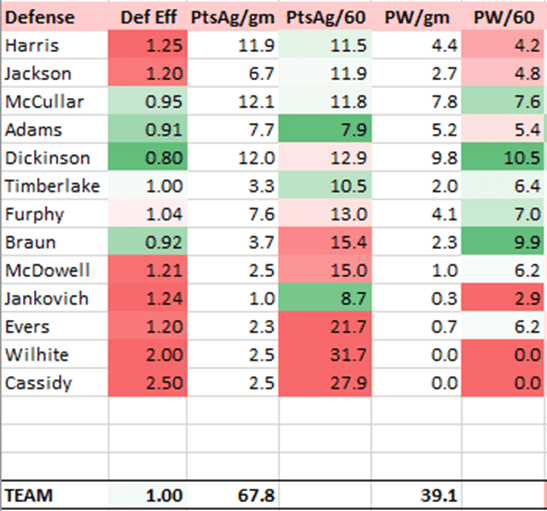
Using the Charting methods, we calculate that Hunter has allowed 276 points in 23 games this season (12.0 ppg). When we convert this to a 60-possession basis, this comes to 12.9 per 60. This conversion is done to compare Hunter to other players.

Next, we can count the number of stops KU gets because Hunter gets the ball back through either a block, rebound, steal, or forced turnover. As rebounds are most common way a defense gets the ball back after a stop, Hunter’s importance is mostly by being a great rebounder. He averages 10.5 possessions “won” over 60 defensive possessions.

For the 2024 team, we can consider this table.

Looking at the Points Against Per 60 column, this shows that Hunter (allowing 12.9 per 60) is worse than the other starters save Furphy (13.0 per 60). However, he is better than his backup Parker Braun (15.4). Additionally, only K.J. Adams (7.9) is significantly better than Hunter at disallowing points. Harris and McCullar have been in the middle-of-the-pack.

If we move to the far-right column, we see possession winners per 60. In this case, Hunter is clear-and-away the best at getting the ball back following a miss or through a forced turnover.

When some think of defense, they mostly consider the first aspect of this, or on-ball defense. And this aspect is very important. Not getting beat, not fouling, closing out on shooters, forcing a player to pick up his dribble and pass, etc. are all ways a defender can make it more difficult for the opponent to score. But the second aspect, or coming away with the ball, is also important. First-shot defense that doesn’t win the ball back will lead to second and third chances that can allow points. A player who might not be a great first-shot defender can still add value if he prevents opponents from getting second-chances. So, we need a way to combine these elements of defense into one number that estimates player value.

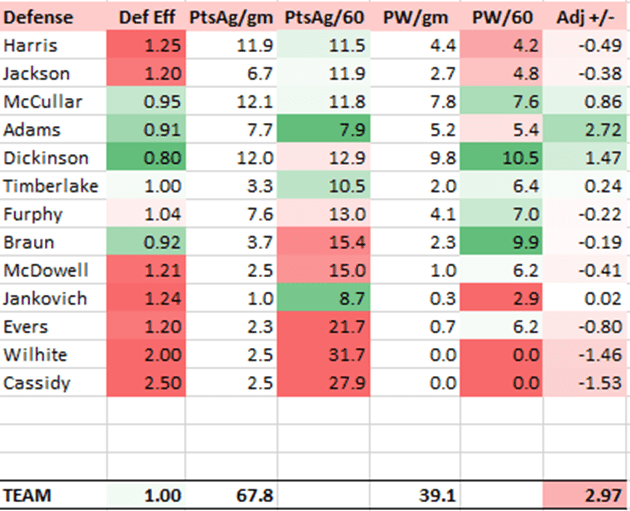
Using theory regarding the relationship to points and possession in basketball, we can calculate how valuable these defensive metrics are. We will now include the defensive value metric in the final column of the table.

This final column estimates, in points per game, how valuable a certain defender is when compared to a replacement (bubble-level) player. Due to his stingy on ball-defense, K.J. has graded out as KU’s best overall defender. But the second-best defender has been Hunter Dickinson–not because he is always great at disallowing points–but because he limits teams’ second-chances. Imagine KU without Hunter on the floor. Teams would get many more baskets through second-chance opportunities.

This is common among bigs in today’s game. The prevailing offensive strategy involves getting opposing 5-men away from the basket (to clear driving lanes and cutting angles). As Hunter is involved in ball-screen defense and plays on the perimeter at times while on defense, he is often put in situations where he can find himself out of position. This leads to breakdowns, rotations, and open shots for opponents. But this isn’t always what happens. Other times he defends fine, and the possession ends with a missed shot that he has a great chance of rebounding due to his height and good rebounding technique.

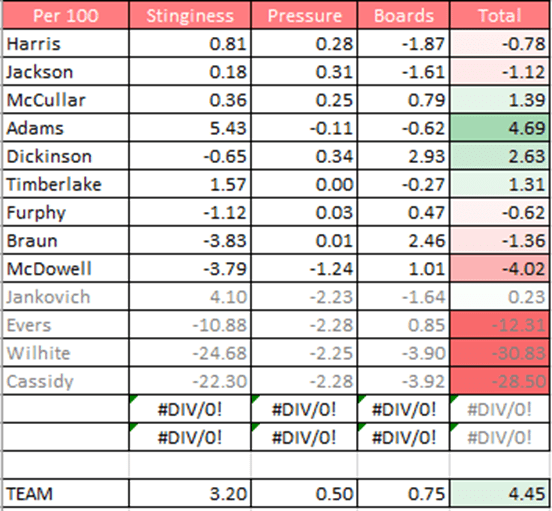
We can break down the defensive value provided by 2024’s roster further, using 3 categories and a Per 100 possession basis. These three categories are: Stinginess (or points allowed), Pressure (forced turnovers/steals), and Boards (rebounds).

Hunter’s Stinginess score is below-bubble, but at -0.65 points we estimate that it only costs KU less than a point per 100 possessions. His Pressure (+0.34) and Boards (+2.93) make up for it, leading him to be a +2.63 player over 100 possessions. This is nearly 4 points better than his backup, Parker Braun has been. He is also better defensively than all other players save K.J. Far from being a liability, Hunt’s been a valuable asset for the 2024 defense.

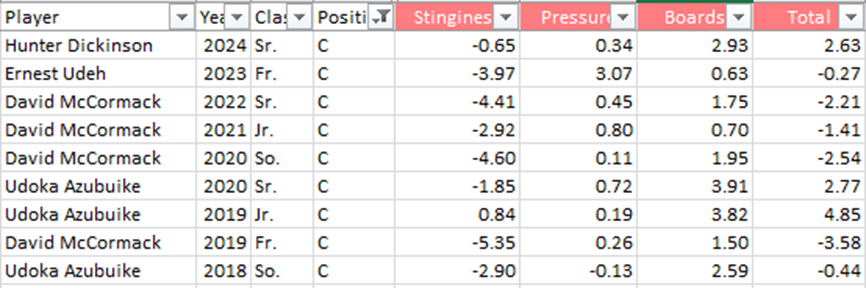
We can also compare Hunter to 5-men of past seasons. Below is a table of all players labeled center who’ve played 10% of minutes on the season or more since 2018. This includes 9 player-seasons.

Here we see a pattern. 8 of the 9 centers on this list have negative Stinginess value, showing that they are allowing points more often than the average defender. This makes sense. Teams are attacking the slowness of the big men to find an advantage that leads to points. However, once we move right, we see that the 5-men can Pressure and Board better than average. So while your guards are likely to be better at preventing open shots, they struggle to get the ball back. Hunter’s rebounding better than any recent center not named Udoka. Additionally, his overall defense is 3rd best out of 9 centers since 2018, again only behind 2019 and 2020 Azubuike.

We can expand this more, just with less detail. Since 1993, there have been 192 players who have played at least 40% of the team’s minutes during the season. Of this 192, only 45 have had a per game defensive value as good as Hunter’s having this year. He’s objectively around the 76th percentile of defensive players in recent Kansas history. Ignore people who don’t know how to track defensive value and fail to consider all relevant factors of defense.

In addition to tracking individual defense, we can confirm these general findings by looking at proxy metrics. One such metric would be points in the paint. This season, for reference, KU’s offense is averaging 40.1 points per game from paint scoring. That’s what a good offense does. A large chunk of this is from Hunter (although K.J. and Kevin are also doing well at the rim). So let’s use KU’s offense as a comparison to KU’s defense. The thought would be that if Hunter’s offensive-value is being wiped away by poor defense, then KU will be allowing nearly as many points in the paint as it is scoring.

This isn’t the case at all. KU is only averaging 25.8 points per game in the paint. This is a difference of 14.3 points, which is more than the overall point difference (10.9). KU is winning points in the paint but losing in all other areas (that is FT’s + 3’s + 2’s outside the lane). This is just further confirmation of Hunter’s value.

A Tale of Two Juans

Dajuan Harris’s last 15 games of 2023 vs. Dajuan Harris’s first 15 games of 2024:

Stat2023 – Last 15 Gms2024 – First 15 Gms
PPG11.36.9
eFG%62.8%48.5%
TS%61.5%471.%
APG5.87.1
A/TO3.02.6
SPG2.61.2
RPG2.92.2
ORtg109.6102.4
Pts AB +/-+48.39-44.98
PPG +/-+3.23-3.00
Per 100 +/-+5.14-4.84

The numbers speak for themselves. Another notable thing is that KU’s average opponent had a KenPom rating of +17.10 over last 15 games in 2023 compared to +4.77 over KU’s first 15 games in 2024. Juan’s drop in production and efficiency has come against weaker foes.

The last three numbers are the value scores, first in total points against bubble, and then rated in per game and per 100 possession bases. These numbers account for opponent strength as well as deeper defensive metrics such as points allowed (Harris is allowing 12.4 points per game in 2024; it was 10.0 over the last 15 in 2023).

Aside from assists, Harris has gotten worse in every facet of the game. But even with assists, his increase in assists has come with a greater increase in turnovers, meaning his overall “ball-handling” value has worsened.

This and That

The following bits of info relate to the 2024 season through KU’s first 15 games.

  • Johnny Furphy’s defense has been better than his offense. Per 100 possessions, Furphy is about -1.03 points to a bubble player on offense and 0.00 to a bubble player on defense. Furphy is shooting well, but he relies on assists to score and turns it over far more than he creates offense for others. Defensively, his coverage score is not terrible and he rebounds at an acceptable clip.
  • Elmarko Jackson has posted 3 above-bubble offensive games, or 20% of the 15 he’s played so far in his KU career. And 2 of these came in KU’s first 2 games. What’s giving him any playing time at the moment is his defense. Jackson has produced 10 positive defensive outings this season (67% of games).
  • K.J. Adams is KU’s best defender right now, posting a +2.23 average defensive game score. This is far better than his 2023 season, which was negative (-0.10). Adams’ improvement on defense is in large part due to him defending less in the post as an undersized 5-man, his role last season. Offensively, Adams has seen a slight decline from ’23 to ’24 (+0.60 to +0.44).
  • Kevin McCullar’s value-score improvement from last season to this season, on a per game basis, is +3.98. This is better than Jalen Wilson’s improvement from ’22 to ’23 (+3.34), Ochai Agbaji’s improvement from ’21 to ’22 (+3.09), and Christian Braun’s improvement from ’21 to ’22 (+3.83). The largest season-to-season jump on record is Frank Mason’s ’16 to ’17 improvement (+4.52). Thomas Robinson from ’11 to ’12 was +3.67. Tyshawn Taylor from ’11 to ’12 was +3.65. Other large jumps in the past include Raef LaFrentz from ’95 to ’96 (+3.67), Keith Langford from ’02 to ’03 (+3.59), and Drew Gooden from ’01 to ’02 (+3.41). There have certainly been other great career developments of steadier growth, but in terms of having such a large leap in value production in consecutive years, what McCullar is doing this season is very special.
  • Hunter Dickinson’s two worst value-score games (-10.40 vs. Marquette, -6.23 at UCF) have coincided with both of KU’s losses. Through 15 games, Hunter is currently KU’s second-most valuable player this season, but is neck-and-neck with Kevin for this distinction. If both can finish the season above +5.00 per game, they’d be the first duo since the Morris twins in 2011 to do this for a Kansas team.
  • Jamari McDowell has not proven to be the answer to the team’s poor wing play. The freshman has produced the worst Per 100 value of any scholarship player, at -7.91. After some initial stingy defense, Jamari has gotten scored on quite frequently in limited minutes. At best, McDowell is only going to be a role player and defense-first guy this season.
  • Parker Braun has been KU’s 5th-best player, and might warrant more court time. He is athletic and experienced. His value scores through 15 games have been 7 positive, 7 negative, and 1 right at 0. While he is at Kansas primarily to back up Hunter, there have been a few moments where Self has gone “small” and played Adams as the 5 when Hunter is sitting. But this leads to more minutes for guys (Jackson, Harris, Timberlake) that aren’t playing as well as Braun has, and haven’t shown enough offensive firepower to compensate the loss of not having a true center inside. Parker isn’t necessarily someone who will win you the game, but he is someone who can keep you in it until Dickinson can return.

Wrapping Up the Non-Con

KU's McCullar earns Big 12 award after second triple-double | KSNT 27 News

The 2023 portion of the 2024 regular season is wrapped up. KU went 12-1 during this non-conference stretch, a good result given the quality of opponents it faced. Using the NCAA’s Net Rankings, KU went 3-1 in Quad 1 games and 1-0 in Quad 2 games. Extrapolate that type of performance out over the rest of the season, and the Jayhawks will cruise into March as a 1-seed. But, this may not be that likely given a few concerning trends.

Best Game, Worse Game

Using a very similar concept to how Ken Pomeroy rates his teams, Charting the Hawks using a point margin difference to rate individual players or games. For CtH, a comparison level of a bubble-team is used to judge how well a player or the Kansas team itself is performing. This is in point differential (or margin) in comparison to a bubble-level mark. For instance, if we’d expect a bubble-level team to beat KU’s current opponent by 10 points (after accounting for location), and KU wins by 18, we’d say that KU had a “game score” of +8.00. This +8.00 score would also equal the net of all Kansas players’ individual game scores, as the system is breaking down each player’s value as a portion of the total team score.

This system is not perfect, but it does have the benefit of being easy(ish) to calculate and understand. In the non-conference, KU’s best game (relative to opponent) was its first one against North Carolina Central. KU’s game score was +24.04, meaning it won by 24 more points than a bubble-team would have expected to. On the flip side, KU’s 8-point win against Eastern Illinois garnished a game score of -15.43, indicating that the actual single-digit margin Kansas won by was about 15 points worse than what a bubble-team would have expected to achieve.

Looking at individuals, KU’s best performance in a game was Hunter Dickinson’s +17.63 margin against Tennessee. Dickinson scored 17 points in that game, but defended great (only allowing 3 points) and rebounded at an elite level, coming down with 20 official rebounds. The interior was owned by Kansas, forcing Tennessee to jack up 33 3-point shots, only to make 9. KU scored 20 more points than the Vols inside the arc that game.

Hunter also has KU’s worst individual performance. It occurred the night before the Tennessee game, against Marquette. Hunt’s score was -10.16 points, indicating a bubble-level player (think average player on a bubble-team) would be expected to play this many more points better against that opponent. In Dickinson’s case, it was the play of Oso Ighodaro which contributed to such a poor game score. Hunter had his worst defensive performance as Ighodaro scored 21 points that night, much of it against HD. In total, Dickinson would give up 26 points to Marquette while grabbing a season-low 8 rebounds.

While this was Dickinson’s worst game, on the season Hunter has been tremendous. Through 13 games, he is adding an estimated 5.35 points per game above bubble, second only to Kevin McCullar at +5.89. The team, as a whole, is averaging only +5.30 points per game above bubble. While the Hawks are 12-1, their point margins haven’t been as good as we’d expect.

Grading Projections

Before the season, KU was projected to have an average game score of +8.51 (vs. +5.30 in reality). This 3.21 point per game difference could be the difference of a win and loss in multiple conference games. In fact, KenPom’s predicted scores for KU’s conference games show 14 games out of 18 to finish within single-digits. KU having underachieving its desired margins so far is a sign of concern, as point margin has predicative implications. This doesn’t mean Kansas can’t improve. To see how, let’s break down KU’s performance to the player level.

This table shows each player’s 2024 projection and actual play through 13 games in points per game.

PlayerPre-Season ProjCurrent Actual
Dajuan Harris+2.50-2.79
Elmarko Jackson+0.10-0.89
Kevin McCullar+1.71+5.89
K.J. Adams+0.93+2.33
Hunter Dickinson+5.18+5.35
Nicolas Timberlake+0.32-1.82
Johnny Furphy-0.84-0.12
Parker Braun-0.39-0.37
Jamari McDowell-0.72-1.07
TEAM+5.30+8.51
In PPG, individual scores won’t add up to TEAM due to walk-on scores missing

While there is still a lot of season left, there have been quite a few players with far different scores than their preseason predictions. Dajuan Harris has been the worst, performing over 5 points worse per game than his projection. Nicolas Timberlake and Elmarko Jackson have also been worse than expected, although Jackson has performed to his preseason expectation over his last 8 games (thanks to his defense). But KU’s guards are what’s holding the team back.

On the flip side, Kevin McCullar has overshot his preseason forecast by more than 4 points a game. McCullar is the Jayhawks’ leading scorer, having hit double-figures in every game this year. His low output was 12 against Kentucky, but this came in his first triple-double performance of the season (he’d add another against Chaminade). Fellow returnee K.J. Adams is defending at a conference first-team level after making the switch back to the defensive perimeter this season. His value score has easily exceeded his value score last year, as he’s also finding new ways to score. Newcomer Hunter Dickinson has hit his lofty preseason expectation of over 5 points of value per game. His backup, Parker Braun, is right at his incoming projection. The other wings, Johnny Furphy and Jamari McDowell, are within range of their projections, but Furphy has certainly played the better of the two.

If we look at where KU can get more value, it’s clear that the wings and interior players are tapped out. Not much more can be expected from Hunter or Kevin. KU needs its guards to start playing better on a consistent basis. This starts with Dajuan Harris. After reaching a season low -3.64 points per game against bubble mark after the Mizzou game, an unprecedented mark for a starter, Harris has responded with 2 positive games over his last 3. Against Wichita State, Harris had his best performance mostly due to a solid defensive game. It’s on this end where Harris has been especially disappointing. Dajuan was the conference defensive player of the year last season; in the 2024 season he’s worse than 1.08 points per game compared to a bubble-level defender. Had he been generating a bunch of offense to compensate, this would be more understandable. But his offense has been the worst it’s ever been, due to limited scoring and poor shooting rates on his floaters and runners.

With KU performing around 3.21 points worse per game than expected, and some of that due to the play of the walk-ons, we can essentially single out one single culprit as to why KU’s margins aren’t as strong as they were expected to be. This culprit is Dajuan Harris. While Timberlake and Jackson have been less valuable than expected, their poor play has been covered by the strong play of McCullar and Adams. Had Harris only played at a bubble-player level, or around 0.00, KU would be hitting its preseason expectations and be about fifth on KenPom (instead of 13th). Furthermore, Harris is KU’s point guard. He is the only one with the pace and ball-handling to run the team effectively at this point. KU can mix and match on the wings, using Furphy and McDowell when Jackson or Timberlake struggle. It doesn’t really have a Dajuan replacement and thus needs him to perform.

New Projections

The new projections use the actual play over the first 13 games along with the preseason projections in a weighted fashion. We should expect a player to trend back toward his preseason projection. These numbers are just a math equation; there’s been no new analysis involved at deriving them.

PlayerPre-season ProjCurrent Projection
Dajuan Harris+2.50-0.63
Elmarko Jackson+0.10-0.49
Kevin McCullar+1.71+4.18
K.J. Adams+0.93+1.76
Hunter Dickinson+5.18+5.28
Nicolas Timberlake+0.32-0.95
Johnny Furphy-0.84-0.36
Parker Braun-0.39-0.38
Jamari McDowell-0.72-0.88
TEAM+8.51+6.61
In PPG, individual scores won’t add up to TEAM due to walk-on scores missing

Worst Case, Median Case, Best Case Scenario

These scenarios are updated from the preseason ones. Also included after each scenario is a look at what that team’s Final 4 chances would be, using historic F4 percentages by seed-line.

The new team scenarios are as follows. The actual worst case is of course an injury to Kevin or Hunter, but barring that improbability, a worst-case scenario that sees KU maintaining its full roster would be that KU’s guards never develop and teams continue to double on Hunter to make the others beat them. In this scenario, teams also focus their defensive energies on denying the ball to McCullar. While I can’t see KU failing to win all but a few of its home games, it could hit a tough spell during conference play on the road and rack up multiple losses in a row. For seeding purposes, KU could fall to a 5 or 6-seed if it can’t get necessary plays from its back-court. F4 chances: ~5%.

The most-likely scenario, or median case, would be that Jackson and Harris pick things up, building off of recent good performances, and start to produce for the Jayhawks during conference play. Harris doesn’t seem far off, and Jackson has been a legitimately solid defender whose offensive game has started to come around (had a career high 12 points vs. Wichita State). In this scenario, KU continues to win close games, loses a few close games, but also gets a bit better on the margin front which helps it out. KU earns a 2 or 3-seed and has a good chance to make the second weekend given its experience and talent. F4 chances: ~15% (Bart Torvik puts KU’s F4 chances at 10.4% as of 1/2/2024)

The best-case scenario is that KU gets the Dajuan Harris of last season to go along with the excellent play of its wings and front-court. Jackson fills his role nicely as a solid transition player and defender, Furphy and Timberlake come off the bench to knock in 3’s, and Braun and McDowell continue providing solid energy so the team can play 9 and stay fresh. In this scenario, KU establishes its dominance during conference play and fends off the new teams with strong efficiency marks in non-conference play. KU then goes on to earn a 1-seed in the NCAA’s and puts itself in a good position to make a Final Four run. F4 chances: ~35%

2024 Kansas Jayhawks

The 2024 Kansas Jayhawks were 23-11 (10-8) and earned a 4-seed in the NCAA Tournament. They made the Round of 32 in the NCAA Tournament before losing. The team’s Sports Reference page is here.

Offense

Defense

Total Adjusted PPGAB +/-

Value Seen 4 Ways

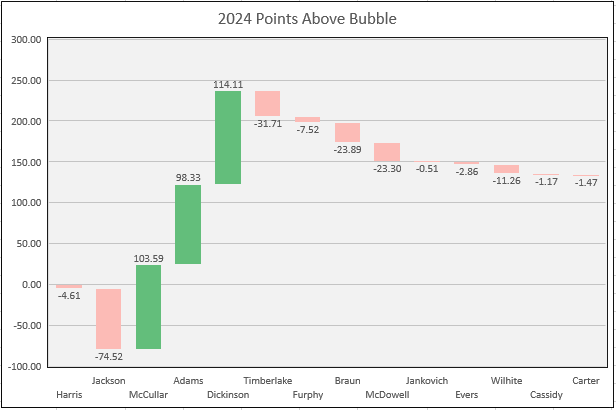
Cumulative Points Above Bubble on the Season Chart

Summary

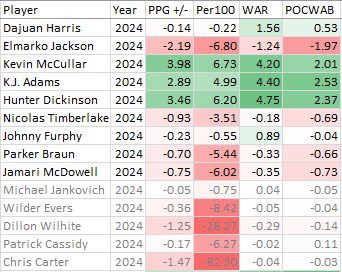
  • KU’s big 3 of McCullar, Adams, and Dickinson accounted for 100.1% of the team’s WAR this season, making it the first time since at least 1993 where a Kansas team had its three best players be over 100% of total WAR.
  • Similarly, KU only has 3 rotation players (10%+ minutes played) with a positive value-score. This was the fewest above-bubble players on any KU team since 1993 (2017 had 4). On average, KU has 6.1 rotation players per season achieve a positive, or above-bubble, value.
  • The above waterfall chart does a great job showing where KU was getting its value from and where it was losing its value. This chart makes those who blame K.J. Adams or Hunter Dickinson look silly. The team’s struggles stemmed from Elmarko Jackson, Nick Timberlake, Parker Braun, and Jamari McDowell. Harris and Furphy, slightly sub-bubble, were overused due to the team’s lack of depth but still basically KU-level rotation guys.
  • To Harris’s credit, he did play better in higher-leverage game (positive 0.53 POCWAB).
  • The following players accounted for team-MVP games: K.J. Adams (11), Hunter Dickinson (9), Kevin McCullar (7), Dajuan Harris (3), Johnny Furphy (2), and Nicolas Timberlake (2).
  • KU’s average game-score at home (+8.34) was far superior to its average game-score in true road games (-0.59).
  • The injury to Kevin McCullar hurt the Jayhawks. Kansas was a +5.51 team in games where Kevin McCullar played, and -2.39 team in games where he did not (8 total games missed).
  • In a similar vein, KU was a +5.35 team through the Iowa State game. Kevin would miss the next game due to injury, while playing off-and-on and through pain some nights the rest of the season. In these final fourteen games, KU was a +1.23 team.

2024 Season blog-posts:

Wrapping Up the 2024 Season (3/25/2024)

Beware the Slides of March (3/14/2024)

The Final Push (3/11/2024)

K.J. Adams’ Defense (2/16/2024)

Hunter Dickinson’s Defense (2/7/2024)

KenPom Rankings, Game Score, Determining Best Teams (1/17/2024)

A Tale of Two Juans (1/11/2024)

Wrapping Up the Non-Con (1/2/2024)

Three’s Company (12/21/2023)

Dajuan, Dajuan, What is Wrong (12/11/2023)

The Battle for Net Extra Possessions (11/28/2023)

Kansas 89, Kentucky 84 (11/15/2023)

2024 Prediction Scenario (10/24/2023)

2024 Projections (10/19/2023)

2024 Projections

KenPom released his preseason ratings earlier in the week. KU is ranked 2nd with a 26.31 AdjEM. This was very close to the player build-up model that I predicted (26.16). See below:

PlayerOff_PGDef_PGTot_PGPer100% Min
Dajuan Harris+0.20+2.30+2.50+4.2085.1%
Elmarko Jackson-0.10+0.20+0.10+0.2068.1%
Kevin McCullar-0.25+1.96+1.71+3.2575.1%
K.J. Adams+0.45+0.48+0.93+1.9070.0%
Hunter Dickinson+3.80+1.38+5.18+9.2580.0%
Nicolas Timberlake+0.62-0.31+0.32+0.7560.0%
Johnny Furphy-0.54-0.30-0.84-6.3019.1%
Jamari McDowell-0.62-0.10-0.72-6.0217.1%
Parker Braun-0.52+0.13-0.39-2.7520.1%
Michael Jankovich+0.15-0.30-0.15-5.001.4%
Justin Cross-0.08-0.08-0.16-6.501.0%
Chris Carter-0.08-0.08-0.16-6.501.0%
Wilder Evers-0.12-0.13-0.25-10.000.5%
Patrick Cassidy-0.20-0.10-0.30-12.000.5%
Dillon Wilhite-0.12-0.13-0.25-8.001.0%
Zach Clemence
Charlie McCarthy
TOTAL+2.97+5.53+8.51+12.16100.0%
Projected to Redshirt

Incoming transfer and Big 12 preseason player of the year Hunter Dickinson is the highest projected value player by far. This is due to his consistency while at Michigan as a prolific scorer and solid rebounder. Coach Self has called him the best offensive big man he’s had while at Kansas. In addition, knock on wood, Hunter has been healthy, having missed only 2 games in 3 seasons at Ann Arbor.

If there’s one question mark, it comes on the defensive end. Given the tendency among the game to play pick-n-roll ball and bring out the opponents’ 5-man, it can be a certainty that Dickinson will play plenty as the pick-n-roll defender and away from the basket. If teams can exploit him on this, it could bring down his score on the defensive end quite a bit. What Dickinson has going for him on defense is his rebounding prowess and low foul rates.

Dajuan Harris is projected to be KU’s second most-valuable player. His durability (estimated 85.1% minutes played) will be called upon now that KU is down to only 2 real ball-handlers (Elmarko Jackson) among its scholarship players. We project a slight improvement from last season’s Dejuan on both sides of the ball. He should see an increased number of 3-point attempts thanks to the departures of Gradey Dick and Jalen Wilson.

Kevin McCullar’s unexpected return to Kansas will see him in an expanded roll, yet his shooting (which has consistently hovered around 30% from 3) is still a question. If he shoots as well as he has been rumored to in practice, he could make the highest leap of anyone. McCullar’s value comes in his defense; namely steals and rebounds. He defends adequately one-on-one but will give up an occasional basket.

K.J. Adams is sliding down to the 4 after playing the 5-spot primarily last season. He is even less of a shooter than McCullar, although with a true 3-point shooting center in Dickinson, having a power forward who can shoot is less of a requirement for spacing-purposes. K.J.’s strength and quickness will get him more baskets than you’d otherwise think by just watching his game. He gets putbacks, makes nice cuts to the rim, and will get the occasional alley-oop. His defense could also take a step up now that he will be guarding opposing 4 men instead of the 5’s.

The next two names are battling to be the 5th starter at the off-guard position. Nicolas Timberlake has a slightly higher prediction, but everyone agrees Elmarko Jackson has the higher ceiling. Jackson is predicted as a first-round pick by many NBA mocks, something that hasn’t been taken into consideration in these preseason numbers but still should be in the back of your mind. For Timberlake, he’s the team’s best shooter and should generate spacing on the offensive end. His defense might not be great, but wings who move their feet and don’t fall asleep on defense usually grade out well.

Jackson’s rating is purely based upon his incoming class rating. He should have a fine season, but true freshmen rarely perform at the star level. Anything around replacement level will be enough to help this team. Jackson has Harris to guide him and guys like Dickinson and Adams to play through. He should thrive being around so many veterans.

After the top 6, the projected skill level drops. This isn’t the end of the world; KU’s top 6 should get the majority of minutes. Even including minutes played during blow-out non-conference games, KU’s top 6 is projected to get 87.7% of the total court-time. But the remaining 3 scholarship players will be called upon to do enough while filling in for the starters.

Parker Braun’s Per100 numbers are expected to tick up from last season (as he plays for a better coach in a better system and is a year older), and because his minutes should tick down it will help his per game mark assuming he gets into each game. He should perform comparably to Zuby Ejiofor last season. Braun was a good pickup given the departure of Ejiofor and fellow big man Ernest Udeh. Despite gaining Dickinson, KU got worse regarding its depth on the inside. It’s unfortunate the Jayhawks couldn’t hold on to a blossoming player like Udeh, but it’s part of the process with the portal. Key pickups can mean losing a young talent that doesn’t want to wait to play.

The remaining two wings are projected to be well-below bubble-level. As freshmen, Jamari McDowell and Johnny Furphy wouldn’t normally be asked to do much aside from bring energy and play their roles while filling in for the likes of McCullar, Adams, Jackson, and Timberlake. However, Coach Self has mentioned both as potential starters still. While this is likely coach-speak, it’s good to hear that both are holding their own.

Jamari McDowell’s score is predicated on his incoming rank. We see him as a better defender but less polished scorer than Furphy. Both players are quite athletic and have decent size/length. McDowell is one of the remaining initial commits that is projected to get playing time thanks to the departure or dropped commitments from numerous other wings. Furphy is a late signee who jumped on board after it was apparent that KU needed wing depth and has been compared to Svi.

Each player’s Per 100 predictions are better than M.J. Rice and Bobby Pettiford’s seasons last year. But it is tough to see either being key cogs in the rotation. Freshmen traditionally are either role players or one-and-done types.

The Jayhawks are redshirting Zach Clemence, a move confirmed by Bill Self many times. This means only 9 scholarship players. However, there are also 7 walk-ons with a few being skilled and athletic former scholarship players at other schools. Justin Cross and Chris Carter are those who played elsewhere before being invited walk-ons. Sharpshooter Michael Jankovich is also a name to watch out for. With the limited depth, a frustrated Self might turn to Jank in a pre-conference if he needs a floor-spacer. He’s done something similar with Clay Young in 2018.

The TEAM score is projected to be +8.51, a number that gets them an estimated KenPom AdjEM score of 26.16 (or 0.15 points away from KenPom’s own preseason mark). This mark is just an average estimate, one that includes the possibility of injury or underperformance from key pieces. A TEAM score of this projection would earn a 2-seed most often, of course depending on how many wins and losses the team has in close games. KU’s defense also should grade out better than its offense, something that KenPom predicts (KP has KU as the #9 offense and #1 defense).

Recent predictions have underestimated KU’s best players (2023 Jalen Wilson, 2022 Ochai Agbaji) while overestimating the contributions of the bench. This year we made sure to keep Dickinson higher than +5.00 despite questions on his defense. Another decision we made is to have each of KU’s top 9 players be expected to play in the full allotment of games. Perhaps Furphy or McDowell will DNP a few games but it shouldn’t be too many…barring injury.

It should be an exciting season. KU is bringing in the nation’s top transfer, fan-favorite veterans, a “legacy” transfer in Parker Braun, and solid freshmen with different skillsets.

Random Jayhawk Player Breakdown 1

This is a new segment for the off-season in which a Kansas player will be randomly selected to have an in-depth statistical breakdown of his career as a Jayhawk. Since 1994, that is the last 30 seasons, there have been 172 players to appear in a regular season game wearing the crimson and blue. In our initial installment, the random player selected is…

Darrell Arthur

Not a bad first random selection! Darrell Arthur played for the Kansas Jayhawks in the 2006-07 and 2007-08 seasons. For simplicity, we will refer to the former season as ’07 and latter as ’08. Arthur came in as a highly-touted true freshman and left after his sophomore year to enter the NBA draft. He was selected 27th overall in the 2008 NBA draft and played in 9 seasons for the Memphis Grizzlies and Denver Nuggets. He played in 503 NBA games and averaged 6.5 PPG over his NBA career. But this write-up is about his college career, and this is where we will now focus.

2007 season

According to College Basketball Reference’s RSCI Top 100 rankings, Darrell Arthur came in as the #11 prospect in his class. He was in the same incoming class as Sherron Collins and Brady Morningstar. Arthur played in all 38 games and produced the following traditional stats:

Arthur came in and performed right away. In his first collegiate game he scored 12 points with 6 rebounds and 3 blocks. The next game, the upset loss to Oral Roberts, Arthur scored 22 on 10/16 FG’s. He would put up his season high in points the next game, a bounce-back win against Towson, with 26 and 8. He had 19 and 9 in the team’s big win in Vegas against that great defending (and eventual) champion Florida Gators team. And while he struggled some during conference play, he was still a very positive player. His best conference game was against Iowa State where he had 15 and 11.

For a freshman to come in and produce, particularly during a time when KU had Julian Wright, Darnell Jackson, and Sasha Kaun; shows the level of play Arthur brought to the floor. He forced Self to play him by how good he was.

Arthur’s advanced stats, calculated by Basketball Reference, are as follows:

Arthur’s shooting was excellent, scoring efficiently by getting close baskets while having a solid mid-range game. His usage shows that he was a scorer, not someone who shot well only due to shot selection. Frosh Darrell Arthur could score. His rebounding percentage was fine for a freshman. His win share of 4.8 was fourth on the team that season, however his WS/40 was the team’s best. There’s an argument to be made here that he deserved more minutes. All of KU’s four bigs were good enough to start elsewhere, which made it tough to find more playing time.

Arthur’s value stats, which incorporate the most information and are thus the most accurate, show this:

This indicates that Arthur added 2.19 points of value per game above that of a bubble-player, with value added nearly equally between offense and defense. Arthur didn’t get routinely torched on defense (as some underclassmen do), and had active hands to not only grab rebounds but also get steals and force turnovers.

On a per-possession basis, Arthur’s value was the team’s best in ’07 at +6.61 points above bubble per 100 possessions. This is more evidence arguing in favor of Arthur’s playing time. Arthur’s best game of the season, and in fact the best outing of anyone that season, is estimated to be his performance against Towson. He had a +13.52 score, opponent-adjusted.

2008 season

Julian Wright, the team’s starting power forward the year prior, left for the NBA draft, which provided an opportunity for Arthur to start at that position his sophomore year. He would do just that, playing in all 40 games and starting in all but one (senior night). Along with his freshman year, his sophomore campaign’s stats are represented below:

Arthur’s stats increased across the board, aside from small drops on blocks/steals. He was the second-leading scorer behind Brandon Rush and second-leading rebounder behind Darnell Jackson. His shooting and scoring abilities increased as his minutes grew, leading to a more-efficient season that was also much more productive.

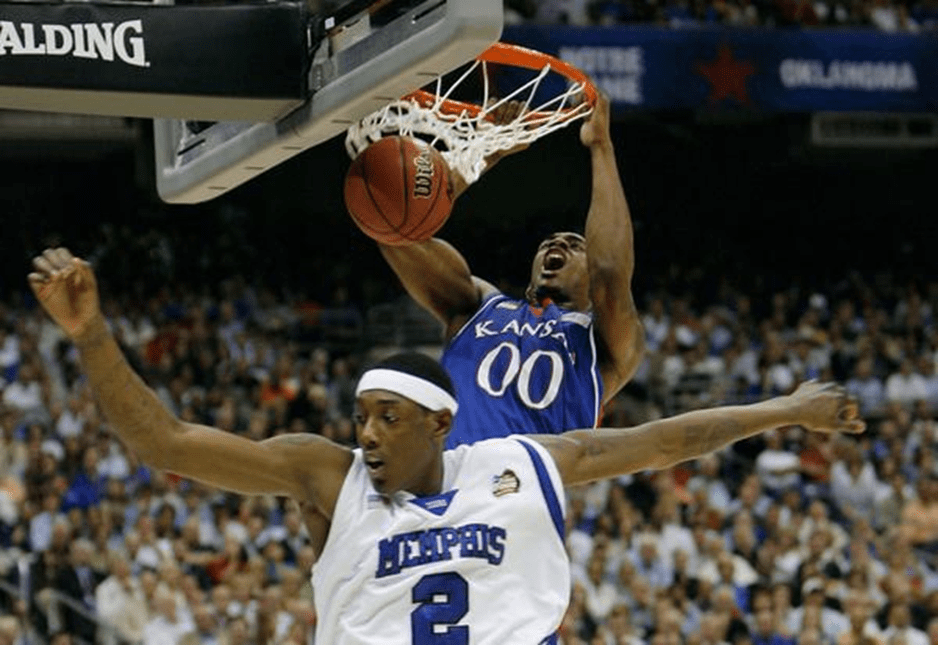
Arthur’s season high was 23 against Baylor, the team he almost went to. While he never touched the 26 he scored the season prior, he was a more reliable double-figure scorer, putting up 10+ points in 28 of 40 games. His most important game as a leading-scorer was his 20-point performance against Memphis in the 2008 National Championship game.

“Shady”’s advanced stats show a bump across the board, with a slight decline in usage. His win share increased by a full win, with a slight downtick on the per-40 metric. More minutes mean more concern with foul trouble, fatigue, etc. so this downtick isn’t anything alarming. The manipulation of the numbers indicate that he was heavily relied upon to be a leading player and that he performed.

Next graphic will show Arthur’s value stats.

In playing more minutes yet staying offensively productive and defensively agile, Arthur increased his per game value score to over +3.00. On a per-possession basis, he was second on the team at +7.26 per 100 possessions (Mario Chalmers). He was the team’s MVP for 8 games, including the National Championship game. On an opponent-adjusted score, Arthur’s best game in the 2008 season was against Texas in the Big 12 Tournament championship game, when he was +13.42 against the Longhorns.

As many KU fans know, Arthur was going to commit to Baylor before changing his mind and going with Kansas, due to a dream he had of Kansas winning the national championship. Arthur’s career is highlighted by this game. While Chalmers had the highlight shot to tie it in regulation, Darrell’s play throughout kept Kansas in it and helped lead the comeback charge. He hit an 18’ jump-shot to cut the 9-point lead to 7 with 1:57 left. He had a clutch basket with 1:00 left to cut the deficit to 2. And he added a dunk off a Chalmers feed early in OT to put KU up 4.

Summary

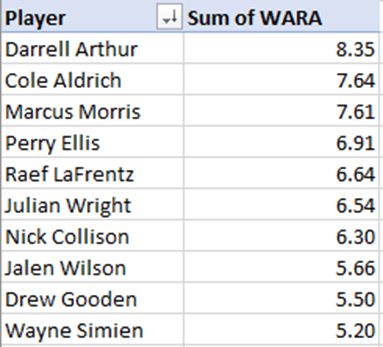
Let’s get to the ultimate question, which is how do we judge Arthur’s career at Kansas when compared to other Jayhawks? This can get tricky as there’s different ways to think about it. College basketball is different than other levels, in that those who are very good will move on sooner and play fewer than 4 seasons. If we take Arthur’s sophomore season: 12.8 PPG, 6.8 RPG, and a +3.08 Adj. PPG +/-; we see a good season that is nevertheless bested by numerous bigs in the Self-era: Perry Ellis, Wayne Simien, Thomas Robinson, Marcus Morris, Markieff Morris, Cole Aldrich, etc. Each of these players, in terms of Wins Above Replacement, had better Kansas careers than Darrell Arthur. For reference, Arthur’s career WAR is calculated to be 8.35. The worst of the above list is Markieff Morris at 9.75. Simien is up at 19.27 WAR.

But most of these names had their breakout seasons as upperclassmen and added their most value later in their careers. Since Arthur wasn’t around for potential junior or senior seasons, we don’t really have an apples-to-apples comparison regarding careers.  

If we look only at a player’s freshman and sophomore years, we get a comparison of how good Arthur was while at Kansas compared to other underclass PF’s and C’s.

Here we see Arthur better than the others over their first two seasons. He was better than Williams-era stalwarts as well; namely LaFrentz, Collison, and Gooden.

If we look at all positions, only Devon Dotson (11.51 WAR) tops Arthur when looking at all KU players’ freshman/sophomore years over the past 30 seasons. Arthur’s production as an underclassman is 2nd best of any Jayhawk over the past 30 seasons. This seems noteworthy for someone who can get overlooked when fans are devising their dream lineups. Incidentally, Devon Dotson is in the same boat when it comes to great KU guards.

Regarding all time seasons and Adj. PPG +/-, Arthur’s 2008 sophomore campaign is 49th and his 2007 freshman campaign is 80th (out of 426 player-seasons). These two years were very good but not great seasons when looking at all-time performances. When we look only at sophomore years, Arthur’s season is either 6th or 7th best (depending if Simien’s 2003 injury-plagued season is counted) out of 98. His frosh season was 9th best out of 119.

If one thinks of Darrell Arthur as one of KU’s great power forwards, he isn’t in the wrong. However, if we are just counting what a player did at KU, and recognize that players who stay for 4 years can have more of an impact than those that only play 1 or 2, we’d place Arthur as 33rd in career WAR out of 172 (81st percentile). Sandwiched in between Tyshawn Taylor and Travis Releford.

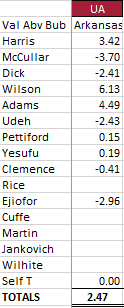
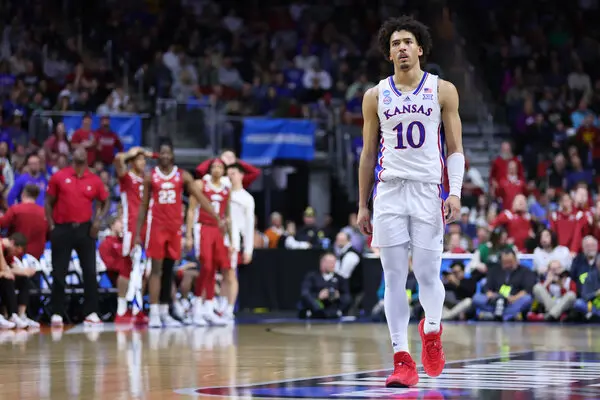
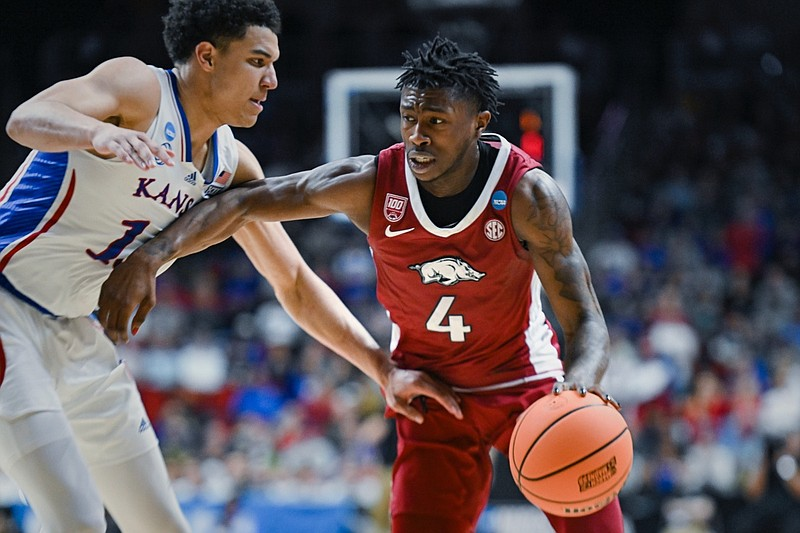
Kansas 71, Arkansas 72

Jalen Wilson had his 18th team-MVP game of the season in his final college basketball game. He recorded half of KU’s game-MVP’s this season, the highest rate of any Jayhawk since Frank Mason’s 2017 season. His game-score for the Arkansas game was slightly-above his season average. K.J. Adams had a fine game himself despite foul trouble. It was his best outing since the home Baylor game in mid-February. Dejuan Harris was the other Jayhawk starter to produce positive value, although he wasn’t mistake-free (5 turnovers counting the 5 second inbounds and 10 second backcourt violations). Gradey Dick was guarded well by Arkansas, and he missed some chances to have a bigger impact. His defense wasn’t terrible, but he needed to score more than 7 points. Kevin McCullar had some big baskets in the second-half, but his negative-value game was due to his defense. He was assigned to stop Arkansas’s scorers and had a rough second-half on the defensive side of things.

The bench finished the season with the distinction of being Self’s worst in his 20-year tenure. Joe Yesufu hit a ridiculous first-half 3 to finish slightly above zero, and Bobby Pettiford’s steal and layup also catapulted him above bubble-level. The trio of Udeh/Clemence/Ejiofor was not at all productive and may have contributed to the loss as they tried to fill in for K.J. Adams’ foul trouble. There were a lot of factors that went into deciding the outcome.

A questionable foul call on McCullar with 23 ticks left sent Arkansas to the line, where they would take the lead for good. Had the blocking call been a charge, KU would have likely gone to OT at worst.