Wrapping Up the 2024 Season

Note: The value-metrics in this write-up might not match the final published numbers, as the 2024 college basketball season is still being played. But since KU’s season is complete, the only changes to value-metrics will be small and due to what happens with KU’s opponents and how their computer metrics trickle down.
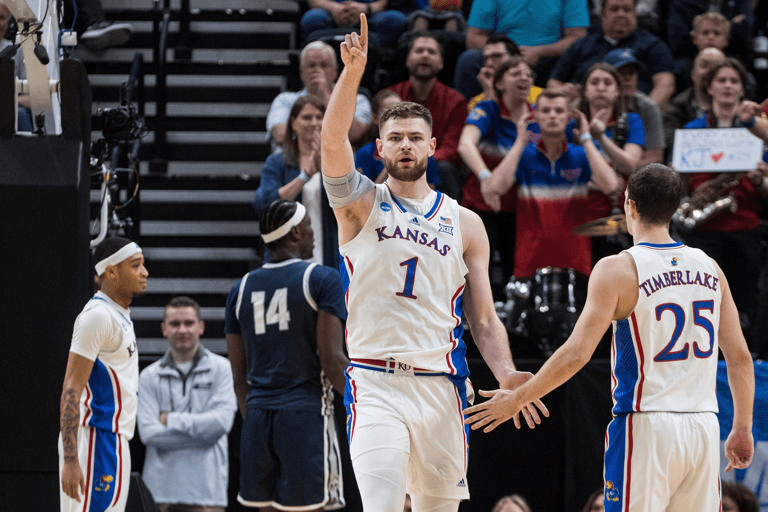
The 2024 team came in with high expectations. Landed the best big-man transfer in the portal. Landed a sought-after portal wing and highly-athletic combo-guard. Returned three starters from team that earned a 1-seed in 2023. A McDonald’s All-American guard leading a decent recruiting class. A healthy coach. Pre-season AP #1. This took a bit of a hit when they lost Arterio Morris to a felony charge. Even still, on paper the team was expected to be good.

For the most part during the non-conference, Kansas lived up to expectations. Sure, its computer metrics took a when it failed to blow out certain teams it should have (Eastern Illinois, UMKC, Missouri). But it got huge wins against the likes of Kentucky, Tennessee, and Connecticut. At 12-1 heading into conference play, the team was trending toward another 1-seed.

The conference schedule was back-loaded in terms of difficulty, so the Jayhawks knew they had to play well in January. Unfortunately, the team lost to UCF and West Virginia on the road (as well as Kansas State in early February). It did have nice home wins—including a 13-point win against Houston in early February—but after McCullar got injured Kansas struggled to find any consistency. Since January 1, KU didn’t win or lose more than 3 games in a row. The team couldn’t find any momentum on the season, although saying the wheels fell off does seem like a stretch.

With that said, the focus on the season recap will be to look at how the roster performed relative to value metrics that help us judge players across seasons. We will also look at how each player did compared to his pre-season expectation, and finally look at the team as a whole. The shooting splits will be listed in the order of FG%/3-pt%/FT%.

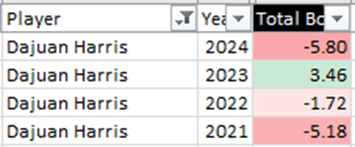
Dajuan Harris

Traditional Stat-Line: 8.5 PPG, 6.5 APG, 2.0 RPG, 1.5 SPG, 0.4 BPG on 35.7 MPG, 42.4%/38.4%/80.4%.

Pre-season Value Projection: +2.50 PPGAB, +4.20 Per100AB, +4.24 WAR

Actual Value Score: -0.14 PPGAB, -0.23 Per100AB, +1.57 WAR

Harris was projected to be KU’s second most-valuable player for 2024, as that’s what he was in 2023. But he got off to an awful start to the 2024 season. Aside from a stellar shooting night against Kentucky, he failed to reach double-figures in points until Indiana (11th game of the season). His defensive metrics were poor to begin the year. Through 10 games he was a -1.27 per game defender (in 2023 he was a +2.17 per game defender). This poor play wasn’t reflected much in the team’s overall record, but it did but Juan behind the 8-ball as far as his season-long performance.

By conference season, Harris would begin to play better, improving on the whole until he started playing near the level he had last season. Over his final 15 games, Harris was +2.54 per game, right where he was projected to be on the season. As these games included the stretch run and tournament play, it should be noted that he basically became the player KU was expecting him to be by the time the games really mattered. This makes his season a bit odd. KU played better during the part of the season where its point guard was playing worse. Given how polarizing he is as a player, this makes things even more confusing.

Harris will be back in 2025. There will be plenty of time to look ahead and forecast out his final season in a Kansas uniform. But in looking back at his 2024 campaign, Harris’ Per100 value metrics put him in the 34.5%ile of all Jayhawk rotation players since 1993. You want more from your starter than this. And while he can’t shoulder all of the blame on the team’s poor season, had he been as good as expected from Day 1, the team may have been a bit more competitive.

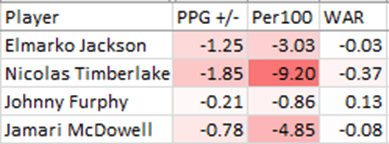
Elmarko Jackson

Traditional Stat-Line: 4.3 PPG, 1.7 APG, 1.4 RPG, 0.8 SPG, 0.1 BPG on 18.6 MPG, 40.6%/26.7%/76.9%.

Pre-season Value Projection: +0.10 PPGAB, +0.20 Per100AB, +1.44 WAR

Actual Value Score: -2.20 PPGAB, -6.83 Per100AB, -1.26 WAR

Freshmen are basically projected on a curve given their incoming class-ranking, so Jackson was expected to be about bubble-level given how the rating services saw him as a high school senior. Even during the off-season, 2024 NBA mock drafts had him as a possible lottery pick given his intangibles (explosive player, good size as a guard, decent-looking stroke, and so on). Nothing close to this potential developed in 2024. Jackson was given the starting spot in the backcourt to begin the season—in large part due to the poor play of others competing for that role—until he started to slump at the beginning of conference play as was replaced by Johnny Furphy.

Jackson’s season is at the bottom of the list in terms of KU history since 1993. He had the second-worst PPGAB score over the last 3+ decades (Quentin Grimes). His Per100 score was in the 3.85%ile of all rotation players, clearing only a hand-full of role-players and walk-ons who played minutes on past KU teams with depth issues (i.e. Jeff Hawkins and Moulaye Niang in 2003). His WAR, thanks to him playing so many minutes, was the worst in the 1993-2024 span.

It was a disaster of a season for Elmarko. He appeared in all 34 games, but only had an above-bubble impact in 8 of them. (Offensively, he was above-bubble in only 5 of 34). His non-conference play of -0.83 PPGAB looks relatively strong, compared to how he ended the season. Since the beginning of the conference season in early January, Jackson was a -3.05 PPGAB player.

Kevin McCullar

Traditional Stat-Line: 18.3 PPG, 4.1 APG, 6.0 RPG, 1.5 SPG, 0.4 BPG on 34.2 MPG, 45.4%/33.3%/80.5%.

Pre-season Value Projection: +1.71 PPGAB, +3.25 Per100AB, +3.23 WAR

Actual Value Score: +3.97 PPGAB, +6.71 Per100AB, +4.22 WAR

McCullar was a late-returnee for Kansas, coming back after nearly going pro. His return was certainly good news in the summer, but when he came out with an improved shot and stronger offensive game in the non-conference, KU was playing its best ball. Kevin cleared his PPGAB estimate by over 2 points and his Per100AB estimate by over 3 points. And even though he got injured and missed 8 ½ games, his WAR was over a win above expected.

McCullar had the highest PPGAB and Per100AB marks of any Jayhawk this season, and his WAR was third on the team but closely behind two players with 248 and 173 more minutes of game action. McCullar’s injury prevented him from adding to his legacy, as his efficiency waned during the part of the season he was trying to play through the pain.

Overall, Kevin’s jump in performance was a pleasant surprise in a season with few of them, and makes his injury and even more frustrating. When he was out there, he was an 85.1%ile Jayhawk, which is right on par with Ben McLemore’s lone season (2013).

K.J. Adams

Traditional Stat-Line: 12.6 PPG, 3.1 APG, 4.6 RPG, 1.1 SPG, 0.6 BPG on 33.5 MPG, 60.1%/0.0%/60.0%.

Pre-season Value Projection: +0.93 PPGAB, +1.90 Per100AB, +2.33 WAR

Actual Value Score: +2.88 PPGAB, +4.98 Per100AB, +4.42 WAR

Alongside McCullar, K.J. Adams was KU’s most-improved player. He overachieved his PPGAB and Per100AB expected scores by 2 and 3 points respectively, and added 2 WAR above his projection. Adams’s offensive value was right where we thought it would be, it was his defense that made a huge leap. Adams was KU’s best defender, allowing 0.145 points per possession (or 8.7 points per 60 possessions). His strength, quickness, and ability to switch to both guards and posts helped KU put together a mostly acceptable defense for much of the season. Adams was also healthy and consistent, something no other Jayhawk from 2024 can really say. He was the team-MVP in 11 of KU’s 34 games, which led the team this year.

Another polarizing player, we will focus on 2025 and his role at a later date. But KU was barely a tournament team without Adams (even if McCullar/Dickinson were healthy all season). Unfortunately, he had his worst game of the season against Gonzaga, especially on the defensive end. For the season, he had a Per100AB at the 75.2%ile, which is very similar to the per possession value Julian Wright gave as a freshman (2006). And K.J. did this playing far more minutes and less rest. Adams’ value was very under-appreciated.

Hunter Dickinson

Traditional Stat-Line: 17.9 PPG, 2.3 APG, 10.9 RPG, 0.9 SPG, 1.4 BPG on 32.2 MPG, 54.8%/35.4%/62.4%.

Pre-season Value Projection: +5.18 PPGAB, +9.25 Per100AB, +6.88 WAR

Actual Value Score: +3.45 PPGAB, +6.19 Per100AB, +4.77 WAR

Hunter Dickinson had a good season, producing the second-highest PPGAB and Per100AB scores on the team and the highest WAR. Let’s start with that fact, so that the rest of the discussion will be in its proper context. Within this context, Dickinson very-much underachieved his projected totals, and his play worsened as the season progressed (even before his shoulder injury).

Hunt was a +5.40 PPGAB player through the home Houston game, when KU looked like it had turned a corner and was poised to have a strong February run building into March. After that game, beginning with the road K-State contest, Hunt was a -0.45 per game player. This was seen on both ends of the floor, but especially on defense. Over these last 11 games he played (he missed the Cincinnati game in Kansas City), Dickinson was a -2.41 per game defender. His shooting, particularly behind the 3-point and free-throw lines, got worse and hurt his overall offensive game. Even during his slumps, his offense was good enough to be value-adding.

On the season, Dickinson had 9 team-MVP games and had the best performance overall in his dominance of Tennessee’s big men during the third-place game at the Maui Invitational. But that seems like months ago because it was. He saw the likes of Samford take advantage of his propensity to over-hedge ball screens and recover slowly. Teams kept hurt the Jayhawks on this play, to the point that March Madness analyst Brendan Haywood pointed out that KU should think about dropping him into the lane to cover ball-screens this way. We would agree.

Dickinson was in many ways the anti-Harris. He started the season great but limped to the finish, unlike Harris who came around during the late push. But we don’t want to ignore Hunter’s 82.5%ile mark, second on the team and comparable to Nick Collison as a sophomore (2001). From a WAR perspective, Hunt’s season compared to the seasons of other big-men such as Perry Ellis as a junior (2015) or Jeff Withey either his junior or senior seasons (2012 or 2013). These are solid players, and show that Hunt added quite a bit of value.

Nicolas Timberlake

Traditional Stat-Line: 5.2 PPG, 0.6 APG, 1.9 RPG, 0.5 SPG, 0.1 BPG on 15.4 MPG, 38.3%/30.3%/78.6%.

Pre-season Value Projection: +0.32 PPGAB, +0.75 Per100AB, +1.50 WAR

Actual Value Score: -0.93 PPGAB, -3.50 Per100AB, -0.18 WAR

Timberlake had a rough season, producing 4 points worse Per100AB than expected. His poor play, particularly to start the season, also lowered his minutes volume…not something this KU team needed given its depth issues. And by the time Nick started to play better, KU had injuries to key pieces. We really never saw him filling his role when KU was at its best, although there were glimpses such as his senior-night performance vs. K-State.

In the non-conference, Timberlake played at a -1.78 PPGAB. Starting January 1, which was the beginning of conference play on through the NCAA Tournament, his performance was at -0.41 per game. This improvement was more pronounced on the defensive end, where he would grade out as a +0.27 per game player. He was able to move his feet okay, grabbed enough rebounds, and otherwise was a healthy and energetic player.

But his offense, unfortunately, never really clicked. He was officially credited with 22 assists on the season, which, as a 2-guard, is really terrible. We had him with 17 value-assists, which even if you doubled his minutes, would come to about 1 per game on 30 minutes. His shot didn’t consistently fall, which really hurt the value he provided to the team.

Timberlake was at the 14.0%ile of all Jayhawk rotation players since 1993. A close comp here would be 2010 Brady Morningstar or 2023 Joseph Yesufu. Given that Timberlake was meant to be a step-up from Yesufu, this was a major disappointment.

Positive moments Nick will be remembered for are his athletic dunks as well as drawing a late foul against Samford and knocking down 2 FT’s to put KU up 3 in the final seconds.

Johnny Furphy

Traditional Stat-Line: 9.0 PPG, 1.0 APG, 4.9 RPG, 0.9 SPG, 0.8 BPG on 24.1 MPG, 46.6%/35.2%/76.5%.

Pre-season Value Projection: -0.84 PPGAB, -6.30 Per100AB, -0.49 WAR

Actual Value Score: -0.23 PPGAB, -0.54 Per100AB, +0.90 WAR

Furphy was KU’s latest roster move, he joined the team so late he didn’t even play in Puerto Rico in August, and he wound up being the only newcomer to meet expectations. His were low, given limited information about him from recruiting services and the unknown about foreign players. Compared to Svi Mykhailiuk, Furphy had a much stronger season as a frosh than Svi did. After cementing his role as KU’s fifth starter (when the team was fully healthy), Furphy worked his way into an above-bubble player for the Jayhawks during the middle of conference play. He had some rough moments down the stretch of the season to finish below-bubble, but he was comfortably above D-1 average and therefore produced nearly 1 full win above replacement.

Furphy was at the 32.1%ile of Jayhawk players who crack the rotation, which was very close to Wayne Selden’s freshman season (2014). A career trajectory like Selden’s would be excellent news for Kansas. We shall see what happens with Johnny, a skilled scorer with clear pro potential.

Johnny’s offense ended up worse than his defense, which seems strange. Furphy’s defense wasn’t great, but he did add value by rebounding and just competing. His inability to break down defenses or generate points for others (only 28 value-assists on the season) took away from his solid shooting numbers.

Parker Braun

Traditional Stat-Line: 2.2 PPG, 0.3 APG, 1.6 RPG, 0.2 SPG, 0.6 BPG on 7.5 MPG, 66.7%/36.4%/66.7%.

Pre-season Value Projection: -0.39 PPGAB, -2.75 Per100AB, 0.00 WAR

Actual Value Score: -0.70 PPGAB, -5.44 Per100AB, -0.33 WAR

Parker was projected to be a replacement player, or average D1 guy coming in as a backup to Hunter Dickinson. The fact he didn’t get there is important, although he was never the guy who was going to make or break the season for Kansas. Parker knew his role, but his defense was never where it needed to be. He did shoot a high percentage, mostly on lob-dunks and layup attempts, but his lack of production hurt the team whenever he played.

Braun’s play registered at the 6.9%ile of all Kansas Jayhawk rotation players since ’93. He was about as good, per possession, as sophomore Mitch Lightfoot (2018), who played a similar role for a Final Four team when he backed up Doke. Braun played 18.6% of available minutes, close to the 20.1% that was projected for him.

Jamari McDowell

Traditional Stat-Line: 1.8 PPG, 0.5 APG, 1.2 RPG, 0.2 SPG, 0.1 BPG on 7.2 MPG, 30.8%/28.1%/84.2%.

Pre-season Value Projection: -0.72 PPGAB, -6.02 Per100AB, -0.40 WAR

Actual Value Score: -0.75 PPGAB, -6.01 Per100AB, -0.35 WAR

Jamari’s projection was the most accurate. We even nailed his minutes (he played 16.4%; projection was 17.1%). As a true freshman toward the lower-end of the Top 100, Jamari was never expected to be a huge contributor. With only 9 scholarship players, he filled a role as a back-up wing who was there to play defense first. McDowell’s play was at the 5.5%ile of all rotation players in KU history since ’93. He was about the same as Tristan Enaruna as a freshman (2020). Given how much better Enaruna has gotten (albeit at a low-major), there’s no reason to think McDowell can’t become a KU-level player as an upper-classman.

TEAM

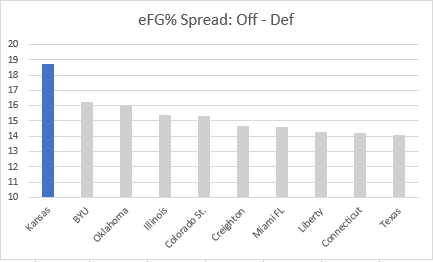
We projected KU to be a +8.51 team, meaning they would beat their opponents by 8.51 more points per game than a bubble-team would be expected to. This projection, independently arrived at, was quite close to how KenPom and Bart Torvik saw them. This number ended up being +3.62 by season’s end. This ended up being the worst team in the Self-era as well as the worst team since 1993 (1989 was likely the last Kansas team to be this bad from a computer-rankings/efficiency perspective).

In October we looked at different scenarios as to how the season could play out. A median case, worst case, and best case scenario. Look at what we wrote about what could happen if KU had a worst case type of season.

In this scenario, one of its key players struggles with an injury and this weakens an already depleted roster. KU’s offense could also struggle as teams force McCullar and Adams to make jump-shots while forcing the ball out of Dickinson’s hands. On defense, while it’s difficult to see KU being bad on this end, teams could put Dickinson in high-ball pick-n-rolls and take advantage of Self’s propensity to switch screens.

If KU were to struggle enough, it could lose games it was projected to win preseason and find itself slipping down into the 5-6 seed range. In this range, a First Round upset loss is more likely and a second-weekend in the NCAA’s less likely. For KU’s worst case scenario to be a comfortable NCAA Tournament team is something most teams can’t say a few weeks before the season starts.

This is basically what happened. McCullar’s injury proved to be too much. Jump-shots stopped falling, and Hunter had more difficulty avoiding double-teams. KU’s defense faltered when Hunt was put in high-ball pick-n-rolls. Kansas did get a 4-seed, making it slightly better than it could have been, but didn’t make the second-weekend. However, its tough to see the season playing out worse under any reasonable situation. KU’s floor is so high, that it makes rebuilding easier. We won’t look ahead until later posts, but there isn’t any reason to panic about the state of the program right now.

That about puts a bow on the 2024 season. Thank you and Rock Chalk.
Understanding the NCAA Tournament Committee

Note: This was written immediately following Selection Sunday 2024. If we can analyze what the committee values on Selection Sunday, it can help us understand what teams can do to make sure they have the best shot to get the seed they deserve.

Every year there is chaos, controversy, and confusion on Selection Sunday. 2024 is no different. Iowa State sits at #8 on the S-curve despite running through the Big 12 Tournament. Auburn, the SEC champ and advanced-metrics darling, got a 4-seed no one wants to face. At the same time, 14-loss Michigan State was comfortably in the field (9-seed) and bubble-team Texas A&M (also a 9-seed) comfortably avoided Dayton despite having 4 Q3/Q4 losses on the season.

What is going on? Is the committee schizo? Well, sort of. But it isn’t really their fault.

The NCAA Tournament committee’s job is to select and seed the best 68 teams for the bracket. To help it, it has certain principles as a guide. There are 32 automatic qualifiers and 36 at-large teams. So, they really only pick 36 teams. After the 36 are selected, they rank all 68. This two-part process is messy to a degree, as the AQ’s and at-larges mix until about the 12-seed or so (most years), after which the worst teams are always AQ’s.

For 2024, Championship Week saw numerous upsets and bid thieves, so the last four teams into the tournament (who make the play-in round in Dayton) were on the 10-line, which is the first time this has happened since the field when to 68. Before it has always been 11’s, 12’s, or even 13’s to make the First Four as at-large teams.

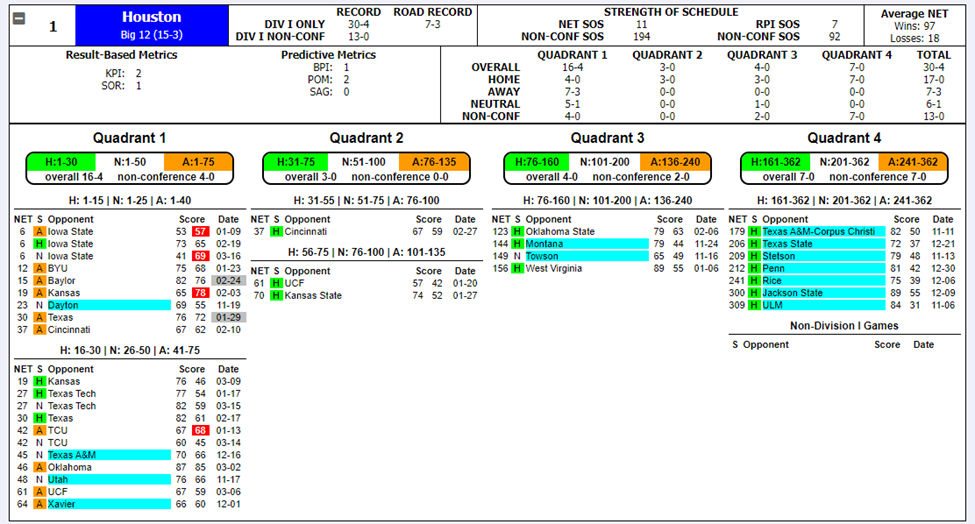
In order to help the committee decide who should be in the field, team sheets are used showing relevant information. This is what Houston’s looked like:

That’s quite a display of number and color. And this is just one team’s team sheet. Imagine going through nearly 100 of these, repeatedly, for hours if not days!

While we aren’t privy to the conversations of the committee, we do have the advantage of people doing bracket exercises which help us understand what the committee values. Believe it or not, bracketologists have some value to give us! Additionally, the committee chair normally hints or gives brief explanations regarding the committee’s decision after the release of the bracket. So we can make certain assumptions and guesses ourselves as we seek to understand the committee.

The Task at Hand

The exercise we’re engaging in is to attempt to quantify the committee’s preferences in terms of the information they have access to. For instance, what’s most important to the committee? Overall record? Quad 1 wins? Computer metrics? Strength of schedule?

There are a few types of criticism the committee sees. The first is that it fails to rank the teams as they truly are. This is a very difficult thing to assess, without first assuming some other metric which to judge the committee against. Instead, we want to study the consistency of the list. Based on the committee’s preferences; what numbers, metrics, etc. on the team sheets is it valuing?

To even get started, we have to identify what relevant numbers are even being evaluated, something we do using common knowledge of the sport of college basketball and clues from bracketologists and the committee chair. We’ve come up with 6 different categories:

  • Strength of Schedule
  • Overall Record
  • Performance Against the Best – Quad 1
  • Performance Against Good Teams – Quads 1 & 2
  • Avoiding Bad Losses – Quads 3 & 4
  • Advanced Metrics

Results

More detail will be provided later on how these are determined. But what we did was quantify these 6 categories by ranking teams in each, then weight each category based on its relative importance to come up with a weighted average score. We then ranked the field on this weighted average score and compared it to the committee’s own S-curve. We want the tightest correlation, so we played around with the weights of these 6 categories until we arrived at an R2 of 0.8793. The weights were as follows:

  • Strength of Schedule (6.5%)
  • Overall Record (0.0%)
  • Performance Against the Best – Quad 1 (25.5%)
  • Performance Against Good Teams – Quads 1 & 2 (9.5%)
  • Avoiding Bad Losses – Quads 3 & 4 (Multiple)
  • Advanced Metrics (58.5%)

There are some noteworthy things here. One, the raw winning percentage wasn’t factored in by the committee. This is to its favor. A team’s overall record shouldn’t matter per se, as the relevant numbers should be seen in other areas of the team sheets.

The next thing to note is that bad losses were calculated using a multiple. If a team has 0 bad losses, its overall weighted average goes down (improving its ranking). The more bad losses a team has, this affects its weighted average (worsening its ranking). Better to have 1 bad loss than 2, 2 bad losses than 3, and so on.

Finally, the advanced metrics accounted for a large proportion of what the committee valued. This isn’t necessarily terrible, as these advanced metrics taken into account what the committee looks for (i.e. good wins increase a team’s SOR, NET and KenPom ranking). But it is interesting, based on how closely the Quadrants are discussed, that just averaging a team’s computer metric component got you most of the way there.

Biggest Outliers – A Discussion of Certain Teams

Given how the committee viewed the importance of each item on the team sheet, let’s look at which teams were furthest from their final place on the S-curve. These outliers should generate the most controversy, because they are where the committee veered off most from their implied preferences.

Florida Atlantic

The Owls were the committee’s #31 overall team (earning an 8-seed), whereas the weighted ranking had them as the #46 team—just outside the at-large field. FAU’s resume was unique in that it had 3 Q3/Q4 losses. While the weighted ranking did indicate that the committee accounted for bad losses for most teams, it seemed to not do this for FAU. Though perhaps the weighted ranking over-penalized bad losses. Either way, FAU’s metrics were solid enough (all in the 30’s and low-40’s) and it played a solid schedule. But #31 is too high.

Colorado

The Buffaloes were the committee’s #39 overall team (earning a 10-seed and First Four game), 13 worse than their #26 weighted ranking. The Buffs could arguably be a 7-seed given their resume and what the committee valued most of the time. Colorado’s worst feature was its Non-Con SOS. Like Iowa State, this may have hurt it.

Boise State

The Broncos were the committee’s #38 overall team (and will face CU Wednesday night), but would have been #28 had the weighted ranking been used. Boise had good metrics across the board; nothing really stood out as being worthy of dropping them to the play-in game.

Kentucky

The Wildcats were “only” 8 spots off—the committee has them #11 while the weighted ranking has them #19—but since it is tougher to miss by many spots toward the top of the bracket, this was noteworthy. UK’s computer metric numbers were all between 18-21. It went 8-8 in Q’s 1&2. Whatever resume numbers you looked at in isolation; it was tough to place Kentucky as a 3-seed or top 12 team in any single of them. Yet they were given a 3-seed above teams such as Auburn or Duke or Kansas.

Others

These others, which were 8 spots off, will be listed in terms of boosted or screwed by the committee. Nevada was screwed. South Carolina was boosted. Colorado State was screwed, and is also a play-in team. Drake was boosted. Northwestern was also boosted.

Bubbles

Some bubbles have already been mentioned. The teams that were the most screwed out of making the tournament, given the committee’s implied preferences, were Oklahoma, Providence, and St. John’s. Virginia was boosted enough to get it in when it should have been out, but the boost wasn’t egregious. They were close given the committee’s preferences. FAU, as mentioned, would have been (barely) out. The other team that would have been out, if weighted average were used, was Northwestern.

What About…

Iowa State was actually only off by 1 spot given the committee’s implied preferences. With its computer metrics averaging over 5, ISU’s case for a 1-seed was always going to be dicey. But what hurt it most was undeniably its SOS score. Despite having the #16 NET SOS overall, its rank in this category was 63, far below the likes of UNC and Tennessee. What stuck out and pulled down ISU’s SOS was its #324 non-con SOS. One can argue that non-con SOS shouldn’t be considered (if we have overall SOS, what’s the point of looking at one portion of the schedule), but the committee sees that number and no doubt uses it in their considerations.

Michigan State, at 19-14, was thought to be gifted a Tourney bid. But the Spartans are actually only one spot off their implied rank given the committee’s preferences across the field. In other words, the same things the committee valued in seeding the rest of the field was applied to MSU. Michigan State had a great schedule overall (8th best according to this exercise) as well as solid computer metrics (being #18 in KenPom and BPI doesn’t hurt a team). This did enough to pull it up to an at-large berth without much sweat. Again, one can criticize what the committee values, but one can’t say it was being inconsistent by including Tom Izzo’s team in the 2024 Tournament.

Texas A&M had four bad losses but was the #34 team according to the S-curve. A&M earned a 9-seed, but maybe deserved a 10 given the committee’s preferences overall. Still, this team was getting in. It went 13-10 in Q’s 1/2 and had solid enough computer metrics.

And Finally… Not being talked about much is the fact Purdue dropped to the #3 overall seed, when many had it as the #1 overall for most of February and into March. The Boilermakers were the #1 overall ranked team according to the weighted rank, thanks to having the best SOS metrics in the nation and performance metrics right there with UConn and Houston. But the committee went with the Huskies and Cougars. Not that this matters much. The #1 overall seed hasn’t won March Madness since 2013, while 1-seeds from the other spots in the bracket have had success.

More Detail, How the Weighted Average Score was Calculated

All data was taken from what the committee had on Selection Sunday. The “Nitty-Gritty” info includes each team’s NET, Avg Opp NET Rank, Avg Opp NET, W-L record, Conf. Record, Non-Con Record, Road W-L, NET SOS, Non-Con SOS, and then results by Quads 1, 2, 3 & 4.

Additional data we needed to pull was each team’s computer metric scores (KPI, SOR, BPI, KenPom). All of these fields became the basis from which we ranked the field using the weighted average. As these categories are what the committee sees, we assumed these categories are what the committee uses to make its judgments.

The next step was the trickiest. How do we apply each of these data-points into sensible categories? After all, some of the information on the team sheets is redundant. After some thought, we came up with the six categories which were presented earlier. In more detail, here are these categories again.

Strength of Schedule

SOS ended up making up 6.5% of the weight. It wasn’t overly important, but it did affect teams like Iowa State. While overall SOS is included, the committee also saw SOS from a few other perspectives, including non-conference SOS. We calculated each team’s SOS sub-categories using percentiles, then found an average percentile, then ranked teams on that percentile. Purdue was #1, Kansas was #6, and Iowa State was #63. Of anyone in consideration for a 1-seed, ISU’s SOS was certainly the biggest outlier.

Overall Record

This is an appealing number, because it is prima facia easy to compare. A 23-9 record looks better than a 19-13 record. However, given SOS differences, this isn’t necessarily the case. To the committee’s credit, it didn’t utilize overall record at all according to the weighted average. This category was 0.0% weight.

Performance Against the Best – Quad 1

There’s no doubt the committee considers Quad 1 games in isolation, which was the gist of this category. They want to know how you did against the top teams in the nation. We looked at both overall wins in this quadrant as well as each team’s winning percentage in Q1 games. Weighting about 2 to 1 to overall wins (i.e. 11-5 is preferable to 8-3), we generated percentiles and rankings for this category. In total, 25.5% of the weight was put here.

Performance Against Good Teams – Quads 1 & 2

We didn’t think the committee looked at each Quad below Q1 in isolation per se, but because some teams don’t play a ton of Quad 1 games and once you get down the bracket not many teams have great Quad 1 winning percentages, we wanted to look to see how much the committee looked a teams’ records against “good opponents” broadly-defined. We had two sub-categories here, total wins from Quads 1&2 as well as the total net wins in these Quads (i.e. going 8-11 in Quads 1&2 mean a -3 net). Balancing these, we see that indeed the committee factored Q1&2 games into its ranking. In total, 9.5% of the weight was put in this category.

Avoiding Bad Losses

Quad 3/Quad 4 losses are seen as discounting a team’s ranking. But this wasn’t done by using weights as with the other categories. A team with 0 bad losses was given a multiple less than 1 (improving its weighted average score). From here, teams with 1 or 2 or 3 or more losses were given a multiple of increasing value (all over 1) which would increase their weighted averages and make them worse in the overall list.

Advanced Metrics

There are five computer ranking systems printed on the team sheets. NET, the NCAA’s performance evaluation tool; KPI, from Kevin Pauga; ESPN’s SOR, a resume-based metric; ESPN’s BPI, an efficiency-based metric; and KenPom, also an efficiency-based metric. The assumption, like with the other categories, was that these were employed by the committee as they were numbers the committee was seeing for each team. What’s clear is that the advanced metrics are being heavily used, and each is being used to some degree. In total, a whopping 58.5% of the weight was put here.

Calculating the Weighted Average

Teams are ranked in each category. From here, weights are applied in each category. Additionally, the bad loss multiple is applied to reward teams with no bad losses and punish teams with bad losses based on the number/severity of the bad losses. We then compare the weighted average ranking to the committee’s actual S-curve, and see how strongly the two lists align.

Using a simple correlation, we attempt to get the R2 as close to 1 as possible. For instance, if we applied 20% weight to each of the 5 categories (aside from the bad loss category, which is a multiple not a weight), we get a solid-enough R2 of 0.8265. After playing around with the weights, the highest R2 we got to was 0.8793 for the weights listed above. While not a perfect system, this is the best we could do without better coding skills.

In Closing

The committee’s preferred preferences matched the S-curve with a 0.8793 correlation. Is this good? Is it bad? Tough to say unless we compare it to other seasons. It clearly had some head-scratching calls, but also fit most teams close enough to what made sense. If we do this for other seasons, we can compare committees from different years to see which was the most and least consistent to its own preferences.

The flip-side is to analyze this from the perspective of teams looking to put themselves in the best possible place on Selection Sunday.

The best things for teams to do is to win games against good teams by as many points as possible. This will help your efficiency and resume metrics, which is what correlates most to the committee’s ultimate seed list (S-curve). Additionally, winning Quad 1 and 2 games (while avoiding bad losses) has a huge impact, and for a related reason. If you in Quad 1 and 2 games you are also improving your computer scores and if you are improving your computer scores it is likely due in part to you winning Quad 1 and 2 games.

What doesn’t help teams is to win “fluff” games. These do improve your overall record, but the committee admirably didn’t show any partiality for a team’s overall record. Sure, teams with great records tend to get great seeds. But this was due to these teams beating good (Q1 & Q2) teams, not just any team.

The last thing that affected a team’s S-curve spot was its SOS metrics. Remember that there are multiple SOS metrics the committee sees, including non-conference SOS. Having poor SOS marks had negative effects on teams’ S-curve ranks.

In wrapping this up, obviously a team wants to beat the best during the regular season so that it gets a top seed in the NCAA Tournament. But that’s easier said than done. Additionally, conference schedules are out of the control of the program, so teams have to do best with who they face in January and February. What coaches can do, on the other hand, is schedule difficult in the non-conference. The three reasons are straightforward: It doesn’t help to beat bad teams. It can only hurt if you lose to a bad team you schedule. A weak non-con SOS will be dinged by the committee. This is the lesson for Iowa State (and perhaps Texas Tech, Colorado, and Nevada).

K.J. Adams’ Defense

After Jalen Wilson departed for the NBA and KU picked up 7’1 center Hunter Dickinson in the portal, K.J. Adams shifted his position from the 5-spot to the 4-spot in KU’s starting line-up. This shift has been seen on both ends of the floor. Offensively, he’s posting up less and making more plays on the perimeter as a creator (where he’s third on the team in assists). And while he doesn’t have what one would call “range,” he’s been making some mid-range jumpers and push-shots with Hunter underneath to rebound, which is what a traditional 4-man does when he is playing with a true 5-man.

But it is K.J. Adams’ defense which has been the most-valuable part of his game with his switch to the 4-spot. Last season, as someone primarily guarding the opposing 5-man at a height and length disadvantage, Adams was basically a neutral-value defender, finishing with a Per100 points-against bubble of -0.22. He gave up 12.7 points per 60 possessions (worst among the starters) as he had to battle inside. (Adams was able to benefit by having a slower player on him on the offensive end, so he did finish as a positive-value player overall (+0.49 per game)). In 2024, Adams is KU’s strongest defender, with a +5.01 Per100 value. And while his rebounding hasn’t really improved, he is giving up only 7.7 points per 60 possessions now that he’s guarding mostly wings and forwards. This defensive stinginess not only leads the team, but is close to the range of what KU’s best defenders have allowed over the past decades.

Since 2018, we have tracked defensive value at detailed-enough level to estimate which players were the best at not allowing points to be scored. This is seven seasons of data, including 2024. In this time, only three times has a player been a stingier defender than K.J. Adams this season. Marcus Garrett (2020 and 2021) accounts for two of these seasons. The other, which you wouldn’t probably guess correctly if you had 20 chances, was Isaiah Moss. While Moss didn’t rebound or force turnovers, he stayed close to his man and didn’t overhelp. Overhelping, particularly off wing shooters, is where many teams lose defensive value. Completely leaving one’s man should only be done to prevent an uncontested layup or wide-open 3 by a good shooter. Moss wasn’t overly athletic, but he had a high BBIQ as a veteran defender.

But back to K.J. K.J.’s value on the defensive end is estimated to be +5.01 points above that of a bubble-level player Per100 possessions. If we look at this from a per game ratio, then Adams is producing an estimated +2.91 points of defensive value above a KU-caliber replacement. According to current information, this would put him as having the 7th-best defensive season in the last 32 seasons (there have been 453 player-seasons in that time. K.J.’s 7th of 453).

That’s rather incredible. Whenever K.J.’s defense is talked about by fans, it’s often derided due to him not getting enough rebounds or having “short arms.” It’s true he doesn’t add value through rebounds or forcing turnovers. But he does an excellent job of not giving up easy scoring opportunities. He uses his strength to guard bigger players and his quickness to stay in front of guards. This versatility means he can easily switch positions 1-4 (and as we saw last season, can also play some against 5’s without being dominated). In turn, this forces teams to over-pass or take a less-than-ideal shot on certain possessions. All of this shows up in the numbers when we chart each defensive possession.

Note that these value estimates aren’t an exact science. Other sources don’t see him as having this much defensive value. Hoop-explorer doesn’t see much difference (although it relies on On/Off data which is very noisy and probably not wholly accurate). Evan Miya, which uses On/Off data and attempts to normalize the relative strengths of the other 9 players on the floor, has him as KU’s fourth-best defender. Without being overly critical, this seems to discount the on/off method for assessing player value. It isn’t K.J.’s fault if another teammate blows a defensive assignment when he’s in the game. While, with enough of a sample size, this “noise” would eventually even itself out (theoretically leaving you with just the player’s impact), it doesn’t seem to be the case unless there is a much larger sampling of minutes played. While K.J. has played 840 minutes so far, this only leaves 165 which he is on the bench. On/Off here isn’t really helping.

In 25 games this season, K.J. has posted positive defensive-scores in 21 of them. Teams aren’t attacking him much (like they would last season if they had a capable big). This means he’s doing his part. KU’s had defensive lapses, particularly among ball-screen coverage, but this is mostly due to Hunter being out of position (KU would do better to drop him rather than have him hard-hedge) or a separate wing/guard not being good at rotating over. K.J.’s fewest minutes in a game came against Chaminade, after he arrived following the death of his mom and didn’t start. He wasn’t expected to play, but did get on the court for 26 minutes and produced a small positive amount of defensive value. Self clearly wanted him on the court despite the opponent being a Division II team. This is further evidence that his defense warrants playing time, and is thus valuable.

Hunter Dickinson’s Defense

All KU fans agree that Hunter Dickinson is a skilled and valuable offensive player. Some argue that Dickinson’s defensive deficiencies (they take for granted he’s a poor defender) severely undercut his offensive value. This post will examine Hunter’s defense by comparing him to other players on this season’s roster as well as KU centers in seasons past.

A player can be a plus defender in one of two broad ways. He can either do so by limiting the amount of points his man scores or he can be a good defender by getting the ball back for his team (such as rebounding). Note that these are related. A defender getting a rebound is also preventing his man from scoring on a putback attempt. The very best defenders are good at both aspects–they limit their opponents’ good looks and they get the ball back for their team.

Applying this to Hunter in particular, we want to examine how often he is most responsible for the other team scoring (compared to others) and how often he wins possession back through a block, rebound, steal, or forced turnover (compared to others).

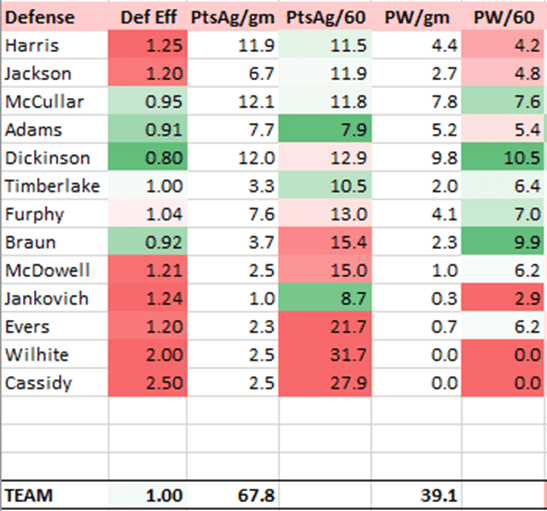
Using the Charting methods, we calculate that Hunter has allowed 276 points in 23 games this season (12.0 ppg). When we convert this to a 60-possession basis, this comes to 12.9 per 60. This conversion is done to compare Hunter to other players.

Next, we can count the number of stops KU gets because Hunter gets the ball back through either a block, rebound, steal, or forced turnover. As rebounds are most common way a defense gets the ball back after a stop, Hunter’s importance is mostly by being a great rebounder. He averages 10.5 possessions “won” over 60 defensive possessions.

For the 2024 team, we can consider this table.

Looking at the Points Against Per 60 column, this shows that Hunter (allowing 12.9 per 60) is worse than the other starters save Furphy (13.0 per 60). However, he is better than his backup Parker Braun (15.4). Additionally, only K.J. Adams (7.9) is significantly better than Hunter at disallowing points. Harris and McCullar have been in the middle-of-the-pack.

If we move to the far-right column, we see possession winners per 60. In this case, Hunter is clear-and-away the best at getting the ball back following a miss or through a forced turnover.

When some think of defense, they mostly consider the first aspect of this, or on-ball defense. And this aspect is very important. Not getting beat, not fouling, closing out on shooters, forcing a player to pick up his dribble and pass, etc. are all ways a defender can make it more difficult for the opponent to score. But the second aspect, or coming away with the ball, is also important. First-shot defense that doesn’t win the ball back will lead to second and third chances that can allow points. A player who might not be a great first-shot defender can still add value if he prevents opponents from getting second-chances. So, we need a way to combine these elements of defense into one number that estimates player value.

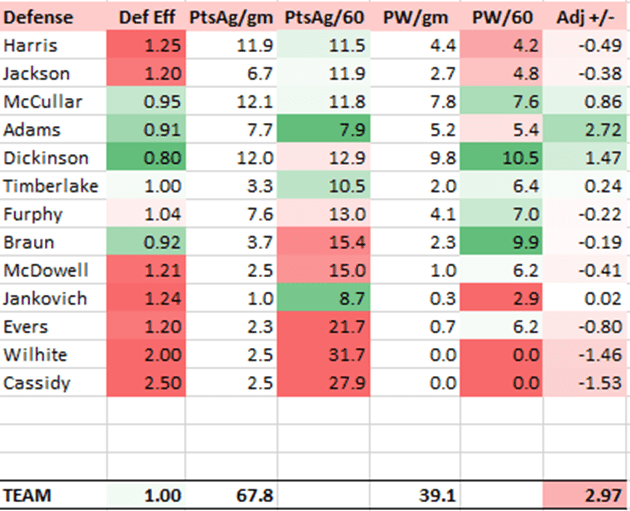
Using theory regarding the relationship to points and possession in basketball, we can calculate how valuable these defensive metrics are. We will now include the defensive value metric in the final column of the table.

This final column estimates, in points per game, how valuable a certain defender is when compared to a replacement (bubble-level) player. Due to his stingy on ball-defense, K.J. has graded out as KU’s best overall defender. But the second-best defender has been Hunter Dickinson–not because he is always great at disallowing points–but because he limits teams’ second-chances. Imagine KU without Hunter on the floor. Teams would get many more baskets through second-chance opportunities.

This is common among bigs in today’s game. The prevailing offensive strategy involves getting opposing 5-men away from the basket (to clear driving lanes and cutting angles). As Hunter is involved in ball-screen defense and plays on the perimeter at times while on defense, he is often put in situations where he can find himself out of position. This leads to breakdowns, rotations, and open shots for opponents. But this isn’t always what happens. Other times he defends fine, and the possession ends with a missed shot that he has a great chance of rebounding due to his height and good rebounding technique.

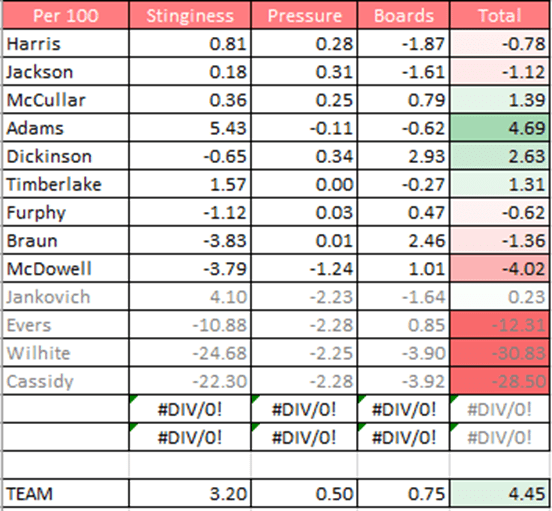
We can break down the defensive value provided by 2024’s roster further, using 3 categories and a Per 100 possession basis. These three categories are: Stinginess (or points allowed), Pressure (forced turnovers/steals), and Boards (rebounds).

Hunter’s Stinginess score is below-bubble, but at -0.65 points we estimate that it only costs KU less than a point per 100 possessions. His Pressure (+0.34) and Boards (+2.93) make up for it, leading him to be a +2.63 player over 100 possessions. This is nearly 4 points better than his backup, Parker Braun has been. He is also better defensively than all other players save K.J. Far from being a liability, Hunt’s been a valuable asset for the 2024 defense.

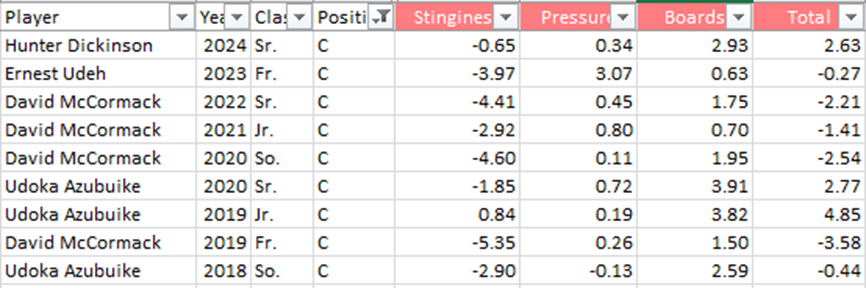
We can also compare Hunter to 5-men of past seasons. Below is a table of all players labeled center who’ve played 10% of minutes on the season or more since 2018. This includes 9 player-seasons.

Here we see a pattern. 8 of the 9 centers on this list have negative Stinginess value, showing that they are allowing points more often than the average defender. This makes sense. Teams are attacking the slowness of the big men to find an advantage that leads to points. However, once we move right, we see that the 5-men can Pressure and Board better than average. So while your guards are likely to be better at preventing open shots, they struggle to get the ball back. Hunter’s rebounding better than any recent center not named Udoka. Additionally, his overall defense is 3rd best out of 9 centers since 2018, again only behind 2019 and 2020 Azubuike.

We can expand this more, just with less detail. Since 1993, there have been 192 players who have played at least 40% of the team’s minutes during the season. Of this 192, only 45 have had a per game defensive value as good as Hunter’s having this year. He’s objectively around the 76th percentile of defensive players in recent Kansas history. Ignore people who don’t know how to track defensive value and fail to consider all relevant factors of defense.

In addition to tracking individual defense, we can confirm these general findings by looking at proxy metrics. One such metric would be points in the paint. This season, for reference, KU’s offense is averaging 40.1 points per game from paint scoring. That’s what a good offense does. A large chunk of this is from Hunter (although K.J. and Kevin are also doing well at the rim). So let’s use KU’s offense as a comparison to KU’s defense. The thought would be that if Hunter’s offensive-value is being wiped away by poor defense, then KU will be allowing nearly as many points in the paint as it is scoring.

This isn’t the case at all. KU is only averaging 25.8 points per game in the paint. This is a difference of 14.3 points, which is more than the overall point difference (10.9). KU is winning points in the paint but losing in all other areas (that is FT’s + 3’s + 2’s outside the lane). This is just further confirmation of Hunter’s value.

A Tale of Two Juans

Dajuan Harris’s last 15 games of 2023 vs. Dajuan Harris’s first 15 games of 2024:

Stat2023 – Last 15 Gms2024 – First 15 Gms
PPG11.36.9
eFG%62.8%48.5%
TS%61.5%471.%
APG5.87.1
A/TO3.02.6
SPG2.61.2
RPG2.92.2
ORtg109.6102.4
Pts AB +/-+48.39-44.98
PPG +/-+3.23-3.00
Per 100 +/-+5.14-4.84

The numbers speak for themselves. Another notable thing is that KU’s average opponent had a KenPom rating of +17.10 over last 15 games in 2023 compared to +4.77 over KU’s first 15 games in 2024. Juan’s drop in production and efficiency has come against weaker foes.

The last three numbers are the value scores, first in total points against bubble, and then rated in per game and per 100 possession bases. These numbers account for opponent strength as well as deeper defensive metrics such as points allowed (Harris is allowing 12.4 points per game in 2024; it was 10.0 over the last 15 in 2023).

Aside from assists, Harris has gotten worse in every facet of the game. But even with assists, his increase in assists has come with a greater increase in turnovers, meaning his overall “ball-handling” value has worsened.

This and That

The following bits of info relate to the 2024 season through KU’s first 15 games.

  • Johnny Furphy’s defense has been better than his offense. Per 100 possessions, Furphy is about -1.03 points to a bubble player on offense and 0.00 to a bubble player on defense. Furphy is shooting well, but he relies on assists to score and turns it over far more than he creates offense for others. Defensively, his coverage score is not terrible and he rebounds at an acceptable clip.
  • Elmarko Jackson has posted 3 above-bubble offensive games, or 20% of the 15 he’s played so far in his KU career. And 2 of these came in KU’s first 2 games. What’s giving him any playing time at the moment is his defense. Jackson has produced 10 positive defensive outings this season (67% of games).
  • K.J. Adams is KU’s best defender right now, posting a +2.23 average defensive game score. This is far better than his 2023 season, which was negative (-0.10). Adams’ improvement on defense is in large part due to him defending less in the post as an undersized 5-man, his role last season. Offensively, Adams has seen a slight decline from ’23 to ’24 (+0.60 to +0.44).
  • Kevin McCullar’s value-score improvement from last season to this season, on a per game basis, is +3.98. This is better than Jalen Wilson’s improvement from ’22 to ’23 (+3.34), Ochai Agbaji’s improvement from ’21 to ’22 (+3.09), and Christian Braun’s improvement from ’21 to ’22 (+3.83). The largest season-to-season jump on record is Frank Mason’s ’16 to ’17 improvement (+4.52). Thomas Robinson from ’11 to ’12 was +3.67. Tyshawn Taylor from ’11 to ’12 was +3.65. Other large jumps in the past include Raef LaFrentz from ’95 to ’96 (+3.67), Keith Langford from ’02 to ’03 (+3.59), and Drew Gooden from ’01 to ’02 (+3.41). There have certainly been other great career developments of steadier growth, but in terms of having such a large leap in value production in consecutive years, what McCullar is doing this season is very special.
  • Hunter Dickinson’s two worst value-score games (-10.40 vs. Marquette, -6.23 at UCF) have coincided with both of KU’s losses. Through 15 games, Hunter is currently KU’s second-most valuable player this season, but is neck-and-neck with Kevin for this distinction. If both can finish the season above +5.00 per game, they’d be the first duo since the Morris twins in 2011 to do this for a Kansas team.
  • Jamari McDowell has not proven to be the answer to the team’s poor wing play. The freshman has produced the worst Per 100 value of any scholarship player, at -7.91. After some initial stingy defense, Jamari has gotten scored on quite frequently in limited minutes. At best, McDowell is only going to be a role player and defense-first guy this season.
  • Parker Braun has been KU’s 5th-best player, and might warrant more court time. He is athletic and experienced. His value scores through 15 games have been 7 positive, 7 negative, and 1 right at 0. While he is at Kansas primarily to back up Hunter, there have been a few moments where Self has gone “small” and played Adams as the 5 when Hunter is sitting. But this leads to more minutes for guys (Jackson, Harris, Timberlake) that aren’t playing as well as Braun has, and haven’t shown enough offensive firepower to compensate the loss of not having a true center inside. Parker isn’t necessarily someone who will win you the game, but he is someone who can keep you in it until Dickinson can return.

Wrapping Up the Non-Con

KU's McCullar earns Big 12 award after second triple-double | KSNT 27 News

The 2023 portion of the 2024 regular season is wrapped up. KU went 12-1 during this non-conference stretch, a good result given the quality of opponents it faced. Using the NCAA’s Net Rankings, KU went 3-1 in Quad 1 games and 1-0 in Quad 2 games. Extrapolate that type of performance out over the rest of the season, and the Jayhawks will cruise into March as a 1-seed. But, this may not be that likely given a few concerning trends.

Best Game, Worse Game

Using a very similar concept to how Ken Pomeroy rates his teams, Charting the Hawks using a point margin difference to rate individual players or games. For CtH, a comparison level of a bubble-team is used to judge how well a player or the Kansas team itself is performing. This is in point differential (or margin) in comparison to a bubble-level mark. For instance, if we’d expect a bubble-level team to beat KU’s current opponent by 10 points (after accounting for location), and KU wins by 18, we’d say that KU had a “game score” of +8.00. This +8.00 score would also equal the net of all Kansas players’ individual game scores, as the system is breaking down each player’s value as a portion of the total team score.

This system is not perfect, but it does have the benefit of being easy(ish) to calculate and understand. In the non-conference, KU’s best game (relative to opponent) was its first one against North Carolina Central. KU’s game score was +24.04, meaning it won by 24 more points than a bubble-team would have expected to. On the flip side, KU’s 8-point win against Eastern Illinois garnished a game score of -15.43, indicating that the actual single-digit margin Kansas won by was about 15 points worse than what a bubble-team would have expected to achieve.

Looking at individuals, KU’s best performance in a game was Hunter Dickinson’s +17.63 margin against Tennessee. Dickinson scored 17 points in that game, but defended great (only allowing 3 points) and rebounded at an elite level, coming down with 20 official rebounds. The interior was owned by Kansas, forcing Tennessee to jack up 33 3-point shots, only to make 9. KU scored 20 more points than the Vols inside the arc that game.

Hunter also has KU’s worst individual performance. It occurred the night before the Tennessee game, against Marquette. Hunt’s score was -10.16 points, indicating a bubble-level player (think average player on a bubble-team) would be expected to play this many more points better against that opponent. In Dickinson’s case, it was the play of Oso Ighodaro which contributed to such a poor game score. Hunter had his worst defensive performance as Ighodaro scored 21 points that night, much of it against HD. In total, Dickinson would give up 26 points to Marquette while grabbing a season-low 8 rebounds.

While this was Dickinson’s worst game, on the season Hunter has been tremendous. Through 13 games, he is adding an estimated 5.35 points per game above bubble, second only to Kevin McCullar at +5.89. The team, as a whole, is averaging only +5.30 points per game above bubble. While the Hawks are 12-1, their point margins haven’t been as good as we’d expect.

Grading Projections

Before the season, KU was projected to have an average game score of +8.51 (vs. +5.30 in reality). This 3.21 point per game difference could be the difference of a win and loss in multiple conference games. In fact, KenPom’s predicted scores for KU’s conference games show 14 games out of 18 to finish within single-digits. KU having underachieving its desired margins so far is a sign of concern, as point margin has predicative implications. This doesn’t mean Kansas can’t improve. To see how, let’s break down KU’s performance to the player level.

This table shows each player’s 2024 projection and actual play through 13 games in points per game.

PlayerPre-Season ProjCurrent Actual
Dajuan Harris+2.50-2.79
Elmarko Jackson+0.10-0.89
Kevin McCullar+1.71+5.89
K.J. Adams+0.93+2.33
Hunter Dickinson+5.18+5.35
Nicolas Timberlake+0.32-1.82
Johnny Furphy-0.84-0.12
Parker Braun-0.39-0.37
Jamari McDowell-0.72-1.07
TEAM+5.30+8.51
In PPG, individual scores won’t add up to TEAM due to walk-on scores missing

While there is still a lot of season left, there have been quite a few players with far different scores than their preseason predictions. Dajuan Harris has been the worst, performing over 5 points worse per game than his projection. Nicolas Timberlake and Elmarko Jackson have also been worse than expected, although Jackson has performed to his preseason expectation over his last 8 games (thanks to his defense). But KU’s guards are what’s holding the team back.

On the flip side, Kevin McCullar has overshot his preseason forecast by more than 4 points a game. McCullar is the Jayhawks’ leading scorer, having hit double-figures in every game this year. His low output was 12 against Kentucky, but this came in his first triple-double performance of the season (he’d add another against Chaminade). Fellow returnee K.J. Adams is defending at a conference first-team level after making the switch back to the defensive perimeter this season. His value score has easily exceeded his value score last year, as he’s also finding new ways to score. Newcomer Hunter Dickinson has hit his lofty preseason expectation of over 5 points of value per game. His backup, Parker Braun, is right at his incoming projection. The other wings, Johnny Furphy and Jamari McDowell, are within range of their projections, but Furphy has certainly played the better of the two.

If we look at where KU can get more value, it’s clear that the wings and interior players are tapped out. Not much more can be expected from Hunter or Kevin. KU needs its guards to start playing better on a consistent basis. This starts with Dajuan Harris. After reaching a season low -3.64 points per game against bubble mark after the Mizzou game, an unprecedented mark for a starter, Harris has responded with 2 positive games over his last 3. Against Wichita State, Harris had his best performance mostly due to a solid defensive game. It’s on this end where Harris has been especially disappointing. Dajuan was the conference defensive player of the year last season; in the 2024 season he’s worse than 1.08 points per game compared to a bubble-level defender. Had he been generating a bunch of offense to compensate, this would be more understandable. But his offense has been the worst it’s ever been, due to limited scoring and poor shooting rates on his floaters and runners.

With KU performing around 3.21 points worse per game than expected, and some of that due to the play of the walk-ons, we can essentially single out one single culprit as to why KU’s margins aren’t as strong as they were expected to be. This culprit is Dajuan Harris. While Timberlake and Jackson have been less valuable than expected, their poor play has been covered by the strong play of McCullar and Adams. Had Harris only played at a bubble-player level, or around 0.00, KU would be hitting its preseason expectations and be about fifth on KenPom (instead of 13th). Furthermore, Harris is KU’s point guard. He is the only one with the pace and ball-handling to run the team effectively at this point. KU can mix and match on the wings, using Furphy and McDowell when Jackson or Timberlake struggle. It doesn’t really have a Dajuan replacement and thus needs him to perform.

New Projections

The new projections use the actual play over the first 13 games along with the preseason projections in a weighted fashion. We should expect a player to trend back toward his preseason projection. These numbers are just a math equation; there’s been no new analysis involved at deriving them.

PlayerPre-season ProjCurrent Projection
Dajuan Harris+2.50-0.63
Elmarko Jackson+0.10-0.49
Kevin McCullar+1.71+4.18
K.J. Adams+0.93+1.76
Hunter Dickinson+5.18+5.28
Nicolas Timberlake+0.32-0.95
Johnny Furphy-0.84-0.36
Parker Braun-0.39-0.38
Jamari McDowell-0.72-0.88
TEAM+8.51+6.61
In PPG, individual scores won’t add up to TEAM due to walk-on scores missing

Worst Case, Median Case, Best Case Scenario

These scenarios are updated from the preseason ones. Also included after each scenario is a look at what that team’s Final 4 chances would be, using historic F4 percentages by seed-line.

The new team scenarios are as follows. The actual worst case is of course an injury to Kevin or Hunter, but barring that improbability, a worst-case scenario that sees KU maintaining its full roster would be that KU’s guards never develop and teams continue to double on Hunter to make the others beat them. In this scenario, teams also focus their defensive energies on denying the ball to McCullar. While I can’t see KU failing to win all but a few of its home games, it could hit a tough spell during conference play on the road and rack up multiple losses in a row. For seeding purposes, KU could fall to a 5 or 6-seed if it can’t get necessary plays from its back-court. F4 chances: ~5%.

The most-likely scenario, or median case, would be that Jackson and Harris pick things up, building off of recent good performances, and start to produce for the Jayhawks during conference play. Harris doesn’t seem far off, and Jackson has been a legitimately solid defender whose offensive game has started to come around (had a career high 12 points vs. Wichita State). In this scenario, KU continues to win close games, loses a few close games, but also gets a bit better on the margin front which helps it out. KU earns a 2 or 3-seed and has a good chance to make the second weekend given its experience and talent. F4 chances: ~15% (Bart Torvik puts KU’s F4 chances at 10.4% as of 1/2/2024)

The best-case scenario is that KU gets the Dajuan Harris of last season to go along with the excellent play of its wings and front-court. Jackson fills his role nicely as a solid transition player and defender, Furphy and Timberlake come off the bench to knock in 3’s, and Braun and McDowell continue providing solid energy so the team can play 9 and stay fresh. In this scenario, KU establishes its dominance during conference play and fends off the new teams with strong efficiency marks in non-conference play. KU then goes on to earn a 1-seed in the NCAA’s and puts itself in a good position to make a Final Four run. F4 chances: ~35%

Future Major Projections – 2024

The following table projects the career majors for 100 top and notable golfers. This projection was made as of January 1, 2024. The ages listed reflect the golfer as of this date.

PlayerAgeCurrent MajorsProjected MajorsEst’d Total Majors
Tom Kim2102.232.23
Scottie Scheffler2712.173.17
Collin Morikawa2621.773.77
Gordon Sargent2001.601.60
Viktor Hovland2601.551.55
Jon Rahm2921.543.54
Jordan Spieth3031.434.43
Sungjae Im2501.421.42
Rory McIlroy3441.085.08
Joaquin Niemann2500.900.90
Rasmus Hojgaard2200.800.80
Justin Thomas3020.722.72
Xander Schauffele3000.690.69
Patrick Cantlay3100.690.69
Cameron Smith3010.611.61
Cameron Young2600.600.60
Brooks Koepka3350.565.56
Matt Fitzpatrick2910.551.55
Sam Burns2700.540.54
Nicolai Hojgaard2200.490.49
Will Zalatoris2700.440.44
Hideki Matsuyama3110.431.43
Bryson DeChambeau3010.411.41
Ludvig Aberg2400.370.37
Ryo Hisatsune2100.310.31
Tommy Fleetwood3200.300.30
Min Woo Lee2500.290.29
Sahith Theegala2600.270.27
Tyrrell Hatton3200.270.27
Si Woo Kim2800.210.21
Jason Day3610.211.21
Patrick Reed3310.191.19
Mito Pereira2800.190.19
Corey Conners3100.180.18
Wyndham Clark3010.181.18
Tony Finau3400.160.16
Cameron Davis2800.160.16
Beau Hossler2800.150.15
Denny McCarthy3000.140.14
Rickie Fowler3500.140.14
Max Homa3300.130.13
Russell Henley3400.120.12
Aaron Rai2800.110.11
Christiaan Bezuidenhout2900.110.11
Justin Suh2700.110.11
Emiliano Grillo3100.110.11
Shane Lowry3610.101.10
Dustin Johnson3920.102.10
Talor Gooch3200.100.10
Patrick Rodgers3100.090.09
J.T. Poston3000.090.09
Brian Harman3610.091.09
Taylor Montgomery2800.080.08
Abraham Ancer3200.080.08
Lee Hodges2800.080.08
Adam Svensson3000.060.06
Sepp Straka3000.060.06
Harris English3400.060.06
Vincent Norrman2600.060.06
Adrian Meronk3000.060.06
Keegan Bradley3710.061.06
Harold Varner III3300.050.05
Jordan Smith3100.050.05
Byeong Hun An3200.040.04
Adam Schenk3100.040.04
Adam Hadwin3600.040.04
Andrew Putnam3400.040.04
Cameron Tringale3600.030.03
Mackenzie Hughes3300.030.03
Billy Horschel3700.030.03
Yannik Paul2900.030.03
Adam Scott4310.031.03
Thorbjorn Olesen3400.030.03
Gary Woodland3910.031.03
J.J. Spaun3300.030.03
Nick Taylor3500.030.03
Alexander Bjork3300.030.03
Justin Rose4310.031.03
Mark Hubbard3400.020.02
Jason Kokrak3800.020.02
Dean Burmester3400.020.02
Chris Kirk3800.020.02
Stephan Jaeger3400.020.02
Alex Noren4100.020.02
Ben Griffin2700.020.02
Brendon Todd3800.020.02
Matthieu Pavon3100.020.02
Matt Wallace3300.020.02
Ben Kohles3300.020.02
Ryan Fox3600.020.02
Marc Leishman4000.020.02
Sam Ryder3400.020.02
Luke List3800.020.02
Matt Kuchar4500.010.01
Tiger Woods48150.0115.01
Chesson Hadley3600.010.01
Eric Cole3500.010.01
Nicholas Lindheim3900.010.01
Lucas Glover4410.011.01
Phil Mickelson5360.006.00

The list is sorted in terms of projected majors from 1/1/2024 on. Tom Kim leads, with a projected 2.23 majors.

The Process for Determining Future Major Champions

Major championships are the defining feature of professional golf, defining a player’s career across generations. Debate about who the greatest golfer of all time generally ends once Jack’s 18 is brought up. When a golfer wins multiple majors, his career is almost always compared to others with the same major total. Brooks Koepka, once he became the 2023 PGA Champion, suddenly joined the echelon of Seve Ballesteros as 5-time major winners. Pundits discuss who the best players are to have not won a major, indicating that this accomplishment is what truly makes a golfer great.

In addition, young players’ careers are often forecast in terms of major championship potential. When we hear of a young new potential star, the question emerges naturally. How good is this new guy gonna be? Just good enough to win a handful of times on Tour and enjoy a profitable career good? Or multiple majors good?

What hasn’t been done, to my knowledge, is the creation of a systematic process meant to identify which golfers have the best potential to win majors. The goal of this process is to quantify a player’s major championship potential. This is no easy task, but there are five key factors that determine a player’s expected future majors.

  • Skill level
  • Age
  • Past major performance
  • Health
  • Major Qualifying Status

Skill Level. As Data Golf has shown, the average major winner has been a player who was playing about 1.5 strokes per round better than an average PGA Tour player leading up to the event. In fact, only 6% of the last 113 major winners were playing worse than an average PGA pro in the onset of those majors. Additionally, pre-tournament models and betting odds reflect that the better the player is, the better his chance is at winning a major.

Age. When projecting out a career, age is also important. The vast majority of major champions have been between 23 and 39 years old. While there are a handful of 40+-year-olds who have won majors, only once as a golfer in his 50’s won a major (Phil Mickelson). As players age, their career windows for winning majors shrink. Historically, the prime spot in a career for golfers has been during their early-30’s (30-32). Lately, there are indications this number has moved toward younger golfers, i.e. those around 28-29. Whatever the case, age is a huge factor.

Past Major Performance. There is a tendency for some guys to play better in majors (than their record week-to-week would otherwise suggest), and for some to play worse in majors. Brooks Koepka is a paradigm example of this, having won 5 majors at this point.

Health. Health is similar to age, in that it determines the amount of opportunities left for a golfer to win a(nother) major. This is difficult to project, but the factor is implicit when we look at historic data.

Qualifying Status. This factor has grown in importance with the onset of LIV and the OWGR refusing to award points to these LIV events. Numerous LIV players without exempt status have lost and will continue to lose major opportunities unless something changes. Talor Gooch is a prime example. As a player in his 30’s, the next couple of years will be his best chance to win a major. Currently, he is not exempt in a single major for 2024 despite winning the 2023 LIV Golf individual title.

The five factors are accounted for in the model, which uses a player’s historic skill-level (using Data Golf public strokes-gained data), age (easy to get), and past major performance (using an internal model which projects estimated true majors won). Implicit in this data will be health data, with qualifying status being important mostly to the names on LIV that don’t have exemptions.

The most time-consuming part of the model was the creation of a player/age skill curve (PASC), which measures the normal career of a player as he ages. Regardless of relative skill level, the average player is at the top of his career during a period between age 26 and 35, normally peaking around 30-32. As mentioned earlier, the trend has been for players to peak younger.

The PASC allows us to project out a player’s remaining career. It is by no means perfect, but it does help to compare a player who is very good for 21 (like Tom Kim) vs. one who is in his prime years.

Independent of the PASC is the major performance chart, which looks at how a player has performed in majors so far using an in-house performance model. This is weighted to be important, but not overriding.

Analyzing the Results

Tom Kim is projected to win 2.23 majors in his career according to this model, the most of any golfer moving forward. The factors in Kim’s favorites are numerous. He is young yet still very skilled. Additionally, he has a T2 finish at a major (2023 British Open). Him being healthy and exempt in 2024 to the majors is also a plus.

Contrast Kim (2.23) vs. Ludvig Aberg (0.37). Aberg burst onto the scene with a solid rookie season, but there are some things that the model dislikes about Aberg’s chances. First, his skill-level has actually been worse than Tom Kim’s in each of the last 4 years. Kim has been better, in terms of strokes gained. Adding context to this is that Kim is three years younger than Aberg. Kim’s age 24 season is projecting out to be better than Aberg’s very good age 24 season. Aberg has also not had a top major finish. This leads to more uncertainty regarding his ability to contend in the biggest events. One might assume that Ludvig will contend in majors without problem, but this isn’t always the case. Max Homa didn’t earn his first Top 10 in a major until last year, during his age 33 season.

Gordon Sargent is also projecting out very high, as the model assumes he should win 1.60 majors in his career. At age 20, Sargent has shown elite potential. Collin Morikawa, who has won 2 majors already, is still only 26. He is just entering his prime. Don’t sleep on him. Of all players currently 30 or over, the model still loves Jordan Spieth to win another major or more. Spieth’s performance in majors is underrated. People forget his 2019 PGA and 2021 British Open battles despite not playing great during this point of his career. Even if Spieth has already peaked, he will have a chance to rack up another grand slam event somewhere along the way.

The LIV guy hurt the most by the current OWGR system is Joaquin Niemann. The model has him winning 0.90 majors, but if he can’t receive exemptions over the next couple of years it will hurt his chances (he has qualified for the 2024 British already). So, adjust this score down somewhat.

Lastly, the model is likely underrating Koepka’s major potential. The problem with any model is that it attempts to apply general factors to specific players, and Brooks is anything but general. Koepka’s career is special. He plays at an elite level in majors, and the major performance factor should likely be weighted more heavily for him. But coming into his age 34 season, he has fewer chances to add to his career than one might otherwise think.

Phil Mickelson is projected to win 0.002 majors moving forward. While I wouldn’t write him off completely (he did finish T2 at last year’s Masters), his 6 majors is a great career and likely the end result. However, his new nemesis, Rory McIlroy, has been sitting on 4 majors for 9 seasons. Rory, a consistent top player with strong major results is expected to win 1.08 more majors, which would be behind Mickelson’s career total. This is an interesting dynamic for sure.

Ideas for the Future

The plan is to do this projection yearly and eventually see how accurate these forecasts are. With time, it would also be enlightening to run this model from some point in the past (say 2000 or 2010) and see how accurate the model was.

Some intriguing bets for most career majors (which include majors already won) are:

  • Scottie Scheffler (1) vs. Justin Thomas (2). Scheffler is projected to win 2.17 more; Thomas to win 0.72 more. Scheffler leads at the moment, but JT currently has a 1 major lead and there is a famous saying about 1 in the hand being worth more than 2 in the bush.
  • Matt Fitzpatrick (1) vs. Viktor Hovland (0). Each is projected to finish with 1.55 career majors. Viktor looks to have more potential, but when can he get that first major?
  • Bryson DeChambeau (1) vs. Sungjae Im (0). Sungjae is only 25, just a year older than Ludvig Aberg. Sungjae has a T2 in a major (2020 Masters). Sungjae has been a consistent performer on the PGA Tour. The model is high on Sungjae Im. Bryson, in contrast, has recently battled injury and is already 30. Right now, the model says Sungjae gets 1.42 majors and Bryson gets 1.41.
  • Tom Kim (0) vs. Dustin Johnson (2). The model has Kim leading. Tom Kim has many years of prime golf ahead of him; Dustin Johnson has already started to slip. Dustin turns 40 in 2024. He might have one more left in him. But the model thinks Kim has a better chance to win more majors (2.23 vs. 2.10).

Closing Thoughts

Current LIV Golfers are projected to win 0.62 majors in 2024, and this works about to about a 50/50 chance that any current LIV golfer wins at least one major. This may seem small, but the PGA Tour has the larger quantity of top players. I would better the over (i.e., at least 1), in part because I think the model is overlooking Bryson DeChambeau’s recent improvement.

Not all golfers are included on the list above, just the top 100 (or top 98 + Phil & Tiger). There is still a chance a winner comes from outside this list. This model isn’t meant to downplay the chances of anyone left off, it’s just that for purposes of time and space we only included 100 names. If any 2024 major winner does emerge outside this list, we can backward forecast his chances (by looking at his career as of 1/1/2024) and update the table to reflect what his projected chances were coming into 2024.

Three’s Company

Eleven games into the 2024 season, KU’s been carried by its “Big 3” of Hunter Dickinson, Kevin McCullar, and K.J. Adams. The trio has combined for 64.7% of KU’s points scored this season while playing 48.4% of available minutes. This production works out to points per game averages of 19.2, 19.2 and 13.0. No one else on the team averages even 7.0.

Additionally, these three have been the best defenders on the team according to the charting. Per total per game value; Dickinson (+6.64), McCullar (+5.14), and Adams (+2.31) are playing well beyond that of a bubble-player, while all 6 of the other scholarship guys are below 0.00. KU is heavily reliant on this trio to win games.

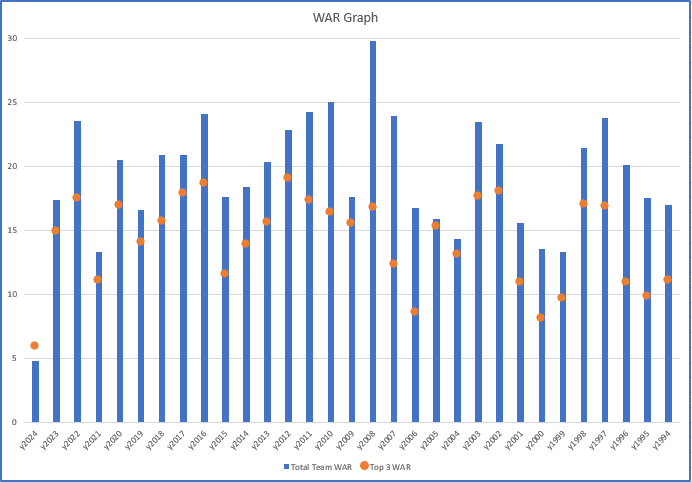
For a Kansas team to be so reliant on just a few players seemed odd, so I explored a way to quantify this and compare it to other KU seasons. The best way was to use WAR, which is additive, and sort each season by that year’s team’s most valuable player to its worst.

Here are the numerous ways the 2024 team stands out:

  • Of the 2024 team’s total WAR, each of KU’s Big 3 has collected at least 25% of the team’s total WAR (note that a player can be negative if he has negative WAR). Since 1994 (31 seasons), only once has this happened over the course of an entire year (2017 with Frank Mason, Josh Jackson, Devonte’ Graham).
  • Through 11 games, the trio of HD/KM/KJA has produced 5.94 WAR, which if multiplied out to a 36-game season, would be 19.43. This would be the best out of any KU team’s best three players, with the 2012 team earning 19.07 during a 38-game schedule. (If we compared apples to apples, this year’s Big 3 is on pace to earn 20.51 WAR over 38 games).
  • It’s not only that this year’s top trio is playing well; it’s also that no one else is doing much. Of the team’s total WAR, the HD/KM/KJA three have earned 124% of the WAR, indicating that the sum of everyone else is below replacement-level. At no point since 1994 have players 4 on down collectively generated negative Wins Above Replacement score for the Kansas Jayhawks. The closest was in 2005, when all players save Wayne Simien, Keith Langford, and Aaron Miles produced a meager 0.53 WAR. The current 2024 non-Big 3 is at -1.15 WAR through 11 games.

Note how the orange dot (Top 3 combined WAR) is always contained within the blue bar (Total Team WAR) except for the 2024 season. For the 2024 team, KU’s needed everything it has gotten from its Big 3 due to the rest of the roster struggling to play at a high level. Projecting forward, one assumes that Dajuan Harris will pick things up. There might also be some reversion down, particularly with Kevin McCullar. McCullar has vastly over-performed his projected marks coming into the season.

Dajuan, Dajuan, What is Wrong?

(Long article. Scroll down to bottom for the summary)

During the midst of the 2023 season, KU had a 3-game losing streak and a date at Rupp Arena against a talented Kentucky team. Dajuan Harris was coming off poor showings in his last 2 games, and questions surrounded a team that had no true center in the starting rotation and a pass-first point guard who wasn’t a natural scorer.

Kansas went on to beat Kentucky that game, bolstered by great play from Jalen Wilson, but also a good outing from the rest of its starters, including its point guard Dajuan Harris. From that game forward, KU would play 16 games to close out the season. Harris produced a +3.22 per game value score, indicating that he was worth over 3 points per game to Kansas than a “bubble” level player would be. During this stretch, Harris was playing his best ball, comparable to a junior-year Frank Mason (2016 season) or senior-year Tyshawn Taylor (2012 season). Harris was doing it in different ways than these scoring guards; certainly through defense first, but he was also adding value on offense thanks to both shot-making and assisting.

In fact, during the closing stretch of 2023—KU’s final 10 games, Harris produced offensive value of +1.06 per game. This was third on the team behind Wilson and Gradey Dick over that period. While KU getting bounced in the Round of 32 wasn’t fun, no one can blame the play of Dajuan Harris. He was solid against the Razorbacks on both ends, adding about a point-and-a-half both ways and +3.30 points overall. For the season, Harris contributed +2.06 points per game above bubble. Roughly, based on his play, Harris was worth 2 points a night when compared to an average player on a bubble-team.

The elements for Dajuan Harris having a successful 2024 were all in place. He was coming in as a 5th-year-in-the-program player (having redshirted), 2-year starter who saw his game improve each season. Always a defense-first, pass-first player, Harris had improved during the back-half of his junior season and started to be a net contributor to the offensive scheme. This development is common, but not guaranteed, among Bill Self program guys. Harris was making the same strides in his game that others had before him. Some of these strides were unique to him, but he was playing better and making a positive mark on a program that has had numerous talented players come through.

Coming in to the 2024 season, Harris was projected to be a +2.50 player on the season, a conservative improvement on his 2023 value scores. Harris was expected to see a slight bump on both offense and defense. It wasn’t that his expectations were too high. If anything, they were somewhat low. By all appearances, Harris had figured things out. His defense had been consistent throughout his career, and now his offense had finally come around. With Hunter Dickinson coming in, his assist numbers would reach career highs. His shooting and scoring would still be there, but he wouldn’t need to do too much.

But through 10 games, this hasn’t been the case. Not only is Harris not performing to his projections, he isn’t performing anywhere near what he is capable of. He is playing worse than in 2023, by a long shot. He is also playing worse than he did in 2022, when he was a role player on the national championship team. But not only that, Harris is worse than he was in 2021 as a red-shirt freshman who rarely shot and got taken advantage of by stronger players.

Looking at Per 100 numbers, that is the value a player adds (in points) to his team over the course of 100 possessions, Harris’s development looks like this:

2021: -5.18

2022: -1.72

2023: +3.46

Players tend to improve as they age through their college careers, although again not everyone develops in this straight-forward of a manner. Some players have drops in value or flat-line after they reach certain points. So, if Harris was merely on pace to produce a similar or slightly worse season than last year, this wouldn’t be out of the ordinary. Even if Harris was noticeably worse, say close to 0.00, it would be disappointing but not unprecedented. Unfortunately, this isn’t the case, either. In fact, Harris is playing the worst basketball of his career at Kansas.

2024: -5.80

Again, this is a per possession number, so it takes into account the fact Harris is playing more than he has in past seasons. On a per possession basis, Harris is worse than a bubble-player by 5.80 points, which is even worse than his value during his freshman season of 2021.

If we look at it from a per-game mark, it looks even worse. At -3.52, Harris is producing the worse per-game mark of any Jayhawk rotation player by over a full point per game (2019 Quentin Grimes -2.40). Harris is also worse than his prior season at over 5.50 points per game. Never has there been such a drop-off, year-over-year. KU has had players unexpectedly decline, Eric Chenowith’s junior year (2000) being one example (he went from a +2.63 player to a +0.59 player), but it has never been this dramatic.

Breaking down Harris’s play so far, we’ll first look at offense, comparing his 2023 and 2024 seasons.

Going through each line, we see that Harris’s efficiency has slipped from 1.11 to 1.03. What makes this worse is that KU hasn’t faced its meaty conference schedule yet. Not only is Harris less efficient, he is less efficient against an easier schedule. Harris is accounting for nearly 2 fewer points per game on offense than he did last year, despite playing more minutes. Harris is shooting worse overall than he did last season (49.5% vs. 45.2%). He is also shooting less, despite the team needing him for more production. In turn, his impact is less this season. Once we adjust for opponent, we see that Harris is 2 points worse (in terms of overall value) on this end that he was last season.

Breaking down into offensive categories on a Per 100 possession basis, we see (2023 vs. 2024):

Not only is Harris’s scoring down, his handling (turnovers/assists) is also down. Only his boarding, or offensive rebounding value, has changed for the better. But in terms of overall value, this increase is negligible.

Defensively, Harris has declined even more.

Harris went from a stingy defender, giving up 9.2 points per 60 possessions to allowing 11.8 per 60. The other important category, possession winners (PW), went from 5.3 to 4.2 per 60. A player needs to win possessions to add value. Harris is getting fewer steals, forcing fewer turnovers, and not rebounding any better while giving up more points to his man. All despite playing an easier schedule when compared to 2023 numbers. This leads to a player who is worse on the defensive end by more than 3 points a game.

His Per 100 numbers on defense, broken down into categories:

Harris went from KU’s best defender in 2023 to its worse in 2024. How? Well, mostly by giving up too many points to his opponent. A stinginess score in the red means he has to add value from generating turnovers (which he hasn’t done well at in 2024) or rebounding (which is marginally better, but as a point guard, not ever going to be the area where he adds defensive value). This is the biggest disappointment in Dajuan’s decline. He was the Big 12 defensive Player of the Year last season. Now, he’s a liability most games.

2023 vs. 2024. Harris is over 5.50 points per game worse in 2024. He is over 9.20 points worse Per 100. He has also gone from a season where he added 3.87 Wins Above Replacement to one where he has lost 0.52 WAR.

Should Harris be benched?

Dajuan is putting up historically-bad numbers in a season which has him playing historically-high minutes. Clearly, something isn’t working with him. But if KU went to the bench, who would replace his minutes? We can’t consider Adams, McCullar, or Dickinson/Braun, players whose minutes are already maximized or aren’t suitable replacements for a guard. Let’s look at KU’s other four guards/wings in terms of player value. Remember, based on the roster, KU needs to have at least 1 of these guys on the court at all times right now. If Juan gets benched, you’ll need 2 of these 4 to play at once.

There’s a bunch of red here. For one, Nicolas Timberlake is playing worse than Harris on a per possession basis. Next, we can look at the play of Jamari McDowell and Elmarko Jackson. Neither has been much better than Harris. McDowell in particular has struggled recently after a hot start. Of these four, only Furphy has produced near bubble-level value and positive WAR.

So, let’s grant that Furphy has been better than Harris. Who else do you go with? Elmarko has had his poor moments. McDowell is very limited on offense, and his defense won’t likely become elite anytime this season. Timberlake is an even worse option. Another consideration is that, when you take Juan out, you need Kevin McCullar to run more point/generate more offense. Sure, you still have Elmarko and maybe part of the solution is giving him the keys from time-to-time. But if he’s been struggling as an off-guard with less pressure, what chance does he have being the guy to get everyone organized and the offense started?

KU’s best chances are still with Harris. He cannot, surely cannot, continue to play as poorly as he has. As a 3-year starter, Harris put up back-to-back seasons that were better than anyone else on the list above. If he could just match the 25% percentile of his play over the past two years, he’ll be much more valuable on the court than more minutes for the other four guards/wings.

Silver Lining

The good news is that Harris will not continue to play as poorly as he has. Yes, it’s been a disappointment. Here are many reasons to consider that his play will tick up.

  • He will get exploitable matchups as teams game plan around stopping Hunter/Kevin/K.J. He will get open layups, open 3’s, and other opportunities.
  • He will have a few defensive shut-down games to boost his defensive score.
  • As schedule gets harder, Harris will play up to his opponent. While he hasn’t done well against KU’s better opponents, he’s still better against KU’s 5 power-conference foes (-2.87 per game) than the 5 lower-tier opponents (-4.17 per game).
  • Harris’s score can naturally climb faster given how poor he’s been. Just a few positive games can be enough to change the narrative.
  • The team is currently 9-1 despite him playing poorly. Juan hasn’t been responsible for a loss, as the 14-point Marquette loss was the fault of many poor showings.
  • Precedence of Tyshawn Taylor in 2011. Taylor was -3.89 per game during 17 conference regular season/tournament play yet still finished the season with a solid NCAA Tournament of +3.35 per game (even his play during the VCU game wasn’t terrible). So other good players have gone through disastrous stretches but still picked things up later on.
  • Precedence of Remy Martin in 2022. Harris’s former teammate Martin had a disappointing regular season (-0.05 per game). But in his 9 tournament games (Big 12 + NCAA’s), Martin put up +3.66 per game in value, hitting huge shots in key moments during KU’s National Title run. Again, like Taylor, we see improvement when it matters most.

If Harris can get back to the level of play he had in 2023, his tough start to 2024 won’t matter at all.

Conclusion

Here are the key points. Dajuan’s performance through 10 games this season has been his career worst. Compared to other KU starters, Harris has been worse than any other Jayhawk in 30 years. He has seen decline in his game across all categories, but the primary problems have been with his scoring and defensive coverage. He isn’t scoring enough but is letting his man score too easily.

However, despite his poor play, Harris is a necessary component to this team. His would-be replacements are either worse or wholly unequipped to carry the load as a Big 12 point guard. Not only does he need to play, he needs to play substantial minutes for this team.

The expectation should be that Harris improves and is back to being a positive contributor by season’s end. There is precedent for good Kansas guards figuring it out by NCAA Tourney time. As KU is winning despite his poor play, a solid Dajuan Harris can make this team a true national title contender.

The Battle for Net Extra Possessions

KenPom has Kansas as the 6th best eFG% offense and the 14th best eFG% defense in nation, counting only D-1 matchups. This spread, of 18.7%, is the best in the nation and nearly 2.5% better than the second-best of BYU. To reference, the difference from #2 BYU to the #10 team is smaller than the gap between Kansas and BYU. Which is to say, KU’s shot quality is far superior to its opponents in the brief number of games played so far.

While KU is winning the shot quality battle, it is losing the other battle, that is the battle for net extra possessions. A net extra possession means offensive rebounds minus turnovers. Teams that turn it over too much lose out on chances to shoot. Teams that hit the offensive glass add shooting chances. We want to find the net of these numbers.

Collectively, KU’s opponents have had -1 net extra possessions, meaning KU has forced 1 additional turnover than it has allowed offensive rebounds. This doesn’t sound all that bad on the defense’s behalf, until you see what KU’s offense has done. In its 6 games, KU has turned it over 41 more times than it has got an offensive board, meaning the team is -41 in this metric. If we find the difference between these numbers, we see that KU’s opponents have had 40 more chances to score than KU has this year, solely due to turnover and offensive rebounding differences. This works out to -6.7 per game. KU is effectively getting 7 fewer scoring chances than its opponent on average. If we only consider the top opponents, who to this point are Kentucky, Marquette, and Tennessee; KU is -11.3 per game. Knowing this, its amazing the Jayhawks were able to take 2 of those 3 games.

OpponentKU NEPOpp NEPDiff
North Carolina Central-60-6
Manhattan-3-6+3
Kentucky-6+7-13
Chaminade-8-5-3
Marquette-80-8
Tennessee-10+3-13
TOTAL-41-1-40
NEP means Net Extra Possessions

The silver lining is that KU should improve on this possession battle. Much of this can be attributed to effort and newcomers learning how they need to play. Valuing the basketball and hitting the glass is something that will be expected for those looking to earn minutes alongside the “big 4” of Harris, McCullar, Adams, and Dickinson (KU also needs more from Harris and Adams on this front). As long as KU continues to get good looks, and having Hunter is a large reason for that, they should be fine. In tonight’s tune-up against Eastern Illinois, KU needs to dominate the glass and turnover margin in order to prepare for Connecticut and other tough games that will come later in the year.