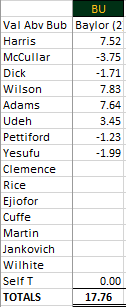
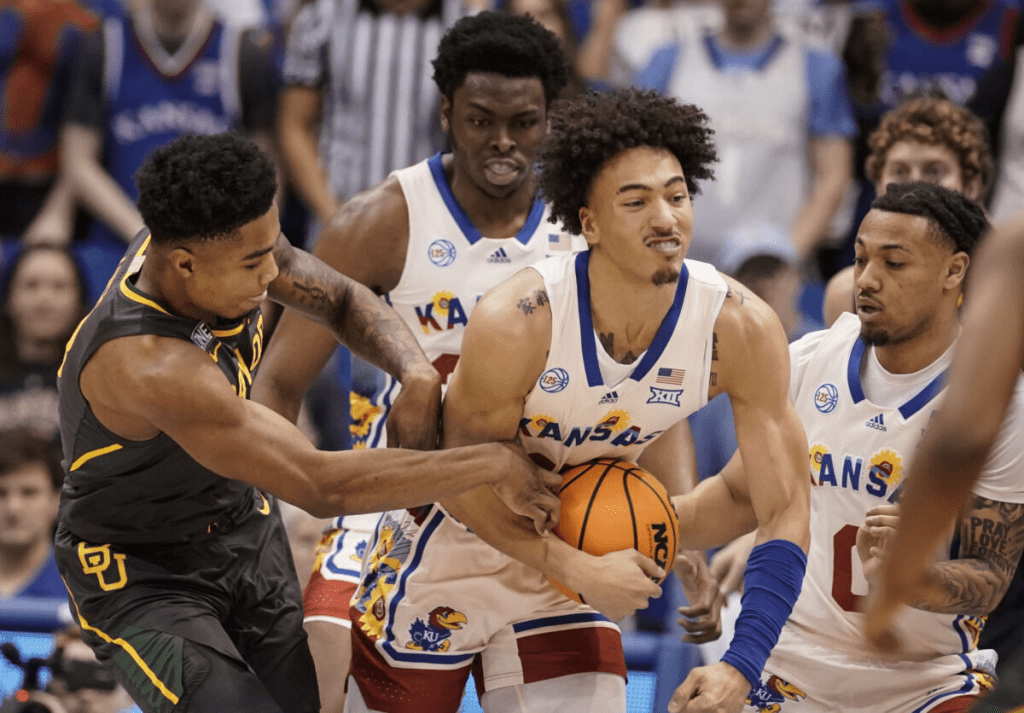
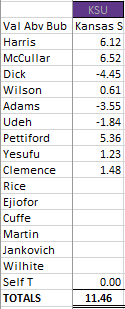
Down as many as 17 in the first half, the Kansas Jayhawks used a ferocious second-half comeback to win going away against Baylor. Jalen Wilson’s value score led the team, his 13th game this season doing such, but both K.J. Adams and Dejuan Harris were essentially just as valuable. Ernest Udeh was also a very solid contributor, continuing his stretch of good play with a positive game score.
The TEAM’s +17.76 score was its 11th above +10 on the season, and its sixth in its last seven games. Signs are pointing to this team peaking at the right time, as the final week of February arrives.
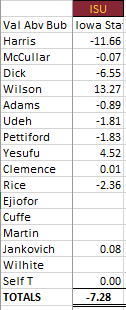
Freshman Gradey Dick had his 5th team-MVP game of the season in a career high 26 point effort. After accounting for his defense and opponent, it was his 4th-best game of the season. Other Jayhawks who added value were Kevin McCullar, Jalen Wilson, Dejuan Harris, Zuby Ejiofor, and Bobby Pettiford. The team was able to go deeper into its bench thanks to the (relative) health of Ejiofor and Pettiford. However, it’s clear that Pettiford in particular isn’t quite 100%. Late injuries to Harris and McCullar might also be a factor moving forward.
Ernest Udeh followed up his excellent OU game with another high-energy performance, although his fouls contributed to a negative-value score. Still, he has played well of late. M.J. Rice only contributed an offensive foul in his 2 minutes of play, and Joe Yesufu had a typical game for him. KU’s worst performer against the Cowboys was K.J. Adams, who had the worst defensive outing of anyone this year. He was responsible for a lot of easy baskets from OSU’s Kalib Boone, and also got scored on at times when switching onto guards late. He has struggled during conference play due to his position (undersized 5), but he is also overrated on the perimeter.
The TEAM is on a roll, averaging an 11.74 value score over its past 6 games (where it has gone 5-1). If it can keep up this level of play, it will not only earn a 1-seed but have the capabilities that past 1-seeds have had. Getting contributions from its bench has been huge, as the bench has been +1.10 per game over that span (this may seem pedestrian, but the bench was averaging -5.57 before that time). In its last 5 outings, the bench has been even better (+3.49). This has shown up in the results of the games.
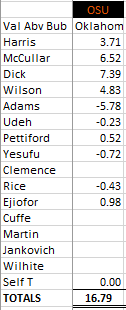
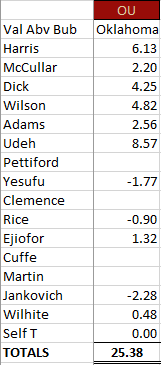
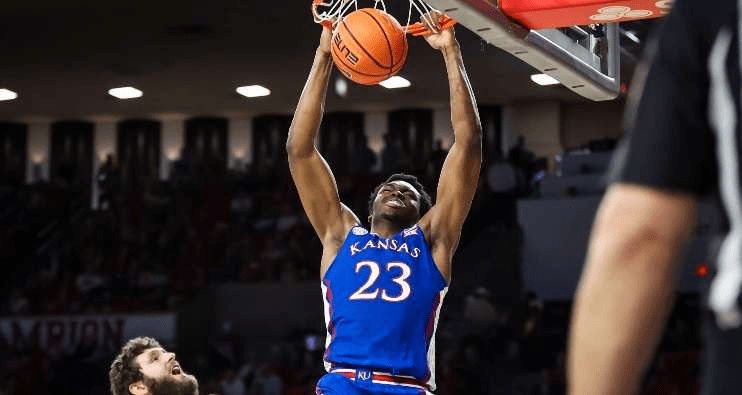
Kansas may have found its next great big man. Ernest Udeh had his best game as a freshman, particularly on the defensive end. He gave up only 1 point while winning 10 possessions due to blocked shots, deflections, steals, forced turnovers, and rebounds. He was all over the place, taking the game over on the defensive end. In total, he added 8.57 points of value above a bubble-player and became the first bench-player to earn a team-MVP for KU this season.
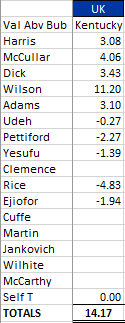
The five starters all put up positive-value games as well, with Dejuan Harris performing best. Gradey Dick didn’t let a lower-output performance (8 points scored, 0 3-pointers) dampen his value as he made up for his lack of production with an efficient game and solid defensive effort. Jalen Wilson was solid as he led the team in scoring after a sluggish start. Kevin McCullar had another solid game on the offensive end. He’s been an above-bubble player on that end of the floor over his last 9 games.
Zuby Ejiofor and Dillon Wilhite had positive outings in mop-up minutes. Joseph Yesufu, M.J. Rice, and Michael Jankovich were the only Jayhawks below zero-value.
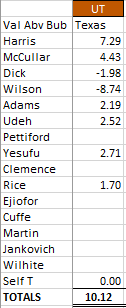
Kansas went to 19-5 (7-4) with a huge Big Monday win. Dejuan Harris led the team in value, producing a value-score of +7.29 for his second team-MVP game of the season. He had a positive impact on both ends of the floor to help the Hawks secure the victory. Kevin McCullar was also effective, scoring in double-figures while also adding offensive value through numerous assists. McCullar has had a nice stretch over his past 5 games, averaging +5.44 points of value per game above bubble. K.J. Adams also contributed a positive outing for only the second time in his last 7.
On the negative side of things, Jalen Wilson had his worst game of the season in an uncharacteristic manner. Scoring on 2 points and adding an assist, Wilson was shut down on the offensive end all night. He also gave up more baskets than he’s accustomed to, contributing to his second game of the year where he had a negative effect on both ends of the floor (Indiana was the other). Strange as it may be, Jalen seems to play better when others around him aren’t.
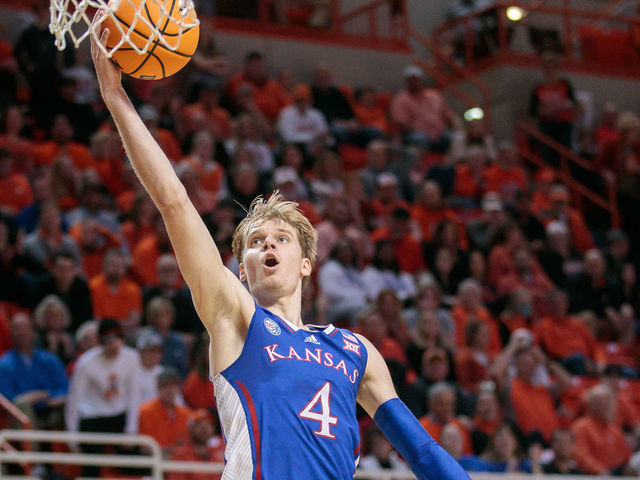
Gradey Dick had as good an offensive outing as anyone Monday night (tied with McCullar, who added his offensive value in a different style). Dick went 2-3 from downtown and finished at the rim effectively to produce nearly 5 points of offensive value. It was his defense which drove him into the red, particularly late in the game. Dick has been a serviceable defender, particularly when you consider his age and role on the team. He has to continue to work on improving on that end and prove his worth, as team’s will game plan around his perceived weaknesses.
Now on to the bench. With five scholarship players out due to injury (Pettiford, Clemence, Ejiofor, Cuffe, Martin), KU went into the game knowing it had to make due with a shortened rotation. And the reserves who were healthy stepped up in a big way. Joe Yesufu had his best offensive game of the season and has now produced three consecutive positive outings for his team. Ernest Udeh finally broke into the plus-side of things. He’s been bringing good energy recently, but his value scores weren’t showing the full effort he brought. M.J. Rice made numerous good hustle plays, finishing with a basket and a couple assists and solid defense in 14.6 minutes of play. The bench has now outperformed the starting 5 for 3 games in a row.
In an ugly game that would have been even uglier if not for Jalen Wilson, KU shot 26% from 3 and had 20 turnovers to reach its second-lowest point total in a game this season. Wilson had his 3rd-best opponent-adjusted game of the season, accounting for a fraction over 24 points while only allowing 6 on the defensive end. He went for 39 minutes yet still competed on both ends of the floor. He desperately needs consistent production from others on the team.
Joseph Yesufu was the other Jayhawk to have a positive-impact Saturday. Yes made a couple of jump shots in his nearly 20 minutes of work, balanced out by solid defense. He’s been a bubble-level player over the past 7 games (86.7 minutes of play), a trend which will hopefully continue.
On the other side of things, the play of Dejuan Harris has been the biggest harbinger of victory or defeat. In the past 5 games, he’s had his worst 3 games of the season which were all defeats. When he’s played well, KU has won. In his past dozen outings, he’s produced a value score of -1.12 PPG, which is worse than his play last season. For KU to win, he has to be better.
Gradey Dick has also been slumping of late, but his worsening value scores are primarily due to missed shots. He’s doing much of the other things better, aside from turnovers which have also ticked up as he has been attempting to put the ball on the deck more.
After 11 consecutive above-bubble games for K.J. Adams, he has produced negative-value scores in 5 of his last 6. He has been struggling to finish some of the plays he was making earlier in the season, and his defense continues to lag behind as he fails to drop well on ball-screen coverage or get many defensive rebounds. He’s still KU’s best option at the 5.
Kevin McCullar, in turn, has generally been playing good ball of late. His defense has reached the point of being the team’s best. He is a great defensive rebounder, attacking the glass with his long frame to finish possessions after an opponent’s missed shot. He also gets his fair amount of steals, blocks, and forced turnovers. Offensively, his game has been a challenge. Since conference play began, he’s only had 2 games above bubble-value from the offensive side of things. KU can live with this, as long as his defense stays stingy. In the 11 games (beginning with Oklahoma State), he’s averaged a defensive game score of +3.06.
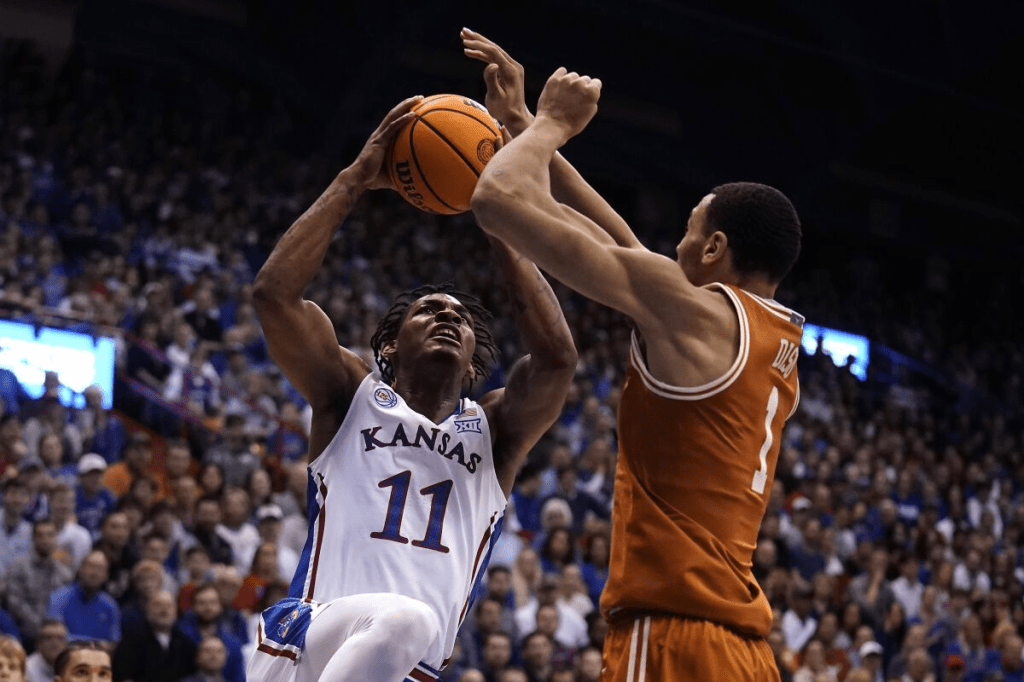
The Jayhawks put the Cats back in their place, using a strong opening half to cruise to a double-digit victory. Kevin McCullar graded out as the team’s best Tuesday night, with Dejuan Harris close behind. Bobby Pettiford had his best performance of the seasons to lead a bench effort that was likewise its best. In fact, the bench outdid the starting 5 last night for Kansas. This was only the 3rd time in 22 games that the bench scored better.
Other positive performances included Zach Clemence, Joseph Yesufu, and Jalen Wilson. On the negative-value side, Ernest Udeh allowed too many baskets while K.J. Adams and Gradey Dick battled foul trouble and worse-than-usual offensive outings.
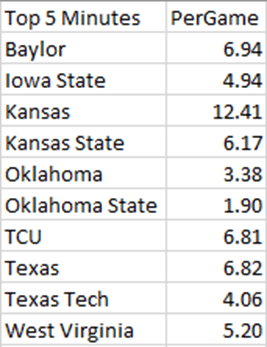
“Starters” reflects the Top 5 players on the team in minutes played. Due to injuries, rotation patterns, and so on; what constitutes a starter might differ from team-to-team. The term “crunch-time five” might also apply. These numbers are in Points Above Bubble through 1/29/23:
Kansas leads the league with a top five which is collectively 12.41 points above bubble per game. There is a large gap until you get to the rest of the pack. The list is in alphabetical order.
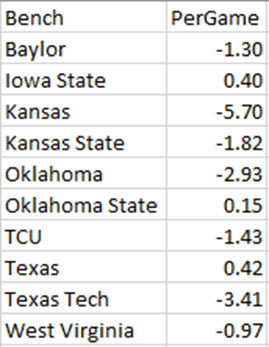
The bench refers to the rest of the roster combined. Walk-ons are included, but their numbers are negligible. This shows the collective points against bubble of the reserves in a per game ratio:
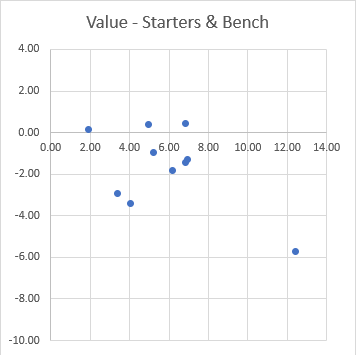
The best bench is Texas’ bench, which is slightly above bubble-level. Iowa State and Oklahoma State are also above-bubble. As you can see, Kansas’ bench is by far the lowest. The below chart graphs this out, putting the starters on the X-Axis and bench on the Y-Axis. To the right and up is where you want your team to be. See if you can tell which button Kansas is represented by:
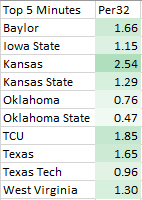
A Per32 look is also instructive. First, look at the average starter for each team in a 32 minute span. This will be a good estimate of how much value a certain team’s average starter can provide if playing a decent load of minutes.
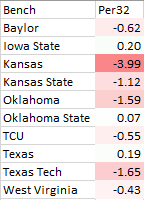
Now the same thing, just with the bench.
KU’s starters are clearly the class of the league, but its reserves are so far behind it almost boggles the mind. KU’s bench isn’t just bad, it’s also the most noticeable unit in this exercise. Any bubble-level player from past seasons, such as a freshman Christian Braun or a sophomore Landen Lucas or a junior Naadir Tharpe, would make this team 2 to 3 points better per game. KU can only make this work as good as it has because it plays its starters the bulk of available minutes (77.4%, leads the conference). If it lost anyone of its starting 5 for a decent amount of time, it would get noticeably worse.
One more note about the Kansas starters. If you removed Jalen Wilson, the other four starters would still produce an above-bubble value which is above 6.00 points per game. That group would still be 5th in the conference among starting 5’s, but very close to the other 4 teams and under 1.00 point per game below the new first-place team. With Jalen, its not even close who has the best starting 5. Effectively, Jalen’s excellent season is mostly being washed away by the team’s poor bench.
Kansas got a huge win, breaking its 3-game skid. Jalen Wilson had his 11th team-MVP game of the season and his 9th consecutive above-bubble-value game. Each starter produced a positive-value game, where each bench-player was negative. Ernest Udeh had the best game off the bench, and was a bit unlucky to end up below zero. He got lost on a rotation which ended in a 3-point basket.
In creating the ranking of Big 12 players, there was the ability to explore more regarding the makeup of the conference. Here are some additional things that stand out about the makeup of players in the Big 12:
The League is Senior-Heavy. While experience has always mattered, the post-pandemic and transfer-portal era has produced a large share of veterans. Using the classifications from KenPom, 36% of all Big 12 players are seniors. When you look at minutes played, the senior-heaviness of the conference becomes more apparent. 51% of the minutes played by Big 12 players have been played by seniors. Iowa State has 8 seniors who have played at least 100 minutes. For Texas and West Virginia, this is 6. K-State and OSU have 5. Kansas is the only team with fewer than 2 seniors in the main rotation (Kevin McCullar). In many cases, a player labeled as a senior is in his fifth year, however there are some 4th year players classified as seniors which does confuse things somewhat. But with 2021 not counting against eligibility, one would expect the trend of senior-heavy rosters to continue for the next two seasons.
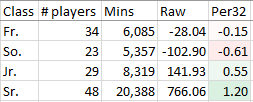
Not only do they play more minutes than the other three classes combined, seniors have collectively produced far more value for their teams. The following chart shows how much value the typical player produces by class. The important column is the one on the right, labeled Per32. This is to set player-value by class over a 32-minute span. We’ll use 32 minutes (80% of a non-OT 40-minute game) to serve as a proxy for the average minutes for a starter in Big 12 play.
When weighted by playing time, the average senior produces 1.20 points above-bubble over 32 minutes of play. The other three classes, when combined, are effectively 0.00. Interestingly, freshmen are out-performing sophomores. This appears to be an effect of the “one-and-done” system. Two Baylor would-be sophomores (Sochan and Brown) went to the NBA draft and are now pros. In turn, two excellent college freshmen in the Big 12 (George from Baylor, Dick from Kansas) are poised to be first round picks in this year’s draft. Were the NBA draft rules different, either the early-entrees would still be in college as sophomores or the freshmen might not have come to school. This would make each class’s value scores look different.
Jalen Wilson is another interesting case. Due to injury as a true freshman, he redshirted. Although he is listed as a junior, by age he is a senior. Think how much wider the senior/junior gap would be if he were classed as a senior. To a lesser extent, this also applies to Dejuan Harris who is a senior by age but junior by class. Last, Joseph Yesufu is classed as a junior even though he is in his fourth season. With him getting a fifth-year of eligibility, KU effectively had both his 2022 and 2023 seasons be as “juniors.” Again, classifications are all a mess in this era.
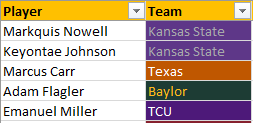
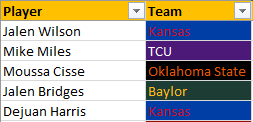
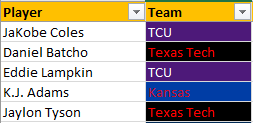
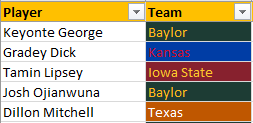
By class, here are the best 5-players in the Big 12 through 1/26/2023.
Seniors
Juniors
Sophomores
Freshmen
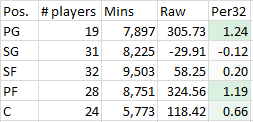
Point Guards and Power Forwards Excel. This is partly due to the two leading Big 12 players, Jalen Wilson (PF) and Markquis Nowell (PG), having separated themselves from the pack. Other great PG’s in the league include Marcus Carr, Adam Flagler, and Mike Miles…all in the Top 6 of all players. Regarding PF’s, Emanuel Miller (TCU), Aljaz Kunc (ISU, currently injured), and Kalib Boone (OSU) are also having good years.
Classing players into a traditional position (PG, SG, SF, PF, C) is harder that it used to be. A few things have happened. One, there are more “positionless” players and systems. Two, teams are becoming more perimeter-oriented, playing 4-out and often 5-out systems without true post presences. This can be handled one of two ways. One is to recognize the change in the game and place players in positions which they’d historically be classed. Therefore, a rotation might play a PG, two SG’s, and a SF alongside a PF. The other way is to do what Pomeroy essentially does, and continue to utilize the traditional position names regardless of the style being played. So when a team plays a small-lineup, this just means that whoever its biggest/most interior player is gets classified as the “Center.” Even a SG might become that line-up’s “Power Forward.” The logic to this seems to be that, regardless of the style you play, you are going to be competing against someone of whatever position you are at, 1-5. To apply this to KU, this would mean that K.J. Adams (as a small-ball “5”) is seen as a Center, because he primarily guards (and is guarded by) the opponent’s biggest player.
For the chart below, players have been classified using a combination of Pomeroy’s algorithm and the alignment of players into their natural, historical positions. For one, Pomeroy’s algorithm isn’t 100% accurate (he has Jalen Wilson as KU’s “Center,” likely due to how poor of a rebounder K.J. Adams is). We want to see which styles have been most effective among Big 12 play. Some teams play two true PG’s (i.e. Texas with Carr and Hunter). We want to reflect that here. As far as K.J. Adams is concerned, his position is PF. This means KU starts two PF’s, instead of a PF and C as would be traditionally done.
The Shooting Guards and Small Forwards grade out the worst, indicating that there is some diminishing value in filling a roster with wing-types who mostly shoot jump-shots. If you have shooters, it obviously works. But if you don’t, then what? Oklahoma State (-68.92) and Texas Tech (-33.42) have the worst collection of wings in the conference (number in total cumulative points against bubble at those positions). They also have the two-worst offenses in the league according to KenPom. Of the wings who are solid, the three best in the league are Johnson (K-State), George (Baylor), and Dick (Kansas).
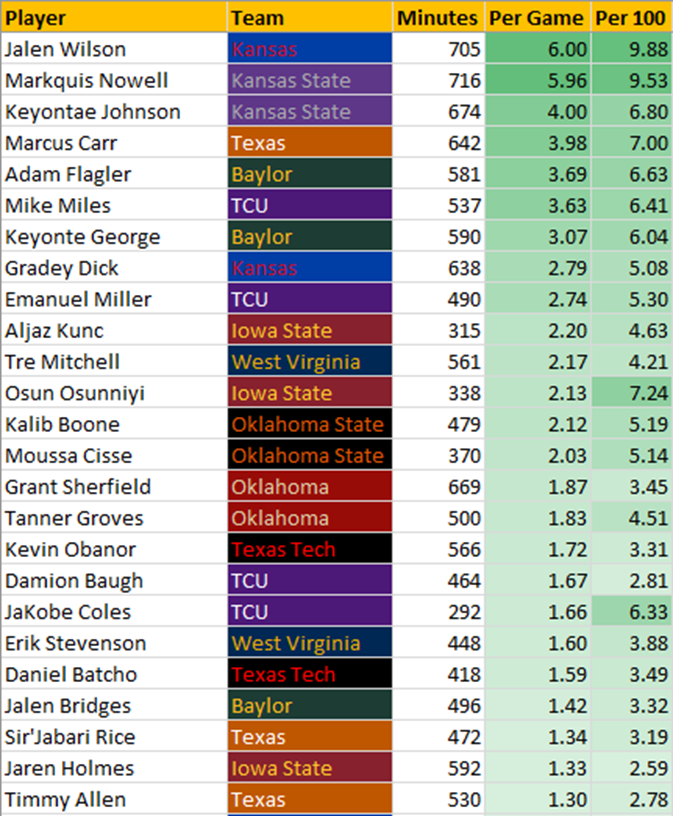
Below are the top 25 players in the Big 12 through: 1/25/2023, linked also here. This ranking covers the entire season of play, not just Big 12 games. This list will be updated on the other link weekly or so, whenever time permits.
The list is sorted on Per Game, which is the Adj. PPG +/- estimate for Big 12 players. Note that for the 9 non-KU Big 12 teams, these are estimates using only box score data. The data for KU players is more complete, as it uses defensive coverage stats (and other non-box-score statistics).
For non-KU players, the actual Adj. PPG +/- number could be higher or lower. This will largely depend on how much better that player is than his team’s average defender, as defensive coverage stats are estimated by divvying out the team’s defensive value among its roster by minutes played. The takeaway is this. For non-KU players, his score is roughly accurate but could vary by as much as 1.00 point per game (or 2.00 points per 100) depending on his defense. If you have good reason to think his defense is much better than average, add some value up to 1.00. Or if he is a less-than-skilled defender, his value may be overstated to some degree.
As far as conference Player of the Year goes, the race is currently between Jalen Wilson and Markquis Nowell. Team success will play into it somewhat, if either Kansas or Kansas State wins the league it might make the difference in who wins this award, but consistency in the area of scoring will be the biggest determinant. Nowell has been a double-figure scorer in 17 of 20 games this season, and two of those were 9-point performances. His low, against Kansas ironically enough, was 4 points.
Jalen Wilson has reached double figure in all of his 20 games, with a season low of 11. Wilson is the better rebounder and has more shot volume, whereas Nowell is the better shooter (TS%) and assist-man. Either would be an acceptable choice at this point.
The other Jayhawk on this list is Gradey Dick, at #8. He checks in as the second-best freshman, only slightly behind Keyonte George. There is a lot of experience on this list. Multiple fourth and fifth-year players are having good seasons. Quite a few of these names were actually born in the 1990’s, making them 23 turning 24 this year. Getting old has been the recipe for success in the post-pandemic era.
Other notable Jayhawks include Dejuan Harris (#26), K.J. Adams (#31), and Kevin McCullar (#32). Right now, KU should have one conference first-teamer and one second-teamer.
If we filter to only include the Big 12 players with at least 100 minutes, which is around 12% of total playing time (each team will have its own number of possible minutes played, but for convenience sake using 100 as a filter works); we get a total set of 97 players. Here are the KU players who qualify, and their conference ranks:
(#1) Jalen Wilson: +9.88
(#14) Gradey Dick: +5.08
(#33) Dejuan Harris: +2.05
(#37) K.J. Adams: +1.74
(#39) Kevin McCullar: +1.52
(#78) Zuby Ejiofor: -3.35
(#88) Joseph Yesufu: -4.61
(#96) M.J. Rice: -6.91
(#97) Bobby Pettiford: -7.95
Compared to the rest of the conference, KU has an elite star, an excellent #2 option, a collection of above-average starters who add a small but positive level of value, and a bench that is among the worst in the league. Actually, other benches are also struggling, even amongst the conference’s good teams. K-State has two elite college players, but after that it goes downhill. Only Texas features a solid, top-to-bottom rotation among its top 8-10 players. The Longhorns are the only school which doesn’t feature a player with a Per100 below -3.00 among its players with at least 100 minutes. In fact, their depth is easily the best in the Big 12. The worst Longhorn is still currently better than -1.00 Per100. Texas’ rotation is deep and experienced.

 Charting the Hawks