Ochai Agbaji had his 5th MVP of the season, tying him for the team lead with Braun
Game Recap:
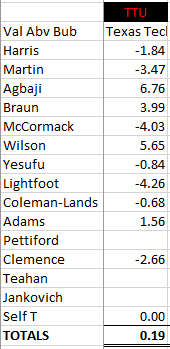
KU got solid performances from four of its wings: Ochai Agbaji, Jalen Wilson, Christian Braun, and even K.J. Adams. These four accounted for over 71% of the team’s points in only about 52% of the team minutes. On defense, these four only have up 40% of the 75 points the Jayhawks allowed Texas Tech. Ochai Agbaji was the team MVP, scoring 24 points and ending with a 1.34 offensive efficiency rate.
Once again, it was KU’s guard and post positions which were a let-down on both ends of the floor. David McCormack failed to follow up his Oklahoma State performance with a good game, as did Dejuan Harris. Remy Martin 12:25 of game play were the fewest in a game this season (aside from the George Mason DNP-injury), making one wonder if he is fully recovered.
The team score of 0.19 was the fourth-worst on the season.
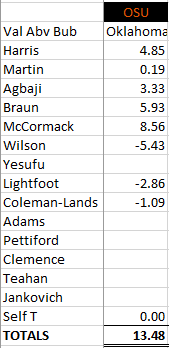
David McCormack was the team’s most valuable player against Oklahoma State on 1/4/2022, his second MVP of the season. Dejuan Harris played the best defense, giving up only 4 points in 31 minutes.
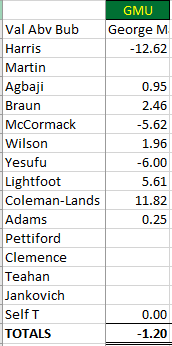
Jalen Coleman-Lands lit it up for 20 points on 5-7 3-point shooting. He earned team MVP honors.
In terms of value produced, here are summaries for each player:
Jalen Coleman-Lands +11.82. Not only did he have an incredible shooting game, JCL also played solid defense, only giving up 7 points while grabbing a few rebounds. His first team MVP as a Jayhawk was also the fourth-best individual performance of any KU player this season.
Mitch Lightfoot +5.61. It was a good game for veteran players, as KU’s second-best performer was the 6th year senior. Both efficient on offense and stingy on defense, Lightfoot’s score was only hampered by his poor defensive rebounding effort.
Christian Braun +2.46. CB overtook Agbaji as Kansas’ best overall player in this game, although the two are statistically even at this point. He didn’t have a great game, but still played well by knocking down late free throws.
Jalen Wilson +1.96. J-Wil rebounded very well to make up for a poor shooting game. He also defended well, in fact all of KU’s wings have played good defense this season.
Ochai Agbaji +0.95. Agbaji didn’t have a great game offensively, but still defended well and made a nice and-1 on a drive to finish with 11 points. He is a “quiet” defender, in that he doesn’t block shots, grab a ton of rebounds, get many steals, or force many opponent turnovers.
David McCormack -5.62. Bad Dave was back, starting the New Year with only 1 point and a poor value score. He grabbed five offensive rebounds, but never finished any of his put-backs. His defense on the perimeter and interior was worse than Lightfoot’s, which is why Coach Self went with the backup during most of the second half.
Joseph Yesufu – 6.00. With Remy Martin out due to injury, this was a great opportunity for Yesufu to have a break-through game. Unfortunately, it was more of the same. Yesufu’s main issue is on defense, where he gives up both outside shots and drives despite his quickness.
DeJuan Harris -12.62. As good as JCL’s game was, Harris’ outing was bad enough to wipe away enough value from what his teammate added. Harris had a typical offensive game for him, only scoring 4 points, but it was on defense where he struggled, allowing 19 points and multiple 3-pointers. It was a disappointing step-back after his solid performance against Nevada.
TEAM -1.20. KU was 1.20 points worse than a hypothetical bubble-team, who would have been expected to beat George Mason at home by about 10.20 points (for this season, think Creighton as a bubble-team). Looking at the performances, KU got more-than-enough from its super seniors Coleman-Lands and Lightfoot. But it was the three players who had terrible games that held them back. With conference play beginning Tuesday, these types of performances will result in losses.
Christian Braun produced his team-leading 5th MVP game. He has produced positive value in all 11 games so far.Adj. to Opponent
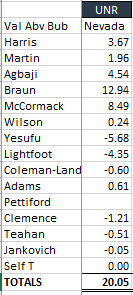
Christian Braun: Produced over 17.5 more points than he allowed, while playing efficiently on both ends by limiting turnovers and winning possessions through rebounds, blocks, and forced TO’s. His opponent-adjusted score of +12.94 was the second-best on the season of any Jayhawk, only slightly behind his season-leading St. John’s performance.
David McCormack: Produced over 8.5 more points than he allowed, while winning more possessions back on defense than he used on offense. This high efficiency allowed him his second-best game of the season at +8.49.
Ochai Agbaji: Despite giving up 9 points on defense, Ochai came away with 10 possession winners (including 4 steals and 1 TO forced) to produce an overall value score of +4.54.
Dejuan Harris: Produced over 15 points, a career-high, but also gave up 12 points on defense against Nevada’s scoring guards. He turned it over twice, but forced five turnovers and grabbed two defensive rebounds, so was possession-positive. His value was +3.67.
Remy Martin: Produced over 4 points more on offense than he allowed. He forced a few turnovers and grabbed few rebounds to finish with a value of +1.96.
K.J. Adams: Assisting on a Braun 3 and a nice pitch-ahead to Agbaji on a fast-break (which the box score missed), Adams produced more points than he allowed despite not scoring himself. He had a miss and a rebound, netting to zero on possessions. His value was +0.61.
Jalen Wilson: Jalen scored 7 points and gave up 7 points, but since he scored two of his baskets on assists his point produced – allowed was negative. However, he made up for this by winning possessions from rebounds (8). His value was +0.24.
Michael Jankovich: Had one miss and one rebound, netting to zero. The slightly-negative score of -0.05 was due to opponent adjustment.
Chris Teahan: Had one miss. Value score of -0.51.
Jalen Coleman-Lands: Made 1 shot of 4, producing 2 points on offense. However, he didn’t give up any points on defense, making up some ground for his poor offensive efficiency. Value score of -0.60.
Zach Clemence: Gave up 3 more points than he produced, fouling three times in his 5:11 of floor time. He grabbed a couple boards as well. Value score of -1.21.
Mitch Lightfoot: Gave up nearly 4 more points than he allowed in 10:16 of floor time. Possessions were also on the negative side, with his 3 turnovers driving his score down. Value score of -4.35.
Joseph Yesufu: Gave up 6 points in only 5:20 of floor time, while turning it over twice on offense. Value score of -5.68.
TEAM: Offensive efficiency of 1.14, Defensive efficiency of 0.79. Value score of +20.05 was the second-best on the season (behind the Missouri game).
Christian Braun had his 4th MVP game of the season
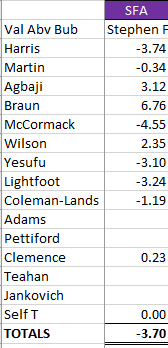
Although it was closer than expected, KU’s talent shown through at crunch time, and the Jayhawks held on to win, 80-72 over Stephen F. Austin. With Kansas being about a 22 point favorite from the computers (Vegas had it at 23.5), the 8 point win meant this was KU’s second-worse performance of the season. Below are the value scores:
Christian Braun has now produced positive value in all ten games this season. He was the most valuable Jayhawk against SFA with a value above bubble of +6.76 points. As in most games, he filled the stat sheet. Along with being the leading point producer, he won 9 defensive possessions Saturday night, the most on the team.
Ochai Agbaji did not have his best game finishing scoring chances (two missed dunks), but played solid defense in 39 minutes, only giving up 7 points defensively. He produced +3.12 points above bubble, showing that his improvement in the off-season has brought up his “floor” immensely.
Jalen Wilson had a nice night off the bench in about 20 minutes. His one 3-point attempt didn’t fall (making him 1-15 on the season), but he made some shots in the midrange. His defense has remained steady in 7 games this year, and it helped provide value for his team last night.
Zach Clemence didn’t play much but scored on a put back attempt following an offensive rebound. His defense wasn’t great in the few minutes he played, but still managed to produce an overall positive value game.
Remy Martin was clutch, making a late 3-point basket to give Kansas a more comfortable 6 point lead during the final minute of play. However, he gave up a quick lay-up soon after. He struggled to get going and had some defensive lapses, leading to a slightly negative game.
Jalen Coleman-Lands made a couple free-throws in a few first-half minutes (he didn’t play in the second half), but also played poor defense.
Joseph Yesufu gave up two buckets in his few minutes of play, once on a mismatch inside and once giving up a drive to a guard.
Mitch Lightfoot played the bulk of the minutes inside, giving up some scoring to SFA’s skilled big Gavin Kinsmil. However, he hit the offensive glass to the tune of 4 boards.
Dejuan Harris only took one field goal attempt, a missed dunk. He did put in four FT’s to ice the game away. While he struggles to produce points aside from assisting, his defense last night was as good as it could have been.
David McCormack had a very poor game, finishing with only 2 points and battling foul trouble all evening. Still, you need more than 10 minutes out of him.
TEAM was at -3.70, meaning a similar type performance against a bubble team on a neutral site would result in a 3-4 point loss. Kansas is getting very consistent positive performances from Ochai Agbaji and Christian Braun. The team normally gets at least an okay game from Martin and Wilson. But it is the others; in particular McCormack, Lightfoot, Coleman-Lands, and Harris; who mix good to great games with bad ones.
Note that K.J. Adams was out sick and was unavailable. Bobby Pettiford is also still recovering from his injury, so KU only dressed 10 scholarship players (all of whom played) for this game. Agbaji, Braun, and Martin all played season-high minutes (39, 36, and 35), which resulted in a game which saw the least amount of bench-play so far this season. Using the HHI player rotation metric (higher means less substitution), the SFA game was at 0.73, well beyond the range of 0.50 – 0.66 that the season’s first 9 games had seen. The rotation is being tightened as conference play nears.
Christian Braun throws down 2 on his way to his third team MVP game of the season
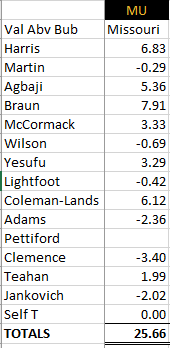
After nine seasons without the rivalry being played, Kansas destroyed Missouri with a balanced attack led by incredibly efficient offense. The win moved Kansas to 8-1 on the season.
Beating Missouri by 37 was the team’s best performance of the season thus far
Dejuan Harris, Joseph Yesufu, Jalen Coleman-Lands, and Chris Teahan had their best outings of the season against Missouri. Braun and Agbaji also produced solid value scores in keeping with the excellent basketball they have been playing. David McCormack played his fourth positive-value game in a row.
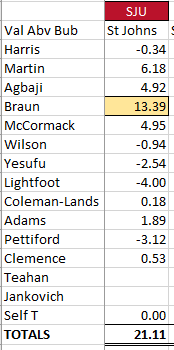
KU defeated St. John’s by 20 in New York in the Big 12 / Big East Challenge game, improving to 6-1 in the non-conference. Below are the value scores for each player.
Christian Braun recorded the best game of any Jayhawk this season at +13.39. David McCormack had his second consecutive good outing, and both Ochai Agbaji and Remy Martin performed at a level we’ve been accustomed to seeing. K.J. Adams actually won 6 possessions from rebounds (5 offensive) in only 6 minutes, two more than what the official box score gave him. Despite only scoring 8 points so far in 7 games, K.J. is actually adding offensive value this season because of his rebounds.
The 2022 Kansas Jayhawks finished with a record of 34-6 (14-4), having won the Big 12 Regular Season and Tournament Championships. The team earned earned a 1-seed in the NCAA Tournament and won the National Championship. The team’s Sports Reference link is here.
Offense
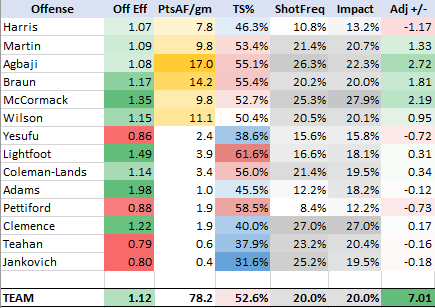
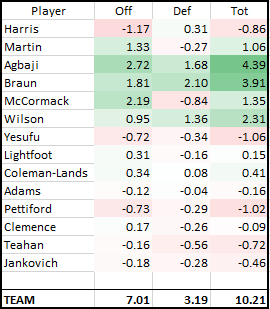
At +7.01, the 2022 team was KU’s third-best offense in the Self era, slightly behind 2017 and 2018. The team had an excellent mix of offensive talent, led by Ochai Agbaji. Agbaji finished with 17.0 points produced per game, which translated to +2.72 offensive points above a bubble-level player. David McCormack was KU’s second most valuable offensive player on a per game basis, producing 9.8 points per game but also adding value through offensive rebounding. His Offensive Efficiency of 1.35 was easily the highest of any starter.
Christian Braun was a steady player on offense, scoring in double figures in all but 5 games. He was good at the rim, shot well from outside, assisted nicely, and had his fair share of stick-backs and other hustle plays to bring value. Remy Martin got hot late in the season, carrying the Jayhawks when the team needed him. Had he been healthy the entire season, his numbers would have looked very good. Even where they are, he provided +1.33 points more per game than a replacement option would have been expected to add.
Jalen Wilson finished a fraction below +1.00, held back by poor perimeter shooting but buffered by rebounding and strong finishes at the rim. Given how many big moments he had, its crazy to think of him as only the fifth-best offensive player during the 2022 season.
Off the bench, both Jalen Coleman-Lands and Mitch Lightfoot added decent offensive value through efficient shooting numbers.
Defense
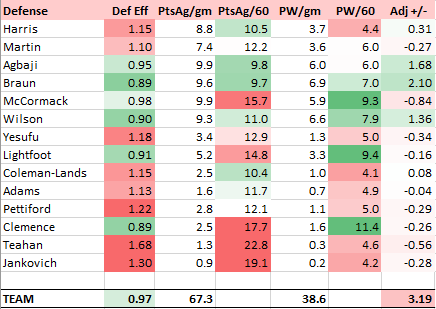
KU’s defense of +3.19 was the weaker side of the ball all season. But the team played well when it mattered most, averaging a +7.75 value score in its last 10 games.
On the season, Christian Braun was KU’s most valuable defender, giving up 9.7 points per 60 possessions and grabbing a fair share of rebounds for a wing. Fellow wings Agbaji and Wilson were also solid and versatile defensive pieces, with Och being a better on-ball defender and Wilson being an excellent defensive rebounder.
Point guard Dajuan Harris was KU’s leading steal-man, coming away with 58 live-ball steals on the year. He also forced 50 (dead-ball) turnovers, for 108 total. Given the fact he turned the ball over only 70 times himself, he was +38 for the year with regards to taking care of the ball. This is what you want to see from your main ball-handler.
Total Adjusted PPG +/-
Ochai Agbaji was KU’s best player all season, and his Adj. PPG +/- of +4.39 was the 24th best season of any Jayhawk in the last 26 seasons (1997-2022). Christian Braun at +3.91 was not far behind, producing the 29th best Adj. PPG +/- score over that time period. Of the 7-man rotation that played the bulk of the minutes during NCAA Tournament play, 6 had positive scores (Agbaji, Braun, Wilson, McCormack, Martin, Lightfoot).
Unbelievably, the TEAM score of +10.21 was KU’s 12th best season from 1997-2022. This speaks to the consistency of the program. 2022 may not have been KU’s most talented team, but they played well when it mattered most. Over the team’s final 10 games, the Jayhawks were +14.22.
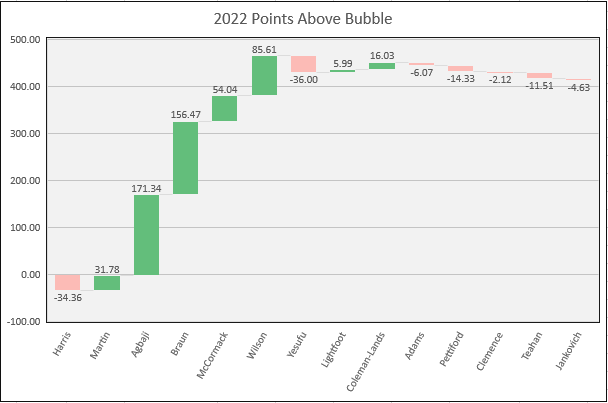
This waterfall chart shows how much value in Points Above Bubble that each Jayhawk added. The bulk of KU’s success came from its wings. The Jayhawks had 7 rotation players produce positive value, a sign of depth and maturity. However, only 1 of these 7 was a point guard type.
MVP’s
In the 40 games KU played, here are the total game MVP’s for KU players ranked from most team-MVP’s to least. Agbaji 11, Braun 10, McCormack 8, Wilson 5, Martin 3, Harris 1, Coleman-Lands 1, Lightfoot 1.
After adjusting for opponent-quality, here are the percent of games with positive value score by player from best to worst (above 50% performers): Braun 83%, Agbaji 74%, Wilson 68%, Clemence 63%, Martin 57%, McCormack 55%, Adams 51%, Coleman-Lands 51%.
Points Above Bubble vs. Points Above Average
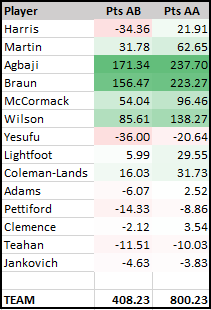
Ideally, each KU rotation player would be at a “bubble level” of value, but this isn’t the case most years. To add context to each player’s season, we can lower the skill level of the comparative player to that of the average D-1 player. When we do this, notice how each player’s Pts AA is higher than Pts AB, and how all rotation players except Joseph Yesufu and Bobby Pettiford have performed above that of a D-1 average player.
This incorporates total minutes, so Dajuan Harris’s ability to play as much as he has helps his Pts AA far more than someone like Joe Yesufu or Jalen Coleman-Lands. Focusing more on Harris, what we can say is that although he isn’t good enough to carry a team to the heights KU has reached, he has been a steady role-player that hasn’t hurt the team’s chances either. The 2022 team was carried by Agbaji, Braun, Wilson, with McCormack and Martin stepping up in the Big Dance as well. But durable guys like Harris and Lightfoot were good enough to keep KU at the high level they’ve had this season. If KU had to replace its role players (specifically Harris, Coleman-Lands, and Lightfoot) with average D-1 players, the team would have been worse off on the year.
National Champions
During the team’s six-game NCAA Tournament run, here are the Adj. PPG +/- scores:
Dajuan Harris -1.02
Remy Martin +4.11
Ochai Agbaji +3.11
Christian Braun +3.42
David McCormack +2.53
Jalen Wilson +1.46
Joseph Yesufu -0.84
Mitch Lightfoot +1.76
Jalen Coleman-Lands +0.02
K.J. Adams -0.06
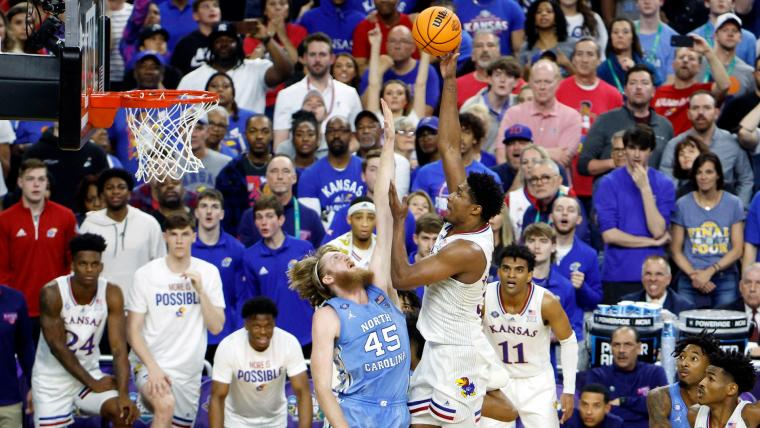
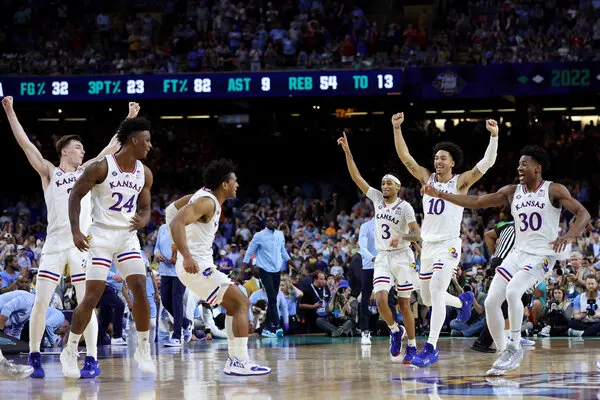
Remy Martin was the most valuable Jayhawk during March Madness, after an up-and-down year plagued by missed games and injuries. David McCormack stepped up late, becoming KU’s best player in the final three games of the season. He may not have won Final 4 MOP officially, but he was the biggest reason KU cut down the nets in New Orleans. His biggest plays came during the final moments of the National Championship game. After missing a turnaround shot, he collected his own rebound and finished it to turn a 1-point deficit into a 1-point lead with 1:21 left. He then played solid defense against Carolina’s Armando Bacot (who went down with an injury), forcing a turnover. On the other end, with the shot clock winding down, McCormack got deep inside position and scored again to extend the lead to 3, which would be the final margin. Down 72-69 and with only seconds to spare, the Tar Heels would fire 3 contested 3’s that were all off the mark, cementing Kansas as the 2022 NCAA Champions.
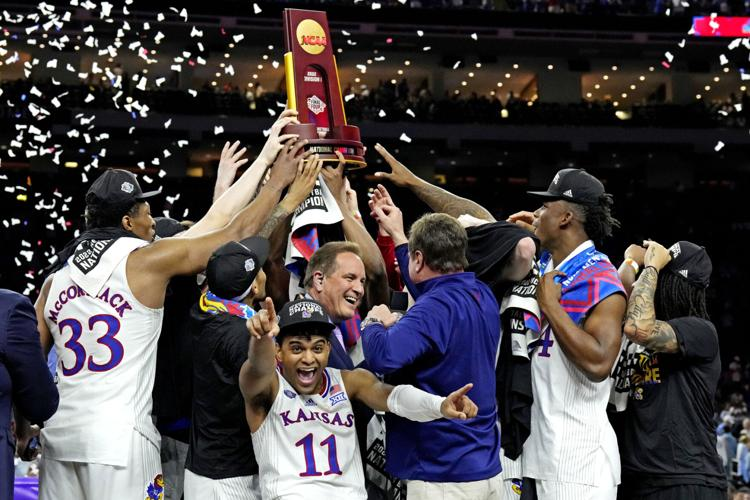
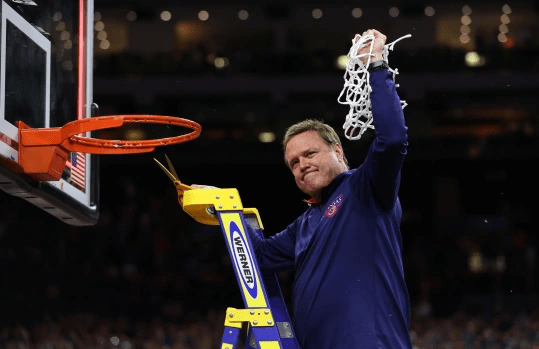
D-Mac’s final bucket put KU up 3 with 22 seconds left, forcing UNC into a difficult spotThe Hawks celebrate after a final defensive standRock Chalk, Championship!National Championship net
Junior wing Christian Braun was the only Jayhawk selected to the all-tournament team
Yesterday Kansas wrapped up its early-season tournament, going 2-1 in Orlando to finish third. The team defeated North Texas and Iona, but it lost to Dayton on a buzzer beater. Here’s what the stats say about the way KU played.
Good Offense, Bad Defense
In the three games over the weekend, KU scored at a pace of 1.165 points per possession, but gave up 1.049 points per possession. Let’s start with the offense. The team didn’t shoot great from outside of easy baskets in the paint (34% on 3, 59% on FT’s), but got itself a ton of great looks with good transition play and solid half-court offense. Not many defenses will be able to slow down this team with its versatility. They’d need too many offensive talents to have off-nights.
On the other side of the ball, Kansas did show some good defense at times, forcing 50 turnovers in the three games, but the Hawks gave up too many easy baskets considering the opponents. With North Texas, Dayton, and Iona all having offensive ratings in the 100’s, KU should have been below 1.000 points per possession allowed over the course of three games. Coming in to the season, the defense was the big question mark. Following the Orlando tournament, this question has only grown. It isn’t a question of depth, size, or athleticism. The potential is there. But the defensive skill is lacking. The discipline isn’t fully developed. Coach Self will harp on this all year, because if he can find guys who can defend while maintaining the scoring ability we’ve seen so far this team can have a great year.
Rotation Reminds Open
Coach Self played all 12 scholarship players in all three games in Orlando, and each one of these 12 got at least 9 minutes in at least one of the three games. This is very rare for Self, which got me to thinking how to best measure roster depth and dispersion of minutes.
One way to measure how spread out the team’s minutes are is to use a modified form of the Herfindahl-Hirschmann Index (HHI). This index is used in economics, but we can modify it for our purposes. Basically, if the number is 1.0, this means a team would never sub (play 5 players all 40 minutes). A team which played 10 players 20 minutes each would be at 0.5. Any realistic number for a basketball team will be in between these values, with numbers closer to 1.0 meaning less substitution. So far for this year, KU’s HHI is at 0.585. As a comparison to a past KU team with limited depth, the 2018 team had an HHI of 0.754. Self never plays 10 guys throughout the course of a season, let alone 11 or 12. But aside from the top 3 or 4 players, it isn’t easy to see who should get more minutes at this stage. Expect this HHI to stay relatively low (close to 0.600) for at least the non-conference season.
Player Rankings from Orlando
Below are the per game Adj. PPG +/- scores for the Orlando tournament:
Braun +3.91
Martin +2.73
Agbaji +2.71
McCormack +2.49
Yesufu +0.67
Adams +0.16
Wilson +0.05
Clemence -0.95
Pettiford -1.48
Lightfoot -1.51
Harris -2.54
Coleman-Lands -4.55
TEAM +1.99
Any surprises here from your expectation are due to defensive performance. David McCormack battled through a couple poor offensive performances before playing well against Iona, but it was his defense which netted him a positive weekend. On the flipside it was Mitch Lightfoot’s poor defense, particularly in the Dayton game, which caused his negative score. The TEAM played slightly above bubble level, dragged down by its lackluster defense.
Agbaji is playing nearly 7 points a game better than a KU-level replacement player. Even though he cooled off some during the three-game stretch in Orlando, he is averaging 22.5 points per game and continues to show adeptness at scoring the ball. The team would not nearly be as good without his improvement, so we should all be glad he came back to Kansas for his senior campaign. His only negative performance was against Iona, when he gave up nearly as many points as he scored and didn’t win enough possessions on defense. Overall, his defense has been stingy with regards to allowing points, but his defensive rebounding has been non-existent. Given his size, quickness, vertical, and length; there is no reason for him to be struggling to win defensive possessions following a missed shot or loose ball.
CB is the only Jayhawk to post a positive score in each of the first 6 games, and was the team’s MVP in Orlando. He was also the only Jayhawk to make the all-tournament team. He is KU’s second-best scorer, assist-man, and offensive rebounder. He is scoring inside the arc more than he has in past seasons, making him the most efficient player on KU’s offense. Defensively, he is playing worse than in prior seasons. He is doing well at winning defensive possessions on missed shots/turnovers, but he is giving up too many baskets to his opponent. Basically, he is playing opposite of how Agbaji is playing on defense. Like Agbaji, Braun is taking on an extra load on the offensive end which is likely hurting the amount of energy he has for defense. Braun’s game-to-game consistency has been remarkable, posting positive scores in all six games. His best game this season, and only MVP, was the Dayton game.
With all the questions about the rotation moving forward, Zach Clemence’s place is a big one. He has been the team’s best performer on a per-possession basis, with the only question being if he can keep up that level of efficiency playing 15, 20, or 25 minutes a game instead of the 5.6 he plays now. Coach Self seems content to play him minutes in games which appear to be a good matchup, not wanting to expose him to quicker or more physical opponents. Clemence is an underrated rebounder and a tremendous shooter. We should hope to see more from him, because he’s performed in the minutes he’s seen so far.
Martin has performed on offense as well as expected, but like others on the team it is his defense which is forgettable. It’s not a good habit to cherry pick in statistics, but his value score looks much better once you exclude his Stony Brook performance in which he was hampered by a back injury. Defensively, Remy is a much better rebounder than you might think given his size. He’s also very pesky, drawing charges and interrupting ball-handlers. He’s won double the defensive possessions Agbaji has in 45 fewer minutes, yet despite this activity has given up too many easy looks to his opponent. Thinking strategically, one might wonder if this is partially due to the numerous switches the defense employees. Opponents work the ball around until they find a mismatch, and oftentimes this leads to Remy playing defense in the post. Still, Remy has to play more disciplined on the defensive end and force opponents into tough shots even when he’s in a defensive mismatch. I expect the defensive score to improve, but it isn’t likely he will be a positive contributor on that end.
Believe it or not, through the team’s first six games K.J. Adams is the only player to play in all games and be positive both on offense and defense. This distinction matters less than being the best player overall, but it still shines a positive light on K.J. who has played hard in the minutes he’s been in. One great attribute he brings is his ability to add value not through scoring, but through hustle plays like rebounds. With so many offensive weapons, the team doesn’t need another scorer as much as it needs someone like Adams to get loose balls, compete, and win possessions.
Jalen Wilson was a welcome sight in the North Texas game, coming back from his suspension to earn team MVP honors despite only scoring 7 points. However, his next two games were less-than-spectacular, and over the course of the tournament he played at replacement level on both ends of the floor. His 13 total points (4.3 per game) in Orlando were surprising for someone who scored well last season. He will need to shoot better to get back to where he should be. One silver lining is that his defense appears to be better than it was last season, but the real test on that end will come against tougher opponents. Coach Self wants to play him more, but for now he hasn’t earned the right to start.
This may sound surprising, but D-Mac’s per-minute offense has been good through 6 games. He has struggled at times, of course, but he played well against Iona and got himself back to where he should be. Despite not being a great defensive rebounder, he does win enough offensive rebounds to add value on that end. His defensive score is improving as well following a solid outing in Orlando. When he plays big inside, he can make it tough for opponents. Had the Dayton buzzer-beater not dropped, we might be talking more about his excellent weak-side block which saved a layup. Nevertheless, it is consistency where McCormack hurts the team. With only 2/6 games being positive, he has too many off-nights. Instead of being great once or twice every five games, the team could use a starting center who is good most nights and average to mediocre on the others. Let’s not write him off, as he is the team’s best interior scorer and will be needed if KU wants to accomplish its season goals.
Mitch took a step-forward during the off-season on offense. Having never sniffed a positive contribution on offense over one of his previous four seasons, he is comfortably on the plus-side through six games. Even with expected reversion, this should be his best offensive season. Defensively, he has struggled to keep his man from scoring and has lacked discipline staying on his man at times. Lightfoot loves the weakside block as well as stepping in to take a charge, but this can lead to overhelping and easy points for the opponent. Mitch has been more consistent than his counterpart big in David McCormack, and his score is hurt most by the poor outing he had against Dayton.
Pettiford has struggled to find the same type of value he provided against Michigan State, particularly on the defensive end. Undersized, he can give up points by being shot over. He is a solid distributor, but not a great outside shooter yet (0-2 from 3). There are also questions about his health.
JCL had the worst tournament of any Jayhawk, failing to score a point while playing worse defense than he did in prior games. It’s clear his value has to come from outscoring his man…making shots and playing solid perimeter defense. He doesn’t get many defense possessions (zero defensive rebounds so far), and if he continues to play poorly could see his minutes shrink as Jalen Wilson gets better acclimated.
Yesufu is trending in the other direction as Coleman-Lands, as Joe has had his three positive games come in the most recent ones. Despite limited minutes, he has scored in spurts including a season-high 9 points in 12 minutes against Iona. Like others on the team, he is struggling to defend. He doesn’t win defensive possessions, and he is getting scored on at too high a clip.
Harris rounds out the 12 players in the rotation, scoring the lowest per game. He hasn’t had any dreadful games necessarily; he just doesn’t score enough to add value. He makes an occasional defensive play, has played good on-ball defense, and takes care of and distributes the ball well of course. Having played the third-most minutes on the team, one would think he could score more points than guys like Mitch Lightfoot or Joseph Yesufu, who’ve only played around 1/3 the minutes Dejuan has. Juan has the worst offensive score on the team, in fact the only negative performance on the season.
For the season, the team has played mostly fine aside from one half against Dayton. The team’s offense, particularly the emergence of Ochai and CB, is fun to watch. There’s reason to think Remy Martin and David McCormack will get things going as well. Add in Jalen Wilson and a number of other offensive talents and the team should not have trouble scoring. The 2022 Jayhawks could be Bill Self’s best offense at Kansas. Defensively, the team has only played to an expected, Top 10, Bill Self defense once in six games (North Texas). The new players in particular have had trouble understanding how to defend. Even KU’s two best returning defenders (Ochai and CB) haven’t played up to their capabilities, although some of this has to be due to the energy they’ve expended on offense.
Point Guard Problems
Much has been made about the poor play of Dejuan Harris, but on a per minute basis he has provided more value than both Joseph Yesufu and Bobby Pettiford. Pettiford has only been a slightly positive offensive contributor. Yesufu has been the best on that side of the ball, but his defense has been very poor. Pettiford hasn’t been as poor on defense as Yesufu, but he is still grading out negative by a wide margin which negates his positive contribution on offense. Dejuan Harris has been the best defender of the three, helping to balance out his poor offense.
Per 60 possessions Adj +/-
Harris: -1.68
Pettiford -2.17
Yesufu: -3.15
I don’t see much argument to be made for any of these guards. None of the three have been playing up to KU-level through six games. This doesn’t mean Coach Self should base his rotation on these numbers alone; practice, potential, and other factors should be weighed to determine who plays. Instead of criticizing Self on his rotation at the PG position, the criticism should come down on these three to improve if they want more minutes. Otherwise a rotation of Remy plus three wings and a post might be the team’s best lineup.
After defeating Stony Brook 88-59 last night, KU improved to 3-0 while finishing up the first portion of its schedule. Each season has its own unique flow, and this flow will change as the season progresses. Starting on Thanksgiving Day, KU will play 3 games in 4 days in Orlando. By that Sunday evening, it will have played double the games it has to this point. The flow of the season also changes due to travel, as KU won’t return to Allen Fieldhouse for a game until it faces Missouri on December 11, a gap of 5 games over 23 days away from Lawrence. Lastly, these first three games were the ones without redshirt sophomore forward Jalen Wilson. For these reasons it seems justifiable to take a look back at the season thus far.
Ochai’s Dominance
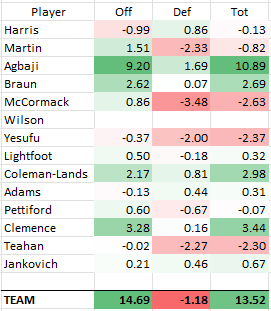
The most significant part of KU’s season has been the impeccable play of Ochai Agbaji. He has been a scoring machine, accounting for double the points that the second and third-most productive Jayhawks have provided. He has been the team’s leading point producer while maintaining better efficiency than the team average, a tough thing for a scoring guard to do. He is taking more shots, tougher shots than his teammates, but still scoring at a efficient pace. Defensively, he has been the team’s best player as well, giving up an estimated 6.4 points per 60 possessions. After calculating all relevant factors, Ochai is producing an Offense, Defense, Total Adj. PPG +/- of: +9.20, +1.69, +10.89. This is validated by the eye test. Ochai is scoring more at the rim and has gotten adept at driving with his right hand. His jump shot is quicker and more composed, and he has shown the patience to stay aggressive, even when starting out in a slump against Stony Brook. He has accompanied this by playing smart and tough defense, not taking plays off. If there were questions before the season they should be answered now. Ochai Agbaji is KU’s best player.
Offensive Skill, Defensive Mediocrity
Through 3 games, KU is scoring 1.25 points per possession and allowing 0.92 points per. For all Division 1, the average is 0.992. At first glance, it appears that KU is doing well on both ends. And while this is true for the offensive side of the ball, once you adjust for the current strength of schedule these points per possession scores are unimpressive on the defensive side. Simply put, KU will face better teams during the bulk of its schedule. And if these games are marred by some of the defensive lapses we’ve seen, these skilled teams will score more than what Tarleton St. or Stony Brook were able to muster. As a team KU has been +14.69 on Offense and -1.18 on Defense for a Total score of +13.52. If they could keep this pace, this would put them as the third-best Bill Self team (behind 2008 and 2010). However, there are questions as to whether KU can keep its offense so well-tuned; can Agbaji keep scoring this well, will there be a reversion to mean from guys like Clemence, how will the team perform against tougher defenses, etc. The questions on defense also remain. While there should be improvement in some areas, this year’s team has no great individual defenders, a few good ones, and many poor ones. While I don’t see this wide of a gap remaining between offense and defense, there is good reason to think that the 2022 Kansas Jayhawks will win most of its games by outscoring its opponents. But improvements on the defensive end have to come.
A Run of Positive Play
One interesting thing of note is that, along with Ochai Agbaji +10.89, these other three players have made positive contributions in each of the first three games played: Christian Braun +2.69, Jalen Coleman Lands +2.98, and Zach Clemence +3.44. Unsurprisingly, these four players have been KU’s best players during this opening stretch. When we look further into the numbers, each of these four players is adding value on both offense and defense. While three games is not a large period of time, it does show who has earned minutes so far. Consistency is key.
Slow Start, Turning Around?
David McCormack posted his first positive performance against Stony Brook. After a poor game against Michigan St. and an okay one against Tarleton St., McCormack played to the level he is capable of in the season’s third game. With each game he is starting to play more like he did last season. Still, he is -2.63 on the season, a value score he will have to improve upon by consistently strong play.
Rotation with Wilson?
The first chapter of the season, the one without Jalen Wilson, is finished. Each one of the 11 scholarship players has played well at times. Some have played better than others. How does the rotation look moving forward? We can assume that Wilson will get at least 20, and likely closer to 30, minutes each game that remains competitive. Where do these minutes come from? At first, one would think these would be wing minutes that Wilson would get, and the current wings would each play a little less. But Coleman-Lands, Braun, and especially Agbaji have all been solid pieces helping win games. Perhaps Wilson will get some minutes as a small-ball 5, but again that means fewer minutes for Clemence (very good so far), Lightfoot (playing slightly positive thus far), and the guy who will hopefully become the team’s best inside scorer in McCormack. The last option is to play more minute with Agbaji at the 2, basically go to a 1 guard, 3 wings, 1 post look. This would take away minutes from the four-headed point/combo-guard monster of Harris, Martin, Yesufu, and Pettiford. Of these four, Yesufu has played the worst but has so much upside. Martin is battling a back injury which may limit his minutes for some time, but when healthy he is an excellent scorer. Harris distributes so well and has solidified his defense which makes it tough to not have him on the court. Pettiford has been a pleasant surprise, although he has lost his man on defense recently. It isn’t an easy question. And we haven’t even mentioned K.J. Adams, an athletic defender who doesn’t need shots but can do so many little things that this team in can use. Self may eventually shorten his bench, but I expect that to be later in the season rather than sooner.
Adj. PPG +/- through 3 games. These numbers will change over the course of the year.


/cloudfront-us-east-1.images.arcpublishing.com/gray/AJARCJ3THNC4FKO6QU6QWGKCGU.jpg)

/cdn.vox-cdn.com/uploads/chorus_image/image/70329162/usa_today_17425776.0.jpg)



 Charting the Hawks