Jalen Wilson had his best over-all performance Monday night against Texas, earning his third team-MVP of the season
Game Summary:
In a disappointing result, Kansas gave up a four-point lead with a minute to play to lose 79-76. Texas scored the final 7 points to send the Jayhawks home with their second conference loss. The game was a high-scoring affair considering how good Texas’s defense has been this season.
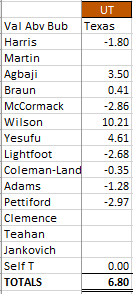
Jalen Wilson earns team MVP honors for a value score of over +10 points. He scored and rebounded well, while giving up only 9 points in nearly 32 minutes of play. Joseph Yesufu also had his best game of the season, pouring in 8 points and an assist with efficient numbers. He gave up 5 points in 15 minutes, which is right on the pace of an average defender. This was Yesufu’s first time to outscore his man since the Missouri game. The game seems to be coming back to him, which can only help this team.
Other positives included Ochai Agbaji and Christian Braun. Och played fine with constant attention, he continued to defend and rebound. Braun had a nice game going until the last 3:30, missing 2 FT’s and allowing his man a tip-in and then a midrange jumper during UT’s 9-4 closing stretch.
Dejuan Harris did not have a great game, but he still distributed it well enough (5 assists) to show a serviceable value number. David McCormack’s solid offensive game (1.29 PPPaf, 16 points, 3 off rebounds) was erased with a dreadful defensive game (21 points allowed). Texas continued to attack him by having his man set high ball-screens. He was slow rotating back on numerous occasions. He did give up the late banked-in 3, a lucky shot but one that was possible due to slow rotation.
The other reserves were not value-adding in their limited minutes of play. K.J. Adams showed poor post defense. Mitch Lightfoot was the same. Bobby Pettiford had a disastrous turnover which led to a late 3 to end the first half.
The TEAM score of +6.80 is below the season average (+9.91), but still within the realm of respectability. KU played well enough to win were it not for a run of poor play and bad luck down the stretch. The performance was good enough to win most nights, just not against a Top 20 team on the road.
Agbaji came back from a one-game absence to post his 9th team-MVP of the season
Game Summary:
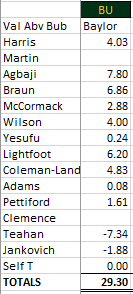
All 10 of KU’s rotation players posted positive value against Baylor. This is the first time to my knowledge that this has happened over the course of 15+ seasons. KU got great efforts from everyone.
Leading the pack was Ochai Agbaji, who finished with 18 points and 9 rebounds. He didn’t produce as much on offense as Christian Braun (18 points) did, but had the better defensive game. Mitch Lightfoot went 4-4 from the floor, added 7 rebounds, and only gave up 3 points on defense.
Jalen Coleman-Lands finished with 8 points in 11 minutes with solid defense. Dejuan Harris posted a very good score despite only scoring 2 points. He dished 7 assists and only gave up 3 points on defense over 28+ minutes of play. Jalen Wilson added 15 points and 4 assists, although his defense wasn’t good. David McCormack hit the glass to account for 8 rebounds, which was the bulk of his value considering he scored and allowed nearly the same amount.
Joe Yesufu and K.J. Adams are barely on the plus side, but Yesufu had a nice shot for 3 and played well on defense. Adams didn’t score but posted positive value because he played solid defense against a good team.
Both walk-ons had poor outings.
At +29.30, this was the team’s best game of the season. If KU had this type of performance against a bubble-team on a neutral site, it would expect to win by ~29.3 points.
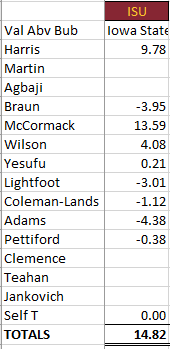
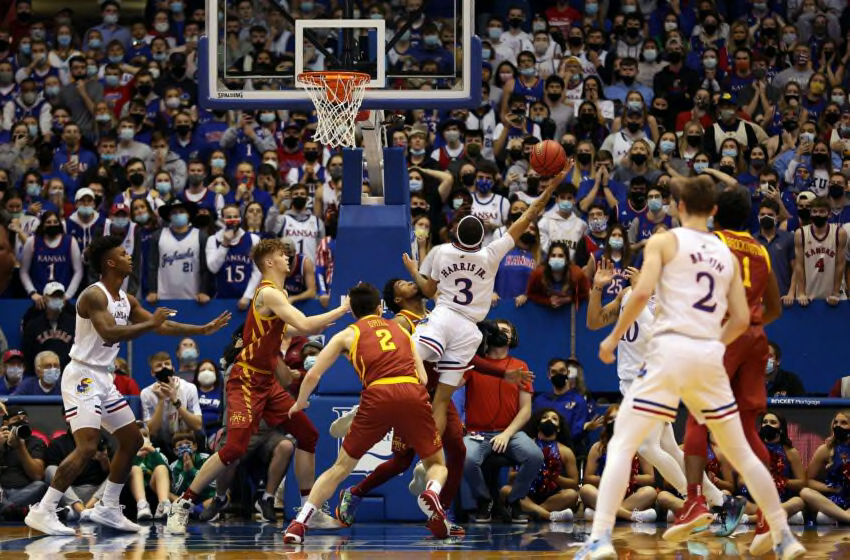
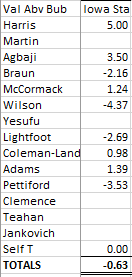
D-Mac and Harris carried Kansas, as each had his best game of the season on a night where neither Ochai Agbaji nor Remy Martin were available. McCormack was great, 7-7 FG’s and 14 points with 14 rebounds. He also played solid defense, although this was partially due to a good matchup. Harris’s night was his best offensive game of his career, he added value not only from scoring but also from 9 assists.
Jalen Wilson bounced back from a rough first half to finish with a positive score. Only giving up 8 points in 36 minutes shows how far his perimeter defense has come. Joseph Yesufu also had a positive game in 22 minutes of play, and his score is somewhat affected downward by his matchup. Iowa State is perimeter-oriented on the offense, meaning he was at risk for giving up more points than say, McCormack. Still, going forward if he continues to play well expect him to produce some positive minutes.
Everyone else had negative-value games. Bobby Pettiford didn’t play much. Jalen Coleman-Lands began the game with a few nice jumpers, but gave up some baskets on the other end as well as failed to get back in transition at times. Mitch Lightfoot wasn’t effective in his few minutes. Christian Braun missed a few shots he could have made, and also had some bad luck in giving up 3 of ISU’s 5 threes. Braun has been slumping of late, but looks like he could break out at any time. K.J. Adams had the worst game of his season, giving up the other 2 ISU threes in limited minutes. But as said earlier with Yesufu, more minutes will even out matchups and tough shots by opponents. For the year, K.J. has been a positive contributor who adds an element that other 5-men don’t have.
The team score of +14.82 is Kansas’s best game since West Virginia and the second-best of the calendar year of 10 games. To do so without Agbaji and Martin shows the team has depth and toughness.
KU’s playing time distribution was the most concentrated its been all year, meaning KU relied heavily on a few players instead of spreading the minutes to a number of players. The five starters plus Yesufu played all but 18 minutes. The HHI score was 0.751, which is well-above the season average of 0.643. This isn’t too surprising considering KU was without two key players.
Ochai Agbaji will not play the Iowa State game tonight (February 1, 2022) due to Covid protocols. Before the news the opening line was -4.5 KU, however it now sits at -2.5 KU with fewer than four hours before tip-off. It could go move more in that time period, but as of now it’s only moved 2 points in favor of ISU following the news.
This seems to be too small of movement. Ochai Agbaji has been KU’s best player, averaging 20.9 PPG on 46.4% 3-point shooting. He is getting attention as a national player of the year candidate, and is certainly on pace to reach first team all-American. Other Jayhawk notables such as Remy Martin or David McCormack who could theoretically take more of a scoring role in his absence have struggled for much of the season.
Player value is what this site is about. Before we get to what the stats say, let’s look back at a couple of other recent instances where a star KU guard missed a road game and what happened to the line. In the 2020 season, PG Devon Dotson was a late scratch for a road game at Oklahoma. Kansas was just coming off a rough home lost (sound familiar?) to Baylor, and the news was concerning for those wanting the Hawks to get back on track. The line started out as -6.5 KU and finished at -4.5 KU, a movement of 2 points. For some reason, memory seems to indicate that the line moved even more toward OU before reverting back toward KU closer to tip. A Marcus Garrett-led Kansas team would pull away in the second half to win 66-52.
Just last season, Marcus Garrett was the star guard finding himself as the one missing a road game (this time against TCU). Once again, Kansas was coming off a bad home loss (this time to Texas). Dajuan Harris would get the start, David McCormack would finish with 20 points, and KU would cruise to a 93-64 in Fort Worth. Interestingly, the line moved from -4 KU to -6 KU, indicating that Garrett’s injury was likely announced before betting was opened on the game, thus his injury had no effect on the difference between the beginning and closing lines. KenPom, who doesn’t adjust his lines for player injury, only had KU as 4-point road favorites. If anything, Vegas was undisturbed by Garrett’s absence.
The lesson going in to tonight is don’t count out Kansas yet. Even without Ochai, they have a solid rotation and are playing against a team ranked 113th in adjusted offense.
Ochai’s Value
So far in the season, Charting the Hawks has Agbaji as a +6.29 player, meaning he has been 6.29 points better than a hypothetical replacement player. This replacement level is set at the “bubble” level. In other words, the comparison is to a player who provides average value for a bubble team (think starter but not star for a bubble team). A +6.29 score is very good, and Agbaji’s 2022 season would be the fifth-best season of any Jayhawk since 1997 should it hold.
Our first estimate of not having Agbaji will be -6.29 for Kansas. So if Vegas thought KU would be -4.5 with Agbaji, maybe without him the line should be +1.5 or +2.
This is but the first estimate. We must consider other factors. For one, neither KU (nor any other team) has a player that is a precise “replacement player” in terms of value. Ochai’s minutes aren’t going to be replaced by someone exactly -6.29 points per game worse than he. Rather, they will be distributed among different KU players, some of whom are skilled players and positive contributors. For the season, Agbaji is playing 85.7% of KU’s minutes, or 34.3 out of 40 minutes. So KU will need to come up with about 34 minutes to make up what Och has been averaging.
A decent portion of these minutes will go to Christian Braun and Jalen Wilson, two wings who are playing better than the hypothetical “replacement player” we discussed earlier. Likely some additional minutes will go to Remy Martin (if healthy) and Jalen Coleman-Lands. Again, both of these guys are better than replacement level, but not by much. There’s also a chance that K.J. Adams gets some minutes at the 4 to account for less wing depth. He has also been a positive-value KU player.
Perhaps Pettiford and Yesufu, two PG-types with poor seasons to this point, will play more, but it’s not likely that either will need to play much even with Ochai’s absence.
The point is, KU will be replacing Ochai’s minutes with better-than-average players, even though no one has been at Agbaji’s level of performance this season. To calculate a more accurate loss of value, we will distribute Ochai’s minutes mostly to the wings (Braun, Wilson, Coleman-Lands, Adams) and a small portion to the guards (Martin, Harris, Yesufu, Pettiford). From there, we will take each player’s per-minute value, leveraged up to the estimated minutes each will play tonight. Adding this together, we get a new team value-score of +4.87. Since the current team value-score is +8.84, we estimate that Agbaji is worth about four points to this year’s team.
Final Thoughts
These estimates have trouble taking into consideration how differently KU might play without Agbaji. Luckily for Kansas, it has quite a bit of wing and guard depth. Furthermore, Och’s shot volume will be replaced by capable players even though these guys haven’t been as good as Agbaji of course. Another factor is scouting. Not having Ochai might throw off Iowa State’s defense, which has prepared to play against him. KU might have new sets that get them an extra bucket or two that their opponents weren’t prepared for.
Hoop-explorer tracks on/off efficiency, essentially showing how a team does when a certain player is on the court vs. off the court. Unsurprisingly, KU has been much better with Agbaji in the game (Net rating of 32.1 vs. 8.2). This is quite a large difference. But some of this is due to Agbaji being out of the game in weaker lineups. Once you remove the walkons, Yesufu, Clemence, and Pettiford; the difference is less pronounced (32.9 vs. 18.1). This works out to about a 9-point difference over a period of 68 possessions. That’s still a big gap. So who knows?
In closing, the line only moving 2 points is likely undervaluing Och’s presence on Kansas. If KU with Ochai is 4.5 point favorites, they are probably either -1 or even Pick without him. However, in a one game scenario, I’m not sure if that is a huge betting edge.
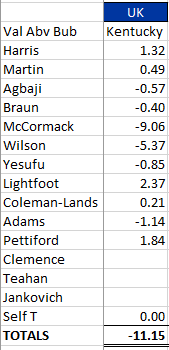
Kentucky used a hot-shooting first half to cruise to an 18-point win. Kansas could never recover from the large first-half deficit it found itself in. It lost the battle of the boards (41-29) and second chance points (17-6); other than that the game was a more respectable margin.
Mitch Lightfoot earned his first game MVP of the season, battling on the boards and winning three additional defensive possessions by forcing a non-steal turnover. He did a far better job of guarding Kentucky’s center than David McCormack did. Bobby Pettiford played solid defense and even added a late basket in his 10 minutes of work. Dejuan Harris was also respectable. Remy Martin and Jalen Coleman-Lands finished slightly positive in limited minutes off the bench.
On the other side of the value ledger, starting wings Christian Braun and Ochai Agbaji had slightly negative value games Saturday night. Neither shot great. K.J. Adams had a tough defensive game at times, but did finish two assisted baskets. Joseph Yesufu had a couple missed shots, a turnover, and a rebound in his few minutes of play.
These players combined were about -2 points unadjusted, meaning that these players cumulatively played well enough to only be down 2 points to Kentucky. Thus the reason for the blowout was largely due to the poor play of the next two players, Jalen Wilson and especially David McCormack.
Wilson had a poor shooting game, whereas his counterpart 4 man (Brooks) had a career-high 27. Wilson did grab 8 rebounds, but it was his second-worst game of the season once adjusted for opponent. David McCormack was outplayed by Kentucky’s center (Tshiebwe), as he gave up 16 points in only 15 minutes of court time. It was McCormack’s second-worst game of the season, and his second very poor game in a row.
In closing, no one played great for Kansas, but the reason for the blowout loss was primarily due to the 4 and 5 positions. Both were constantly out of position on defense, and didn’t make enough plays to recover.
Mitch Lightfoot competed well against Kentucky, earning him team-MVP honors.
With 5:04 left in regulation, Remy Martin checked out for the final time against Texas Tech on Monday. Although we didn’t know it at the time, the game would last 15:04 due to 2 overtimes being needed, and it would be Dejuan Harris and not Remy Martin getting the PG duties. When Martin left the game, KU was up 8. The Hawks would be outscored by 5 the rest of the way, first giving up an 8-point lead in regulation and then needing a second overtime to avoid losing the game.
Martin’s playing time, or lack thereof, down the stretch certainly had Jayhawk fans scratching their heads. Coach Self was even asked about this during his press conference. He responded that he didn’t know who to take out if he put Remy in, even insinuating that he didn’t consider removing Harris by noting he couldn’t play two small guards together due to defensive mismatches.
Those wanting to see Martin finish the game pointed out +/- differentials to justify their arguments. Martin was +9 and Harris -8 on Monday night. But even those using +/- acknowledged its limitations and uselessness over a small sample size of 1 game. *
*Really the sample size isn’t 1 game, but the 85 possessions the game featured, or perhaps the 50 or 60 possessions that Martin or Harris actually played. Nevertheless, we would want to see more possessions (closer to 1,000) against similar competition than what we saw on Monday.
The eye-test certainly bolsters the argument for Remy. He was quick, aggressive, and made countless plays despite only scoring 4 points (the same total as Harris). The team seemed to have more offensive flow with Martin running the show. On the other hand, the eye-test runs into the same problem as +/-. Yes, Remy played better on Monday night. But what about the whole season? Just a few days prior, Martin had a rough game against Kansas St. Given his recent health issues and bouts of inconsistent play, how long do you want to gamble with someone who has overperformed in this one game?
The point of all this, is to ask the question on everyone’s mind…who should play more as the team’s point guard, Dejuan Harris or Remy Martin? To answer this, we will use the stats found on this website to compare how each has played over the first 19 games.
To start, we will fragment each’s games into offensive numbers and defensive numbers. From there, we will combine these into value scores and see which has played better so far throughout the course of the season. Last, we will look beyond the value scores (which are just season averages) and attempt to see who has been more consistent, who has produced more good games, fewer bad games, and so on.
Offensive Stats:
The first offensive stat we will compare is actually PPG. Although this is not an “advanced” stat, it actually correlates quite strongly with overall player value. Players who lead the team in points per game are likely the team’s best natural offensive talent. They are likely to be better shooters than average (from a TS% perspective). They are likely to be better athletes than average and thus are probably better rebounders or passers or defenders than others their position. And they are also good enough to play enough minutes to have the chance at leading the team in PPG.
Through 19 games, Remy Martin is averaging 8.4 points and Dejuan Harris is averaging 5.2. This is a noticeable difference. When we even out the minutes (Harris is playing 4.5 more MPG), this gap is even wider. Martin is averaging 14.0 points per 40, and Harris is nearly half as proficient of a scorer at 7.2.
Next, we will look at shooting efficiency. Effective FG% is a good way to do this, but TS% is even better. Getting to the FT line, and converting, is a skill that needs to be accounted for. Using the formula for calculating TS% developed by CtH, we arrive with Martin at 50.8% and Harris at 46.8% (Sports Reference has Martin at 55.1% and Harris at 50.5%, so the relative difference isn’t affected much by source).
Putting these two stats together, we see that Remy is scoring more than Harris is on a rated basis and is doing so by shooting better. The last comparison we want to make for two guards is assist and turnover numbers. Once again, per 40 numbers from Sports Reference are helpful. Both players are averaging 5.1 assists per 40, whereas Martin turns it over more than Harris (3.0 vs. 2.0 per 40 minutes). CtH’s numbers are similar, but we give the slight ball-handling advantage to Harris.
Offensive rebounds are negligible for small guards. The main components on offense are scoring, shooting, assists, and turnovers. Martin is comfortably the better of the two when it comes to scoring and shooting, whereas Harris is slightly better on the ball-handling stats.
Putting it all together, Martin is producing +0.50 points per game of value more than a KU-level replacement guard would. He hasn’t been great on offense, but he has been serviceable. On the other hand, Harris is well-below where KU fans would expect from a starting or even backup PG. His only value-adding offensive aspect is his low turnover numbers, although this is a product of conservative play which creates little offense.
Martin’s shot frequency is in a normal range, Harris barely shoots.
Defensive stats:
Just as points scored is a strong indicator of player value, the strongest defensive indicator is how many points a player gives up on defense. However, this stat isn’t kept at the official level. It is kept by CtH, so we are in luck. Instead of a per game basis, we will compare Harris and Martin on a per possession basis. This is multiplied up to 60 possessions, so the numbers are per 60.
Harris is allowing 10.8 points per 60; Martin is giving up 12.3 points per 60. Harris has been the more consistent defender and grades slightly above replacement, whereas Martin is slightly below replacement. The next thing to check is possession winners, which are defensive rebounds, steals, and forced turnovers. When we rate per 60 possessions, we see that Martin is better at winning possessions off a defensive stop than Harris (6.6 vs. 4.7). There isn’t much more to say on defense. Once we put everything on this end together, we see that Harris (-0.02) grades out slightly better than Martin (-0.33). Neither are that impressive.
Martin’s defense took a step forward after a solid outing Monday night.
Total Value:
Next comes simple arithmetic. Adj. PPG +/- is just the sum of the Off and Def components.
Adj. PPG +/- scores
Martin is over 1.5 points per game better than Harris. This isn’t an insignificant difference by any means. Harris’s poor offensive output really stands out here. KU-level players should be able to reach a higher level of production.
Consistency:
The last thing to consider is the level of consistency each displays. What are each’s highs and lows? To answer this, we will take each’s best three games and worst three games using value score, adjusted to opponent.
Harris has both the best and worst overall game between the two. He also has the worst second and third lowest scores, whereas Martin has the second and third best scores in comparison. It should be noted that Harris has played 19 games, but Martin has only played 16. This is partially the reason Harris has lower-scored games. Of course, playing in fewer games works against Martin on the plus side. But generally Martin’s highs and higher and lows lower than Harris.
Team MVP’s is another way to compare. Harris’s +4.98 score against Iowa State (including the game winner) was the best of any Jayhawk that night. Martin has yet to register a team MVP this year. Each player has had one game where he was more valuable than the team’s margin of victory; Harris +4.98 in that 1-point win over Iowa State and Martin +5.42 in that 3 point Texas Tech win. On the other side, Harris scored -4.36 against Dayton (in a 1-point loss) and Martin has not had a score lower than the margin of defeat in any of KU’s losses so far this season.
We can also look at the number of positive games vs. negative games using value score. Harris has had 6 positive games and 13 negative games, meaning 32% of the games he plays in add value to KU. Martin is 8 positive and 8 negative, which is 50%. Just as with average value score, Martin has been the better player over the course of the season when we use this measure of consistency.
Conclusion:
In summary, Martin is the better offensive player as he is a better scorer and shooter even at higher volumes than Harris. Harris takes care of the ball better and grades slightly higher at assisting, but these are too small to make up for the scoring/shooting value difference.
On defense, Harris is better at not giving up points, whereas Martin’s rebounding is superior (Harris gets more steals/forces more turnovers). These factors mean Harris has more defensive value.
In total, Martin has been worse than advertised yet still a consistently better player than Harris. I don’t recommend changing the starting lineup, but the closing lineup, that is the one down the stretch in a close important game should include Martin as the PG and leave Harris on the bench.
Ochai Agbaji’s career high of 37 points was matched by solid defense.
Game Summary:
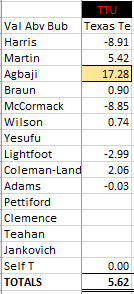
For the second consecutive game, Ochai Agbaji had the best game of his career. Finishing with 37 points, Ochai only gave up 9 points on defense, a stout number in 46+ minutes of play. Agbaji also grabbed 7 defensive boards, including a few clutch ones in double-OT. Remy Martin had the second best game of any Jayhawk. Despite scoring only 4 points, Martin only gave up 2 points, and produced additional value with 6 assists and 3 forced-turnovers. His energy really sparked the Jayhawks, and hopefully there is more to come.
Coleman-Lands didn’t play a ton, but he was solid in his nearly 5 minutes of play. He made a jump shot while not giving up points on defense. Christian Braun and Jalen Wilson, in 48+ and 47+ minutes each, had slightly positive contributions overall. Both had nice plays toward the end of the second OT, sealing the win for the Hawks.
K.J. Adams has the most misleading score, as he was guarding Tech’s Bryson Williams for most of the time he played. Adams gave up 9 points (3 off a banked in jump shot), but scored 6 of his own to go with 6 rebounds and 0 misses/turnovers. Unlucky defense will even itself out over the course of a 35 game schedule, and Adams showed he is capable of playing at this level moving forward.
Mitch Lightfoot was in foul trouble for much of the night, and ended up giving 9 points while only scoring 4. He’s had better outings for sure. David McCormack had his second-worst performance of the season, partially due to Bryson Williams playing outstanding. Still, whenever Tech needed a pop-out 3 they did so going against McCormack. Big Dave also failed to collect important defensive rebounds in crucial times.
Last, Dejuan Harris had a poor outing on both ends. He has produced 4 consecutive negative games since hitting the game-winning shot vs. Iowa St., his worst performance being against Texas Tech.
The team’s score of +5.62 was about 4 points below expectation, as you’d want KU to win a bit more comfortably than they did. KU built up a 12 point lead with about 6 minutes to play, and it was still 8 before Tech won a few offensive rebounds off missed free throws and converted to cut the lead to 4. Personnel questions were also abundant; KU seemed to struggle once Martin came out for good with 5:04 left in regulation. The final 15:04 were played by Harris as the sole ball-handling guard, and KU was -5 in that stretch.
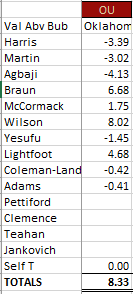
Jalen Wilson and Christian Braun led the Jayhawks to their fourth conference win with efficient offense and solid defense. Kansas also got positive contributions from Mitch Lightfoot and David McCormack, and Ochai Agbaji came back from a poor first half and wrist injury to make big plays down the stretch. KU’s small guards each had poor showings. Remy Martin did not play well in his return, and Dejuan Harris was outplayed by Oklahoma’s guards for most of the night. Yesufu gave up a bucket in his 2 minutes of game action. K.J. Adams posted a negative value game for the first time since Missouri.
The team’s score of +8.33 is slightly below their season-average (12th best of 17 games so far), yet was still good enough to get a win.
Jalen Wilson earned his second team-MVP honors with his 16-point performance in Norman.
Ochai Agbaji earned his 6th team-MVP of the season, scoring 20 points as well as playing great defense.
Game Summary:
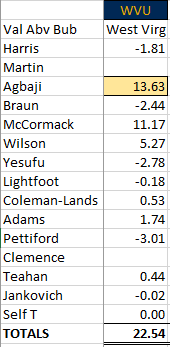
Ochai Agbaji was the overlooked player in KU’s 85-59 win, as 20+ point games are quite common for him now. However, it was Och’s defense which made him so valuable, only allowing 2 points the entire game. Och’s value score against the Mountaineers is the highest game performance of any Jayhawk this season. Of course, the performances of David McCormack (19 points, 15 rebounds) and Jalen Wilson (23 points, 8 rebounds) were a welcome sight to KU fans. The two best returning offensive players from last season finally got going, showing how high the team’s ceiling can be if everyone is playing well. Wilson’s performance was tempered somewhat by poor defense, but for the season he has shown enough improvement on that end to make one think that the last game was a one-off performance. Other positive performers included K.J. Adams, Jalen Coleman-Lands and Chris Teahan.
On the other side of the value-ledger, Christian Braun struggled to finish at the rim in the first half and had his second consecutive negative-value performance after starting the season with fourteen positive games. Another notable would be the play of Joseph Yesufu, who got more minutes Saturday than he typically sees. While his value score wasn’t pretty, he did make some athletic plays, making one think that he is due for a breakout game and some positive-value performances in the future.
With a team score of +22.54, KU broke a slump of poor games with its second-best opponent-adjusted performance of the year (Missouri).
Dejuan Harris earned his first career team MVP against Iowa State
Game Summary:
Not only did he hit the game-winner with 7 seconds left; Dejuan Harris was solid on both ends to earn team MVP honors. Ochai Agbaji was poised to win this distinction due to a solid 22-point outing, but his defense down the stretch lowered his value score significantly. K.J. Adams got the start and had yet another positive outing (10 of his 13 game appearances have netted positive value). Despite being benched for most of the game and only scoring 1 point, David McCormack was good on the defensive end and glass. Christian Braun had his first negative-value performance of the season, and Bobby Pettiford returned from injury but looked very rusty.
The team is missing Remy Martin, and frankly David McCormack although the latter is on the coach and not due to injury. Playing worse players at these positions (such as Pettiford/Yesufu or Lightfoot) has unsurprisingly made this team worse. The team is loaded at wing, so giving K.J. Adams a look at the 5 can provide a small bit of value most nights.







/cloudfront-us-east-1.images.arcpublishing.com/gray/4V5PD5SGMJGP5CVJ5YQQOCKJ2Q.jpg)
 Charting the Hawks