
The 2015 Kansas Jayhawks finished with a record of 27-9 (13-5), winning the Big 12 Regular Season. The team earned a 2-seed in the NCAA Tournament, reaching the Round of 32 before losing. The team’s Sports Reference link is here.
Offense
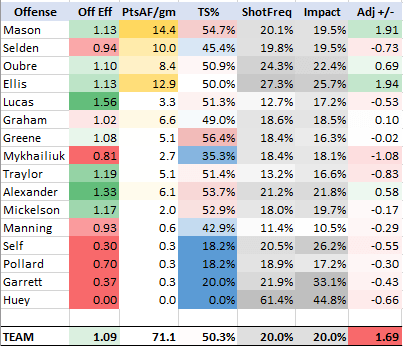
The 2015 Offense struggled to score, producing only about 1.69 points per game above a bubble offense. Both Frank Mason and Perry Ellis were solid contributors, each just a shade under +2.00. Freshmen Kelly Oubre and Cliff Alexander will likewise positive on the offensive end of things. Aside from that, players were either bubble-level or worse.
Defense
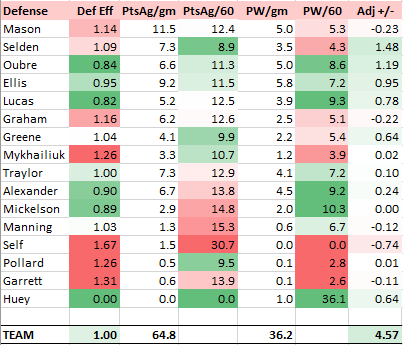
The 2015 Defense was the better side for Kansas, ranking 9th in KenPom adjusted defensive efficiency. Wayne Selden graded out as KU’s strongest defender, allowing only 9.0 points per 60 possessions. Both Kelly Oubre and Perry Ellis were also above 1.00 PPGAB in defensive value. The defense didn’t have a weak spots opponents could exploit, although the younger guards (Mason, Graham) would improve on this end as their careers developed.
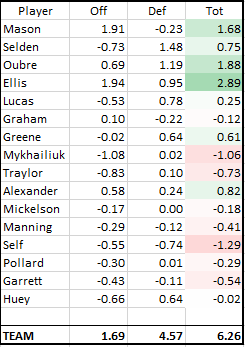
Perry Ellis was the team’s most valuable player in 2015, averaging over 3.00 PPGAB in value before his knee injury (he would struggle for the first few games when he returned, which dropped him to the final PPGAB mark he’s showing). Despite a slow start to the season, Kelly Oubre added nearly 2.00 PPGAB in value, with sophomore PG Frank Mason not far behind. Wayne Selden, Cliff Alexander, Brannen Greene, and Landen Lucas were other players with positive impact on the season.
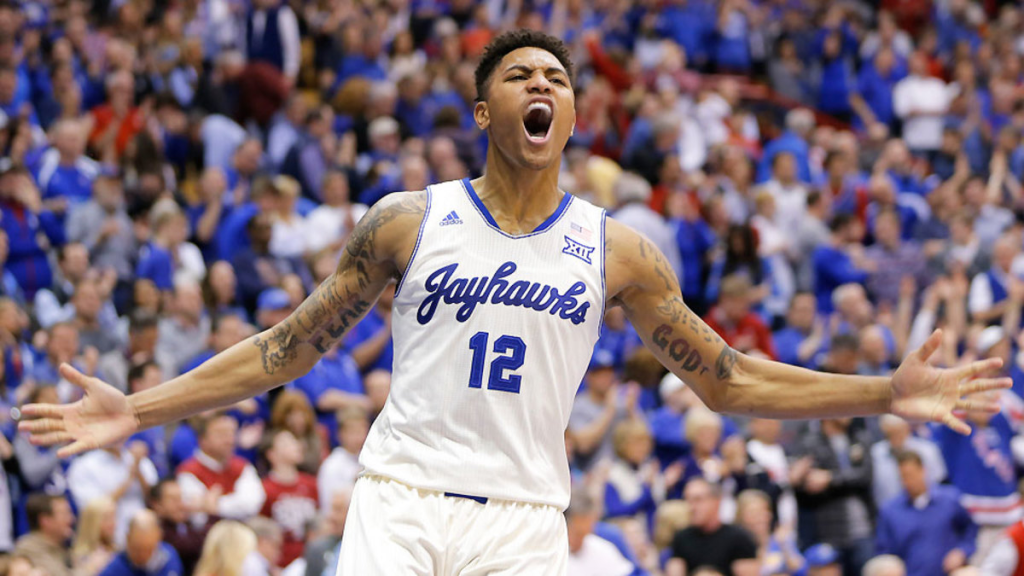
Kelly Oubre and the 2015 Jayhawks went undefeated at Allen Fieldhouse (15-0).
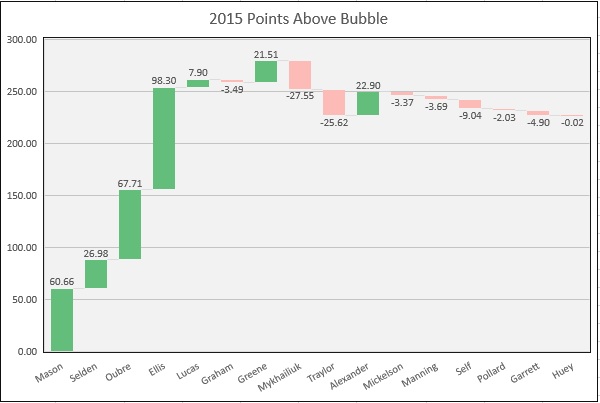
KU had a nice rotation for much of 2015, but this got weaker after Cliff Alexander was held out and Perry Ellis suffered his knee injury.
Data Fulfillment

For the 2015 season, 23/36 games were able to be watched in their entirety. The other 13 games were charted using video highlights, radio broadcasts, play-by-play box score information, and other sources to most accurately record what happened. This led to a Coverage score of 96.93%, which is very good. Over 71.2% of the season’s plays were available on video, with 95.5% of all possessions having at least a 90% confidence rating.
What this indicates is that the value-stat estimates from this season are not prone to much data-absence error. These value scores aren’t likely to be too far off what they would be had we the entire season, since only a small percentage of overall possessions are in question.
 Charting the Hawks