Post-Oklahoma (2) Recap

Earlier today Kansas fell to Oklahoma 68-75, for their third loss in a row. Interestingly, the previous Jayhawk seasons with three-game losing streaks (2005, 2013), also concluded with losses at Oklahoma. Below are the traditional stats, alongside the PPG +/- numbers.

Marcus Garrett – Adj: +11.64. 21 pts, 12 rebs, 1 assist.

Christian Brown – Adj: -7.83. 2 pts, 1 reb, 1 assist.

Ochai Agbaji – Adj: -2.94. 10 pts, 3 rebs, 2 assists.

Jalen Wilson – Adj: -5.87. 13 pts, 0 rebs, 0 assists.

David McCormack – Adj: +5.76. 9 pts, 2 rebs, 4 assists.

Tyon Grant-Foster – Adj: +0.15. 0 pts, 2 rebs, 0 assists.

Tristan Enaruna – Adj: -1.03. 2 pts, 0 rebs, 0 assists.

Mitch Lightfoot – Adj: +0.28. 6 pts, 3 rebs, 0 assists.

Dejuan Harris – Adj: -0.08. 5 pts, 2 rebs, 4 assists.

Summary

Marcus Garrett showed why he is KU’s best player, playing 37 minutes of great defense while knocking down jumpers and getting in the paint. Had some late turnovers, but aside from Dejuan Harris, is really the only Jayhawk who can create with the dribble. David McCormack had a solid game defensively, playing primarily when Oklahoma’s center was in the game. His offensive efficiency was not what it should have been, especially when one recalls the looks he had. This game should have been better for him, and had he finished the close shots he missed, could have changed the outcome.

Ochai Agbaji shook off another poor first half to bounce back and finish somewhat respectably. Hit two late 3’s to give Kansas a fighting chance. Christian Braun couldn’t get an outside shot to fall, and was only able to convert 2-2 FT’s when being fouled attacking the rim. Jalen Wilson seemed to break out of his slump by scoring 8 quick points to begin the game, but he only finished with 13 total. He added no rebounds or assists, and got abused on the defensive end down the stretch. Teams are purposely setting dummy screens to get match-ups against him when he is defending. Self needs to change the defense up and not auto-switch.

The bench had some good moments. Dejuan Harris played well, although his score was negative mainly due to being undersized and giving up an and-1 to Austin Reaves. Mitch Lightfoot also had a good offensive game in his limited minutes. Tristan Enaruna was so-so, and Tyon-Grant Foster played fine defense in five minutes yet couldn’t stay in the game due to two bricked jumpers.

After 15 games, the team’s PPG +/- looks like this:
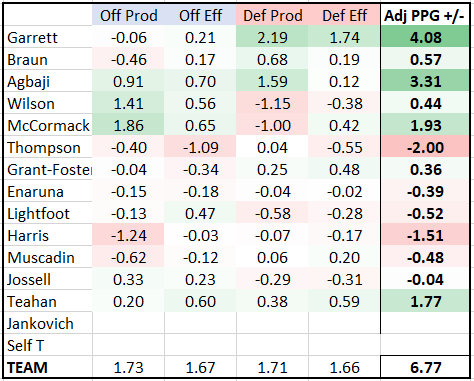
The team is about equally as good on offense as it is on defense. The starters all grade-out positively, and the bench is primarily below “bubble-level.” If there were any doubts, Marcus Garrett’s defense remains elite and grades slightly better than even last year. As a prior blog post noted, his offense has slipped in 2021, but following his 21-point game this afternoon has gotten back above bubble-level. Christian Braun’s inconsistent play continues; when he isn’t making shots he has poor games and when he makes shots he has good games. The way to break the inconsistency is to find ways to score inside, off the bounce or offensive rebound. Ochai Agbaji has become KU’s best scorer, finding ways to get to double-figures even in games where he starts out slow. Jalen Wilson has crashed back down after a good non-conference season, and finds himself on pace to have the worst defensive season of any Kansas Jayhawk over the past 20 years. A large part of this is the style of play. The primary offensive strategy in recent seasons is to hunt for advantageous matchups and play iso-ball off of these. With KU’s automatic switches on the perimeter, Wilson is being picked on as the man to attack. Despite some misunderstanding, Wilson should not be thought of as a “guard,” he is a forward, and allowing him to switch on perimeter defense onto a quicker man 50 possessions a game will hurt the team. David McCormack has earned 25 minutes per game, but he needs to play more consistently when he gets chances inside. His defensive score has gotten better, but some of that is due to reversion to mean. He isn’t a great defender, and will have games where he gives up points.

Bryce Thompson has not shown the ability to add value at this level, he’s had exactly 1 positive game in the 10 he’s played (vs. Creighton). Tyon Grant-Foster is a solid defender, but his offensive flow in limited minutes has hurt the team. I would play him more minutes and not let him shoot 3’s (1-17 on season). He can add value by driving the ball and attacking the offensive glass. His lateral quickness and length allows the team to defend better on the perimeter as well. Tristan Enaruna is close to putting together a solid stretch of games. Mitch Lightfoot is quietly having his most valuable season as a Jayhawk. Dejuan Harris is a season away from being a consistent performer at this level. Of all the bench players, he has the best chance to improve his numbers dramatically over the rest of the season. His biggest weakness is that he doesn’t score much (averages less than 2 ppg). He distributes well on offense, but even getting his ppg average to 4 likely be enough to become replacement-level. Another thing hurting him is that he doesn’t play with great “finishers.” He doesn’t have a Doke to throw lobs to, and guys like Braun don’t move great off the ball. Which is only to say that in this scoring system, who you play with does affect your score, just as much as it affects traditional stats such as your assists, rebounds, and points.
Marcus Garrett and Elijah Johnson, and the value of defense.

In keeping with the trend of comparing players from different seasons, some KU fans have pointed out that Marcus Garrett in 2021 is having a statistically similar season to Elijah Johnson’s 2013. Both senior guards, who played primarily off the ball their first three seasons, now thrust into primary point guard duties and doing it less-than-spectacularly.

Traditional stats have Marcus Garrett at 9.2 ppg, 4.3 rpg, 3.9 apg so far this season. Johnson finished 2013 at 9.9 ppg, 3.1 rpg, 4.6 apg. Shooting percentages are also comparable; Garrett is 45.0%, 32.0%, and 82.1% (2 pt%, 3 pt%, FT%) and Johnson was 42.8%, 33.1%, and 76.3%.

The eye-test also agrees with these numbers. Both players certainly have/had ball-handling skills, but they pale in comparison to the offensive abilities of the primary point guards the years prior. Devon Dotson in 2020 was a blur, the team’s leading scorer who could seemingly get around his man at will and get a bucket, and handle the ball against the opponents’ quickest defenders. Likewise, Tyshawn Taylor in 2012 was a blur, the team’s second leading scorer who could get shots up at will and yet remain somewhat efficient, and of course handled the ball against the quickest defenders night-in, night-out.

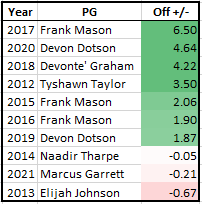
Below is a chart of each Kansas starting PG from 2012-2021, ranked by Off +/-. Again for reference, this number calculates how much better in points per game the player is than a typical “bubble player” (or replacement-level power conference player) on offense. It is a “one-number” metric that attempts to combine all value-adding plays (like WAR in baseball sabermetrics).

Over the past decade, KU has had great PG’s. Yes, senior Mason was that good. At the bottom of this list are Johnson and Garrett, adding further proof that they are offensively comparable.

We can also compare Garrett and Johnson’s senior seasons with their junior seasons, when they primarily played off-guard roles. Johnson’s Off +/- in 2012 was -0.238, below-bubble but still better than his senior year. Garrett’s 2020 Off +/- was +0.763, a number which may surprise people. Garrett’s drop-off has been more pronounced than Johnson’s, but any drop-off from one year to the next is noteworthy because it happens only about 20% of the time for any player. As players get older, they get better. The fact Johnson and now Garrett have seen noticeable declines in offensive value indicates they are playing out of position (Johnson also had a knee injury in 2013).

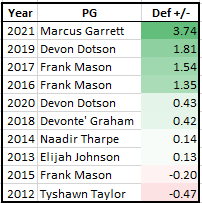
But offense only tells half the story, a fact commonly glossed over by those analyzing a basketball player’s value. This isn’t entirely their fault as traditional defensive statistics are incomplete. We don’t have the same limitations here. Below is the same chart as before, except for Defense.

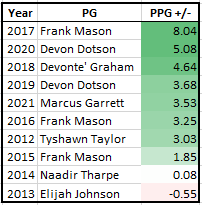
Garrett’s defense at the point guard position has been better than anyone else to play that role at KU this decade (or ever). The difference between him and second on the list (Dotson’s FRESHMAN season), is greater than that of Frosh Dotson and 8th place and the aforementioned injury-plagued Elijah Johnson.

Garrett’s defense so far this season has been equivalent to what it was last year, so we shouldn’t expect it to drop off much and might even improve once a full season has been played. He locks down in the half-court, while also providing solid help-side defense, steals, rebounds, and many forced turnovers. There’s a reason he won National Defensive Player of the Year.

Putting the numbers together, Garrett grades out as the 5th best KU PG over the last decade. His game is far uglier than Dotson as a freshman or Mason as a junior, but as far as replacement value there isn’t any real difference. The 2021 team with either of those two guys from those seasons instead of Garrett would be as good as it currently is.

Over the past decade, KU’s point guards have been better than the average of the other positions on the court. It’s a bit harsh to demand that Garrett be equivalent to a Mason or Dotson, yet some want to make that comparison. Why not compare him to an underclass Tyshawn Taylor? Or a Russell Robinson?

Look at the string of PG talent from 2016-2020 (Jr. Mason, Sr. Mason, Sr. Graham, Fr. Dotson, So. Dotson). A fairer comparison would not be Garrett against other KU point guards, but Garrett against other KU starters. Is Garrett holding his own regardless of position?

Going back to 2012, the average PPG +/- for players of all positions getting starters minutes (>50% of minutes played) is +2.13. So despite playing out of position, Garrett at +3.53 is easily adding value above even the average starter. He is comparable to other off guards in years past such as Wayne Selden 2016, Kirk Hinrich 2002, and Andrew Wiggins 2014. On a team with little to no interior defense (Wilson, McCormack, and Lightfoot all grade out well-below replacement defensively); it is remarkable that the team is currently 14th in adjusted defense. Marcus Garrett is the largest reason why (Agbaji and Braun are also plus defenders). Ignore anyone who thinks the team is better with Garrett on the bench.

Post-Baylor Recap

Tonight Kansas fell to Baylor, 69-77, and is now 10-4 on the year. The Hawks fought well, but Baylor was too good and answered every comeback attempt the Hawks had. Below are the Raw and Adj. PPG +/- scores for the game along with traditional stats for reference:

Marcus Garrett. Raw: +2.33 Adj: +5.00. 9 pts, 3 rebounds, 8 assists.

Christian Braun. Raw: +6.17 Adj: +8.83. 17 pts, 4 rebounds, 1 assist.

Ochai Agbaji. Raw: +3.00 Adj: +5.37. 16 pts, 2 rebounds, 1 assist.

Jalen Wilson. Raw: -6.50 Adj: -4.75. 4 pts, 5 rebounds, 3 assists.

David McCormack. Raw: -8.17 Adj: -6.64. 6 pts, 2 rebounds, 1 assist.

Tristan Enaruna. Raw: +1.33 Adj: +2.68. 4 pts, 1 rebound, 2 assists.

Mitch Lightfoot. Raw: -7.00 Adj: -5.73. 8 pts, 4 rebounds, 1 assist.

Dejuan Harris. Raw: -1.67 Adj: -0.21. 2 pts, 1 rebound, 1 assist.

Chris Teahan. Raw +2.50 Adj: +2.57. 3 pts, 0 rebounds, 0 assists.

The Good: Starting Guards

Christian Braun had the best game of any Jayhawk, due to his highly efficient offensive performance (17 pts on 5-7 FG, 2-2 FT). His defensive effort was also solid once adjusted for opponent. Ochai Agbaji shook off a rough first half to finish as a positive contributor. Despite the box score only showing one defensive rebound, he forced four turnovers in the game to go along with his two steals. Marcus Garrett also played solid on both ends of the court. His defense was elite until the end (got beat/gave up and-one layup; unnecessary bonus foul gave up 2 FT’s), but still finished around his season average. Combining the three starting guards’ efforts, Kansas was +11.50 points better than Baylor, raw. Simply put, had the others pulled their weight KU could have won this game.

The OK: Reserve Guards:

Tristan Enaruna continued his solid play, out-valuing his man through good offensive efficiency and solid defensive positioning. As a back-up wing, he did what he needed to stay on the court and help his team compete (18 minutes). His improvement over the recent games has been a sign of encouragement. Dejuan Harris showed good hustle and energy, although he finished slightly negative even when adjusting to the opponent’s high level of skill. Once he adds a shot, he will be a complete player. But his defense is creeping toward replacement-level after tonight’s game. Chris Teahan added a buzzer 3-pointer, continuing his torrid play in limited minutes.

The Ugly: The Bigs:

Given how good Baylor’s guards are, it was assumed that KU had to get positive contributions from Wilson, McCormack, and Lightfoot for the team to win. Even this wasn’t the case tonight, all that was needed from these 3 was respectable numbers, but none of the three could muster anything decent. Baylor put these bigs in pick-n-rolls and iso situations, and punished them repeatedly. McCormack was the worst of the bunch, coming away with one blocked-shot but nothing more of value on the defensive end. He was out there getting scored on, and not much else. Wilson did grab four rebounds and force two turnovers, but he was too slow to check Baylor’s guards on switches. Lightfoot was very bad in the second half, and his defense alone was roughly the difference in the game (~ -7.24 raw).

Final Analysis:

Matching the film with the scorecard, it’s clear that KU’s guards were able to match the effort of those from Baylor. Teams, and Baylor is no exception, shy away from going at Garrett due to his defensive prowess. Braun is solid on defense but not spectacular, yet is a plus rebounder who wins possessions back for his team. Agbaji’s on-ball defense has continued to improve, and he showed tonight what he can do on both ends, shaking off a poor first-half to help get the team back in the game.

But getting a complete effort from the entire roster continues to be elusive. McCormack followed up a great game last week against Oklahoma State with a dud tonight. Wilson has failed to reach double figures in scoring in three consecutive games, after reaching that mark in 9 of his first 11 games this season. When bench players like Tristan Enaruna and Dejuan Harris have solid games, their efforts are cancelled out by a poor game from Mitch Lightfoot. The team appears to be huddling around the 12-15 rank mark in efficiency (currently #15 on KenPom), in the 3/4 seed range.

Bryce Thompson is injured and out, Tyon Grant-Foster did not play as well.

Ochai Agbaji’s Junior Season Similar to Wayne Selden’s

With 12 games in the books in the 2021 season, Ochai Agbaji has shown that the sophomore slump is far behind him. In traditional stats, he’s leading the team with 14.8 ppg, while adding 4.7 rpg and 2.3 apg. He’s been mainstay. His 31.6 mpg is second only to Marcus Garrett, yet Agbaji leads the team in total minutes due to Garrett missing the TCU game.

This brings to mind the career arc of Wayne Selden. After two years of less-than-expected performance, the former guard/wing went for 13.8 ppg, 3.4 rpg, 2.6 apg for a team that achieved the #1 overall seed and Elite 8 appearance in 2016. And while Selden came in much more heralded than Agbaji, both players showed signs of talent in their underclass years that was not consistently realized until their junior seasons.

The similarities don’t end there. Both players have the same listed height (6’5) and play the same wing position with similar skill sets. Compare scouting reports of Agbaji to Selden. Ball handling? Just okay. Shooting? Above average. Body-type? Strong, athletic, able to finish at the rim. Defense? Well above-average, capable of guarding multiple positions.

For the 2016 season, Wayne Selden had a PPG +/- of +3.38, with +1.90 of those points coming from offense and +1.48 from defense. He didn’t grab a lot of rebounds or come up with many steals, but rather played great positional defense by allowing 0.158 ppp (or about 9.5 ppg allowed in 60 possessions).

Ochai Agbaji is currently at +3.52 PPG, and is projected to be between +2.5 and +4.8 90% of simulations given the data from his season so far. Like Selden, he is neither offense nor defense heavy, at +1.96 offense and +1.56 defense. His positional defense (about 8.7 ppg allowed in 60 possessions) is also where his defensive value lies; not rebounding, steals or forced turnovers.

Should he end his season where he is now, Agbaji would grade out at about the 28th best KU Jayhawk since 2002, equal with Kirk Hinrich’s excellent junior season. This would also put him around the 90th percentile of all Jayhawks in the last 20 years. He also has a chance to be the best Jayhawk this season, depending on how Marcus Garrett fares (Garrett’s defense is elite, while his offense has slipped and is below-bubble. This makes comparisons with Agbaji somewhat difficult). Regardless of where he ends up, Agbaji’s improvement from last season (-0.95) will be among the best of all Jayhawks year-over-year. Frank Mason’s award-winning 2017 season saw a 4.78 increase in value over his solid 2016 season for reference. While Agbaji’s improvement in 2021 was “easier” due to how poor his 2020 season went, it has nevertheless been good to see a popular Jayhawk develop into the type of player we all thought he could become.

2020 Kansas Jayhaws PPG +/-

How to Interpret:

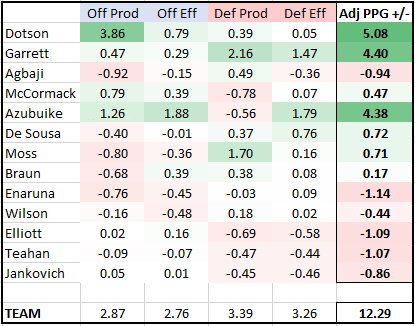
Adj PPG +/- is the Adjusted Points Per Game the player was against his collective opponents over the course of the season. It is the “one-number” metric (such as WAR in baseball) that tells us how much value a player adds, incorporating all relevant statistics on both sides of the ball. The “Adjusted” refers to the fact the number is adjusted to a hypothetical schedule entirely composed of neutral-site games against a “bubble team.” This is done so the number can be more fairly compared year-over-year or even game-over-game.

Taking Devon Dotson as an example, the metric indicates that KU is roughly 5 points per game better with him on the court than they would be with a hypothetical “bubble” player at his position.

Production vs. Efficiency

The middle four columns break down the PPG +/- into four components of value. Note that these four columns sum to Adj PPG +/-. In basketball, a player helps his team by producing points (scoring, assisting) or winning possessions (rebounds, steals, forced turnovers). Off Prod refers to offensive production. Namely, how many points is that player producing for his team; while counting unassisted points differently than points scored off an assist as assisted-points must be split between the scorer and assist-man. Off Eff refers to offensive efficiency, which is improved by high FG%, low turnover rate, and grabbing offensive rebounds.

Def Prod accounts for how frequently a player is getting scored on. This requires taking whole new stats that are not tracked or published anywhere else in basketball. More will be said on this in a later entry. Def Eff refers to defensive efficiency, incorporating traditional defensive stats such as blocks, rebounds, and steals (alongside the non-box score stat of forced turnovers).

Interpreting the chart above, Devon Dotson had a highly productive offensive output in 2020. He scored most of his points by himself (unassisted), while also setting up others (second-highest assists on team behind Marcus Garrett). Dotson’s ability to get and convert his own shot grades out as the most valuable aspect of any one Jayhawk during the 2020 season. Udoka Azubuike was the most efficient player on offense, something that makes immediate sense given his high FG% and offensive rebounds.

Marcus Garrett grades out as the best defender, and it isn’t close. Given his minutes, and in turn possessions played, he did an excellent job of “shutting down” his man throughout the course of the season. Isaiah Moss added all his value on this aspect of defense as well. Going to the tape, this was largely due to his ability to restrict open looks from outside against the wings he was guarding. Azubuike was the team’s most efficient defender. His rebounding, shot blocking, and ability to clog the lane to force turnovers were unrivaled. He “won” 302 possessions throughout the year on the defensive end, meaning that per game nearly 10 possessions ended in KU’s favor thanks to an Azubuike block, rebound, steal, or forced turnover. Marcus Garrett’s 202 defensive possessions won in 31 games is also noteworthy, particularly due to his position as a guard.

2020 Kansas Jayhawks – Defense

Key

  • Pts Agst – Points scored against that player.
  • Poss Agst – Possessions used when scoring against that player.
  • D Reb – Defensive rebounds credited to playerA.
  • Steals – Steals awarded to player.
  • TO frcd – Turnovers forced by player.
  • Adj PPP – Adjusted Points Per Possession (against). Takes into account prior stats.

A Defensive rebounds also include blocked shots when team wins possession.

2020 Kansas Jayhawks – Offense

Key

  • Pts Una – Points the player scored unassisted.
  • Pts Ast – Points the player scored via assist.
  • Ast pts – Points the player’s teammates scored off his assists
  • Poss Una – Possessions the player used when scoring unassisted.
  • Poss ast – Possessions used when scoring via assist.
  • Ast Poss – Possessions used on assists, i.e. number of assists.
  • Miss – Possessions ending in missed shotsA by player.
  • TO – Turnovers committed by player.
  • O Reb – Offensive rebounds credited to player.
  • Min – Minutes played during season
  • Adj PPP – Adjusted Points Per Possession, factoring all prior stats.

A FT possessions can also count with misses, not just FG misses. If a player goes 0-2 from FT, or misses front-end of 1&1, the player will be credited with a miss. If a player goes 1-2 from FT, that possession is counted within Poss Una.