
Post-Baylor Recap

Tonight Kansas fell to Baylor, 69-77, and is now 10-4 on the year. The Hawks fought well, but Baylor was too good and answered every comeback attempt the Hawks had. Below are the Raw and Adj. PPG +/- scores for the game along with traditional stats for reference:

Marcus Garrett. Raw: +2.33 Adj: +5.00. 9 pts, 3 rebounds, 8 assists.

Christian Braun. Raw: +6.17 Adj: +8.83. 17 pts, 4 rebounds, 1 assist.

Ochai Agbaji. Raw: +3.00 Adj: +5.37. 16 pts, 2 rebounds, 1 assist.

Jalen Wilson. Raw: -6.50 Adj: -4.75. 4 pts, 5 rebounds, 3 assists.

David McCormack. Raw: -8.17 Adj: -6.64. 6 pts, 2 rebounds, 1 assist.

Tristan Enaruna. Raw: +1.33 Adj: +2.68. 4 pts, 1 rebound, 2 assists.

Mitch Lightfoot. Raw: -7.00 Adj: -5.73. 8 pts, 4 rebounds, 1 assist.

Dejuan Harris. Raw: -1.67 Adj: -0.21. 2 pts, 1 rebound, 1 assist.

Chris Teahan. Raw +2.50 Adj: +2.57. 3 pts, 0 rebounds, 0 assists.

The Good: Starting Guards

Christian Braun had the best game of any Jayhawk, due to his highly efficient offensive performance (17 pts on 5-7 FG, 2-2 FT). His defensive effort was also solid once adjusted for opponent. Ochai Agbaji shook off a rough first half to finish as a positive contributor. Despite the box score only showing one defensive rebound, he forced four turnovers in the game to go along with his two steals. Marcus Garrett also played solid on both ends of the court. His defense was elite until the end (got beat/gave up and-one layup; unnecessary bonus foul gave up 2 FT’s), but still finished around his season average. Combining the three starting guards’ efforts, Kansas was +11.50 points better than Baylor, raw. Simply put, had the others pulled their weight KU could have won this game.

The OK: Reserve Guards:

Tristan Enaruna continued his solid play, out-valuing his man through good offensive efficiency and solid defensive positioning. As a back-up wing, he did what he needed to stay on the court and help his team compete (18 minutes). His improvement over the recent games has been a sign of encouragement. Dejuan Harris showed good hustle and energy, although he finished slightly negative even when adjusting to the opponent’s high level of skill. Once he adds a shot, he will be a complete player. But his defense is creeping toward replacement-level after tonight’s game. Chris Teahan added a buzzer 3-pointer, continuing his torrid play in limited minutes.

The Ugly: The Bigs:

Given how good Baylor’s guards are, it was assumed that KU had to get positive contributions from Wilson, McCormack, and Lightfoot for the team to win. Even this wasn’t the case tonight, all that was needed from these 3 was respectable numbers, but none of the three could muster anything decent. Baylor put these bigs in pick-n-rolls and iso situations, and punished them repeatedly. McCormack was the worst of the bunch, coming away with one blocked-shot but nothing more of value on the defensive end. He was out there getting scored on, and not much else. Wilson did grab four rebounds and force two turnovers, but he was too slow to check Baylor’s guards on switches. Lightfoot was very bad in the second half, and his defense alone was roughly the difference in the game (~ -7.24 raw).

Final Analysis:

Matching the film with the scorecard, it’s clear that KU’s guards were able to match the effort of those from Baylor. Teams, and Baylor is no exception, shy away from going at Garrett due to his defensive prowess. Braun is solid on defense but not spectacular, yet is a plus rebounder who wins possessions back for his team. Agbaji’s on-ball defense has continued to improve, and he showed tonight what he can do on both ends, shaking off a poor first-half to help get the team back in the game.

But getting a complete effort from the entire roster continues to be elusive. McCormack followed up a great game last week against Oklahoma State with a dud tonight. Wilson has failed to reach double figures in scoring in three consecutive games, after reaching that mark in 9 of his first 11 games this season. When bench players like Tristan Enaruna and Dejuan Harris have solid games, their efforts are cancelled out by a poor game from Mitch Lightfoot. The team appears to be huddling around the 12-15 rank mark in efficiency (currently #15 on KenPom), in the 3/4 seed range.

Bryce Thompson is injured and out, Tyon Grant-Foster did not play as well.
Ochai Agbaji’s Junior Season Similar to Wayne Selden’s

With 12 games in the books in the 2021 season, Ochai Agbaji has shown that the sophomore slump is far behind him. In traditional stats, he’s leading the team with 14.8 ppg, while adding 4.7 rpg and 2.3 apg. He’s been mainstay. His 31.6 mpg is second only to Marcus Garrett, yet Agbaji leads the team in total minutes due to Garrett missing the TCU game.

This brings to mind the career arc of Wayne Selden. After two years of less-than-expected performance, the former guard/wing went for 13.8 ppg, 3.4 rpg, 2.6 apg for a team that achieved the #1 overall seed and Elite 8 appearance in 2016. And while Selden came in much more heralded than Agbaji, both players showed signs of talent in their underclass years that was not consistently realized until their junior seasons.

The similarities don’t end there. Both players have the same listed height (6’5) and play the same wing position with similar skill sets. Compare scouting reports of Agbaji to Selden. Ball handling? Just okay. Shooting? Above average. Body-type? Strong, athletic, able to finish at the rim. Defense? Well above-average, capable of guarding multiple positions.

For the 2016 season, Wayne Selden had a PPG +/- of +3.38, with +1.90 of those points coming from offense and +1.48 from defense. He didn’t grab a lot of rebounds or come up with many steals, but rather played great positional defense by allowing 0.158 ppp (or about 9.5 ppg allowed in 60 possessions).

Ochai Agbaji is currently at +3.52 PPG, and is projected to be between +2.5 and +4.8 90% of simulations given the data from his season so far. Like Selden, he is neither offense nor defense heavy, at +1.96 offense and +1.56 defense. His positional defense (about 8.7 ppg allowed in 60 possessions) is also where his defensive value lies; not rebounding, steals or forced turnovers.

Should he end his season where he is now, Agbaji would grade out at about the 28th best KU Jayhawk since 2002, equal with Kirk Hinrich’s excellent junior season. This would also put him around the 90th percentile of all Jayhawks in the last 20 years. He also has a chance to be the best Jayhawk this season, depending on how Marcus Garrett fares (Garrett’s defense is elite, while his offense has slipped and is below-bubble. This makes comparisons with Agbaji somewhat difficult). Regardless of where he ends up, Agbaji’s improvement from last season (-0.95) will be among the best of all Jayhawks year-over-year. Frank Mason’s award-winning 2017 season saw a 4.78 increase in value over his solid 2016 season for reference. While Agbaji’s improvement in 2021 was “easier” due to how poor his 2020 season went, it has nevertheless been good to see a popular Jayhawk develop into the type of player we all thought he could become.

2020 Kansas Jayhaws PPG +/-

How to Interpret:

Adj PPG +/- is the Adjusted Points Per Game the player was against his collective opponents over the course of the season. It is the “one-number” metric (such as WAR in baseball) that tells us how much value a player adds, incorporating all relevant statistics on both sides of the ball. The “Adjusted” refers to the fact the number is adjusted to a hypothetical schedule entirely composed of neutral-site games against a “bubble team.” This is done so the number can be more fairly compared year-over-year or even game-over-game.

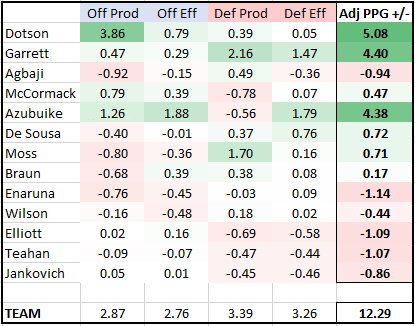
Taking Devon Dotson as an example, the metric indicates that KU is roughly 5 points per game better with him on the court than they would be with a hypothetical “bubble” player at his position.

Production vs. Efficiency

The middle four columns break down the PPG +/- into four components of value. Note that these four columns sum to Adj PPG +/-. In basketball, a player helps his team by producing points (scoring, assisting) or winning possessions (rebounds, steals, forced turnovers). Off Prod refers to offensive production. Namely, how many points is that player producing for his team; while counting unassisted points differently than points scored off an assist as assisted-points must be split between the scorer and assist-man. Off Eff refers to offensive efficiency, which is improved by high FG%, low turnover rate, and grabbing offensive rebounds.

Def Prod accounts for how frequently a player is getting scored on. This requires taking whole new stats that are not tracked or published anywhere else in basketball. More will be said on this in a later entry. Def Eff refers to defensive efficiency, incorporating traditional defensive stats such as blocks, rebounds, and steals (alongside the non-box score stat of forced turnovers).

Interpreting the chart above, Devon Dotson had a highly productive offensive output in 2020. He scored most of his points by himself (unassisted), while also setting up others (second-highest assists on team behind Marcus Garrett). Dotson’s ability to get and convert his own shot grades out as the most valuable aspect of any one Jayhawk during the 2020 season. Udoka Azubuike was the most efficient player on offense, something that makes immediate sense given his high FG% and offensive rebounds.

Marcus Garrett grades out as the best defender, and it isn’t close. Given his minutes, and in turn possessions played, he did an excellent job of “shutting down” his man throughout the course of the season. Isaiah Moss added all his value on this aspect of defense as well. Going to the tape, this was largely due to his ability to restrict open looks from outside against the wings he was guarding. Azubuike was the team’s most efficient defender. His rebounding, shot blocking, and ability to clog the lane to force turnovers were unrivaled. He “won” 302 possessions throughout the year on the defensive end, meaning that per game nearly 10 possessions ended in KU’s favor thanks to an Azubuike block, rebound, steal, or forced turnover. Marcus Garrett’s 202 defensive possessions won in 31 games is also noteworthy, particularly due to his position as a guard.

2020 Kansas Jayhawks – Defense

Key

  • Pts Agst – Points scored against that player.
  • Poss Agst – Possessions used when scoring against that player.
  • D Reb – Defensive rebounds credited to playerA.
  • Steals – Steals awarded to player.
  • TO frcd – Turnovers forced by player.
  • Adj PPP – Adjusted Points Per Possession (against). Takes into account prior stats.

A Defensive rebounds also include blocked shots when team wins possession.

2020 Kansas Jayhawks – Offense

Key

  • Pts Una – Points the player scored unassisted.
  • Pts Ast – Points the player scored via assist.
  • Ast pts – Points the player’s teammates scored off his assists
  • Poss Una – Possessions the player used when scoring unassisted.
  • Poss ast – Possessions used when scoring via assist.
  • Ast Poss – Possessions used on assists, i.e. number of assists.
  • Miss – Possessions ending in missed shotsA by player.
  • TO – Turnovers committed by player.
  • O Reb – Offensive rebounds credited to player.
  • Min – Minutes played during season
  • Adj PPP – Adjusted Points Per Possession, factoring all prior stats.

A FT possessions can also count with misses, not just FG misses. If a player goes 0-2 from FT, or misses front-end of 1&1, the player will be credited with a miss. If a player goes 1-2 from FT, that possession is counted within Poss Una.