2023 Preview

Today KenPom released his preseason rankings for the 2023 basketball season. In it, KU is 8th in the country and 3rd in the conference. By his estimate, KU should go 20-9 in its scheduled games (it still has 2 games against unknown opponents in the Bahamas Tournament). The AP also released its top 25, having KU at 5.

Charting the Hawks will also attempt to evaluate KU’s true ranking by looking at this year’s roster, and then build up to a team prediction based on the sum of the parts.

Returning Players:

Dejuan Harris (RS Jr.) 2023 PPGAB Projection: -0.28

Jalen Wilson (RS Jr.) 2023 PPGAB Projection: +2.79

Joseph Yesufu (Jr.) 2023 PPGAB Projection: -0.35

K.J. Adams (So.) 2023 PPGAB Projection: +0.28

Bobby Pettiford (So.) 2023 PPGAB Projection: -0.59

Zach Clemence (So.) 2023 PPGAB Projection: +0.47

Michael Jankovich (Sr.) 2023 PPGAB Projection: -0.36

Kansas has 7 returnees, with Harris and Wilson also returning as starters. Of these, 6 are rotation (non-walk-on) players. The projections shown here expect about a 0.50 PPG increase per player compared to last season, with minutes-played estimates having a factor. Jalen Wilson is expected to be KU’s best player, and has the best potential of any Jayhawk to finish with All-American honors. Coach Self hit the nail on the head when he stated that for this team to reach its potential, it needs Jalen to play ta an All-American level. Normally a score of +4.50 or even +5.00 is All-American. Wilson has the best chance of any Jayhawk to get there, but history says we shouldn’t expect this. What Wilson has going for him is that he will get a lot more opportunities to score with no McCormack, Agbaji, or Martin to generate offense through. This could boost his value score above his projected number.

Incoming Transfers:

Kevin McCullar (Sr.) 2023 PPGAB Projection: +1.94

Cam Martin (Rs Sr.) 2023 PPGAB Projection: -0.31

McCullar’s projection is taken using box-score stats from his previous time at Texas Tech, with the caveat that his defensive plays weren’t charted. The tape would indicate he is a superb defender, with the ability to score at times. He won’t give up easy baskets, and should be an anchor on that end.

Incoming Freshmen:

Kyle Cuffe (RS Fr.) 2023 PPGAB Projection: -0.35

Gradey Dick (Fr.) 2023 PPGAB Projection: +1.57

M.J. Rice (Fr.) 2023 PPGAB Projection: +0.69

Zuby Ejiofor (Fr.) 2023 PPGAB Projection: -0.18

Ernest Udeh (Fr.) 2023 PPGAB Projection: +0.12

Charlie McCarthy (RS Fr.) 2023 PPGAB Projection: -0.53

Dillon Wilhite (RS Fr.) 2023 PPGAB Projection: -0.53

With freshmen, the projections are tough. The only real framework is their rankings in the class as well as any hype around them. What we use is historic freshman value based upon incoming class rank. This isn’t a perfect way to do it of course, but higher-ranked players do tend to perform better. For Gradey Dick, his high incoming ranking has him projected to have player value somewhere between the freshman seasons of Kelly Oubre 2015 or Perry Ellis 2013. M.J. Rice is somewhere around Ochai Agbaji 2019. Udeh compares to Cole Aldrich 2008 or Markieff Morris 2009. Ejiofor would be closest to Carlton Bragg 2016. Again, these are broad estimates that are meant to incorporate the possibility of over or underachievement.

The TEAM ranking then attempts to take in these player numbers and combine them in a way which recognizes minute distribution. We know Wilson, Harris, and McCullar should get starters’ minutes. There is much to be determined for the 5-spot, as well as who among the other guards and wings can win minutes. The team has a lot of depth.

The number for the team that was calculated is +5.76. This would put KU at around a 4-seed should it win and lose the expected number of games a team of such strength might. While this may seem a bit bearish, remember that losing Agbaji, McCormack, and Martin to graduation was tough. And losing Braun to the draft was the biggest lost in terms of expectation; him not returning drops the 2023 team down a couple seed-lines.

Worst Case, Best Case, Medium Case

Within reason, the worst case scenario would be for Kansas to struggle due to lack of outside shooting and experience. Teams would force the Hawks to knock down shots; forcing guys like Wilson (26.3%), Harris (32.3%), Yesufu (26.2%), Clemence (27.3%), and McCullar (31.1%) to hit open 3’s (3-point percentage from 2022). Another struggle could be the abundance of depth without much differentiation. The 5-spot is still up for grabs, and the D-1 experience at this position is lacking to say the least. Either freshman big has the athleticism, but can either anchor inside in his first year? Clemence showed some talent last year, but played 10+ minutes in a game only twice the entire season. Cam Martin did get a year of practice to adjust to the speed and talent of this level, but how much of his D-2 success can lever up? It may be that K.J. Adams starts the season at the “5,” at least in the games before KU faces true low-post skill.

The point guard position is also another question. Dejuan Harris is loved by fans, but he hasn’t produced the numbers to match this affection. He will need to be a bigger scorer than he was last year. He scored at a rate below half of what the team did as a whole last year. His offensive value from scoring was -4.11 points below bubble per 100 possessions, easily the worst of the top 8 guys in the rotation. While we expect improvement, it would have to be monumental for Harris to become a top 2 or 3 scorer (as Bart Torvik projects). That kind of leap is rare. Moving on to Yesufu and Pettiford; neither were suitable backups last season. In fact, each was even worse than Harris on offense, along with being subpar defenders. Worst case scenario: KU gets a middling-seed (6 or worse) and gets bounced in the First Round.

Switching gears to a reasonable best-case scenario, Kansas finds a nice rotation of 8-9 guys which balance to fill each position nicely. Wilson has an all-American type year, and bolstered by strong defense, the Jayhawks go on to win 25 or so games and get a top-2 seed in the Tournament. From there, a Final Four run is possible, with a very low chance at cutting down the nets in April. Final Four is a good reasonable goal for the 2023 team.

The medium scenario places KU at about a 4-seed. They will compete with the top teams in the Big 12 and maybe even share the title. The freshmen show potential but also reminders of their age. Jalen has a good but not elite year, and has to carry the team for much of the way. The defense is solid but poor outside shooting occasionally plagues them. A second-weekend NCAA Tournament is within expectation, but after that they should be underdogs in the later rounds barring massive upsets.

Wrapping up Last Season

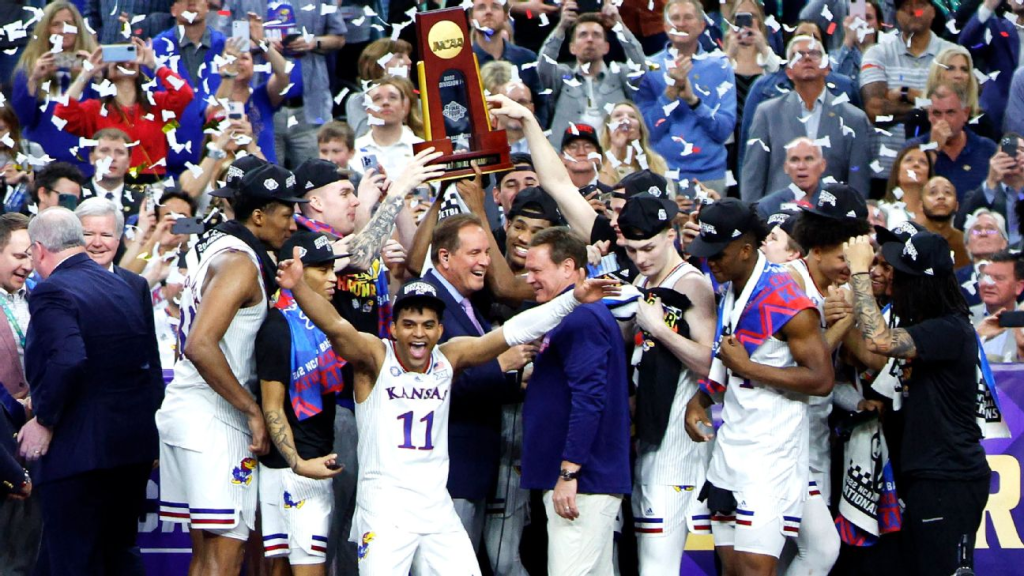
Finally, we look back at last season’s projections. For a TEAM score, we projected +9.50, which was basically matched at +9.46 following the Big 12 Tournament. Thanks to an outstanding 6-game run in the NCAA Tourney, KU finished at +10.21 to exceed expectations and win the National Championship.

But while the TEAM projection was quite accurate, how the team got there was not. Ochai Agbaji (+4.39) and Christian Braun (+3.91) exceeded their low pre-season estimates. Meanwhile, Remy Martin (+1.06) and David McCormack (+1.35) did not achieve what they had been expected to. Jalen Wilson (+2.31) was another bright spot, whereas Joseph Yesufu (-1.06) was very disappointing as an incoming transfer.
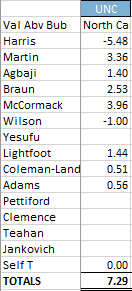
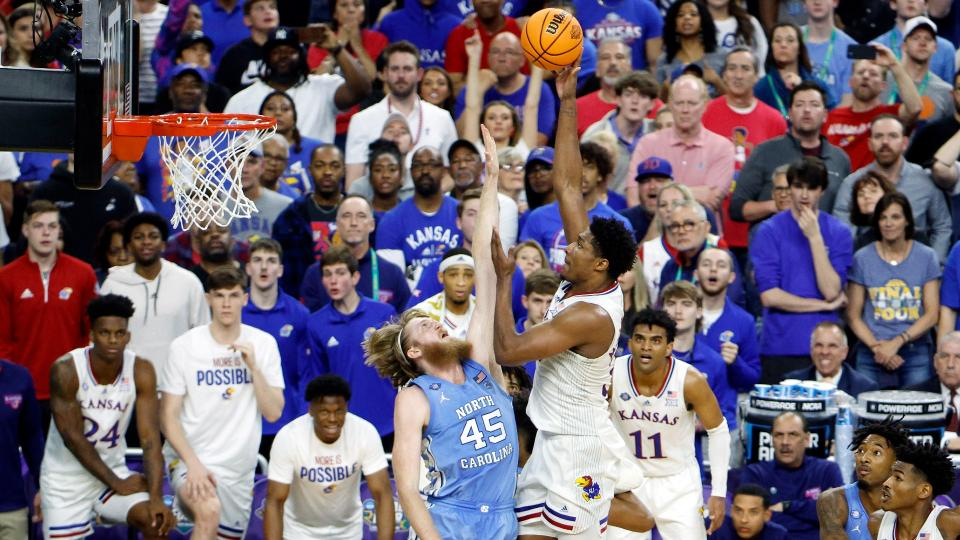
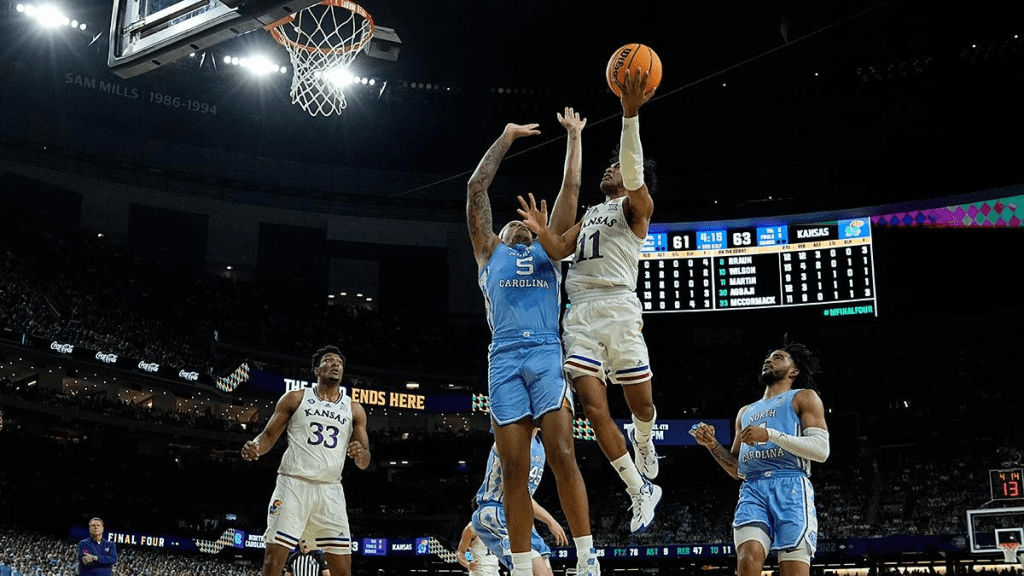
Kansas 72, North Carolina 69

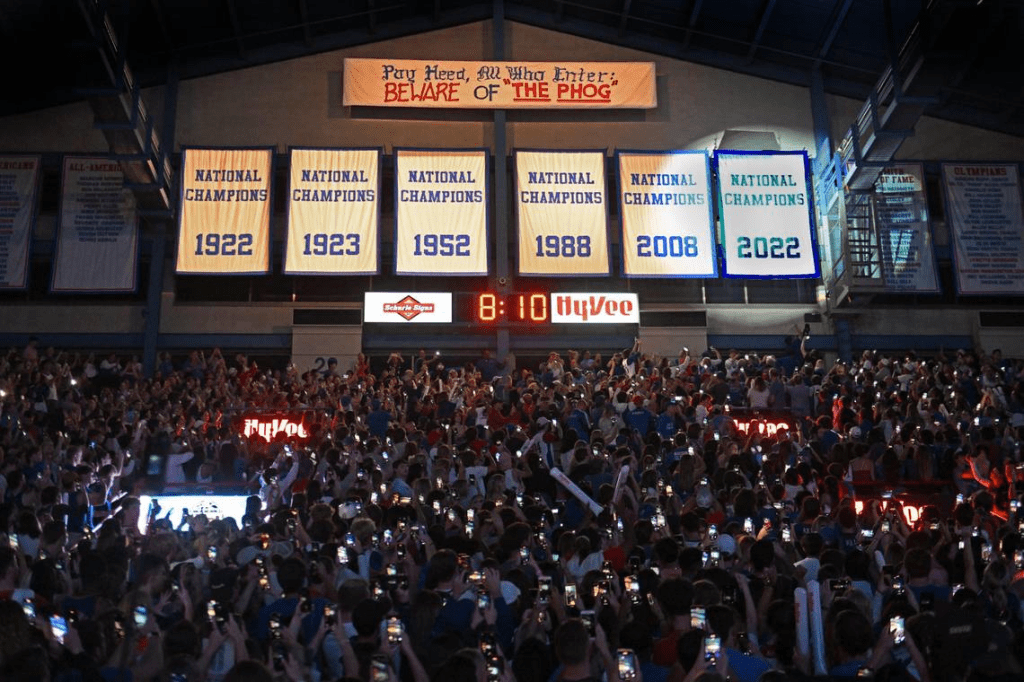
Allen Fieldhouse has been redecorated. The 2022 banner has now been raised, so it seems like a good time to review the National Championship games in terms of player value.

Game Summary:

David McCormack was the game MVP for the Jayhawks. His value above bubble was added in the final two minutes. He made a put-back off his own miss to put KU up 70-69, walled up Armando Bacot to force a turnover, and then made the final basket of the game over Brady Manek to extend the score to 72-69. These three possessions made the difference.

Remy Martin was just below McCormack in terms of player value. He hit 3 huge second-half 3’s as well as a driving layup, with each shot answering Carolina runs which had brought the Tar Heels closer to the lead. Martin was KU’s best player in the tournament, adding 4.11 PPG above bubble during the 6 tournament games.

Christian Braun shook off a tough first half to finish in the black. His tough contest on the final shot made it impossible for Carolina to hit a miracle 3 to tie the game. Mitch Lightfoot fouled a lot, but when he was in he did enough to add value. He made his own shot, grabbed an offensive rebound, and forced a turnover to balance out the 3 FT’s he gave up. Ochai Agbaji didn’t record a counting play after his missed layup with 5:53 to play. but throughout the game, he did more good than harm, particularly in the first half when other Jayhawks were struggling. K.J. Adams contributed one play, forcing UNC into a turnover in the first half. Jalen Coleman-Lands grabbed a rebound for his contribution.

Jalen Wilson turned away from a dreadful first half to contribute to a comeback for the ages. Although he finished below bubble, he was very close to neutral. Dejuan Harris had the worse game of any Jayhawk, with his best stretch coming at the beginning of the second half. His worse blunder was stepping on the sidelines with 4 seconds left to give the Heels a final shot to tie. But by only scoring 2 points on 5 shots, he was KU’s weakest link in the game.

The TEAM score of +7.29 was KU’s 11th consecutive positive, above-bubble performance. While not the best overall game of the season, it was enough to get the win and with it KU’s 6th banner.

Estimating KU’s Total Wins (Football)

Off to a surprising and thrilling 5-0 start, Jayhawk Football finds itself 1 win away from bowl eligibility. And with each additional win, the prospects of a better bowl game and overall season success grow as well.

Let’s look at the remaining schedule:

Vs. TCU

@ Oklahoma

@ Baylor

Vs. Oklahoma St.

@ Texas Tech

Vs. Texas

@ Kansas St.

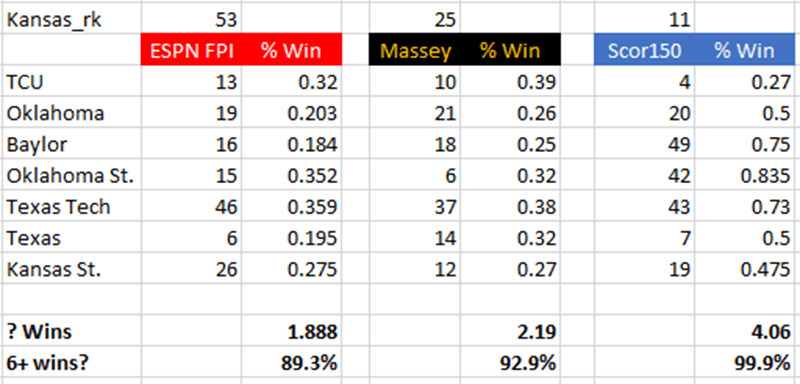
Three home games and four road games remain. I’ve made a table which shows each opponent, that opponent’s computer rank, and the chances KU wins that particular game. At the bottom is the expected number of wins in the remaining portion of the schedule (add that number to 5 to get total projected wins), and the chances KU gets at least 6 wins in the regular season.

There are three computer ranks. The first two are known. ESPN FPI (Football Power Index) and Massey Ratings. The third, called Scor150, is a proprietary system that looks only at this season’s results and doesn’t have a preseason element. So let’s compare:

Looking first at FPI, the projected win total for KU is about 6.9. While KU is scheduled to be underdogs in each of its remaining games, none of these games aren’t winnable, so KU should get 1 and perhaps 2 more somewhere along the way.

Massey is a little more optimistic on KU’s chances, at 7.2 expected wins. This site projects KU to be bowl eligible 92.9% of the time.

What these two systems have in common is some preseason element. ESPN appears to have more reliance on the preseason rating, with Massey data mostly being from games played only.

Now, let’s get to the third. This system only looks at data from this season, using score margin to determine the strength of a team. Using historic winning percentage on point spreads, this system estimates KU to have 4 more wins and make a bowl game almost certainly. Again, if this season is truly independent of what teams have done in the past, then we should have strong optimism regarding the remainder of the season. This system also has KU at the highest power ranking (11th), and has teams like Baylor and Oklahoma St. much lower than they otherwise are in other computer rating systems.

Note that Oklahoma St. is undefeated, but it gave up 44 points to Central Michigan in one game and had a non-D1 opponent (Arkansas-Pine Bluff) which doesn’t help it much. It also has a win against Arizona St., which normally seems like a good win. But the Sun Devils lost to Eastern Michigan this year at home. OSU’s only good win is against Baylor. For Baylor, it has a good win at Iowa St. but not much else. Its loss to BYU should give us pause.

The point is not that OSU and Baylor should actually be ranked in the 40’s. After a few more weeks, we should see a clearer picture. But Baylor hasn’t done much to show itself as a top 20 team. And OSU at 6 on Massey is on the basis of being undefeated more than total margin of victory against quality opponents.

The Big 12 is a mess this year, and I mean this in a good way. Sorting teams from 1 to 10 may not be easy, and the regular season winner of the conference may have multiple conference losses. TCU has looked great, so this Saturday will be tough. Don’t lose heart if KU drops a game or two. They should be competitive, and if they continue to fight will earn at least one more regular season victory.

2007 Kansas Jayhawks

The 2007 Kansas Jayhawks finished with a record of 33-5 (14-2), winning both the Big 12 Regular Season and Conference Tournament. The team earned a 1-seed in the NCAA Tournament and reached the Elite 8 before losing. The team’s Sports Reference link is here.

Offense

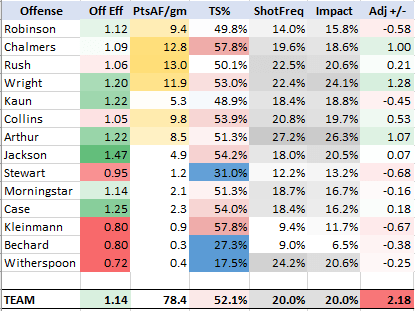
The 2007 offense was worse than people may remember, finishing 29th in Adjusted efficiency according to KenPom. The team’s most productive players were Brandon Rush, Mario Chalmers, and Julian Wright–each producing more than 10 points a game. Chalmers, with a TS% of 57.8%, was the team’s most efficient shooter.

There was good balance among the rotation players, with Darrell Arthur posting the highest shot frequency of 27.2%. Russell Robinson was the opposite end, distributing more than shooting from the PG position.

In total, the 2017 team produced some decent but not spectacular offensive seasons. Wright, Arthur, and Chalmers were all above +1.00 PPG in value. Freshman Sherron Collins was also positive, with Rush and Darnell Jackson barely above 0.00.

Defense

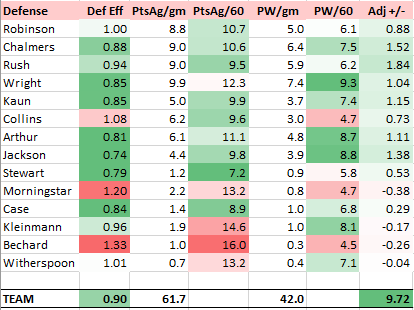
On the other side of things, the 2007 defense is Bill Self’s best defensive team and the best since at least 1997. The team held 7 opponents to under 50 points during the season. Brandon Rush led all rotation defenders by allowing 9.5 points per 60 possessions, with Sherron Collins, Darnell Jackson and Sasha Kaun also posting solid coverage stats. Additionally, reserves like Rodrick Stewart and Jeremy Case defended solidly in their limited playing time.

The team also had balance in winning possessions. Forward Julian Wright led the team in getting the ball back after a defensive stop with strong defensive rebounding, but guards like Mario Chalmers and Russell Robinson got plenty of stops with steals and forced turnovers. The team also blocked tons of shots, finishing second in the nation in block% according to Pomeroy.

The team’s top 10 players (in minutes played) all finished with positive defensive scores, the only time a KU team has done this on record. Rush, Chalmers, Jackson, Kaun, Arthur, and Wright all finished with value scores above +1.00, with Robinson and Collins not far behind.

Adj. PPG +/-

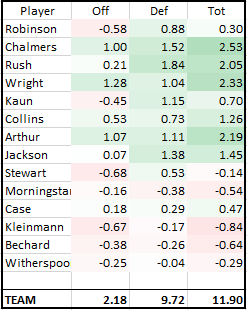
The 2007 team was incredibly balanced, with no true stars but no weaknesses either. Chalmers, Wright, Arthur, and Rush all finished above +2.00 in value; in addition Jackson and Collins added over +1.00 points per game in value. It’s top 8 players were all positive contributors against bubble-level.

The TEAM score of +11.90 was KU’s first +10 score (roughly equating to a 1-seed level performance) since Bill Self began coaching at Kansas.

Mario Chalmers contributed the most value of any player. But not far behind him were Julian Wright, Darrell Arthur, and Brandon Rush. The 2007 team didn’t have a “best” player, but a bunch of very good ones.

Elite 8 Run

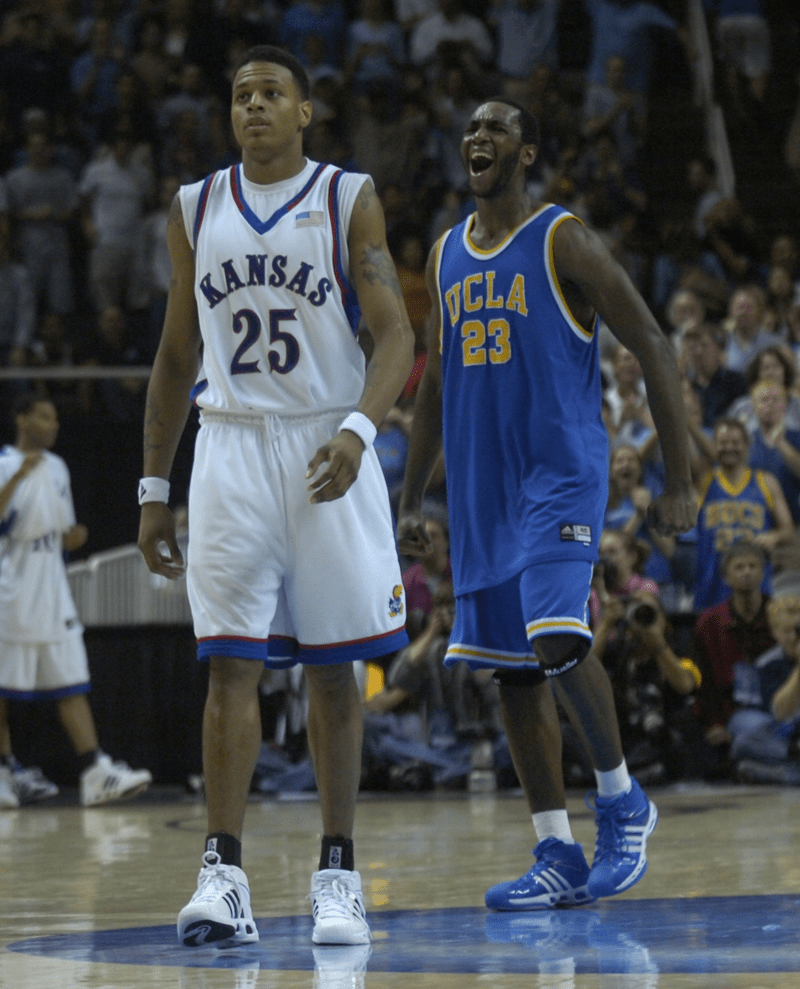
After getting bounced in back-to-back opening rounds in the NCAA Tournament, Bill Self and his players were ready to put the past behind them and make a deep run. Earning the final #1 seed, the Jayhawks cruised past Niagara in the Round of 64, and then defeated #8 seed Kentucky in the Round of 32. A defensive struggle in the Sweet 16 saw Kansas get past #4 seed Southern Illinois, only to lose in the regional finals against UCLA.

It was a tough ending to a successful season. But KU was back. The program, despite a few rocky seasons, had reestablished itself as one of the top teams in college basketball.

Brandon Rush would return for his junior season in ’08 after an ACL injury following the ’07 season.
Julian Wright played his final game as a Jayhawk in the 2007 season.
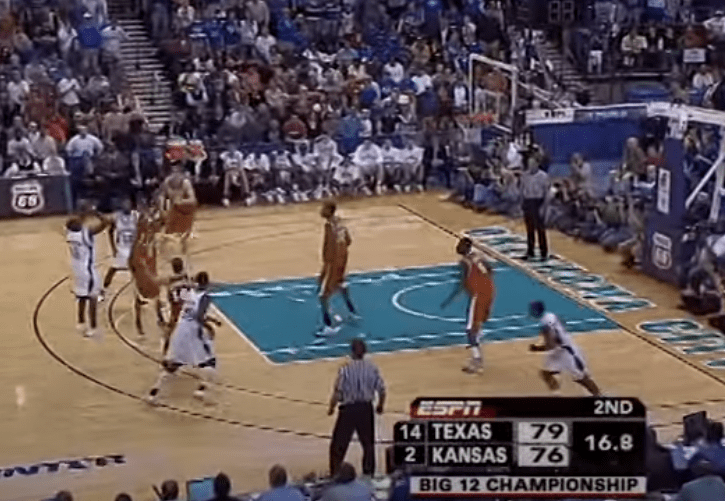
The Mario shot before “the shot.” KU ran same play as they would a year later. This one sent Big XII Tournament Championship game to OT, which would then be won by Kansas 88-84.

2008 Kansas Jayhawks

The 2008 Kansas Jayhawks finished with a record of 37-3 (13-3), winning both the Big 12 Regular Season and Conference Tournament. The team earned a 1-seed in the NCAA Tournament and won the National Championship. The team’s Sports Reference link is here.

Offense

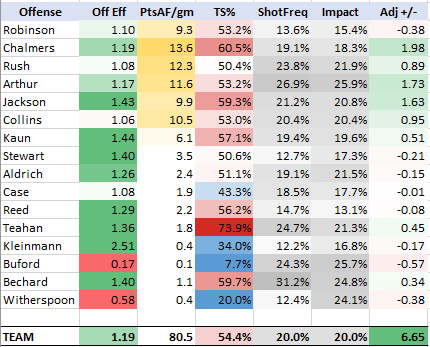
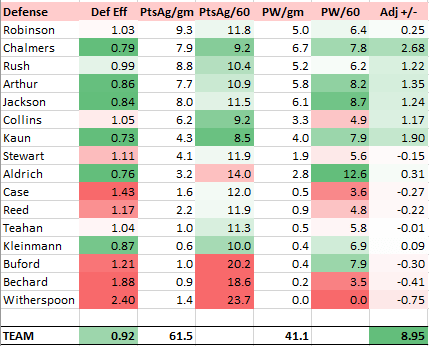
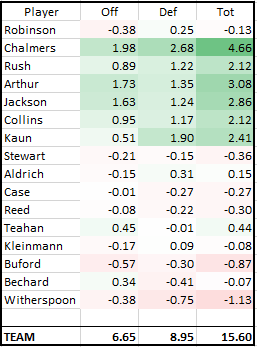
The 2008 team was so balanced, and this balance applied on offense. It’s top six player accounted from between 9.3 and 13.6 points per game. No one had a shot frequency above 27%. Six of the top seven players had a positive Offensive Adj. PPG +/-, though none scored above +2.00.

Mario Chalmers’ season gets overlooked somewhat due to this balance and a particular shot he is more famous for. But he was very good. Not needing to shoot a ton on volume, he torched the nets with a 60.5% True Shooting percentage, and contributed as an off-guard with assists and ball-handling. Inside, both Darrell Arthur and Darnell Jackson put together strong seasons on the offensive side of the ball. Sherron Collins, Brandon Rush, and Sasha Kaun were also positive contributors on this end.

The team had a very good score of +6.65.

Defense

The 2008 defense was even better than its offense, and was the team’s calling card for a multi-year period during this era (2006-2008). It isn’t hard to see why. Mario Chalmers getting steals. Brandon Rush locking down. Sasha Kaun grabbing boards and blocking shots. Both Darnell Jackson and Darrell Arthur developed into fine defenders, using their size and athleticism to bother shots both inside and out. Russell Robinson’s score is a little lower than expected during this season, although his pressure defense was unrivaled during his career.

But once again, we see that Chalmers was the team’s most valuable defender. Known for his steals, Mario did a fine job of not over-gambling and kept his man in front quite well.

Adj. PPG +/-

The 2008 team saw 6 players with a PPG +/- score above +2.00, the most of any season for Kansas since 1997. This balance manifested itself throughout the year. Once again, note that Chalmers easily graded out as the team’s MVP. He was efficient on offense and solid on defense. The team’s trio of big men in Arthur, Jackson, and Kaun were excellent as well.

The TEAM score of +15.60 is KU’s best in the last 26 years, with 1997 the next closest.

Rock Chalk Championship

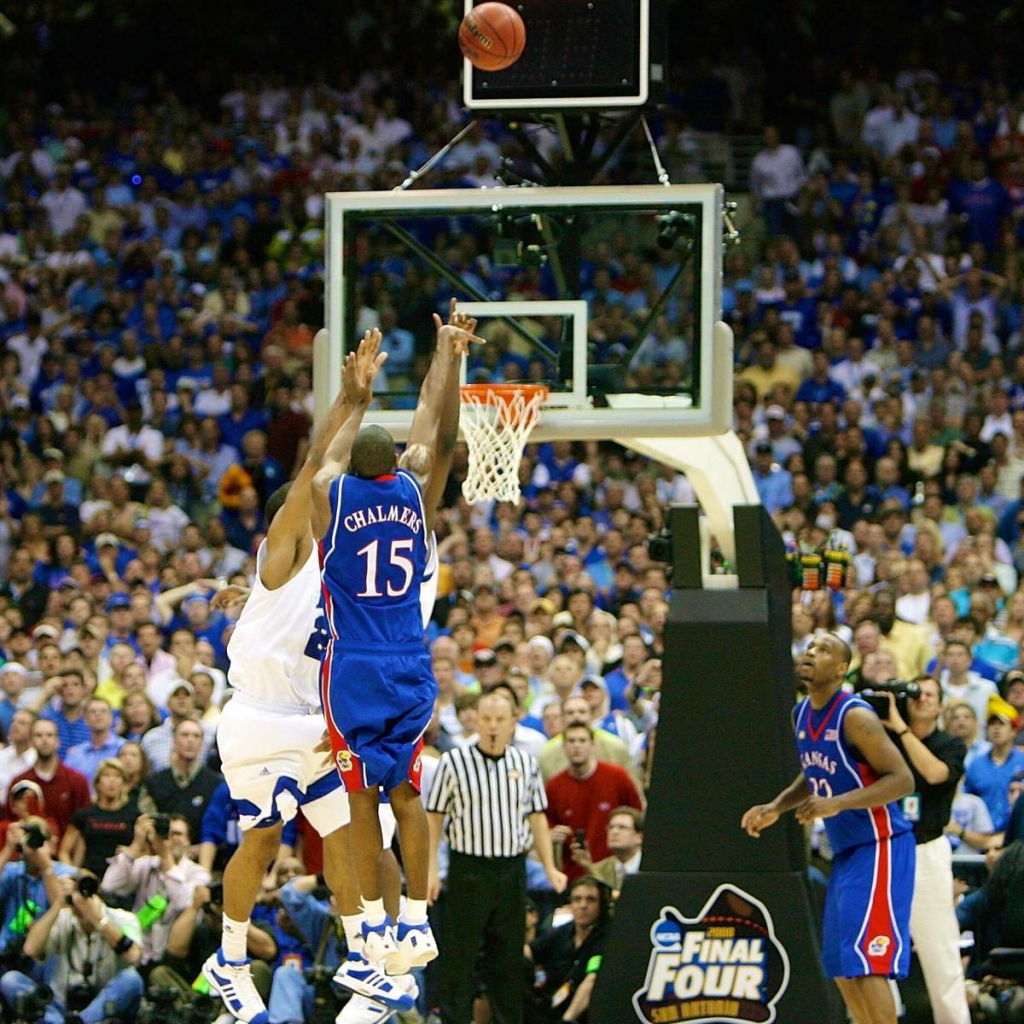
The question this team faced during the year was simply, who will take the big shot when the team needs a bucket in a close NCAA Tournament game? At the time, it was a silly question. Whoever was open was the correct one. But KU would face this dilemma. It needed a play; it needed 3 points. Thankfully Coach Self had a trick up his sleeves. Down 3, with 12 seconds left, he had his best driver race downcourt and flip it to his best shooter coming around on a curl.

You know the rest.

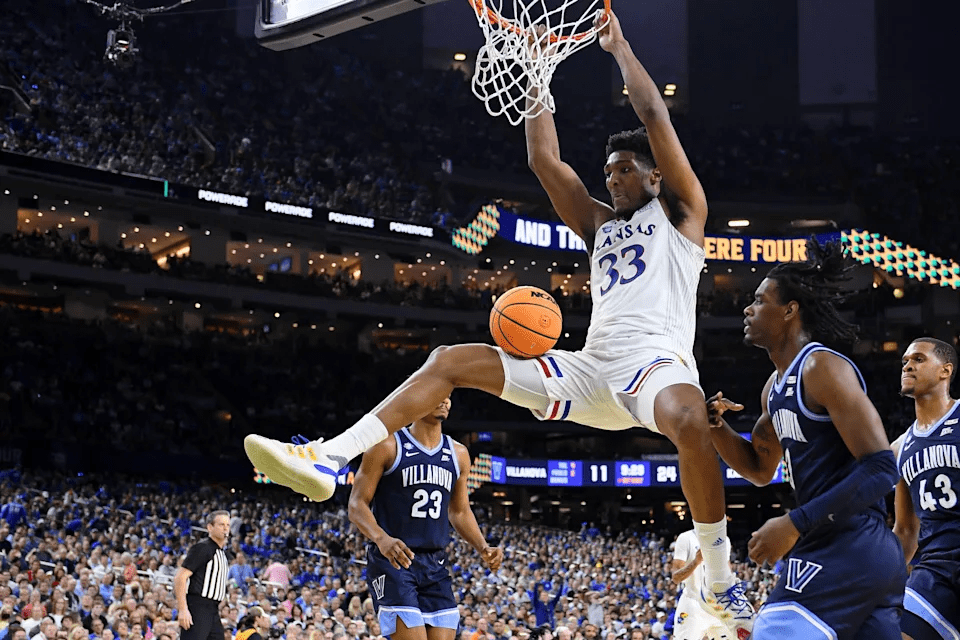
Kansas 81, Villanova 65

David McCormack had his 7th team-MVP game of the season

Game Summary:

David McCormack had 25 points Saturday against Villanova, but none bigger were the 2 he got after rebounding a Christian Braun miss with 5:50 to go. This basket put KU up 8, and Nova would never get closer as KU put the game away during its final run. Ochai Agbaji was on fire from deep (6-7) from 3, and Jalen Wilson’s double-double (11 points, 12 rebounds) and solid defense earned him another quality game.

Both Mitch Lightfoot and Christian Braun did enough to add small value. Braun had a tough first half, but made three huge shots down the stretch to ice the game. Neither Martin nor Harris had great outings, and this was partly due to a difficult matchup at the guard positions.

The five reserves all posted positive games as well, with Joseph Yesufu forcing a turnover.

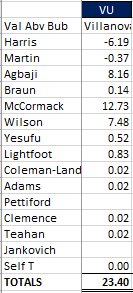
The TEAM score of +23.40 is KU’s fourth-best of the season, and second consecutive game with a +20 score. The team plays in the National Championship game next.

2009 Kansas Jayhawks

The 2009 Kansas Jayhawks finished 27-8 (14-2), winning the Big 12 Regular Season. The team earned a 3-seed in the NCAA Tournament and made the Sweet 16 before losing. The team’s Sports Reference link is here.

OFFENSE

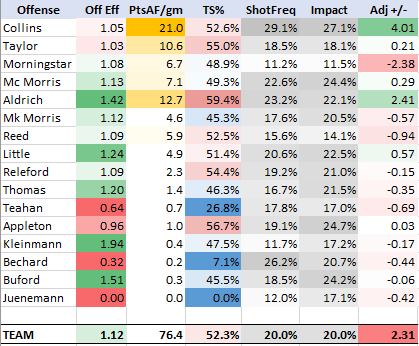
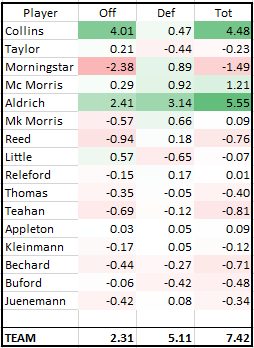
The 2009 offense was led by junior point guard Sherron Collins, who produced 21 points a game, shooting 29.1% of the time. He added 4.01 points of value above a replacement-level player. Collins’s efficiency was low due to the need for him to generate so much offensive opportunity for the team. Sophomore center Cole Aldrich had a strong true shooting percentage of 59.4%. A solid offensive rebounder, Aldrich was the team’s most efficient rotation player and provided +2.41 points of value. Junior Mario Little was the team’s third-most valuable offensive player, buttressed by strong rebounding and low turnover numbers. Freshmen Marcus Morris and Tyshawn Taylor were the other two rotation players to add value on offense.

DEFENSE

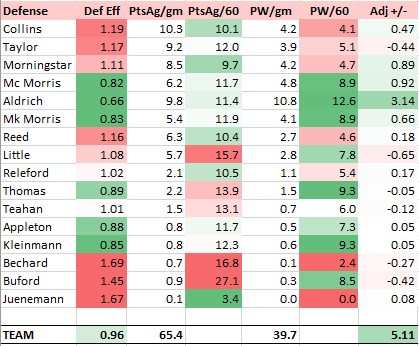
On defense, Cole Aldrich anchored the team to the tune of +3.14 points of value per game. Aldrich was able to dominate inside, blocking shots and rebounding the ball, limiting easy baskets and second chance opportunities. The other Jayhawks did their part on this end, with Marcus Morris and RS junior Brady Morningstar adding nearly a point of value each. The team’s defense was what carried it.

Total Adjusted PPG +/-

Cole Aldrich was the team’s most valuable player for the 2009 season, and had the 8th most-valuable season for a Jayhawk over the 26-season period of 1997-2022. With the caveat that not all defensive information was available for this season, Aldrich graded out as the best interior defender in the Bill Self era (2004-2022). His running mate Sherron Collins was not far behind, generating his value from offense. Collins posted only 1 of 10 +4.00 offensive value scores from 1997-2022. Marcus Morris was also a solid piece for the 2009 team, as his +1.21 score was nice value from a true freshman.

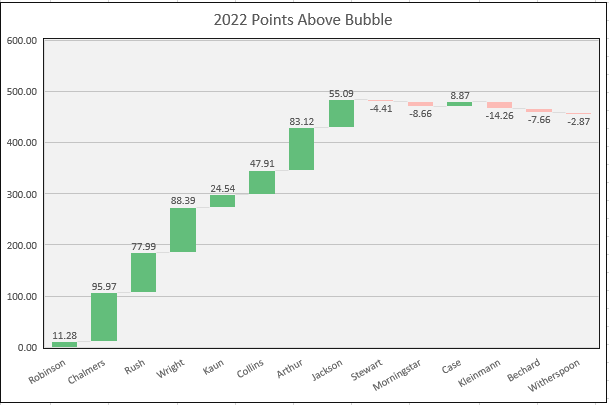
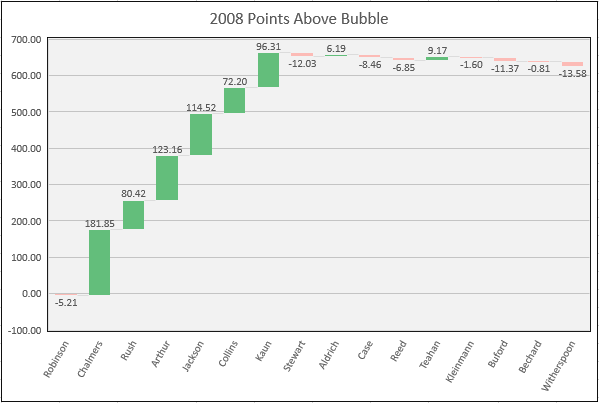
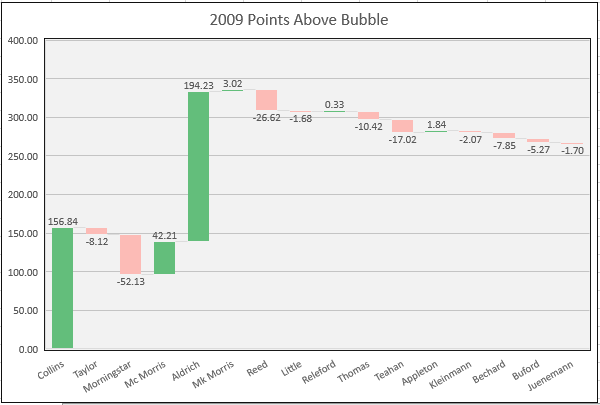
This chart helps to visualize where KU was getting its value. Brady Morningstar, who finished second in minutes played, likely played too much given his low offensive output. With multiple newcomers, the team relied heavily on its key returnees and hoped that its role players would do enough to keep the team competitive. For the most part, this was the case.

The 2009 team won the Big 12 Regular Season title, KU’s 5th in a string of 14 in a row, and had two solid outings in the NCAA Tournament to avoid potential upset bids and make the Sweet 16. With a rematch against a Michigan State team that soundly beat them the first time, Kansas jumped out to an early lead but lost control down the stretch and ultimately, also lost the game. Following the 2008 championship and departure of so many key players, the 2009 season was proof that Kansas was the caliber of program that would reload, not rebuild.

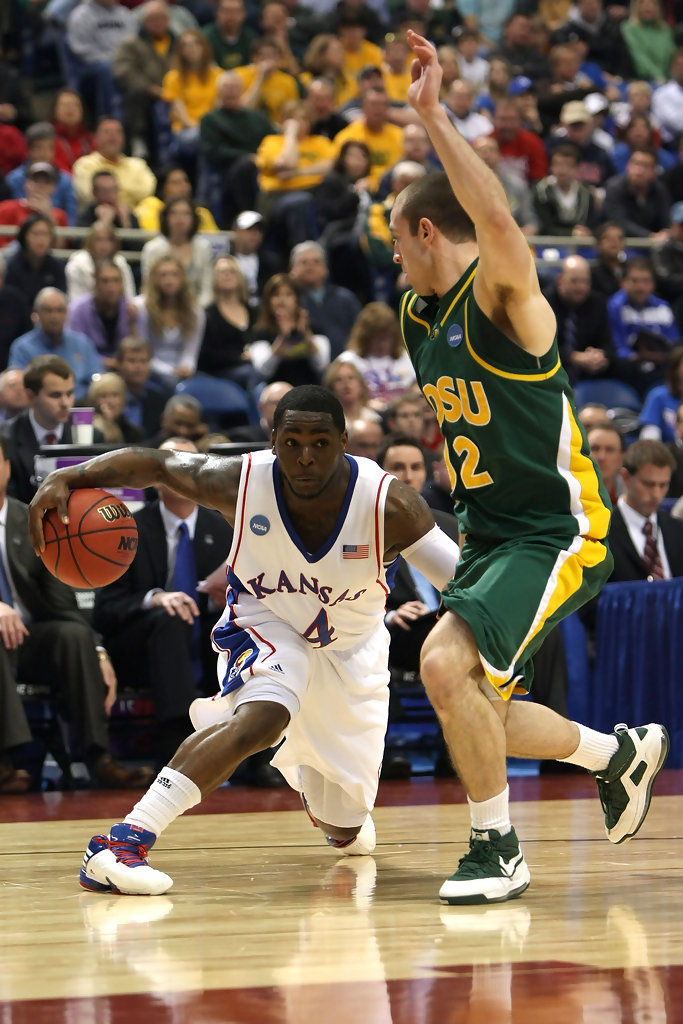
Sherron Collins scored 32 points in KU’s R64 84-74 win over NDSU.

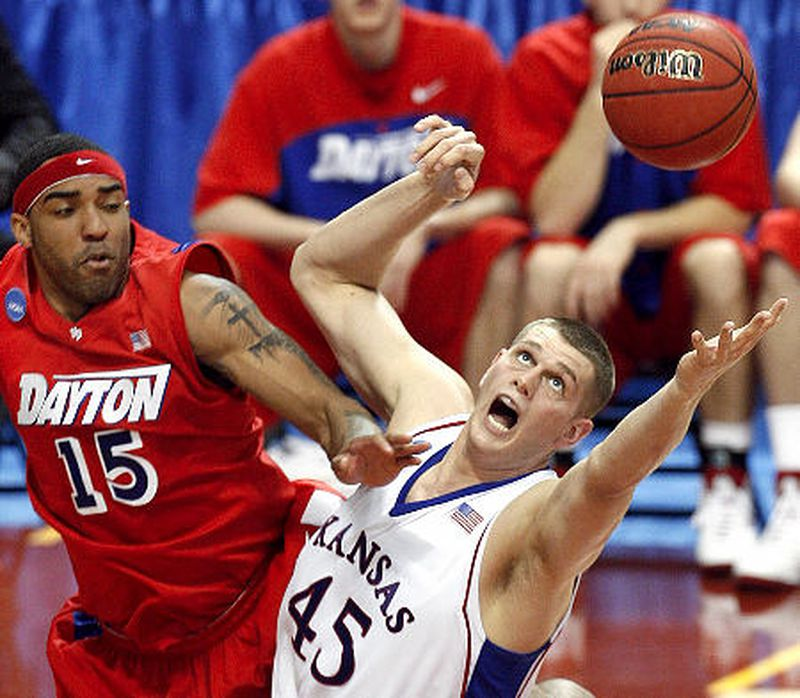
Cole Aldrich had a triple-double in KU’s R32 60-43 win over Dayton

Kansas 76, Miami 50

David McCormack had his 6th team-MVP of the season

Game Summary:

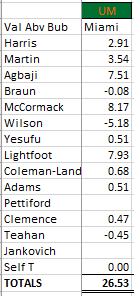
Down 6 at halftime, not much was going well for Kansas. The team was only 13-31 from the floor (0-5 on 3’s), and worse still from the free-throw line (3-9). Despite the size and athletic advantage, the Hawks were being outrebounded 17 to 16. The results by player were mixed…Ochai Agbaji was playing okay; 6 points on 3-5 shooting, 2 rebounds, 1 steal, 1 assist. Remy Martin also had 6 points on 3-7 shooting. Jalen Wilson had yet to score.

But David McCormack was quietly having a good game. He had 7 points in 10 minutes on 3-3 shooting, making his only FT attempt as well. He added 2 rebounds and had a +/- of +3, one of only 2 Jayhawks to have a positive first half +/-. Defensively, he only gave up 2 points in the half.

It makes sense that he would be the one to lead Kansas back in the second half. D-Mac scored the first 5 Kansas points (cutting the 29-35 deficit to 34-35). But his biggest highlight was in the midst of a 16-2 run. After Jalen Wilson missed a transition shot, McCormack pulled down an offensive rebound in traffic, battled through the contact, and finished for an and-1 to put KU up 7. His FT made it 8, and KU would never see the lead dip below 6 following that play.

When he checked out at 12:25, KU was up 7 and would go on another extended run to put the game away. Although Ochai Agbaji was the team’s leading scorer with 18 points, McCormack was the team’s most valuable player, adding 15 points while giving up only 2. He added 3 rebounds as well. This was McCormack’s first MVP since the first TCU game.

KU dominated the interior, as Mitch Lightfoot’s minutes were nearly equally as valuable as McCormack’s. But Mitch did it a little differently. Scoring 9 points, Mitch added more activity on defense, blocking a shot and getting boards. He also drew a charge. But like McCormack, he only allowed 2 points on defense.

Ochai Agbaji broke out of his slump to finish with 18 points. He was also active on defense, coming away with 4 steals. Remy Martin had his lowest scoring output of the NCAA Tournament, with 9, but he did other things to help his team win. 3 assists. 4 defensive rebounds. Solid perimeter defense. Ditto for Dejuan Harris. A nifty layup was part of the 5 points he scored, but he also added 4 assists and played stingy defense. After Kameron McGusty lit up KU in the first half, Harris took away Miami’s best weapon during the second half with strong defensive energy. Christian Braun had big plays in the second half, and although his score finished up below 0, it was due to him allowing points in the first half. He made adjustments and played well for Kansas when it counted.

The reserves also had good moments. Joseph Yesufu drew a charge. Jalen Coleman-Lands (finally) hit a 3, but he also played solid defense during the first half to not allow any points. Speaking of solid defense, K.J. Adams made an excellent block to keep KU within 6 at the end of the first half. Zach Clemence grabbed a board and Chris Teahan missed his only shot attempt.

A TEAM score of 26.53 is KU’s second-best outing of the year, only behind the Baylor game. Kansas is Final Four bound, and is playing its best ball at the right time. In its 7 post-season games, the Hawks are averaging a team score of +14.69.

Kansas 66, Providence 61

Remy Martin now has 3 team-MVP’s, continuing his hot streak in March

Game Summary:

It was KU’s defense, not its offense, which carried it for most of the game. But when Providence made a run to take the lead, the Hawks got huge buckets from Jalen Wilson and Christian Braun.

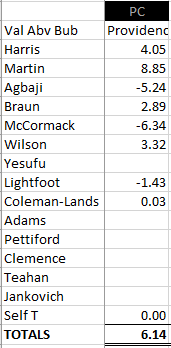
Remy Martin was the team’s MVP, producing over 23 points while giving up only 9. On an opponent-adjusted basis, his game against Providence has been his best in the season. In his last five games, he is averaging +5.72 points of value above bubble per game. He has been Remy Marchtin for sure.

Dejuan Harris deserves a shout-out here, specifically because he will be overlooked. He finished with 6 points and 2 assists while only giving up a junk bucket late. He started out each half well, only to come out to allow Remy to enter. On defense, he forced 2 turnovers and played pesky defense all night.

Other positives were Jalen Wilson and Christian Braun. Wilson racked up 14 rebounds once you factor in the dead-ball rebounds that he won possession of. He scored 16 points, most of them unassisted, on a night where KU’s two leading scorers didn’t have great offensive outings. CB, KU’s #2 scorer on the year, did add value thanks to solid defense and rebounding. Even when he doesn’t have his best game on offense, Braun plays so consistently on defense that he rarely gets outplayed. After giving up a layup on a back-cut (which gave Providence its only lead 48-47), CB added almost 4 points of value over the final 5 1/2 minutes, with no negative plays. He made his only shot, won 4 defensive rebounds, had an assist on Ochai’s dunk, and didn’t turn it over.

On the negative side, Lightfoot made some nice defensive plays but also found himself giving up size inside. He did make a basket in the second-half after a dime by Remy Martin. Ochai Agbaji struggled to get clean looks. He had a great defensive outing in the first half, but his second period was marred by lapses on jump-shooters. David McCormack struggled on both ends, and his 8 points scored was overshadowed by his 13 points allowed. He also rebounded poorly for the amount of time he played.

Last, Jalen Coleman-Lands played nearly 4 minutes and didn’t record a stat. He played solid defense to not give up a bucket.

The TEAM had a score of +6.14, which is its second game in a row below the +10 mark (KU reached that milestone in 4 consecutive games before Creighton). To get through Miami, KU will need a game score of +2 or better. What this means is that Miami is about 2 points a game better than a bubble-team.

After an inconsistent year on the defensive side of the ball, KU has produced 6 out of 7 solid defensive outings down the stretch. KU will want its offense to be much better on Sunday afternoon, but thankfully the Hawks have not had two below-bubble team offensive games in a row this season.

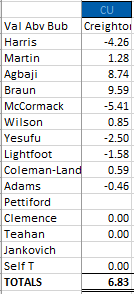
Kansas 79, Creighton 72

CB had his 10th team MVP of the season thanks to solid play on both ends

Game Summary:

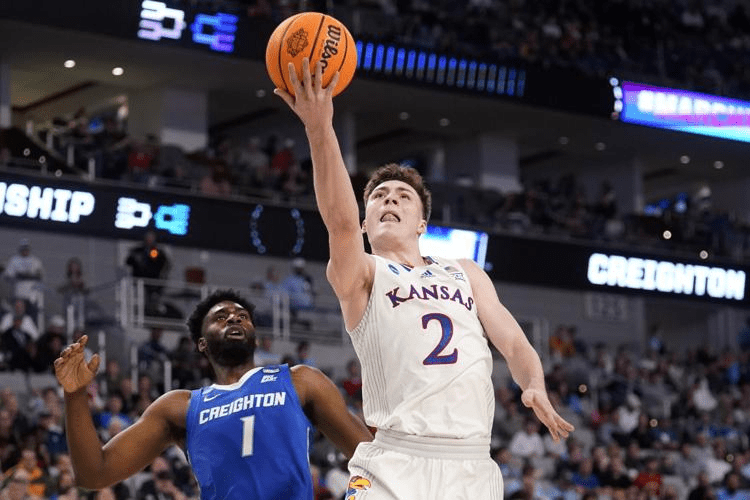
With about 10 seconds to go in KU’s 79-72 win over Creighton, Christian Braun switched onto Blue Jay point guard Trey Alexander. With the game only being decided a few plays earlier, Braun mirrored Alexander’s moves as he attempted to take it toward the basket. After being cut off, Alexander pulled up from about 15′, looking to shoot a jump-shot. Braun mirrored that, too, getting an arm out to bother the would-be shot so much that Alexander decided to pass the ball at the last instance to avoid getting his shot swatted. But that proved unfruitful, as the pass did not connect and would result in a Creighton turnover. From there, all KU had to do was inbound and dribble out the clock.

This play was emblematic of Braun’s defense all game. No matter who he switched onto, he had the ability to defend that opponent. Another crucial play happened at the 3:28 mark of the second half. Creighton’s Arthur Kaluma had a game-high 24 points, but none of them were against CB. He did attempt to hit a mid-range jumper over Braun, but saw it get blocked straight over his head. In Braun’s 38 minutes of play, he only gave up 4 points on defense. Combined with an efficient offensive outing (1.29 PPP_af, 13 points, 4 assists), and he was nearly 10 points better than a bubble-level player.

Ochai Agbaji’s offense has noticeably dipped in recent weeks. But he turned up his defensive efforts on Saturday, only allowing 6 points on defense to go along with 5 rebounds, 2 steals, and 1 blocked shot. KU doesn’t win without either player.

Remy Martin was KU’s best offensive weapon against Creighton, scoring 20 points with a PPP_af of 1.24. And while he gave up 16 points, it wasn’t due to effort but due to Creighton making some deep 3’s over his short frame. This also shouldn’t be overlooked: Remy’s ability to generate offense allows guys like Braun, Agbaji, and Wilson to put more effort into making defensive stands and getting rebounds off misses on either end.

Jalen Coleman-Lands showed why he has been a better option off the bench than Joe Yesufu, first grabbing a miss and putting it back in the first-half and then hitting a second-half 3. His defense, while not great vs. Creighton, has been replacement-level for the year.

Jalen Wilson finished with 14 points and 14 rebounds, and a positive contribution despite some defensive lapses.

On the negative side: Mitch Lightfoot gave up a bad offensive rebound which resulted in a kick-out 3, David McCormack had trouble guarding the 3-point line and struggled to score like he normally does, Dejuan Harris got outplayed, K.J. Adams missed his only shot attempt, and Yesufu fouled a jump-shooter while turning it over twice.

The TEAM score of +6.83 was good enough to get the win. KU played down to Creighton’s level for most of the game, not putting away a scrappy team who was down to a 6-man rotation following key injuries. But in the end it was enough to win.