
Note: First posted 3/18/2026.
The 2026 NCAA Tournament is underway with First Four games having been played yesterday and later this evening. While we don’t have the final lines for the R64 for Tennessee’s opponent (either Miami (OH) or SMU) or Florida’s (Prairie View/Lehigh), we do have opening round lines for the other 30 games. 3/19 update: Miami and Prairie View won.
First, let’s look at the historic winning percentage and point differential for all favored seeds in the First Round.
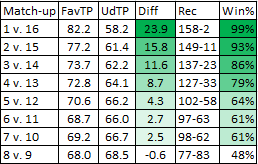
This is since 1985, so 40 tournaments’ worth. The 1-seed’s average margin is 23.8 points and so on. Let’s now look at the current average betting lines by better seed for 2026 (includes all R64 games):
- 1 v. 16: -31.3
- 2 v. 15: -23.5
- 3 v. 14: -20.0
- 4 v. 13: -13.8
- 5 v. 12: -10.0
- 6 v. 11: -5.3
- 7 v. 10: -3.4
- 8 v. 9: -0.3
This is further evidence of a college basketball trend many have been noticing, namely the growing chasm between the very best of the sport and the rest of the sport. While the opening round games between seeds 6 through 11 are in keeping with the historic gaps of these spots, seeds 5 or better are stronger relative to the worse seeds than they’ve historically been. There is almost no chance a 16 knocks off a 1 this season, and moving on down we can see that the 2/15 matchup in 2026 is basically a 1/16 matchup in previous seasons, a 3/14 matchup is a surer result in favor of the better team than a typical 2/15 game, and the 4/13 matchup this year is expected to be somewhere in the middle of a typical 2/15 slash 3/14 First Round contest. While a 12-over-5 upset wouldn’t be shocking this year1, even this gap is noticeably wider compared to prior seasons.
The years 2000, 2004, 2007, 2017, and 2025 are unique in that they are the only ones where no seed worse than a 12 won an opening round game (in 2000 and 2007 all 12’s won their R64 games as well). There is a good chance this happens again. Using the historic line to winning percentage table, we estimate the chance that all top four seeds advance to the weekend at 56.6%. For something that has happened only 12.5% of the time, the projected chalkiness of the 2026 bracket is notable2.
Potential Evolution of the Tournament
We plan on writing more of the phenomenon later, but essentially what is happening is that the best, richest programs are acquiring non-power conference talent from the portal during the offseason and this not only makes the good teams better it makes the mid and low-majors worse. We can see this through KenPom data; currently there are 8 teams with an AdjEM of +30.00 or better, which would be an all-time high. Last season there were 6 teams, which at the time was tied for the highest number in all seasons since 1997. Going all the way back to 2023 (I know, so long ago) there were exactly 0 at season’s end reach that +30.00 threshold. And this was hardly some outlier, in 2022 there was only 1.
Good teams are getting better, and the winners of one-bid leagues (seeds 12 on down) are getting worse. The gap is widening from both directions.
If this continues, we project this will create an evolution in the Tournament. Less exciting will be the First Round games, where chalk predominates more years than not (though upsets when they do occur will become more appreciated), but games in the Second Round and later will see better matchups and more madness. More 4/5 coin-flip games. Fewer 14’s and 15’s getting beat in the R32 by double digits, so the 2’s playing the 7/10 winner and 3’s playing the 6/11 winner will be competitive.
The first time the Round of 64 saw all 5-seeds and better win (2000), we saw two 8-seeds and a 5-seed make the Final Four. Interestingly, the growing gap doesn’t really help the 1-seeds, who have historically already been dominant in the first weekend. Instead, it seeds 2-5 secure a more-likely First Round victory and better odds to make the Final Four. 1-seeds who have to face the 4/5 in the S16 and (more likely) a 2/3 in the E8 are going to get to the final weekend less often than they do when they get a break somewhere in the bracket3.
Closing Thoughts
Assuming the 68-team bracket in its current iteration persists, and we hope it does, there will likely be a push from fans for more upsets, and at some point we hope more regulation when it comes to player movement and NIL. There is still the potential for more mid-majors to grow into competitive teams (think McNeese recently) which helps shore up the bottom of the bracket more. We might even see one-bid leagues manipulate their conference tournaments more to protect the higher seeds, so that the ASUN for instance sends Central Arkansas (KP #152) instead of Queens (#183), which would help when it comes to opening round upset potential.
- ESPN BPI projects that all 5-seeds win 43.2% of the time, with the 5-seeds earning a collective 0.76 estimated wins. Only 6 times out of 40 (15%) have the 5-seeds gone 4-0 against the 12’s. ↩︎
- If we include 5-seeds, the chances that all of the top 20 teams win their R64 games is 27.5%. Given the historic precedent is 5.0%, this is a five-fold increase. ↩︎
- The 1-seeds are 24-0 against 12/13 seeds in the S16 and 21-7 against seeds 6/7/10/11 in the E8. When playing the 4/5 in the S16, the 1’s are 83-29 (74.1%). When playing the 2/3 in the E8, the 1’s are 45-34 (57.0%). 1’s have disproportionately enjoyed better paths with earlier-round upsets than other seeds, so as this changes expect there to be fewer 1’s make Final Fours. ↩︎

 Charting the Hawks
One thought on “2026 NCAA Tournament – First Round Preview”