
The NCAA Tournament selection committee uses Team Sheets and a number of metrics and data to determine how to seed the bracket, and we’ve graded them on this by seeing how consistent they’ve been at applying a standard across the board. Using this same idea, that applying a hidden weighting system to the pool of D1 teams will produce an unbiased S-curve ranking, we have created a mock bracket. As of end of games Tuesday, 3/10/2026.
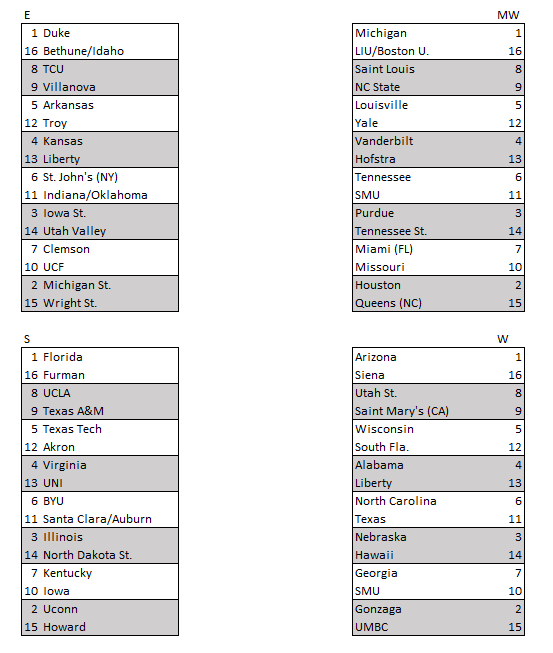
Below is the S-curve.
- Duke
- Michigan
- Arizona
- Florida
- UConn
- Houston
- Michigan St.
- Gonzaga
- Nebraska
- Illinois
- Iowa St.
- Purdue
- Vanderbilt
- Alabama
- Virginia
- Kansas
- Texas Tech
- Arkansas
- Louisville
- Wisconsin
- North Carolina
- St. John’s (NY)
- BYU
- Tennessee
- Miami (FL)
- Georgia
- Clemson
- Kentucky
- Saint Louis
- Utah St.
- TCU
- UCLA
- Saint Mary’s (CA)
- Texas A&M
- Villanova
- NC State
- Ohio St.
- Missouri
- Iowa
- UCF
- SMU
- Texas
- Santa Clara
- Indiana
- Oklahoma
- Auburn
- South Fla.
- Yale
- Troy
- Akron
- Liberty
- UNI
- High Point
- Hofstra
- Utah Valley
- Hawaii
- North Dakota St.
- Tennessee St.
- Wright St.
- UMBC
- Queens (NC)
- Howard
- Siena
- Furman
- Idaho
- LIU
- Boston U.
- Bethune-Cookman
Right off the bat, we had to change some things up. According to the weighted team sheet rankings, Michigan was ahead of Duke, but since the Blue Devils beat the Wolverines head-to-head, we are confident in saying the order would be Duke #1, Michigan #2.
As we are in the midst of Champ Week, only some of the mid and low-major conference champions in this bracket are official auto-qualifiers. The projected AQ’s listed is the team with the best NET rating still left in that conference tournament. The AQ teams in italics have yet to officially qualify.
Because of taking the best NET rating, this bracket projects Akron as the MAC Tournament winner, not Miami (OH). The RedHawks get left out in this scenario, due to poor metrics and and an abysmal SOS. In fact, Miami (OH) isn’t even that close using the weighted team sheet rankings. I don’t know what the committee is going to do should Miami (OH) not win their conference tournament, but if they apply one standard across the board, it will be an unprecedented snubbing. My prediction was that Miami (OH) would make it due to their strong WAB and resume metrics. Currently Miami (OH) is 31st in WAB and 21st in SOR.
On the flip side, Auburn would get in under this scenario. The Tigers would land the final spot and have to play in Dayton, but imagine the uproar if this occurred. Yet, given the committee’s historical preferences, the weighted team sheet has them in.
For Kansas, the Jayhawks sit at the precarious #16 spot, earning the final 4-seed but certainly in danger of sliding to a 5-seed. Losing both the Arizona St. and Cincinnati games are hurting a team that could be a comfortable 3-seed. Win either one, and the numbers look quite a bit better across the board. Every game matters. Now KU can still move up based on how it does in Kansas City. At the moment, it would be better for KU to have Texas Tech lose in the Big 12 Tournament. Also we should root against Arkansas, Louisville, Virginia, and Alabama.
The bubble looks like this:
Last Four In:
- Santa Clara
- Indiana
- Oklahoma
- Auburn
First Four Out:
- Belmont
- New Mexico
- Stanford
- San Diego St.
Also in bubble consideration is South Fla. The Bulls are in the Field conditionally based on them being the highest NET team in the American, but should they lose in their conference tourney, they could still get in as an at large. The weighted team sheet ranking here would likely have them out, but this doesn’t mean the committee would agree.
Belmont suffered a bad loss to Drake in the MVC quarters and Stanford’s defeat to Pittsburgh was disastrous for the Cardinal’s chances. But both New Mexico and San Diego St. are alive in the Mountain West with chances to improve their resumes.
Looking at the wider bubble picture, power conference teams are sitting prettier than the mid-majors nearby. Of the final 10 at large spots (all the projected 10 and 11-seeds), the weighted team sheet rankings show 9 power conference teams and only 1 mid-major. Spots 47-56 on the S-curve (which include South Fla. which is a strange bubble-case) make up the first 10 spots outside the Tournament and contain 6 mid-majors to 4 power conference teams.
If the committee does end up producing a bracket similar to the one above, there will no doubt be outrage from many pundits and teams outside the power conference structure, claiming bias. What this exercise has shown is not that there isn’t a disadvantage to now-power teams, but rather that it is structural not bias-related. Most mid-major teams, even the very good ones, have glaringly worse team sheet numbers in a variety of categories, from Quadrant 1 wins to SOS, when compared to teams in the middle of the power conferences. And while mid-major coaches complain about the difficulty of scheduling more difficult, very few good mid majors are foregoing buy games and looking to play multiple games against better fellow mid-majors in the non-con. Had Miami (OH), VCU, Belmont, and New Mexico gotten together to play each other in non-conference, each team could have added 3 Q1/Q2 games with at least one of them being a Q1 game. Sure, there is uncertainty if scheduling in the off season due to the fluctuation of team strength, but this makes the old bracket busters concept worth revisiting. Teams in the better mid-major conferences should reserve a weekend in mid-February to compete in cross-conference 2 or 3-game showcase tournaments that serve as a sort of play-in to at-large consideration. Some would lose and see their resumes get worse, but the risk would be worth the reward of winning multiple Q1/Q2 games.
The current Bracket Matrix projections show roughly a 0.92 correlation to this one, and when the dust settles my guess is that the actual team sheet weights for 2026 will converge with what Bracket Matrix has. Each season is different, and the committee has been talking more about WAB so this metric will likely receive more attention from the members and should have a higher weight than it currently does.

 Charting the Hawks
One thought on “Bracketology 2026 – Weighting Team Sheets”