The 2026 Kansas Jayhawks finished the non-conference portion of their schedule with a 10-3 record. At #17 in the AP Poll, #16 in KenPom, #15 in NET, and #11 in Torvik, the Jayhawks have proven they can play with about anybody with or without their star freshman, Darryn Peterson. KU has a +9.85 PPGAB value score (+1.82 Offense and +8.03 Defense), with KU’s defense ranking 7th in KP and 2nd in Torvik as of 12/23/2025. Torvik shows the Jayhawks with a +2.4 WAB.
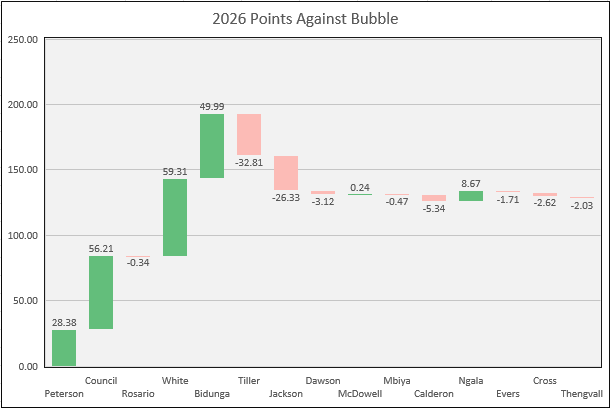
The Waterfall chart above shows the total value per player. This is not rated in per game or possession, so it does a fine job of discounting Peterson given his limited minutes so far. We will look at the team by player, evaluating each’s role on the team now that we’re 13 games in.
Darryn Peterson
The much-hyped incoming recruit has been as good as advertised. Peterson is shooting an official 65.1% in true shooting on a high shot frequency (34.1% by our count), leading to an estimated offensive value of +14.5 PAB per 100 possessions. The problem at the moment is that he has only played 4 official games (and 20% of possible minutes) due to an ongoing leg injury.
The nature of the leg injury is oft-debated among the fans, many of whom have become frustrated by his unavailability. But let’s first look at his value profile. After all, he’s played in 4 games, helping KU win against power conference foes Missouri and N.C. State. Currently, he’s posting a team-best +7.09 PPGAB and +16.17 Per100. These numbers would put him in the top 99% of all KU players. Unfortunately, his limited playing time hurts his cumulative value. He is fourth in the team in WAR (+0.96), total PAB (+28.38) and POCWAB (+0.64). He has only played in one game in Allen Fieldhouse (vs. Green Bay), adding further frustration to the fanbase.
His overall value and place in KU lore will depend on what happens in the New Year. If he cannot play much more, and if he ultimately “shuts it down” and misses the bulk of conference play and NCAA Tournament on what appears to be a relatively minor issue, he will not be viewed favorably. However, if he can get healthy enough to play, his talent should catapult him into being a notable KU name among the one-and-dones.
Tre White
The senior transfer from Illinois, White was projected to be a comfortable above-bubble player but not a star. He’s far exceeded this, posting a +4.56 PPGAB and +9.08 Per100, helping him to lead the team in overall PAB and WAR. White is the team’s third-leading scorer in PPG (second overall) but is doing so at an incredibly high efficiency (67.9% TS). Lately White’s defense has also been solid, adding value by being a versatile iso defender who doesn’t get beat or allow many open 3’s for his man. He’s also KU’s best wing rebounder, complementing the Kansas bigs.
Without Peterson the question of how KU will score is still an issue, but White has stepped up admirably. White’s Per100 percentile is at 93.4% of all KU rotation-player-seasons since 1993. This puts him in the company of 2008 Mario Chalmers and 2023 Jalen Wilson.
Melvin Council
Council has been a fan-favorite since the off-season, but even the biggest Melvin Council fan couldn’t have predicted a season as well as the one Melvin has started to produce. He’s putting up a +4.32/+7.75 season so far, and is the team-leader in POCWAB (+1.67) thanks to a 36-point performance against N.C. State. Melvin’s durability is in sharp contrast to Peterson’s. Council has played a team-high 83% of possible minutes (he played an astonishing 93% of minutes last season, indicating there’s more in the tank for Kansas if they need him for Big 12 play) and in 33 or more minutes against each power conference opponent KU has faced.
More detail about Council’s value profile shows that he is a very good defender. His stinginess has disallowed easy baskets for opponents, and for a guard he rebounds quite well. His offensive profile is solid despite low shooting marks. Council’s best weapon is his ball-handling, indicated by his official 3.7 A/TO ratio (we indicate that this aspect of his game adds to the team 4.7 points per 100). Melvin’s low shooting marks have been improving since the N.C. State game. He has more confidence and is taking better shots in recent games.
Flory Bidunga
Among those who have been available (so, excluding Peterson), Flory is right along Council and White in terms of value. KU truly has a “big 3” of solid pieces this year, ironic given how much derision KU’s big 3 got last season. Flo’s current value marks are +3.85 and +7.60. He’s the team’s best rebounder by far and a menace around the rim (32 total dunks), particularly against weaker opponents. Flory’s opponent-adjusted numbers have been better against non-power conference foes (+5.70 per game) than for power-conference opponents (+2.69). Hopefully Flory can maximize his play against the better teams.
In a sense Bidunga might be KU’s most important piece. His rim protection and rebounding are clearly absent when he’s out of the game. He’s KU’s only real inside presence with solid value as we will see, so when he’s out, KU doesn’t really have much behind him.
Bryson Tiller
Now we arrive at the Kansas player with the fourth-most minutes played on the team. After Peterson and KU’s durable big 3, Tiller is the player Self trusts the most. Bryson had a break-out game, really half, against North Carolina in Chapel Hill by making 4 three-pointers out of 4, but has struggled to shoot from deep since.
His overall value is frankly not good. His TS% of 53.8% looks solid enough, but this is done off of assisted baskets primarily. He’s not great at getting his own shot, either by iso work or in put-backs (especially for someone his size). He plays soft at the rim at times, leading to missed layup chances and blown defensive coverage. His value (-2.52/-5.81) profile fits alongside someone like 2018 Mitch Lightfoot. He grades out as KU’s worst rotation defender on a per game basis (second-worst on Per100 basis).
Tiller’s playing about as well as one might expect a lower-ranked true freshman to. It’s not the end of the world. He has clear talent and skill that should lead to better things down the road. But he’s nowhere near the player many think he is, and the staff should play him less.
Jamari McDowell
McDowell has emerged as KU’s fifth starter when DP is out, and though he only had his first double-figure game of his career in the most-recent one against Davidson, McDowell has put up solid, bubble-level marks (+0.02/+0.06) while playing 44% of minutes. Jamari is doing this by hitting his threes (42.4%) and playing solid defense. He doesn’t create much offense, though he does see the floor well and has positive ball-handling marks with a 2.25 A/TO ratio.
The interesting thing to see will be what he can do if/when teams start crowding his shot. He has only taken 5 shots inside the arc (compared to 33 outside it) this year. The better teams will look to make him beat them off the bounce.
Elmarko Jackson
Jackson is the other returnee that Self has played more in games Peterson has missed, though Elmarko has been far inferior. Jackson’s value (-2.03/-7.02) has been plagued by very poor performances around a few solid ones. Elmarko scored 17 against Tennessee in KU’s comeback win in Las Vegas and followed that up with a solid 11 against stingy Connecticut, his two best efforts of the year. However, since that time he has only scored 5 total points in 78.5 total minutes. One area Elmarko has looked better in recently has been his ball-handling, which on the year is slightly above-bubble.
Aside from this, Jackson hasn’t been a good defender, he hasn’t rebounded in part due to his position, and he doesn’t do a lot to contribute on offense either. Jackson’s best role should be to put defensive pressure on opposing players and to spell Council when KU’s starter needs a break. While everyone has bad games, Jackson needs to find a way to make his bad games not outright terrible ones. Either way, Self is likely playing him too many minutes.
Kohl Rosario
Rosario is the third guard/wing type that Self is trying to fit in. Kohl has been electric at times finishing dunks. He’s 14-15 this year inside the arc (all at the rim), including 10 dunks. He makes hustle plays on the glass, and when it’s all said in done, is a bubble-level player (-0.03/-0.09). What is holding him back is a quick trigger (13-47 from 3, 27.7%) and little offensive creation abilities. He just isn’t anywhere near a KU-level player on the offensive side of the ball at this time.
His defense has been solid, especially guarding his man. He among the leaders in stinginess, adding about 5.3 points of value per 100 possession in this regard. Combined with a decent ability to generate steals and an average defensive rebounding profile as a guard, Kohl is a +4.2 per 100 defender. I’d roll with him over Jackson for the most part.
Jayden Dawson
Dawson rounds out our rotation of guards/wings that Self has experimented with, and despite coming in as an offensive weapon who could score with questions on his defense, Dawson has been a defense-first player with very poor offensive marks. Overall, his value (-0.28/-1.34) indicates that he has only earned a back-up role at this point.
It’s not always possible to know if the reason someone is shooting well or not is due to opportunity, but Dawson’s 6-26 (23.1%) mark from 3 hasn’t been what KU thought it would get. If Dawson played more there’s reason to think those numbers would increase, but at the moment someone like McDowell has hit shots at a higher clip. Ultimately, one has to believe that Dawson will have his moments and produce at some point even if he never becomes a star while in a Jayhawk uniform.
The Rest
Paul Mbiya gets a special call-out due to his position. Mbiya, though not a full rotation player (8.7% of minutes), does play as a back-up big whenever KU’s 2 main bigs are in foul trouble. This has led to the freshman center appearing in 10 of KU’s 13 games, including big minutes against Tennessee. Mbiya isn’t the most mobile, but he does have size and length that he uses well. His value numbers (-0.05, -0.62) are high enough to make you wonder if he should be getting some of Tiller’s, but we surmise that he would be exposed given KU’s defensive style.
Samis Calderon (-0.76/-6.88) is an athletic and potentially solid player, but he doesn’t have the ball-skills to do much on offense at this level at the moment. But his defense has allowed him to get spot minutes here and there.
Nginyu Ngala (+1.44/+17.98) torched the nets early on in spot minutes against weaker opponents, but Gee has only played 3 total minutes against power conference opponents this season (all against Syracuse). His size his limiting his ability to contribute.
The walk-ons have all appeared in 4 games each. Wilder Evers (-0.43/-9.44) is the only one to have scored (3 points), Justin Cross (-0.65/-20.90) has added an assist this year, and Will Thengvall (-0.51/-17.56), the only native Kansan on the roster, has a defensive rebound to his name.
Conclusion
The 2026 Kansas Jayhawks are getting much more from three starters than expected, and even without Peterson have been noticeably better than last year’s team. On the year the team is +8.76 in games without DP (and +12.31 in games he’s played). While KU needs Darryn back to be at its best and have the best chance at making a Final 4, even without him they can win games with elite defense and timely shooting.
All things considered, it’s better that KU isn’t reliant on one player like it looked they might be, and should Peterson get fully healthy, missing him for a large portion of the non-conference might be a benefit in that it helped others build confidence. Adding Peterson to the play of Council, White, and Bidunga is an exciting thought.

 Charting the Hawks
2 thoughts on “2026 Team – Christmas Break Review”