
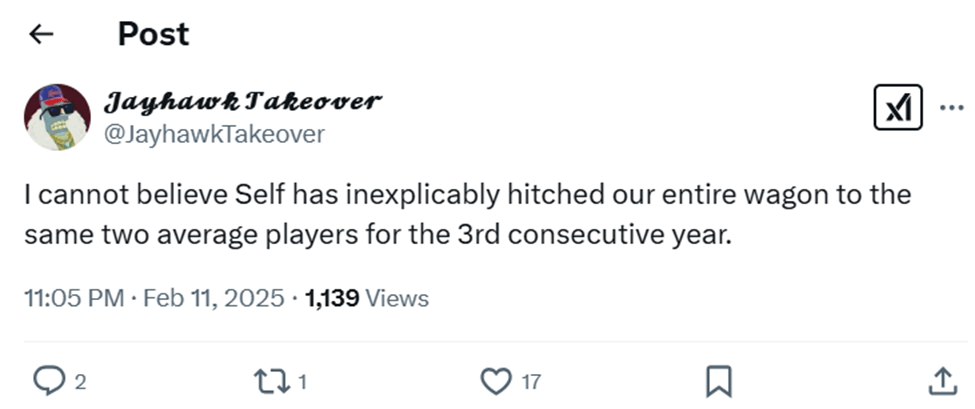
The above X post was chosen as a fairly representative reflection of KU fans’ thoughts on the state of the 2025 team (as well as the two prior seasons). Although the sentiment is put in different ways, whenever Kansas has struggled or failed to achieve a certain level of success in recent seasons, a large swath of the fanbase has been quick to criticize or blame Dajuan Harris and/or K.J. Adams.
Frankly Jayhawk Takeover’s post is mild compared to others. His criticism is a bit more indirect as well, putting the blame more on Self than Harris/Adams, whom he doesn’t even name. But while he’s entitled to his opinion, his sentiment couldn’t be more wrong. Both Harris and Adams have been key pieces over the last few seasons. Adams was the third-best Jayhawk (marginally below McCullar and Dickinson) in 2024 and Harris has been KU’s third-best player (or second-best if looking at total value given his durability) in 2025. Both were also value-adding starters on a 2023 team which earned a 1-seed despite almost no quality depth.
Sometimes KU’s three main returnees (Harris, Adams, and Dickinson) are derided online as the “big 3,” with the sentiment being that as long as these guys are in Lawrence, KU cannot have success, or that Self is unjustifiably relying on their contributions while not playing others who could do better. While lumping in different players and treating them as equally important to team success isn’t normally justified, since fans often look at certain players this way, we felt it insightful to do so utilizing value metrics as we compare groups of players to each other.
Thus begins our look into player value splits. These splits will tell a much different narrative than the one commonly assumed by the vocal majority of Jayhawk fans. Each split first divides the roster into different groups so we can blindly compare value metrics. This should strip the bias, “eye test,” etc. and get a purely objective look at value estimates.
Note: The value metrics presented below are through 24 games in KU’s 2025 season.
Split # 1
| Group 1 | 43.5% minutes played | +8.57 cumulative PPGAB |
| Group 2 | 45.7% minutes played | -0.27 cumulative PPGAB |
| Group 3 | 9.9% minutes played | +1.25 cumulative PPGAB |
Which of these groups looks to be the best? Group 1 accounts for nearly half of minutes played, yet generates 8.57 points of value above a bubble-team. Group 2 plays a bit more but is essentially a bubble-team, losing 0.27 points to this benchmark. Group 3 has a limited impact in terms of minutes but is adding a bit of value.
If we looked at the team in this way, no one would be criticizing Group 1 as a collective, but Group 2 would face a ton of heat for holding the team back. One cannot say that the players who make up Group 2 aren’t getting enough playing time as a whole, either. Group 2 has played slightly more minutes than Group 1.
Group Reveal:
- Group 1 – Returning Veterans (Harris, Adams, Dickinson, Clemence)
- Group 2 – Incoming Transfers (Mayo, Griffen, Storr, Coit, Moore)
- Group 3 – True Freshmen (Bidunga, Passmore)
Since Clemence hasn’t played much this season due to his backup role and injury, Group 1 is for all intents and purposes the “Big 3.” To spell this out further, the “Big 3” are collectively adding over 8.5 points to KU’s skill level when compared to a bubble-team1. The incoming transfers have been reduced to a collective bubble-level output. It’s tough to see how anyone with eyes would blame the returnees as a group (or even individually) more than those incoming transfers who’ve struggled. For Group 3, we see a freshman having an excellent season (Bidunga) and one having a terrible one (Passmore). Freshmen are usually judged less-harshly, as they don’t have the same experience as returnees. Yet KU is getting more from Bidunga than any of the five veteran newcomers.
Split # 2
| Group 1 | 62.6% minutes played | +1.28 cumulative PPGAB |
| Group 2 | 36.5% minutes played | +8.27 cumulative PPGAB |
Once again, we see a clear favorite emerge. Group 1 is slightly ahead of bubble-level value, but it is Group 2 which is producing the bulk of the value for the 2025 Kansas Jayhawks.
Group 1 is the perimeter players, the guards and wings. It includes Harris, Mayo, Griffen, Storr, Coit, Passmore, and Moore. Group 2 is the interior players, that is Adams, Dickinson, Bidunga, and Clemence.
This split is stark, yet how often do we hear praise lauded on the posts specifically or specific criticism about the backcourt collective? It’s just odd how certain narratives take root while others are not discussed. Now, it wouldn’t be right to be overly critical of Zeke Mayo (who has been solid) just because he’s in the backcourt, but as far as narratives go, that’s exactly what the harsher critics of Harris, Adams, or Dickinson are doing.
Split #3
| Player 1 | 74.1% minutes | +9.55 PP100AB |
| Player 2 | 40.6% minutes | +7.90 PP100AB |
| Player 3 | 75.4% minutes | +4.84 PP100AB |
| Player 4 | 77.9% minutes | +3.53 PP100AB |
| Player 5 | 63.4% minutes | +2.85 PP100AB |
| Player 6 | 46.7% minutes | +0.45 PP100AB |
| Player 7 | 37.5% minutes | -1.98 PP100AB |
| Player 8 | 4.3% minutes | -2.57 PP100AB |
| Player 9 | 41.1% minutes | -3.63 PP100AB |
| Player 10 | 25.4% minutes | -4.40 PP100AB |
| Player 11 | 8.8% minutes | -15.90 PP100AB |
These players could be ascertained by simply looking at the minutes played distribution, but without names attached, one would normally want to play those at the top more than those at the bottom. For instance, Player 2 seems like he should be playing more. From there, the minutes distribution looks reasonable, with Players 9 and 10 looking like they haven’t earned a spot in the rotation at the moment. In addition, one would assume that the ire from the fanbase would be due to the play of Players toward the bottom half (starting around player 6 or 7 and on down) while praising those toward the top. Let’s look at the same list, with names included this time.
| Hunter Dickinson | 74.1% minutes | +9.55 PP100AB |
| Flory Bidunga | 40.6% minutes | +7.90 PP100AB |
| Dajuan Harris | 75.4% minutes | +4.84 PP100AB |
| Zeke Mayo | 77.9% minutes | +3.53 PP100AB |
| K.J. Adams | 63.4% minutes | +2.85 PP100AB |
| Rylan Griffen | 46.7% minutes | +0.45 PP100AB |
| David Coit | 37.5% minutes | -1.98 PP100AB |
| Zach Clemence | 4.3% minutes | -2.57 PP100AB |
| A.J. Storr | 41.1% minutes | -3.63 PP100AB |
| Shakeel Moore | 25.4% minutes | -4.40 PP100AB |
| Rakease Passmore | 8.8% minutes | -15.90 PP100AB |
Let’s reexamine the list now that we have names listed. The top five players include each of the “Big 3,” with Hunter Dickinson grading out as KU’s best overall player and Dajuan Harris besting everyone on roster who plays on the perimeter. Even Adams, who has struggled to finish this season, is comfortably adding above-bubble value.
Conversely, Bidunga has earned more minutes than he’s gotten this season. We’ll discuss his role later, and the role of the bigs in a bit. Given that KU wants to play 3 perimeter players alongside 2 bigs, it needs to find minutes for someone beside Harris/Mayo. Griffen has gotten the starting nod of late, and for good reason as he’s the best of the rest so to speak. But even Rylan has been inconsistent, and his value is just marginally above that of a bubble-level player.
From here, we’ve seen some bright spots from Diggy Coit and fewer good moments from A.J. Storr, Shak Moore, and Rakease Passmore. From this list, it’s tough to suggest that any of these sub-bubble guys playing more minutes would help the team.
Now onto the interior rotation. Perhaps the only thing the consensus view from fans is getting right is that Flory Bidunga has shown himself to be valuable and should get more minutes. One can excuse him not being used by Self as much early in the season when he was yet unproven, but after filling in nicely for Hunter (when he was ejected the final 10 minutes against Duke) and K.J. (when he was injured in late January), he’s proven himself to be a serious force. In fact, Flory was KU’s best player in K.J.’s absence, adding 7.78 PPGAB of value while playing more minutes than he normally does (about 70% of possible minutes in Adams’ absence).
This isn’t to knock K.J., which is what people often do when looking at the rotation. Adams has been the better player since his return (Flory has really struggled in the last few outings), muddying the debate even further. Some are blaming Adams for the recent poor play of Flory (an asinine suggestion which is so dumb it becomes impossible to refute—as once Flory begins to play well again no one will start crediting K.J. for Flory’s re-emergence but use it as further evidence that Flory should play while K.J. sits), but it’s clear that like any freshman, Bidunga is going to have off nights. Still, we’re left with the question. How should Self best utilize the front court rotation to ensure the best possible chance for his team to win games?
With 80 minutes to use (40 minutes among 2 spots), the 3 bigs should average 26.7 minutes. We’d argue giving Hunter the most (close to 30-32), Flory a bit less (25-27), and K.J. the remainder (22-24) seems ideal. However, these are just ranges that don’t take into account opponent quality, opponent style, foul trouble, and which player is playing the best that game. Self has to use his judgment and the feel of the game to determine how KU best matches up.
As discussed in Split #2, KU’s frontcourt is carrying it this season. Any combination of Adams/Dickinson/Bidunga has been value-adding while KU plays poorly when it tries to “go small” and play with four guards/wings around a single big. That’s the biggest indictment on the fans and conventional wisdom. Flory’s emergence as a possible starter alongside Dickinson wasn’t suggested by anyone until it was discovered in the second half of the West Virginia game when Adams (and Storr, Griffen, etc.) was benched for poor play. Although both Dickinson and Bidunga are centers, KU was able to defend and score adequately to narrow the deficit and get the Hawks back in the game. Simply put, crafting a rotation that fulfills some secondary concern (like “spacing”) matters less than playing the best talent. While position and complementary pieces still matter in a rotation, coaches have some flexibility. Small lineups work, provided the guards are skilled scorers who can hit open shots and put pressure on bigger opponents (i.e. to force turnovers). Two-big lineups can also work, provided the posts are active on the glass and take advantage of their size. For KU in 2025, the skill is clearly in the front court so as many minutes as can reasonably be had by 2 of Adams/Dickinson/Bidunga is going to be what is best for the team.
If it were up to some fans, KU would go small more for “spacing” and to “get Storr going.” But Storr, like Griffen or others on the wing, has had plenty of opportunities to get going. He just hasn’t played well. Some have blamed this on not enough playing time, but Flory Bidunga proves a player can produce with limited minutes. Flory has played fewer minutes than A.J. has this season, yet he is putting up a season that would rank in the 90th percentile of all seasons put up by KU rotation pieces since 1993, while Storr is currently below Nick Timberlake’s 2024 performance and sits in the 13th percentile to this point of the season.
If we look beyond minutes played, the myth Storr has had limited opportunities becomes stranger to suggest. Storr is putting up shots when he plays; he’s not being hidden. According to KenPom he is third on the team in shot percentage (24.6%), far in front of players like Dajuan Harris (17.1%) or K.J. Adams (14.8%). These numbers also support the idea that Harris’ and Adams’ value comes from intangibles and not from scoring…that Harris and Adams are “role players.” Storr has not produced winning moments for KU this season, and in two of KU’s losses, Storr’s negative-value efforts surpassed the team’s final margin of defeat.
If fans take to social media in order to express frustration, they should do so with a modicum of basketball IQ and blame the players who are underperforming.
Split #4
| Player 1 | +1.346 WPA |
| Player 2 | +1.207 WPA |
| Player 3 | +0.518 WPA |
| Player 4 | +0.126 WPA |
| Player 5 | -0.106 WPA |
| Player 6 | -0.198 WPA |
| Player 7 | -0.225 WPA |
| Player 8 | -0.413 WPA |
| Player 9 | -0.730 WPA |
| Player 10 | -1.412 WPA |
| Player 11 | -1.503 WPA |
WPA, or Win Probability added, is calculated by looking at each play made during the game and assigning the relative win percentage difference to the player responsible for that play. WPA is adjusted to not overweight the importance of defensive rebounds (they are important but defensive stops aren’t entirely due to the player who gets the ball after a missed shot). For the season, KU has a -1.214 WPA, meaning the Jayhawks have lost 1.214 more games than they were expected to. To be sure, KU has been mostly un-clutch this season2.
These calculations provide another look at player value, in that we can see who is performing in the higher-leverage situations. Players who dominate the easier opponents but struggle against good teams in key spots might be fooling us with elevated value scores. WPA provides a different look.
At the top we have the following four players with positive WPA. Note a commonality?
- Dickinson: +1.346
- Bidunga: +1.207
- Adams: +0.518
- Clemence: +0.126
Again, we decreased the importance of defensive rebounds and played around with this metric, so this is not due to positional advantages per se. KU’s most clutch players are its post players. While this probably doesn’t bode well for March, when it is rumored that guards carry teams, this blame should be on the shoulders of the underperforming backcourt than the frontcourt. Has a single fan produced the narrative that the backcourt is the reason KU will struggle to win, while simultaneously defending the efforts of the bigs? Yet, consistently, we see that the 2025 Jayhawk frontcourt has out-produced the backcourt on a variety of value-metrics.
When we get to the rest of the list, keep in mind that more high-leverage opportunities equate to a higher likelihood of a WPA further away from 0. The rest of the list is as follows.
- Harris: -0.106
- Coit: -0.198
- Passmore: -0.225
- Moore: -0.413
- Griffen: -0.730
- Storr: -1.142
- Mayo: -1.503
For all the hate Juan gets, he’s been KU’s best backcourt option in not only PAB but also the clutchness factor of WPA. Contrast Juan with Zeke. Zeke’s play against Houston cost him an astounding 0.849 WPA, but even aside from his choke job against the Cougars he’s not been good against the better opponents or in many key situations. Zeke was also bad in the losses to Missouri, Iowa State, Baylor, and Kansas State. Now, we don’t want to overstate this. Mayo is also needing to do more than he should given the weakness of the team’s other wing scorers. He’s been a reliable piece on the whole. His play in key situations has to improve if KU’s going to make a deep run this March. But it hasn’t only been Zeke. Both Rylan Griffen and A.J. Storr, though they’ve been in fewer high-leverage situations than Mayo, have produced significant negative-WPA seasons. Not a single one of the 3 most-important transfer additions has been the slightest-bit clutch for KU. If we broke it down by the “Big 3” returnees (Harris, Adams, and Dickinson) and the “Big 3” transfers (Mayo, Griffen, and Storr), we’d show that the Big 3 returnees are collectively adding 1.757 wins while the Big 3 returnees are collectively losing 3.375 wins to what this KU team is expected to have on the season.3
In closing, Harris and Adams (and Dickinson) have done well enough to be seen as positive pieces to the 2025 KU team. While Bidunga has outplayed Adams on the whole, this hasn’t been the case in 3 of the last 4 recent games. Nevertheless, KU’s front-court is best with all 3 bigs rotating among 2 spots, and it is certainly better than the backcourt. Blaming K.J. for imperfection is missing the forest for the trees. Harris is KU’s best guard, something no one acknowledges.4 It is hardly his fault KU has failed to recruit or bring in talented transfer options to supplement his role. The sooner fans realize this, the better they can get closure with whatever happens for this team the rest of the way.
Addendum: 2024 Splits
| Big 3 (Harris, Adams, Dickinson) | 50.0% minutes played | +6.11 cumulative PPGAB |
| All Others in Rotation | 48.6% minutes played | -1.69 cumulative PPGAB |
Looking back to 2024, we see that the trio collective of Harris, Adams, and Dickinson was worth over 6 points per game of value compared to bubble, while the remaining scholarship pieces were well-below that level of performance. In 2024, Harris struggled while Adams played much better than he has in 2025, but the idea is the same. The “Big 3” as a group were getting KU on its way to 1-seed possibilities, but the team was held back by the sub-bubble play of the others.
Of course it would be wrong to not mention that Kevin McCullar, though not part of the Big 3 of the 2025 roster, was very much a member of this group for the 2024 team. McCullar was KU’s best player on a Per 100 possession basis (+6.73) and was worth +3.98 points per game in the games he was healthy enough to play. It was the combined efforts of the others that were a disaster.
For that reason, it’s tough to listen to critics who place heavy blame on any of Harris/Adams/Dickinson for the team’s record the past two seasons. KU would have missed the tournament last season without them, and they would be a bubble-team this year without the trio. While its true that each has limitations and there are valid critiques to each player’s overall game, the fanbase’s level of hate for Harris, Adams, and/or Dickinson is way too extreme. There’s no proportionality when comparing them to the rest of the roster.5
- In other words, a team that has all bubble players + Harris/Adams/Dickinson would be favored by about 8.5 against a bubble team on a neutral floor. For reference a 1-seed is typically about 12 points better than a bubble team. The “Big 3” get KU over 70% of the way to 1-seed status, or about to 3-seed/4-seed status alone. ↩︎
- Close losses include West Virginia, Houston, and the Baylor debacle. KU has won some close games early (North Carolina, Duke) but on the whole isn’t getting the best record given its skill-level. This can be looked at one of two ways. The pessimistic view is that KU cannot close against good teams and is destined for an early exist in the NCAA’s. The optimistic view is that KU is good enough to beat anyone and that their poor play in clutch situations is mostly “bad luck” that can be remedied. ↩︎
- This doesn’t change much if you play with the relative value of a defensive rebound. It isn’t like WPA is overweighing Dickinson’s importance due to his defensive rebounding prowess. He’s just been more clutch than the others, with Mayo being most-unreliable in big moments. ↩︎
- Almost no one acknowledges that Harris has been one of KU’s 2 best backcourt players either. We’d grant the possibility that Zeke is more important than Juan (Mayo is a better scorer to be sure), but after that there is a wide gap between Harris/Mayo and the rest of the backcourt. Yet it is Juan who gets the lion’s share of the blame. How absurd! ↩︎
- In 2023, Harris + Adams combined for 2.56 PPGAB while the rest of the roster was at +4.35. When we adjust for minutes played, Harris + Adams as a duo were better than the combined efforts of the other rotation players. At no point in the last 3 seasons has it been statistically acceptable to place the majority of the blame on them for the team’s struggles. ↩︎

 Charting the Hawks
One thought on “Value Splits Tell Different Stories Than the Consensus”