
Published 1/31/2025
Not many more players in the history of Kansas basketball have been as polarizing as Dajuan Harris and K.J. Adams. Both have been starters on the three most-recent KU teams and both are seen as being responsible for the success or lack thereof since 2023.1
We’ll table the contributions of K.J. Adams for now, and focus on Dajuan Harris, particularly his play this current season. A common refrain from many is that Harris is not good enough to be KU’s starting point guard, or he should play limited minutes, or even that the team would be better starting someone else (like Shak Moore). With Harris’ injury and a DNP, we got a glimpse of the post-Dajuan era, and it wasn’t pretty. Kansas nearly lost to a middle-of-the-pack conference team at home. Ironically enough, it was the defensive plays and free throws of K.J. Adams which helped seal the win.
Nevertheless, we’ve wanted to compare the play of Dajuan Harris to others for some time, as a way to contextualize the discussions around the only Jayhawk to have played the last five seasons at KU. Specifically, we were most concerned with this season. Harris in 2021 was not good, and even in 2022 he was the weakest link of the starting rotation by far. No one is denying this. Furthermore, the biggest critiques currently Harris faces is from his play this season, and they really aren’t warranted.
Harris Compared to Players in Kansas’ History
First, we will compare how Harris stacks up to others in Kansas history using the fullest statistical data we have, which is defensive charting and the PPGAB/Per100AB calculations. With video available in KU seasons from 1993-2025 (albeit not complete), we have a good idea as to the contributions of the 194 players who’ve played for Kansas over that time. In these 33 seasons there’ve been 321 player-seasons with at least 10% of minutes played, indicating we have plenty of KU players over the years to compare Dajuan Harris to.
How does he stack up? Using a combination of the 3 main value metrics—PPGAB, Per100AB, and WAR—we place 2025 Dajuan Harris in the 66.3%ile, or #102 out of 321. If we just look at PG seasons since 1993, this places him at #18 out of 63, two spots behind his solid 2023 season. This is about in the middle of all PG starters since ’93 (#18 with 33 seasons played).2 Harris’s Per100 metric, which is minutes-neutral, places him in the 70.8%ile, right next to 1993 Adonis Jordan and 2004 Keith Langford.
There might be some room for critiquing Juan’s play over the course of last season (he was at the 34.4%ile) and certainly his play as an underclassman was subpar. But it’s a mystery why he gets so much heat in a year where he’s been better than the other options in the backcourt. Let’s compare the 2025 perimeter rotation next.
Harris Compared to 2025 KU Guards
Through 20 games, Harris edges out Zeke Mayo as KU’s most-valuable perimeter player this season. This might be partly due to timing, as Mayo had his worst game of the season against Houston. So come season’s end, maybe it will be Mayo then Harris. Either way, Harris is clearly more valuable than the other options. Let’s compare the team’s 7 perimeter rotation players in terms of minutes-neutral Per100AB:
- Harris +4.35
- Mayo +3.90
- Griffen +1.60
- Coit -1.82
- Moore -2.47
- Storr -4.24
- Passmore -15.66
Harris’ would-be replacements, Coit and Moore, have struggled more often than Juan has this season. Why would KU want to give up 6 to 7 points per 100 possessions by leaving Harris out of the game longer than Juan needs for his normal in-game breaks, occasional foul trouble, etc.? Perhaps during games where Moore or Coit is playing well and Harris is not you might see diminished minutes for Harris so the hot hand can continue playing, but the general trend of the rotation should be for Juan to get the most minutes.
Harris Compared to Big 12 Guards
The last response of Juan’s critics normally accepts that Harris is KU’s best option as point guard this year, but pivots and says this is due to poor recruiting at the guard position. We’ll let the reader judge for himself how good KU’s recruiting has been, but we can judge this idea in terms of how Harris stacks up to other guards in the Big 12. If Harris is in the middle-of-the-pack or below compared to the other Big 12 guards, this would be a problem for a team which wants to win the league and get a high seed in March. Ultimately, for KU to win as a team it needs its players to win their individual match-ups. If Harris is not doing this at a high-enough rate, it means the other positions have to pick up the slack if KU is going to reach its regular season goals heading into March Madness.
Unfortunately, we do not have charted stats for the other 15 Big 12 teams. We can’t fully say how good a different player’s defensive coverage is, or how much more value a player’s shot-creation is adding or subtracting. Therefore, we need to use a different set of statistical information. This won’t be as robust or accurate as the charting process, but it is the best we have when comparing players on other teams. We will use 3 sources and a total of 5 metrics to analyze and rank the Big 12 guards through the end of January, 2025.
First, we will use Bart Torvik. We will use Torvik’s algorithm to generate the list of Big 12 point and combo guards. Setting the limit to all players who’ve played 25%+ minutes, and filtering to include only the “pure point guards,” “scoring point guards” and “combo guards,” we get a population of 48 guards. This works out to an average of 3 per team, which is fitting as it aligns with the common practice of having three ball-handlers rotate at the 1 and 2 positions throughout the game.
Now that we have the list of 48 Big 12 ball-handling guards, we will use Torvik’s (offensive) value score, PRPG! as well as his defensive PRPG! metric. Combining these two numbers gets us a total PRPG! estimate, which serves as Torvik’s estimate to the relative value of a player. Total PRPG! is our first metric.
We will also use Torvik’s calculation of Box Plus-Minus (BPM). BPM is an older value metric than PRPG! and can be calculated a bit differently depending on the source. BPM is probably the most similar to CtH’s PPGAB or Per100AB, just with less information than what we gather. BPM is our second metric.
The third metric is taken from Evan Miyakawa. It is BPR, or Bayesian Performance Rating. This rating utilizes On/Off +/- data to estimate a player’s value. While we have our own concerns with how “noisy” (and accurate) this data is, its value is that it is conceptually different from other value metrics. Also, it should in theory provide more insight to defense.
The fourth metric is College Basketball Reference’s Win Share/40. While Torvik’s PRPG! is a per game metric, WS/40 is minutes-neutral. We don’t want to overly bias players who play large minutes against those who play fewer.
The fifth metric is CBB Ref’s PER, Player Efficiency Rating. This rating is offense-heavy, and if anything is done to hedge. We don’t want to bias anything toward Harris, and by including PER we are doing the opposite.
These five metrics are recorded for each Big 12 guard, and then normalized to find a mean and standard deviation among the population. From here, corresponding z-scores are calculated for each category.
Next, we average the z-scores among these categories to find an average z-score and then find the associated percentile to make the ranking more intuitive.
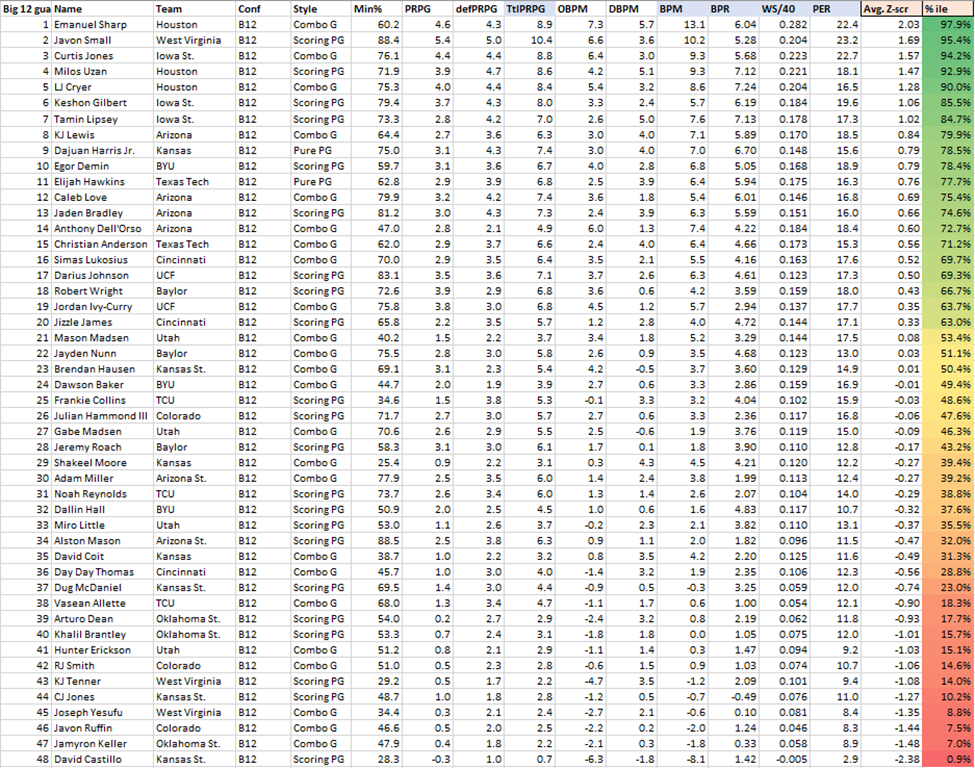
This exercise places Dajuan Harris as the 9th best 1-or-2 guard in the Big 12, at the 78.5%ile and ahead of anyone else on 11 of the other 15 Big 12 teams. We’ll grant that both Houston and Iowa State have better backcourts, but Harris would objectively start on 14 of the 16 Big 12 teams this season.
If the critic’s point was simply that Harris is not elite, no one would disagree, but Harris is viewed much more negatively than that. And for no reason. It’s factually wrong that Harris in 2025 is not a good college basketball player at the high-major level.
2/14/2025 Update – Juan up to #5 among Big 12 PG/CG’s
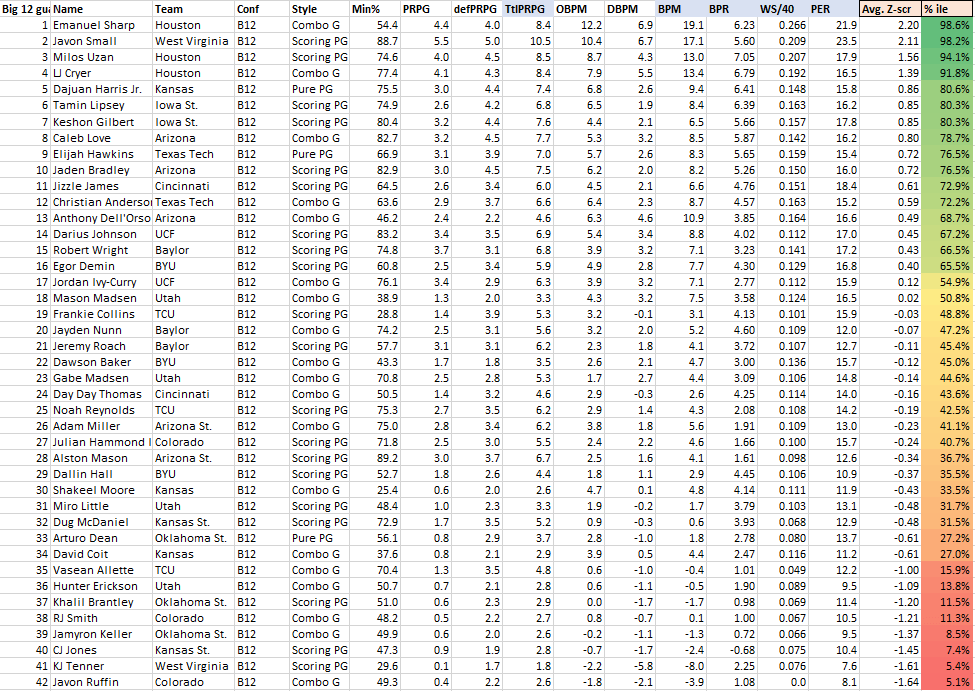
Through 24 games, Dajuan Harris is now grading out as the 5th best B12 PG/CG. There are 42 such players with at least 25% minutes played for their teams, with Harris in the 80.6th%ile among his B12 peers. He’s now grading slightly better than the Iowa State guards (Lipsey, Gilbert), which shouldn’t surprise anyone who saw the KU/ISU matchup in Lawrence.
Note that there are some B12 guards classified as “wings” which aren’t included, with some having classifications changed with more games being played. It’s unlikely that including these players would change the calculation much (some would grade better than Harris, but most would be below him). Either way, for Harris to be in the 80th percentile of ball-handling guards in the B12 shows he has value. When comparing Juan to his Kansas counterparts-Shakeel Moore (33.5th percentile) and David Coit (27.0th percentile), it puts into perspective that KU is better with Harris in the game.
- While not the point of this blogpost, Harris and Adams were starters on a 2023 team which won the Big 12 and earned a 1-seed. Sure, they lost in the Round of 32 (by 1, without Bill Self). They were also starters on a 2024 team that, despite its flaws, was a 4-seed despite losing its best wing scorer in Kevin McCullar. Now the Round of 32 is, by definition, a disappointment for a program at KU’s level, but it’s not like the Harris/Adams era is colored by missed tournaments or even bubble-teams. When viewed in the context of the overall landscape of college basketball, KU’s been quite good the last couple seasons. There needs to be more common sense in assessing the state of the program. ↩︎
- We haven’t adjusted WAR, which accumulates over a season, so it is more likely than not that Harris’s 2025 season relative to KU history improves rather than declines. ↩︎

 Charting the Hawks
One thought on “Dajuan Harris’s Value in Context”