
In basketball, depth is an oft-discussed aspect of a team but one that can be difficult to measure or quantify. The size of the rotation is part of what depth is, but when we discuss “depth” we also want to know how good the rotation is. A team which plays 9 to 10 guys who aren’t any good isn’t really “deep,” at least not in terms of our expectations for KU basketball. Thus, a metric named Effective Depth has been created for us to measure recent KU teams in terms of depth.
Effective Depth measures not only how many players on the roster play a certain percentage of minutes, it also filters out players who don’t reach a certain threshold of player value. See the table below.
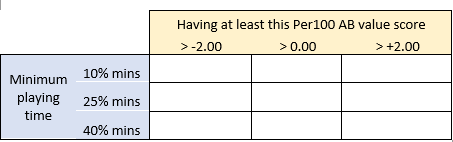
To calculate Effective Depth, fill in the number of players on the roster that meet the criteria in each of the 9 spaces. The top left is the easiest to reach (and will therefore be the highest number in the 3 x 3 matrix) and accounts for all players which play at least 10% of team’s minutes and contribute a Per100 value score of at least -2.00 points. After filling each of the 9 spaces, divide the total number by 9 and this will be that team’s Effective Depth.
Effective Depth does a few things. Not only does it adjust for the skill of depth, it also does so on a sliding scale. A very deep team won’t just have 10 guys in the rotation, it will have multiple players which reach 40% minutes and also have a minimum value score which is at least positive. A player with at least +2.00 Per100 AB value and 40% minutes played will contribute a full point to the tally. Players who contribute fewer minutes and/or at a lower value score will contribute some fraction of a point.
Since 1993, or the most-recent 32 seasons of Jayhawk basketball, the average KU team has had an Effective Depth of 5.47. This number is scaled to rotation size, so anything north of 5 means KU has a roster which should be solid at all times. Anytime such a team would have to go to the bench to play lesser players, it shouldn’t have to expend too many minutes on them and thus can manage minutes to be consistently competitive.
The teams with the highest Effective Depth scores since 1993 are the following:
- 1993 (7.89 players)
- 2007 (7.11)
- 2008 (6.67)
- 2006 (6.67)
- 2010 (6.44)
The 1993 team’s value score estimates aren’t as complete as those in later years, so this season’s Effective Depth score might be inflated somewhat. If a few guys see their scores drop, this number could come down closer to the others. But it is still safe to say that the 1993 team had solid depth.
Other deep teams came during the Chalmers/Rush-era, when KU didn’t rely on any one star but was still solid enough to win three straight Big XII regular season and conference titles, earn two #1 seeds, make two Elite 8’s, and of course win the ’08 NCAA National Championship. Additionally, the 2010 team had great Effective Depth and was the most-recent Kansas team to have a score above 6.00 players. Since the 2010 season, KU just hasn’t been super deep1. Blame recruiting, NIL/transfer rule changes, early entrants to the NBA, etc. but the simple fact is KU teams aren’t as deep as they used to be.
Still, it hasn’t been all bad news. The bottom 4 rosters in terms of Effective Depth were solid teams that made it work by having stars carry the load despite not having much depth.
- 2004 (4.56)
- 2017 (4.22)
- 2009 (4.11)
- 2005 (4.00)
The 2004 and 2005 teams carried over three solid upperclassmen from the Williams era (Simien, Langford, Miles) yet not much else. Self’s best recruits were only underclassmen or not yet on campus. And while the big three holdovers had success in these seasons, they could only do so much. The 2004 run to the Elite 8 was a good tournament showing; the following year we’d rather forget. The ’09 and ’17 teams each had two elite players, a few solid role players, and then after that tried to make do and win games. They were both second-weekend teams, however.
The above teams weren’t actually the bottom 4, but rather team’s 2-5 in the bottom 5. The team with the worst depth hasn’t been discussed yet. It was last season’s team, the 2024 team, which had Effective Depth of 3.67 players. Remember in order to add Effective Depth, a player must contribute time on the floor and player value. For the 2024 team, only McCullar, Dickinson, and Adams could do both. Harris and Furphy did add a little value (as they were better than a -2.00 player), but the 2024 bench gave KU no Effective Depth. This is why KU struggled to maintain leads and was so bad after McCullar got injured. It decimated an already thin rotation. If we compared the 2024 roster’s Effective Depth to all others in the most-recent 32 seasons, it has a z-score of -1.90 or percentile of 2.9%. Your eyes weren’t lying. The 2024 roster was an outlier in terms of how thin and weak it was.
That’s also why Self said in the offseason he wanted a roster with “8 starters.” One way to look at Effective Depth is that it measures how many (KU-level) starters are on the roster. An Effective Depth of 5.00 should be considered the median score. Such a team’s depth is okay, neither great nor terrible. Anything below 5.00 and the roster is thin with certain players logging minutes despite not being quite up to the level KU fans would want. A score above 5.00 means KU has more depth and is likely bringing talented-enough-to-start players off the bench.
Looking at the bright side, the 2025 team is expected to have around 6.00 Effective Depth given preliminary projections2. Even if these projections don’t fully hit, KU will certainly have a deeper team than it did last year, and should also be about as deep or deeper than it has been at any point over the last 15 seasons.
Edit Note: Now that season has begun, the 2025 season will show updated scores.
Effective Depth by Season:


 Charting the Hawks
One thought on “Introducing Effective Depth”