At Big 12 Media Day, Coach Self was all praises on his Point Guard:
And he should be. Harris is the type of kid who plays the game hard, never complains, is a great teammate, and from all appearances seems like the model player off the court. And as he comes into his third year as a Jayhawk player (fourth year in the program), he is positioned to be one of the leaders on the team in the 2023 season.
On KU Twitter and the Message Boards, Harris is generally seen as a positive contributor, however there are the occasional unpopular types who will point out his stats. The Harris-haters are derided. But are they completely wrong? For instance, take a look at his per game stats for 2022.

Harris isn’t a scorer, of that people agree. His assist total is solid, but then again, he is a PG. The A/TO ratio of is 2.8 is very good. He also gets some steals. On the negative side, his rebounding is quite low. And his shooting could improve. But stats are meaningless without context. The question is less, is Dejuan Harris good, and more, how should we judge his skill? Against all D-1 college basketball? Or against KU-level point guards? Let’s first compare his stats to other KU point guards from their sophomore years.
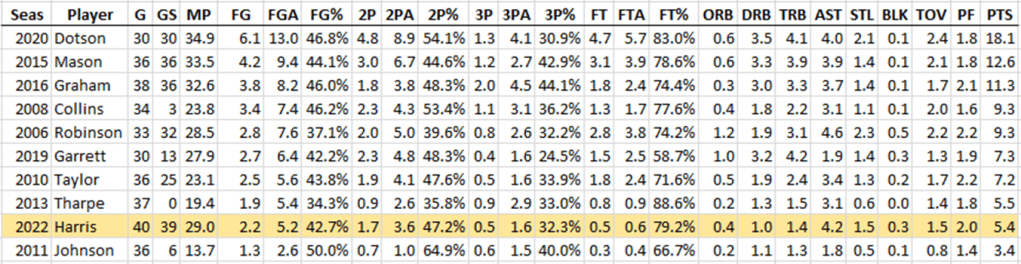
This list contains the sophomore-year stats of all players in the Self-era who were the primary starting PG for their team in at least one season. We want to compare Harris as the starting PG against other starters. For this reason, guys like Mario Chalmers (he played some point, but was never the primary starter at that position) and Niko Roberts (never started) are left off, and guys like Elijah Johnson (who was an off-guard most of his career until he became the PG as a senior) are included.
The list is sorted by highest PPG total. Looking at the comparison, we see Harris below everyone except Elijah Johnson, who played 13.7 MPG on a loaded 2011 team and was behind 4 other guard-types. Harris has relatively good numbers when it comes to ball-handling stats (assists, turnovers) and steals. His rebounding and shot attempt numbers don’t look great.
But what about his defense? Unlike traditional stats, Charting the Hawks has the ability to judge defensive skill-level more robustly, and not just steals, fouls, rebounds, and blocks. Let’s take a look at these 10 player-seasons from the defensive side of the ball.
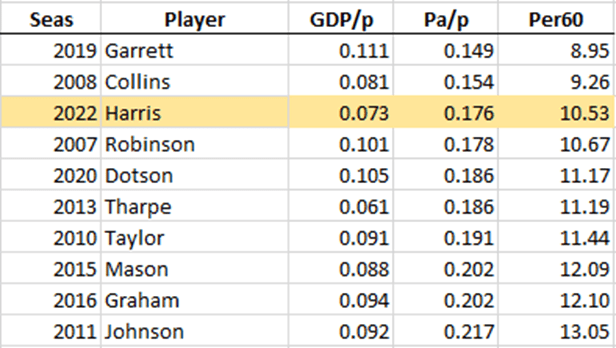
Some explanation here is helpful. This list is sorted by Pa/p or Per60 columns, with lowest being better. Pa/p stands for Points Against per Possession. This shows how many points the player gave up per possession. This number is set to Per 60 possessions (about 35 minutes of game play) to make it more intuitive. Harris is third among his peers in the Self-era in this category.
The GDP/p refers to Good Defensive Plays per possession. This refers to the number of rebounds, steals, blocks, and non-steal forced turnovers a player contributes on the defensive end. We note that Harris is second-worst on this end, as his rebounding totals are below his peers.
Player value is best seen by putting everything together. All relevant offensive and defensive metrics makes the total player. Glancing above, we know that Harris is a solid defender and good ball-handler. These are two skills associated with point guards. However, we also see he doesn’t do much else, even when compared to other point guards.
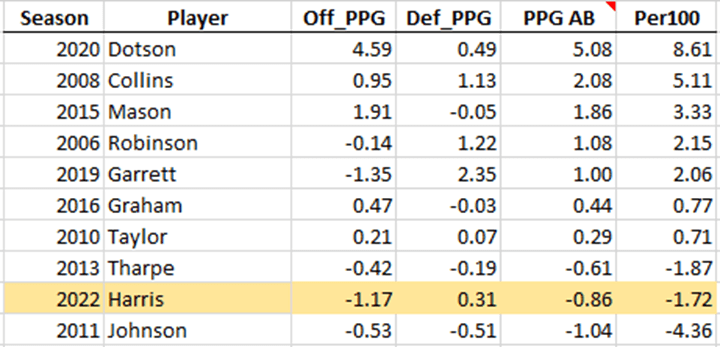
The final table sorts these 10 players by PPG AB +/-. Harris comes in 9th of 10, only ahead of 2011 Elijah Johnson. The Per100 column is also useful, as it looks at player value from a per (100) possession basis to account for playing time differences. Here Harris grades out slightly higher than 2013 Naadir Tharpe.
Breaking down Harris further, we see his offense only bettered that of 2019 Marcus Garrett. His defense came in around average, and this was in large part due to his rebounding. Had he rebounded at a rate of Devon Dotson (3.5 DRPG), he would have been the second-best defender on this list and had a PPG AB +/- value score that was positive.
The irony of Harris is this. When you examine “pure” point guard skills such as defensive pressure, steals, forced turnovers, ball-handling, assists, turnovers, and free throw shooting; Harris is solid and one of the best. But when you add the other elements of basketball not always associated with PG’s—such as scoring volume and rebounding—Harris’s value diminishes. Point guards don’t have to rebound much, but they have to get enough boards. And they don’t have to lead the team in scoring, but they still have to be a capable enough option that it forces other teams to guard them.
Last, the final table looks at the seasons all starting point guards have had since 2007. This is different in that it compares PG’s of different classes—freshman, sophomore, junior, and senior.
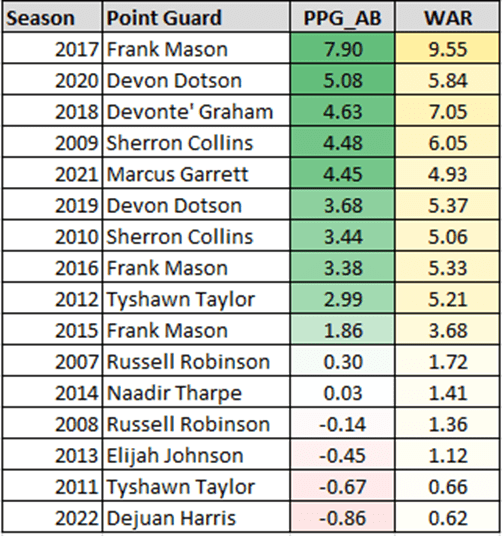
Here we see Harris in last. The WAR is Wins Above Replacement, with replacement-level equaling the average D-1 player. This is estimating that Harris gave KU an extra 0.62 wins above the average D-1 player getting his minutes. So even if Harris has been at the bottom of starting point guards in the Self-era, he can still add value.
Looking ahead to 2023:
For the upcoming season, we expect Harris to improve on his 2022 campaign. College players tend to improve season-to-season. As Harris plays a larger role, expect his scoring to improve. But we also want to see gains on his rebounding numbers. There were multiple times when he allowed an offensive rebound, which gave the opponent a good-look at a score (see 3:42 here: https://www.youtube.com/watch?v=AIMOY6CoQKI Harris drifts away from his man instead of blocking out and watches his man tip the ball out for an open 3). By just adding a little more physicality to his game, he can add a rebound per game or so which will lift his value alongside other improvements to his game.
Charting the Hawks has Dejuan Harris’s 2023 season with a -0.28 projected PPGAB. But this is merely an objective estimate using trends of player improvement. Players improve by an average of around half a point per game per season. But some improve more than this, while some actually decline in value. Don’t be surprised if Harris makes a big leap from sophomore to junior year.

 Charting the Hawks