2016 Kansas Jayhawks

The 2016 Kansas Jayhawks finished with a record of 33-5 (15-3), winning the Big 12 Regular Season and Conference Tournament. The team earned a 1-seed in the NCAA Tournament, reaching the Elite 8 before losing. The team’s Sports Reference link is here.

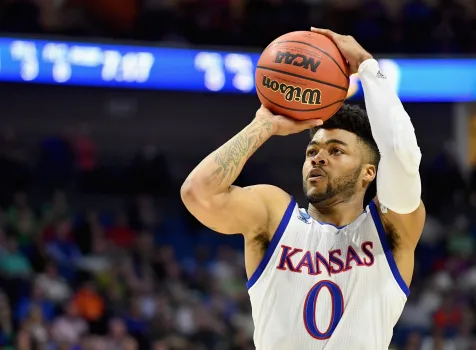
Austin Peay v Kansas

OFFENSE

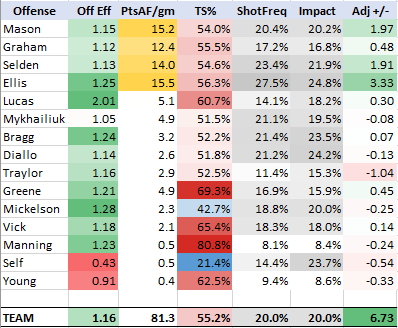
The team was led by a “big 4” of scorers averaging 12+ Pts AF/game

Senior Perry Ellis was the team’s leading scorer, combining high efficiency with a high shot frequency. He was followed by Frank Mason, the leading assist-man but also a good scorer in his own right. Wayne Selden also added nearly 2 points of offensive value above replacement. Devonte’ Graham was the team’s fourth most valuable offensive player. Close behind him was Brannen Greene, who shot an incredible percentage (49% from 3, 62% from 2, 84% from FT) in limited minutes. The +6.73 value score the team produced was the best a Bill Self offense had to that time.

DEFENSE
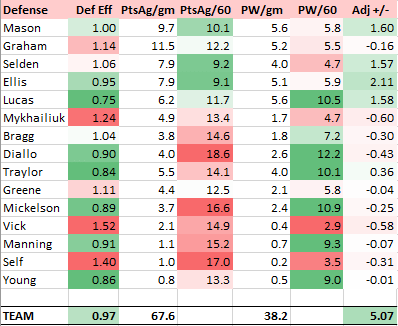
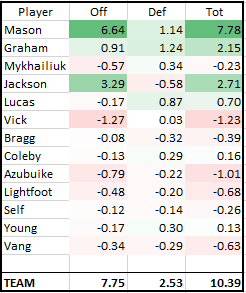
Perry Ellis was also the team’s most valuable defender in 2016. In allowing 9.0 points per 60 possessions, he defended his man better than others did. His rebounding numbers and shot blocking numbers were low for a 4-man. Landen Lucas did have great rebounding numbers, and also didn’t give up easy baskets to opposing centers. The team hit their stride when Lucas emerged as the fifth starter. Both Wayne Selden and Frank Mason had successful defensive seasons as juniors, however Devonte’ Graham gave away too many points and was slightly below replacement. Jamari Traylor was the only other Jayhawk who provided positive defensive value.

Adjusted PPG +/-
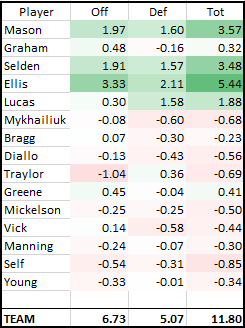
In total, the 2016 team was a very good team that rightfully earned the overall #1 seed. The team was balanced throughout its starting rotation, and had a talented bench however one that didn’t provide much value. The team was good on both ends of the court, and hit its stride during the back-half of conference play and produced a 17-game winning streak.
Data Fulfillment

For the 2016 season, 24/38 games were able to be watched in their entirety. The other 14 games were charted using video highlights, radio broadcasts, play-by-play box score information, and other sources to most accurately record what happened. This led to a Coverage score of 96.93%, which is very good. Over 72.0% of the season’s plays were available on video, with 95.4% of all possessions having at least a 90% confidence rating.

What this indicates is that the value-stat estimates from this season are not prone to much data-absence error. These value scores aren’t likely to be too far off what they would be had we the entire season, since only a small percentage of overall possessions are in question.
2017 Kansas Jayhawks

The 2017 Kansas Jayhawks finished with a record of 31-5 (16-2), winning the Big 12 Regular Season. The team earned a 1-seed in the NCAA Tournament, reaching the Elite 8 before losing. The team’s Sports Reference link is here.

Offense

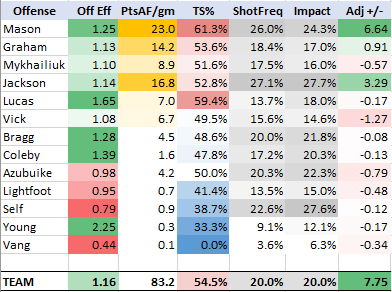
The 2017 offense is Bill Self’s best since coming to KU (through the 2021 season), and it was led by Frank Mason and Josh Jackson. These two accounted for nearly half of the team’s points. Mason shot an incredible 61.3% true shot on a 26.0% frequency. It was this side of the ball that won Frank his Naismith Player of the Year award. Jackson was a high-impact player, and he added offensive value in the areas of scoring, shooting, assisting, and rebounding. Devonte’ Graham was also a positive value player.

Defense

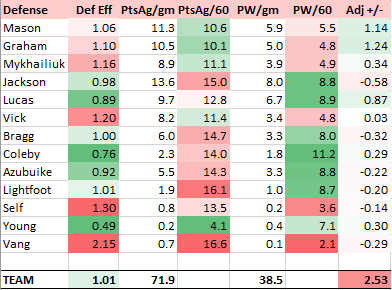
The 2017 team was offense-led, but had some decent defenders. Devonte’ Graham and Frank Mason produced over a point per game in value, and Landen Lucas was a solid rebounder and paint defender. However, there were some holes in the defense. Josh Jackson was a poor on-ball defender who gave up 15.0 points per 60 possessions played. He did do well at getting steals and rebounds. The bench was neither great nor awful on the defensive side.

Adjusted PPG +/-

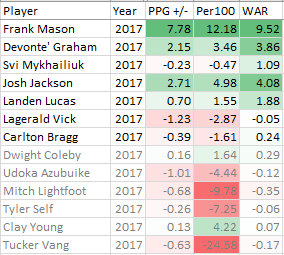
Frank Mason’s PPGAB score of nearly +8 earned him numerous accolades (including college basketball’s best), and when compared to the great seasons in KU history since 1993, is a very close-second to the estimated score Wayne Simien produced in 2005. Josh Jackson’s season, while very good, was overrated on the whole due to his poor defense. Devonte’ Graham had a solid year on both sides of the ball, and Landen Lucas was the final starter to post a positive value score. The bench was lightly used in 2017, although Dwight Coleby emerged as the second-best big after Carlton Bragg had off-court issues and Udoka Azubuike had a season-ending injury.

Points Above Bubble

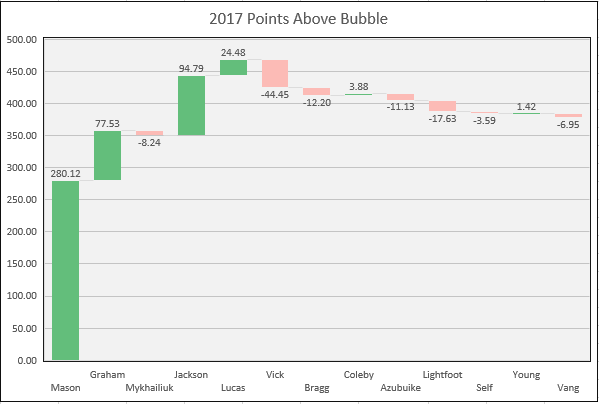
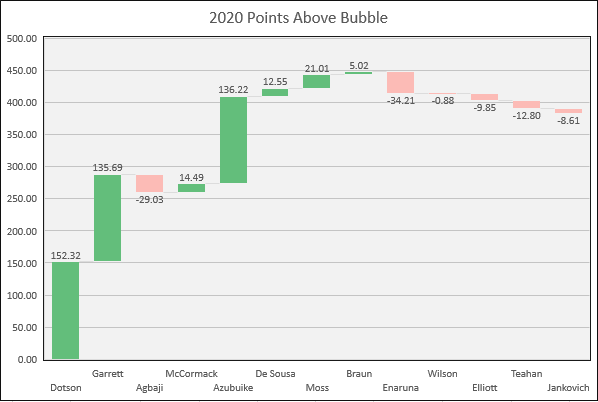
Total Points Above Bubble (PAB) show the outsized effect the play of Frank Mason had on the team. KU’s five starters contributed to produce an elite team and got would it could from the bench.

Value 3-Way

The 2017 roster’s Per100 PAB percentiles, compared to all KU rotation players since 1993, shows the following skill-levels:

  • Frank Mason – 98.6%
  • Josh Jackson – 75.3%
  • Devonte’ Graham – 64.4%
  • Landen Lucas – 48.9%
  • Svi Mykhailiuk – 32.7%
  • Carlton Bragg – 24.7%
  • Lagerald Vick – 17.2%

Video Coverage

The 2017 season had a coverage of 97.95%. This tells us we are confident in the accuracy of nearly 98% of the possessions that were played that season. This range can theoretically be between 65% (just box score information) and 100% (all games are video-charted). We have full game video for 28 of the 36 games and the other 8 games are supplemented through a mix of video highlights, play-by-play/box score detail, and radio coverage. Therefore we are confident to state there is only a very small error in the above value stats.

2020 Kansas Jayhawks

The 2020 Kansas Jayhawks finished with a record of 28-3 (17-1), winning the Big 12 Regular Season. The team’s Sports Reference link is here.

OFFENSE

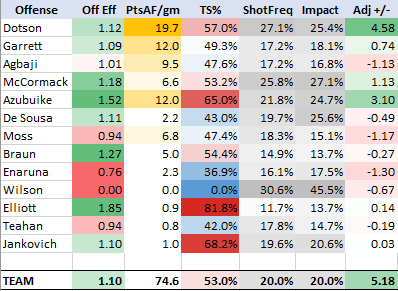
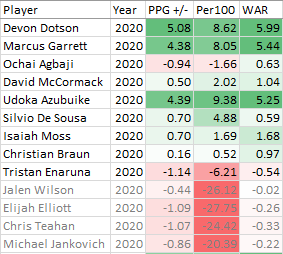
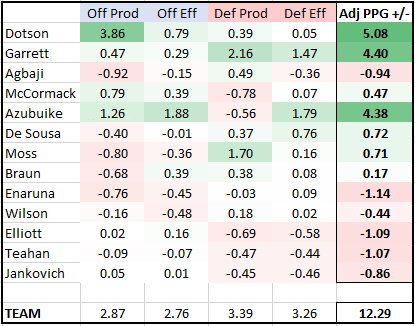
We’ll first focus on the 2020 offense. Devon Dotson was spectacular at scoring on his own play (84% of points off were unassisted). He was the team’s most productive player by a long shot, and quite efficient for how involved he was on offense. Udoka Azubuike used his size and positioning to great effect, allowing him to have the team’s highest true shooting percentage in spite of poor free throw shooting. A majority of his points (54%) were assisted, the highest of all rotation players. David McCormack actually produced more points per minutes than Azubuike, but did so with less efficiency. Marcus Garrett was the only other rotation player having positive value on the offensive end, doing so by being the team’s leading assist-man and finding a niche at scoring the ball on his own play. The team’s jump-shooters struggled to shoot the ball, leading to negative value on that end.

DEFENSE

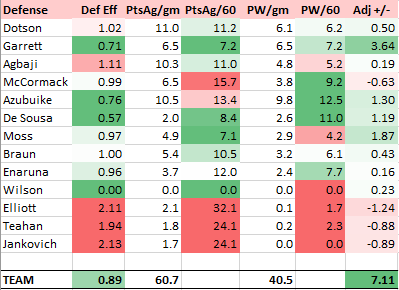
Defensively, Marcus Garrett had the program’s best year (since 1997), giving up only 7.2 points per 60 possessions played while winning 7.2 possessions per 60. An efficiency score that far below 1.00 for a guard/wing is unheard of. But the biggest defensive surprise of the year was Isaiah Moss on the wing, who actually performed better than Garrett on points allowed. One area he did a good job in was staying home on shooters and not over-helping. He played textbook position defense for a wing. Opposing teams wanted to space the floor and bring Azubuike out, which neutralized Doke’s defensive dominance inside the paint. It was this stylistic difference in opponents’ offense that made Moss score higher as a defender than Azubuike. Note that this stylistic difference often hurt opponents on the other end, where Doke could dominate inside. That’s the thing about trying to extract a competitive advantage in one area of basketball. It often comes at a cost. Silvio De Sousa, when he played, showed excellent footwork for a post and hit the glass hard. Last, Devon Dotson’s defense declined from his freshman year, but this was probably due to how much energy he expended on offense. To reframe what was previously stated, when team’s get value from one area of the game it often comes at a cost. Relying so heavily on Dotson on offense almost certainly hurt the PG’s ability to play his best defense.

Total Adjusted PPG +/-

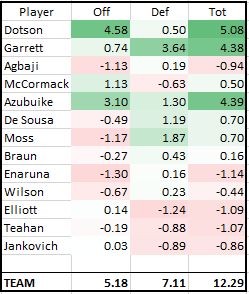
When we put offense and defense together, we see that Dotson, Azubuike, and Garrett carried the team. Moss and Agbaji’s sub -1.0 offensive scores really stand out, so it should be noted that each only shot around 33% from 3 while generating relatively little offense for others off the bounce. These low shooting percentages are somewhat surprising given how much attention other teams paid to Doke and Dot. They should have gotten quite a few open looks to be nearer to 40%. Agbaji may have been overworked, he finished with the second-most minutes on the team and took tough defensive assignments. He was a better talent than his value score suggests.

Freshman Christian Braun proved to be a solid defensive rebounder and shooter. He didn’t create much offense, but took care of the ball and won enough possessions to finish the year on the positive side. The back-up bigs each showed promise, and each were positive contributors albeit in limited minutes behind Doke.

2018 Kansas Jayhawks

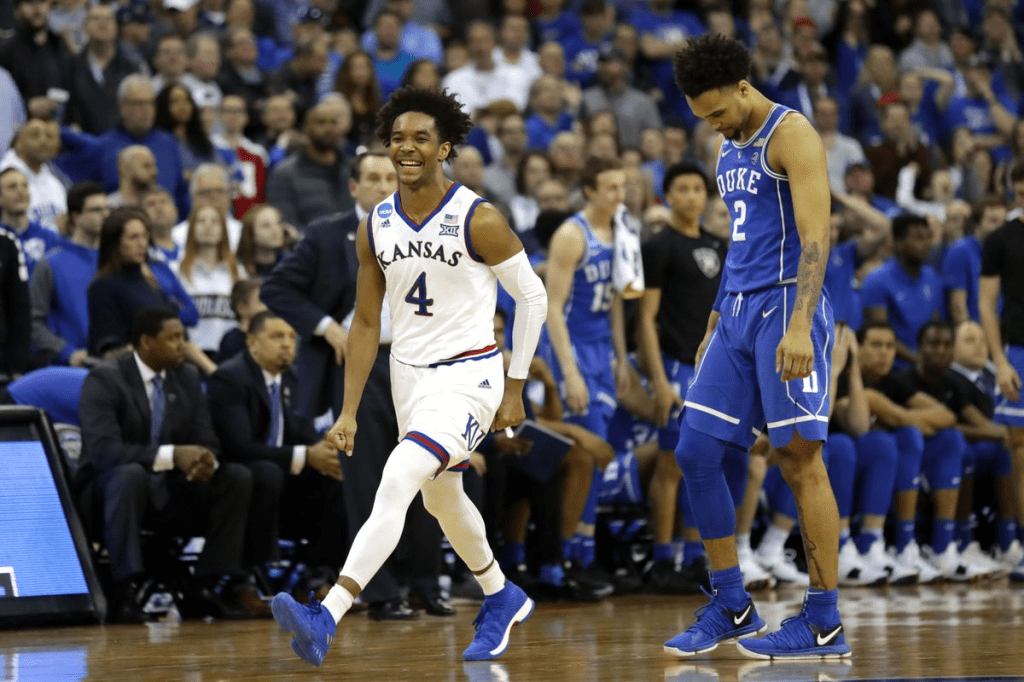
The 2018 Kansas Jayhawks finished with a record of 31-8 (13-5), winning both the Big 12 Regular Season and Conference Tournament. It earned a 1-seed in the NCAA Tournament and made the Final 4 before losing. The team’s Sports Reference link is here.

Offense

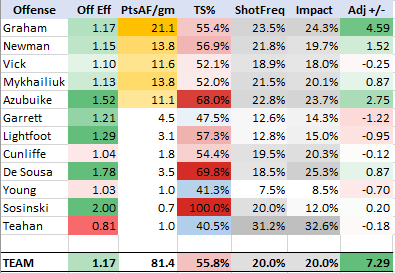
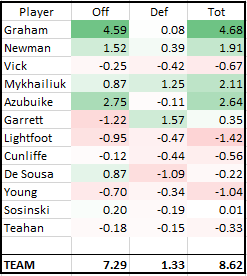
The 2018 offense was led by Devonte’ Graham, both through his scoring and assisting. His true shooting was on par with the team’s, showing his shot frequency was at a reasonable level. The main inside scoring threat was Udoka Azubuike, who shot an insane 68.0% true shooting. Malik Newman developed into a solid offensive weapon. Svi Mykhailiuk as a starter and Silvio De Sousa as a developing reserve were other two positive Jayhawks on offense. As of the 2025 season, this was Bill Self’s second-best offense while at Kansas.

Defense

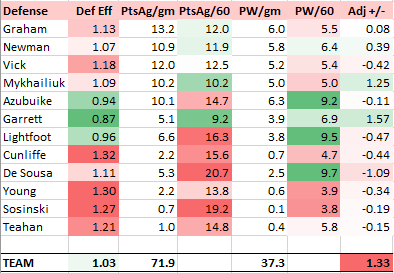
The defense was less effective than in years past. The team graded out as slightly better than a bubble defense, but compared to KU-level this was less-than-ideal. Its best defense was from wings Svi Mykhailiuk and Marcus Garrett. The team’s interior defense was lacking at times, specifically due to depth at the 5 position.

Adjusted PPG +/-

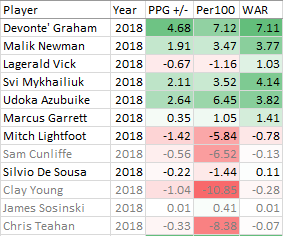
As far as typical KU teams go, the 2018 team was far more offense-heavy/defense-light than average. Regarding total value, the team was much weaker than 1-seeds historically. Still, it played great in March and made a run to the national semifinals. Devonte’ Graham played 94.2% of possible minutes, a record that will last a long time. At one point during conference play, he played 40 minutes in 10 straight games. But it was certainly needed. His +4.68 value score and 13 MVP’s were easily the highest on the team. Azubuike (+2.64, 7 MVP’s), Mykhailiuk (+2.11, 5 MVP’s), and Newman (+1.91, 9 MVP’s) were the other key pieces on the roster.

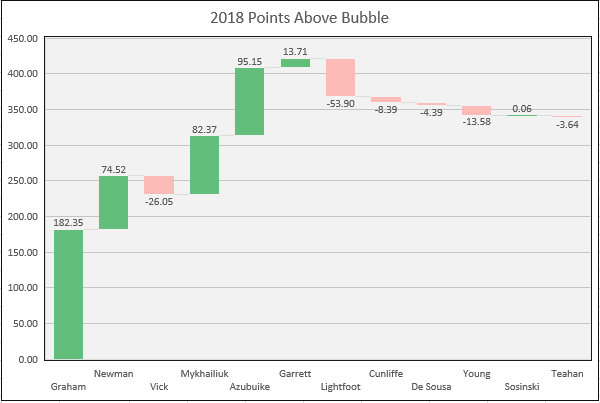
Total Points Above Bubble (PAB) Chart

Value 3-Way

Video Coverage

The 2018 season has a 99.4% coverage number, which is very good. The above value numbers only have a small amount of potential error (due to coverage, other error risks remain). Only 2 games of 39 are determined to be incomplete from a video coverage perspective. We are confident that the value scores reflected above accurately depict what the charting process is meant to show.

End of a Career

2018 was Devonte’ Graham’s senior season and capped off a four-year career that saw him lead his team to their first Final Four since 2012. Graham finished with 1,748 points in 4,498 minutes played (placing him 9th and 2nd of all Jayhawks since 1993). Also, he currently has the 11th-most career WAR and is 21st in terms of career PAB. Graham was a player who improved each year he was in Lawrence, and his durability and value his senior season contributed to KU winning yet another Big 12 title.

Svi Mykhailiuk was another four-year player who finished his KU career in 2018. Like Graham, Svi improved over the course of his career. Svi would finish with 1,181 career points in 3,070 minutes. He is 52nd in career WAR and 74th in career PAB (out of 194 total Jayhawks from 1993 – 2025).

2020 Kansas Jayhaws PPG +/-

How to Interpret:

Adj PPG +/- is the Adjusted Points Per Game the player was against his collective opponents over the course of the season. It is the “one-number” metric (such as WAR in baseball) that tells us how much value a player adds, incorporating all relevant statistics on both sides of the ball. The “Adjusted” refers to the fact the number is adjusted to a hypothetical schedule entirely composed of neutral-site games against a “bubble team.” This is done so the number can be more fairly compared year-over-year or even game-over-game.

Taking Devon Dotson as an example, the metric indicates that KU is roughly 5 points per game better with him on the court than they would be with a hypothetical “bubble” player at his position.

Production vs. Efficiency

The middle four columns break down the PPG +/- into four components of value. Note that these four columns sum to Adj PPG +/-. In basketball, a player helps his team by producing points (scoring, assisting) or winning possessions (rebounds, steals, forced turnovers). Off Prod refers to offensive production. Namely, how many points is that player producing for his team; while counting unassisted points differently than points scored off an assist as assisted-points must be split between the scorer and assist-man. Off Eff refers to offensive efficiency, which is improved by high FG%, low turnover rate, and grabbing offensive rebounds.

Def Prod accounts for how frequently a player is getting scored on. This requires taking whole new stats that are not tracked or published anywhere else in basketball. More will be said on this in a later entry. Def Eff refers to defensive efficiency, incorporating traditional defensive stats such as blocks, rebounds, and steals (alongside the non-box score stat of forced turnovers).

Interpreting the chart above, Devon Dotson had a highly productive offensive output in 2020. He scored most of his points by himself (unassisted), while also setting up others (second-highest assists on team behind Marcus Garrett). Dotson’s ability to get and convert his own shot grades out as the most valuable aspect of any one Jayhawk during the 2020 season. Udoka Azubuike was the most efficient player on offense, something that makes immediate sense given his high FG% and offensive rebounds.

Marcus Garrett grades out as the best defender, and it isn’t close. Given his minutes, and in turn possessions played, he did an excellent job of “shutting down” his man throughout the course of the season. Isaiah Moss added all his value on this aspect of defense as well. Going to the tape, this was largely due to his ability to restrict open looks from outside against the wings he was guarding. Azubuike was the team’s most efficient defender. His rebounding, shot blocking, and ability to clog the lane to force turnovers were unrivaled. He “won” 302 possessions throughout the year on the defensive end, meaning that per game nearly 10 possessions ended in KU’s favor thanks to an Azubuike block, rebound, steal, or forced turnover. Marcus Garrett’s 202 defensive possessions won in 31 games is also noteworthy, particularly due to his position as a guard.

2020 Kansas Jayhawks – Defense

Key

  • Pts Agst – Points scored against that player.
  • Poss Agst – Possessions used when scoring against that player.
  • D Reb – Defensive rebounds credited to playerA.
  • Steals – Steals awarded to player.
  • TO frcd – Turnovers forced by player.
  • Adj PPP – Adjusted Points Per Possession (against). Takes into account prior stats.

A Defensive rebounds also include blocked shots when team wins possession.

2020 Kansas Jayhawks – Offense

Key

  • Pts Una – Points the player scored unassisted.
  • Pts Ast – Points the player scored via assist.
  • Ast pts – Points the player’s teammates scored off his assists
  • Poss Una – Possessions the player used when scoring unassisted.
  • Poss ast – Possessions used when scoring via assist.
  • Ast Poss – Possessions used on assists, i.e. number of assists.
  • Miss – Possessions ending in missed shotsA by player.
  • TO – Turnovers committed by player.
  • O Reb – Offensive rebounds credited to player.
  • Min – Minutes played during season
  • Adj PPP – Adjusted Points Per Possession, factoring all prior stats.

A FT possessions can also count with misses, not just FG misses. If a player goes 0-2 from FT, or misses front-end of 1&1, the player will be credited with a miss. If a player goes 1-2 from FT, that possession is counted within Poss Una.