The 2006 Kansas Jayhawks finished the season with a 25-8 (13-3) record, winning a share of the Big 12 Regular Season as well as the Conference Tournament. The team earned a 4-seed in the NCAA Tournament, and would be eliminated in the Round of 64. The team’s Sports Reference link is here.
Offense
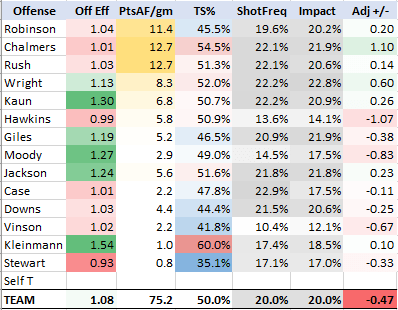
The 2006 Offense was a work in progress, with the team producing a value score below bubble-level for the season. Mario Chalmers led the team with a +1.10 value-score thanks to accounting for a team-leading 0.486 points per minute. Chalmers played fewer minutes than the other starting guards yet produced as much or more offense than Robinson and Rush. Julian Wright was the team’s second most-valuable offensive player. One area of note is the team’s offensive balance. Among its main starters, shot frequency ranged from 19.6% to 22.2%. Chalmers graded out as the team’s best shooter, but there wasn’t a large range of offensive performance as is seen in other years.
Defense
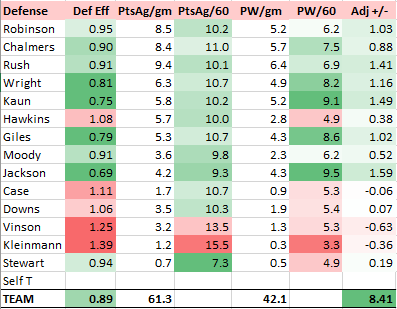
The 2006 Defense made up for the team’s offensive struggles, finishing the season as KenPom’s #2 defense overall. This defense would also be the first year of a three-year run of excellent defense; anchored by strong defenders such as Mario Chalmers, Brandon Rush, Russell Robinson, and Sasha Kaun. But the player who graded out as the team’s best defender in ’06 was actually Darnell Jackson, a strong rebounder and solid positional player in the post. The team was stingy about giving up points and competed for rebounds and loose balls. They also had a fair amount of balance on defense, with their guards winning possessions at a reasonable clip.
Adj. PPGAB +/-
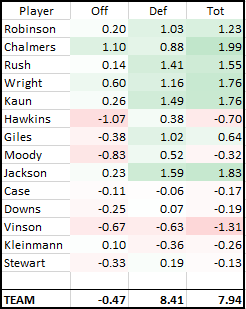
The 2006 team had six players post > +1.00 value scores on the season. Leading all Jayhawks was Mario Chalmers, whose score was a shade under +2.00. Darnell Jackson finished second on a per game basis despite playing only 26.5% of available minutes (some of this was due to eligibility issues). Julian Wright and Sasha Kaun graded out with equal value scores. Brandon Rush and Russell Robinson also had very solid seasons in 2006.
The TEAM score of +7.94 is below the average of +9.63 over the past 26 seasons (1997-2022), placing the team 19th of 26 over this period. This was a team that saw steady improvement as its younger players matured. After 11 games it was only performing at +3.10 points above bubble. By 16 games it was +4.66. And by 21 games it was +7.36.
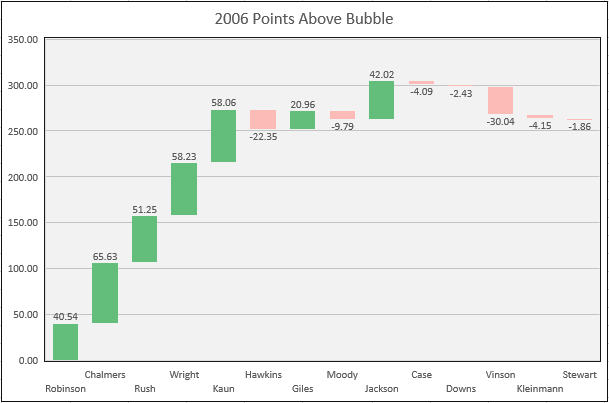
Much of the balance can be seen in this chart. Note that Jackson’s total points above bubble is fifth on the team, as he only played in 23 games.
Season Recap
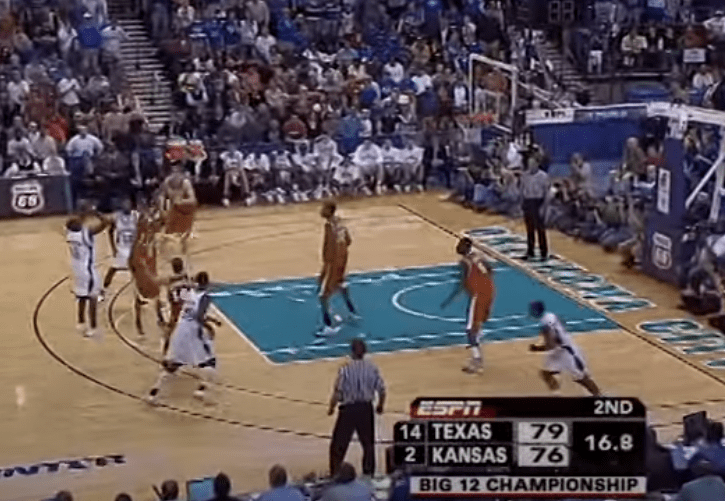
After January 1, the 2006 Jayhawks went 18-4 (13-3), playing basketball at a true KU-level of +10.36 points above bubble. Although it wasn’t known at the time, this hot streak would be crucial in securing a share of the conference title (with Texas), and would become the second regular season Big 12 title in a stretch of 14 in a row. The co-champ Jayhawks and Longhorns would meet in Dallas for the tournament championship in March, with Kansas avenging its loss a few weeks earlier in an 80-68 fashion.
Despite the hot play late in the year, KU was only able to get a 4-seed in the NCAA Tournament and would draw a talented and experienced Bradley team. For the second season in a row, KU would lose in the First Round. But the core of the team would regroup, return, and go on to achieve considerably more in the next two seasons.
Julian Wright had an explosive freshman season.
Despite the lack of collegiate experience, the 2006 team gelled during Big 12 play.
The 2023 Kansas Jayhawks went 28-8 (13-5). The team won the Big 12 Regular Season Championship and earned a 1 seed in the NCAA Tournament. Kansas reached the Round of 32 before losing. The team’s Sports Reference page is here.
Offense
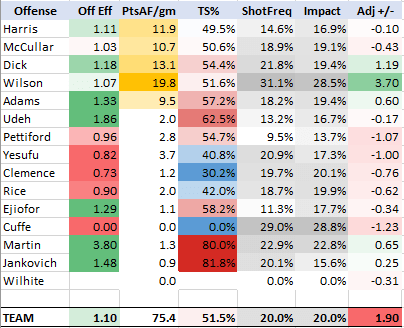
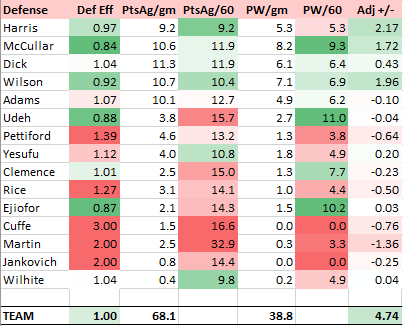
The 2023 Offense was led by Jalen Wilson. Wilson’s shot frequency was the team’s highest since Thomas Robinson in 2012 also had a 31.1% ShotFreq. Despite his high volume, Jalen was right on pace with the team average regarding true shooting percentage (TS%). Gradey Dick was the team’s second most-valuable player on offense, generating his value through scoring and high-percentage outside shooting. His ability to limit turnovers also was a plus. K.J. Adams was the other starter to add offensive value, largely due to his offensive rebounding and efficiency. Dajuan Harris improved the most toward the end of the season. Over his last 13 games, Juan was over +1.00 per game on offense.
Defense
The 2023 defense was the better half of the ball for Kansas. Despite playing an undersized starting 5, KU finished the season as KenPom’s #11 defense. Dajuan Harris earned Big 12 DPOY honors, and his value is quantified best here at over 2 points per game above-bubble. Jalen Wilson and Kevin McCullar were also excellent defensive players. Gradey Dick was someone who got overly criticized for his defense. While he had some struggles, he hustled, rebounded, and had a fair amount of deflections. In total, he produced an above-bubble defensive effort to compliment the value he provided on the offensive side of things. K.J. Adams was around bubble-level while playing out of position. The bench had some acceptable defenders, with Joe Yesufu probably getting overlooked the most. Joe wasn’t a lock-down defender, but he also used his strength and quickness to bother bigger players. Freshman Ernest Udeh showed the most defensive potential as an athletic and long big-man. It will be interesting to see how his career develops on this end of the floor.
Total Adjusted PPGAB +/-
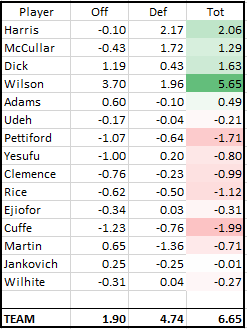
Jalen Wilson put up an All-American level of value, and with it, a 1st team nod. All starters were positive, while each bench player producing at or below-bubble. KU’s bench was bad this season, and finished as the worst in Self’s 20 seasons in Lawrence.
Value Seen 3 Ways
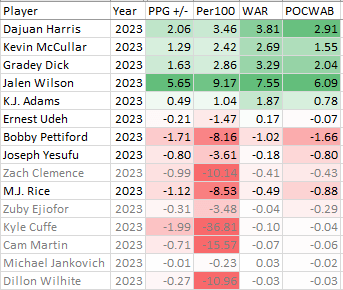
Player value can be shown in slightly different ways. This is because players have different levels of playing time based on a variety of factors. To best show this, we want to consider these four levels of player value.
First is PPG +/-. This is generally the best metric as it tracks closest with the traditional stats that are most intuitive to basketball fans, such as points per game or rebounds per game. This value metric estimates how much better, in net points per game, a player has been above that of a hypothetical bubble-level player.
Second is Per 100 possessions +/-. This value metric looks at how much better a player has been over a bubble-level player over the course of 100 possessions. This metric is valuable when comparing players who’ve played in different numbers of games but similar minutes. KU’s bench players, who tend to battle each other for backup playing time this season, are best compared against one another using this metric rather than PPG +/-.
Third is WAR, or Wins Above Replacement. This value metric compares KU players against a hypothetical replacement player who is an average D1 player instead of the (better) bubble-level player. It also converts points +/- into “wins” using a multiple. This metric is cumulative, so players with more minutes will have the chance to earn more WAR (provided they are above replacement…below replacement players will see their values dip).
Fourth is POCWAB, or Player’s Own Clutch Wins Against Bubble. This metric takes into account to relative toughness of the opponent, allowing a player to show his “clutchness” and weights games played against teams around bubble-level more than those low-major buy games.
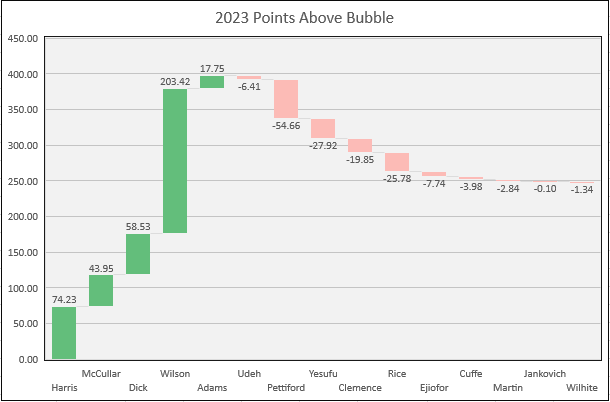
Cumulative Points Above Bubble on the Season Chart
This chart is a telling picture of how the team’s starting 5 carried KU. Each starter is solidly positive, but this value begins to drop once you get to the bench. Ernest Udeh was KU’s best rotation bench player, yo-yoing above and below bubble on the season game-to-game. The reserve guards/wings were mostly dreadful, while the other bench bigs didn’t get many minutes.
Assessing the 2023 Team
Back in mid-October, the 2023 team’s value-stats were projected here.
Given who was returning, and attempting to project how good the incoming players would be, we estimated KU would have an average game score of +5.76. The 2023 team outperformed this benchmark by about 1 point. Given historic trends, KU’s estimated game score would have placed it around a 4-seed, whereas KU earned a 1-seed due to a great record in close games. With its toughest-in-the-nation strength of schedule and 17 Quad-1 wins, KU earned a 1-seed despite the various computer metrics placing the team around 10th. While the team lost in the second-round to an 8-seed, it was only 4 point favorites at tip, making the early exit less of an upset than one normally associates with 8-seed over 1-seed games. In total, the team overachieved in the regular season and underachieved in the Tournament. While one wishes these scenarios were reversed, they aren’t completely without hardware. The team did win a Big 12 Title outright by going 13-5. In (parentheses) are the preseason projections for the individual’s Adj PPG +/-. Actuals are in the table above.
Getting to individual performances, Jalen Wilson outdid his projection (+2.79) by nearly 3 value points per game. He became the volume scorer the team needed him to be, and finished the season as a 1st-team All-American thanks to the highly productive season he had.
Dajuan Harris was KU’s second-best player over the course of the season, and his season also exceeded expectations greatly (-0.28). It seems odd now that he was projected to be a (slightly) below-bubble player. But that is what he was his first two seasons. Harris showed an improved ability to score the ball, and became more comfortable running the show and making reads off the high-ball screen. His defense was also greatly improved, as evidenced by his conference DPOY award.
Gradey Dick’s freshman season was about as projected (+1.57). He started out the season on fire from behind the arc, but as teams started to defend him more aggressively he had to find other ways to contribute. It was the best freshman season since Devon Dotson in 2019, and despite the high expectations, Dick was the only newcomer to meet his projected score in 2023.
Kevin McCullar, a veteran newcomer, was slightly below his projected value (+1.94). This shouldn’t discount his season, which was still solid. Kevin’s defense was certainly where his value was. He was less of a stingy defender than expected, but he made up for this by proficient rebounding and forced turnover numbers. He was capable at switching and communicating things as well. KU isn’t anywhere near the 10th best defense without him.
K.J. Adams (+0.28) didn’t exceed expectations by as much as one might think, however a per-game above-bubble value score is only one way to quantify player value. Adams’ projection was premised on the idea he would get fewer minutes and play out-of-position less. The fact he was KU’s starting 5, played nearly 68% of available minutes, and still reached expectations means quite a bit. He was able to utilize the mismatch on the offensive side of things, being quicker than most opposing 5’s. His defensive rebounding was a work-in-progress for most of the year (although it did improve). His position moving into future seasons will be something to watch. While he proved he can handle the 5, where he plays will be predicated on the roster construction. If he does move to the power-forward role, expect his defense to improve (as he defends more perimeter-oriented players) and his offense to worsen (as he would be guarded by quicker players).
Ernest Udeh (+0.12) didn’t finish above-bubble as forecast, but he wasn’t too far off. Udeh was KU’s best bench player, and showed the most upside. While he is still underdeveloped on the offensive side of the ball, he should prove to be a good to great defender in upcoming seasons. And with a PG as good as Dajuan Harris finding him for lobs, he should still project to produce for the KU offense next season. Watch out, Udeh should be a good one.
Zuby Ejiofor (-0.18) was around his projection. Zuby’s rebounding abilities and instinct as a freshman were impressive. Like Udeh, he has great potential to be a very good defender on the interior. Questions still surround his offensive capabilities. If he can develop a back-to-the-basket game, it would improve his chance for minutes in future seasons.
Joe Yesufu (-0.35) had an improved season from last, but one still not good enough to reach projections. Joe shot poorly again in 2023 (28.6% from 3), while at least his defense did reach positive-value. To defend Yesufu a bit, he played more minutes than projected and had a Per100 score that was close to projection.
Zach Clemence (+0.47) was the most-disappointing returnee. After a freshman year that saw some him show toughness in moments (at TCU in 2022) and big shots (home vs. OU in 2022), he was picked to be the guy to have that sophomore jump. It never came, and instead went to K.J. Adams. Clemence graded out as a worse defender in 2023 while he never could get his shot to fall.
M.J. Rice (+0.69) was obviously over-projected, as one would expect his adjustment to be easier for a wing than it would be for the freshman bigs. Partly due to injury, Rice never got established in the rotation and didn’t see any court time in the NCAA Tournament. Rice was negative on both sides of the ball for the season. He showed flashes of potential (19 points vs. Texas Southern), but how much better he gets in future years will depend on how hard he is willing to work.
Bobby Pettiford (-0.59) had the worst season of any returning player and anyone who played at least 10% of available minutes. He missed his (already quite low) projected score by over 1 ppg. Injury issues were also a problem for him, but he hasn’t shown much over the past 2 seasons to project much success moving forward. He had trouble taking care of the ball at times, which is the one thing you absolutely needed from a player of his role.
Cam Martin (-0.31) played 10 and 1/2 minutes in an injury-affected season. Known for his shooting coming in, Martin went 3-4 from the floor and grabbed 2 offensive boards in that time. He only appeared in four games, but his biggest moment would come in his final game (at Texas Tech), where he would make a basket off a Pettiford feed in the 1st half in what would turn out to be a 3-point game. Martin’s defense and lateral quickness was worse than the other bigs.
Kyle Cuffe (-0.35) played a little of 6 minutes before a season-ending injury in November. He didn’t score during his time on the court. After redshirting in 2022, and no doubt getting a medical redshirt in 2023, he still has 4 more seasons of college basketball eligibility. One doesn’t know what his career will look like, but he still has time to figure that out and one hopes he can stay healthy.
Michael Jankovich (-0.36) reached his projection in limited playing time by sharp shooting (4-7 from 3). One wonders how close the staff was to playing him for a minute or so in a close game given his shooting abilities and the fact the other bench guards struggled.
Dillon Wilhite (-0.53) didn’t play much, but did get a rebound in his 7 minutes of play.
The 2007 Kansas Jayhawks finished with a record of 33-5 (14-2), winning both the Big 12 Regular Season and Conference Tournament. The team earned a 1-seed in the NCAA Tournament and reached the Elite 8 before losing. The team’s Sports Reference link is here.
Offense
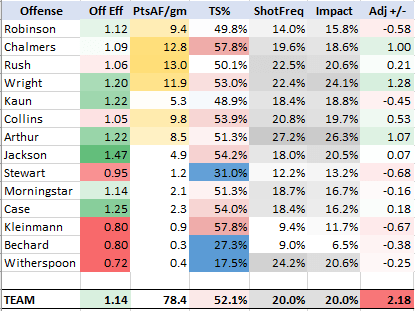
The 2007 offense was worse than people may remember, finishing 29th in Adjusted efficiency according to KenPom. The team’s most productive players were Brandon Rush, Mario Chalmers, and Julian Wright–each producing more than 10 points a game. Chalmers, with a TS% of 57.8%, was the team’s most efficient shooter.
There was good balance among the rotation players, with Darrell Arthur posting the highest shot frequency of 27.2%. Russell Robinson was the opposite end, distributing more than shooting from the PG position.
In total, the 2017 team produced some decent but not spectacular offensive seasons. Wright, Arthur, and Chalmers were all above +1.00 PPG in value. Freshman Sherron Collins was also positive, with Rush and Darnell Jackson barely above 0.00.
Defense
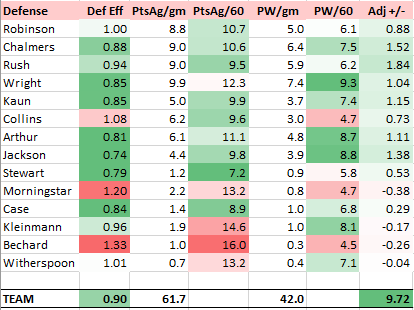
On the other side of things, the 2007 defense is Bill Self’s best defensive team and the best since at least 1997. The team held 7 opponents to under 50 points during the season. Brandon Rush led all rotation defenders by allowing 9.5 points per 60 possessions, with Sherron Collins, Darnell Jackson and Sasha Kaun also posting solid coverage stats. Additionally, reserves like Rodrick Stewart and Jeremy Case defended solidly in their limited playing time.
The team also had balance in winning possessions. Forward Julian Wright led the team in getting the ball back after a defensive stop with strong defensive rebounding, but guards like Mario Chalmers and Russell Robinson got plenty of stops with steals and forced turnovers. The team also blocked tons of shots, finishing second in the nation in block% according to Pomeroy.
The team’s top 10 players (in minutes played) all finished with positive defensive scores, the only time a KU team has done this on record. Rush, Chalmers, Jackson, Kaun, Arthur, and Wright all finished with value scores above +1.00, with Robinson and Collins not far behind.
Adj. PPG +/-
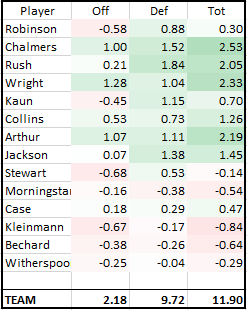
The 2007 team was incredibly balanced, with no true stars but no weaknesses either. Chalmers, Wright, Arthur, and Rush all finished above +2.00 in value; in addition Jackson and Collins added over +1.00 points per game in value. It’s top 8 players were all positive contributors against bubble-level.
The TEAM score of +11.90 was KU’s first +10 score (roughly equating to a 1-seed level performance) since Bill Self began coaching at Kansas.
Mario Chalmers contributed the most value of any player. But not far behind him were Julian Wright, Darrell Arthur, and Brandon Rush. The 2007 team didn’t have a “best” player, but a bunch of very good ones.
Elite 8 Run
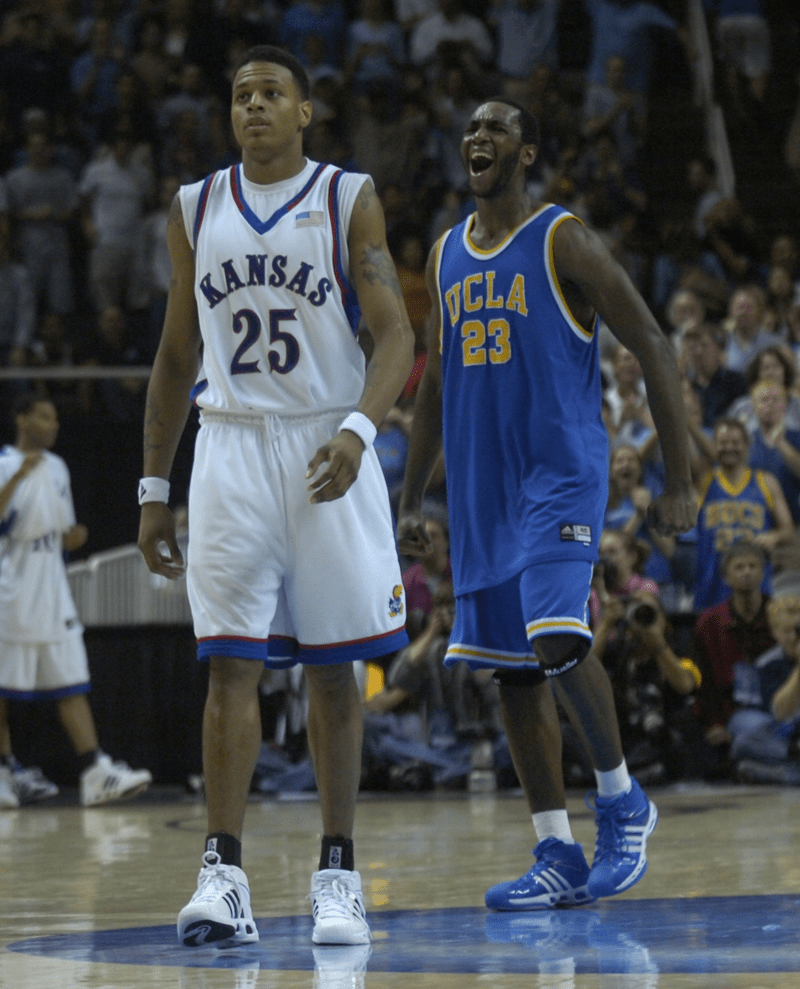
After getting bounced in back-to-back opening rounds in the NCAA Tournament, Bill Self and his players were ready to put the past behind them and make a deep run. Earning the final #1 seed, the Jayhawks cruised past Niagara in the Round of 64, and then defeated #8 seed Kentucky in the Round of 32. A defensive struggle in the Sweet 16 saw Kansas get past #4 seed Southern Illinois, only to lose in the regional finals against UCLA.
It was a tough ending to a successful season. But KU was back. The program, despite a few rocky seasons, had reestablished itself as one of the top teams in college basketball.
Brandon Rush would return for his junior season in ’08 after an ACL injury following the ’07 season.Julian Wright played his final game as a Jayhawk in the 2007 season. The Mario shot before “the shot.” KU ran same play as they would a year later. This one sent Big XII Tournament Championship game to OT, which would then be won by Kansas 88-84.
The 2022 Kansas Jayhawks finished with a record of 34-6 (14-4), having won the Big 12 Regular Season and Tournament Championships. The team earned earned a 1-seed in the NCAA Tournament and won the National Championship. The team’s Sports Reference link is here.
Offense
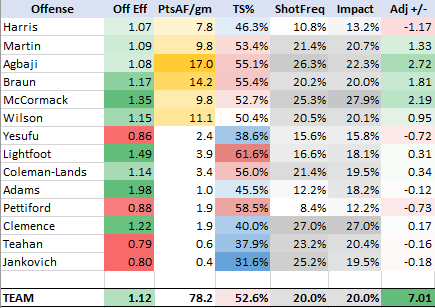
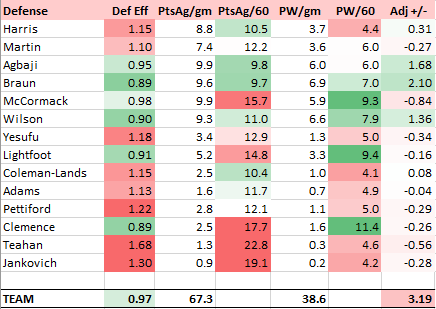
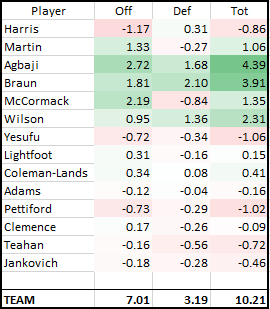
At +7.01, the 2022 team was KU’s third-best offense in the Self era, slightly behind 2017 and 2018. The team had an excellent mix of offensive talent, led by Ochai Agbaji. Agbaji finished with 17.0 points produced per game, which translated to +2.72 offensive points above a bubble-level player. David McCormack was KU’s second most valuable offensive player on a per game basis, producing 9.8 points per game but also adding value through offensive rebounding. His Offensive Efficiency of 1.35 was easily the highest of any starter.
Christian Braun was a steady player on offense, scoring in double figures in all but 5 games. He was good at the rim, shot well from outside, assisted nicely, and had his fair share of stick-backs and other hustle plays to bring value. Remy Martin got hot late in the season, carrying the Jayhawks when the team needed him. Had he been healthy the entire season, his numbers would have looked very good. Even where they are, he provided +1.33 points more per game than a replacement option would have been expected to add.
Jalen Wilson finished a fraction below +1.00, held back by poor perimeter shooting but buffered by rebounding and strong finishes at the rim. Given how many big moments he had, its crazy to think of him as only the fifth-best offensive player during the 2022 season.
Off the bench, both Jalen Coleman-Lands and Mitch Lightfoot added decent offensive value through efficient shooting numbers.
Defense
KU’s defense of +3.19 was the weaker side of the ball all season. But the team played well when it mattered most, averaging a +7.75 value score in its last 10 games.
On the season, Christian Braun was KU’s most valuable defender, giving up 9.7 points per 60 possessions and grabbing a fair share of rebounds for a wing. Fellow wings Agbaji and Wilson were also solid and versatile defensive pieces, with Och being a better on-ball defender and Wilson being an excellent defensive rebounder.
Point guard Dajuan Harris was KU’s leading steal-man, coming away with 58 live-ball steals on the year. He also forced 50 (dead-ball) turnovers, for 108 total. Given the fact he turned the ball over only 70 times himself, he was +38 for the year with regards to taking care of the ball. This is what you want to see from your main ball-handler.
Total Adjusted PPG +/-
Ochai Agbaji was KU’s best player all season, and his Adj. PPG +/- of +4.39 was the 24th best season of any Jayhawk in the last 26 seasons (1997-2022). Christian Braun at +3.91 was not far behind, producing the 29th best Adj. PPG +/- score over that time period. Of the 7-man rotation that played the bulk of the minutes during NCAA Tournament play, 6 had positive scores (Agbaji, Braun, Wilson, McCormack, Martin, Lightfoot).
Unbelievably, the TEAM score of +10.21 was KU’s 12th best season from 1997-2022. This speaks to the consistency of the program. 2022 may not have been KU’s most talented team, but they played well when it mattered most. Over the team’s final 10 games, the Jayhawks were +14.22.
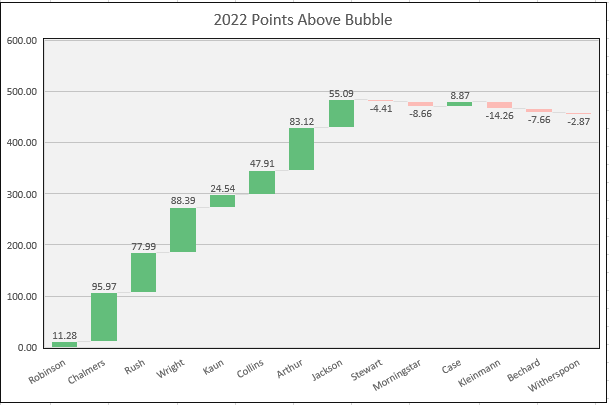
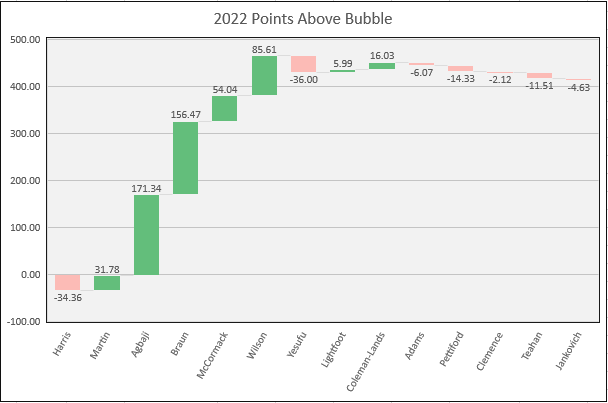
This waterfall chart shows how much value in Points Above Bubble that each Jayhawk added. The bulk of KU’s success came from its wings. The Jayhawks had 7 rotation players produce positive value, a sign of depth and maturity. However, only 1 of these 7 was a point guard type.
MVP’s
In the 40 games KU played, here are the total game MVP’s for KU players ranked from most team-MVP’s to least. Agbaji 11, Braun 10, McCormack 8, Wilson 5, Martin 3, Harris 1, Coleman-Lands 1, Lightfoot 1.
After adjusting for opponent-quality, here are the percent of games with positive value score by player from best to worst (above 50% performers): Braun 83%, Agbaji 74%, Wilson 68%, Clemence 63%, Martin 57%, McCormack 55%, Adams 51%, Coleman-Lands 51%.
Points Above Bubble vs. Points Above Average
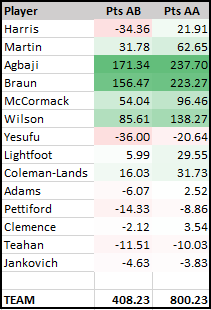
Ideally, each KU rotation player would be at a “bubble level” of value, but this isn’t the case most years. To add context to each player’s season, we can lower the skill level of the comparative player to that of the average D-1 player. When we do this, notice how each player’s Pts AA is higher than Pts AB, and how all rotation players except Joseph Yesufu and Bobby Pettiford have performed above that of a D-1 average player.
This incorporates total minutes, so Dajuan Harris’s ability to play as much as he has helps his Pts AA far more than someone like Joe Yesufu or Jalen Coleman-Lands. Focusing more on Harris, what we can say is that although he isn’t good enough to carry a team to the heights KU has reached, he has been a steady role-player that hasn’t hurt the team’s chances either. The 2022 team was carried by Agbaji, Braun, Wilson, with McCormack and Martin stepping up in the Big Dance as well. But durable guys like Harris and Lightfoot were good enough to keep KU at the high level they’ve had this season. If KU had to replace its role players (specifically Harris, Coleman-Lands, and Lightfoot) with average D-1 players, the team would have been worse off on the year.
National Champions
During the team’s six-game NCAA Tournament run, here are the Adj. PPG +/- scores:
Dajuan Harris -1.02
Remy Martin +4.11
Ochai Agbaji +3.11
Christian Braun +3.42
David McCormack +2.53
Jalen Wilson +1.46
Joseph Yesufu -0.84
Mitch Lightfoot +1.76
Jalen Coleman-Lands +0.02
K.J. Adams -0.06
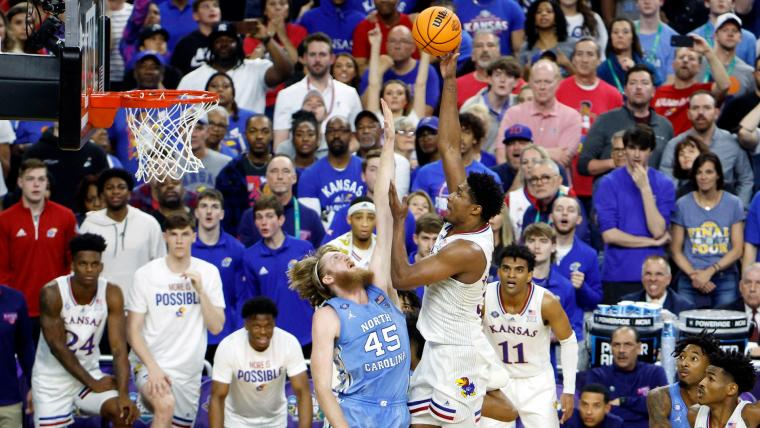
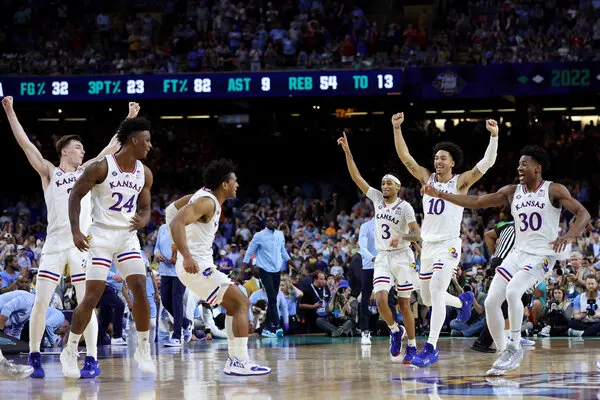
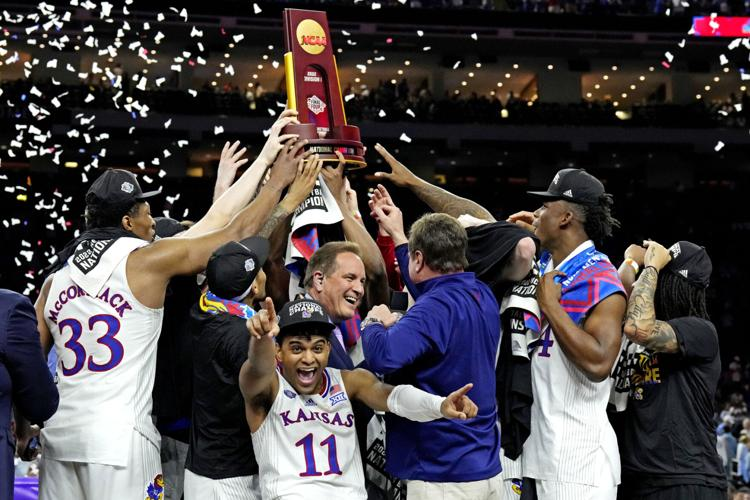
Remy Martin was the most valuable Jayhawk during March Madness, after an up-and-down year plagued by missed games and injuries. David McCormack stepped up late, becoming KU’s best player in the final three games of the season. He may not have won Final 4 MOP officially, but he was the biggest reason KU cut down the nets in New Orleans. His biggest plays came during the final moments of the National Championship game. After missing a turnaround shot, he collected his own rebound and finished it to turn a 1-point deficit into a 1-point lead with 1:21 left. He then played solid defense against Carolina’s Armando Bacot (who went down with an injury), forcing a turnover. On the other end, with the shot clock winding down, McCormack got deep inside position and scored again to extend the lead to 3, which would be the final margin. Down 72-69 and with only seconds to spare, the Tar Heels would fire 3 contested 3’s that were all off the mark, cementing Kansas as the 2022 NCAA Champions.
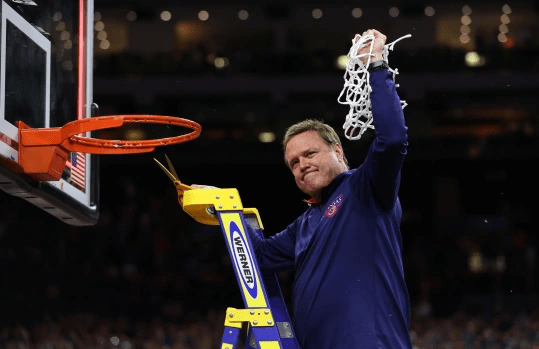
D-Mac’s final bucket put KU up 3 with 22 seconds left, forcing UNC into a difficult spotThe Hawks celebrate after a final defensive standRock Chalk, Championship!National Championship net
The 2011 Kansas Jayhawks finished 35-3 (14-2), winning the Big 12 Regular Season and Conference Tournament. The team earned a 1-seed in the NCAA Tournament and made the Elite 8 before losing. The team’s Sports Reference link is here.
OFFENSE
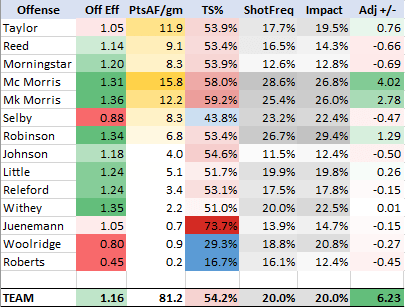
The 2011 offense was based heavily on the interior, with PF Marcus Morris producing the most value of anyone at +4.02. Markieff Morris and reserve Thomas Robinson were also efficient and productive, adding +2.78 and +1.29 points of value per game. The point production was fairly balanced among the main guards, although aside from Josh Selby it was clear that the role of the guards was to be facilitators first. The team’s true shooting was fairly balanced, again aside from Selby who took too many shots. This suggests the other players took shots at a sensible frequency that would best help the team win.
DEFENSE
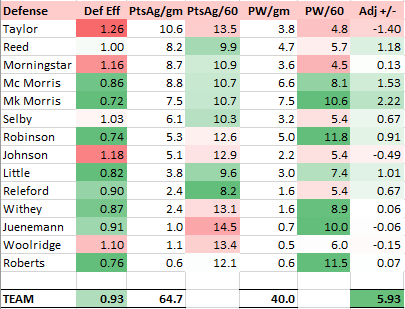
The 2011 defense was an underrated group. Without a primary shot-blocker in the starting rotation; it relied on lateral quickness, communication, and rebounding. Junior PF Markieff Morris graded out as the best individual defender, winning 10.6 possessions per 60. His brother was also solid inside. On the perimeter Tyrel Reed, Josh Selby, and Travis Releford produced solid seasons. Brady Morningstar finished with positive value on this side (albeit not by much), and Tyshawn Taylor finished with the worst per game value score of any defender since 1997.
Total Adjusted PPG +/-
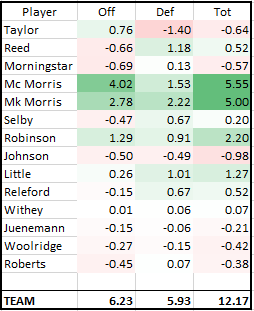
Marcus Morris and Markieff Morris performed a feat that has only been done one other time since 1997 (through the 2021 season), namely be a part of a duo that each produced over 5 points of per game value. Raef LaFrentz and Paul Pierce in 1998 also accomplished this. Beyond the Morris twins, KU had valuable bench forwards in Thomas Robinson and Mario Little. Tyrel Reed made a small contribution (+0.52) as a senior, as did Josh Selby in his only season (+0.20). The other rotation guards faired poorly. Travis Releford, who had a per game value score equal to Reed, could have made the argument that he warranted more time on the wing.
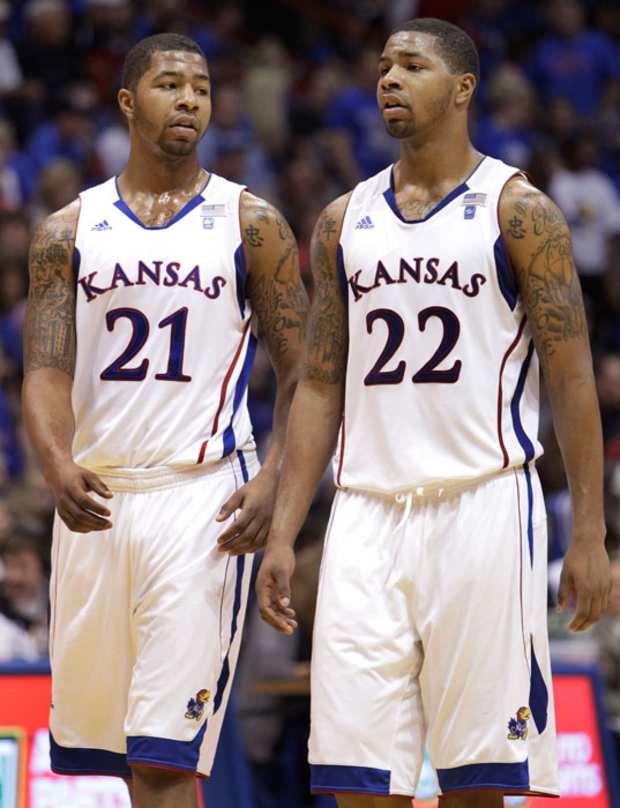
There was a lot of questions coming into the 2011 season for Kansas, but it soon became clear that Marcus and Markieff had improved enough to get Kansas to the heights it wanted to get. In their junior season, the Morris twins parlayed their starring roles at Kansas into mid-first round picks in the following summer’s NBA Draft. Each developed from inconsistent freshmen into lottery picks with similar but slightly different games that were good enough to stick around in the professional ranks. Like most players, their careers ended on a sour note. But without them, this team is nowhere near a 1 seed or Elite 8 caliber squad.
The 2012 Kansas Jayhawks finished with a record of 32-7 (16-2), winning the Big 12 Regular Season. The team earned a 2-seed in the NCAA Tournament and finished National Runners-Up. The team’s Sports Reference link is here.
Offense
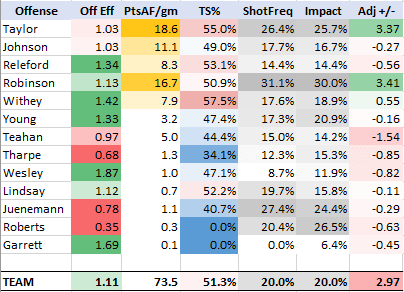
The 2012 Offense was led by Thomas Robinson (31.1% of shots while in game) and Tyshawn Taylor (26.4% shot frequency). With each player having such high volume, neither finished with high efficiency marks. But it was their overall productions, with Taylor producing 18.6 points a game and Robinson at 16.7, that drove their value scores.
The only other positive-value Jayhawk on offense was Jeff Withey, who was efficient thanks to a 57.5% true shooting and solid offensive rebounding marks.
Defense
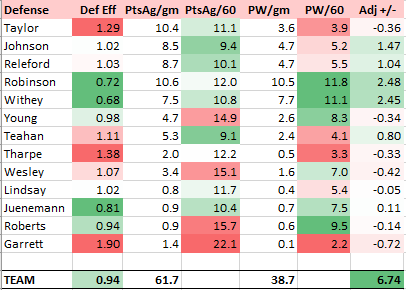
The 2012 Defense was what carried the team, as it was the #3 ranked adjusted defense on KenPom that year. Jeff Withey was the Big 12’s Defensive Player of the Year thanks to his shot blocking prowess (led the nation in block rate), but it was Thomas Robinson who actually produced the highest value score thanks to his excellent defensive rebounding ability (in fact he led the nation in defensive rebounding rate). Elijah Johnson and Travis Releford also produced over a point of value per game on defense. Conner Teahan was the other Jayhawk rotation player to provide positive defensive value, as he only allowed 9.1 points per 60 possessions. His positioning and ability to move laterally were underrated.
Adj. PPG +/-
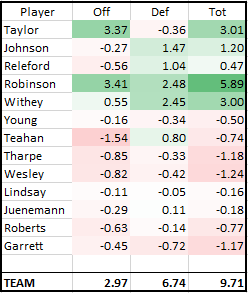
Thomas Robinson showed why he was the Big 12 Player of the Year and Consensus first-team All-American, producing over 6 points of value per game above that of a bubble-player at his position. Tyshawn Taylor edged out Jeff Withey for second place on the list, as each hovered around 3 points of value per game. Both Johnson and Releford rounded out the starting lineup with positive-value seasons thanks to solid defense.
The bench was another story. Both Kevin Young and Conner Teahan were able to keep their value scores respectable given that each was playing more minutes than expected (Young transferred from a mid-major; Teahan was a former walk-on), and they were certainly better than both Naadir Tharpe and Justin Wesley. Both Tharpe and Wesley had sub -1.00 scores despite playing relatively few minutes, if we looked at these value scores on a per possession basis they would look even lower for these two.
Per-100 Numbers:
Taylor +5.37
Johnson +2.22
Releford +0.91
Robinson +11.04
Withey +7.20
Young -2.61
Teahan -2.09
Tharpe -11.85
Wesley -9.04
Lindsay -4.13
Juenemann -3.46
Roberts -21.27
Garrett -30.46
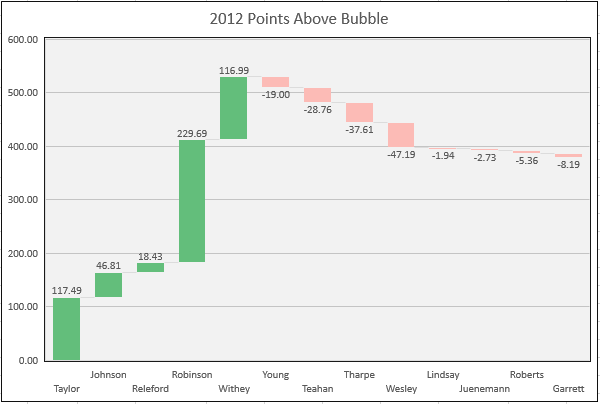
This waterfall chart is a nice representation of KU’s strengths and weaknesses. Good point guard play, dependable wing play, excellent power forward play, alongside good center play from its starters. When the team went to its bench, it started losing value rapidly.
Jayhawk of the Year
T-Rob celebrating a Final Four berth
KU’s run to the national championship game was quite unexpected at the beginning of the year, and wouldn’t have been possible if not for the dominant play of junior forward Thomas Robinson. A bench guy his first two seasons, Robinson excelled as a starter and go-to offensive weapon. He played with a lot of heart as well, bringing energy and helping to elevate the play of his teammates.
The 2012 season was a memorable run and has a special place in the hearts of many KU fans. Self’s ability to get the most out of his starters (all returnees who had their best seasons to that point in 2012) earned him many coaching accolades.
The 2013 Kansas Jayhawks finished with a record of 31-6 (14-4), winning the Big 12 Regular Season and Conference Tournament. The team earned a 1-seed in the NCAA Tournament, reaching the Sweet 16 before losing. The team’s Sports Reference link is here.
Offense
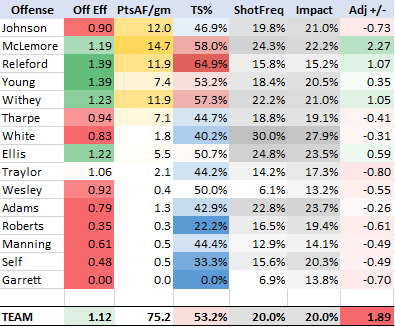
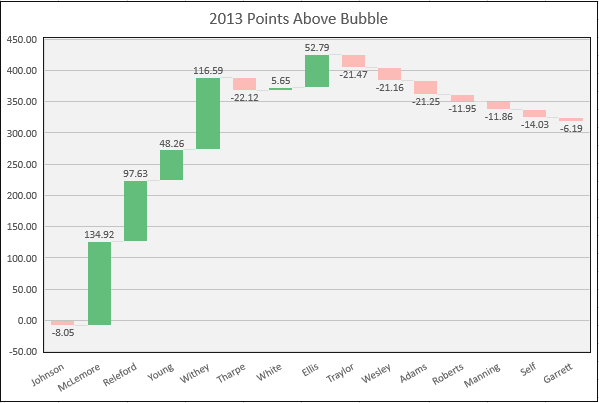
Losing leading scorers Thomas Robinson and Tyshawn Taylor from the prior year, the 2013 offense struggled compared to other Jayhawk teams. Redshirt freshman Ben McLemore was KU’s most talented scorer, contributing 14.7 points of offense per game while shooting a nice percentage on good volume. He was the only Jayhawk who provided over 2 points of value on offense for the season.
Seniors Travis Releford and Jeff Withey had solid offensive seasons, with Releford contributing an excellent 1.39 Offensive Efficiency at the wing position. Both Perry Ellis and Kevin Young were complimentary offensive players as well. Senior PG Elijah Johnson’s poor offensive season was due primarily to poor shooting.
Defense
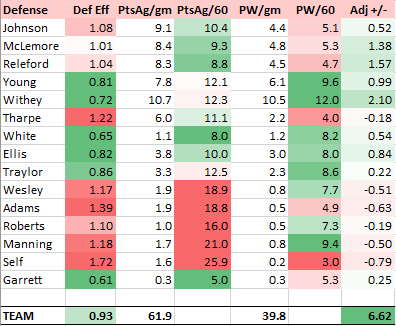
The 2013 team was very defensive-oriented. In fact, of its top-9 players, only Naadir Tharpe failed to provide above-bubble value. The defense was anchored inside by Jeff Withey who finished with a defensive score above +2.00 for the second straight season. Ben McLemore’s defense was underrated, as he graded out as a near-peer defender to senior Travis Releford. The 2013 team was Bill Self’s 8th consecutive team to reach a defensive Adj. +/- score of +5.00 or better, a mark that only 2 KU defenses have reached since (2016, 2020). The 2013 team was a classic, early Bill Self team that hung its hat on defense.
Adj. PPG +/-
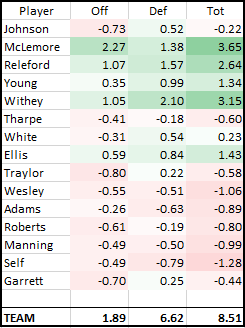
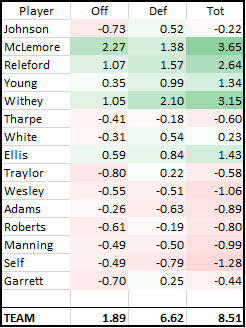
Ben McLemore was KU’s most valuable player in 2013, followed by Jeff Withey and Travis Releford. The team had nice balance with Young and Ellis also providing over +1.00 of value per game. The PG position was the team’s weakness, with Elijah Johnson battling injury all year and Naadir Tharpe struggling in moments. The TEAM score of +8.51 is actually a full point below KU’s average score since 1997. What’s amazing is that this team was still good enough to earn a 1 seed. The veteran play from its four seniors won it many close games.
Season Memories:
The 2013 team had multiple nice wins. Going into Columbus and beating a good Ohio State team for the third-straight time over the past two seasons. Smoking K-State by 21 after going through a rough three-game losing streak. But most memorable for this team are its two regular season wins against Iowa State. The first was in Allen Fieldhouse, when Ben McLemore banked in a 3 with 2 seconds left to send the game to overtime. He would torch the nets in the extra session as well, finishing with 33 points on 6-6 3’s for the game to lead the Jayhawks to victory.
The other Iowa State game will always be remembered as the “Elijah game.” With the Jayhawks needing a miracle to win in Ames, Johnson hit big shot after big shot to get the game to overtime, where he would then win it single-handedly. Johnson finished with 39 points and had a season-high game score of +19.78.
These moments proved to be huge for a Kansas program looking to extend its Big 12 Conference Title streak. KU would go on to share the regular season crown with K-State as each team had 14-4 records, though KU won both regular season meetings. In the conference tournament, KU would establish itself as the best team in the league by beating K-State for a third time in three tries, taking home the tournament trophy.
Stud frosh Ben McLemore shot 42% from 3 on the seasonJeff Withey spurred a huge second-half comeback in the Sprint Center to advance KU to the Sweet 16
Information Availability Analysis for 2013 season
Charting the Hawks looks to estimate player value for Kansas Jayhawks teams and players by using as much information as is publicly available. In order to get the most accurate player value data, game video must be available. For seasons past, this isn’t always possible for each game KU has played. When a certain game isn’t available to watch, supplemental information is used (play-by-play data, video replay highlights, scouting videos, radio coverage, box score info, postgame write-ups, game-feed discussions, etc.). This supplemental information allows for a better estimates, which can be amended whenever better information comes available. However, this necessarily means that each season has different amounts of info which can be used. More recent seasons have every play (or 99.9% of plays) on video. These estimates are the best. The further we go back, generally there are fewer games available for rewatch and less supplemental info.
To account for this discrepancy, CtH has a system which can analyze how complete the info is for a given season. This scale is set to 100%, with 100% meaning that each available possession during the season was watched on video. If no games were on video and the only information that was available were box scores, we would have an estimate of around 67%. This means that box score data can get us player value estimates that are about 2/3 as good as having each game. Thus the range of options for a given game, going back from the mid-90’s to today, tends to be around 67% to 100%, again with that number more likely to be closer to the high end the nearer to the present we are.
For the 2013 Kansas Jayhawks season, the info availability scores are:
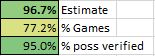
The Estimate number best estimates the average accuracy of each possession over the course of the season. For plays that weren’t able to be recorded (such as defensive points allowed), an educated guess is used, divided among the players in the game. There is a scale which determines how certain we are of player-value for that possession. At 96.7%, we have good confidence that the 2013 player value scores listed above are accurate to within a small range. With more information, the player value scores would change, but probably not by much.
The % Games shows the number of full games that were available to watch for that season during the time CtH was charting these games for player value. At 77.2%, this means that 28 of the 37 KU games for the 2013 were available. Thanks to those who upload archived games, whether on YouTube or elsewhere.
The % Poss verified number looks at all possessions, and counts only the ones that were recorded either through video or through a play-by-play transcript. While play-by-plays aren’t 100% accurate, they are mostly reliable and excellent supplemental information to use. They are missing a few important player value components, most notably defensive points allowed, but for offensive stats and rebounding/steals, they help make things more accurate. At 95.0%, only 1 possession out of 20 is below a 90% confidence level of estimating player-value.
In summary, the take-away is this. For the 2013 player value numbers, resubmitted below, there is a high confidence level that these values are within +/- 0.25 points per game. The info availability for 2013 is quite good, and while the true CtH player value would be somewhat different if we had 100% info availability through all possessions being on video when charted, there wouldn’t be much change in all likelihood. Note this doesn’t say anything about the CtH system itself. So even at 100% info availability, these numbers would still best be considered quantitative estimates of player value.
The 2013 Kansas Jayhawks player value table. At Adjusted PPG +/-, Ben McLemore is considered to be +3.65 points better per game than a bubble-level replacement would be at his position and minutes. This value score is an estimate, but one that is backed up by a solid amount of information (96.7%) and a logically-based system that seeks to balance all elements of a basketball game in order to show one value-score.
The final 2021 stats have been published. Below is a brief look at the value provided by this season’s roster. Note that the assessments are in relation to a KU-level talent for how they performed this season. It is not a prediction on what they will be later in their careers.
2021 Value Scores
STARTERS
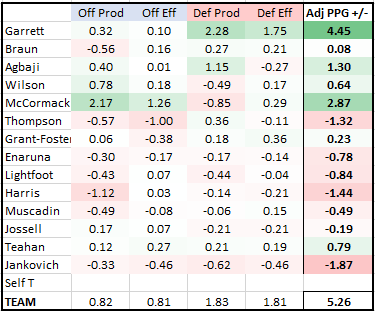
Marcus Garrett led the team with a +4.45 score. He provided the most-valuable defensive season on record (20 seasons) with a +4.03 Def PPG +/- score. The scores confirm what the eye-test tells us, Garrett’s defense was outstanding. Additionally, Garrett provided +0.42 value on offense. Not great, but above replacement-level. Since 2012, Garrett was KU’s fourth-best starting point guard, and not too far below Devonte’ Graham’s 2018 season.
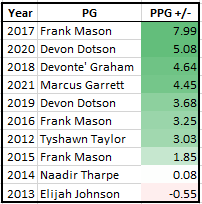
KU PG’s over past 10 seasons
KU has been spoiled with outstanding PG’s in recent years. Don’t blame Garrett for having to play out of position in 2021, blame those around him for not elevating their games. Assessment: KU-level star (A+).
Christian Braun finished barely in the green, with a +0.08 score. He had some excellent games but was an inconsistent shooter. He also had trouble generating his own offense, so he was the least productive starter on offense. His defense was not bad, but not great either. He is a good rebounder for a guard, and an okay on-ball defender. Looking at his total value, he likely doesn’t start most seasons at KU. But he was still the team’s fifth-best player, and will be a vital piece moving forward should he improve like most KU players do who return for a third season. Assessment: KU-level reserve (C).
Ochai Agbaji was the team’s leading scorer at 14.1 ppg, and finished with a +1.30 score. His offensive efficiency declined throughout the season, and he didn’t grab many rebounds or steals on defense either. Still, he did a good job of outscoring his man, and he graded out as the team’s second-best defender. I don’t see him being anywhere near an NBA-level talent yet. His junior season was a clear jump over his underclass years, but he still has room to grow as a player. Assessment: KU-level starter most years (B-).
Jalen Wilson finished with a score of +0.64, with his value coming on the offensive side of the ball. At times he was a very good scorer, and his rebounding skill made KU less of a “small ball” team than was predicted. His defense was poor, particularly when he was in a mismatch against a quicker player. If he can improve his shooting and on-ball defense, he can be a very good college player. Assessment: KU-level reserve (C+).
David McCormack had a dominant offensive portion of the schedule, which elevated him to a +2.87 score. He graded out as a better offensive weapon than Doke last season due to his production, free throw shooting, and ability to take care of the ball while playing against a tougher schedule. He was a versatile scorer. McCormack’s defense, while better than his underclass years, was nevertheless quite poor. He struggled against versatile players whether underneath or (especially) on the perimeter. Assessment: KU-level starter (A-).
ROTATION BENCH PLAYERS
Bryce Thompson finished his freshman season at -1.32. This is actually far more respectable than how he played at the beginning of the season. Thompson’s offense was the worst on the team, and he never outscored the 12 points he put up against Gonzaga in the first game of the season. His defense was slightly positive, and he showed flashes of the talent that brought him to Kansas. I don’t doubt he can improve. Assessment: Not KU-level (D-).
Tyon Grant-Foster was the only rotation bench guy to have a positive score, at +0.23. He was not an efficient offensive player, which hurt his minutes. But he defended, rebounded, and made the occasional athletic play when he was in the game. He should have been given more minutes given what he did do. His lack of minutes will end up hurting his grade, as we don’t know if he would have been able to maintain his value playing more minutes. Assessment: KU-level reserve (C-).
Tristan Enaruna did perform slightly better than last season, but across the board he was negative on all categories. His total score was -0.78. He did some things well, but he was a bit soft on both ends of the court. Assessment: Not KU-level (D).
Mitch Lightfoot did not put up a score as high as he should have, given his status as a 5th year senior. He finished at -0.84. His minutes were mostly due to KU not having a viable back-up at the 5, unlike in years past. His inability to develop offensively is surprising, given how athletic he is and how competent his shot looks. Assessment: Not KU-level (D).
Dejuan Harris made many nice plays last season, but also wasn’t much of an offensive factor. This is why his score was so low at -1.44. Harris has a nice game; he takes care of the ball, sees the floor well, can make an open shot. He needs to improve his scoring and on-ball defense. Assessment: Not KU-level (D-).
DEEP BENCH PLAYERS
Gethro Muscadin didn’t see the court much, and when he did he showed how his size could be of value but not much of his skill. His score was -0.49 while only playing 2.7% of possible minutes. With him transferring out, there’s not much else to say. Assessment: Not KU-level (N/A).
Latrell Jossell also didn’t play much, but his quickness and ball-skill weren’t bad. He is undersized, so might have trouble defending should he get more minutes. His score of -0.19 included some deep jump-shots, showing range. Assessment: Undetermined (N/A).
Chris Teahan was money, and had a score of +0.79 thanks to multiple made shots and decent defense. He could have played 5-10 minutes against most opponents and been fine. Assessment: KU-level walk-on (N/A).
Michael Jankovich was injured for most of the season and played in one game (USC), finishing with a score of -1.87. Assessment: KU-level walk-on (N/A).
To reiterate, the assessments and grades relate to the 2021 season only, and are not a reflection of the player’s potential or a prediction of the player’s value moving forward. Before next season, a prediction of the 2022 season will be published, using players’ historic numbers and historic trends of player improvement over the years.
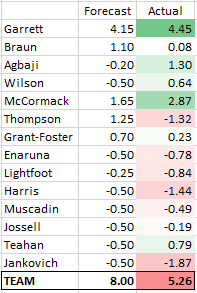
Having said that, let’s take a look at how close this season’s forecasted Value scores (Adj PPG +/-) were to the actual results. Note that the forecasted numbers weren’t published before now, so you’ll just have to trust these predictions were made before the season:
2021 Player Forecasts vs. Actual PPG +/- scores
The sum of the five starters exceeded their collective forecast by around 3 ppg. Looking back, it is easy to see I should have flipped Braun and Agbaji. In 2020, however, Braun was nearly a full point better than Agbaji, who had a poor season as a sophomore. Agbaji’s sophomore to junior jump was impressive even if we want more out of Och. Wilson was a nice surprise, and McCormack elevated his offensive production as the team’s main interior scorer. KU’s five starters weren’t the problem.
The bench was a major disappointment. Thompson’s forecast was ridiculously off in a bad way, but it was a prediction made after believing much of the hype around him. To a similar extent, this happened on Tyon Grant-Foster. Lightfoot not improving from 2019 was discouraging, and the rest of the bench was tough to predict. Part of Harris’ low score was him getting more minutes than expected. Either way, not a single bench player was able to consistently produce at a level that should warrant considerable time on the floor in a Kansas uniform.
Looking at the team score, the team underperformed what I thought it was capable of. However, the initial form of this team included Silvio De Sousa. De Sousa was a good interior defender in 2020, so his place on the roster would have helped the team immensely on that end. As much as I’d like to predict the 2022 team right now, we’ll let the roster finalize and make forecasts in the fall. There are many moving pieces at the current stage.

 Charting the Hawks