Many people think the Tournament doesn’t start until the 68-team bracket is announced on Selection Sunday, but for most conference and most teams, the only chance to get into that bracket is to win their conference tournament. Therefore, for all intents and purposes, the NCAA Tournament begins with the single-elimination conference tournaments which will select the various 13, 14, 15, and 16 seeds in the final bracket. With that in mind, there are four conferences kicking off their postseason play on 3/1/2022 with the final games being played on Selection Sunday right before the Bracket is revealed.
Let’s take one team from a one-bid league as our example, the darlings of the 2012 Tournament, Florida Gulf Coast. In order to make it to the Big Dance this year, the Eagles will have to win four games over the next week, beginning tomorrow (3/1/2022) night against North Alabama.
From there they would have to win either 6 or 7 games (depending on how the First Four shakes out). So to complete their ultimate dream of winning the National Championship, they’d have to win 10 (or 11) in a row. Obviously, it won’t happen, but the dream is still alive!
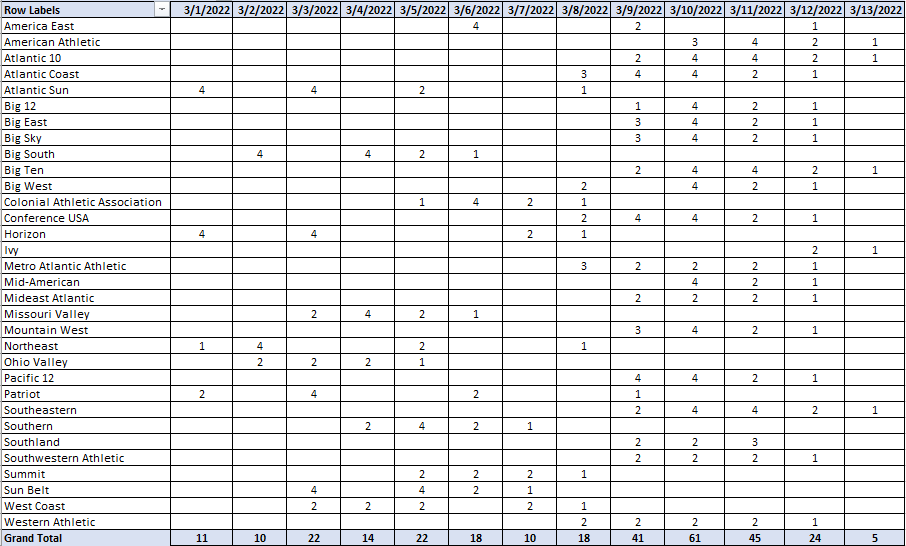
Below are the number of games for each Conference Tournament by date. Happy watching!
The 2022 Kansas Jayhawks finished with a record of 34-6 (14-4), having won the Big 12 Regular Season and Tournament Championships. The team earned earned a 1-seed in the NCAA Tournament and won the National Championship. The team’s Sports Reference link is here.
Offense
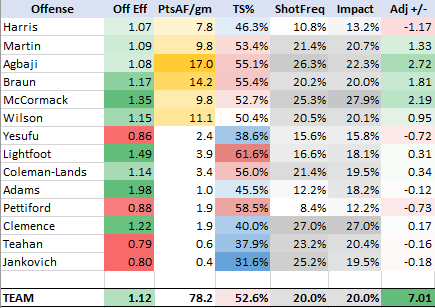
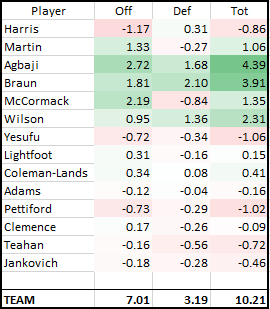
At +7.01, the 2022 team was KU’s third-best offense in the Self era, slightly behind 2017 and 2018. The team had an excellent mix of offensive talent, led by Ochai Agbaji. Agbaji finished with 17.0 points produced per game, which translated to +2.72 offensive points above a bubble-level player. David McCormack was KU’s second most valuable offensive player on a per game basis, producing 9.8 points per game but also adding value through offensive rebounding. His Offensive Efficiency of 1.35 was easily the highest of any starter.
Christian Braun was a steady player on offense, scoring in double figures in all but 5 games. He was good at the rim, shot well from outside, assisted nicely, and had his fair share of stick-backs and other hustle plays to bring value. Remy Martin got hot late in the season, carrying the Jayhawks when the team needed him. Had he been healthy the entire season, his numbers would have looked very good. Even where they are, he provided +1.33 points more per game than a replacement option would have been expected to add.
Jalen Wilson finished a fraction below +1.00, held back by poor perimeter shooting but buffered by rebounding and strong finishes at the rim. Given how many big moments he had, its crazy to think of him as only the fifth-best offensive player during the 2022 season.
Off the bench, both Jalen Coleman-Lands and Mitch Lightfoot added decent offensive value through efficient shooting numbers.
Defense
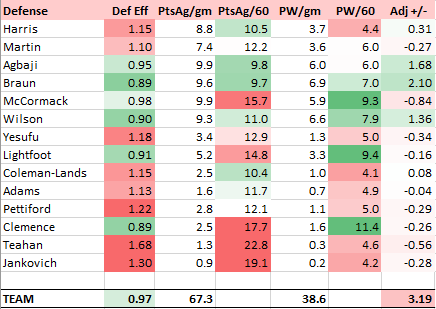
KU’s defense of +3.19 was the weaker side of the ball all season. But the team played well when it mattered most, averaging a +7.75 value score in its last 10 games.
On the season, Christian Braun was KU’s most valuable defender, giving up 9.7 points per 60 possessions and grabbing a fair share of rebounds for a wing. Fellow wings Agbaji and Wilson were also solid and versatile defensive pieces, with Och being a better on-ball defender and Wilson being an excellent defensive rebounder.
Point guard Dajuan Harris was KU’s leading steal-man, coming away with 58 live-ball steals on the year. He also forced 50 (dead-ball) turnovers, for 108 total. Given the fact he turned the ball over only 70 times himself, he was +38 for the year with regards to taking care of the ball. This is what you want to see from your main ball-handler.
Total Adjusted PPG +/-
Ochai Agbaji was KU’s best player all season, and his Adj. PPG +/- of +4.39 was the 24th best season of any Jayhawk in the last 26 seasons (1997-2022). Christian Braun at +3.91 was not far behind, producing the 29th best Adj. PPG +/- score over that time period. Of the 7-man rotation that played the bulk of the minutes during NCAA Tournament play, 6 had positive scores (Agbaji, Braun, Wilson, McCormack, Martin, Lightfoot).
Unbelievably, the TEAM score of +10.21 was KU’s 12th best season from 1997-2022. This speaks to the consistency of the program. 2022 may not have been KU’s most talented team, but they played well when it mattered most. Over the team’s final 10 games, the Jayhawks were +14.22.
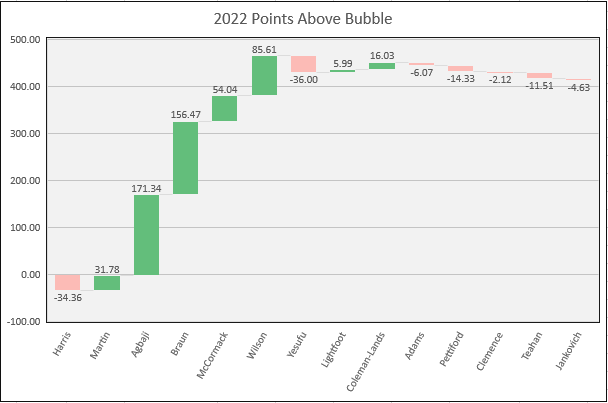
This waterfall chart shows how much value in Points Above Bubble that each Jayhawk added. The bulk of KU’s success came from its wings. The Jayhawks had 7 rotation players produce positive value, a sign of depth and maturity. However, only 1 of these 7 was a point guard type.
MVP’s
In the 40 games KU played, here are the total game MVP’s for KU players ranked from most team-MVP’s to least. Agbaji 11, Braun 10, McCormack 8, Wilson 5, Martin 3, Harris 1, Coleman-Lands 1, Lightfoot 1.
After adjusting for opponent-quality, here are the percent of games with positive value score by player from best to worst (above 50% performers): Braun 83%, Agbaji 74%, Wilson 68%, Clemence 63%, Martin 57%, McCormack 55%, Adams 51%, Coleman-Lands 51%.
Points Above Bubble vs. Points Above Average
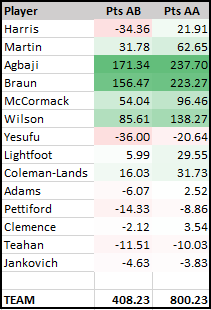
Ideally, each KU rotation player would be at a “bubble level” of value, but this isn’t the case most years. To add context to each player’s season, we can lower the skill level of the comparative player to that of the average D-1 player. When we do this, notice how each player’s Pts AA is higher than Pts AB, and how all rotation players except Joseph Yesufu and Bobby Pettiford have performed above that of a D-1 average player.
This incorporates total minutes, so Dajuan Harris’s ability to play as much as he has helps his Pts AA far more than someone like Joe Yesufu or Jalen Coleman-Lands. Focusing more on Harris, what we can say is that although he isn’t good enough to carry a team to the heights KU has reached, he has been a steady role-player that hasn’t hurt the team’s chances either. The 2022 team was carried by Agbaji, Braun, Wilson, with McCormack and Martin stepping up in the Big Dance as well. But durable guys like Harris and Lightfoot were good enough to keep KU at the high level they’ve had this season. If KU had to replace its role players (specifically Harris, Coleman-Lands, and Lightfoot) with average D-1 players, the team would have been worse off on the year.
National Champions
During the team’s six-game NCAA Tournament run, here are the Adj. PPG +/- scores:
Dajuan Harris -1.02
Remy Martin +4.11
Ochai Agbaji +3.11
Christian Braun +3.42
David McCormack +2.53
Jalen Wilson +1.46
Joseph Yesufu -0.84
Mitch Lightfoot +1.76
Jalen Coleman-Lands +0.02
K.J. Adams -0.06
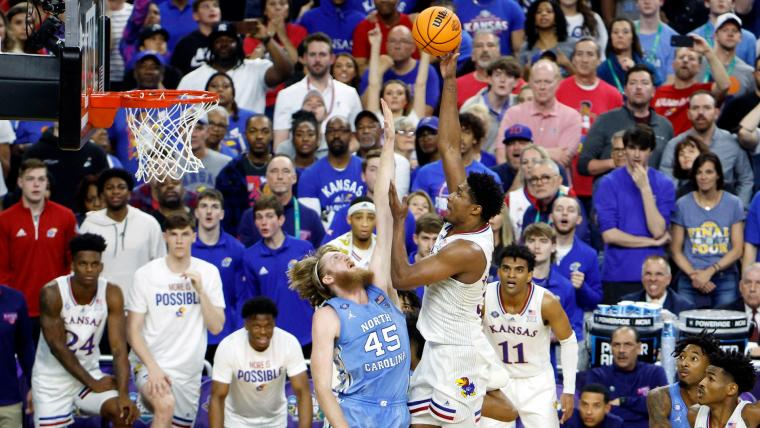
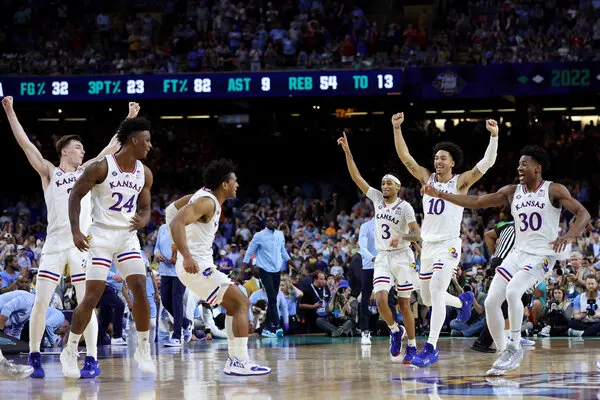
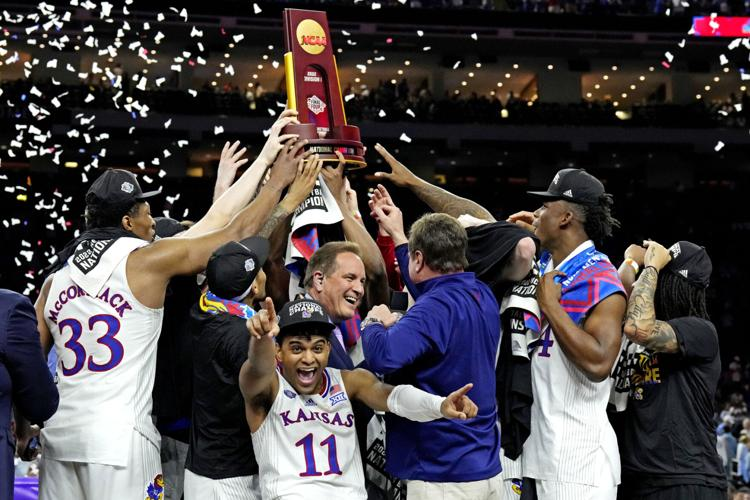
Remy Martin was the most valuable Jayhawk during March Madness, after an up-and-down year plagued by missed games and injuries. David McCormack stepped up late, becoming KU’s best player in the final three games of the season. He may not have won Final 4 MOP officially, but he was the biggest reason KU cut down the nets in New Orleans. His biggest plays came during the final moments of the National Championship game. After missing a turnaround shot, he collected his own rebound and finished it to turn a 1-point deficit into a 1-point lead with 1:21 left. He then played solid defense against Carolina’s Armando Bacot (who went down with an injury), forcing a turnover. On the other end, with the shot clock winding down, McCormack got deep inside position and scored again to extend the lead to 3, which would be the final margin. Down 72-69 and with only seconds to spare, the Tar Heels would fire 3 contested 3’s that were all off the mark, cementing Kansas as the 2022 NCAA Champions.
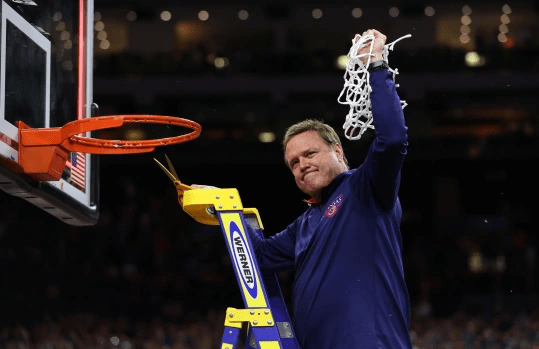
D-Mac’s final bucket put KU up 3 with 22 seconds left, forcing UNC into a difficult spotThe Hawks celebrate after a final defensive standRock Chalk, Championship!National Championship net
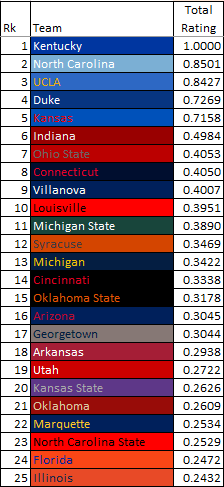
The ranking system used below is a mathematically-objective system based around the bracket structure of the NCAA Tournament. The NCAA Tournament is a bracket tournament, in which each successive round has half the teams of the prior round until a champion is crowned (64…32…16…8…4…2…1). The important concept here is that each successive round is twice as difficult to reach. The system awards points to a program based on its tournament success for that season, a team which advances to the Sweet 16 is awarded double the points of a team that only reached the Round of 32 and half the points of a team that makes the Elite 8. Seasons accumulate together, so a team that has a lot of NCAA tournament appearances can build up its program ranking with even a little bit of tournament success.
Regular season success is also incorporated in the formula, utilizing seed-line win-expectations as the gauge for how well a team did during the regular season. 2021 regular season scores are included. The standard-bearer with the best NCAA Tournament and regular season success in college basketball since 1939 has been Kentucky, which has a total rating set at 1.00.
Top 25 Programs (1939 – present)
To calculate the relative dominance of one team over another, simply divide Team A’s Total Rating by Total B’s Total Rating. For example, dividing (.7158/.4984) tells us Kansas as a program is 1.44 times better than Indiana as a program from 1939 – present. Although Kansas has fewer NCAA championships (3 vs. 5), it makes up for this by having more runners-up, Final 4’s, Elite 8’s, tournament appearances, better seed-lines, etc.
Below are the program rankings for the 2021 tournament teams in the South and Midwest regionals. West and Midwest Regional rankings will be published after the Round of 64 is set following Thursday night’s play-in games.
South Regional:
1. Baylor (#49)
16. Hartford (#314)
8. North Carolina (#2)
9. Wisconsin (#27)
5. Villanova (#9)
12. Winthrop (#205)
4. Purdue (#33)
13. North Texas (#249)
6. Texas Tech (#66)
11. Utah State (#80)
3. Arkansas (#18)
14. Colgate (#263)
7. Florida (#24)
10. Virginia Tech (#115)
2. Ohio State (#7)
15. Oral Roberts (#155)
The South region has the second-best college basketball program (North Carolina) along with a program making its first tournament appearance (Hartford), and three of the top ten programs of the NCAA Tourney era (Ohio State, Villanova). Baylor is the lowest-rated program of the four #1 seeds, but is still easily in the upper quintile of college basketball programs. Wisconsin and Purdue look to continue climbing, as each is just outside the Top 25. 2019 National runner-up Texas Tech and Utah State are in the Top 100 and looking to climb; while Virginia Tech, Oral Roberts, Winthrop, and North Texas start the tournament outside the Top 100. As an example of how quickly a lower-ranked team could rise if it made a run, North Texas could jump all the way up to #199 if it made the Sweet 16 by winning 2 games this weekend.
North Carolina (6), Villanova (3), Florida (2), Wisconsin (1), Ohio State (1), and Arkansas (1) are national title winners; the South region has the most programs with at least 1 prior NCAA Tournament title of all regions in this year’s bracket.
Midwest Regional:
1. Illinois (#25)
16. Drexel (#218)
8. Loyola Chicago (#74)
9. Georgia Tech (#51)
5. Tennessee (#68)
12. Oregon State (#55)
4. Oklahoma State (#15)
13. Liberty (#216)
6. San Diego State (#125)
11. Syracuse (#12)
3. West Virginia (#38)
14. Morehead State (#135)
7. Clemson (#120)
10. Rutgers (#119)
2. Houston (#32)
15. Cleveland State (#197)
The best program in the Midwest is Syracuse with one national championship, but Oklahoma State is not far behind with its two titles. Loyola Chicago is the third team from this region to have a national title, and is the most recent Final 4 team in the region.
The string of years from 2003 to 2005 were good to teams in this region. Illinois was national runners-up in 2005, Georgia Tech defeated Oklahoma State in the 2004 Final 4 in its runner-up season, and the prior-mentioned Syracuse Orangemen won in 2003. Houston has also competed for a title, in fact two of them, but came up empty in both championship game appearances. West Virginia’s best appearance is a national runner-up as well. Surprise Pac-12 winner Oregon State has made two Final 4’s. Tennessee has underperformed its seed-lines in the NCAA tournament, having made only one Elite 8. The winner of the Rutgers/Clemson game has a chance to crack the Top 100 with a Final 4 run. Morehead State is in its eighth NCAAs, and Cleveland State has gone 3-2 in its prior two tournaments (as a 13 and 14-seed), making it unbeaten in the First Round. Liberty and Drexel would also jump multiple spots with a win on Friday.
 Charting the Hawks