Since 1985, when it expanded to 64 teams, the NCAA Tournament has been held 38 times. In this period, there have been four programs separate themselves from everyone else. Duke (102), North Carolina (96), Kansas (93), and Kentucky (84) lead the others in terms of tournament wins during this period. Michigan State (62) and Connecticut (61) are next in line.
In this period, a 1-seed has won 3.29 games per tournament. A 2-seed is 2.33 games, a 3-seed 1.85 games, and a 4-seed 1.55 games. If we take each program’s collective expected wins each year on Selection Sunday after the brackets have been set, we have these programs as having the most expected wins in the period from 1985-present:
Kansas: 89.9
Duke: 88.9
North Carolina: 77.8
Kentucky: 67.3
Arizona: 63.1
This list can be thought of as showing which programs have had the best (collective) regular seasons since 1985. Kansas and Duke are essentially tied, with North Carolina third but comfortably ahead of the rest before Kentucky and then Arizona round out the top 5. Notice how Arizona is on this list but not the one above. Despite being seeded quite well throughout the years, Arizona has underperformed expectation in the Big Dance. Next, we will examine the top and bottom teams, relative to performance.
There are 10 teams which have won 10 more NCAA Tournament games than they were expected to (given their earned seeds). The list is as follows:
North Carolina: +18.2
Connecticut: +17.9
Kentucky: +16.7
Florida: +14.1
Michigan State: +13.5
Duke: +13.1
Michigan: +12.3
UCLA: +11.2
Louisville: +10.6
Butler: +10.5
It should be mentioned that these results do not take into account vacated wins. Louisville in particular lost numerous tournament wins during the 2014-2017 period because of its NCAA penalties. Other programs on this list have also had vacated win that would affect the totals had this been considered.
Kansas, despite its reputation of underachieving in March, is +3.1 on this list and number 22 (of 303 teams). It is also tops in the Big 12 in this metric.
On the flip side, there are a number of programs that haven’t performed to expectation. Before the list is revealed, can you think who these might be? Which programs seem to have good regular seasons, only to “choke” success away in March? Here is the bottom 10 list, starting with the worst program:
Purdue: -10.8
Pittsburgh: -9.3
Illinois: -8.7
Virginia: -8.4
BYU: -7.8
Missouri: -7.5
Cincinnati: -7.3
Oklahoma: -7.2
Arizona: -7.1
New Mexico: -7.1
One point in defense of these schools. In order to be on this list, a program has to be good enough to make numerous tournaments. Purdue is a perennial NCAA Tournament team, having made the Big Dance 14 of the last 17 years (Matt Painter’s tenure) there was a Tourney. The Boilermakers have had a top-4 seed in 8 of these seasons, showing they’ve played quality basketball in the regular season. But for some reason, March Madness has been more sadness than gladness.
Of the 303 programs which have made an NCAA Tournament since 1985 (i.e. the Round of 64, play-in “First Four” games are excluded in terms of results here), 112 (or 37%) have not won a single game. Many of these programs are low-major types which have only been to the Big Dance at most few times as a 14-seed or worse. By far the most notable program to never win an NCAA Tournament game is Nebraska, which was expected to win 6.1 games during this span. The biggest upset loss for the Cornhuskers was in 1991, when they were upset in the First Round as a 3-seed.
Gonzaga is an interesting case. The Bulldogs’ first NCAA appearance was in 1995, but since 1999 the Zags have been as consistent as anyone. First, they were America’s darlings and the Cinderella which made the Elite 8. Since that time, they’ve developed into a good program, then a great one, and now borderline elite. They’ve earned 5 1-seeds since 2013 (second-most in that span behind Kansas) and finished national runner-up twice. The only thing missing is a National Championship. Because of this, some think Gonzaga has underachieved, but the Zags are actually +6.5 wins better than expected given their seeds. With 45 Tournament victories, they’ve won only 1 fewer game than Villanova (3 titles) has in that time. If we restrict the period to start with 1999, the year Gonzaga made its first Cinderella run, the Zags are tied 6th (with UConn) in terms of Tourney wins.
We’ll finish with Kansas. Bill Self’s teams have won 45 Tournament games in his tenure (including 2023, when Norm Roberts was the bench coach for the Tournament games due to Self’s health issue). However, his teams have been expected to win 50.1 games, for an underachievement of 5.1 games. Roy Williams’ tenure was marked by 35 wins against 32.5 expected wins, for an overachievement of 2.5 games. It was Larry Brown who did the best, winning 13 games against an expected 7.3 games. This is an overachievement of 5.7 games. In total, this adds up to +3.1 against expectation.
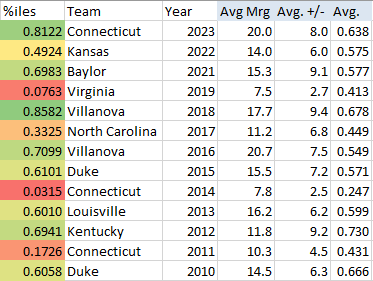
The 2023 Connecticut Huskies won the NCAA Tournament in dominant fashion. Each win was by 10+ points, and they never seemed to be in any real peril throughout their run. I wanted to examine each champion’s path to the title over the years to see which were the most dominant and which ones were the most stressful.
To quantify this, I settled on three different metrics. Margin of Victory, average score throughout each game, and average lowest winning percentage during each of the 6 games (per KenPom). Because these final two metrics rely on info that has only recently been provided, this list will only go back to 2010. Thus, only the previous 13 champions are included.
Let’s look a bit closer at each metric and see why each was chosen as a way to measure Champion run domination.
Margin of Victory – Simply put, the higher the MOV, the more dominant you were that game. This one is the easiest to calculate and can be applied going back much further than 2010. Since 2010, all but two champions have an average winning margin of +10.0 in their six game spurts.
Average +/- Throughout Game – While MOV tells us quite a bit, it cannot relay another level of dominance/stress, which is the margin during the game. A team which wins by 10 by making a bunch of FT’s at the end of a once-close game was less dominant than a team that coasted to a double-digit lead and held it throughout the second-half, only to give up some late baskets to its opponent once the game was out of reach. Dominant teams control the game throughout, and this is reflected in average margin throughout the game.
Lowest Winning Percentage per Game (averaged) – This metric is made possible by KenPom’s 2010 and later game data. He calculates at which point in the game the winning team’s lowest chances were (per his model). For instance, in the 2022 National Championship game, his model calculated that KU had a 16.7% chance of winning at halftime, the lowest point of the game. By averaging these numbers, we can compare how “comfortable” each champion’s run was relative to one another. The lowest point for any champion during that time was 2019 Virginia’s Final 4 game against Auburn. Down 61-57 with 17 seconds left, Virginia had a 5.5% chance of winning at that point.
Combining the metrics – Lastly, we will combine these metrics and compare them using percentiles. The range of possible values are 0.0000 to 1.0000. The greener the number, the closer to 1. The redder the number, the closer to 0.
2018 Villanova had the most dominant run according to this system, with 2022 UConn coming in second. The least dominant was 2014 UConn, which won as a 7-seed but was projected to lose at some point in each of its 6 games. In fact, it had to comeback just to force overtime to even get out of its R64 game. 2022 Kansas is in the middle, placing 9th out of 13 but still very close to 0.5000 from a percentile look. That team had some stressful moments, including halftime deficits and close wins, but also some dominant moments as well.
There’s no real formula to success when it comes to being a champion. Sure, you would like to win each game by double-figures and with ease. But there are some teams that aren’t on this list despite having done just that for 4 or 5 games.
In the Bill Self era, a common critique is that KU teams struggle in the Round of 32. A similar complaint is that KU teams struggle in the second game of the weekend series in the Tourney, i.e. not just the Round of 32 but also the Elite 8.
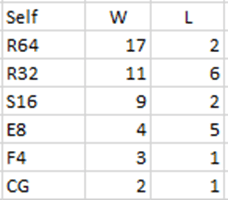
Let’s look at Self’s W-L record in the NCAA Tournament by round while at Kansas. *These games include the 2023 Tourney, in which Norm Roberts was the acting coach on the bench as Coach Self was recovering from his health issue.
There is a steady drop-off from the R64 to R32, but this should be expected given that the second round games will be against good teams, not sub-100 KenPom teams as it is most years in the first round. But when KU teams make it to the S16, they do quite well, only to see another steep drop in the E8. The next table compares the records of KU in the first games of the Tourney pods (R64, S16, F4) against the second games of these pods (R32, E8, CG).
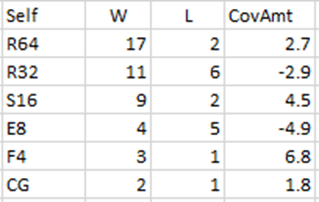
This shows quite a contrast. Again, opponent quality is likely at play here. But there does seem to be some indication that KU plays better in its first games (when it has time to rest/prepare) than its second games (which occur with only one day of rest/prep). To test this, we will see how KU did against its projected margin using Vegas odds.
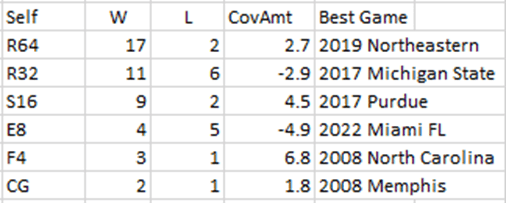
This table recreates the earlier one, with the average Cover Amount column added. This column shows how much better (or worse) KU does in points against its cover amount. For the R64, KU’s average margin is 2.7 points better than what the lines showed. But when we get to the R32, KU is 2.9 points worse than their lines. The last time KU covered a R32 was in 2017 vs. Michigan State. They are 0-5 ATS in this round since. The second weekend games are even more pronounced. KU is +4.5 in the S16 and a shocking -4.9 in the E8. And this was with KU going 2-0 in its last two E8 appearances (2018 vs. Duke, 2022 vs. Miami FL). Before 2018, Self’s teams were 10.28 points worse than expected on average in the E8 round.
For whatever reason, KU teams under Self do better in the NCAA Tourney when they have more time to prepare. Last, we’ll expand the table again to show KU’s best performance (against Vegas expectation) during the Self era.
The NCAA Tournament also goes by the moniker “March Madness,” reflecting the unpredictability of outcomes. Kansas has been no stranger to this madness, as it has been bounced early on multiple occasions as a highly-favored team but also won the 1988 NCAA Tourney as a 6-seed.
Each path to a possible title is unique. Some years, the bracket can open up for a team as upsets clear the way for a better chance at success. Other years, the bracket goes chalk and difficult opponents are faced. We will explore how varied KU’s possible paths have been down below.
Also at play is the idea of the possible opponent. Had KU defeated Arkansas this year in the R32, its next game would have been against Connecticut in the S16. For fans of any team, viewing potential matchups down the line is commonplace after the brackets are released on Selection Sunday. But after the team loses, the would-be matchups become less intriguing. For this exercise, we will be examining KU’s would-be matchups had they advanced.
We will restrict our study to the Bill Self era. This gives us 19 seasons worth of Tournament data (Self has been the coach at KU for 20 seasons, but 2020 is excluded obviously). For data, we will use KenPom’s final results of that season to serve as a team’s relative strength. We will then match up Kansas against its actual or hypothetical opponents for any given round. For years where KU makes the championship game, these opponents will all be actual opponents. For other years, some opponents will be those KU would have faced had it kept winning. Then, using KenPom’s numbers, KU will be compared to said opponent to get an estimated points spread. Next, these point spreads will be converted to winning percentage estimates using historic data from Team Rankings and a smoothing process. For instance, if a team is 7.7-point favorites (per KenPom), then that team wins the games an estimated 78.0% of the time (using the smoothed historic numbers). It is this 78.0% number that gets used to estimate Final 4 and National Championship odds.
We’ll start with Final 4 odds. Below is a table which calculates KU’s odds of making the Final 4 given the path that occurred.
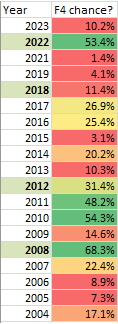
The seasons with actual F4 appearances are highlighted in green. The average F4 chance for KU in the Self-era is 23.1%, with conditional formatting being set as Red for 1/10 chance, Yellow for 1/4 chance, and Green for a 1/2 chance. There are two factors at play. First is the draw, how the bracket turns out. More upsets in your region means an easier path. The second factor is the strength of the team, and this also turns out to be important. For 2008, KU’s biggest break was in the S16, when it faced 12-seed Villanova. For a S16 game, it was a much weaker opponent than normal. The E8 game, against 10-seed Davidson, was not really a break. Despite the double-digit seed, Davidson was about as strong as the average E8 opponent or potential opponent KU faces/could face.
KU took advantage of 2 of its better chances to make the Final Four in 2008 and 2022. The biggest chances wasted were in 2010 and 2011. KU’s toughest opponent to make it to the F4 (and in fact the NC game) in 2011 was actually its R32 opponent Illinois. For 2010, KU would have been favored by 8.2 and 9.3 points for its would-be S16 and E8 games.
The 2012 path was Self’s fifth-best chance, which he converted by getting to New Orleans. 2018, which was a year in which KU didn’t get any seeding breaks or upsets, was the most-unlikely F4 for Self. Next we look at National Championship chances.
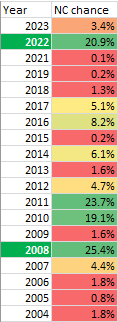
This table will look similar to the Final Four table. Note that the conditional formatting is set at Red for a 1/50 chance, Yellow for a 1/20 chance, and Green for a 1/5 chance. KU’s 2008 and 2022 titles are highlighted.
Self has had four really good chances, given the strength of his team and the draw he received (2008, 2010, 2011, 2022). But “really good” regarding odds of a title in the NCAA Tournament is still far less than even a 30% chance. He cashed in on two of those chances when just one title would have been above expectation. Aside from those four seasons, KU’s best title chance was below 10%. It’s really hard to win 6 games in the Big Dance, especially if you don’t get some breaks.
Removing KU’s team strength from the equation
Above there were 2 variables, the path that played out in that specific bracket and the relative strength of each KU team. As the 2008 squad was KU’s strongest, it isn’t unsurprising that it had better odds than other KU teams. What we will now do is remove the KU-specific component and look at each tournament path assuming a team with a 30.00 KenPom AdjEM is facing it. 30.00 is a very good AdjEM, and most teams that achieve that mark will earn a 1-seed. As good as KU has been in the past 20 seasons, its average AdjEM is 25.82, well below this 30.00 mark. It has only reached an AdjEM of 30.00 in 3 seasons under Self; 2008, 2010 and 2020.
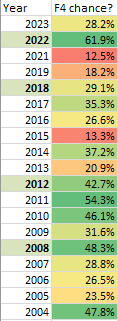
This exercise will serve a dual-purpose. It is this 2020 team that didn’t get a chance to make a run for a title. With an AdjEM of 30.23, it is very close to the 30.00 number. We can plug the 2020 team for other KU teams in other brackets to analyze how successful it would have expected to be. For the first table, we see which paths were the easiest and which were the hardest to get to a Final 4. Later we will look at the National Championship table.
The 2022 path was the easiest, as that KU team faced weak S16 and E8 opponents. Unsurprisingly, 2011 was also a good break. However, none of these paths can remotely be described as a “cake-walk.” Even the 2011 path is expected to miss a F4 nearly half the time. On average, a KenPom team at 30.00 AdjEM (abbreviated from now on as KP30) is only expected to make 33.3% of Final Fours. Looking at the 10 years KU got a 1-seed, this KP30 team makes the F4 37.9% of the time. In the other 9 seasons (either as a 2,3, or 4 seed), this KP30 team makes the F4 only 28.1% of the time. Even the Final Four is flat-out hard to get to.
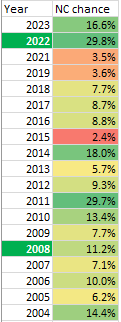
With National Championship chances, what first stands out is how much 2008 drops once you account for KU’s strength that season. The Final Four was loaded, with all four one-seeds. Having to beat North Carolina and Memphis was not easy. All told, a KP30 team getting KU’s path in 2008 was expected to win only 11.2% of the time. Incidentally, 11.2% was also the average chance of winning a national championship for a KP30 team.
KU’s easiest paths occurred in 2022 and 2011, with KU cashing in 2022. 2014, with teams like 11-seed Dayton, 7-seed UConn, and 8-seed Kentucky in the path; was an underrated good chance at a trophy. KU’s toughest paths have come relatively recently in the Self-tenure. The 2015 path would have been the only time KU had to face a chalk-bracket, as it would have had to have beaten three #1 seeds (including number-1 overall Kentucky) to earn a trophy.
The run of 2016-2018 also feels better in retrospect. While KU got three 1-seeds in this span, they only reached one Final Four and never played for a title in a championship game. But the cumulative expected titles a KP30 team would achieve in total for these three years is only 0.252. They turned out to be tough draws.
To tie this to the 2020 team, that group would have been expected to reach a Final Four, at best, 40% of the time. A National Championship would be 15% at best. Even as a 1-seed with a typical path, KP30 teams are likely to still get beat somewhere along the way. Winning 6 is tough.
Last, to highlight how difficult the tournament is, we’ll look at what AdjEM would be needed to reach certain thresholds. For instance, it would take an AdjEM of 34.72 for a team to reach the Final 4 50% of the time given the draws KU got over the past 19 tournaments. Even if we limit the draws to 1-seed paths only, the AdjEM would have to be 33.36. This is a level of play that only one KU team has reached in the 20-year Self-era. For National Championships, this level is more remarkable. To win a title 20% of the time, you’d need a 32.37 AdjEM. To win it 25% of the time, 34.00. To win it 33.3% of the time, the level of play would have to reach 36.30. To have even odds of winning, the estimated AdjEM would have to be 40.53. This type of performance has only achieved by the 1999 Duke team which was National Runners-up.
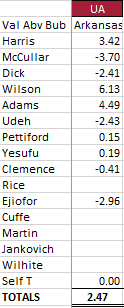
Jalen Wilson had his 18th team-MVP game of the season in his final college basketball game. He recorded half of KU’s game-MVP’s this season, the highest rate of any Jayhawk since Frank Mason’s 2017 season. His game-score for the Arkansas game was slightly-above his season average. K.J. Adams had a fine game himself despite foul trouble. It was his best outing since the home Baylor game in mid-February. Dejuan Harris was the other Jayhawk starter to produce positive value, although he wasn’t mistake-free (5 turnovers counting the 5 second inbounds and 10 second backcourt violations). Gradey Dick was guarded well by Arkansas, and he missed some chances to have a bigger impact. His defense wasn’t terrible, but he needed to score more than 7 points. Kevin McCullar had some big baskets in the second-half, but his negative-value game was due to his defense. He was assigned to stop Arkansas’s scorers and had a rough second-half on the defensive side of things.
The bench finished the season with the distinction of being Self’s worst in his 20-year tenure. Joe Yesufu hit a ridiculous first-half 3 to finish slightly above zero, and Bobby Pettiford’s steal and layup also catapulted him above bubble-level. The trio of Udeh/Clemence/Ejiofor was not at all productive and may have contributed to the loss as they tried to fill in for K.J. Adams’ foul trouble. There were a lot of factors that went into deciding the outcome.
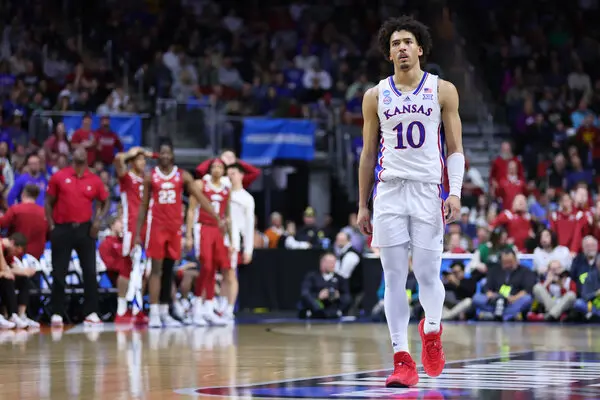
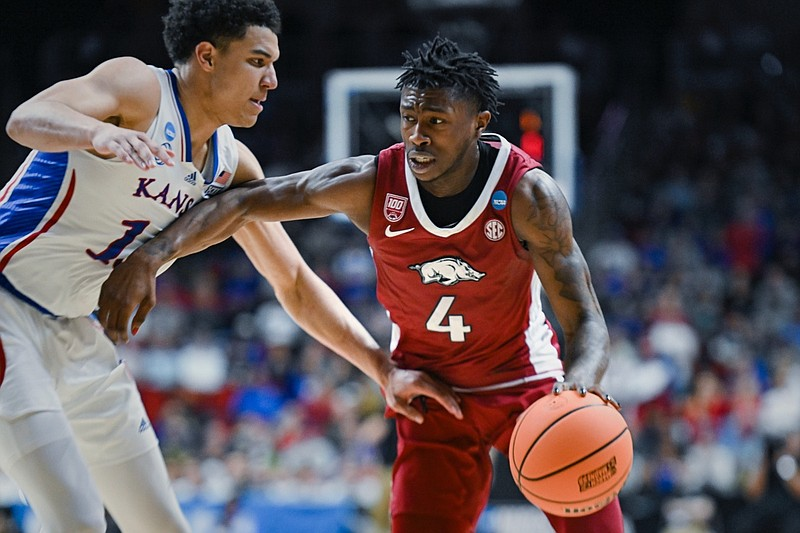
A questionable foul call on McCullar with 23 ticks left sent Arkansas to the line, where they would take the lead for good. Had the blocking call been a charge, KU would have likely gone to OT at worst.
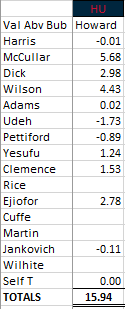
Kevin McCullar was KU’s most-valuable player in their Round of 64 win against Howard. The bulk of his value came from stingy defense and solid rebounding, but he also produced a positive offensive outing as well. Jalen Wilson had a quiet 20 points and also played strong defense, whereas Gradey Dick had the Jayhawks’ best offensive performance to overshadow his poor defense. This was also the bench’s first positive-value performance in its last 7 games.
The TEAM score of +15.94 was its third +15 game in the last four.
Since 1985, the NCAA Tournament has had 64+ teams, with four regionals of teams seeded 1 – 16. In this format, each team has to win 6 games to win the Tournament with each seed having a different path (for instance, a 1 seed has to beat a 16, 8/9, 4/5/12/13, 2/3/6/7/10/11/14/15 to make the Final 4…this differs from a 2 seed’s path). What this means, is that given this many instances, we have some interesting data by seed-line.
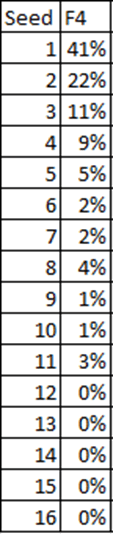
For today, we will focus on the prevalence of each seed in the Final 4. With four regionals, the Final 4 is made up of the four regional winners. It isn’t until this round that teams of the same seed can meet. We will first look at which percent of each seed makes the Final 4.
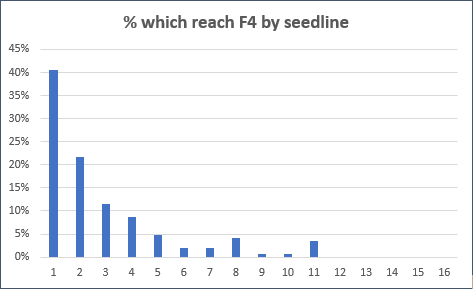
Above is the table, and below is the bar chart of the same data.
The 1-seed is the most prevalent (unsurprising), with a declining frequency by seed down to the 7 seed. However, we see a jump when we get to the 8-seed, and the 11-seed has also won its regional more times (5x) than the 6-seed (3x) since 1985. This is definitely a surprise in the data. Some might hypothesize that the reason for this is that the 11-seeds often contain undervalued mid-majors, whereas the 6-seeds are often weaker power conference teams, and that the best mid-majors are therefore under-seeded. In other words, it would be a claim that the bracket-makers get things wrong along these middle seed-lines.
However, this doesn’t really work. After all, the 6 v. 11 game is played 4 times in the First Round. If 11-seeds were systematically under-seeded, it would show up here. Instead, in 148 games, we see that 6-seeds win 61% of these matchups and have an average scoring margin of +2.96 (nestled in between the 5v12 and 7v10 margins). For whatever reason, the 11 seeds have had more success than the 6’s at winning a regional. However, a 6-seed has won the NCAA Tournament (1988 Kansas). Of course the 1983 N.C. State championship team was also a 6-seed. It falls outside the range of 1985-present, but their run was no less impressive than it would be today.
But now let’s look a little deeper at the 1-seed’s frequency at a Final 4. In the 37 tournaments since 1985, 41% (60/148) of the top seeds made the Final 4. This works out to an expected number of 1-seeds per in the Final 4 per tournament of 1.62. Because each regional is decided independently, this is just the average expectation. Some years it might be 1, some it might be 2. And other years, less frequently, it might be 3 or all 4. Or, it could be 0.
Historically, there has been 1 tournament (from 1985-2022) where all four 1-seeds made it to the Final 4. This was in 2008. There have also been 2 tournaments in this span where no 1-seed has made it to the Final 4. This happened fairly close to 2008, with 2006 and 2011 seeing no 1-seeds win their regionals.
We are left with 148 independent events, which are the historic regional results by seed. Using this data set, we have had all four 1-seeds win their regionals in exactly 1 tournament of 37 (2.7%). How often should we expect this to happen? If we take (0.4054)^4, we get the answer, which is also 2.7%. While one would expect the 1-seed to have the best chance of winning its regional, having all four 1-seeds go 16-0 before the Final 4 is a rare event, as shown by the historic results.
The flip side is the question of how frequently we should see NO 1-seeds make the Final 4. It has happened twice in 37 tournaments, but is that about what we’d expect? The formula here will calculate how likely it is that at least one 1-seed makes the Final 4. It is similar to the earlier example, and it is calculated thusly: 1 – ((1-0.4054)^4). The result is 87.5%, meaning that we’d expect to see no 1-seeds about 12.5% of the time (roughly 1 year out of 8). In reality, this has only occurred 2 years out of 37.
Using the 1-seed success rate at making a Final 4, the last question is, what will happen next? All 1-seeds, or no 1-seeds? Clearly, the answer is the latter is more likely. This does depend on the strength of the 1-seeds relative to the field. In 2008, the 1-seeds were all excellent (although 2011 had a good crop of 1-seeds by computer metrics as well). But assuming the relative 1-seed skill-level will remain what it has been over the past 37 seasons, the math says it is 5.15 more likely that all the 1-seeds miss the Final 4 in any given year than it is that all four 1-seeds make the Final 4.
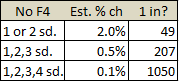
We will next look at other seed-lines. While 2-seeds are all excellent teams, their performance when compared to the 1-seeds is a significant drop-off. We’d expect all four 2-seeds to make a Final 4 only once in 458 tournaments. For the 3-seeds, this would occur once in 5,744 tournaments. This gets exponentially rarer as we move down the seed-line.
Last, let’s look at how often we’d expect to not see any top seed. This table has the estimates:
2011 is the only tourney to fail to have a 1 or 2 seed in the Final 4. The other two scenarios haven’t occurred and likely won’t in your lifetime.
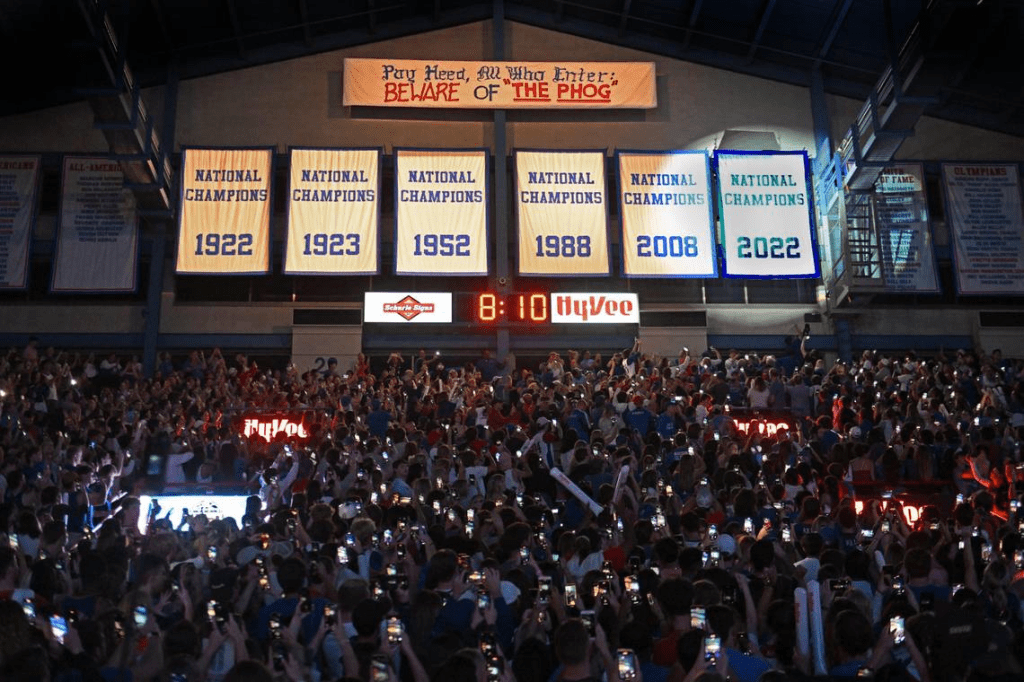
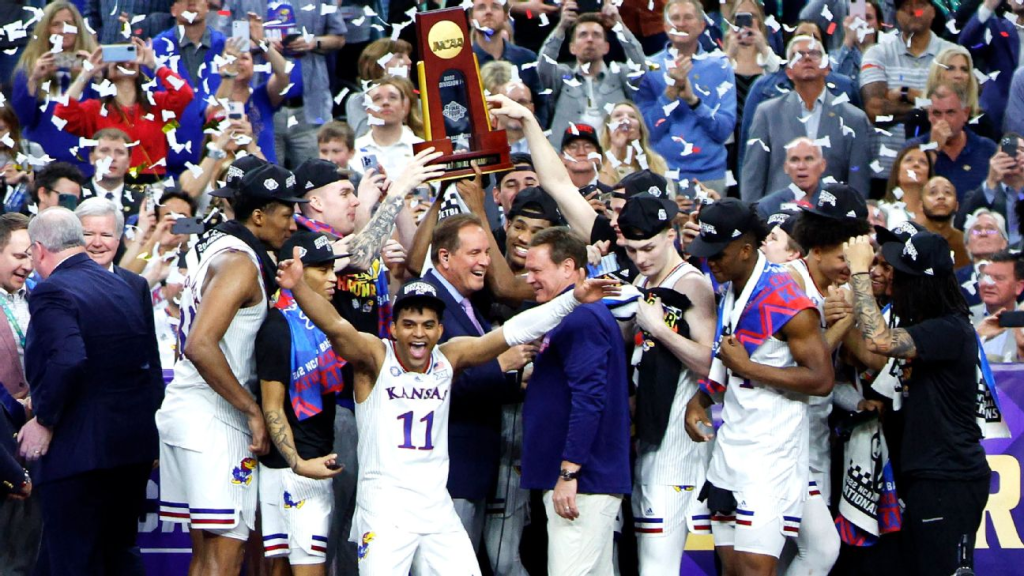
Allen Fieldhouse has been redecorated. The 2022 banner has now been raised, so it seems like a good time to review the National Championship games in terms of player value.
Game Summary:
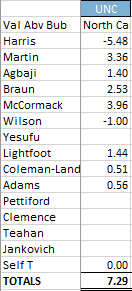
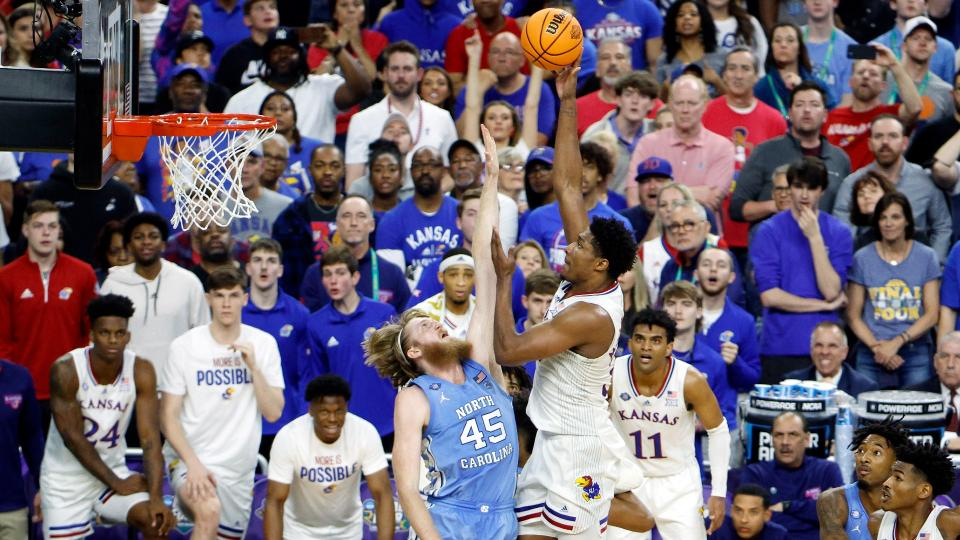
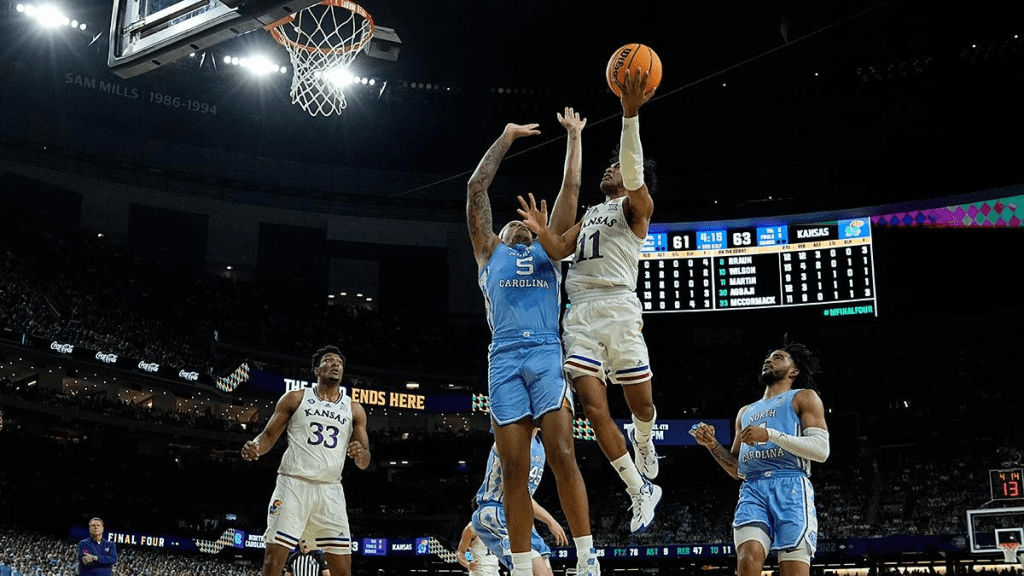
David McCormack was the game MVP for the Jayhawks. His value above bubble was added in the final two minutes. He made a put-back off his own miss to put KU up 70-69, walled up Armando Bacot to force a turnover, and then made the final basket of the game over Brady Manek to extend the score to 72-69. These three possessions made the difference.
Remy Martin was just below McCormack in terms of player value. He hit 3 huge second-half 3’s as well as a driving layup, with each shot answering Carolina runs which had brought the Tar Heels closer to the lead. Martin was KU’s best player in the tournament, adding 4.11 PPG above bubble during the 6 tournament games.
Christian Braun shook off a tough first half to finish in the black. His tough contest on the final shot made it impossible for Carolina to hit a miracle 3 to tie the game. Mitch Lightfoot fouled a lot, but when he was in he did enough to add value. He made his own shot, grabbed an offensive rebound, and forced a turnover to balance out the 3 FT’s he gave up. Ochai Agbaji didn’t record a counting play after his missed layup with 5:53 to play. but throughout the game, he did more good than harm, particularly in the first half when other Jayhawks were struggling. K.J. Adams contributed one play, forcing UNC into a turnover in the first half. Jalen Coleman-Lands grabbed a rebound for his contribution.
Jalen Wilson turned away from a dreadful first half to contribute to a comeback for the ages. Although he finished below bubble, he was very close to neutral. Dejuan Harris had the worse game of any Jayhawk, with his best stretch coming at the beginning of the second half. His worse blunder was stepping on the sidelines with 4 seconds left to give the Heels a final shot to tie. But by only scoring 2 points on 5 shots, he was KU’s weakest link in the game.
The TEAM score of +7.29 was KU’s 11th consecutive positive, above-bubble performance. While not the best overall game of the season, it was enough to get the win and with it KU’s 6th banner.
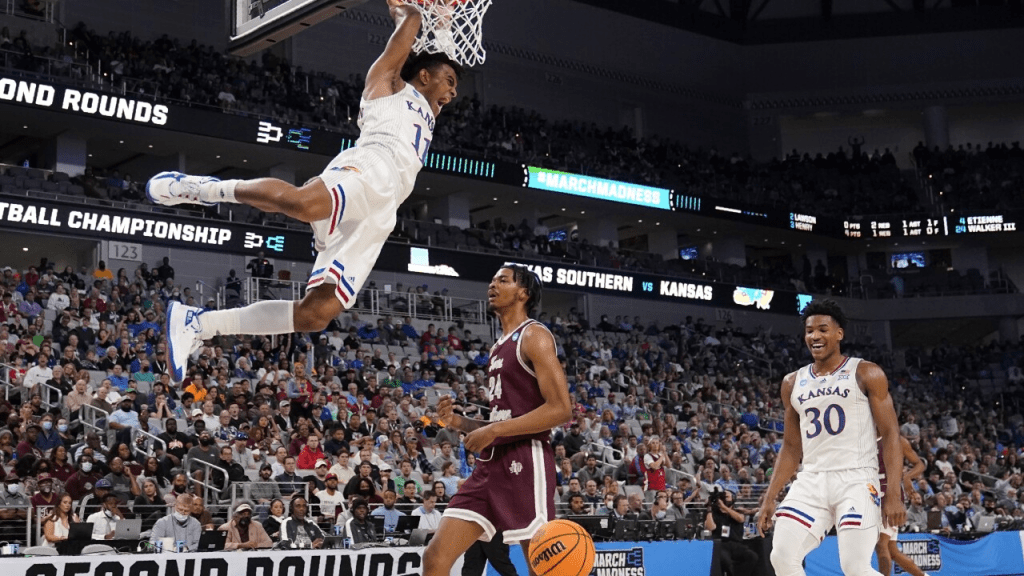
Remy Martin slams down 2 points, and earns his second team-MVP of the season
Game Summary:
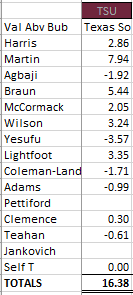
Cook, Remy, cook. After earning his first team-MVP of the season in the 34th game on the schedule in the Big 12 Championship, Remy Martin got his second team-MVP right away. Scoring, assisting, stealing, and playing with a contagious energy; he was a spark that allowed KU to put away 16-seed Texas Southern early in the game. If he continues to play like this, KU is undervalued when it comes to their chances.
Other strong outings were from Christian Braun, Mitch Lightfoot, Jalen Wilson, Dejuan Harris, and David McCormack. Focusing on Mitch, the sixth-year super-senior has had positive value-performances in 5 of his last 6 games. For the season he is nearly adding more value than a bubble-player, showing he has improved tremendously.
With a TEAM score of +16.38, KU has played four games in a row where their opponent-adjusted value score was +10 or higher. This matches their longest streak of the season, which occurred in the season’s first four games. It may be tough to remember that streak now, but it was when KU was playing its best and didn’t look to have many flaws. Although that period was short-lived, injury and slumping play from some its regulars would plague much of the season, it seems to have returned at the right time.
Coach Self said that Martin and Lightfoot essentially give KU 7 starters, an assessment that the numbers show to be accurate. If anything, it is understated; Jalen Coleman-Lands has been playing well on the year, also. With the team strongly favored in its next two potential games, KU is rolling when you want to be.
Since 1985, (before 2022 Tourney) here are how seed-lines have performed in the NCAA Tournament:
There have been 36 tournaments (1985-2019, 2021). With 4 of each seed-line during each tournament, there have been 144 total teams for each seed line over this time period. This gives us a healthy sample from which to make observations.
Let’s begin by tracking overall tournament wins per seed line.
Seed
Wins
1
3.46
2
2.42
3
1.90
4
1.56
5
1.14
6
1.10
7
0.93
8
0.73
9
0.61
10
0.64
11
0.66
12
0.54
13
0.26
14
0.17
15
0.08
16
0.01
The 1-seed averages 3.46 wins per tournament, the 2-seed 2.42 and so on.
Round 64
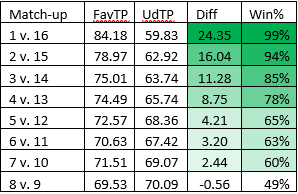
The table below is fairly self-explanatory. FavTP is the average total points for the favorite (better seed), and the UdTP is the underdog (worse seed) average total points for each seed matchup. Point differential and winning percentage (for better seed) is then shown.
One thing to note is that only the top 3 seed lines are expected to win their games by double-digits. The 4-seed wins by 10+ less than half the time. Another notable factor is that the 5/12, 6/11, and 7/10 games are fairly close to one another in terms of point differential and favorite win percentage. The 8/9 is almost a true coin flip, but the 9 seeds have actually had slightly more success to this point.
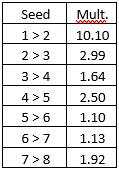
There is a clear drop-off from the 1/16 to the 2/15 games. It is actually the starkest drop-off in terms of winning success. 1-seeds are 143-1 in Round 64 NCAA Tourney games; it is almost a bye game to the next round for the top seeded teams. To illustrate the relative performance by seed line, observe the following table. This table compares a favorite seed (seeds 1-8) against the next seed line down in terms of winning success. So we compare 1 v 2, 2 v 3, etc. and see how much more successful the better seed-line is than the next line down.
This table shows that a 1-seed is 10.1 times more likely to win its R64 matchup than a 2-seed. To be certain, 2-seeds are relatively safe to advance this round. But 1-seeds are just this much likelier to advance. As we go down the chart, we see that difference between seed lines shrinks. 5-seeds are barely better than 6-seeds when it comes to getting out of the First Round. If your team is projected to be near one of these seed lines or the other, getting that extra bump up a seed line can matter.
Round 32
When we get to this round, there become diverging possibilities with regards to which seeds play which seeds. For instance, a 1-seed can play either an 8 or a 9. A 4-seed which wins will play a 5 or a 12. This means that additional context is needed to understand how the bracket has historically played out.
Let’s start with the 1-seeds. Of the 143 top seeds which made the R32, 123 have gone on to win in this round (86%). Of the 20 which lost, interestingly 14 of these have lost to 8-seeds and only 6 have lost to 9-seeds. With the only 16-seed to reach this round falling to a 9-seed, this means that the 1/16/8/9 pod has had this many advance out of the R32 (to the S16):
1: 123 (85%)
16: 0 (0%)
8: 14 (10%)
9: 7 (5%)
Continuing on, here are how the 2/15/7/10 pods have gone:
2: 91 (63%)
15: 2 (1%)
7: 28 (19%)
10: 23 (16%)
Here are how the 3/14/6/11 pods have gone:
3: 75 (52%)
14: 2 (1%)
6: 43 (30%)
11: 24 (17%)
Here are how the 4/13/5/12 pods have gone:
4: 67 (47%)
13: 6 (4%)
5: 49 (34%)
12: 22 (15%)
The first thing that stands out is how good the 1-seeds are at getting out of the first weekend. At 85%, this is far more than the 63% of 2-seeds that make the S16 or beyond. Next, notice this effect on the 8 and 9-seeds. 10, 11, and even 12-seeds are more likely to make the S16 than the 8 or 9-seed because these worse seed lines avoid the 1-seed in the region. In fact, a 10, 11, or 12 is more likely to make the S16 than the 8 and the 9 combined.
The worse seed to make the S16 is a 15-seed, and this has been done twice. Two 14-seeds have also made the S16. We will focus on that round next.
Sweet 16
With another round in the books, the bracket possibilities can become even more complex. By this point, usually the entire country has seen its perfect bracket busted. If the bracket is chalk in a region, this is where the 1-seed faces the 4-seed and the 2-seed faces the 3-seed. Note that a 1-seed has faced a 4-seed 55 times (38.2%), and a 2-seed has faced a 3-seed 45 times in this round (31.3%). A Sweet 16 which has all four top seeds still alive should occur about 11.9% of the time. Since there are four regions (four occurrences), we expect a Sweet 16 with seeds 1,2,3,4 in any one of the same region to only happen in 2/5 tournaments. This just shows how crazy the bracket can get given the possible permutations and upset possibilities.
When we look at success, we see that 1-seeds have won 100/123 games in this round (81%). After accounting for those 1-seeds that have already lost prior to this round, we discover that 69% of 1-seeds make it through the S16. Below is the table showing how many of each seed-line makes it through, from the S16, to the E8:
1: 100 (69%)
2: 65 (45%)
3: 37 (26%)
4: 21 (15%)
5: 9 (6%)
6: 15 (10%)
7: 10 (7%)
8: 8 (6%)
9: 4 (3%)
10: 8 (6%)
11: 9 (6%)
12: 2 (1%)
No seed worse than a 12 has made it to the E8. We see the 1-seed power once again in how the results are skewed, as 5-seed is now less likely to advance than either the 6 or 7-seeds (and has the same number of E8 appearances as the 11-seed). By this point, the only seed expected to make it past the S16 more often than not is that top line. Even the 2-seed is batting less than 50%.
Elite 8
The Elite 8 round has with it additional pressure, as teams can taste a Final 4 berth. Interestingly, in this round the 1-seed does not have the best winning percentage. In fact, the 4,5, and 8-lines are all better than the 1-seeds. 5-seeds are 7-2 in this round, showing that if they can make it through, they do quite well in the later rounds.
Nevertheless, the 1-seeds get the most teams through this round due to the fact they get so many teams to this round. Of the 100 1-seeds to make the Elite 8, 59 have made the Final 4 (59%). Below are the teams to make it past the E8 and into the F4 by seed-line:
1: 59 (41%)
2: 30 (21%)
3: 17 (12%)
4: 13 (9%)
5: 7 (5%)
6: 3 (2%)
7: 3 (2%)
8: 5 (3%)
9: 1 (1%)
10: 1 (1%)
11: 5 (3%)
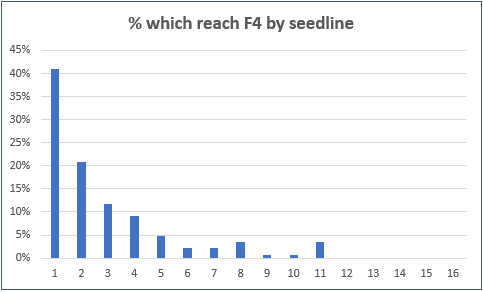
This handy graph helps you visualize the above:
The 1-seed is nearly twice as likely to make the Final 4 as the 2-seed. There seems to be a steady decline in F4 frequency by seed-line, until you reach the 8-seed. It drops back down, until, surprisingly, the 11-seed pops back up with 5 teams making a Final 4. A curious case of how the bracket has unfolded, to be sure. 59% of the Final 4 features teams in the top half of the bracket (seeds 1,4,5,8,9,12,13,16); 41% of the Final 4 features teams in the bottom half of the bracket (seeds 2,3,6,7,10,11,14,15). This is, once again, due to the skew of the 1-seed.
Final 4
The Final 4 round, or National Semifinals, is the first round that can feature teams of the same seed-line facing off against one another (ignoring the First Four/play-in games). This has happened in 18 out of the 72 times (25%). In 13 instances, it has been two 1-seeds. In 3 instances, it has been a matchup of 2-seeds. Once it has been between 4-seeds, and once more it has been between 5-seeds. No 3-seeds have ever faced off against each other in this round.
Using the same idea as before, we track the teams which won in this round and made it to the next. Of the 72 teams which won a Final 4 game to make it to the National Championship game, this is how the result are broken down by seed-line:
1: 36 (50%)
2: 13 (18%)
3: 11 (15%)
4: 3 (4%)
5: 3 (4%)
6: 2 (3%)
7: 1 (1%)
8: 3 (4%)
A point of clarity may be in order. These percentages add up to 100%, which is to say that exactly half of all teams to make the national championship round have been 1-seeds. But this does NOT mean that a 1-seed has a 50% chance of making the National Championship game. To get those odds, you’d have to divide each percentage above by 2. So, a 1-seed has a 25% chance of making the NC game, a 2-seed a 9% chance, etc. given the historical precedent.
The 1-seed dominates this round again, showing that in a battle of attrition (which is the NCAA Tournament’s loser-go-home system), the best teams tend to last the longest. The final NCAA tournament “round” (the National Championship game) will be the final round examined.
National Championship Game
Even though 1-seeds occasionally face each other in this round, (7 times out of 36), the 1-seed has a winning percentage of 64%, and captures 64% of all NCAA Tournaments. This means that a 1-seed is more likely to win the NC game than the rest of the seed-lines combined. When a 1-seed has faced a team of a different seed in the NC game since 1985, it is 15-5 (.750). For whatever reason, the best seed-line seems to outperform in this round. In fact, 4 of the losses that the 1-seed had against non-1-seeds were before 1998…since that year only 2-seed Villanova in 2016 has knocked off a 1-seed in the NCAA title game.
Below are the proportion of national champions by seed-line. Once again, these aren’t the odds of a team on that seed line winning the NC (you’d have to divide by 4 to get the odds of any one team winning), but rather how many national champions have that associated seed.
1: 23 (64%)
2: 5 (14%)
3: 4 (11%)
4: 1 (3%)
5: 0 (0%)
6: 1 (3%)
7: 1 (3%)
8: 1 (3%)
Once again, this is only data from 1985 on. Before the tournament expanded to 64 teams in 1985, there were lower-seeded teams like 1983’s N.C. State (6-seed) who won. But since ’85 the title has been mostly claimed by 1-seeds with some 2-seeds.
If anything, this trend is moving against underdogs. The 80’s saw multiple Cinderella runs, including 1985 Villanova (8-seed) and 1988 Kansas (6-seed). Since 2007, the only team that has won a National Championship outside a 1 or 2-seed is UConn (2011 as a 3-seed, 2014 as a 7-seed). There have been upsets and even Final 4 runs by double-digits seeds, but in the end it tends to be a 1-seed that wins it all.
538 Data
Since 2014, 538 has released March Madness models which project each team’s chances after the bracket is released and throughout the tournament. Using the pre-tournament data (but following the play-in First Four games), we will use these models to compare against the actual results. The reason to do this is to see if the historic results are close to what is predicted, or if the models think the seed-line success to follow a different distribution.
Starting with expected wins by seed, here is what 538 has projected in the 7 tournaments from 2014 – 2021 (with no tourney in 2020):
1: 3.12
2: 2.52
3: 1.83
4: 1.70
5: 1.29
6: 1.08
7: 0.86
8: 0.69
9: 0.64
10: 0.60
11: 0.59
12: 0.38
13: 0.21
14: 0.16
15: 0.06
16: 0.02
With more data, these numbers should become an even more accurate “predictor” of what seed-lines “should” win. Let’s now compare what 538 is saying seed-lines “should” win with what the wins the seed-lines have actually produced:
Seed Actual Wins Expected Wins Difference
1: 3.46 3.12 +0.34
2: 2.42 2.51 -0.09
3: 1.90 1.83 -0.07
4: 1.56 1.70 -0.14
5: 1.14 1.29 -0.15
6: 1.10 1.08 +0.02
7: 0.93 0.86 +0.07
8: 0.73 0.69 +0.04
9: 0.61 0.64 -0.03
10: 0.64 0.60 +0.04
11: 0.66 0.59 +0.07
12: 0.54 0.38 +0.16
13: 0.26 0.21 +0.05
14: 0.17 0.16 +0.01
15: 0.08 0.06 +0.02
16: 0.01 0.02 -0.01
The 1-seed has the biggest differential between “expected” wins and actual wins. 538 models have 1-seeds winning 0.34 fewer games per team per tournament, which isn’t a small number. On the flip side, 5-seeds are expected to win more often at 0.15 wins per team per tournament. 4-seeds are similar to 5-seeds. Clearly the 81% winning for 1-seeds in that Sweet 16 round is showing up in these differences.
We’ll next compare the Round of 64 games, the only games with set seed matchups (1 v 16, 2 v 15, etc.).
Matchup ActWin% ExpWin% Diff
1 v 16 99.3% 98.0% +1.3%
2 v 15 93.8% 95.3% -1.5%
3 v 14 84.7% 87.8% -3.1%
4 v 13 84.1% 78.5% +5.6%
5 v 12 64.6% 73.0% -8.4%
6 v 11 62.5% 61.8% +0.7%
7 v 10 60.4% 56.7% +3.7%
8 v 9 49.3% 51.2% -1.9%
As far as favorites go; 1-seeds, 4-seeds, 6-seeds, and 7-seeds have outperformed in the R64. For underdog seeds; 9-seeds, 12-seeds, 14-seeds, and 15-seeds have been better than expected. The biggest thing that jumps out is the 5/12 matchup, a trend many filling out their NCAA brackets have picked up on. The % difference can be misleading. We’ll now look at the expected number of wins (out of 144) for the better seed compared to what has actually occurred:
Better Seed in R64 Act Wins Exp Wins Diff
1 143 141.2 +1.8
2 135 137.3 -2.3
3 122 126.3 -4.3
4 113 121.1 -8.1
5 92 105.1 -13.1
6 90 89.0 +1.0
7 87 81.6 +5.4
8 71 73.8 -2.8
In terms of numbers, the 12-seed over the 5-seed is the biggest historic surprise. However, there is one better way to judge the performance of seeds against expectation.
Seed in R64 Multiple
1 2.887
2 0.736
3 0.775
4 0.688
5 0.655
6 1.030
7 1.168
8 0.926
9 1.080
10 0.856
11 0.971
12 1.526
13 1.453
14 1.289
15 1.358
16 0.346
What this shows is that the 1-seed has actually performed the best in the R64 compared to expectation. To best explain this, 1-seeds are expected to win 49.5 times more often than they lose in the Round of 64. In reality they’ve won 143 times more often than they’ve lost (143-1). This generates a 2.887 multiple (143/49.5). Moving down the line, 2-seeds are expected to win 20.4 times more often than they lose. In reality they’ve won 15 times more often, for a multiple of 0.736 (15/20.4).
Instead of comparing each round, we’ll move on to the Final 4 and see how seed-lines have done against expectation. Below shows the seed, actual frequency of the F4, expected frequency, and difference.
Seed ActF4% ExpF4% Diff
1 41% 39% +2%
2 21% 22% -1%
3 12% 10% +2%
4 9% 10% -1%
5 5% 6% -1%
6 2% 4% -2%
7 2% 3% -1%
8 3% 2% +1%
9 1% 1% 0%
10 1% 1% 0%
11 3% 1% +2%
12 0% 0% 0%
There isn’t a ton to say here. The numbers are fairly close to what is expected, with the 11-seed (unsurprisingly) overperforming.
Last, we’ll look at National Championships. This is similar to the F4 table above, but includes total NC’s by seed (since 1985) alongside percentage of national champions.
Seed ActNC ExpNC Diff
1 23 (64%) 18.6 (52%) +4.4
2 5 (14%) 7.8 (22%) -2.8
3 4 (12%) 2.7 (7%) +1.3
4 1 (3%) 2.9 (8%) -1.9
5 0 (0%) 1.3 (4%) -1.0
6 1 (3%) 1.0 (3%) 0.0
7 1 (3%) 0.5 (2%) +0.5
8 1 (3%) 0.4 (1%) +0.6
9 0 (0%) 0.3 (1%) -0.3
10 0 (0%) 0.2 (1%) -0.2
11 0 (0%) 0.3 (1%) -0.3
12 0 (0%) 0.0 (0%) 0.0
First, 1-seeds have clearly overachieved according to this table. They’re “expected” to win an NC about half the time, but in reality account for nearly 2/3 of all titles in the 64+ team era. Next, 4-seeds are “expected” to win more often than 3-seeds. This reveals an anomaly in the model data. Apparently since 2014, 4-seeds have graded out as slightly stronger than 3-seeds from an efficiency perspective. Over a longer time horizon, we’d expect this to revert to normal. We see that seeds below have a slight chance per the model, until you reach the 12-seed where it becomes extremely rare.
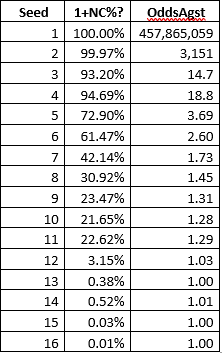
We can also look at how likely it is for a seed-line to have won over a certain time period. In other words, given the 36 tournaments since 1985, how likely is it that an 8 seed has won at least one National Championship?
It isn’t too surprising that it is very likely that at least 1-seed has won a NC since 1985. With 36 years of play, it is guaranteed that a top seed will be able to cut down the nets. This remains true for all of the top four seeds. It is somewhat of a surprise that a 5-seed hasn’t won a NC yet, since this should happen 72.9% of the time over a 36-year period. But the 7 and 8-lines make up for this.
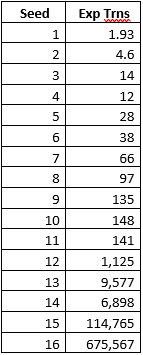
We’ll close this out by showing how many tournaments are expected for a seed-line to win a NC. For a 1-seed, you’d need 1.93 tournaments, which reflects that a 1-seed “should” win a NC about every other year. Obviously, at some points a 1-seed will win multiple years in a row (currently at 4 in a row), and at other points it will be a few years when a 1-seed doesn’t win (they’ve been shut out in consecutive years multiple times, including 85/86, 88/89, 97/98, 03/04).
Once again, the “expected” data needs more years to smooth out. A 4-seed shouldn’t be more likely to win than a 3-seed, the same goes for a 14-seed over a 13-seed. If you combined seeds 10-16, we run into a calculation of a double-digit seed winning the National Championship once every 67 years. This may seem to be too generous to double-digit seeds, but remember that 4 11-seeds and 1 10-seed have made a Final 4. Although none of these have won a national semifinal game, UCLA came very close last season in 2021. Had they knocked off Gonzaga, they’d have been one win away from doing just this (and would have had about a 20% chance of winning). With more time, the unthinkable might happen. But it’d almost certainly be a 10, 11, or under-seeded 12 which won.


 Charting the Hawks