The 2023 Kansas Jayhawks went 28-8 (13-5). The team won the Big 12 Regular Season Championship and earned a 1 seed in the NCAA Tournament. Kansas reached the Round of 32 before losing. The team’s Sports Reference page is here.
Offense
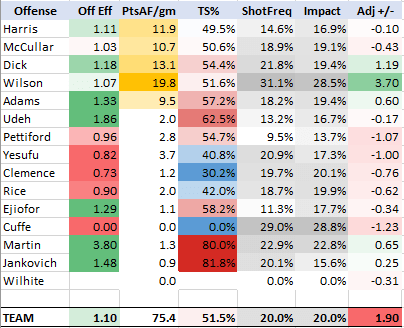
The 2023 Offense was led by Jalen Wilson. Wilson’s shot frequency was the team’s highest since Thomas Robinson in 2012 also had a 31.1% ShotFreq. Despite his high volume, Jalen was right on pace with the team average regarding true shooting percentage (TS%). Gradey Dick was the team’s second most-valuable player on offense, generating his value through scoring and high-percentage outside shooting. His ability to limit turnovers also was a plus. K.J. Adams was the other starter to add offensive value, largely due to his offensive rebounding and efficiency. Dajuan Harris improved the most toward the end of the season. Over his last 13 games, Juan was over +1.00 per game on offense.
Defense
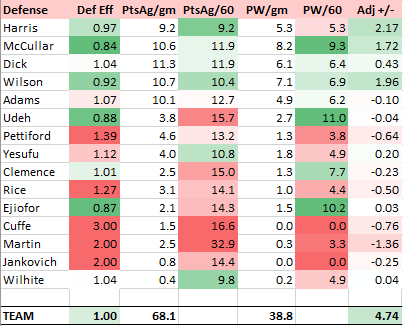
The 2023 defense was the better half of the ball for Kansas. Despite playing an undersized starting 5, KU finished the season as KenPom’s #11 defense. Dajuan Harris earned Big 12 DPOY honors, and his value is quantified best here at over 2 points per game above-bubble. Jalen Wilson and Kevin McCullar were also excellent defensive players. Gradey Dick was someone who got overly criticized for his defense. While he had some struggles, he hustled, rebounded, and had a fair amount of deflections. In total, he produced an above-bubble defensive effort to compliment the value he provided on the offensive side of things. K.J. Adams was around bubble-level while playing out of position. The bench had some acceptable defenders, with Joe Yesufu probably getting overlooked the most. Joe wasn’t a lock-down defender, but he also used his strength and quickness to bother bigger players. Freshman Ernest Udeh showed the most defensive potential as an athletic and long big-man. It will be interesting to see how his career develops on this end of the floor.
Total Adjusted PPGAB +/-
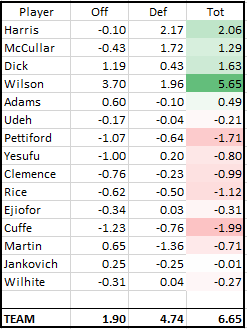
Jalen Wilson put up an All-American level of value, and with it, a 1st team nod. All starters were positive, while each bench player producing at or below-bubble. KU’s bench was bad this season, and finished as the worst in Self’s 20 seasons in Lawrence.
Value Seen 3 Ways
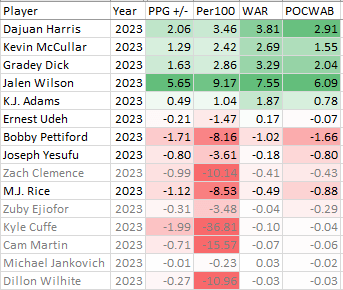
Player value can be shown in slightly different ways. This is because players have different levels of playing time based on a variety of factors. To best show this, we want to consider these four levels of player value.
First is PPG +/-. This is generally the best metric as it tracks closest with the traditional stats that are most intuitive to basketball fans, such as points per game or rebounds per game. This value metric estimates how much better, in net points per game, a player has been above that of a hypothetical bubble-level player.
Second is Per 100 possessions +/-. This value metric looks at how much better a player has been over a bubble-level player over the course of 100 possessions. This metric is valuable when comparing players who’ve played in different numbers of games but similar minutes. KU’s bench players, who tend to battle each other for backup playing time this season, are best compared against one another using this metric rather than PPG +/-.
Third is WAR, or Wins Above Replacement. This value metric compares KU players against a hypothetical replacement player who is an average D1 player instead of the (better) bubble-level player. It also converts points +/- into “wins” using a multiple. This metric is cumulative, so players with more minutes will have the chance to earn more WAR (provided they are above replacement…below replacement players will see their values dip).
Fourth is POCWAB, or Player’s Own Clutch Wins Against Bubble. This metric takes into account to relative toughness of the opponent, allowing a player to show his “clutchness” and weights games played against teams around bubble-level more than those low-major buy games.
Cumulative Points Above Bubble on the Season Chart
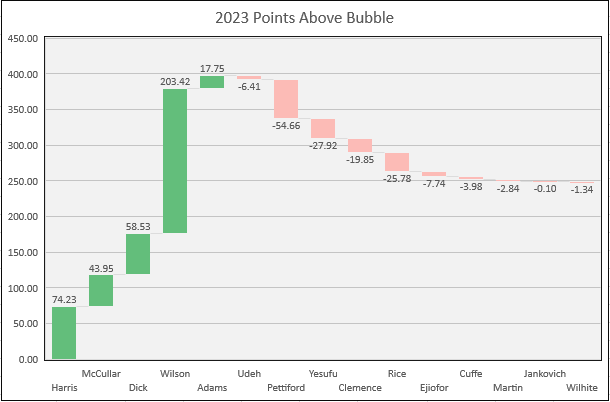
This chart is a telling picture of how the team’s starting 5 carried KU. Each starter is solidly positive, but this value begins to drop once you get to the bench. Ernest Udeh was KU’s best rotation bench player, yo-yoing above and below bubble on the season game-to-game. The reserve guards/wings were mostly dreadful, while the other bench bigs didn’t get many minutes.
Assessing the 2023 Team
Back in mid-October, the 2023 team’s value-stats were projected here.
Given who was returning, and attempting to project how good the incoming players would be, we estimated KU would have an average game score of +5.76. The 2023 team outperformed this benchmark by about 1 point. Given historic trends, KU’s estimated game score would have placed it around a 4-seed, whereas KU earned a 1-seed due to a great record in close games. With its toughest-in-the-nation strength of schedule and 17 Quad-1 wins, KU earned a 1-seed despite the various computer metrics placing the team around 10th. While the team lost in the second-round to an 8-seed, it was only 4 point favorites at tip, making the early exit less of an upset than one normally associates with 8-seed over 1-seed games. In total, the team overachieved in the regular season and underachieved in the Tournament. While one wishes these scenarios were reversed, they aren’t completely without hardware. The team did win a Big 12 Title outright by going 13-5. In (parentheses) are the preseason projections for the individual’s Adj PPG +/-. Actuals are in the table above.
Getting to individual performances, Jalen Wilson outdid his projection (+2.79) by nearly 3 value points per game. He became the volume scorer the team needed him to be, and finished the season as a 1st-team All-American thanks to the highly productive season he had.
Dajuan Harris was KU’s second-best player over the course of the season, and his season also exceeded expectations greatly (-0.28). It seems odd now that he was projected to be a (slightly) below-bubble player. But that is what he was his first two seasons. Harris showed an improved ability to score the ball, and became more comfortable running the show and making reads off the high-ball screen. His defense was also greatly improved, as evidenced by his conference DPOY award.
Gradey Dick’s freshman season was about as projected (+1.57). He started out the season on fire from behind the arc, but as teams started to defend him more aggressively he had to find other ways to contribute. It was the best freshman season since Devon Dotson in 2019, and despite the high expectations, Dick was the only newcomer to meet his projected score in 2023.
Kevin McCullar, a veteran newcomer, was slightly below his projected value (+1.94). This shouldn’t discount his season, which was still solid. Kevin’s defense was certainly where his value was. He was less of a stingy defender than expected, but he made up for this by proficient rebounding and forced turnover numbers. He was capable at switching and communicating things as well. KU isn’t anywhere near the 10th best defense without him.
K.J. Adams (+0.28) didn’t exceed expectations by as much as one might think, however a per-game above-bubble value score is only one way to quantify player value. Adams’ projection was premised on the idea he would get fewer minutes and play out-of-position less. The fact he was KU’s starting 5, played nearly 68% of available minutes, and still reached expectations means quite a bit. He was able to utilize the mismatch on the offensive side of things, being quicker than most opposing 5’s. His defensive rebounding was a work-in-progress for most of the year (although it did improve). His position moving into future seasons will be something to watch. While he proved he can handle the 5, where he plays will be predicated on the roster construction. If he does move to the power-forward role, expect his defense to improve (as he defends more perimeter-oriented players) and his offense to worsen (as he would be guarded by quicker players).
Ernest Udeh (+0.12) didn’t finish above-bubble as forecast, but he wasn’t too far off. Udeh was KU’s best bench player, and showed the most upside. While he is still underdeveloped on the offensive side of the ball, he should prove to be a good to great defender in upcoming seasons. And with a PG as good as Dajuan Harris finding him for lobs, he should still project to produce for the KU offense next season. Watch out, Udeh should be a good one.
Zuby Ejiofor (-0.18) was around his projection. Zuby’s rebounding abilities and instinct as a freshman were impressive. Like Udeh, he has great potential to be a very good defender on the interior. Questions still surround his offensive capabilities. If he can develop a back-to-the-basket game, it would improve his chance for minutes in future seasons.
Joe Yesufu (-0.35) had an improved season from last, but one still not good enough to reach projections. Joe shot poorly again in 2023 (28.6% from 3), while at least his defense did reach positive-value. To defend Yesufu a bit, he played more minutes than projected and had a Per100 score that was close to projection.
Zach Clemence (+0.47) was the most-disappointing returnee. After a freshman year that saw some him show toughness in moments (at TCU in 2022) and big shots (home vs. OU in 2022), he was picked to be the guy to have that sophomore jump. It never came, and instead went to K.J. Adams. Clemence graded out as a worse defender in 2023 while he never could get his shot to fall.
M.J. Rice (+0.69) was obviously over-projected, as one would expect his adjustment to be easier for a wing than it would be for the freshman bigs. Partly due to injury, Rice never got established in the rotation and didn’t see any court time in the NCAA Tournament. Rice was negative on both sides of the ball for the season. He showed flashes of potential (19 points vs. Texas Southern), but how much better he gets in future years will depend on how hard he is willing to work.
Bobby Pettiford (-0.59) had the worst season of any returning player and anyone who played at least 10% of available minutes. He missed his (already quite low) projected score by over 1 ppg. Injury issues were also a problem for him, but he hasn’t shown much over the past 2 seasons to project much success moving forward. He had trouble taking care of the ball at times, which is the one thing you absolutely needed from a player of his role.
Cam Martin (-0.31) played 10 and 1/2 minutes in an injury-affected season. Known for his shooting coming in, Martin went 3-4 from the floor and grabbed 2 offensive boards in that time. He only appeared in four games, but his biggest moment would come in his final game (at Texas Tech), where he would make a basket off a Pettiford feed in the 1st half in what would turn out to be a 3-point game. Martin’s defense and lateral quickness was worse than the other bigs.
Kyle Cuffe (-0.35) played a little of 6 minutes before a season-ending injury in November. He didn’t score during his time on the court. After redshirting in 2022, and no doubt getting a medical redshirt in 2023, he still has 4 more seasons of college basketball eligibility. One doesn’t know what his career will look like, but he still has time to figure that out and one hopes he can stay healthy.
Michael Jankovich (-0.36) reached his projection in limited playing time by sharp shooting (4-7 from 3). One wonders how close the staff was to playing him for a minute or so in a close game given his shooting abilities and the fact the other bench guards struggled.
Dillon Wilhite (-0.53) didn’t play much, but did get a rebound in his 7 minutes of play.

 Charting the Hawks
One thought on “2023 Kansas Jayhawks”